
Increasing Child Welfare Permanency Options The Kinship Guardianship
- Slides: 14
Increasing Child Welfare Permanency Options: The Kinship Guardianship Assistance Payment Program Daniel Webster, MSW, Ph. D University of California, Berkeley Joseph Magruder, MSW University of California, Berkeley Aron Shlonsky, MSW, Ph. D University of Toronto National Association for Welfare Research and Statistics 46 nd Annual Workshop August 2003 The Performance Indicators Project is funded by the California Department of Social Services and the Stuart Foundation
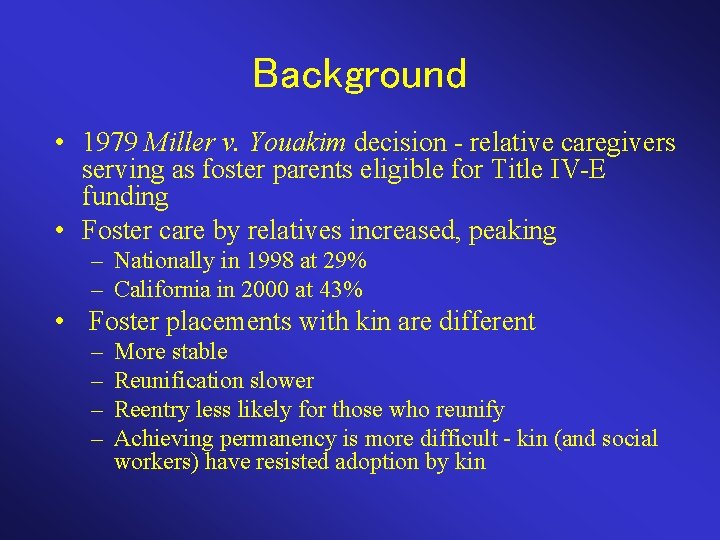
Background • 1979 Miller v. Youakim decision - relative caregivers serving as foster parents eligible for Title IV-E funding • Foster care by relatives increased, peaking – Nationally in 1998 at 29% – California in 2000 at 43% • Foster placements with kin are different – – More stable Reunification slower Reentry less likely for those who reunify Achieving permanency is more difficult - kin (and social workers) have resisted adoption by kin
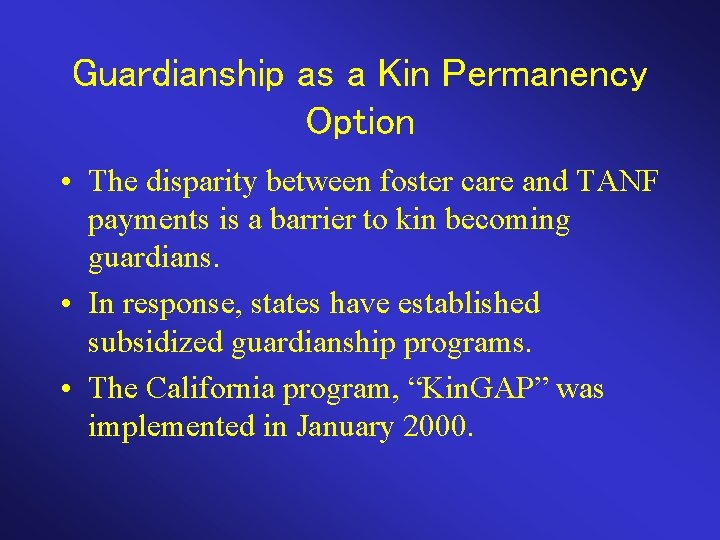
Guardianship as a Kin Permanency Option • The disparity between foster care and TANF payments is a barrier to kin becoming guardians. • In response, states have established subsidized guardianship programs. • The California program, “Kin. GAP” was implemented in January 2000.
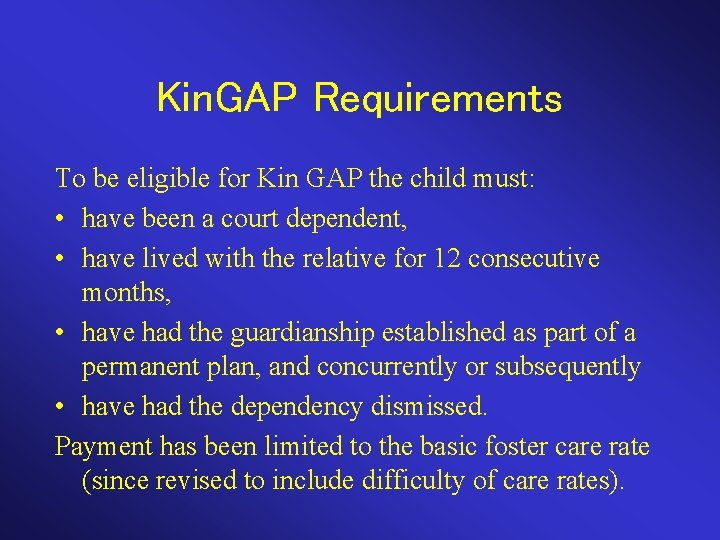
Kin. GAP Requirements To be eligible for Kin GAP the child must: • have been a court dependent, • have lived with the relative for 12 consecutive months, • have had the guardianship established as part of a permanent plan, and concurrently or subsequently • have had the dependency dismissed. Payment has been limited to the basic foster care rate (since revised to include difficulty of care rates).
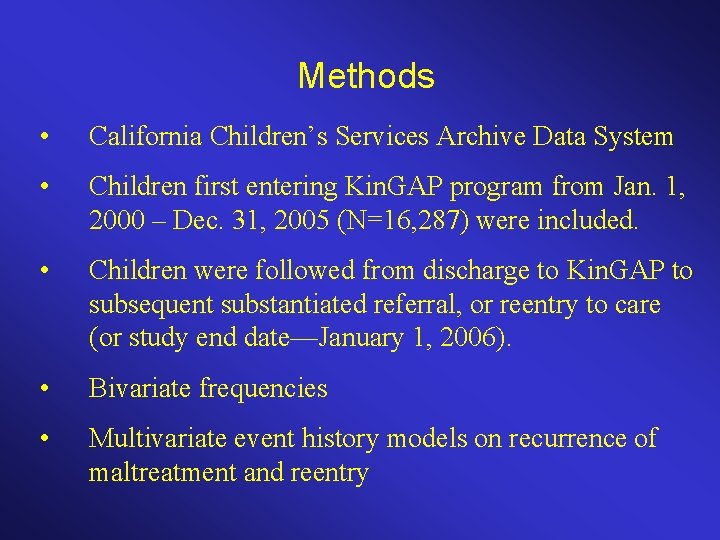
Methods • California Children’s Services Archive Data System • Children first entering Kin. GAP program from Jan. 1, 2000 – Dec. 31, 2005 (N=16, 287) were included. • Children were followed from discharge to Kin. GAP to subsequent substantiated referral, or reentry to care (or study end date—January 1, 2006). • Bivariate frequencies • Multivariate event history models on recurrence of maltreatment and reentry
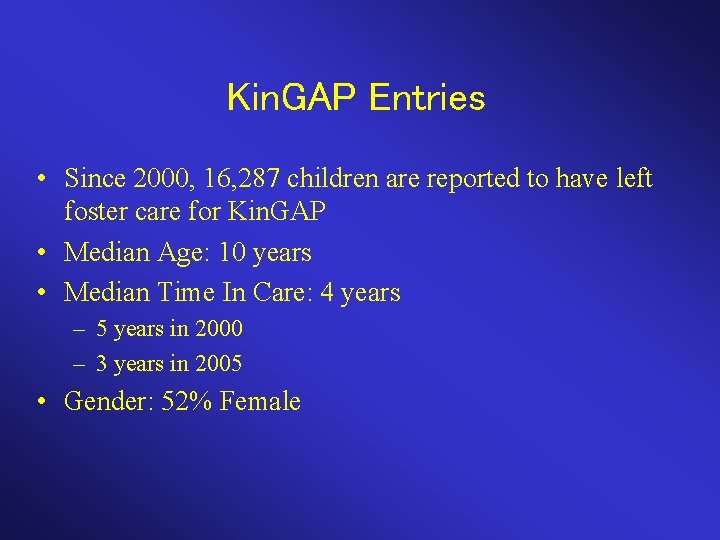
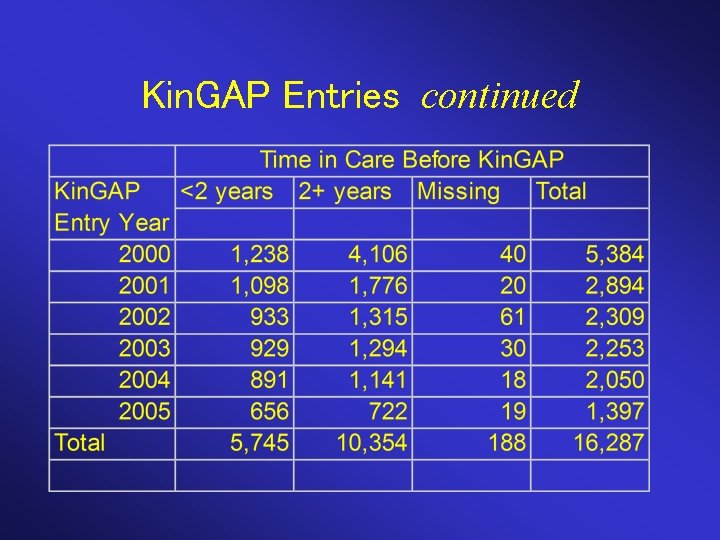
Kin. GAP Entries • Since 2000, 16, 287 children are reported to have left foster care for Kin. GAP • Median Age: 10 years • Median Time In Care: 4 years – 5 years in 2000 – 3 years in 2005 • Gender: 52% Female
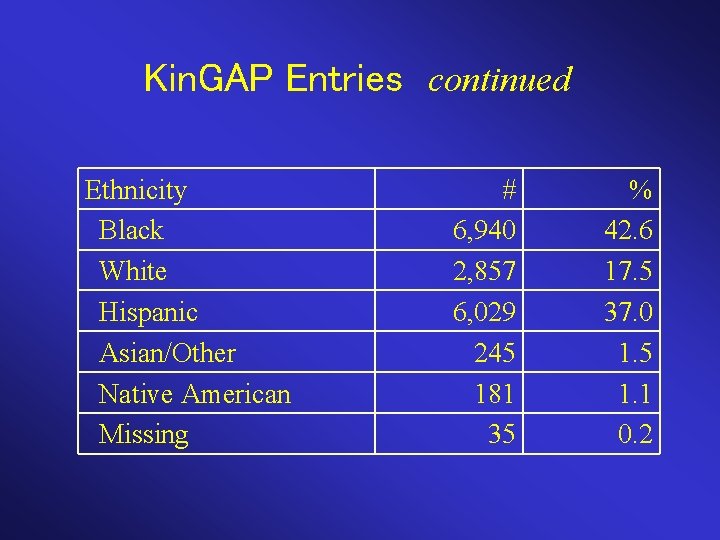
Kin. GAP Entries continued Ethnicity Black White Hispanic Asian/Other Native American Missing # 6, 940 2, 857 6, 029 245 181 35 % 42. 6 17. 5 37. 0 1. 5 1. 1 0. 2
Kin. GAP Entries continued
Kin. GAP Net Permanency Gain
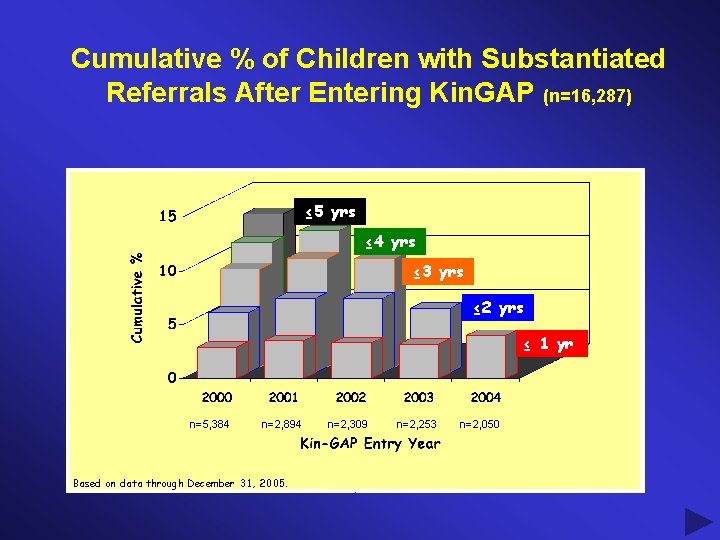
Cumulative % of Children with Substantiated Referrals After Entering Kin. GAP (n=16, 287) ≤ 5 yrs ≤ 4 yrs ≤ 3 yrs ≤ 2 yrs ≤ 1 yr n=5, 384 n=2, 894 Based on data through December 31, 2005. n=2, 309 n=2, 253 n=2, 050
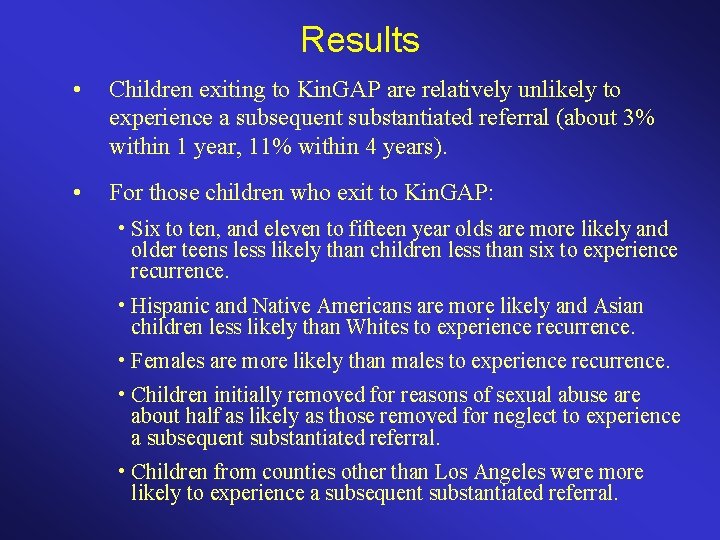
Results • Children exiting to Kin. GAP are relatively unlikely to experience a subsequent substantiated referral (about 3% within 1 year, 11% within 4 years). • For those children who exit to Kin. GAP: • Six to ten, and eleven to fifteen year olds are more likely and older teens less likely than children less than six to experience recurrence. • Hispanic and Native Americans are more likely and Asian children less likely than Whites to experience recurrence. • Females are more likely than males to experience recurrence. • Children initially removed for reasons of sexual abuse are about half as likely as those removed for neglect to experience a subsequent substantiated referral. • Children from counties other than Los Angeles were more likely to experience a subsequent substantiated referral.
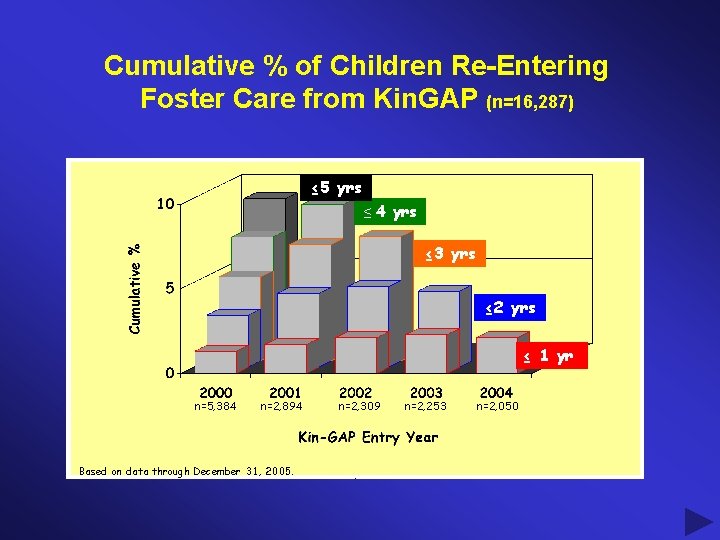
Cumulative % of Children Re-Entering Foster Care from Kin. GAP (n=16, 287) ≤ 5 yrs ≤ 4 yrs ≤ 3 yrs ≤ 2 yrs ≤ 1 yr n=5, 384 n=2, 894 Based on data through December 31, 2005. n=2, 309 n=2, 253 n=2, 050
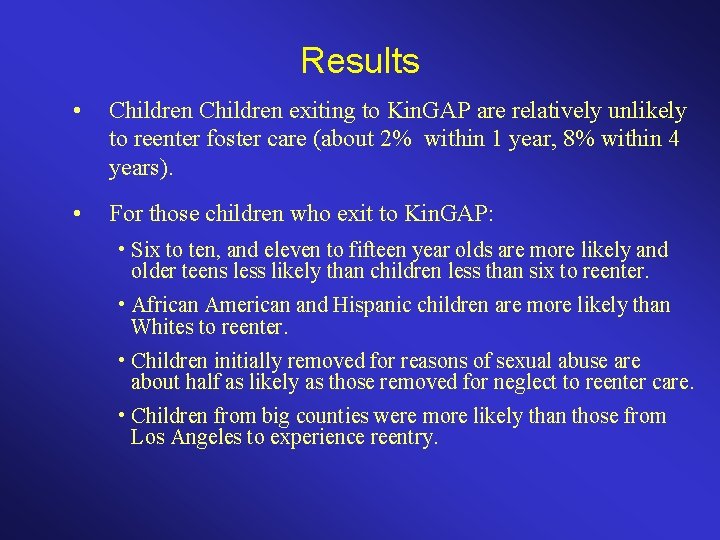
Results • Children exiting to Kin. GAP are relatively unlikely to reenter foster care (about 2% within 1 year, 8% within 4 years). • For those children who exit to Kin. GAP: • Six to ten, and eleven to fifteen year olds are more likely and older teens less likely than children less than six to reenter. • African American and Hispanic children are more likely than Whites to reenter. • Children initially removed for reasons of sexual abuse are about half as likely as those removed for neglect to reenter care. • Children from big counties were more likely than those from Los Angeles to experience reentry.
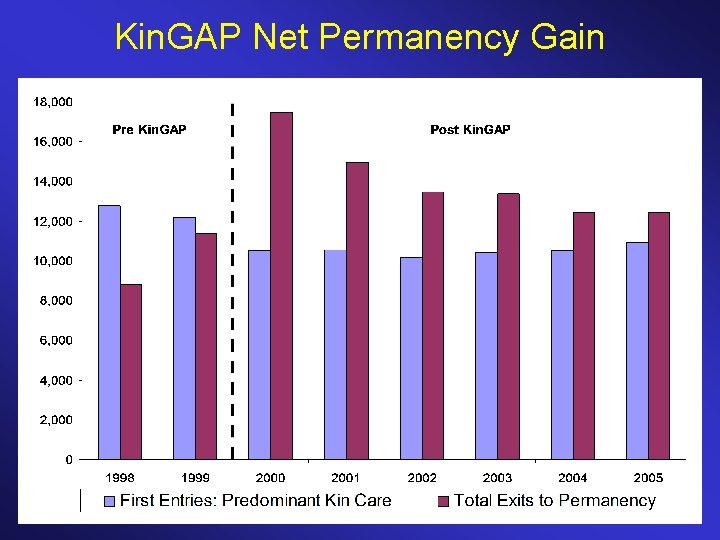
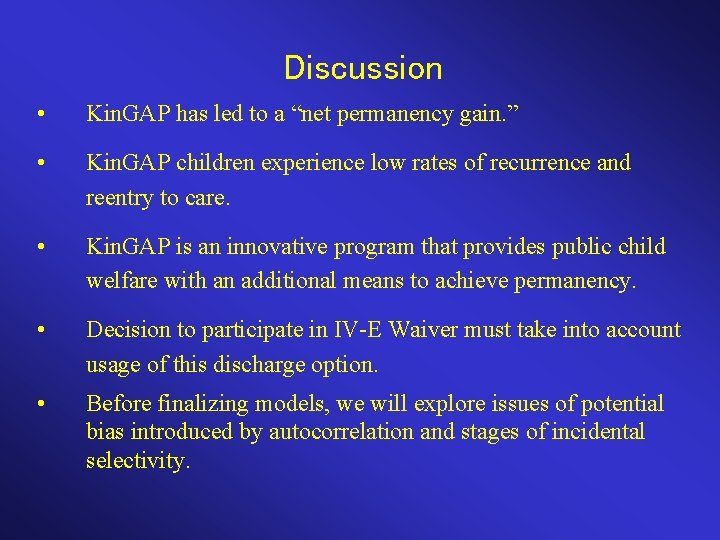
Discussion • Kin. GAP has led to a “net permanency gain. ” • Kin. GAP children experience low rates of recurrence and reentry to care. • Kin. GAP is an innovative program that provides public child welfare with an additional means to achieve permanency. • Decision to participate in IV-E Waiver must take into account usage of this discharge option. • Before finalizing models, we will explore issues of potential bias introduced by autocorrelation and stages of incidental selectivity.