
INCOSE Michigan May Dinner Meeting Failure Mode Effect

- Slides: 25
INCOSE Michigan – May Dinner Meeting Failure Mode & Effect Analysis (FMEA) in Half the Time Howard C Cooper, MS, DFSS-BB May 13 th, 2014
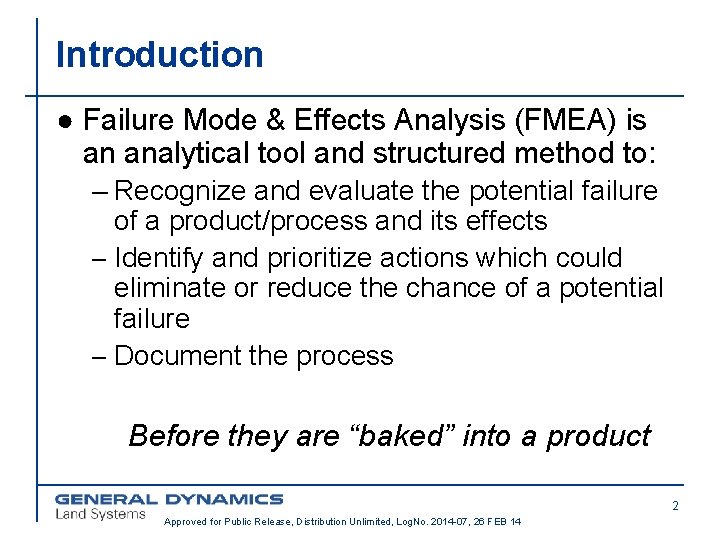
Introduction ● Failure Mode & Effects Analysis (FMEA) is an analytical tool and structured method to: – Recognize and evaluate the potential failure of a product/process and its effects – Identify and prioritize actions which could eliminate or reduce the chance of a potential failure – Document the process Before they are “baked” into a product 2 Approved for Public Release, Distribution Unlimited, Log. No. 2014 -07, 26 FEB 14
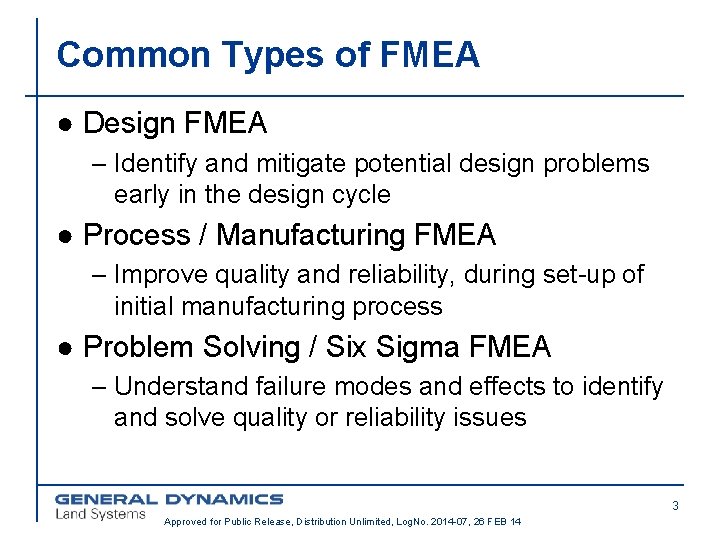
Common Types of FMEA ● Design FMEA – Identify and mitigate potential design problems early in the design cycle ● Process / Manufacturing FMEA – Improve quality and reliability, during set-up of initial manufacturing process ● Problem Solving / Six Sigma FMEA – Understand failure modes and effects to identify and solve quality or reliability issues 3 Approved for Public Release, Distribution Unlimited, Log. No. 2014 -07, 26 FEB 14
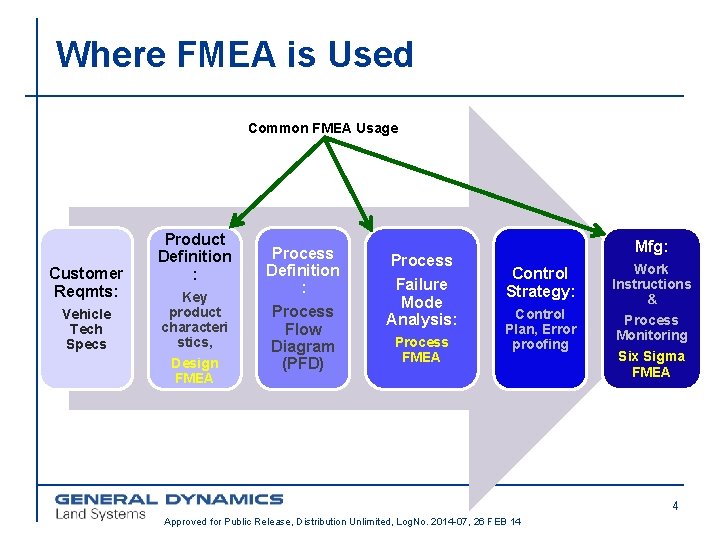
Where FMEA is Used Common FMEA Usage Customer Reqmts: Vehicle Tech Specs Product Definition : Key product characteri stics, Design FMEA Process Definition : Process Flow Diagram (PFD) Process Failure Mode Analysis: Process FMEA Mfg: Control Strategy: Control Plan, Error proofing Work Instructions & Process Monitoring Six Sigma FMEA 4 Approved for Public Release, Distribution Unlimited, Log. No. 2014 -07, 26 FEB 14
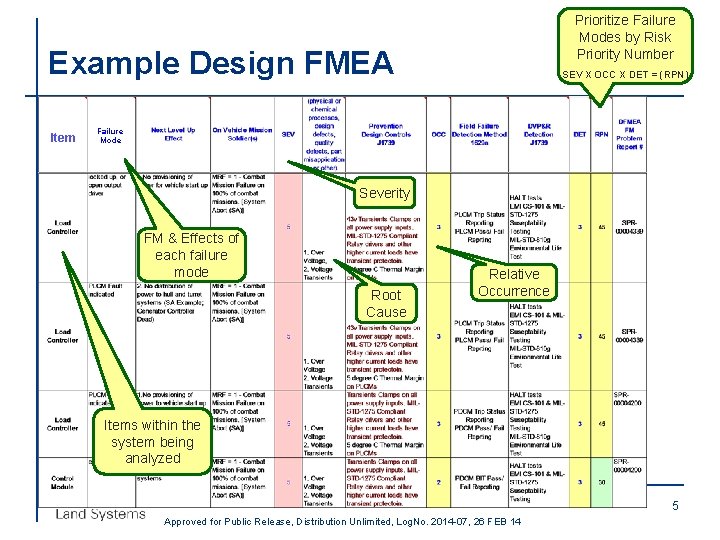
Prioritize Failure Modes by Risk Priority Number Example Design FMEA Item SEV X OCC X DET = (RPN) Failure Mode Severity FM & Effects of each failure mode Root Cause Relative Occurrence Items within the system being analyzed 5 Approved for Public Release, Distribution Unlimited, Log. No. 2014 -07, 26 FEB 14
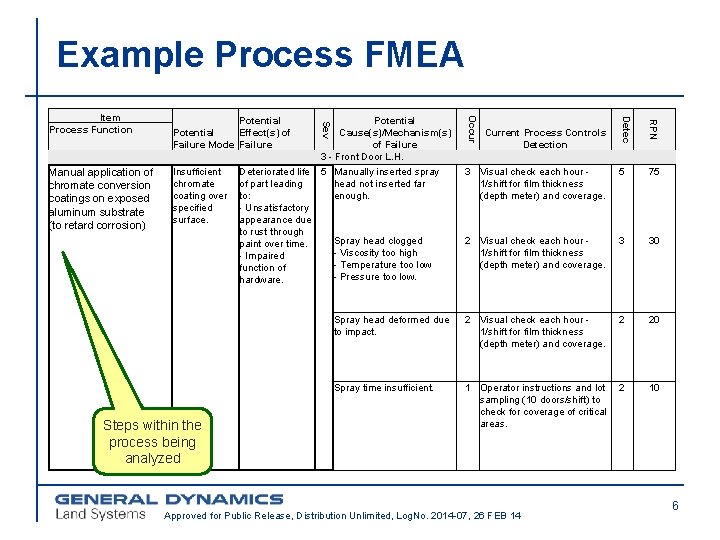
Example Process FMEA Steps within the process being analyzed Deteriorated life of part leading to: - Unsatisfactory appearance due to rust through paint over time. - Impaired function of hardware. RPN Insufficient chromate coating over specified surface. Detec Manual application of chromate conversion coatings on exposed aluminum substrate (to retard corrosion) Potential Cause(s)/Mechanism(s) of Failure 3 - Front Door L. H. 5 Manually inserted spray head not inserted far enough. Occur Potential Effect(s) of Failure Mode Failure 3 Visual check each hour 1/shift for film thickness (depth meter) and coverage. 5 75 Spray head clogged - Viscosity too high - Temperature too low - Pressure too low. 2 Visual check each hour 1/shift for film thickness (depth meter) and coverage. 3 30 Spray head deformed due to impact. 2 Visual check each hour 1/shift for film thickness (depth meter) and coverage. 2 20 Spray time insufficient. 1 Operator instructions and lot sampling (10 doors/shift) to check for coverage of critical areas. 2 10 Sev Item Process Function Current Process Controls Detection Approved for Public Release, Distribution Unlimited, Log. No. 2014 -07, 26 FEB 14 6
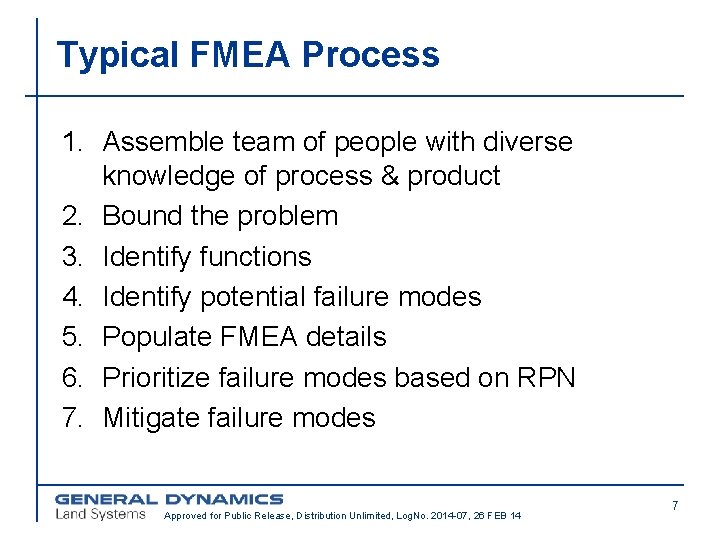
Typical FMEA Process 1. Assemble team of people with diverse knowledge of process & product 2. Bound the problem 3. Identify functions 4. Identify potential failure modes 5. Populate FMEA details 6. Prioritize failure modes based on RPN 7. Mitigate failure modes Approved for Public Release, Distribution Unlimited, Log. No. 2014 -07, 26 FEB 14 7
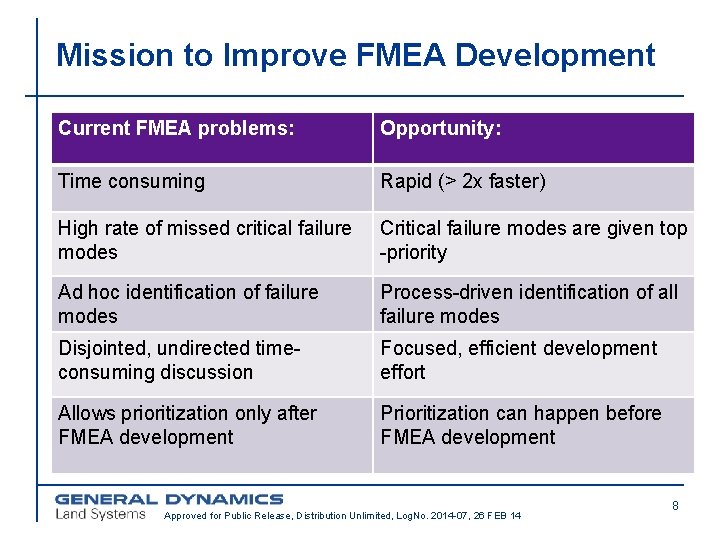
Mission to Improve FMEA Development ● Challenge Current FMEA problems: Opportunity: Time consuming Rapid (> 2 x faster) High rate of missed critical failure modes Critical failure modes are given top -priority Ad hoc identification of failure modes Process-driven identification of all failure modes Disjointed, undirected timeconsuming discussion Focused, efficient development effort Allows prioritization only after FMEA development Prioritization can happen before FMEA development Approved for Public Release, Distribution Unlimited, Log. No. 2014 -07, 26 FEB 14 8
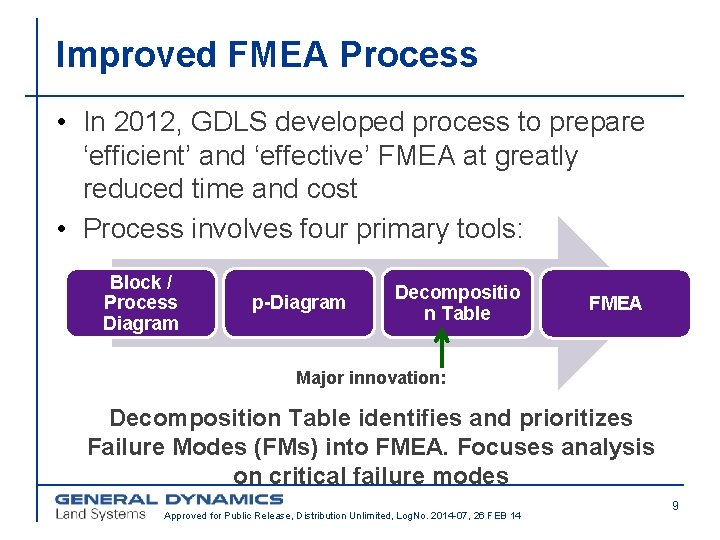
Improved FMEA Process • In 2012, GDLS developed process to prepare ‘efficient’ and ‘effective’ FMEA at greatly reduced time and cost • Process involves four primary tools: Block / Process Diagram p-Diagram Decompositio n Table FMEA Major innovation: Decomposition Table identifies and prioritizes Failure Modes (FMs) into FMEA. Focuses analysis on critical failure modes Approved for Public Release, Distribution Unlimited, Log. No. 2014 -07, 26 FEB 14 9
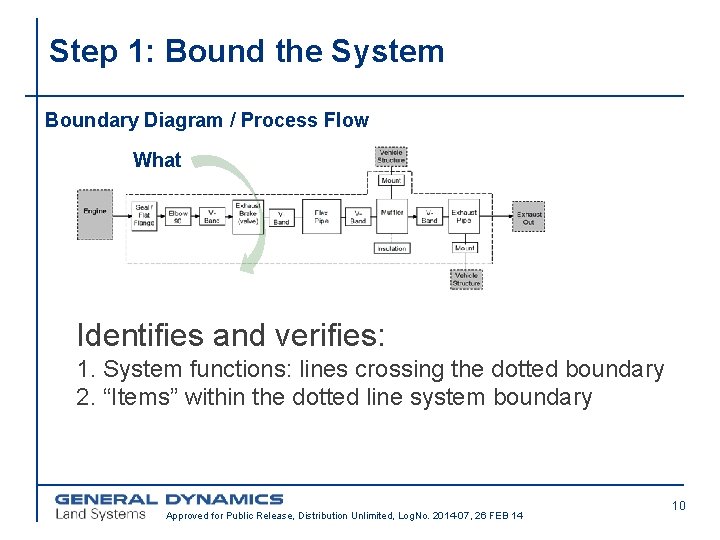
Step 1: Bound the System Boundary Diagram / Process Flow What Identifies and verifies: 1. System functions: lines crossing the dotted boundary 2. “Items” within the dotted line system boundary Approved for Public Release, Distribution Unlimited, Log. No. 2014 -07, 26 FEB 14 10
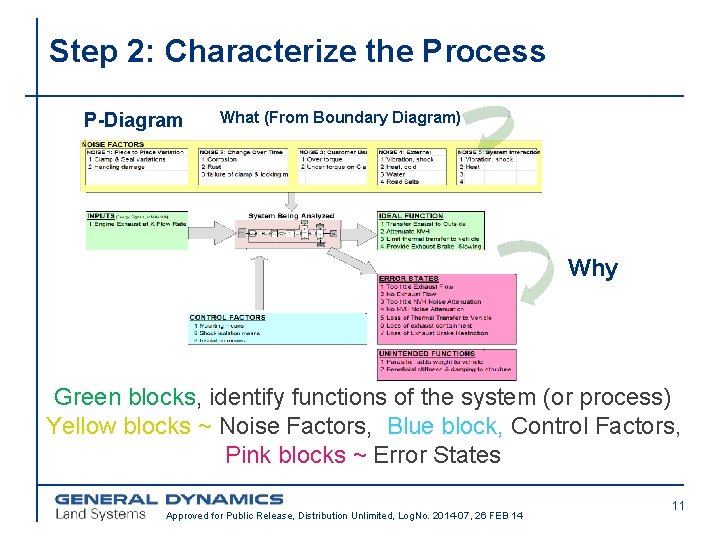
Step 2: Characterize the Process P-Diagram What (From Boundary Diagram) Why Green blocks, identify functions of the system (or process) Yellow blocks ~ Noise Factors, Blue block, Control Factors, Pink blocks ~ Error States Approved for Public Release, Distribution Unlimited, Log. No. 2014 -07, 26 FEB 14 11
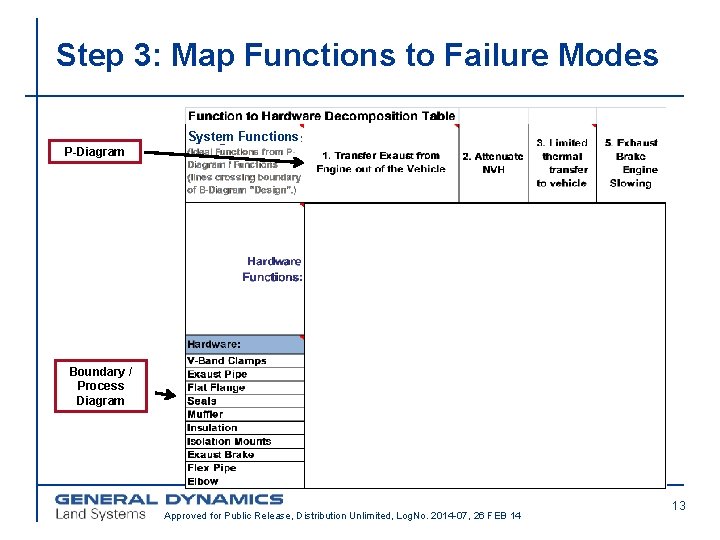
Outstanding Problem & Opportunity ● Boundary or Process Flow Diagram – Identifies “Items” for the FMEA, but not the Failure Modes (FM) of those “items” ● P-Diagram – Identifies system functions or requirements (even noise factors) but not the function or FMs of the “items” ● Opportunity – Develop a table that will identify and link “items” to their functions, and to their functional FMs Approved for Public Release, Distribution Unlimited, Log. No. 2014 -07, 26 FEB 14 12
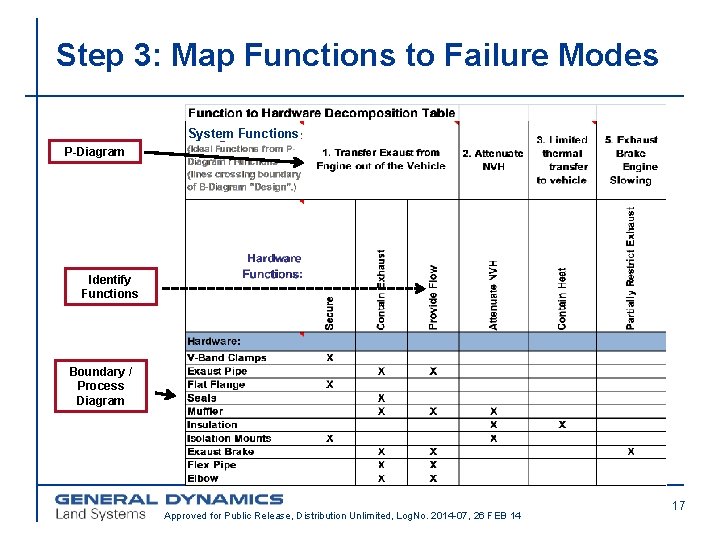
Step 3: Map Functions to Failure Modes System Functions P-Diagram Boundary / Process Diagram Approved for Public Release, Distribution Unlimited, Log. No. 2014 -07, 26 FEB 14 13
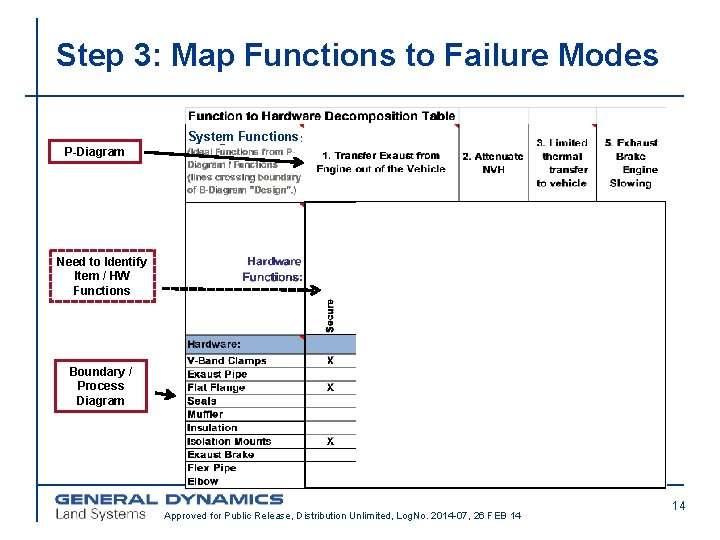
Step 3: Map Functions to Failure Modes System Functions P-Diagram Need to Identify Item / HW Functions Boundary / Process Diagram Approved for Public Release, Distribution Unlimited, Log. No. 2014 -07, 26 FEB 14 14
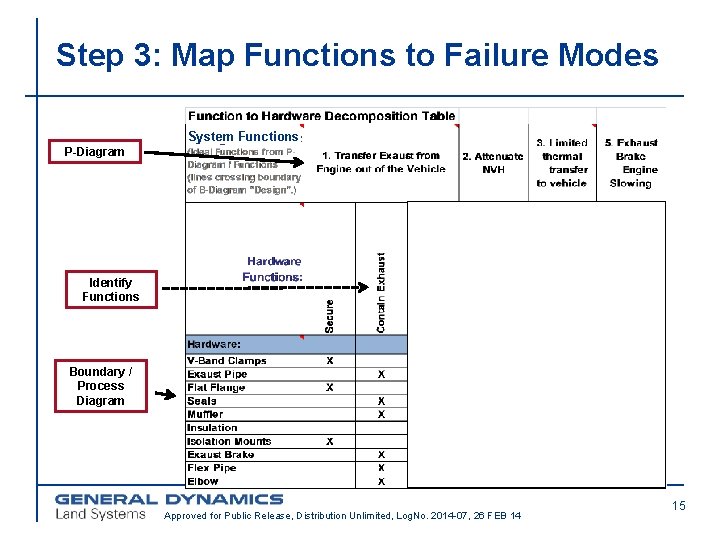
Step 3: Map Functions to Failure Modes System Functions P-Diagram Identify Functions Boundary / Process Diagram Approved for Public Release, Distribution Unlimited, Log. No. 2014 -07, 26 FEB 14 15
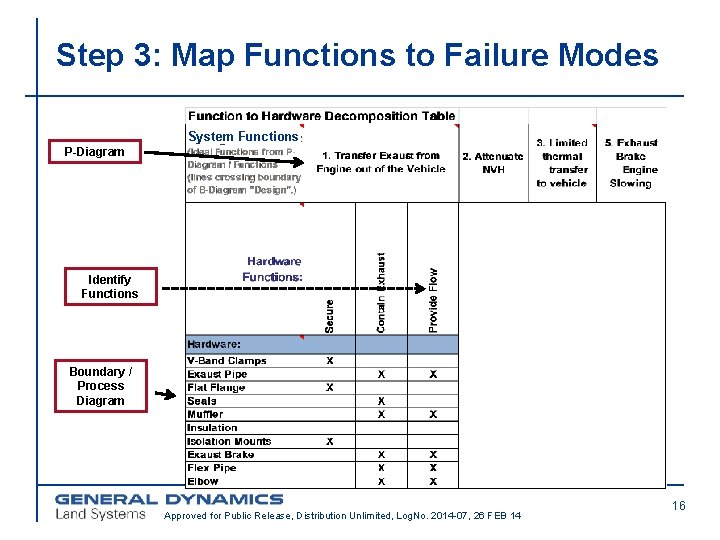
Step 3: Map Functions to Failure Modes System Functions P-Diagram Identify Functions Boundary / Process Diagram Approved for Public Release, Distribution Unlimited, Log. No. 2014 -07, 26 FEB 14 16
Step 3: Map Functions to Failure Modes System Functions P-Diagram Identify Functions Boundary / Process Diagram Approved for Public Release, Distribution Unlimited, Log. No. 2014 -07, 26 FEB 14 17
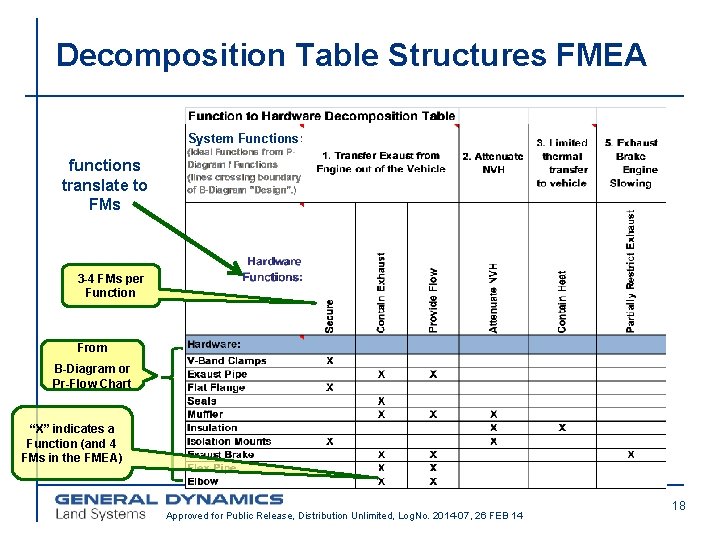
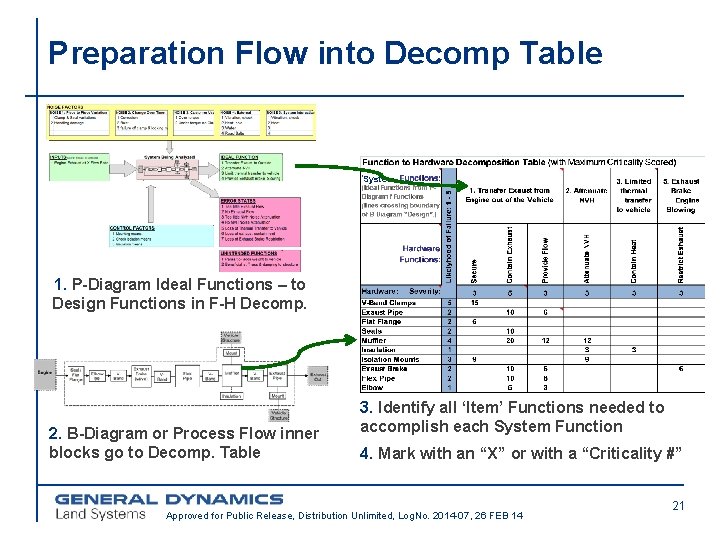
Decomposition Table Structures FMEA System Functions functions translate to FMs 3 -4 FMs per Function From B-Diagram or Pr-Flow Chart “X” indicates a Function (and 4 FMs in the FMEA) Approved for Public Release, Distribution Unlimited, Log. No. 2014 -07, 26 FEB 14 18
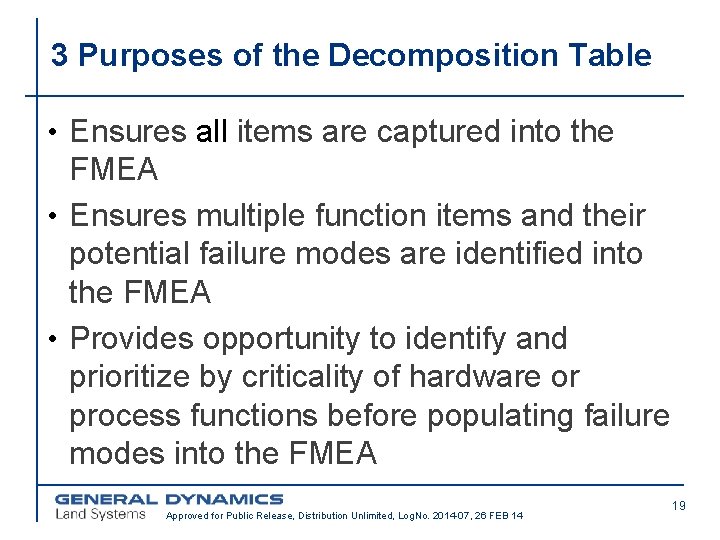
3 Purposes of the Decomposition Table • Ensures all items are captured into the FMEA • Ensures multiple function items and their potential failure modes are identified into the FMEA • Provides opportunity to identify and prioritize by criticality of hardware or process functions before populating failure modes into the FMEA Approved for Public Release, Distribution Unlimited, Log. No. 2014 -07, 26 FEB 14 19
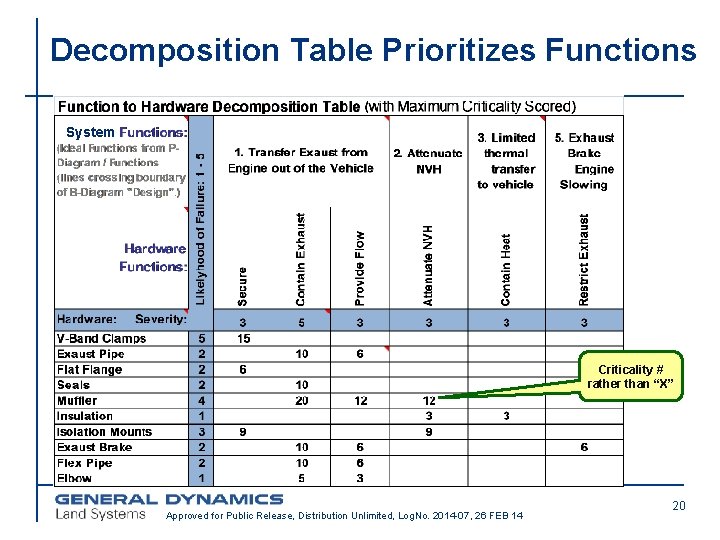
Decomposition Table Prioritizes Functions System Criticality # rather than “X” Approved for Public Release, Distribution Unlimited, Log. No. 2014 -07, 26 FEB 14 20
Preparation Flow into Decomp Table System 1. P-Diagram Ideal Functions – to Design Functions in F-H Decomp. 2. B-Diagram or Process Flow inner blocks go to Decomp. Table 3. Identify all ‘Item’ Functions needed to accomplish each System Function 4. Mark with an “X” or with a “Criticality #” Approved for Public Release, Distribution Unlimited, Log. No. 2014 -07, 26 FEB 14 21
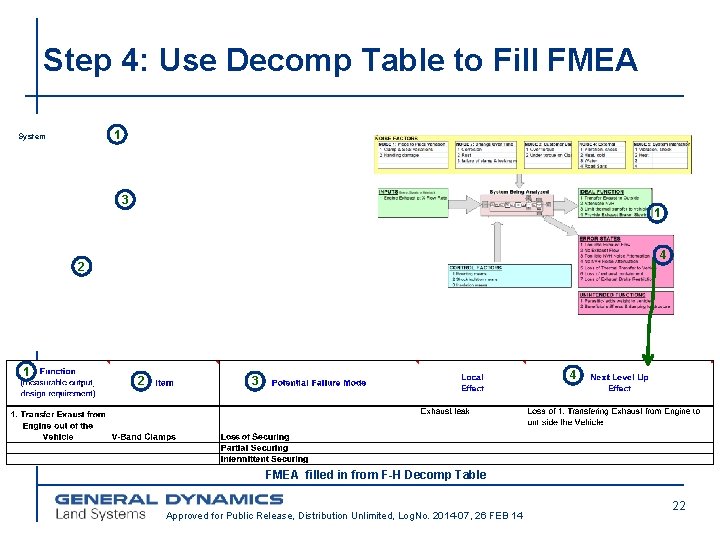
Step 4: Use Decomp Table to Fill FMEA 1 System 1 33 1 4 22 1 2 4 3 FMEA filled in from F-H Decomp Table Approved for Public Release, Distribution Unlimited, Log. No. 2014 -07, 26 FEB 14 22
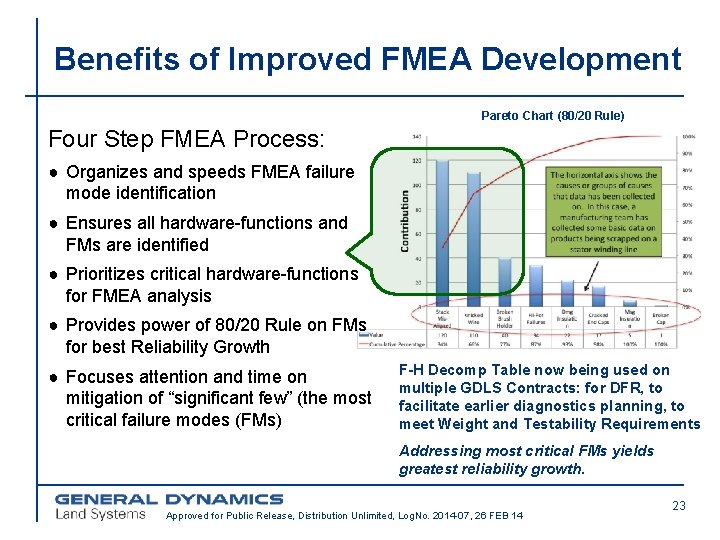
Benefits of Improved FMEA Development Pareto Chart (80/20 Rule) Four Step FMEA Process: ● Organizes and speeds FMEA failure mode identification ● Ensures all hardware-functions and FMs are identified ● Prioritizes critical hardware-functions for FMEA analysis ● Provides power of 80/20 Rule on FMs for best Reliability Growth ● Focuses attention and time on mitigation of “significant few” (the most critical failure modes (FMs) F-H Decomp Table now being used on multiple GDLS Contracts: for DFR, to facilitate earlier diagnostics planning, to meet Weight and Testability Requirements Addressing most critical FMs yields greatest reliability growth. Approved for Public Release, Distribution Unlimited, Log. No. 2014 -07, 26 FEB 14 23
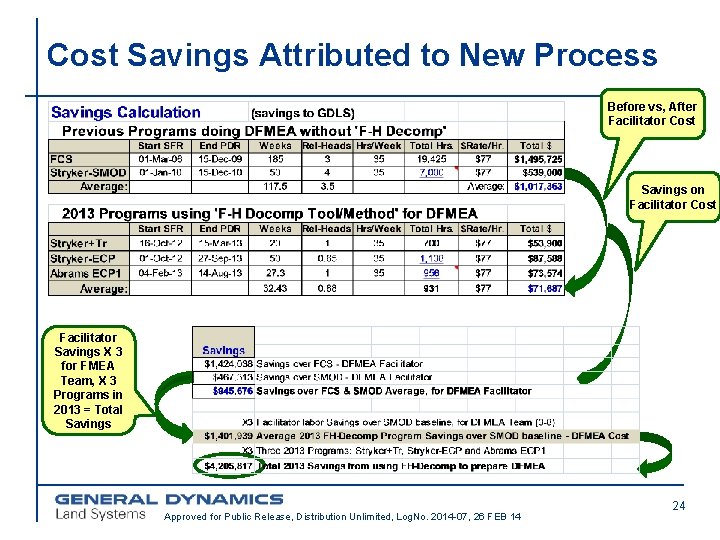
Cost Savings Attributed to New Process Before vs, After Facilitator Cost Savings on Facilitator Cost Facilitator Savings X 3 for FMEA Team, X 3 Programs in 2013 = Total Savings Approved for Public Release, Distribution Unlimited, Log. No. 2014 -07, 26 FEB 14 24
Questions? Presenters: Howard C Cooper, MS, DFSS-BB DFR Reliability Engineer cooperh@gdls. com Mark Petrotta, MS, DFSS-MBB Engineering Process Excellence petrotta@gdls. com 25