
Incorporating the two ticks policy into selection for
- Slides: 1
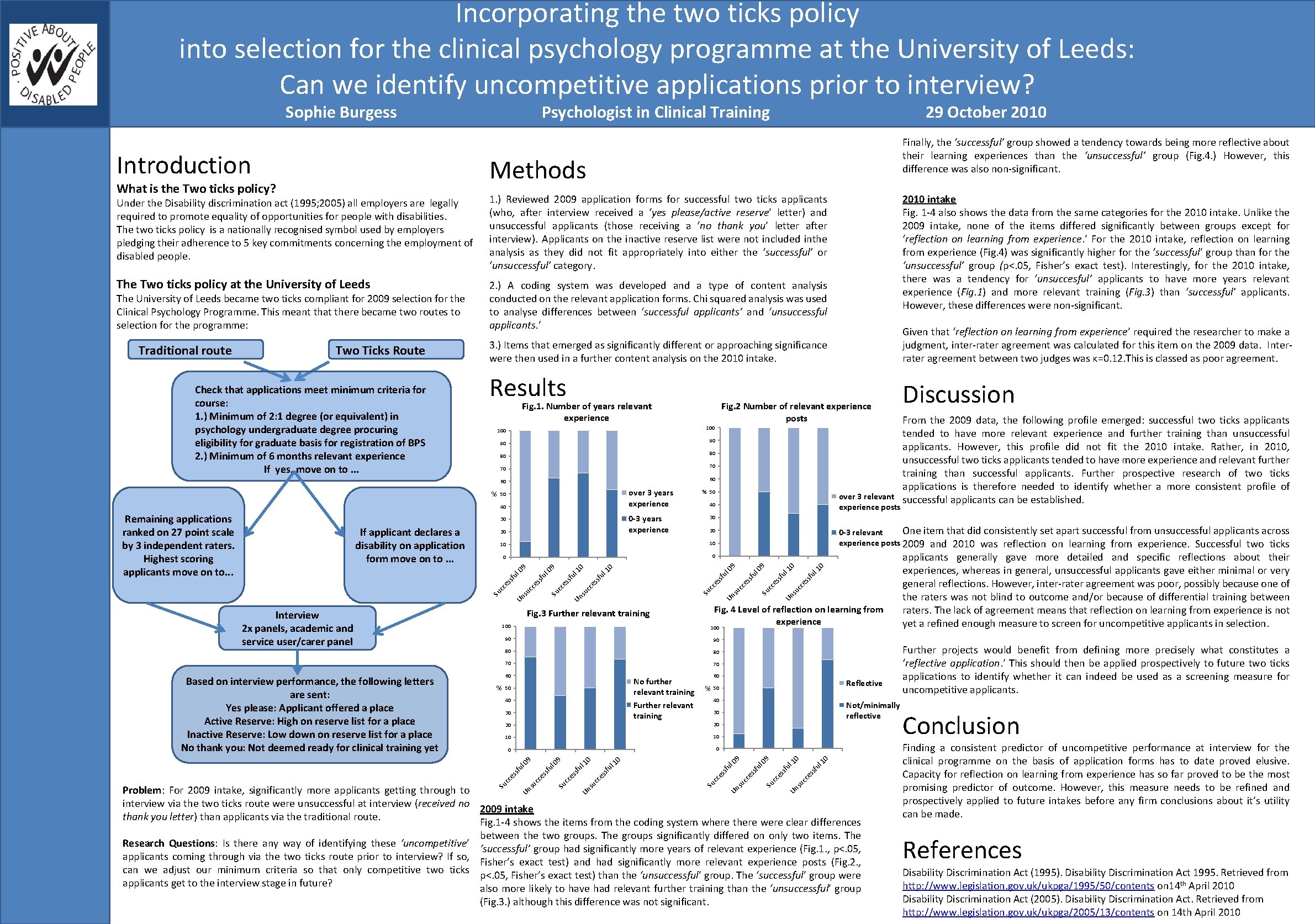
Incorporating the two ticks policy into selection for the clinical psychology programme at the University of Leeds: Can we identify uncompetitive applications prior to interview? Sophie Burgess Psychologist in Clinical Training 29 October 2010 Finally, the ‘successful’ group showed a tendency towards being more reflective about their learning experiences than the ‘unsuccessful’ group (Fig. 4. ) However, this difference was also non-significant. Introduction Methods Under the Disability discrimination act (1995; 2005) all employers are legally required to promote equality of opportunities for people with disabilities. The two ticks policy is a nationally recognised symbol used by employers pledging their adherence to 5 key commitments concerning the employment of disabled people. 1. ) Reviewed 2009 application forms for successful two ticks applicants (who, after interview received a ‘yes please/active reserve’ letter) and unsuccessful applicants (those receiving a ‘no thank you’ letter after interview). Applicants on the inactive reserve list were not included inthe analysis as they did not fit appropriately into either the ‘successful’ or ‘unsuccessful’ category. The Two ticks policy at the University of Leeds 2. ) A coding system was developed and a type of content analysis conducted on the relevant application forms. Chi squared analysis was used to analyse differences between ‘successful applicants’ and ‘unsuccessful applicants. ’ Results Fig. 1. Number of years relevant experience 100 90 80 80 70 70 60 60 80 70 70 0 0 l 1 es sfu cc su 0 es sfu cc cc e ss fu l 1 9 l 0 es sfu cc l 1 0 ss fu 0 cc e 10 0 10 9 20 l 0 Not/minimally reflective 30 20 ss fu Un 40 9 30 Reflective 50 es sfu 40 % cc 50 60 su No further relevant training Further relevant training cc su 80 cc e es sfu ss fu cc e Su cc su Un 90 9 % Fig. 4 Level of reflection on learning from experience 100 90 60 9 l 0 0 l 1 es sfu ss fu Su cc e es sfu cc su Un l 1 9 l 0 ss fu cc e Based on interview performance, the following letters are sent: Yes please: Applicant offered a place Active Reserve: High on reserve list for a place Inactive Reserve: Low down on reserve list for a place No thank you: Not deemed ready for clinical training yet 100 ss fu 0 9 0 0 10 Fig. 3 Further relevant training Un Un su Un Su Un su Problem: For 2009 intake, significantly more applicants getting through to interview via the two ticks route were unsuccessful at interview (received no 2009 intake thank you letter) than applicants via the traditional route. Fig. 1 -4 shows the items from the coding system where there were clear differences between the two groups. The groups significantly differed on only two items. The Research Questions: Is there any way of identifying these ‘uncompetitive’ ‘successful’ group had significantly more years of relevant experience (Fig. 1. , p<. 05, applicants coming through via the two ticks route prior to interview? If so, Fisher’s exact test) and had significantly more relevant experience posts (Fig. 2. , can we adjust our minimum criteria so that only competitive two ticks p<. 05, Fisher’s exact test) than the ‘unsuccessful’ group. The ‘successful’ group were applicants get to the interview stage in future? also more likely to have had relevant further training than the ‘unsuccessful’ group (Fig. 3. ) although this difference was not significant. Su From the 2009 data, the following profile emerged: successful two ticks applicants tended to have more relevant experience and further training than unsuccessful applicants. However, this profile did not fit the 2010 intake. Rather, in 2010, unsuccessful two ticks applicants tended to have more experience and relevant further training than successful applicants. Further prospective research of two ticks applications is therefore needed to identify whether a more consistent profile of successful applicants can be established. One item that did consistently set apart successful from unsuccessful applicants across 0 -3 relevant experience posts 2009 and 2010 was reflection on learning from experience. Successful two ticks 20 10 Su Interview 2 x panels, academic and service user/carer panel Discussion 30 l 0 20 9 If applicant declares a disability on application form move on to. . . 40 cc e 0 -3 years experience 30 over 3 relevant experience posts l 0 40 % 50 Su over 3 years experience 50 Su 90 % Remaining applications ranked on 27 point scale by 3 independent raters. Highest scoring applicants move on to. . . Given that ‘reflection on learning from experience’ required the researcher to make a judgment, inter-rater agreement was calculated for this item on the 2009 data. Interrater agreement between two judges was κ=0. 12. This is classed as poor agreement. Fig. 2 Number of relevant experience posts Un Check that applications meet minimum criteria for course: 1. ) Minimum of 2: 1 degree (or equivalent) in psychology undergraduate degree procuring eligibility for graduate basis for registration of BPS 2. ) Minimum of 6 months relevant experience If yes, move on to. . . 2010 intake Fig. 1 -4 also shows the data from the same categories for the 2010 intake. Unlike the 2009 intake, none of the items differed significantly between groups except for ‘reflection on learning from experience. ’ For the 2010 intake, reflection on learning from experience (Fig. 4) was significantly higher for the ‘successful’ group than for the ‘unsuccessful’ group (p<. 05, Fisher’s exact test). Interestingly, for the 2010 intake, there was a tendency for ‘unsuccesful’ applicants to have more years relevant experience (Fig. 1) and more relevant training (Fig. 3) than ‘successful’ applicants. However, these differences were non-significant. 3. ) Items that emerged as significantly different or approaching significance were then used in a further content analysis on the 2010 intake. l 0 Two Ticks Route ss fu Traditional route cc e The University of Leeds became two ticks compliant for 2009 selection for the Clinical Psychology Programme. This meant that there became two routes to selection for the programme: Su What is the Two ticks policy? applicants generally gave more detailed and specific reflections about their experiences, whereas in general, unsuccessful applicants gave either minimal or very general reflections. However, inter-rater agreement was poor, possibly because one of the raters was not blind to outcome and/or because of differential training between raters. The lack of agreement means that reflection on learning from experience is not yet a refined enough measure to screen for uncompetitive applicants in selection. Further projects would benefit from defining more precisely what constitutes a ‘reflective application. ’ This should then be applied prospectively to future two ticks applications to identify whether it can indeed be used as a screening measure for uncompetitive applicants. Conclusion Finding a consistent predictor of uncompetitive performance at interview for the clinical programme on the basis of application forms has to date proved elusive. Capacity for reflection on learning from experience has so far proved to be the most promising predictor of outcome. However, this measure needs to be refined and prospectively applied to future intakes before any firm conclusions about it’s utility can be made. References Disability Discrimination Act (1995). Disability Discrimination Act 1995. Retrieved from http: //www. legislation. gov. uk/ukpga/1995/50/contents on 14 th April 2010 Disability Discrimination Act (2005). Disability Discrimination Act. Retrieved from http: //www. legislation. gov. uk/ukpga/2005/13/contents on 14 th April 2010