
Incorporating surface roughness into DEM models of crushable
Incorporating surface roughness into DEM models of crushable soils Ningning Zhang Supervisors: Marcos Arroyo, UPC, Barcelona, Spain Antonio Gens, UPC, Barcelona, Spian Matteo Ciantia, University of Dundee, UK 1
OUTLINE 1. Introduction 2. Model description of rough crushable contact 3. Effect of contact roughness on single particle breakage 4. Effect of contact roughness on sand high stress behavior 5. Conclusions 2
OUTLINE 1. Introduction 2. Model description of rough crushable contact 3. Effect of contact roughness on single particle breakage 4. Effect of contact roughness on sand high stress behavior 5. Conclusions 3
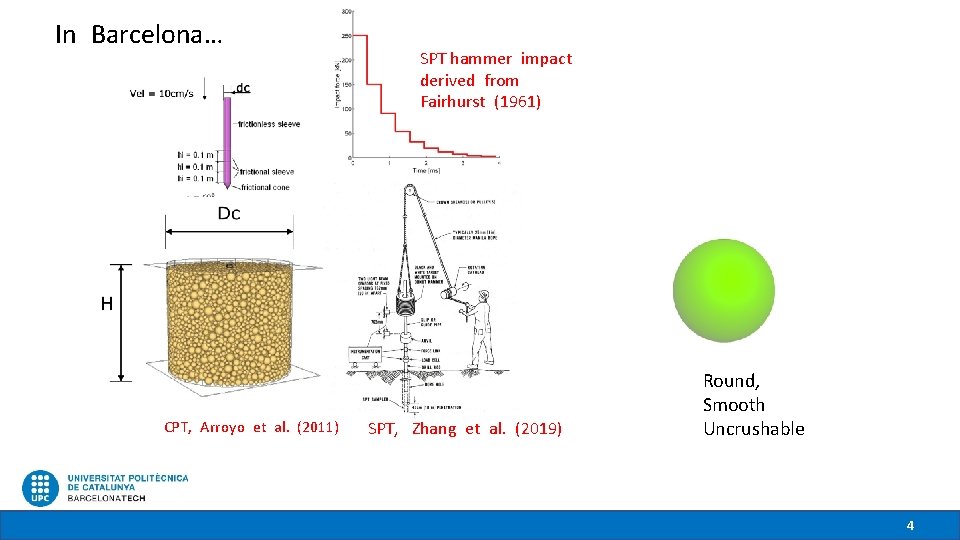
In Barcelona… CPT, Arroyo et al. (2011) SPT hammer impact derived from Fairhurst (1961) SPT, Zhang et al. (2019) Round, Smooth Uncrushable 4
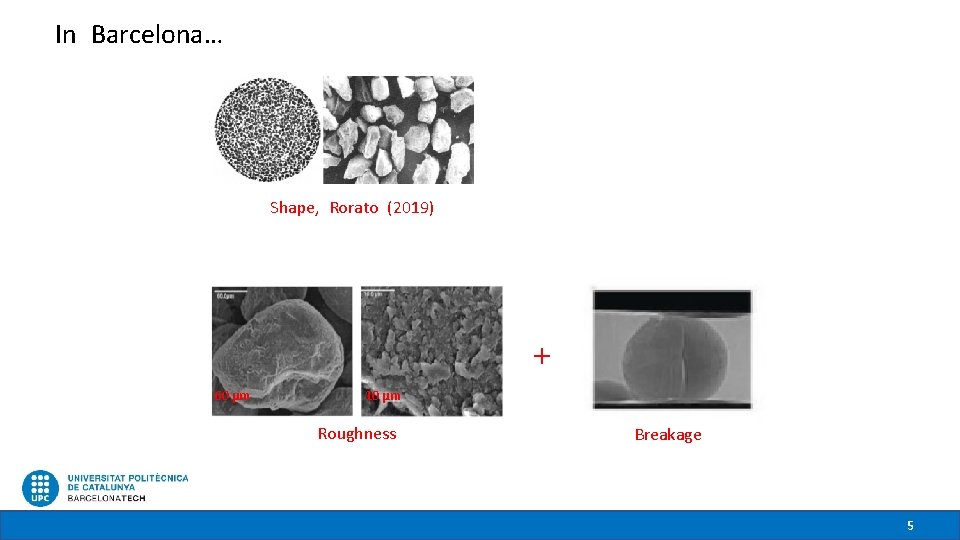
In Barcelona… Shape, Rorato (2019) + 60 µm 10 µm Roughness Breakage 5
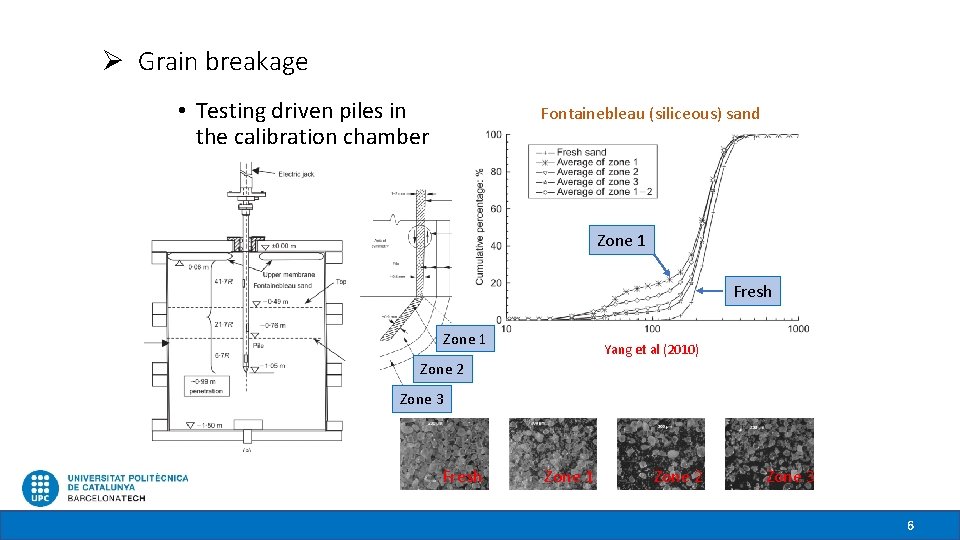
Ø Grain breakage • Testing driven piles in the calibration chamber Fontainebleau (siliceous) sand Zone 1 Fresh Zone 1 Yang et al (2010) Zone 2 Zone 3 Fresh Zone 1 Zone 2 Zone 3 6
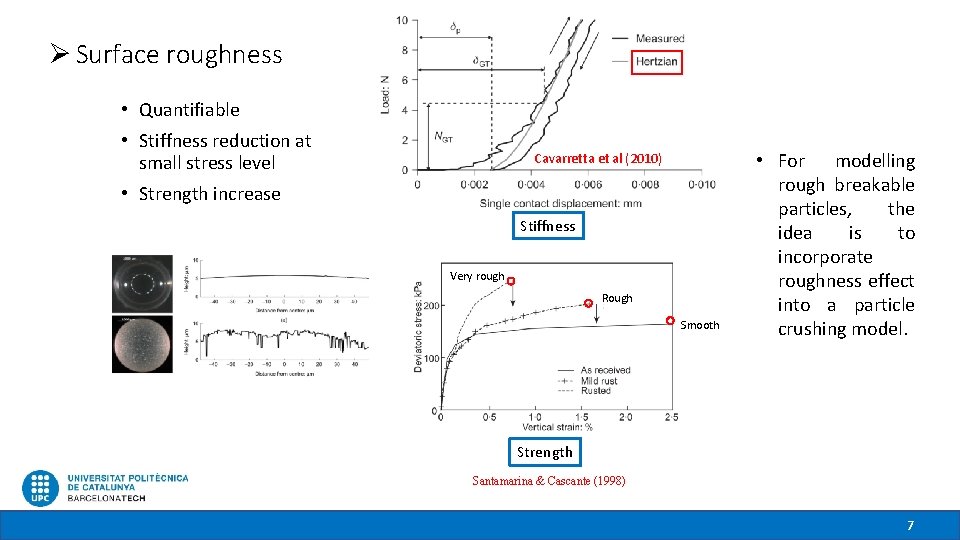
Ø Surface roughness • Quantifiable • Stiffness reduction at small stress level Cavarretta et al (2010) • Strength increase Stiffness Very rough Rough Smooth • For modelling rough breakable particles, the idea is to incorporate roughness effect into a particle crushing model. Strength Santamarina & Cascante (1998) 7
OUTLINE 1. Introduction 2. Model description of rough crushable contact 3. Effect of contact roughness on single particle breakage 4. Effect of contact roughness on sand high stress behavior 5. Conclusions 8
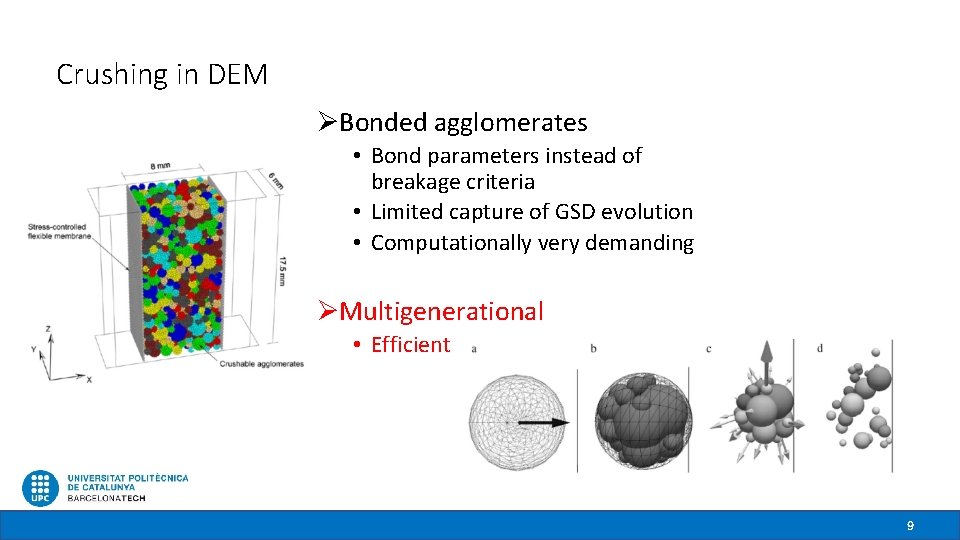
Crushing in DEM ØBonded agglomerates • Bond parameters instead of breakage criteria • Limited capture of GSD evolution • Computationally very demanding ØMultigenerational • Efficient 9
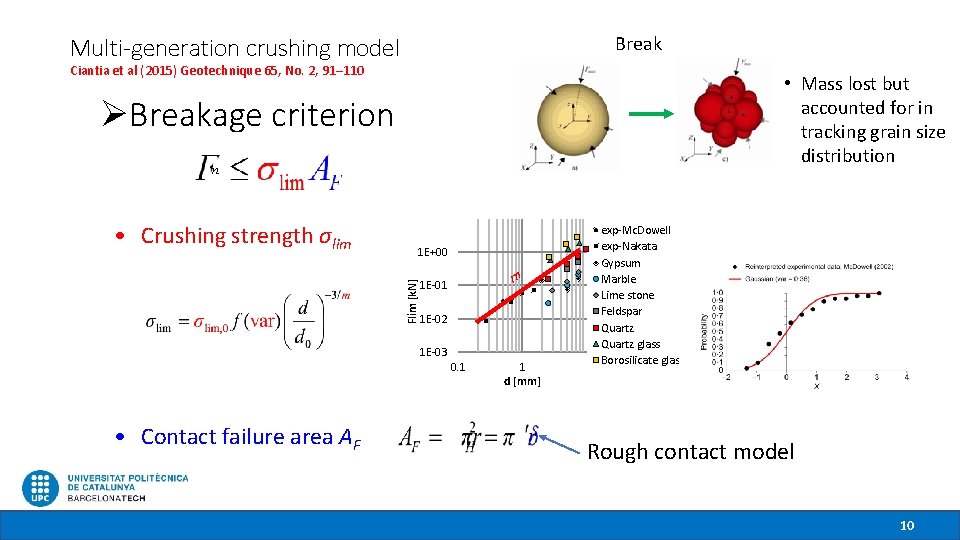
Break Multi-generation crushing model Ciantia et al (2015) Geotechnique 65, No. 2, 91– 110 • Mass lost but accounted for in tracking grain size distribution ØBreakage criterion n 1 E+00 Flim [k. N] • Crushing strength σlim m 1 E-01 1 E-02 1 E-03 0. 1 • Contact failure area AF 1 d [mm] exp-Mc. Dowell exp-Nakata Gypsum Marble Lime stone Feldspar Quartz glass Borosilicate glass Rough contact model 10
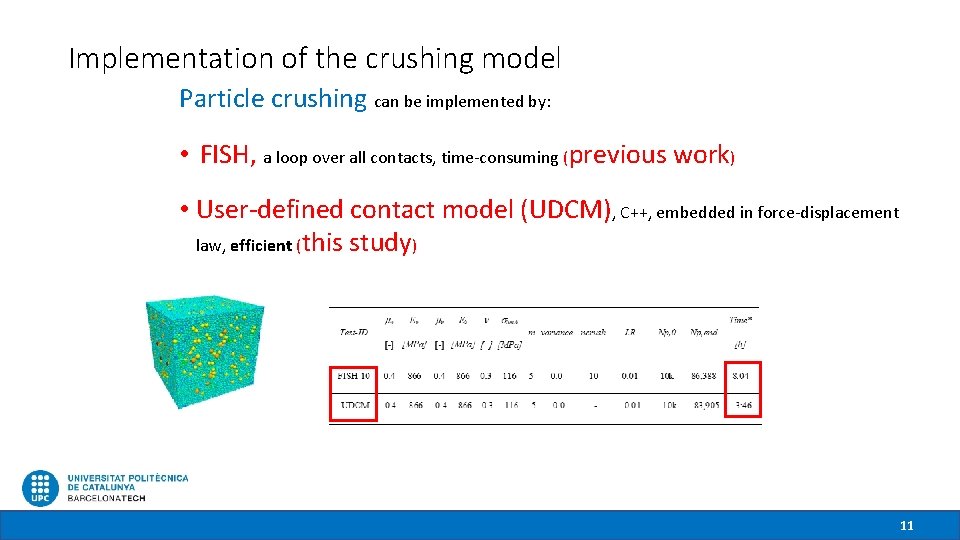
Implementation of the crushing model Particle crushing can be implemented by: • FISH, a loop over all contacts, time-consuming (previous work) • User-defined contact model (UDCM), C++, embedded in force-displacement law, efficient (this study) 11

Incorporation of roughness effect into the crushing model • Hertzian model Rough contact model Contact • Rough contact model Described in: Otsubo et al (2017) for the rough contact model New variables: Sq (measurable), n 1, n 2 12
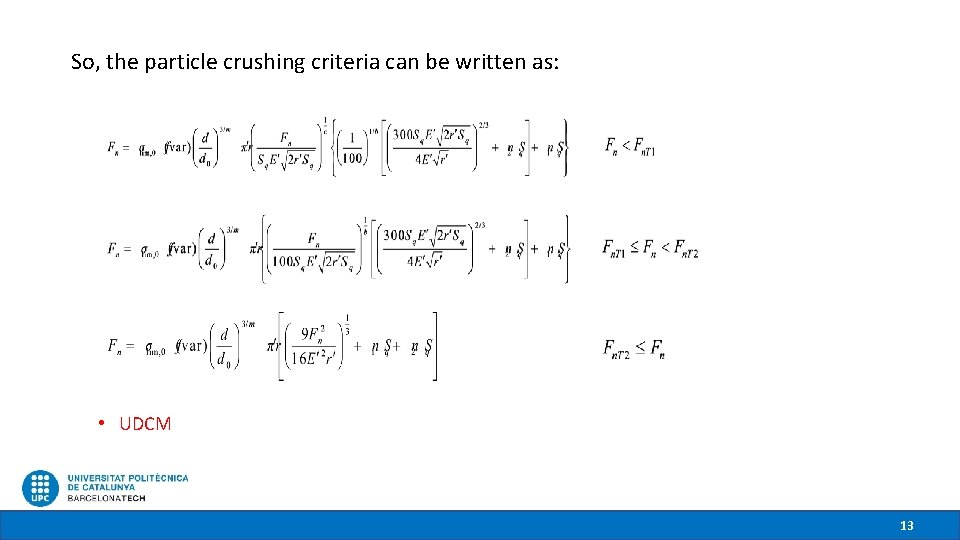
So, the particle crushing criteria can be written as: • UDCM 13
OUTLINE 1. Introduction 2. Model description of rough crushable contact 3. Effect of contact roughness on single particle breakage 4. Effect of contact roughness on sand high stress behavior 5. Conclusions 14
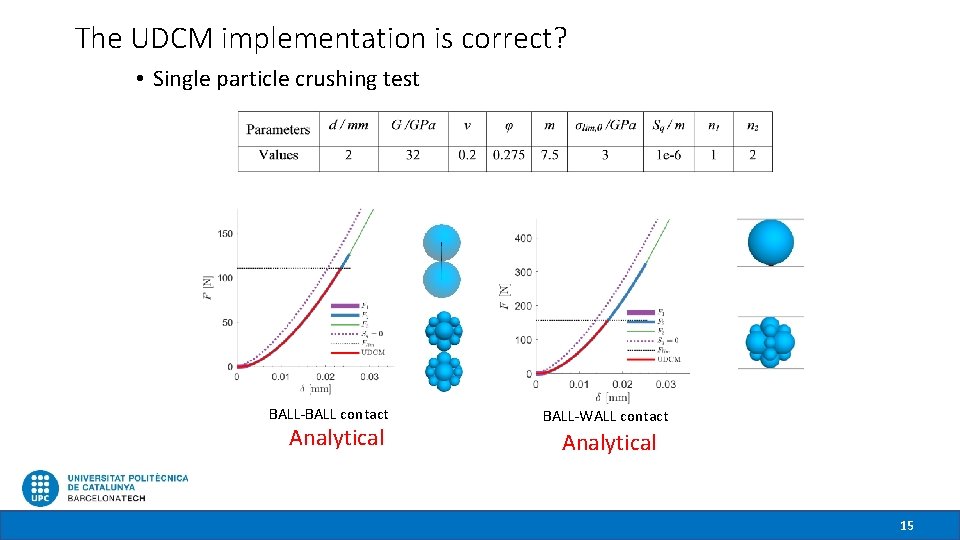
The UDCM implementation is correct? • Single particle crushing test BALL-BALL contact Analytical BALL-WALL contact Analytical 15
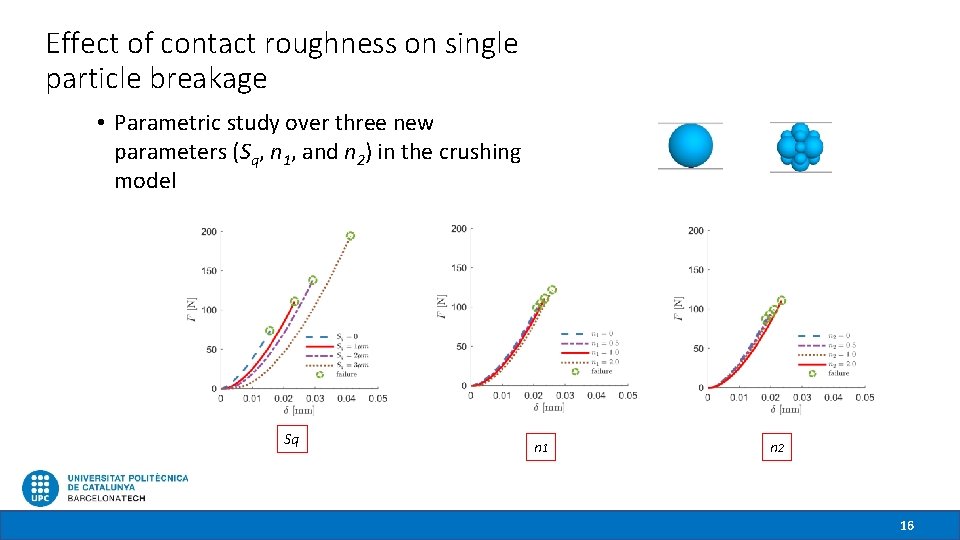
Effect of contact roughness on single particle breakage • Parametric study over three new parameters (Sq, n 1, and n 2) in the crushing model Sq n 1 n 2 16
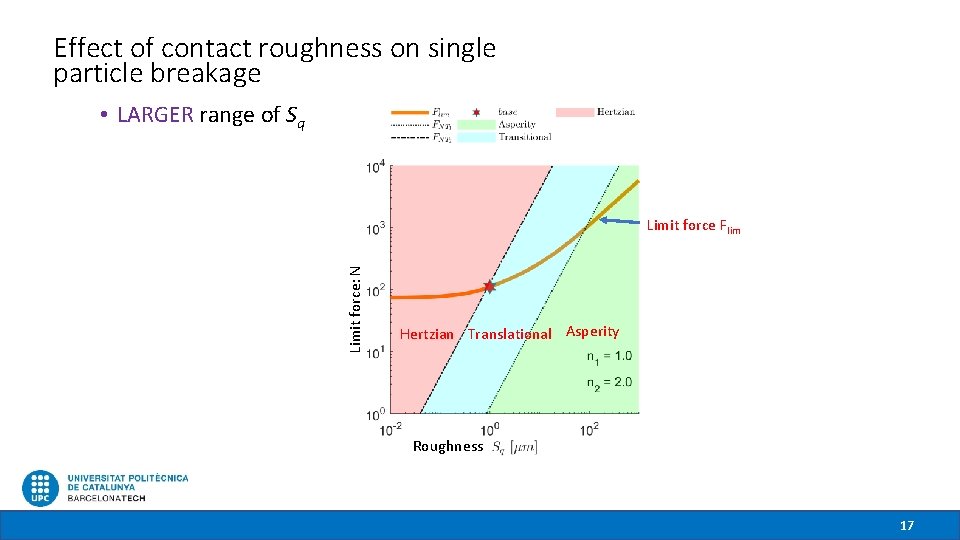
Effect of contact roughness on single particle breakage • LARGER range of Sq Limit force: N Limit force Flim Hertzian Translational Asperity Roughness 17
OUTLINE 1. Introduction 2. Model description of rough crushable contact 3. Effect of contact roughness on single particle breakage 4. Effect of contact roughness on sand high stress behavior 5. Conclusions 18
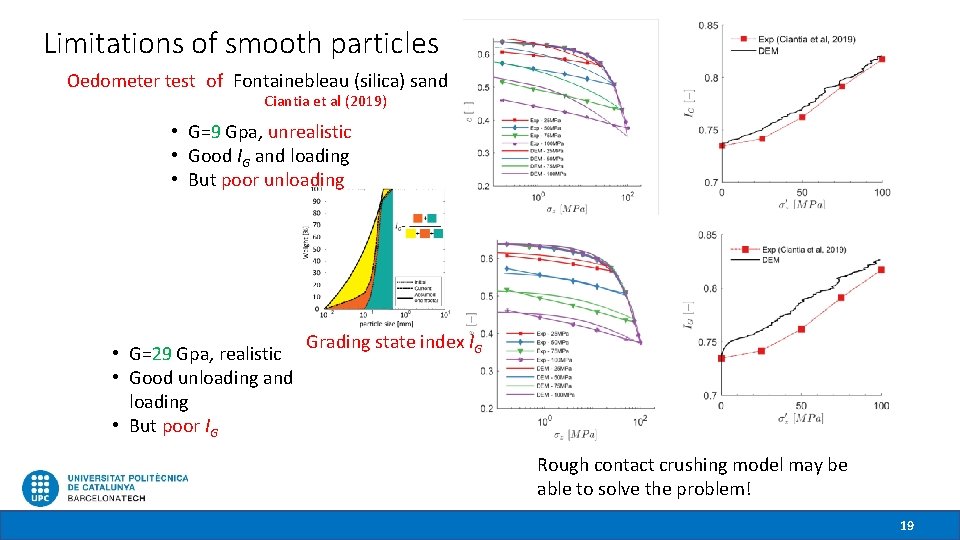
Limitations of smooth particles Oedometer test of Fontainebleau (silica) sand Ciantia et al (2019) • G=9 Gpa, unrealistic • Good IG and loading • But poor unloading • G=29 Gpa, realistic • Good unloading and loading • But poor IG Grading state index IG Rough contact crushing model may be able to solve the problem! 19
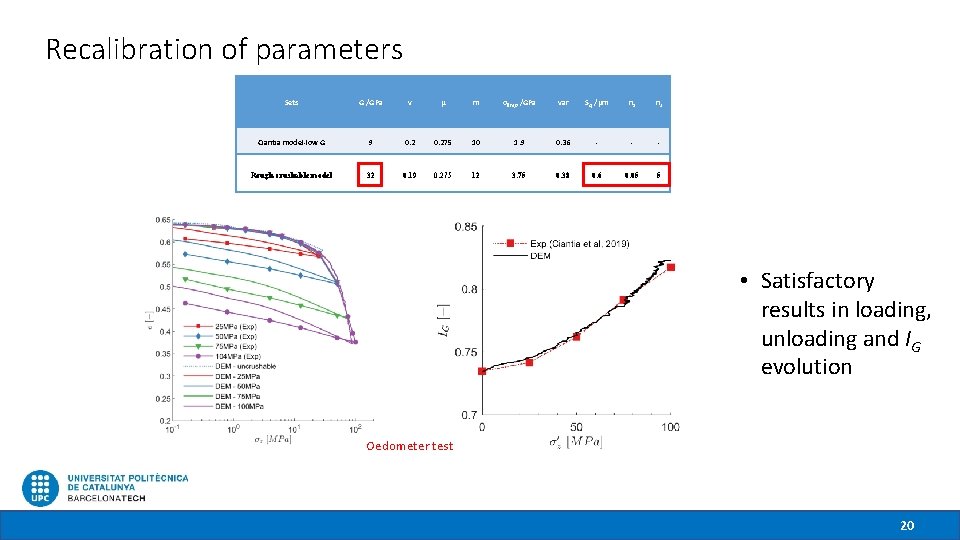
Recalibration of parameters Sets G /GPa v μ m σlim, 0 /GPa var Sq /μm n 1 n 2 Ciantia model-low G 9 0. 275 10 1. 9 0. 36 - - - Rough-crushable model 32 0. 19 0. 275 12 3. 75 0. 38 0. 6 0. 05 5 • Satisfactory results in loading, unloading and IG evolution Oedometer test 20
Conclusions This contribution documents the incorporation of particle surface roughness into a DEM model for crushable sands using a UDCM. The effect of contact roughness on single particle breakage has been investigated via parametric studies. The model parameters for a discrete analogue of a representative quartz sand have been recalibrated. The main findings are: The parametric study shows that increasing either roughness or the ni ratios results in larger crushing forces and less stiff contact behaviour; The effect of roughness Sq is more significative than those of the ni ratios. The recalibrated parameters including realistic values of surface roughness (using realistic values of elastic bulk properties for the sand grains) enable to correctly capture both load-unload behaviour and particle size distribution evolution of high pressure oedometric tests. Roughness is then a model refinement that may result in simpler and more objective DEM calibrations. 21

To acknowledge: Professor Marcos Arroyo, Antonio Gens and Dr Matteo Ciantia ITASCA, Sacha Emam Thank you for your attention! 22
- Slides: 22