
Incorporating Social Determinants of Health into CaseBased Teaching
Incorporating Social Determinants of Health into Case-Based Teaching Using Online Resources and Digital Tools SGIM 2018 NATHAN DOUTHIT, DIVYA BHAMIDIPATI, MICHELLE FLESHNER, THUY BUI APRIL 14, 2018
Workshop outline • • • Introduction (5 min) Online repositories of case reports (10 min) Framework for incorporating SDH teaching into clinical cases (10 min) Small group breakout (15 min) Reporting from small groups (10 min) Conclusion (5 -10 min)
Objectives 1. Access available online curricular resources for case-based teaching in social determinants of health (SDH) 2. Utilize online repositories of clinical cases to teach SDH 3. Modify or adapt existing cases to illustrate SDH teaching points
Online Repositories of Clinical Case Reports JGIM Fast Facts http: //www. sgim. org/web-only/social-determinants-of-health/ Pros: • Brief with multiple choice questions • Already constructed, helpful references/discussion questions • Easy integration Cons: • Brief • Only single SDH instead of confluence of factors
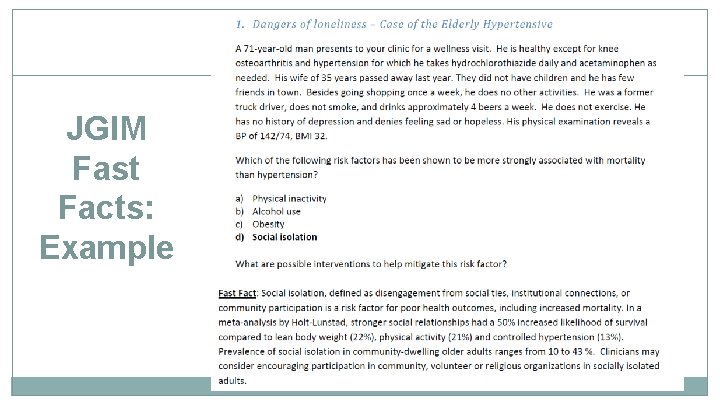
JGIM Fast Facts: Example
Online Repositories of Clinical Case Reports BMJ Case Reports http: //Casereports. bmj. com Pros: Cons: • Especially applicable to • Need paid membership global health to view all cases • Curriculum in production • Global health > domestic with Q+A applicability
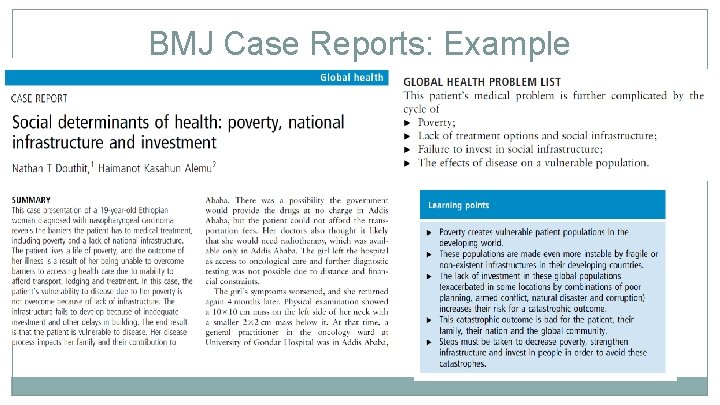
BMJ Case Reports: Example
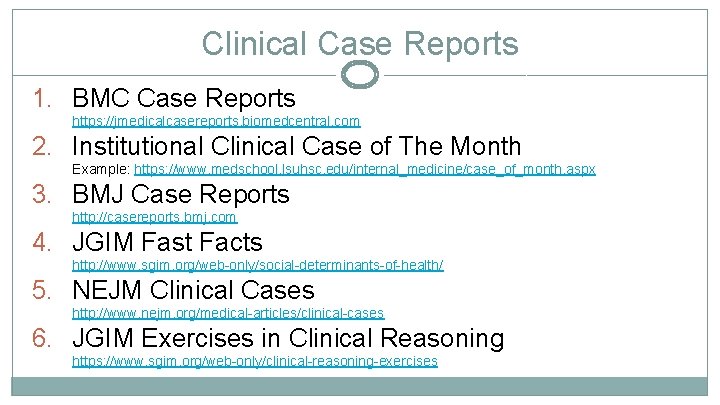
Clinical Case Reports 1. BMC Case Reports https: //jmedicalcasereports. biomedcentral. com 2. Institutional Clinical Case of The Month Example: https: //www. medschool. lsuhsc. edu/internal_medicine/case_of_month. aspx 3. BMJ Case Reports http: //casereports. bmj. com 4. JGIM Fast Facts http: //www. sgim. org/web-only/social-determinants-of-health/ 5. NEJM Clinical Cases http: //www. nejm. org/medical-articles/clinical-cases 6. JGIM Exercises in Clinical Reasoning https: //www. sgim. org/web-only/clinical-reasoning-exercises
Narrative Case Reports 1. JAMA-Piece of My Mind https: //jamanetwork. com/collections/5766/narrative-medicine 2. Health Affairs http: //content. healthaffairs. org/narrative_matters/#top 3. Annals of Internal Medicine—On Being a Doctorhttp: //annals. org/aim/pages/on-being-a-doctor 4. Patient Provider Communication http: //www. patientprovidercommunication. org/case_examples. htm 5. Patient Voices http: //www. patientvoices. org. uk/sask. htm 6. Other sources: local and national media
Framework for incorporating SDH 1. Pre-clinical curriculum • • Epidemiology, risk factors Biology of disadvantage: Chronic stress, dopamine signaling, corticosteroids and epigenetics 2. Clinical training • • Clinical reasoning Systems-based practice Interprofessional practice Public health and policy implication
Incorporating SDH: Pre-Clinical Curriculum Epidemiology and risk factors • Case: respiratory physiology - carbon monoxide poisoning • • Case: hypertensive kidney disease - effect of race • • Kerosene space heater and housing condition Disparities in living organ donation Case: delay diagnosis of sickle-cell crisis in a Puerto Rican patient
Incorporating SDH: Pre-Clinical Curriculum Biology of Disadvantage • Neuroscience: telomere length • • Endocrine: diabetes, obesity • • Case: child without father (discussion of mass incarceration) Case: incorporate built environment, social network Cardiovascular medicine • Case: social isolation, low socioeconomic status as risk factors
Incorporating SDH: Clinical Years Affective/emotional or framing bias Case: A patient from a certain ethnic-racial minority group; a patient with limited English proficiency • Case: A patient with inappropriate behavior, certain appearance or particular mannerism •
Incorporate SDH: Clinical Years Management of patients who are noncompliant or high-need, high utilizer Case: triggers to address to SDH (frequent no-shows, ED visits, poorly controlled chronic diseases, etc. ) • Case: interprofessional practice (teambased care), access community resources •
Incorporate SDH: Clinical Years Implication for public health and policy • Case: opioid overdose and root causes of the opioid crisis and access to addiction treatment
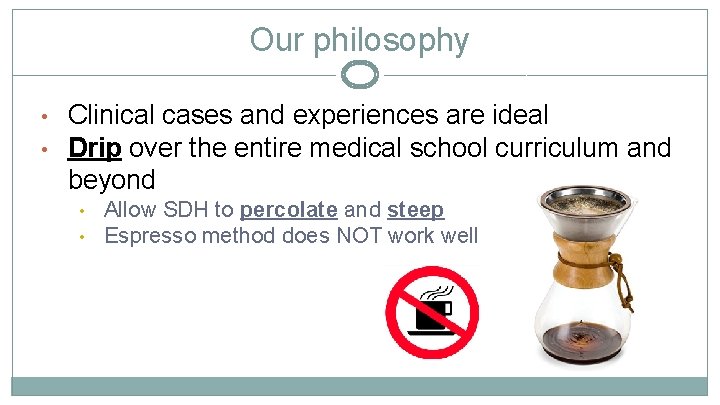
Our philosophy • • Clinical cases and experiences are ideal Drip over the entire medical school curriculum and beyond • • Allow SDH to percolate and steep Espresso method does NOT work well
Our philosophy cont. • Incorporate into existing curricular initiatives • • • Ambulatory case conference Morning reports Simulation exercises Didactic sessions on SDH Home visits Service-learning experiences
Challenges • • Institutional climate Course directors and faculty Competency guidelines Attitude and perception of trainees
Small Group Breakout • • Break into groups of 3 -4 Half will work through “Influenza” case (pre-clinical), half will work through “Young woman with mass” case (clinical) Please read both cases to familiarize yourself prior to the full group discussion Select a spokesperson
Large Group Discussion 1. Challenges you encountered incorporating SDH into the case 2. Examples of SDH risk factors + possible interventions 3. Share SDH-related learning objectives
Summary • • • Many online curricular resources for case-based teaching of SDH Modify or adapt existing cases to illustrate SDH teaching point Slow “drip” of SDH concepts into teaching
Moving Forward • • Reach out to course directors and emphasize realistic, tangible goals Encourage learners to write up cases on SDH Highlight risk factors, triggers, myths or implicit bias Explore interventions (clinical, systems and policy)
Conclusion • • Infuse SDH into existing educational paradigms Utilize case-based teaching Challenges exist “Drip” one step at a time
Questions?
- Slides: 24