
Incorporating Low Dose Radiation Information into US Laws
- Slides: 29
Incorporating Low Dose Radiation Information into US Laws, Regulations and Policies: Challenges and Opportunities Paul A. Locke, JD, Dr. PH Johns Hopkins Bloomberg School of Public Health Department of Environmental Health and Engineering Baltimore, MD plocke@jhu. edu
Presentation Overview • Background, perspective, disclosures • Drive-by tour of US laws, regulations and policies on ionizing radiation • How IR science is traditionally incorporated into US laws, regulations and policies • An evolving view of risk assessment • Potential way forward – opportunities and challenges incorporating low dose IR into US laws, regulations and policies
Introduction, perspective, disclosure
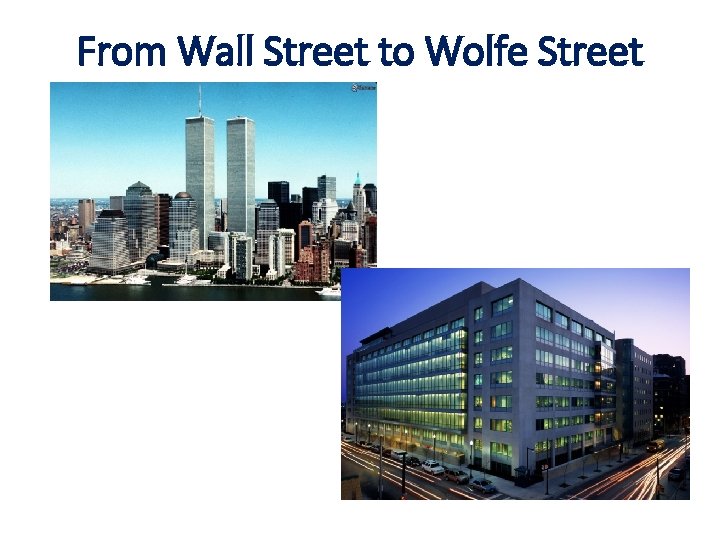
From Wall Street to Wolfe Street
My disclosures • I have no financial conflict of interest to disclose. • I am a member of EPRI’s low dose radiation advisory committee. • I chair Columbia University’s Advisory Council for its Center for Radiological Research. • I have served as an expert witness in two uranium mining cases (one in Canada, one in the US). • I have publicly taken the position that low dose radiation research is important and should be funded. • The opinions expressed in this presentation are mine and do not represent the positions or policies of Johns Hopkins Bloomberg School of Public Health or the Johns Hopkins University.
US laws, regulations and polices applicable to ionizing radiation
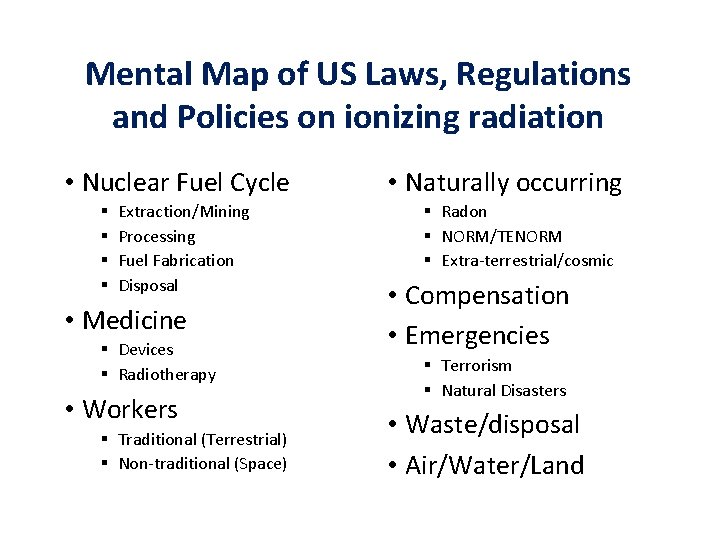
Mental Map of US Laws, Regulations and Policies on ionizing radiation • Nuclear Fuel Cycle § § Extraction/Mining Processing Fuel Fabrication Disposal • Medicine § Devices § Radiotherapy • Workers § Traditional (Terrestrial) § Non-traditional (Space) • Naturally occurring § Radon § NORM/TENORM § Extra-terrestrial/cosmic • Compensation • Emergencies § Terrorism § Natural Disasters • Waste/disposal • Air/Water/Land
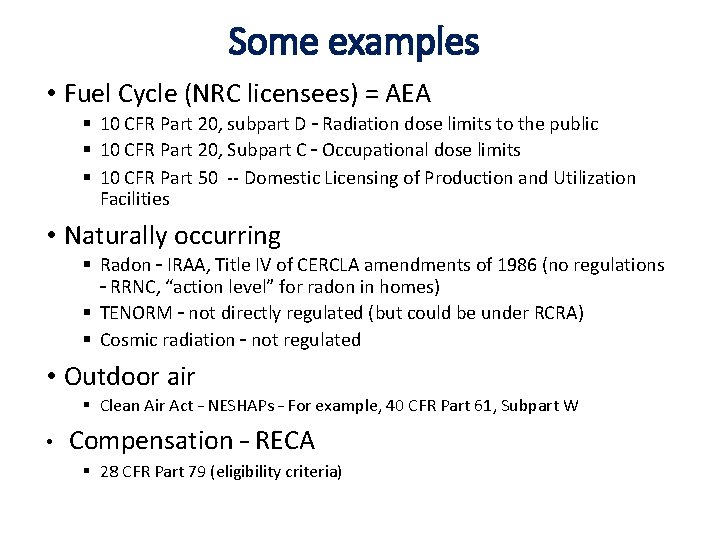
Some examples • Fuel Cycle (NRC licensees) = AEA § 10 CFR Part 20, subpart D – Radiation dose limits to the public § 10 CFR Part 20, Subpart C – Occupational dose limits § 10 CFR Part 50 -- Domestic Licensing of Production and Utilization Facilities • Naturally occurring § Radon – IRAA, Title IV of CERCLA amendments of 1986 (no regulations – RRNC, “action level” for radon in homes) § TENORM – not directly regulated (but could be under RCRA) § Cosmic radiation – not regulated • Outdoor air § Clean Air Act – NESHAPs – For example, 40 CFR Part 61, Subpart W • Compensation – RECA § 28 CFR Part 79 (eligibility criteria)
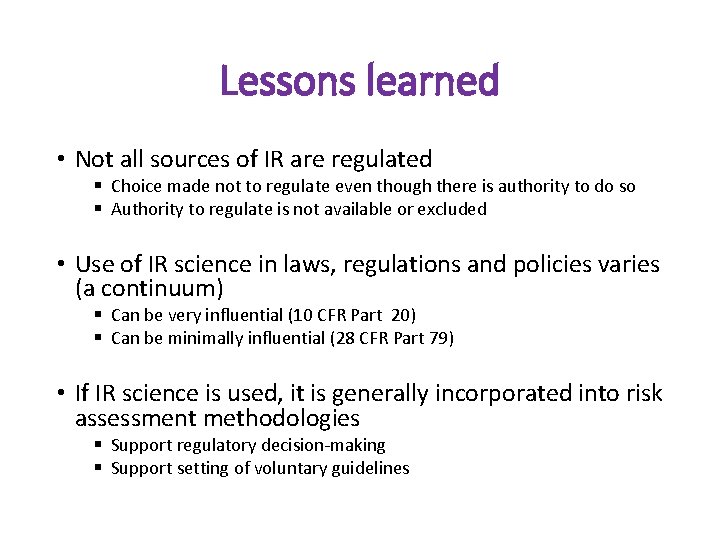
Lessons learned • Not all sources of IR are regulated § Choice made not to regulate even though there is authority to do so § Authority to regulate is not available or excluded • Use of IR science in laws, regulations and policies varies (a continuum) § Can be very influential (10 CFR Part 20) § Can be minimally influential (28 CFR Part 79) • If IR science is used, it is generally incorporated into risk assessment methodologies § Support regulatory decision-making § Support setting of voluntary guidelines
Risk assessment – how IR science is traditionally incorporated into US laws, regulations and policies
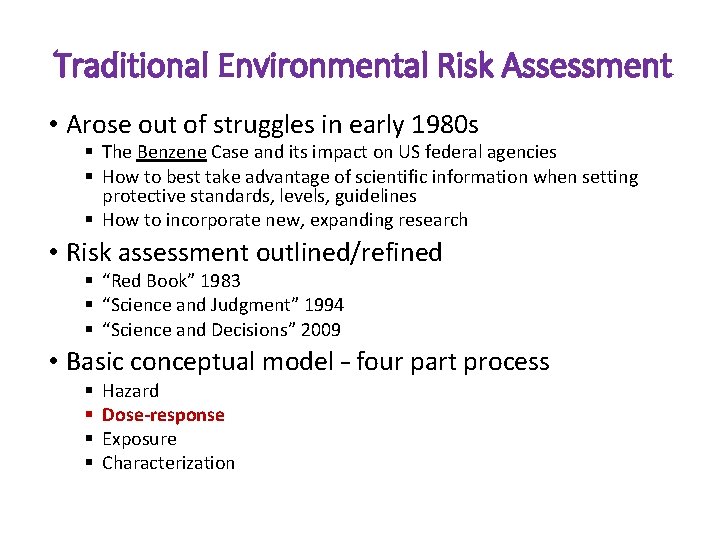
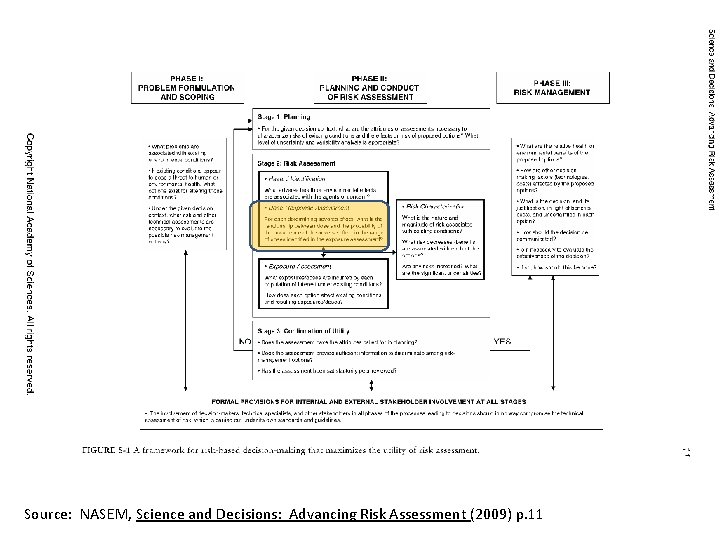
Traditional Environmental Risk Assessment • Arose out of struggles in early 1980 s § The Benzene Case and its impact on US federal agencies § How to best take advantage of scientific information when setting protective standards, levels, guidelines § How to incorporate new, expanding research • Risk assessment outlined/refined § “Red Book” 1983 § “Science and Judgment” 1994 § “Science and Decisions” 2009 • Basic conceptual model – four part process § § Hazard Dose-response Exposure Characterization
Source: NASEM, Science and Decisions: Advancing Risk Assessment (2009) p. 11
IR dose/response • LNT underpins federal (and international) radiation protection paradigm • Meant to be protective and conservative • Recent epidemiology in low dose range generally supports LNT but is not entirely consistent • Recent radiobiology studies show variability in response at molecular, cellular and tissues levels that show nonlinearity in certain circumstances
An evolving view of risk assessment
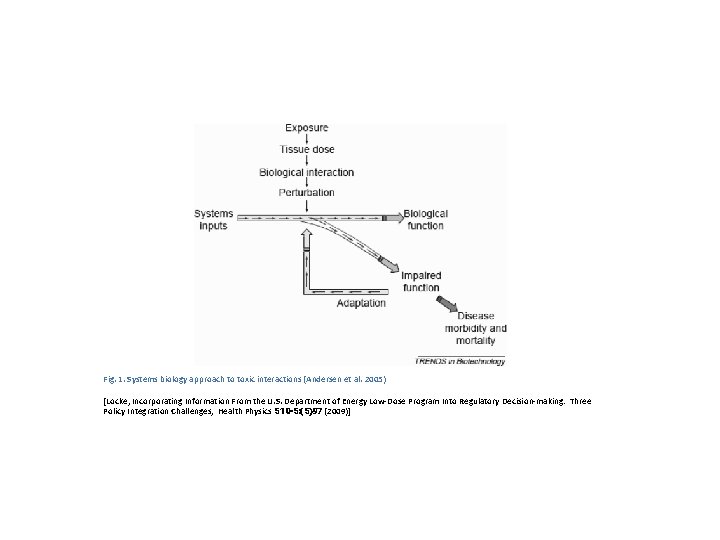
Fig. 1. Systems biology approach to toxic interactions (Andersen et al. 2005) [Locke, Incorporating Information From the U. S. Department of Energy Low-Dose Program Into Regulatory Decision-making: Three Policy Integration Challenges, Health Physics 510 -5: (5)97 (2009)]
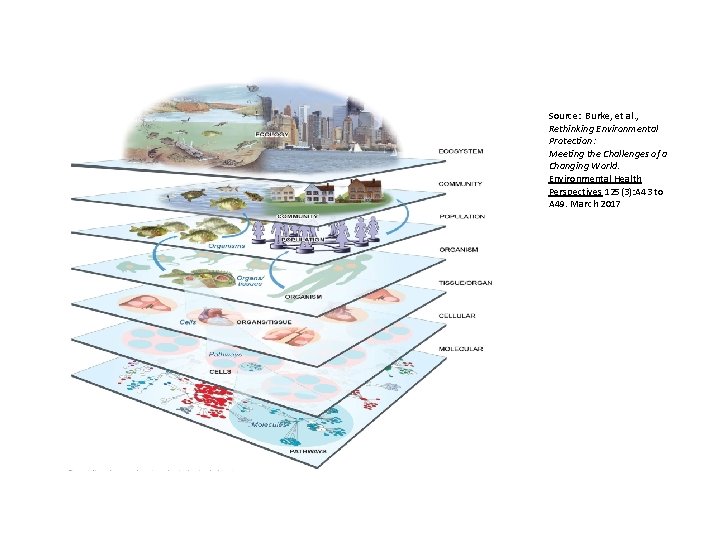
Source: Burke, et al. , Rethinking Environmental Protection: Meeting the Challenges of a Changing World. Environmental Health Perspectives 125(3): A 43 to A 49. March 2017
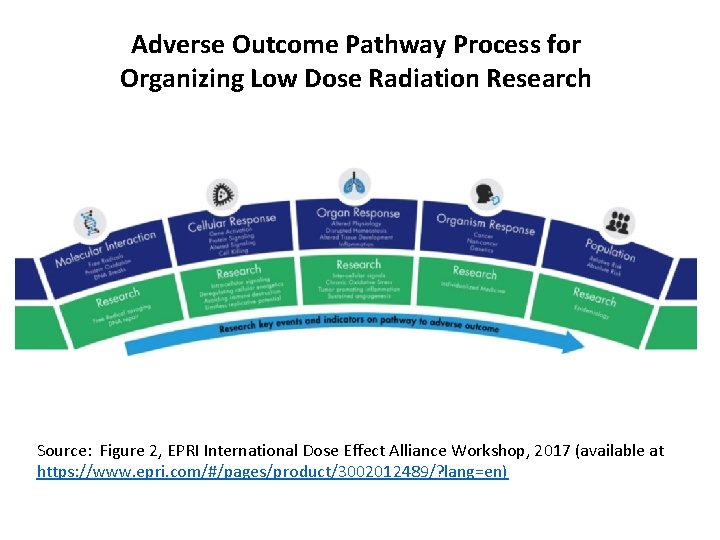
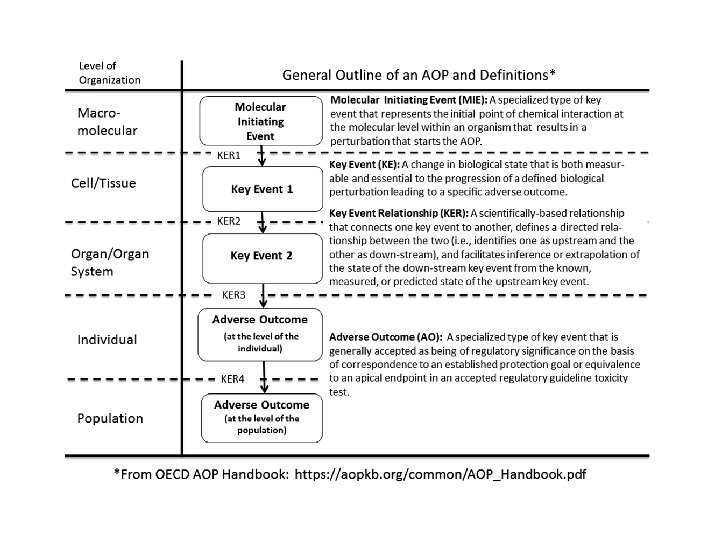
Adverse Outcome Pathway Process for Organizing Low Dose Radiation Research Source: Figure 2, EPRI International Dose Effect Alliance Workshop, 2017 (available at https: //www. epri. com/#/pages/product/3002012489/? lang=en)
An integrative role for systems biology • There is a strong interest in understanding the process of disease progression and its relationship to ionizing radiation üInteraction of cell function, signaling – not merely isolated parts üIntegrating information across systems • Concept of systems biology üHolistic way to evaluate and predict outcomes üInterdisciplinary
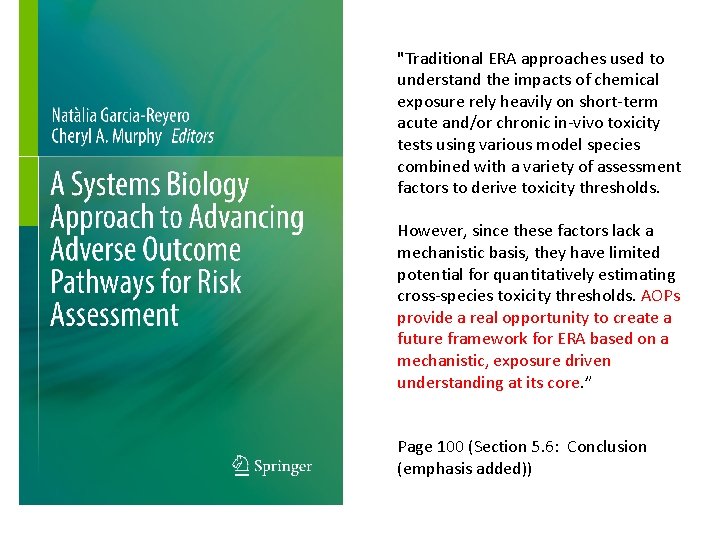
"Traditional ERA approaches used to understand the impacts of chemical exposure rely heavily on short-term acute and/or chronic in-vivo toxicity tests using various model species combined with a variety of assessment factors to derive toxicity thresholds. However, since these factors lack a mechanistic basis, they have limited potential for quantitatively estimating cross-species toxicity thresholds. AOPs provide a real opportunity to create a future framework for ERA based on a mechanistic, exposure driven understanding at its core. ” Page 100 (Section 5. 6: Conclusion (emphasis added))
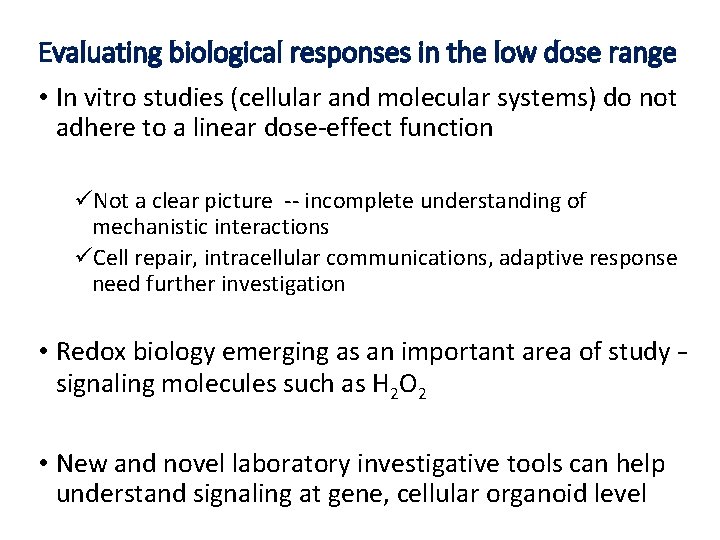
Evaluating biological responses in the low dose range • In vitro studies (cellular and molecular systems) do not adhere to a linear dose-effect function üNot a clear picture -- incomplete understanding of mechanistic interactions üCell repair, intracellular communications, adaptive response need further investigation • Redox biology emerging as an important area of study – signaling molecules such as H 2 O 2 • New and novel laboratory investigative tools can help understand signaling at gene, cellular organoid level
The path forward – research and regulatory acceptance
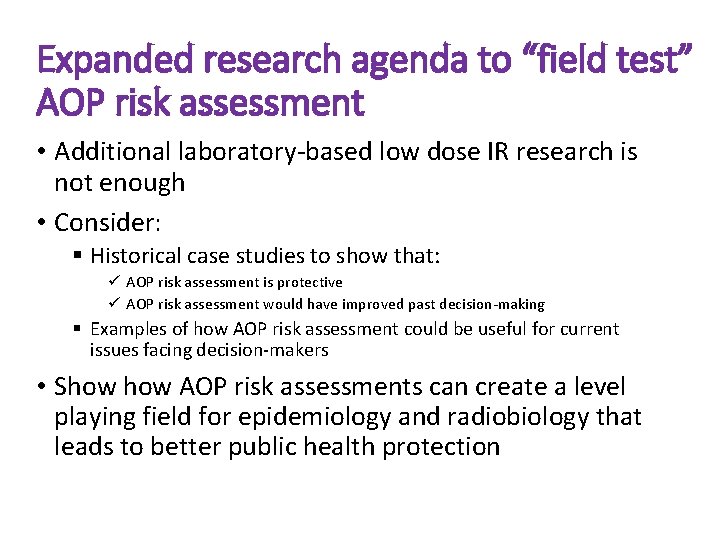
Expanded research agenda to “field test” AOP risk assessment • Additional laboratory-based low dose IR research is not enough • Consider: § Historical case studies to show that: ü AOP risk assessment is protective ü AOP risk assessment would have improved past decision-making § Examples of how AOP risk assessment could be useful for current issues facing decision-makers • Show AOP risk assessments can create a level playing field for epidemiology and radiobiology that leads to better public health protection
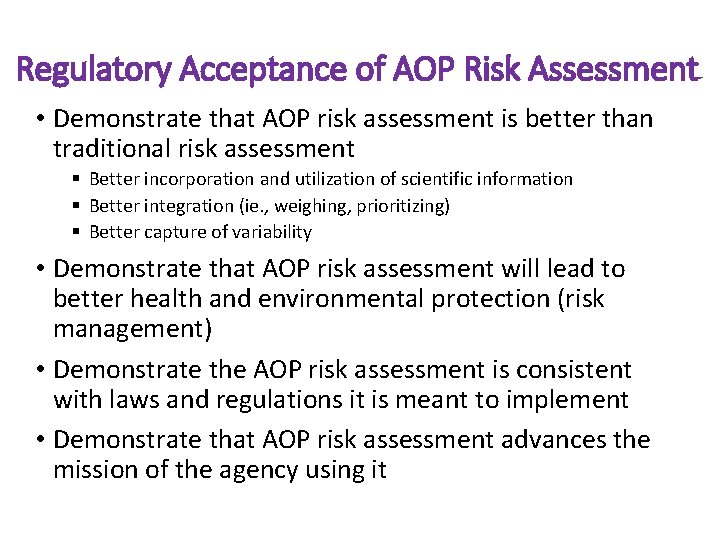
Regulatory Acceptance of AOP Risk Assessment • Demonstrate that AOP risk assessment is better than traditional risk assessment § Better incorporation and utilization of scientific information § Better integration (ie. , weighing, prioritizing) § Better capture of variability • Demonstrate that AOP risk assessment will lead to better health and environmental protection (risk management) • Demonstrate the AOP risk assessment is consistent with laws and regulations it is meant to implement • Demonstrate that AOP risk assessment advances the mission of the agency using it
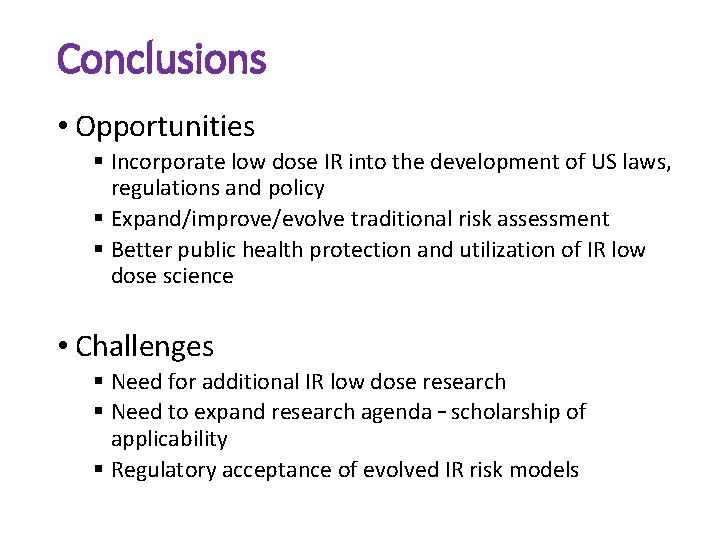
Conclusions • Opportunities § Incorporate low dose IR into the development of US laws, regulations and policy § Expand/improve/evolve traditional risk assessment § Better public health protection and utilization of IR low dose science • Challenges § Need for additional IR low dose research § Need to expand research agenda – scholarship of applicability § Regulatory acceptance of evolved IR risk models
Paul A. Locke, MPH, JD, Dr. PH Associate Professor Department of Environmental Health and Engineering plocke@jhu. edu @Dr. Locke. JHU