
Incorporating Caring Competencies Transforming Healthcare Education REBECCA C
Incorporating Caring Competencies: Transforming Healthcare Education REBECCA C. THREATT, DNP, RN, CHSE 12 TH ANNUAL OHWC SIMULATION CONFERENCE MAY 22, 2018
Disclosures
Objectives To improve the focus and importance of caring concepts and behaviors through didactic, simulation, and modeling interactions in healthcare education.
Caring Science Caring Competencies Background Caring associated with healthcare, but not the concept of teaching caring Significance Press Ganey (patient satisfaction) Improved patient outcome Increased safety Problem Professionals leaving practice, not able to provide care as desired
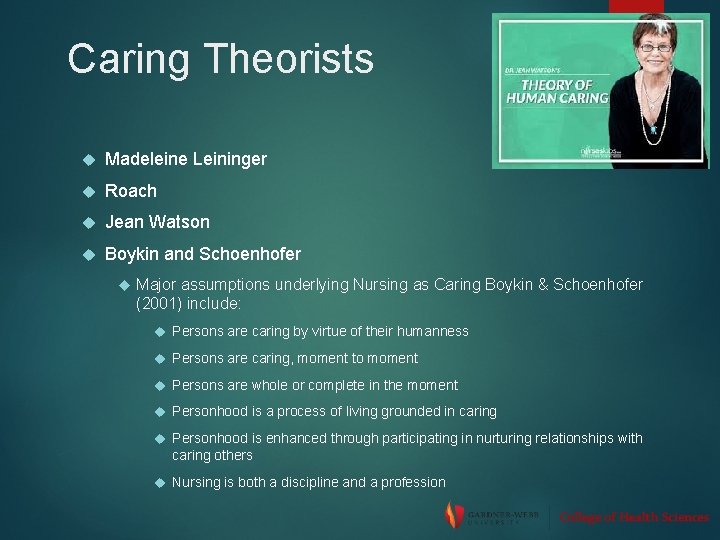
Caring Theorists Madeleine Leininger Roach Jean Watson Boykin and Schoenhofer Major assumptions underlying Nursing as Caring Boykin & Schoenhofer (2001) include: Persons are caring by virtue of their humanness Persons are caring, moment to moment Persons are whole or complete in the moment Personhood is a process of living grounded in caring Personhood is enhanced through participating in nurturing relationships with caring others Nursing is both a discipline and a profession
Caring Competencies Compassion: The quality that fosters trusting relationships. Competence: The state of having knowledge, judgment, skills, energy, experience and motivation required to respond adequately to the demands of one’s professional responsibilities. Confidence: A way of living born out of an awareness of one’s relationship to all living creatures. Conscience: The morally sensitive self attuned to values and is integral to personhood. Commitment: A complex affective response characterized by a convergence between one’s desires and one’s obligations and by a deliberate choice to act in accordance with them. Comportment: Manner of being with others or demeanor expressed through the dress, language and behavior of nurses while caring for patients. (Florida Atlantic University, 2016)
What the Literature Says Importance of caring in healthcare practices cannot be over emphasized. Large gap in health education with caring and the humanistic side of patient care. Caring can be taught and enhanced when incorporated through objectives and competencies.
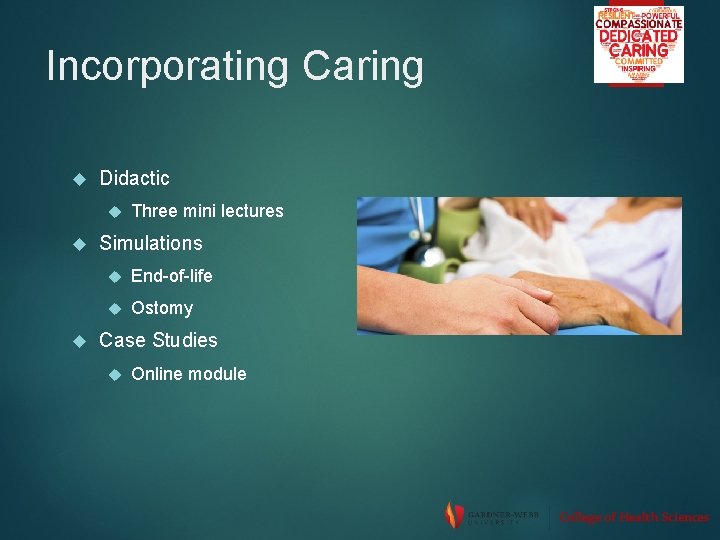
Incorporating Caring Didactic Three mini lectures Simulations End-of-life Ostomy Case Studies Online module
Case Study: Caring Between a Nurse and a Young Adult Experiencing Cancer Mrs. Quinn, a person I cared for before my ICU days, has never left my heart. She was a 30 -year-old woman hospitalized in a step down unit. Immediately I pegged her for an easy admit and discharge. The other nurses avoided her room, and I figured it was because she was ornery and staff was not able to deal with her. I was assigned to her because I was the only one that did not refuse. Armed with this false sense of who she was and half expecting a demanding rude patient, I started my shift and opened her door. I was taken aback by how beautiful she was. She was a fit, young woman from the Caribbean, with gorgeous tan skin and a little black pixie haircut. Her sweet young children, a boy and a girl, were lying beside her. Her husband was at her bedside, despondent with his head in her lap as she stroked his hair. She looked like a queen consoling her king. Her big doe eyes met mine, and if I could say there were a moment God Almighty Himself put me right where I needed to be, it was at that moment. She had stage four uterine cancer with metastasis to the lungs and bone. I couldn’t wrap my mind around how somebody who looked better than I did physically could be so sick. I proceeded to care for her, took her vital signs, and offered her medication as ordered. When asked how she was feeling, she barely spoke to me.
Case Study (cont’d) When her family left the following morning, her stoic guard collapsed. She waited until her husband children left before she let her true feelings show. She told me her story, how quickly she was diagnosed, and stated, “As a woman and mother, I have to be strong for them. Do you mind if I cry with you? ” It was time for my shift to end, and I ended up spending three hours after my shift just talking to her, listening, consoling, and being present in the moment. She said I reminded her of her sister. She explained how she accepted God’s challenge but lived in the real fear of leaving her family behind. There was a solid strength in her that awed me and as we spoke like two old friends, I felt Godly agape love. Her realness with me was baffling. I could see she bottled up all these emotions for the sake of her family and I was happy to be her shoulder to cry on. She told me something that will resonate with me forever: “I may not ever know for sure why I was put on this earth, but I sure hope that I left the people I loved in life in a better state than I found them. I won’t question God, because His will is sovereign over anything, but I’m a human. I’m scared and I’m not ashamed of that. ” I washed her hair and massaged her feet before I left, and we shared a final hug. I was so devastated that something so bad was happening to somebody so nice that I admit that I questioned Almighty God as to why these terrible diagnoses plague people. I understand why colleagues refused her as a patient now. It physically hurt me to take care of her, because I cared about her so much. The essence of caring in this nursing situation is courage (Dorsey, 2015).
Case Study Discussion 1. What was the caring between the nurse/health care professional and the one nursed, how was it demonstrated? 2. Using the Ways of Knowing, how can we come to understand the call(s) for nursing? (See Definitions below and answer at least one of the questions under each category. ) Personal Knowing: Empirical Knowing: Ethical Knowing: Sociopolitical Knowing: Spiritual Knowing: Unknowing: Emancipatory Knowing: Aesthetic Knowing: (Dorsey, 2015)
Case Study Discussion 3. What are the calls for nursing? (The nurse identifies the call for authentic presence and to listen to her hopes and fears. What other calls may be present? What mattered most to Mrs. Quinn at this moment in time? What might be “unspoken” calls? What are the calls from her family? ) 4. How did the study of this nursing situation enhance your knowledge of nursing? (What did I learn about myself as I studied this situation? What did I learn about caring science? What new possibilities can be created from this nursing situation? 5. What are your thoughts on caring expressed by the nurse in this situation? What would you have done differently and why? (Dorsey, 2015)
Caring Constructs Respectful Knowledge and Skill Connectedness: optimistic and constant readiness on part of nurse to help the other Assurance: investment in other’s needs and security Attentiveness: appreciation of and engrossment in the other’s perspective and experience Collaboration: engagement in collegial, interdependent partnership (Wolf, Bailey, & Keeley, 2014)
Respectful Caring objectives The student will show respectful courteous regard for the patient and patient’s family. Student Actions: Acts courteously and deferentially Introduces self and identifies title Acts in genuine manner to create a therapeutic relationship with patient Explains roles of health care team Respects patient’s dignity Listens patiently to patient and family Is gentle Accepts patient’s silence (Wolf, Bailey, & Keeley, 2014)
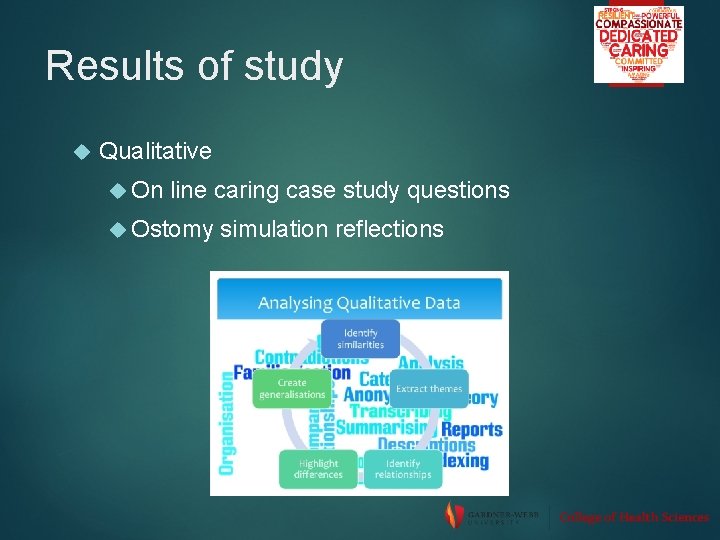
Results of study Qualitative On line caring case study questions Ostomy simulation reflections
Results of study Quantitative Caring Efficacy Scale (Coates, 2010) The mean for the pre CES (M = 5. 16) was slightly less than the mean for the post CES (M = 5. 39). The paired samples t test (t (30) = -8. 06, p < 3. 46), indicated no significant difference between the pre and post CES aggregate means. Comparison to other research
Recommendations to School of Nursing Mini lectures reduced to one per semester Simulation in Fundamentals turned into skill stations (end-of-life sim in senior course) Ostomy Simulation retained Caring added to philosophy statement Caring objectives added to each course and to each simulation in all SON curricula
Recommendations to Academic Healthcare Institutions Caring added to philosophy statement Caring theorist to undergird program Caring competencies added to curriculum Caring objectives added to each course and to each simulation Model caring behaviors
Implications for Practice Link between caring and negative patient outcomes Need for healthcare curriculum to emphasize caring and humanitarianism as core values. Be creative innovators of caring science to sustain initial caring passion and cultivate mature caring competencies. Caring Science organizations: International Association for Human Caring Watson Caring Science Institute
Taking it home and implementing caring in simulation How can you implement caring science and caring competencies in your program? What simulations would be best to emphasize caring? Should there be a caring component to every course and every simulation?
Questions & Discussion Rebecca C. Threatt: rthreatt@gardner-webb. edu
References Blum, C. A. , Hickman, C. , Parcells, D. A. , & Locsin, R. (2010). Teaching caring nursing to RN-BSN students using simulation technology. International Journal for Human Caring. 14(2), 41 -50. Boykin, A. & Schoenhofer, S. (2001). Nursing as caring: A new face in baccalaureate nursing education at Brigham Young University. Journal of Nursing Education, 44(9). 421 -425. Costello, J. & Haggart, M. , (2009). The nature of nursing: Can we teach students how to care? University of Manchester. Retrieved from: http: //www. gcu. ac. uk/care/issuesarchive/issue 2 volume 2/vol 2 iss 2. the-nature-of-nursing. can-weteach-students-how-to-care. -8310. pdf Diaz, D. A. , Maruca, A. T. , Kuhnly, J. E. , Jefferies, P. , & Grabon, N. (2015). Creating caring and empathic nurses: A simulated ostomate. Clinical Simulation in Nursing, 11(12). 513 -518. Dorsey, M. (2015). Caring between a nurse and a young adult experiencing cancer. In Barry, C. D. , Gordon, S. C. & King, B. M. (Eds. ) Nursing Case Studies in Caring (pp. 105 -110). NY, Springer. Egenberger, T. , Keller, K. & Locsin, R. C. (2010). Valuing caring behaviors within simulated emergent nursing situations. International Journal of Human Caring, 14(2), 23 -29. Florida Atlantic University. (2016) School of nursing caring competencies. Retrieved from http: //iea. fau. edu/ALC/Nursing. SLOA. pdf Gardner-Webb University. (2016). College of Health Sciences. Retrieved from http: //www. gardnerwebb. edu/academic-programs-and-resources/colleges-and-schools/health-sciences/schools-and -departments/ Greger, J. K. (2012). Facilitating caring behaviors in technology-dependent nursing practice through the use of simulation training and confluent education strategies. St. Catherine University White Paper. Retrieved from: http: //sophia. stkate. edu/cgi/viewcontent. cgi? article=1047&context=ma_nursing
References Huston, C. (2013). The impact of emerging technology on nursing care: Warp speed ahead. The Online Journal of Issues in Nursing, 18(2), Manuscript 1. Korhonen, E. , Nordman, T. , & Eriksson, K. (2015). Technology and its ethics in nursing and caring journals: An integrative literature review. Nursing Ethics, 22(5), 561 -576, doi: 10. 1177/09697333014549881 Locsin, R. C. & Purnell, M. (2015). Advancing theory of technological competency as caring in nursing: The universal technological domain. International Journal for Human Caring, 19(2), 5054. Manary, M. P. , Boulding, W. , Staelin, R. , & Glickman, S. W. (2013). The patient experience and health outcomes. New England Journal of Medicine, 386, 201 -203. Matsuoka, R. (2007). Examining caring theories in nursing from non-nursing viewpoints. Journal of Nursing Studies, 6(1), 43 -51. Mc. Grath, M. (2008). The challenges of caring in a technological environment: Critical care nurses experiences. Journal of Clinical Nursing, 17(8), 1096 -1104. Panosky, D. , & Diaz, D. (2009). Teaching caring and empathy through simulation. International Journal for Human Caring, 13(3), 44 -46. Storr, G. B. (2010). Learning how to effectively connect with patients through low-tech simulation scenarios. International Journal for Human Caring, 14(2), 36 -40. Swanson, K. (1993). Nursing as informed caring for the well-being of others. IMAGE: Journal of Nursing Scholarship, 25(4), 353 -357. Wolf, Z. R. , Bailey, D. N. & Keeley, P. A. (2014). Creation of a caring protocol: Activities and dissemination strategies in caring research and instruments. International Journal for Human Caring, 18(1), 66 – 82.
- Slides: 25