
INCOMPATIBLE CHEMICALS CHEMICAL STORAGE a b c d
INCOMPATIBLE CHEMICALS CHEMICAL STORAGE a. b. c. d. Merck chemical company. Chemical Safety Office, Risk Management Department, University of Vermont Hazards in the Chemical Laboratory, 4 th. edition. 1986. Bretherick. Manufacturing Chemist’s Association, Guide for Safety in the Chemical laboratory, (UNH website )
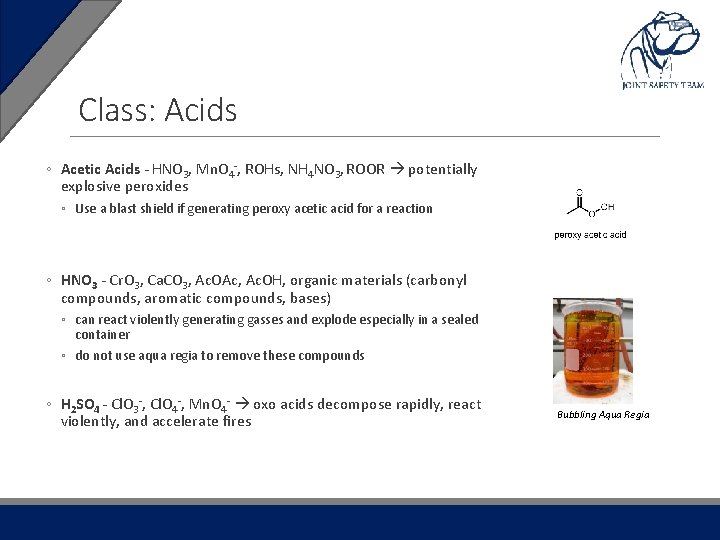
Class: Acids ◦ Acetic Acids - HNO 3, Mn. O 4 -, ROHs, NH 4 NO 3, ROOR potentially explosive peroxides ◦ Use a blast shield if generating peroxy acetic acid for a reaction ◦ HNO 3 - Cr. O 3, Ca. CO 3, Ac. OAc, Ac. OH, organic materials (carbonyl compounds, aromatic compounds, bases) ◦ can react violently generating gasses and explode especially in a sealed container ◦ do not use aqua regia to remove these compounds ◦ H 2 SO 4 - Cl. O 3 -, Cl. O 4 -, Mn. O 4 - oxo acids decompose rapidly, react violently, and accelerate fires Bubbling Aqua Regia
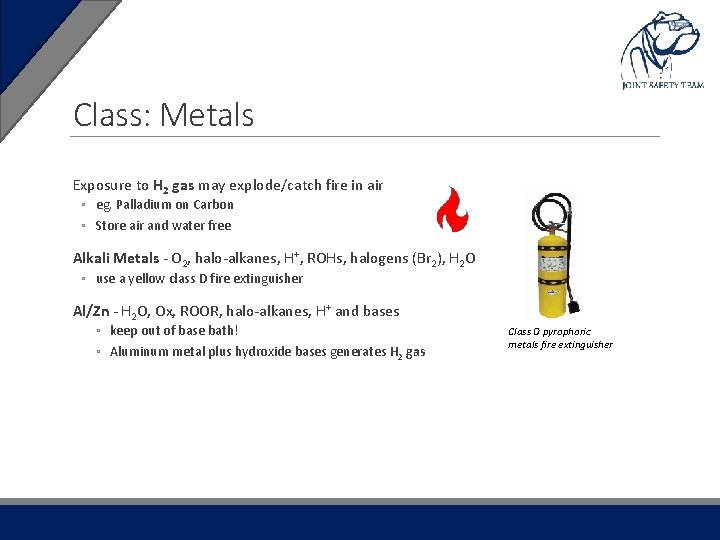
Class: Metals Exposure to H 2 gas may explode/catch fire in air ◦ eg. Palladium on Carbon ◦ Store air and water free Alkali Metals - O 2, halo-alkanes, H+, ROHs, halogens (Br 2), H 2 O ◦ use a yellow class D fire extinguisher Al/Zn - H 2 O, Ox, ROOR, halo-alkanes, H+ and bases ◦ keep out of base bath! ◦ Aluminum metal plus hydroxide bases generates H 2 gas Class D pyrophoric metals fire extinguisher

Class: Organics ◦ Acetaldehyde - Ac. OH, Ac. OAc exothermic polymerization reactions possible ◦ Acetone - HNO 3, H 2 SO 4, H 2 O 2 acetone peroxide is highly unstable and explosive ◦ keep strong acids out of acetone waste ◦ Anilines - HNO 3, H 2 O 2 trinitroaniline is strongly oxidizing and explosive similar to picric acid and TNT Acetone peroxide monomer
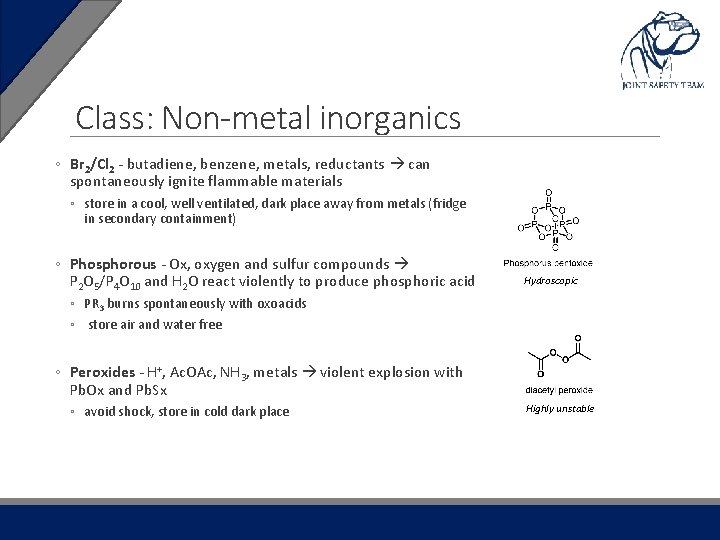
Class: Non-metal inorganics ◦ Br 2/Cl 2 - butadiene, benzene, metals, reductants can spontaneously ignite flammable materials ◦ store in a cool, well ventilated, dark place away from metals (fridge in secondary containment) ◦ Phosphorous - Ox, oxygen and sulfur compounds P 2 O 5/P 4 O 10 and H 2 O react violently to produce phosphoric acid Hydroscopic ◦ PR 3 burns spontaneously with oxoacids ◦ store air and water free ◦ Peroxides - H+, Ac. OAc, NH 3, metals violent explosion with Pb. Ox and Pb. Sx ◦ avoid shock, store in cold dark place Highly unstable
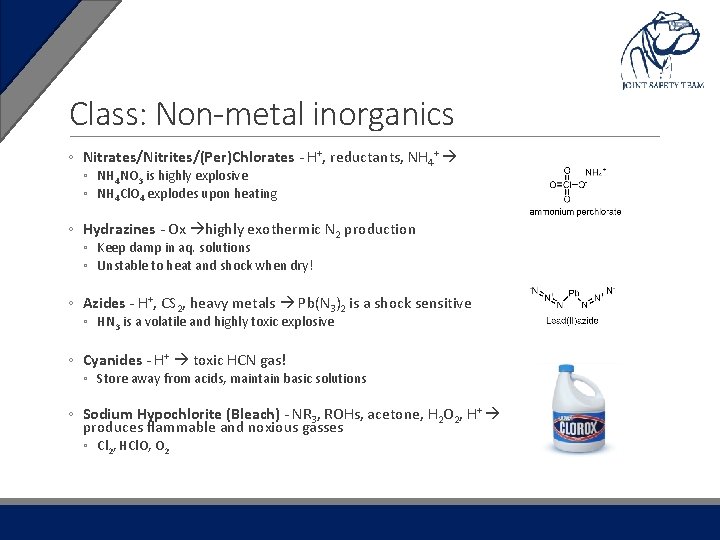
Class: Non-metal inorganics ◦ Nitrates/Nitrites/(Per)Chlorates - H+, reductants, NH 4+ ◦ NH 4 NO 3 is highly explosive ◦ NH 4 Cl. O 4 explodes upon heating ◦ Hydrazines - Ox highly exothermic N 2 production ◦ Keep damp in aq. solutions ◦ Unstable to heat and shock when dry! ◦ Azides - H+, CS 2, heavy metals Pb(N 3)2 is a shock sensitive ◦ HN 3 is a volatile and highly toxic explosive ◦ Cyanides - H+ toxic HCN gas! ◦ Store away from acids, maintain basic solutions ◦ Sodium Hypochlorite (Bleach) - NR 3, ROHs, acetone, H 2 O 2, H+ produces flammable and noxious gasses ◦ Cl 2, HCl. O, O 2
- Slides: 6