
Income Verification Collection Report Child Nutrition Program Administration
- Slides: 29
Income Verification & Collection Report Child Nutrition Program Administration New York State Education Department
Regulatory Authority • 7 CFR ◦ Part 210– National School Lunch Program ◦ Part 215– Special Milk Program ◦ Part 220– School Breakfast Program ◦ Part 235– State Administrative Expense ◦ Part 245– Free and Reduced Price Eligibility ◦ Part 3016 - Procurement for Public & Charter Schools ◦ Part 3019 - Procurement for Non-Public Schools ◦ Part 3052 - Audit Requirements • Public Law 111 -296 (Healthy, Hunger-Free Kids Act of 2010) • 2 CFR Chapter I, and Chapter II, Parts 200, 215, 220, 225, and 230 - Uniform Administrative Requirements, Cost Principles, and Audit Requirements for Federal Awards; Final Rule ◦ Supersedes and streamlines requirements from OMB CIRCULARS A-87; A-122
Income Verification • Verification is an annual requirement that confirms the eligibility of free and reduced price meals under the NSLP and SBP • Confirmation of information provided on a free/reduced application: ◦ Income eligibility ◦ Child or household member is receiving assistance under SNAP, FDPIR, TANF ◦ Not required through the Direct Certification Matching Process (DCMP) • Verification must be completed by November 15 th ◦ Includes changes in eligibility • SED prototype forms ◦ Review POS generated letters • Keep all supporting documentation on file ◦ ◦ Number of applications on file as of October 1 st Number of applications that must be verified Documentation of confirmation review Summary of the verification process and results
Income Verification Not required for: • • • SFAs claiming paid reimbursement only SFAs only in the Special Milk Program RCCIs with no day students SFAs in Non base year Provision 2 SFAs in Community Eligibility Provision (CEP) • These SFAs must however still submit and report information to SED
Income Verification • SFAs have the option to begin the Verification process prior to October 1 st • If SFA chooses this approach SFA MUST: • Decide how often to sample applications • Include only applications approved since the last sample was selected • Select either 3% or 1. 5% of approved applications as required by the sampling method each time
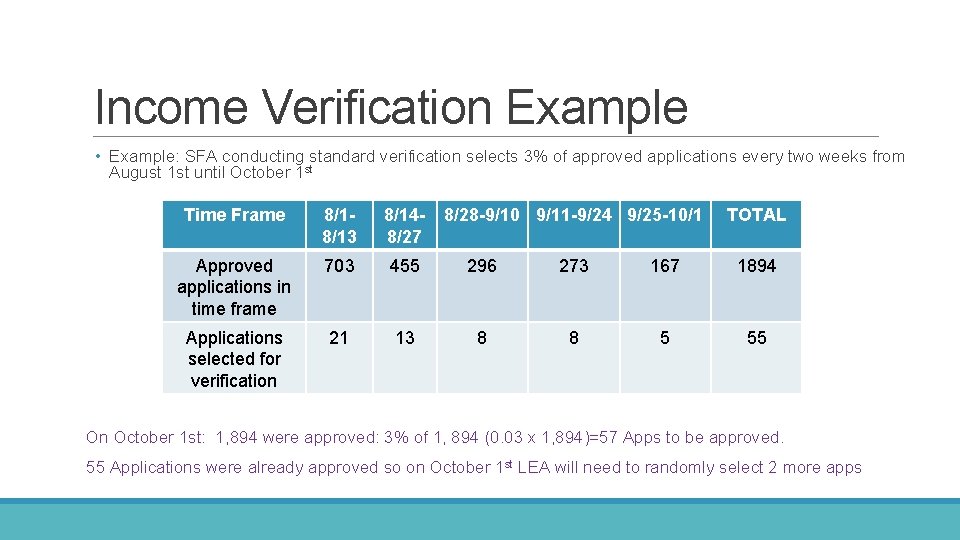
Income Verification Example • Example: SFA conducting standard verification selects 3% of approved applications every two weeks from August 1 st until October 1 st Time Frame 8/18/13 8/148/27 8/28 -9/10 9/11 -9/24 9/25 -10/1 TOTAL Approved applications in time frame 703 455 296 273 167 1894 Applications selected for verification 21 13 8 8 5 55 On October 1 st: 1, 894 were approved: 3% of 1, 894 (0. 03 x 1, 894)=57 Apps to be approved. 55 Applications were already approved so on October 1 st LEA will need to randomly select 2 more apps
Step 1: Establish Sample Pool • Sample Pool: Total number of newly approved applications on file as of October 1 • How to Determine your Verification Sample Pool: (Start October 1) ◦ ◦ Count # free and reduced applications, district-wide (pieces of paper) Include income applications, Applications listing a case number Applications with the foster child box checked but a letter or documentation from social service/placement agency was not submitted
Establish Sample Pool The following should not be included in your sample pool: ◦ Direct Certification Match ◦ Homeless, migrant, runaways, or Head Start children ◦ Foster children who are deemed eligible based on a letter from the State or local placement agency ◦ Carry-over applications from the previous year who have not yet submitted a new application ◦ Denied Applications
Step 2: Determine the Sampling Method Your Response Rate from the last completed SY determines how you should conduct income verification for current SY Error Prone Method ◦ Must be used if you had less than 80% response rate to verification last SY ◦ SED generate the list of LEA’s that had a greater than 80% response rate ◦ If your LEA is not listed, you must use this method ◦ Must be used if you are coming off Provision 2 ◦ Must be used if you are in first year of operation Alternate Options ◦ If 80% or more of households responded to income verification last SY, you can use either the error prone method OR 1 of 2 alternate options: ◦ Random Method ◦ Focused Method
Error Prone Method • Verify the lesser of 3% or 3, 000 of applications that fall within $24/week, $100/month or $1200/year of the eligibility limit • Always round up • Do not verify more applications than required • When initially approving applications, it may be helpful to flag error prone applications to help facilitate the process.
Error Prone Method Example: 210 application forms are on file Take 3% = 6. 3 Round up to 7 • Choose 7 error-prone applications to be verified • Suppose you only have 3 error-prone applications – what would you need to do? • Choose the remaining 4 using random method
Random Method (Alternate 1) • Verify the lesser of 3% or 3, 000 of the total number of approved applications on file as of October 1 st selected at random • Random sample must include both: ◦ Income applications ◦ Categorical applications ◦ Applications that families indicated a SNAP/TANF/FDPIR case number or checked the foster box on the application but whose names do not appear on the direct certification matching list
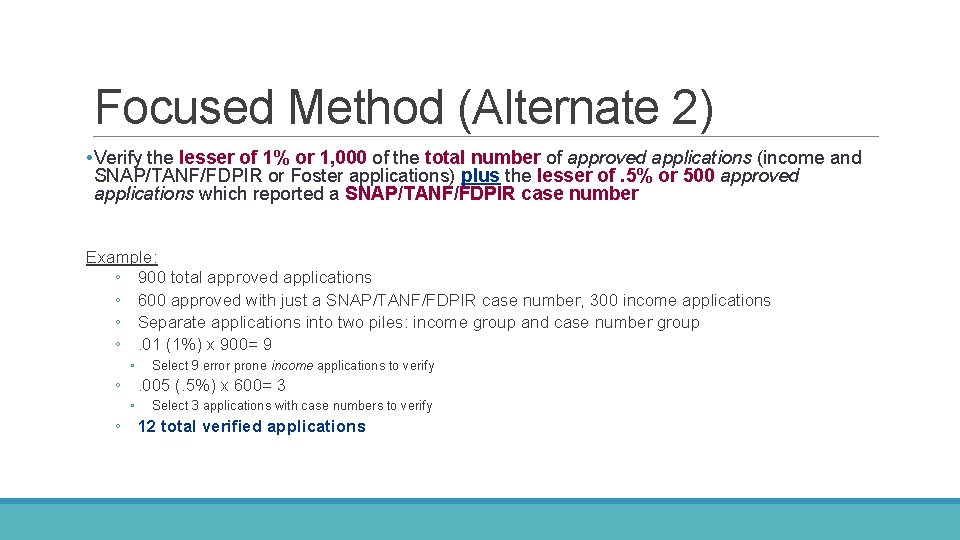
Focused Method (Alternate 2) • Verify the lesser of 1% or 1, 000 of the total number of approved applications (income and SNAP/TANF/FDPIR or Foster applications) plus the lesser of. 5% or 500 approved applications which reported a SNAP/TANF/FDPIR case number Example: ◦ 900 total approved applications ◦ 600 approved with just a SNAP/TANF/FDPIR case number, 300 income applications ◦ Separate applications into two piles: income group and case number group ◦. 01 (1%) x 900= 9 ◦ Select 9 error prone income applications to verify ◦. 005 (. 5%) x 600= 3 ◦ Select 3 applications with case numbers to verify ◦ 12 total verified applications
Step 3: Select Applications to Verify • Select applications in accordance with the type of verification conducted o Error Prone o Random (Alternate 1) o Focused (Alternate 2) • Always round up • 6. 1= 7 applications • Do not verify any more or any less than required sample size • Check computerized systems for accuracy • Refer to the Income Verification Booklet for guidance
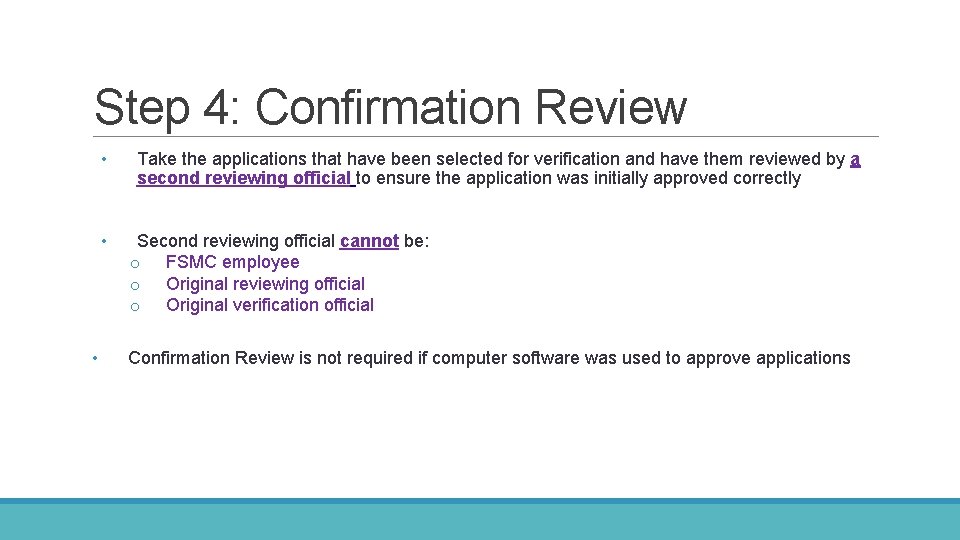
Step 4: Confirmation Review • • • Take the applications that have been selected for verification and have them reviewed by a second reviewing official to ensure the application was initially approved correctly Second reviewing official cannot be: o FSMC employee o Original reviewing official o Original verification official Confirmation Review is not required if computer software was used to approve applications
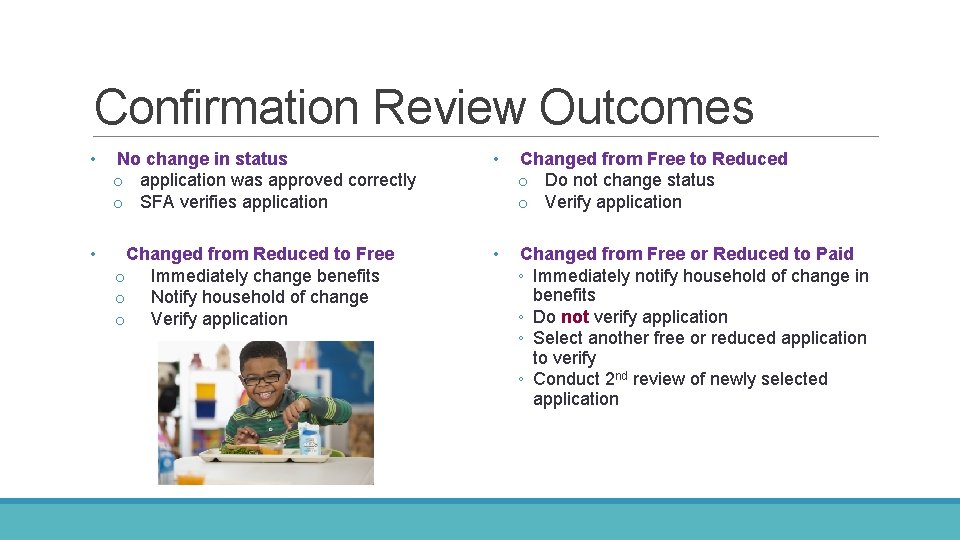
Confirmation Review Outcomes • No change in status o application was approved correctly o SFA verifies application • Changed from Free to Reduced o Do not change status o Verify application • Changed from Reduced to Free o Immediately change benefits o Notify household of change o Verify application • Changed from Free or Reduced to Paid ◦ Immediately notify household of change in benefits ◦ Do not verify application ◦ Select another free or reduced application to verify ◦ Conduct 2 nd review of newly selected application
Step 5: Notify Household of Selection • Must notify households of selection ◦ Recommended to use SED prototype letters • Must inform households: ◦ The type of acceptable verification documentation to confirm current income ◦ That the household may provide proof that the child or any household member is receiving benefits under the Assistance Programs (SNAP/TANF/FDPIR) instead of providing income information ◦ The date the information must be provided by and that failure to respond by the deadline will result in termination of benefits ◦ Name of an SFA official who can answer questions and provide assistance ◦ A toll free number for parents to obtain assistance. This can be a local number within the district. It cannot be a long distance call
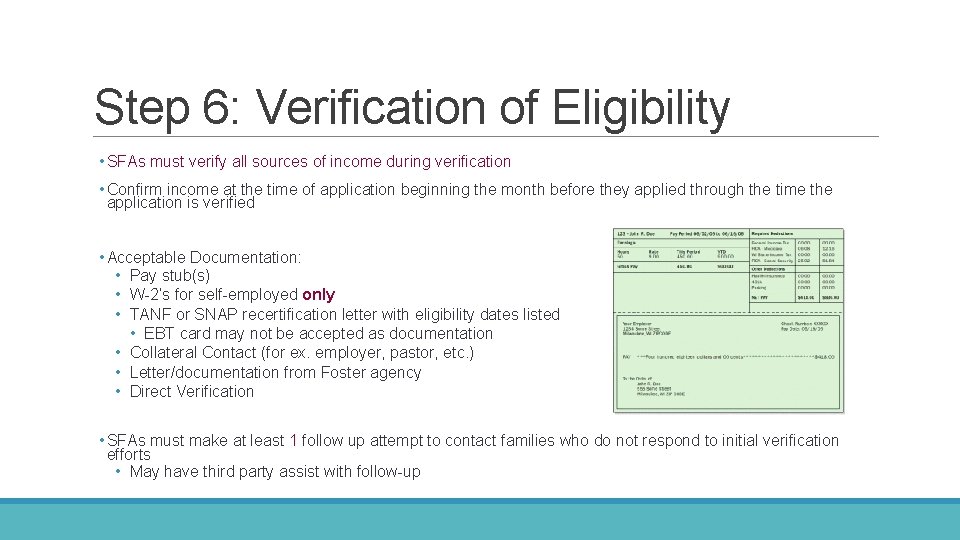
Step 6: Verification of Eligibility • SFAs must verify all sources of income during verification • Confirm income at the time of application beginning the month before they applied through the time the application is verified • Acceptable Documentation: • Pay stub(s) • W-2’s for self-employed only • TANF or SNAP recertification letter with eligibility dates listed • EBT card may not be accepted as documentation • Collateral Contact (for ex. employer, pastor, etc. ) • Letter/documentation from Foster agency • Direct Verification • SFAs must make at least 1 follow up attempt to contact families who do not respond to initial verification efforts • May have third party assist with follow-up
Step 7: Results of Verification Notify Families of the outcome of verification ◦ Use NYSED prototype letter Changes in eligibility – ◦ Increase in benefits ◦ Must be made within 3 operating days (e. g. reduced to free) ◦ Decrease in benefits ◦ Families must be given 10 calendar days written notice (e. g. free to paid) ◦ Notice must include required information on denial letter ◦ Change Benefits must be made for ALL family members NOTE: ◦ No response = benefits must be terminated
Households who do not respond: • • SFAs must take the following written action: ◦ Benefits must be terminated ◦ 10 -calendar day advance notice (the 1 st day is the day the notification is sent) ◦ This should be built into the verification timeline to be completed by November 15 • The written notice must include: ◦ Change in benefits ◦ Reason(s) for change ◦ Right to appeal ◦ Appeal process ◦ Non-discrimination statement ◦ Reapplication process Households that appeals within 10 calendar days: ◦ Must continue to receive benefits until decision is made by hearing official
Fragile Households • Fragile household: is one that may be having major hospitalization and/or health issues or tragic events ◦ SFAs may decline up to 5% of their verification sample and replace them with other approved applications when a fragile household is chosen The SFA may: ◦ Skip over the “fragile” household’s application ◦ Document why the SFA passed over the “fragile” application ◦ Only in rare and necessary circumstances should this be used ◦ Select another application and begin the verification process
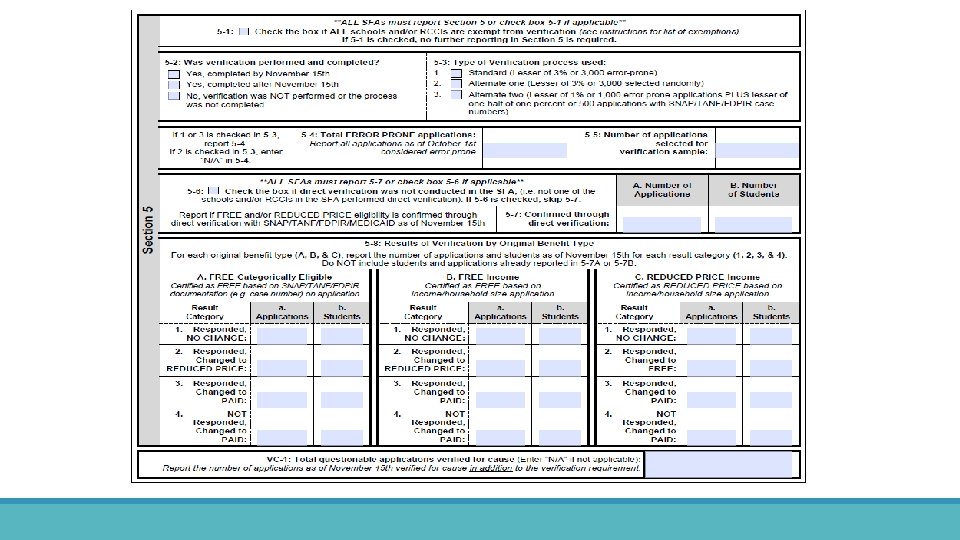
Direct Verification • Direct Verification is the confirmation of eligibility by using records from public agencies to verify assistance program participation. • Purpose– Help reduce termination of eligible families who fail to return information when chosen for verification • Intent–To validate a household’s eligibility SFAs will: Access Business Portal and click on New York State Identification System (NYSSIS) SFAs will use the search tool to verify students eligibility o Must match 3 unique identifiers (i. e. DOB, address, name) o Keep a record of directly verified students on file for review o Report data on Income Verification Collection Report (Attachment G)
Verification for Cause • SFAs are obligated to verify all questionable applications • Applications verified for cause are in addition to the annually required verification process • Restriction on sample size (over-verifying) does not pertain to verification for cause applications • Follow Income Verification procedures • Report those applications verified for cause and the results on the Income Verification Collection Report (Attachment G)
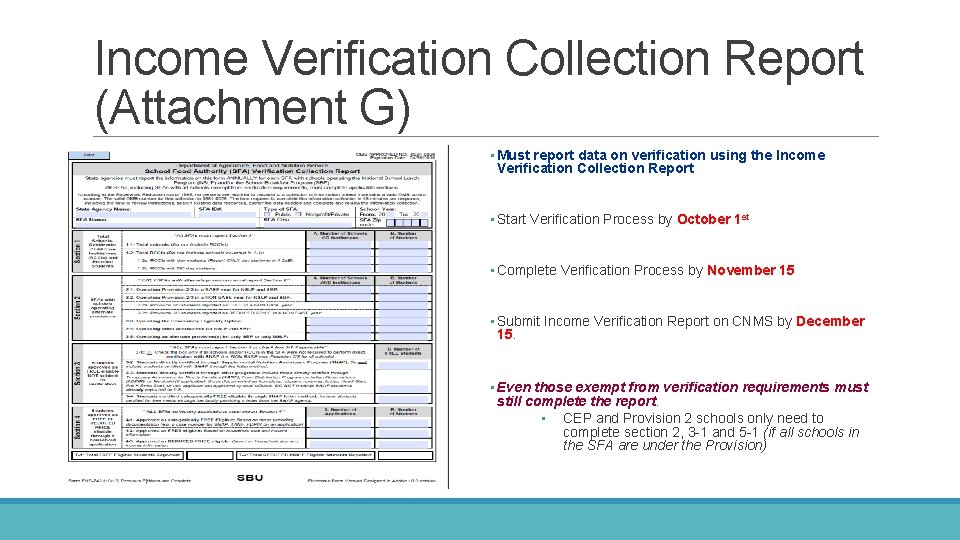
Income Verification Collection Report (Attachment G) • Must report data on verification using the Income Verification Collection Report • Start Verification Process by October 1 st • Complete Verification Process by November 15 • Submit Income Verification Report on CNMS by December 15. • Even those exempt from verification requirements must still complete the report. • CEP and Provision 2 schools only need to complete section 2, 3 -1 and 5 -1 (if all schools in the SFA are under the Provision)
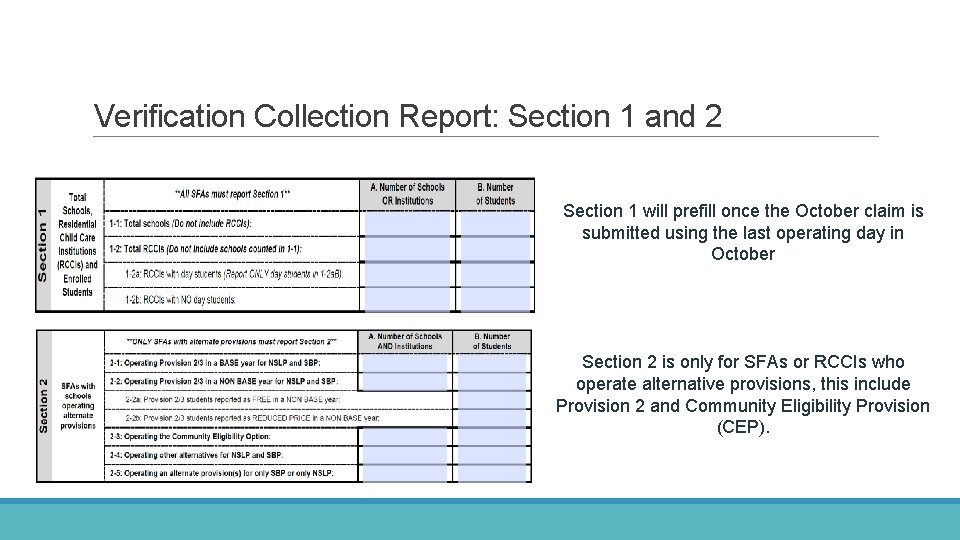
Verification Collection Report: Section 1 and 2 Section 1 will prefill once the October claim is submitted using the last operating day in October Section 2 is only for SFAs or RCCIs who operate alternative provisions, this include Provision 2 and Community Eligibility Provision (CEP).
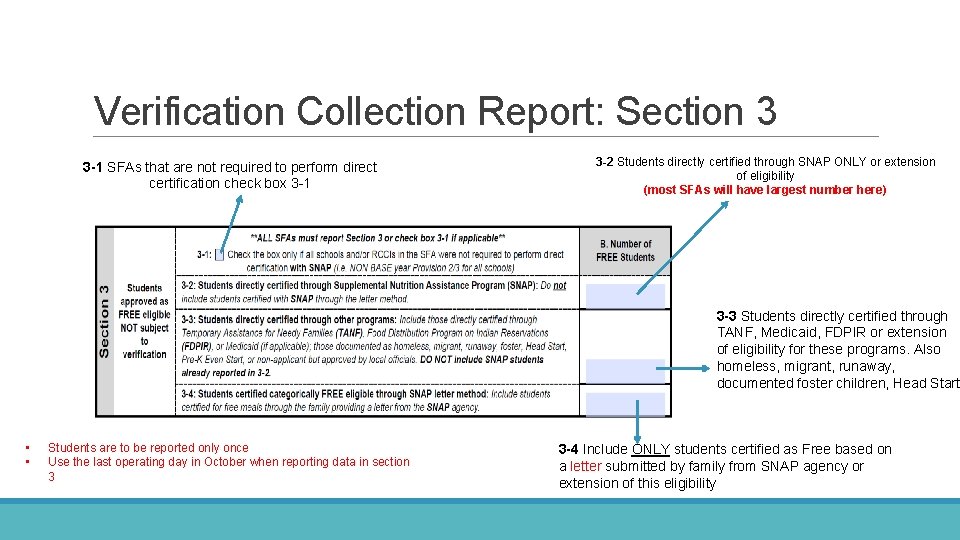
Verification Collection Report: Section 3 3 -1 SFAs that are not required to perform direct certification check box 3 -1 3 -2 Students directly certified through SNAP ONLY or extension of eligibility (most SFAs will have largest number here) 3 -3 Students directly certified through TANF, Medicaid, FDPIR or extension of eligibility for these programs. Also homeless, migrant, runaway, documented foster children, Head Start • • Students are to be reported only once Use the last operating day in October when reporting data in section 3 3 -4 Include ONLY students certified as Free based on a letter submitted by family from SNAP agency or extension of this eligibility
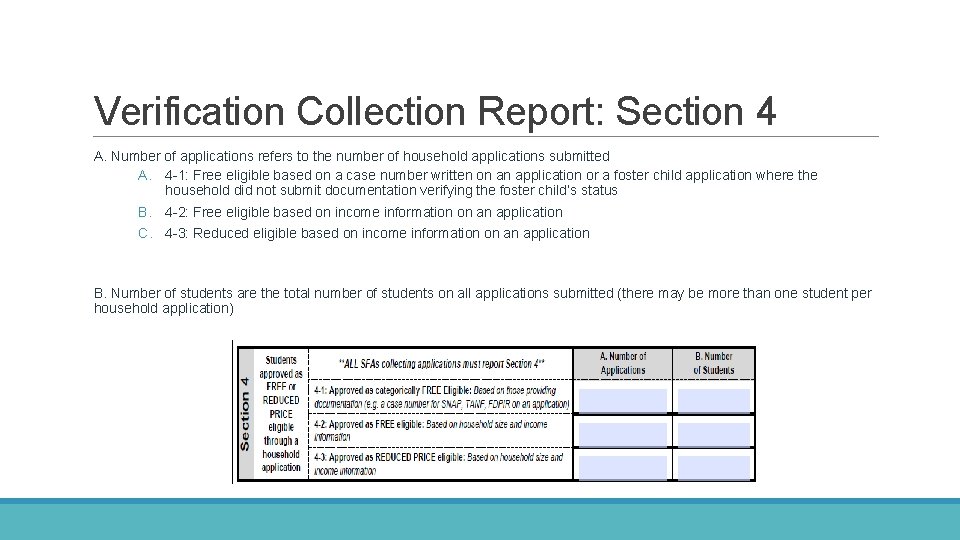
Verification Collection Report: Section 4 A. Number of applications refers to the number of household applications submitted A. 4 -1: Free eligible based on a case number written on an application or a foster child application where the household did not submit documentation verifying the foster child’s status B. 4 -2: Free eligible based on income information on an application C. 4 -3: Reduced eligible based on income information on an application B. Number of students are the total number of students on all applications submitted (there may be more than one student per household application)
Child Nutrition Program Administration 89 Washington Avenue, Room 375 EBA Albany, NY 12234 (518) 473 -8781 In accordance with Federal civil rights law and U. S. Department of Agriculture (USDA) civil rights regulations and policies, the USDA, its Agencies, offices, and employees, and institutions participating in or administering USDA programs are prohibited from discriminating based on race, color, national origin, sex, disability, age, or reprisal or retaliation for prior civil rights activity in any program or activity conducted or funded by USDA. Persons with disabilities who require alternative means of communication for program information (e. g. Braille, large print, audiotape, American Sign Language, etc. ), should contact the Agency (State or local) where they applied for benefits. Individuals who are deaf, hard of hearing or have speech disabilities may contact USDA through the Federal Relay Service at (800) 877 -8339. Additionally, program information may be made available in languages other than English. To file a program complaint of discrimination, complete the USDA Program Discrimination Complaint Form, (AD-3027) found online at: http: //www. ascr. usda. gov/complaint_filing_cust. html, and at any USDA office, or write a letter addressed to USDA and provide in the letter all of the information requested in the form. To request a copy of the complaint form, call (866) 632 -9992. Submit your completed form or letter to USDA by: (1) mail: U. S. Department of Agriculture Office of the Assistant Secretary for Civil Rights 1400 Independence Avenue, SW Washington, D. C. 20250 -9410; (2) fax: (202) 690 -7442; or (3) email: program. intake@usda. gov This institution is an equal opportunity provider.