
Income Statement and Related Information Chapter 4 Acct
- Slides: 44
Income Statement and Related Information Chapter 4 Acct. 3311, Ch 4, Slide 1, © Richard S. Mark
Income Statement l Used for l Relevance l l Evaluate past performance (feedback). Predicting future performance. Assess future cash flow risks. (conceptual framework objective) Limitations l Reliability l l Does not include items that cannot be measured reliably. Based on entity discretion l l Accounting methods employed. Management and measurement judgment. l Management is often paid through entity profitability. Acct. 3311, Ch 4, Slide 2, © Richard S. Mark
Income Statement - Revenue l l Inflows or other asset enhancements or liability settlements. Examples l l l Sales Fee revenue; Interest revenue; Dividend revenue; Rent revenue. Acct. 3311, Ch 4, Slide 3, © Richard S. Mark
Income Statement - Expenses l l Outflows or other use of assets or increases in liabilities Examples l l l Cost of goods sold; Depreciation expense; Interest expense; Rent expense; Salary expense. Acct. 3311, Ch 4, Slide 4, © Richard S. Mark
Income Statement - Gains/Losses l Gains and losses can result from l l l sale of investments or plant assets; settlement of liabilities; write-offs of assets. Gains – Increases in equity (net assets) from transactions during the period. Losses - Decreases in equity (net assets) transactions during the period. Acct. 3311, Ch 4, Slide 5, © Richard S. Mark
Income Statement Formats l Single Step l l Multiple Step l l Used by service firms, banks, utilities Used by merchandising and manufacturing firms Why? How are they different? Acct. 3311, Ch 4, Slide 6, © Richard S. Mark
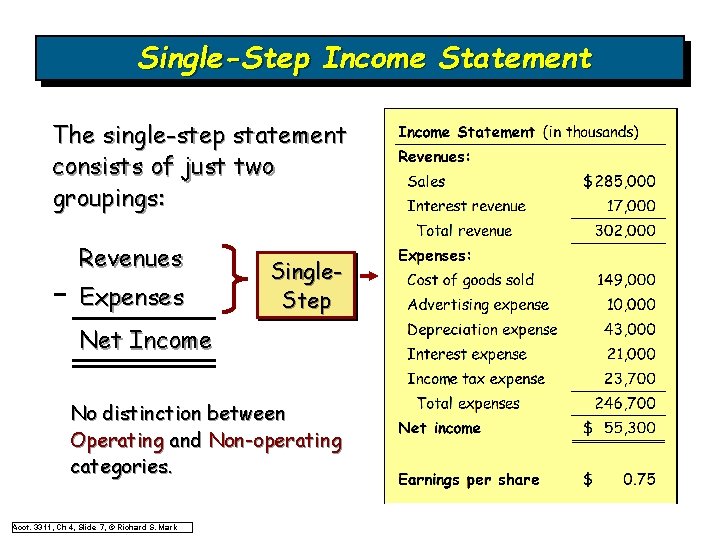
Single-Step Income Statement The single-step statement consists of just two groupings: Revenues Expenses Single. Step Net Income No distinction between Operating and Non-operating categories. Acct. 3311, Ch 4, Slide 7, © Richard S. Mark
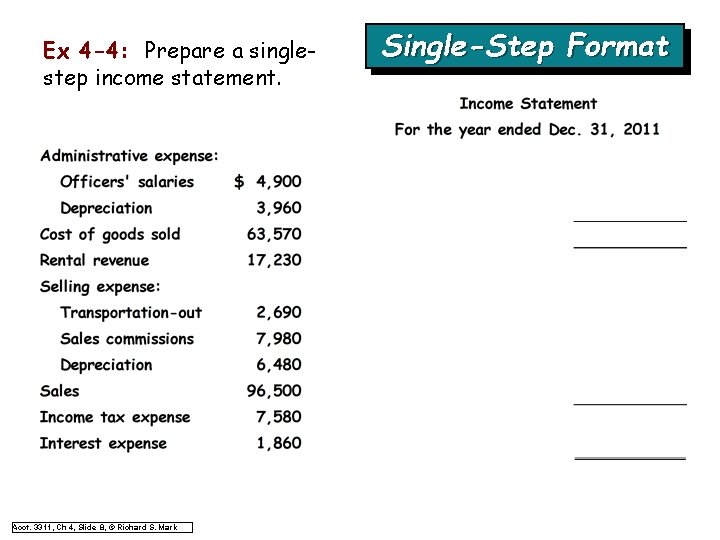
Ex 4 -4: Prepare a singlestep income statement. Acct. 3311, Ch 4, Slide 8, © Richard S. Mark Single-Step Format
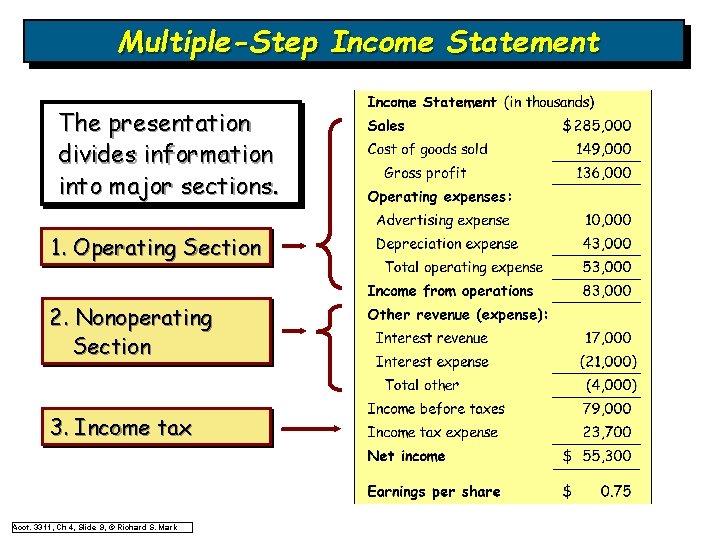
Multiple-Step Income Statement The presentation divides information into major sections. 1. Operating Section 2. Nonoperating Section 3. Income tax Acct. 3311, Ch 4, Slide 9, © Richard S. Mark
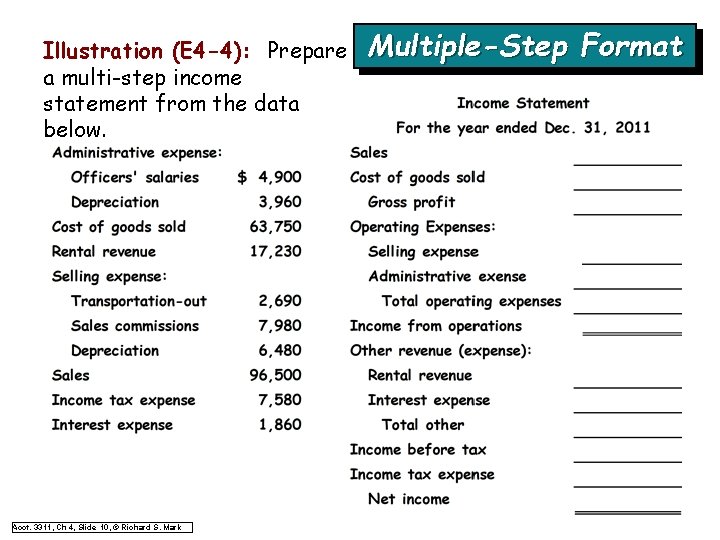
Illustration (E 4 -4): Prepare a multi-step income statement from the data below. Acct. 3311, Ch 4, Slide 10, © Richard S. Mark Multiple-Step Format
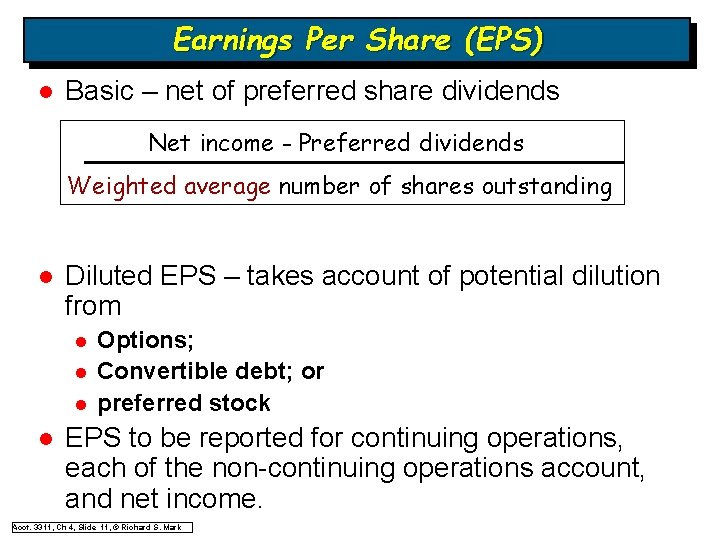
Earnings Per Share (EPS) l Basic – net of preferred share dividends Net income - Preferred dividends Weighted average number of shares outstanding l Diluted EPS – takes account of potential dilution from l l Options; Convertible debt; or preferred stock EPS to be reported for continuing operations, each of the non-continuing operations account, and net income. Acct. 3311, Ch 4, Slide 11, © Richard S. Mark
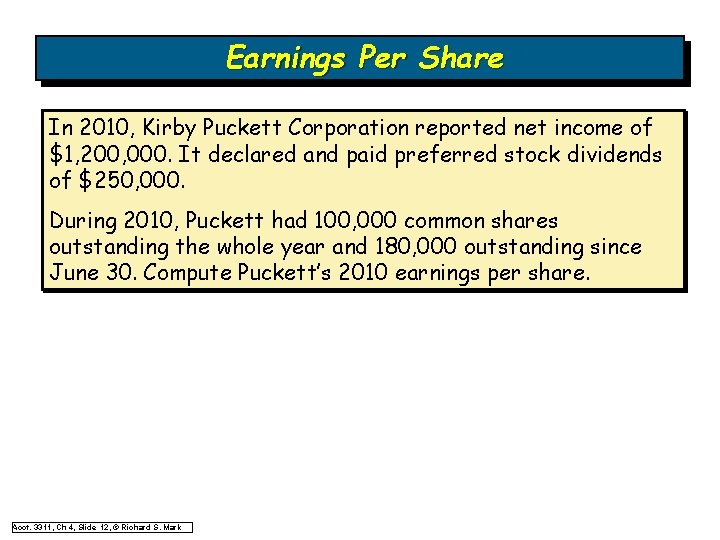
Earnings Per Share In 2010, Kirby Puckett Corporation reported net income of $1, 200, 000. It declared and paid preferred stock dividends of $250, 000. During 2010, Puckett had 100, 000 common shares outstanding the whole year and 180, 000 outstanding since June 30. Compute Puckett’s 2010 earnings per share. Acct. 3311, Ch 4, Slide 12, © Richard S. Mark
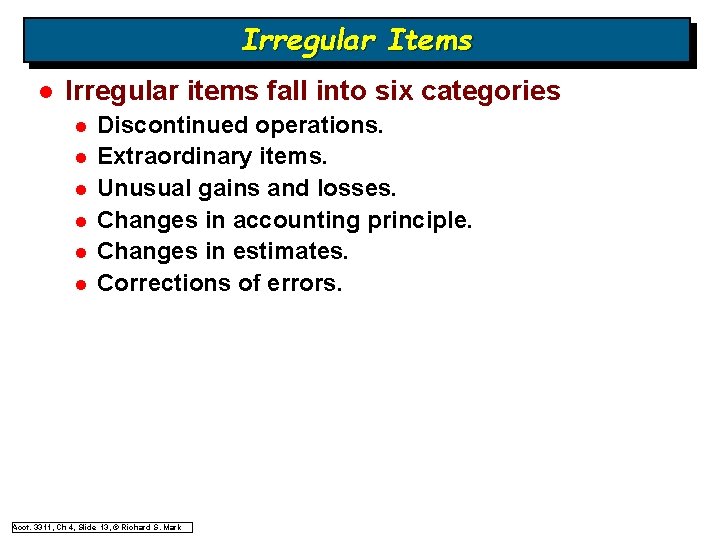
Irregular Items l Irregular items fall into six categories l l l Discontinued operations. Extraordinary items. Unusual gains and losses. Changes in accounting principle. Changes in estimates. Corrections of errors. Acct. 3311, Ch 4, Slide 13, © Richard S. Mark
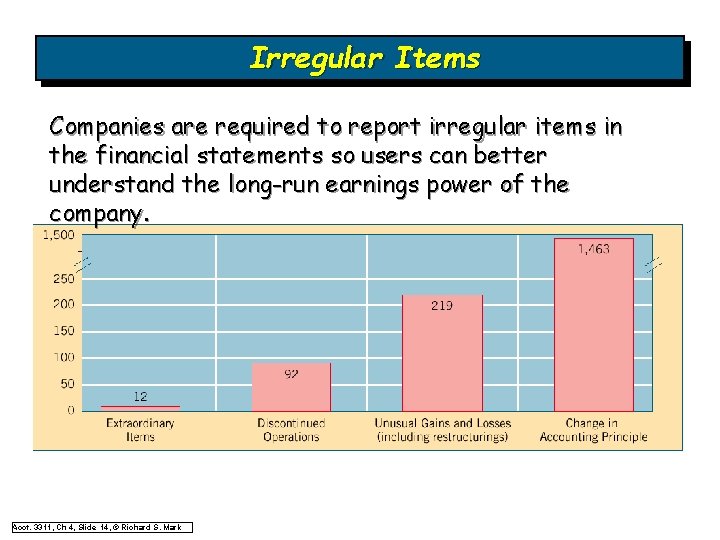
Irregular Items Companies are required to report irregular items in the financial statements so users can better understand the long-run earnings power of the company. Acct. 3311, Ch 4, Slide 14, © Richard S. Mark
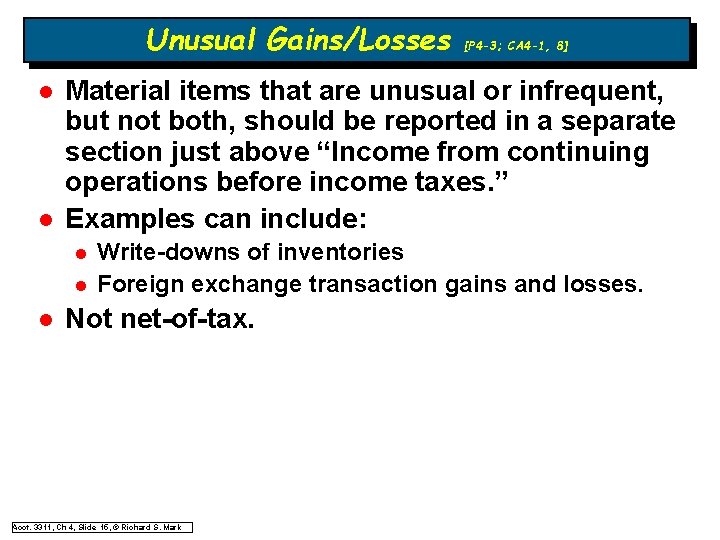
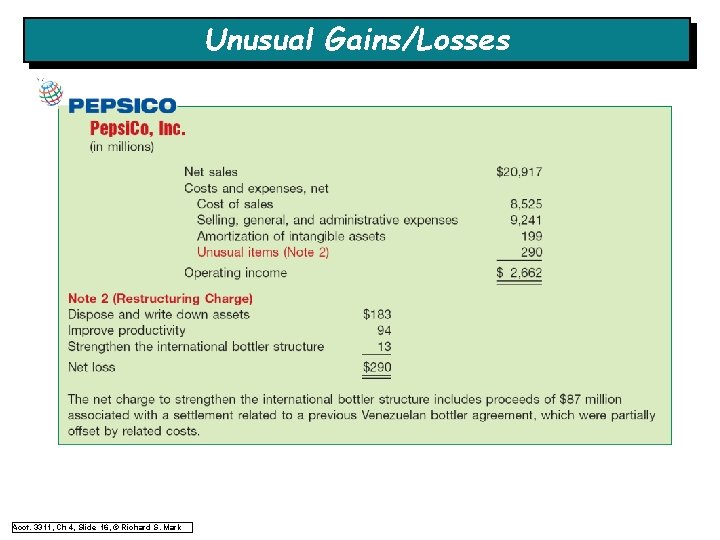
Unusual Gains/Losses l l Material items that are unusual or infrequent, but not both, should be reported in a separate section just above “Income from continuing operations before income taxes. ” Examples can include: l l l [P 4 -3; CA 4 -1, 8] Write-downs of inventories Foreign exchange transaction gains and losses. Not net-of-tax. Acct. 3311, Ch 4, Slide 15, © Richard S. Mark
Unusual Gains/Losses Acct. 3311, Ch 4, Slide 16, © Richard S. Mark
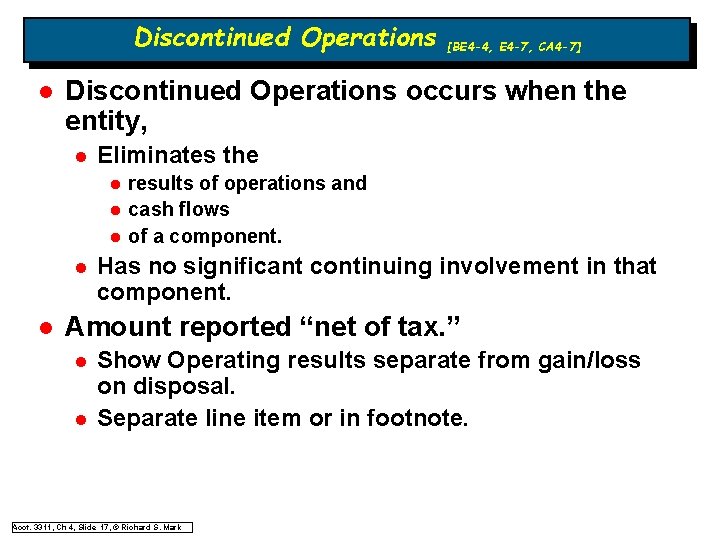
Discontinued Operations l Discontinued Operations occurs when the entity, l Eliminates the l l l [BE 4 -4, E 4 -7, CA 4 -7] results of operations and cash flows of a component. Has no significant continuing involvement in that component. Amount reported “net of tax. ” l l Show Operating results separate from gain/loss on disposal. Separate line item or in footnote. Acct. 3311, Ch 4, Slide 17, © Richard S. Mark
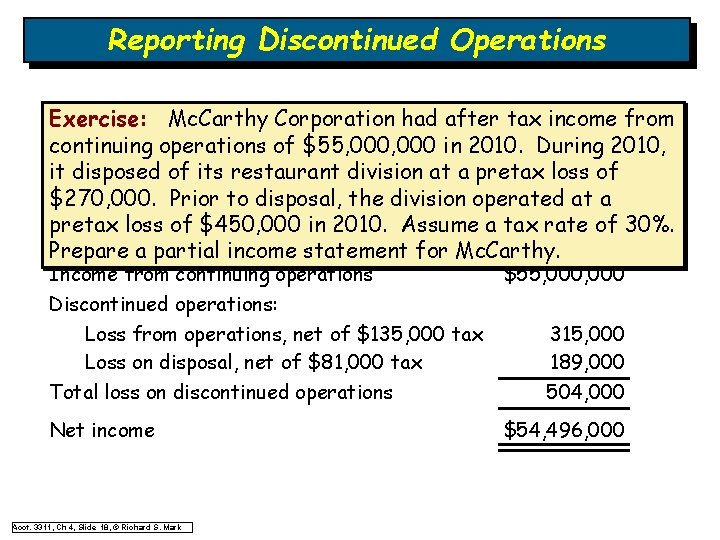
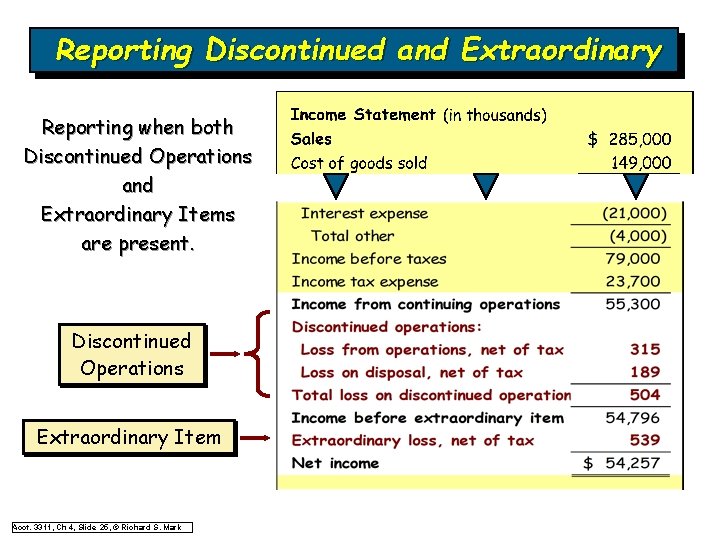
Reporting Discontinued Operations Exercise: Mc. Carthy Corporation had after tax income from continuing operations of $55, 000 in 2010. During 2010, it disposed of its restaurant division at a pretax loss of $270, 000. Prior to disposal, the division operated at a pretax loss of $450, 000 in 2010. Assume a tax rate of 30%. Prepare a partial income statement for Mc. Carthy. Income from continuing operations $55, 000 Discontinued operations: Loss from operations, net of $135, 000 tax 315, 000 Loss on disposal, net of $81, 000 tax 189, 000 Total loss on discontinued operations 504, 000 Net income Acct. 3311, Ch 4, Slide 18, © Richard S. Mark $54, 496, 000
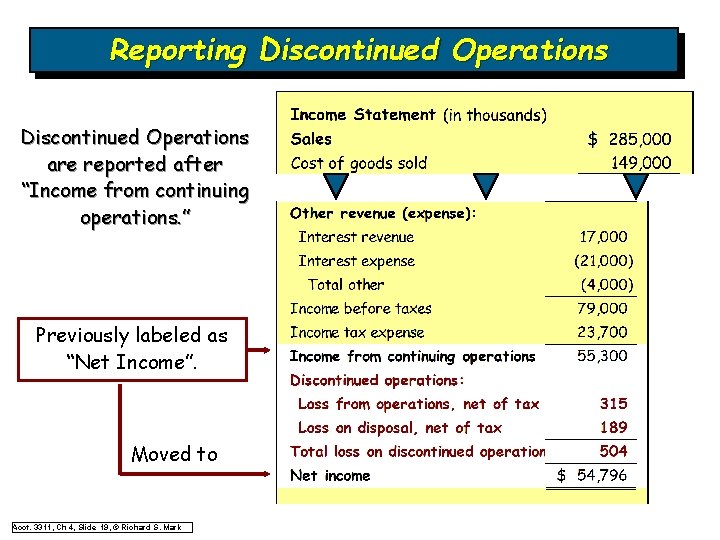
Reporting Discontinued Operations are reported after “Income from continuing operations. ” Previously labeled as “Net Income”. Moved to Acct. 3311, Ch 4, Slide 19, © Richard S. Mark
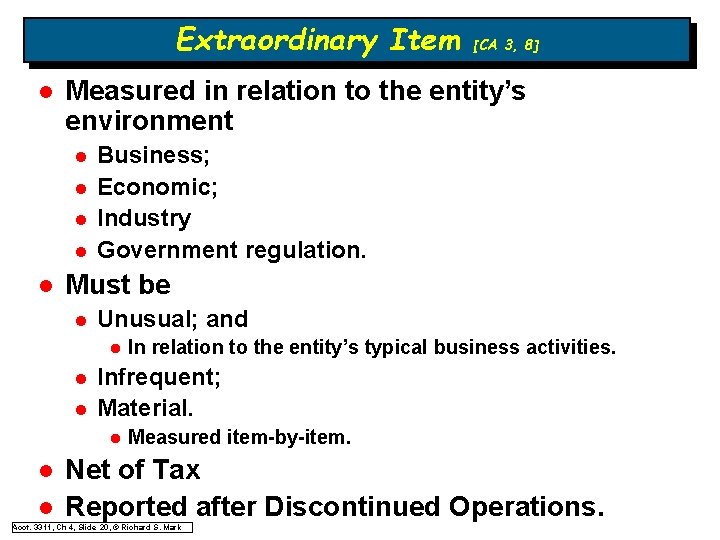
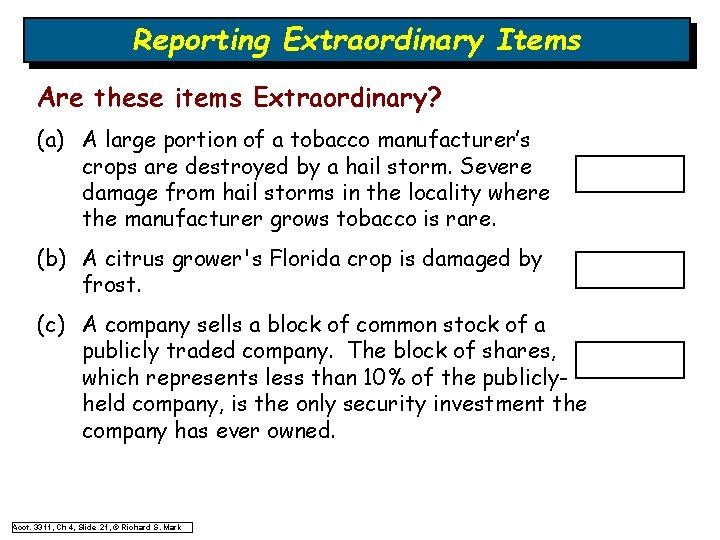
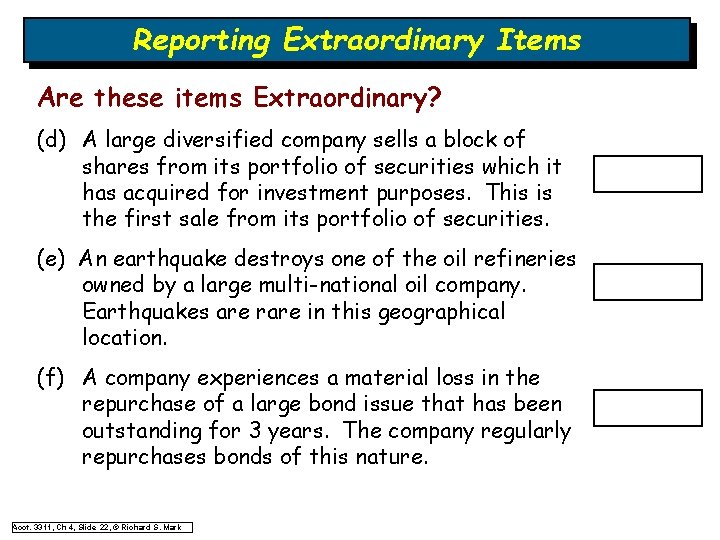
Extraordinary Item l Measured in relation to the entity’s environment l l l Business; Economic; Industry Government regulation. Must be l Unusual; and l l In relation to the entity’s typical business activities. Infrequent; Material. l l [CA 3, 8] Measured item-by-item. Net of Tax Reported after Discontinued Operations. Acct. 3311, Ch 4, Slide 20, © Richard S. Mark
Reporting Extraordinary Items Are these items Extraordinary? (a) A large portion of a tobacco manufacturer’s crops are destroyed by a hail storm. Severe damage from hail storms in the locality where the manufacturer grows tobacco is rare. (b) A citrus grower's Florida crop is damaged by frost. (c) A company sells a block of common stock of a publicly traded company. The block of shares, which represents less than 10% of the publiclyheld company, is the only security investment the company has ever owned. Acct. 3311, Ch 4, Slide 21, © Richard S. Mark
Reporting Extraordinary Items Are these items Extraordinary? (d) A large diversified company sells a block of shares from its portfolio of securities which it has acquired for investment purposes. This is the first sale from its portfolio of securities. (e) An earthquake destroys one of the oil refineries owned by a large multi-national oil company. Earthquakes are rare in this geographical location. (f) A company experiences a material loss in the repurchase of a large bond issue that has been outstanding for 3 years. The company regularly repurchases bonds of this nature. Acct. 3311, Ch 4, Slide 22, © Richard S. Mark
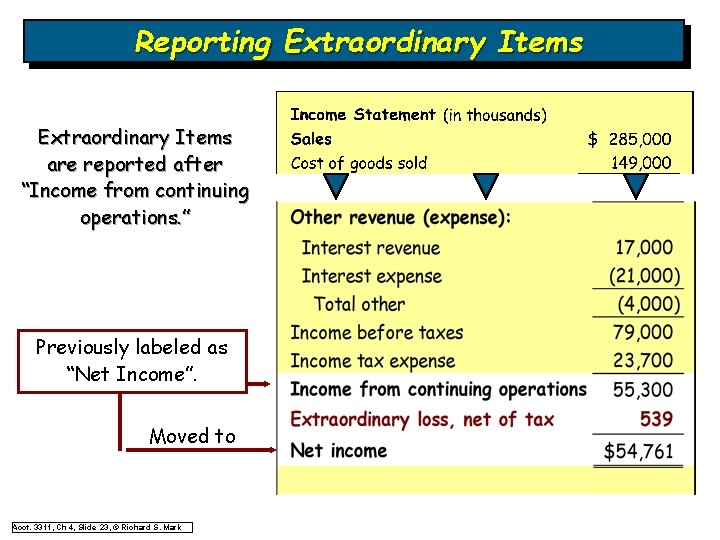
Reporting Extraordinary Items are reported after “Income from continuing operations. ” Previously labeled as “Net Income”. Moved to Acct. 3311, Ch 4, Slide 23, © Richard S. Mark
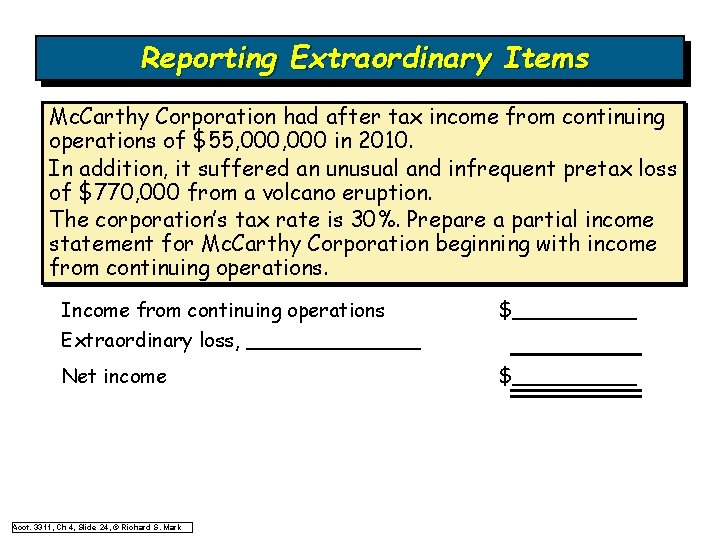
Reporting Extraordinary Items Mc. Carthy Corporation had after tax income from continuing operations of $55, 000 in 2010. In addition, it suffered an unusual and infrequent pretax loss of $770, 000 from a volcano eruption. The corporation’s tax rate is 30%. Prepare a partial income statement for Mc. Carthy Corporation beginning with income from continuing operations. Income from continuing operations Extraordinary loss, _______ $_____ Net income $_____ Acct. 3311, Ch 4, Slide 24, © Richard S. Mark
Reporting Discontinued and Extraordinary Reporting when both Discontinued Operations and Extraordinary Items are present. Discontinued Operations Extraordinary Item Acct. 3311, Ch 4, Slide 25, © Richard S. Mark
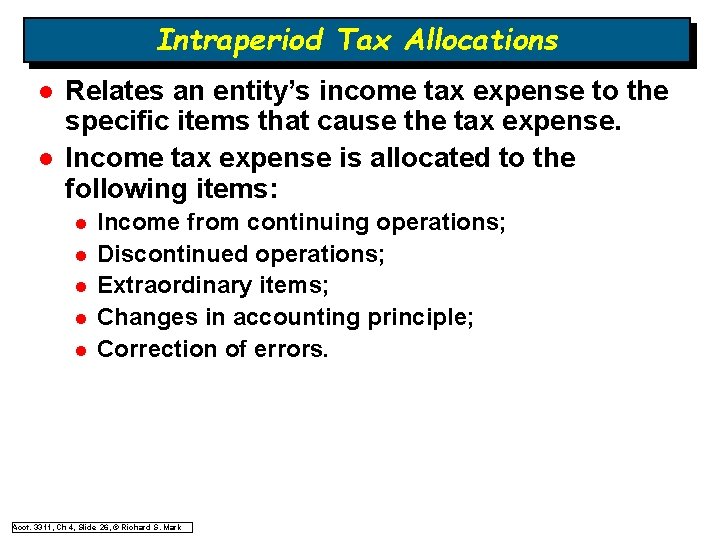
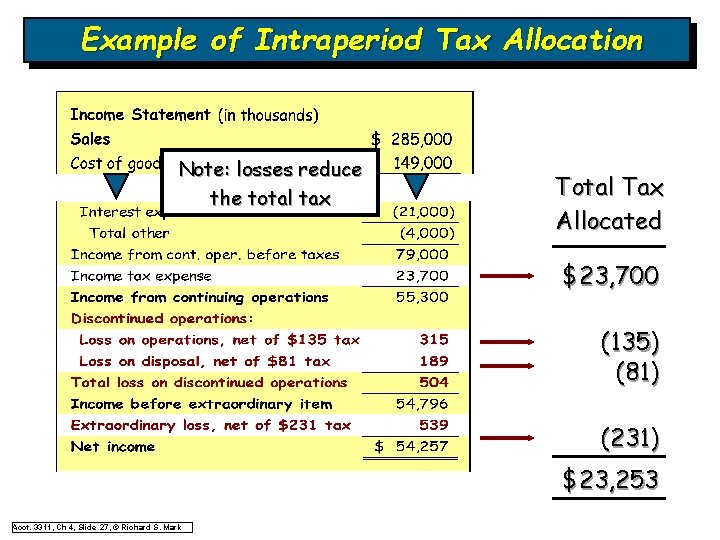
Intraperiod Tax Allocations l l Relates an entity’s income tax expense to the specific items that cause the tax expense. Income tax expense is allocated to the following items: l l l Income from continuing operations; Discontinued operations; Extraordinary items; Changes in accounting principle; Correction of errors. Acct. 3311, Ch 4, Slide 26, © Richard S. Mark
Example of Intraperiod Tax Allocation Note: losses reduce the total tax Total Tax Allocated $23, 700 (135) (81) (231) $23, 253 Acct. 3311, Ch 4, Slide 27, © Richard S. Mark
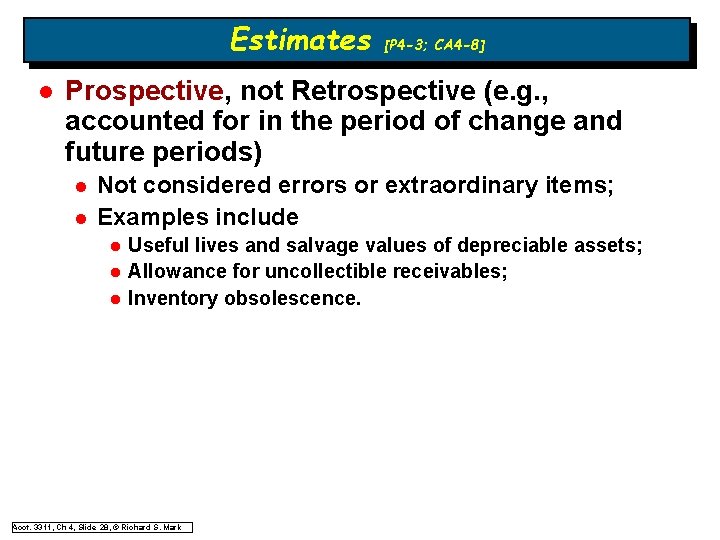
Estimates l [P 4 -3; CA 4 -8] Prospective, not Retrospective (e. g. , accounted for in the period of change and future periods) l l Not considered errors or extraordinary items; Examples include l l l Useful lives and salvage values of depreciable assets; Allowance for uncollectible receivables; Inventory obsolescence. Acct. 3311, Ch 4, Slide 28, © Richard S. Mark
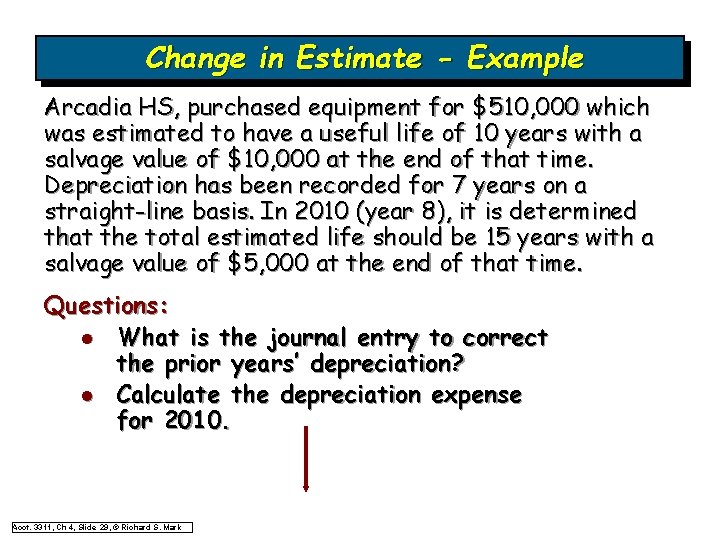
Change in Estimate - Example Arcadia HS, purchased equipment for $510, 000 which was estimated to have a useful life of 10 years with a salvage value of $10, 000 at the end of that time. Depreciation has been recorded for 7 years on a straight-line basis. In 2010 (year 8), it is determined that the total estimated life should be 15 years with a salvage value of $5, 000 at the end of that time. Questions: l What is the journal entry to correct the prior years’ depreciation? l Calculate the depreciation expense for 2010. Acct. 3311, Ch 4, Slide 29, © Richard S. Mark
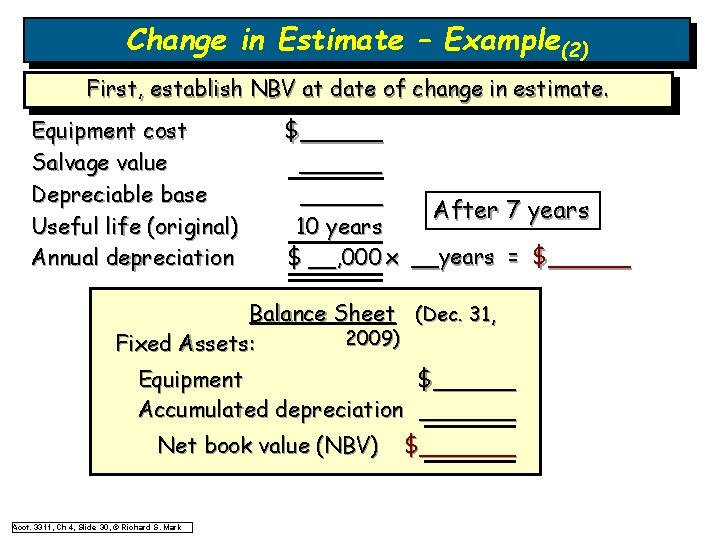
Change in Estimate – Example(2) First, establish NBV at date of change in estimate. Equipment cost Salvage value Depreciable base Useful life (original) Annual depreciation $______ After 7 years 10 years $ __, 000 x __years = $______ Balance Sheet (Dec. 31, 2009) Fixed Assets: Equipment $______ Accumulated depreciation _______ Net book value (NBV) Acct. 3311, Ch 4, Slide 30, © Richard S. Mark $_______
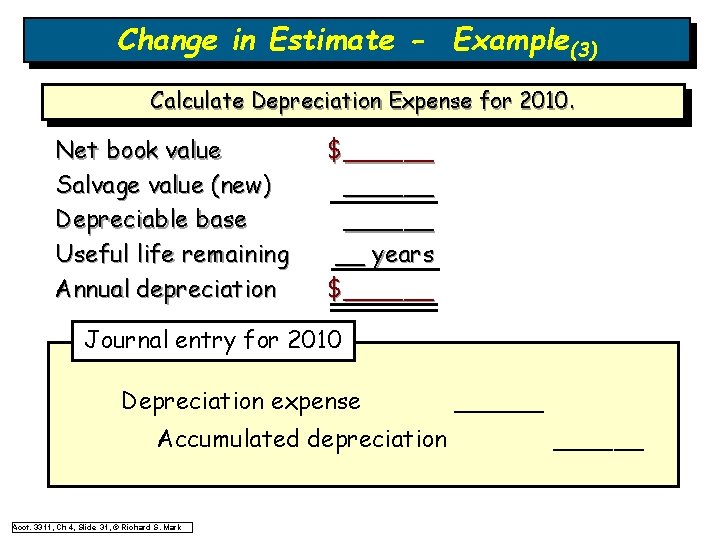
Change in Estimate - Example(3) Calculate Depreciation Expense for 2010. Net book value Salvage value (new) Depreciable base Useful life remaining Annual depreciation $______ __ years $______ Journal entry for 2010 Depreciation expense Accumulated depreciation Acct. 3311, Ch 4, Slide 31, © Richard S. Mark ______
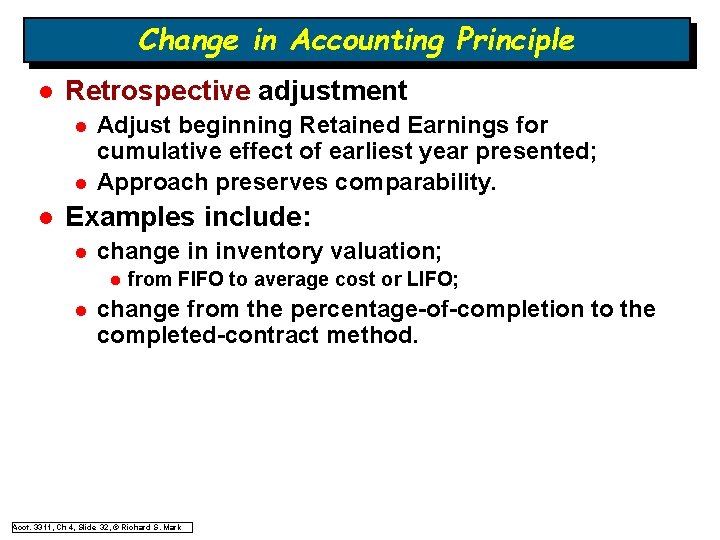
Change in Accounting Principle l Retrospective adjustment l l l Adjust beginning Retained Earnings for cumulative effect of earliest year presented; Approach preserves comparability. Examples include: l change in inventory valuation; l l from FIFO to average cost or LIFO; change from the percentage-of-completion to the completed-contract method. Acct. 3311, Ch 4, Slide 32, © Richard S. Mark
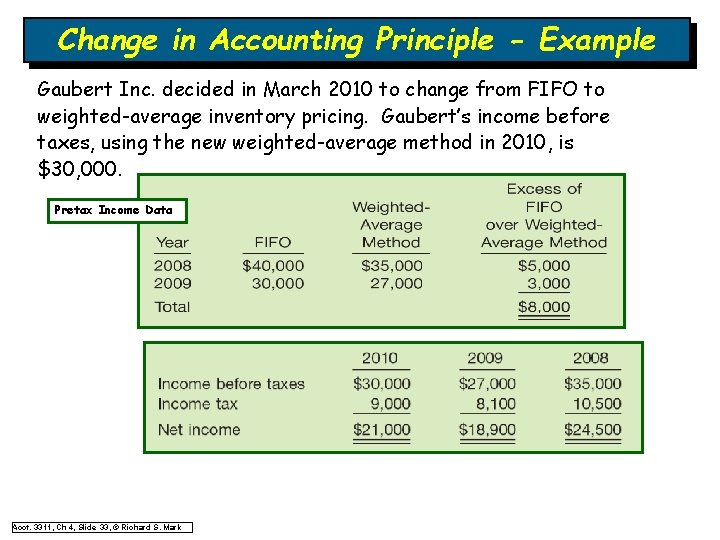
Change in Accounting Principle - Example Gaubert Inc. decided in March 2010 to change from FIFO to weighted-average inventory pricing. Gaubert’s income before taxes, using the new weighted-average method in 2010, is $30, 000. Pretax Income Data Acct. 3311, Ch 4, Slide 33, © Richard S. Mark
Error Correction l Result from: l l mathematical mistakes; mistakes in application of accounting principles; oversight or misuse of facts; Corrections treated as prior period adjustment l restate all prior financial statements presented. Acct. 3311, Ch 4, Slide 34, © Richard S. Mark
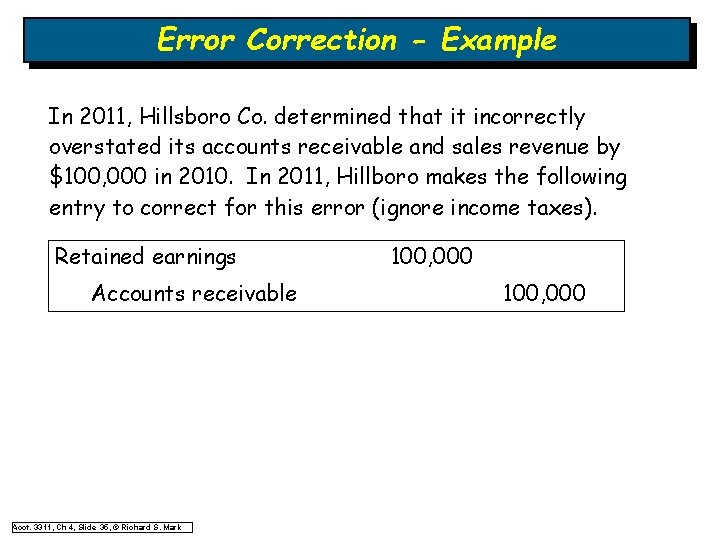
Error Correction - Example In 2011, Hillsboro Co. determined that it incorrectly overstated its accounts receivable and sales revenue by $100, 000 in 2010. In 2011, Hillboro makes the following entry to correct for this error (ignore income taxes). Retained earnings Accounts receivable Acct. 3311, Ch 4, Slide 35, © Richard S. Mark 100, 000
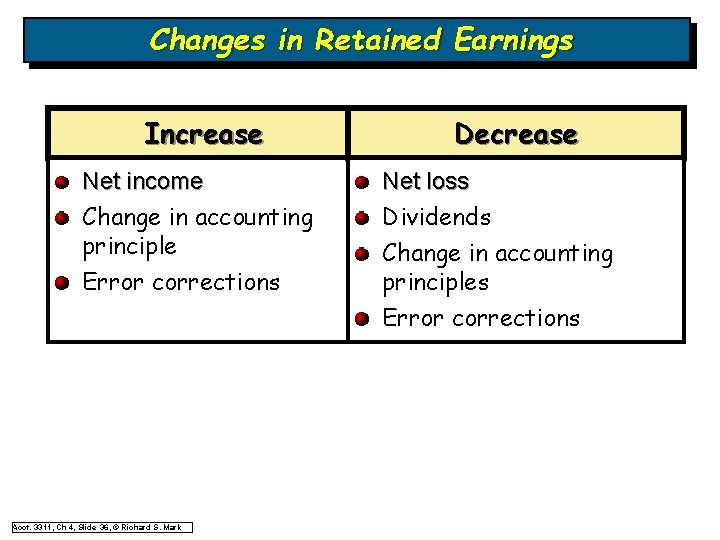
Changes in Retained Earnings Increase Net income Change in accounting principle Error corrections Acct. 3311, Ch 4, Slide 36, © Richard S. Mark Decrease Net loss Dividends Change in accounting principles Error corrections
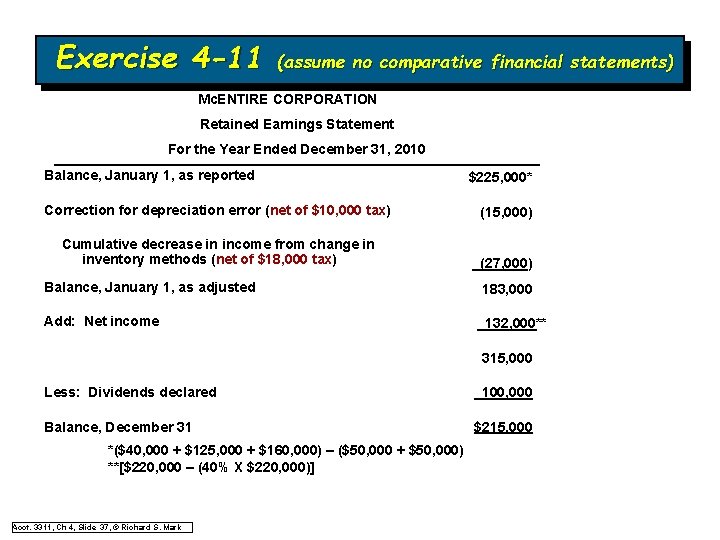
Exercise 4 -11 (assume no comparative financial statements) Mc. ENTIRE CORPORATION Retained Earnings Statement For the Year Ended December 31, 2010 Balance, January 1, as reported $225, 000* Correction for depreciation error (net of $10, 000 tax) (15, 000) Cumulative decrease in income from change in inventory methods (net of $18, 000 tax) (27, 000) Balance, January 1, as adjusted 183, 000 Add: Net income 132, 000** Less: Dividends declared Balance, December 31 *($40, 000 + $125, 000 + $160, 000) – ($50, 000 + $50, 000) **[$220, 000 – (40% X $220, 000)] Acct. 3311, Ch 4, Slide 37, © Richard S. Mark 315, 000 100, 000 $215, 000
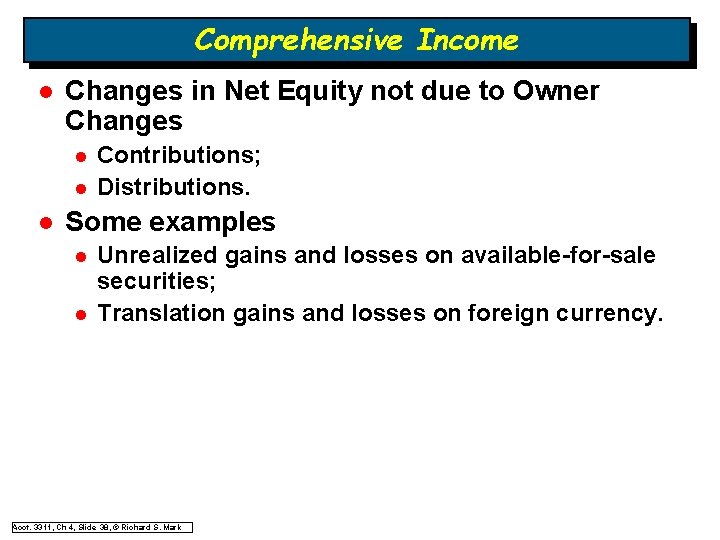
Comprehensive Income l Changes in Net Equity not due to Owner Changes l l l Contributions; Distributions. Some examples l l Unrealized gains and losses on available-for-sale securities; Translation gains and losses on foreign currency. Acct. 3311, Ch 4, Slide 38, © Richard S. Mark
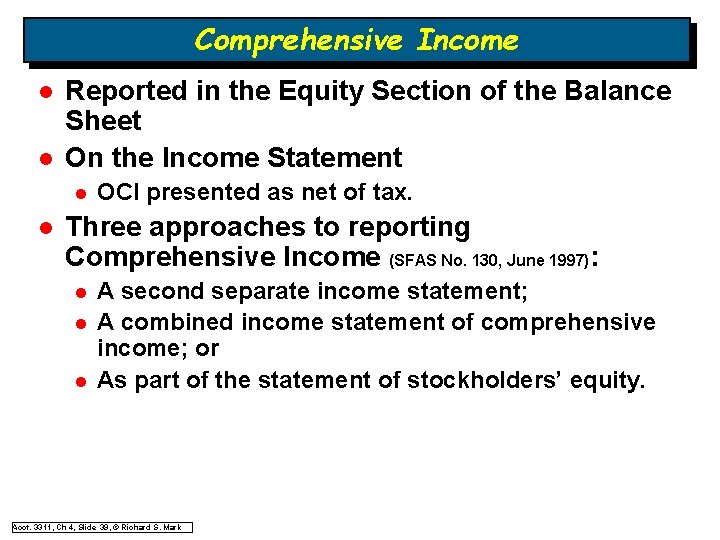
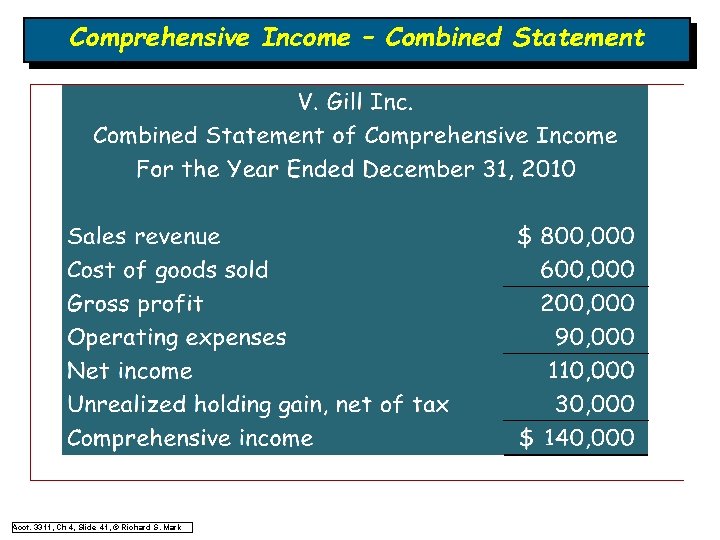
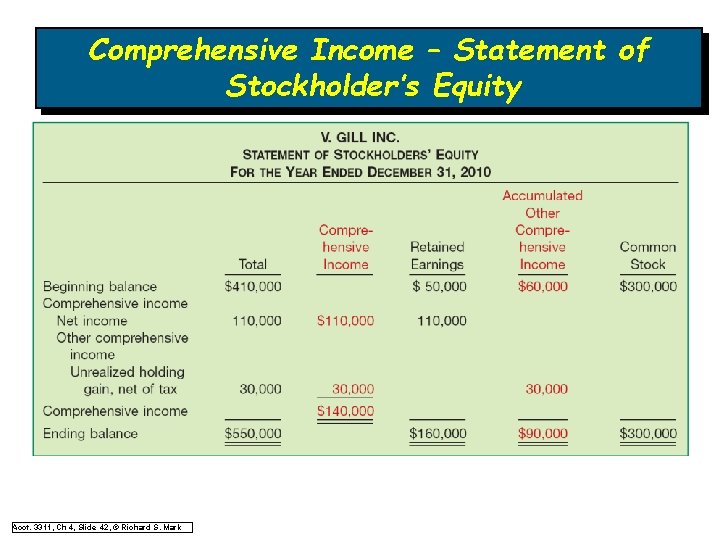
Comprehensive Income l l Reported in the Equity Section of the Balance Sheet On the Income Statement l l OCI presented as net of tax. Three approaches to reporting Comprehensive Income (SFAS No. 130, June 1997): l l l A second separate income statement; A combined income statement of comprehensive income; or As part of the statement of stockholders’ equity. Acct. 3311, Ch 4, Slide 39, © Richard S. Mark
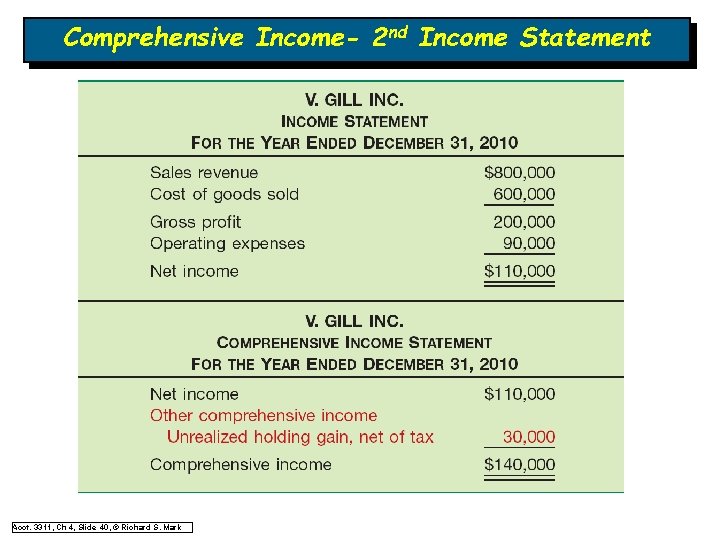
Comprehensive Income- 2 nd Income Statement Acct. 3311, Ch 4, Slide 40, © Richard S. Mark
Comprehensive Income – Combined Statement Acct. 3311, Ch 4, Slide 41, © Richard S. Mark
Comprehensive Income – Statement of Stockholder’s Equity Acct. 3311, Ch 4, Slide 42, © Richard S. Mark
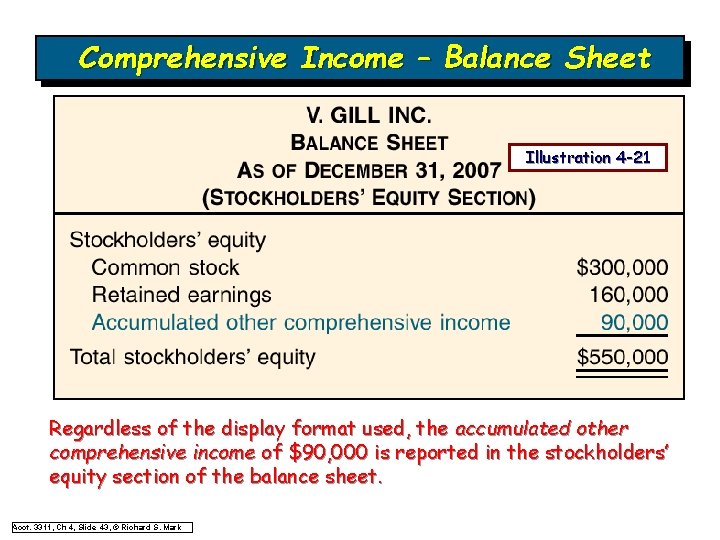
Comprehensive Income – Balance Sheet Illustration 4 -21 Regardless of the display format used, the accumulated other comprehensive income of $90, 000 is reported in the stockholders’ equity section of the balance sheet. Acct. 3311, Ch 4, Slide 43, © Richard S. Mark
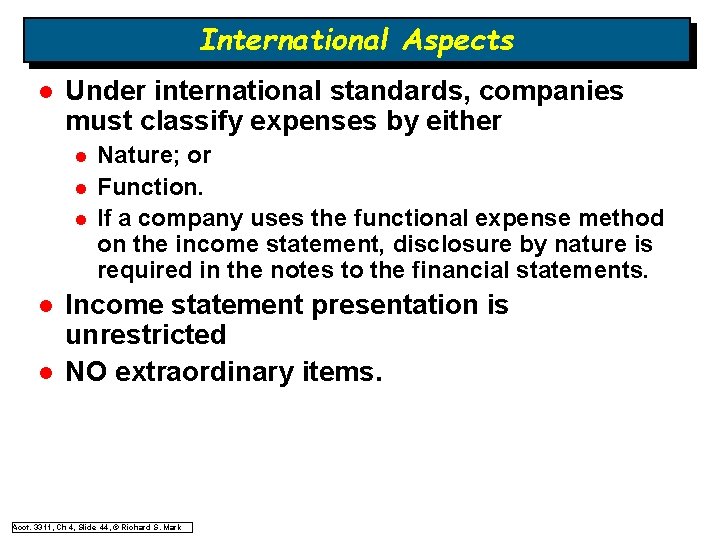
International Aspects l Under international standards, companies must classify expenses by either l l l Nature; or Function. If a company uses the functional expense method on the income statement, disclosure by nature is required in the notes to the financial statements. Income statement presentation is unrestricted NO extraordinary items. Acct. 3311, Ch 4, Slide 44, © Richard S. Mark