
Inclusive Society for All 2019 East Asia Disability
‘Inclusive Society for All’ 2019 East Asia Disability Studies Forum (EDSF) Employment in an Inclusive Society HYUN GEUNSIK Head Researcher The Disabilities Policy Monitoring Center in Gyeonggi
UN Committee on the Rights of Persons with Disabilities(CRPD) Article 3 C Full and effective participation and inclusion in society The difference of conception about Full Inclusion In Society between countries
Integration and inclusion v integration - Allowing people with disabilities the opportunity to become normal members of society by decreasing the environmental restrictions they face and through proper care and rehabilitation. v inclusion - Ensure the right to have unity, difference and personal character in situations with disabilities “Inclusion in an inclusive society, emphasizes human-environmental interactions and conceptualizes the definition of interactive disability situations of any type of deficiency, allowing all persons with disabilities to be included in normal acitivity. ”** *Le Capitaine, J-Y. (2013). L’inclusion n’est pas un plus d’intégration: l’exemple des jeunes sourds. ERES **박혜미(2018). 프랑스의 포용적 장애인 복지 전달체계. 국제사회보장리뷰, Vol. 5.
Employment policies for people with disabilities in the inclusive society Employment of people with disabilities is an area where labor and welfare intersect. v Its primary aim is ‘employment without categorization’ v In practical terms, it promotes employment through proper consideration of people with disabilites.
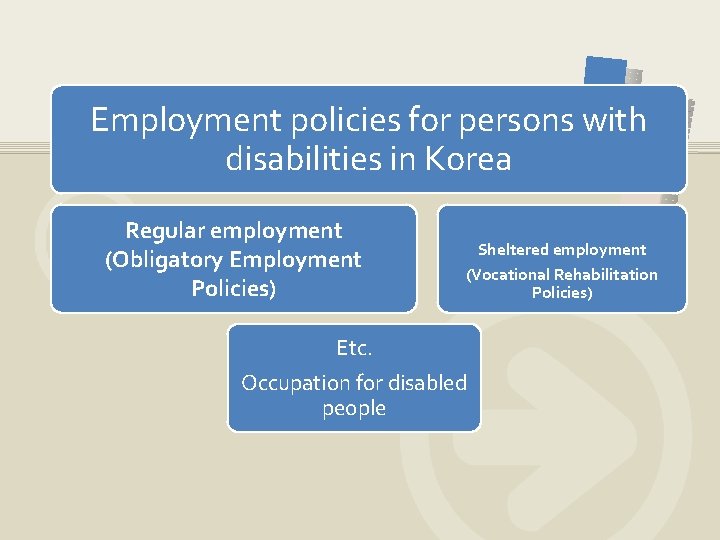
Employment policies for persons with disabilities in Korea Regular employment (Obligatory Employment Policies) Sheltered employment (Vocational Rehabilitation Policies) Etc. Occupation for disabled people
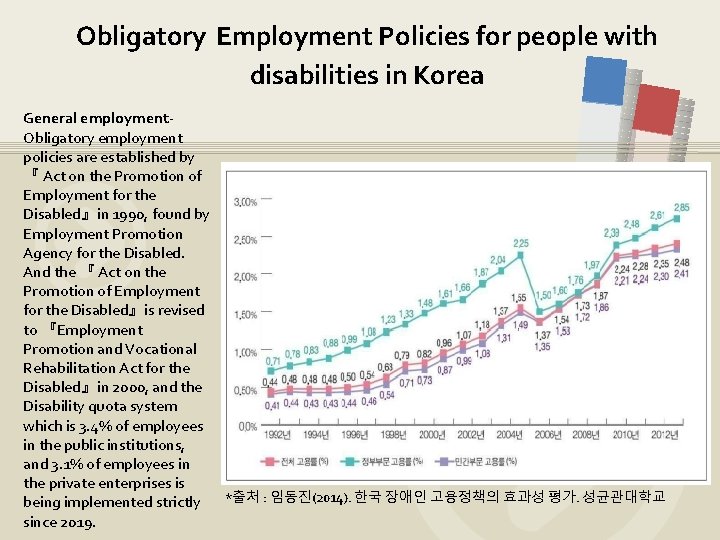
Obligatory Employment Policies for people with disabilities in Korea General employment. Obligatory employment policies are established by 『 Act on the Promotion of Employment for the Disabled』in 1990, found by Employment Promotion Agency for the Disabled. And the 『 Act on the Promotion of Employment for the Disabled』is revised to 『Employment Promotion and Vocational Rehabilitation Act for the Disabled』in 2000, and the Disability quota system which is 3. 4% of employees in the public institutions, and 3. 1% of employees in the private enterprises is *출처 : 임동진(2014). 한국 장애인 고용정책의 효과성 평가. 성균관대학교 being implemented strictly since 2019.
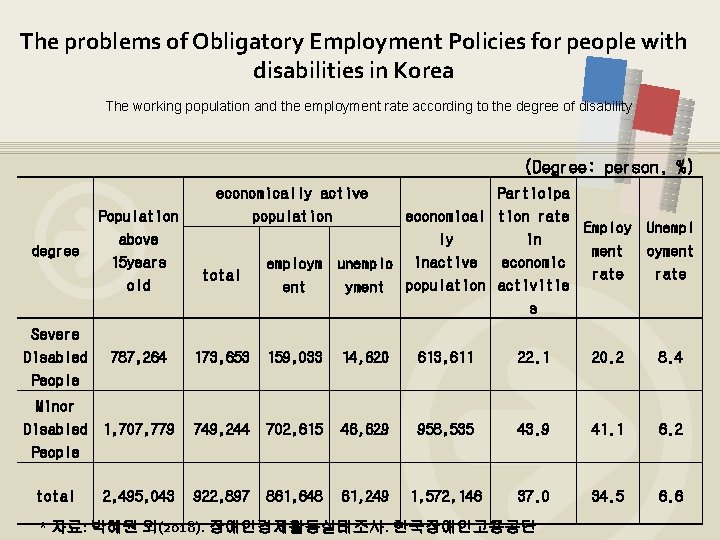
The problems of Obligatory Employment Policies for people with disabilities in Korea The working population and the employment rate according to the degree of disability (Degree: person, %) degree Severe Disabled People Population above 15 years old 787, 264 Minor Disabled 1, 707, 779 People total 2, 495, 043 economically active population total Participa economical tion rate Employ Unempl ly in ment oyment economic employm unemplo inactive rate population activitie ent yment s 173, 653 159, 033 14, 620 613, 611 22. 1 20. 2 8. 4 749, 244 702, 615 46, 629 958, 535 43. 9 41. 1 6. 2 922, 897 861, 648 61, 249 1, 572, 146 37. 0 34. 5 6. 6 * 자료: 박혜원 외(2018). 장애인경제활동실태조사. 한국장애인고용공단
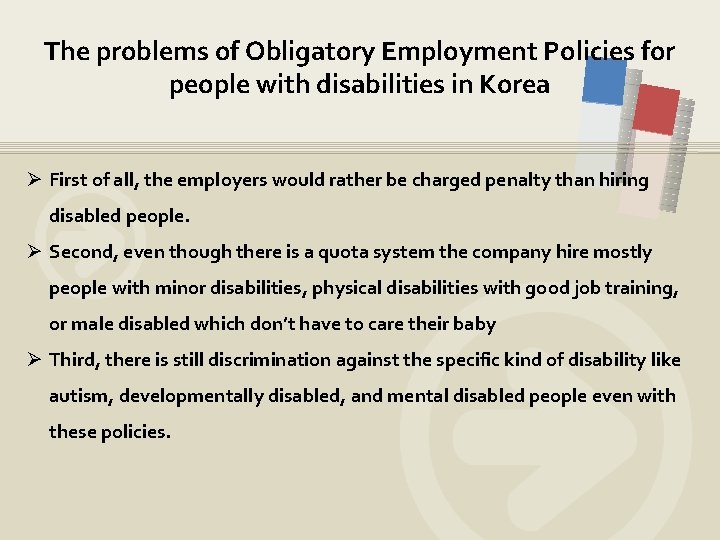
The problems of Obligatory Employment Policies for people with disabilities in Korea Ø First of all, the employers would rather be charged penalty than hiring disabled people. Ø Second, even though there is a quota system the company hire mostly people with minor disabilities, physical disabilities with good job training, or male disabled which don’t have to care their baby Ø Third, there is still discrimination against the specific kind of disability like autism, developmentally disabled, and mental disabled people even with these policies.
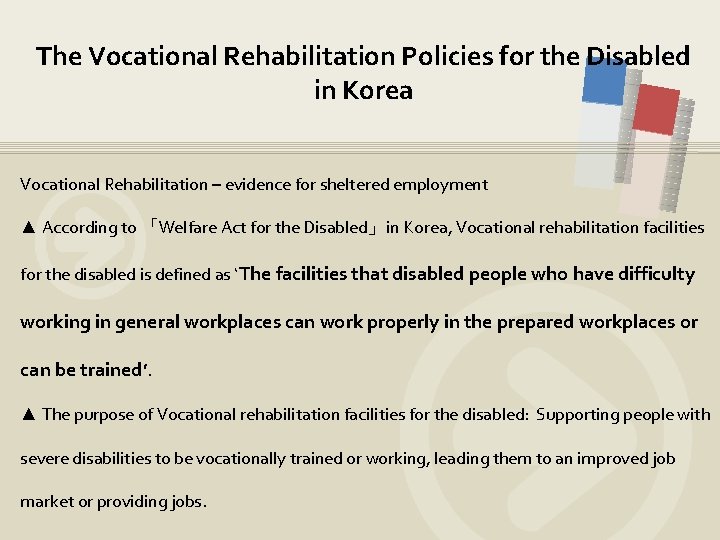
The Vocational Rehabilitation Policies for the Disabled in Korea Vocational Rehabilitation – evidence for sheltered employment ▲ According to 「Welfare Act for the Disabled」in Korea, Vocational rehabilitation facilities for the disabled is defined as ‘The facilities that disabled people who have difficulty working in general workplaces can work properly in the prepared workplaces or can be trained’. ▲ The purpose of Vocational rehabilitation facilities for the disabled: Supporting people with severe disabilities to be vocationally trained or working, leading them to an improved job market or providing jobs.
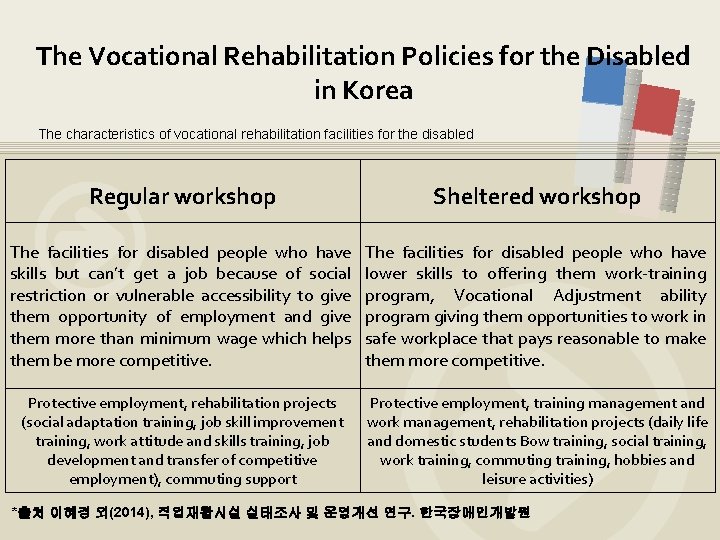
The Vocational Rehabilitation Policies for the Disabled in Korea The characteristics of vocational rehabilitation facilities for the disabled Regular workshop Sheltered workshop The facilities for disabled people who have skills but can’t get a job because of social restriction or vulnerable accessibility to give them opportunity of employment and give them more than minimum wage which helps them be more competitive. The facilities for disabled people who have lower skills to offering them work-training program, Vocational Adjustment ability program giving them opportunities to work in safe workplace that pays reasonable to make them more competitive. Protective employment, rehabilitation projects (social adaptation training, job skill improvement training, work attitude and skills training, job development and transfer of competitive employment), commuting support Protective employment, training management and work management, rehabilitation projects (daily life and domestic students Bow training, social training, work training, commuting training, hobbies and leisure activities) *출처 이혜경 외(2014), 직업재활시설 실태조사 및 운영개선 연구. 한국장애인개발원
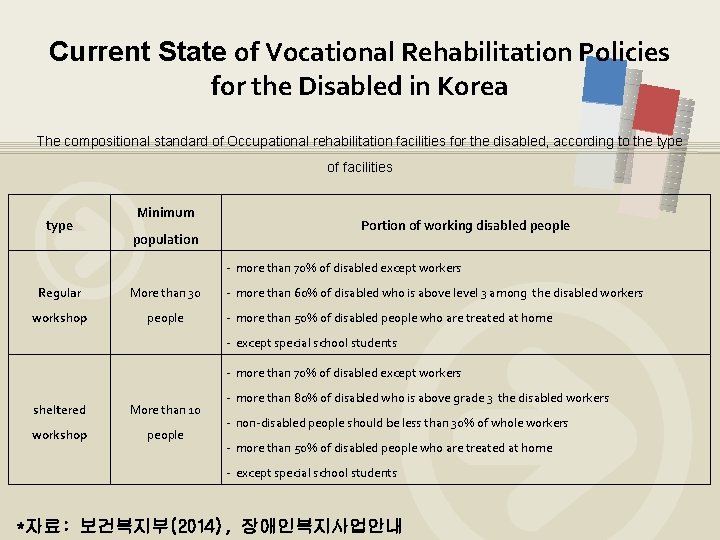
Current State of Vocational Rehabilitation Policies for the Disabled in Korea The compositional standard of Occupational rehabilitation facilities for the disabled, according to the type of facilities type Minimum population Portion of working disabled people - more than 70% of disabled except workers Regular More than 30 workshop people - more than 60% of disabled who is above level 3 among the disabled workers - more than 50% of disabled people who are treated at home - except special school students - more than 70% of disabled except workers sheltered More than 10 workshop people - more than 80% of disabled who is above grade 3 the disabled workers - non-disabled people should be less than 30% of whole workers - more than 50% of disabled people who are treated at home - except special school students *자료: 보건복지부(2014), 장애인복지사업안내
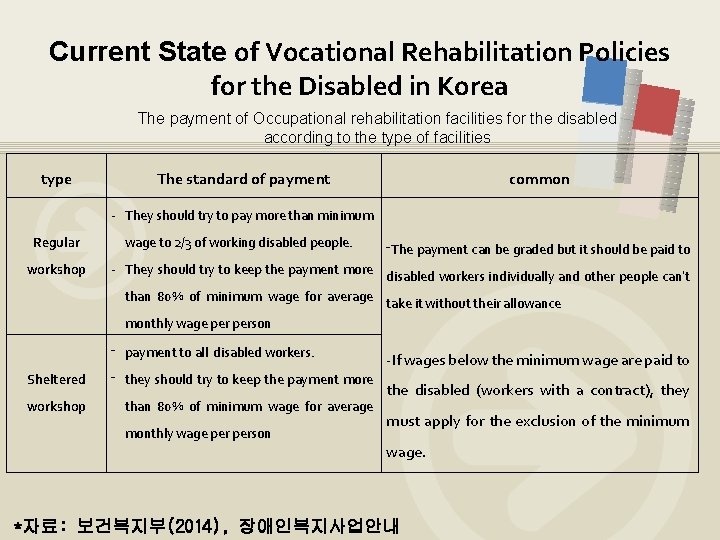
Current State of Vocational Rehabilitation Policies for the Disabled in Korea The payment of Occupational rehabilitation facilities for the disabled according to the type of facilities type The standard of payment common - They should try to pay more than minimum Regular workshop wage to 2/3 of working disabled people. ⁻The payment can be graded but it should be paid to - They should try to keep the payment more disabled workers individually and other people can’t than 80% of minimum wage for average take it without their allowance monthly wage person ⁻ payment to all disabled workers. Sheltered ⁻ they should try to keep the payment more workshop than 80% of minimum wage for average monthly wage person -If wages below the minimum wage are paid to the disabled (workers with a contract), they must apply for the exclusion of the minimum wage. *자료: 보건복지부(2014), 장애인복지사업안내
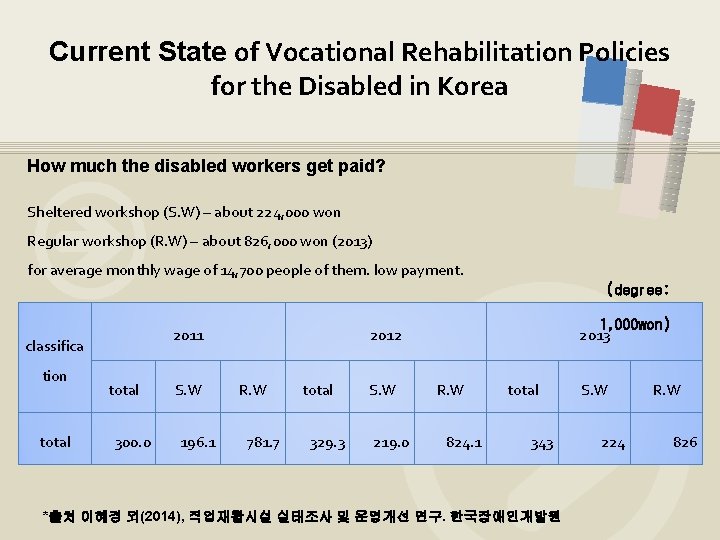
Current State of Vocational Rehabilitation Policies for the Disabled in Korea How much the disabled workers get paid? Sheltered workshop (S. W) – about 224, 000 won Regular workshop (R. W) – about 826, 000 won (2013) for average monthly wage of 14, 700 people of them. low payment. (degree: 2011 classifica tion total 300. 0 S. W 196. 1 1, 000 won) 2013 2012 R. W 781. 7 total 329. 3 S. W 219. 0 R. W 824. 1 total 343 *출처 이혜경 외(2014), 직업재활시설 실태조사 및 운영개선 연구. 한국장애인개발원 S. W 224 R. W 826
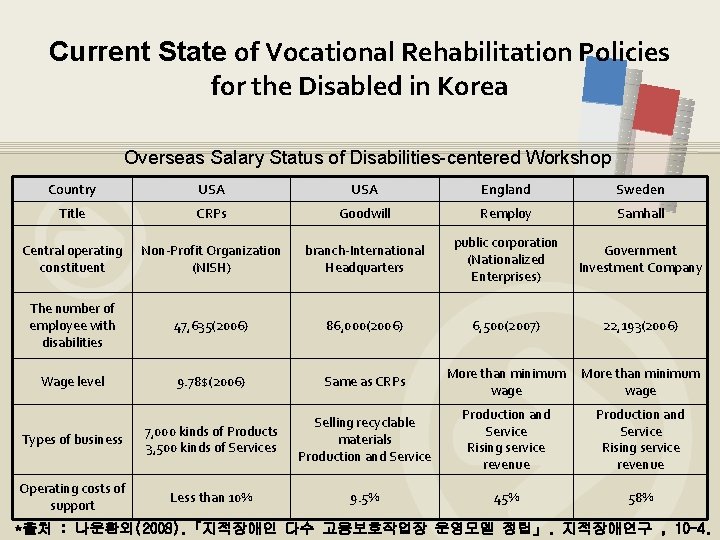
Current State of Vocational Rehabilitation Policies for the Disabled in Korea Overseas Salary Status of Disabilities-centered Workshop Country USA England Sweden Title CRPs Goodwill Remploy Samhall Central operating constituent Non-Profit Organization (NISH) branch-International Headquarters public corporation (Nationalized Enterprises) Government Investment Company The number of employee with disabilities 47, 635(2006) 86, 000(2006) 6, 500(2007) 22, 193(2006) Wage level 9. 78$(2006) Same as CRPs More than minimum wage Types of business 7, 000 kinds of Products 3, 500 kinds of Services Selling recyclable materials Production and Service Rising service revenue Operating costs of support Less than 10% 9. 5% 45% 58% *출처 : 나운환외(2008). 「지적장애인 다수 고용보호작업장 운영모델 정립」. 지적장애연구 , 10 -4.
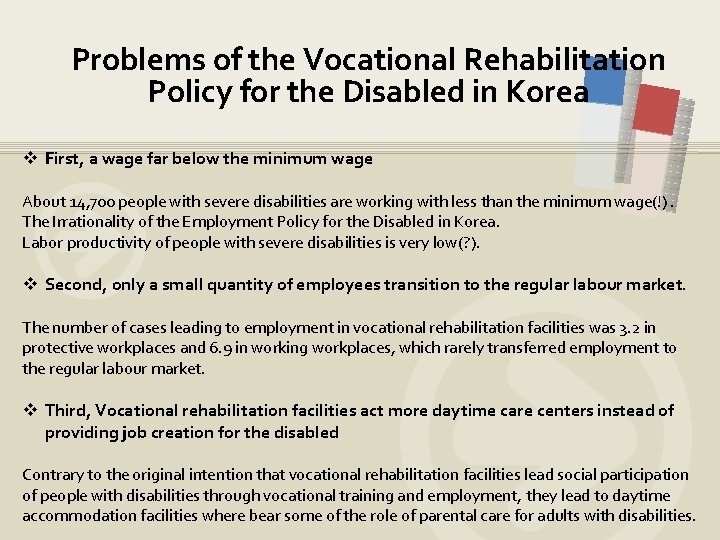
Problems of the Vocational Rehabilitation Policy for the Disabled in Korea v First, a wage far below the minimum wage About 14, 700 people with severe disabilities are working with less than the minimum wage(!). The Irrationality of the Employment Policy for the Disabled in Korea. Labor productivity of people with severe disabilities is very low(? ). v Second, only a small quantity of employees transition to the regular labour market. The number of cases leading to employment in vocational rehabilitation facilities was 3. 2 in protective workplaces and 6. 9 in working workplaces, which rarely transferred employment to the regular labour market. v Third, Vocational rehabilitation facilities act more daytime care centers instead of providing job creation for the disabled Contrary to the original intention that vocational rehabilitation facilities lead social participation of people with disabilities through vocational training and employment, they lead to daytime accommodation facilities where bear some of the role of parental care for adults with disabilities.
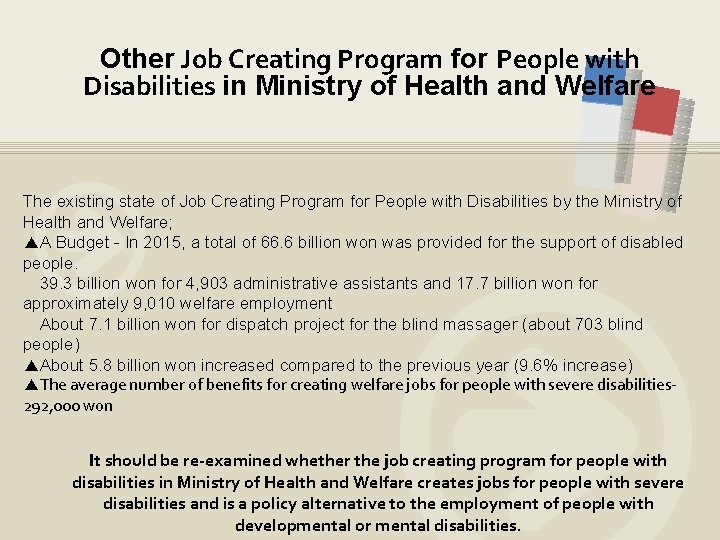
Other Job Creating Program for People with Disabilities in Ministry of Health and Welfare The existing state of Job Creating Program for People with Disabilities by the Ministry of Health and Welfare; ▲A Budget - In 2015, a total of 66. 6 billion was provided for the support of disabled people. 39. 3 billion won for 4, 903 administrative assistants and 17. 7 billion won for approximately 9, 010 welfare employment About 7. 1 billion won for dispatch project for the blind massager (about 703 blind people) ▲About 5. 8 billion won increased compared to the previous year (9. 6% increase) ▲The average number of benefits for creating welfare jobs for people with severe disabilities 292, 000 won It should be re-examined whether the job creating program for people with disabilities in Ministry of Health and Welfare creates jobs for people with severe disabilities and is a policy alternative to the employment of people with developmental or mental disabilities.
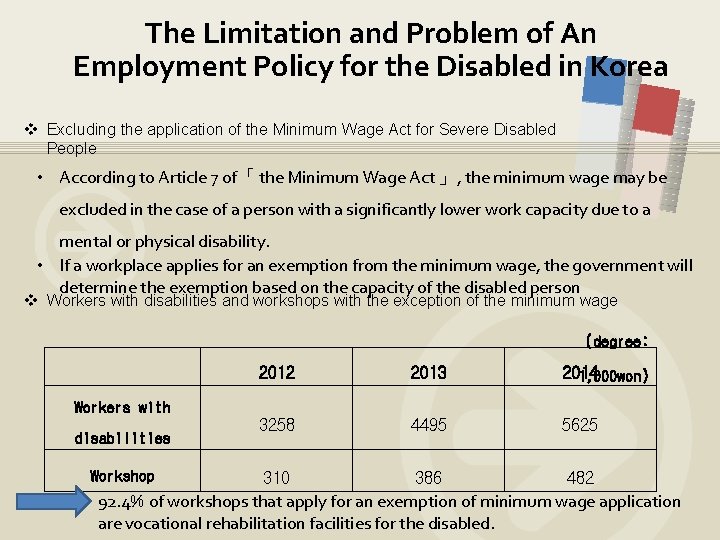
The Limitation and Problem of An Employment Policy for the Disabled in Korea v Excluding the application of the Minimum Wage Act for Severe Disabled People • According to Article 7 of「 the Minimum Wage Act 」, the minimum wage may be excluded in the case of a person with a significantly lower work capacity due to a mental or physical disability. • If a workplace applies for an exemption from the minimum wage, the government will determine the exemption based on the capacity of the disabled person v Workers with disabilities and workshops with the exception of the minimum wage (degree: 2012 2013 2014 1, 000 won) 3258 4495 5625 Workers with disabilities Workshop 310 386 482 92. 4% of workshops that apply for an exemption of minimum wage application are vocational rehabilitation facilities for the disabled.
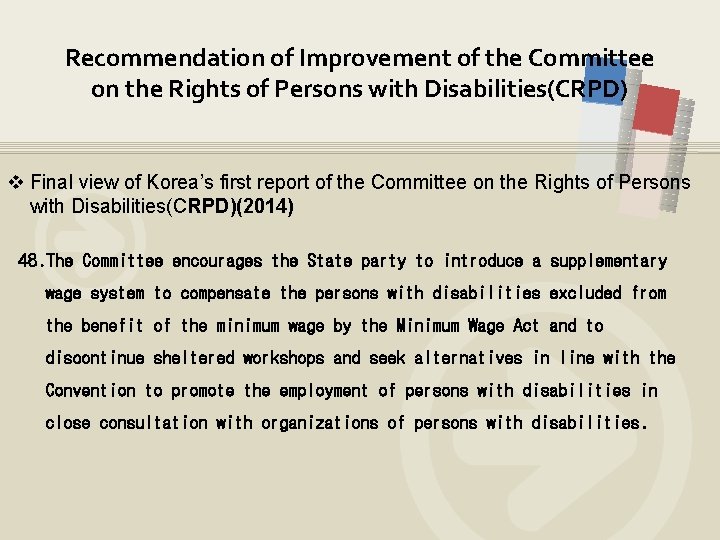
Recommendation of Improvement of the Committee on the Rights of Persons with Disabilities(CRPD) v Final view of Korea’s first report of the Committee on the Rights of Persons with Disabilities(CRPD)(2014) 48. The Committee encourages the State party to introduce a supplementary wage system to compensate the persons with disabilities excluded from the benefit of the minimum wage by the Minimum Wage Act and to discontinue sheltered workshops and seek alternatives in line with the Convention to promote the employment of persons with disabilities in close consultation with organizations of persons with disabilities.
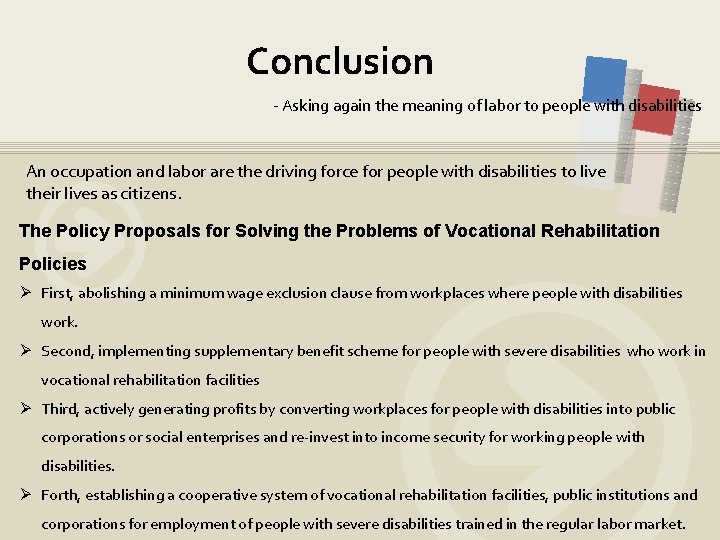
Conclusion - Asking again the meaning of labor to people with disabilities An occupation and labor are the driving force for people with disabilities to live their lives as citizens. The Policy Proposals for Solving the Problems of Vocational Rehabilitation Policies Ø First, abolishing a minimum wage exclusion clause from workplaces where people with disabilities work. Ø Second, implementing supplementary benefit scheme for people with severe disabilities who work in vocational rehabilitation facilities Ø Third, actively generating profits by converting workplaces for people with disabilities into public corporations or social enterprises and re-invest into income security for working people with disabilities. Ø Forth, establishing a cooperative system of vocational rehabilitation facilities, public institutions and corporations for employment of people with severe disabilities trained in the regular labor market.

Thank you
- Slides: 20