
Inclusive Practice in Massachusetts Teacher preparation program overview
- Slides: 37
Inclusive Practice in Massachusetts Teacher preparation program overview of evidence-based best practices
Lesson Objectives Participants will be able to: Articulate a working framework for inclusive practice using the evidence based frameworks of: Universal Design for Learning, Positive Behavior Intervention and Supports, and Social and Emotional Learning. Apply ESE guidance to support inclusive practice through the MA Educator Evaluation Framework. 2 Massachusetts Department of Elementary and Secondary Education
Lesson Agenda Inclusive Practice (30 min) Universal Design for Learning (45 min) Positive Behavior Intervention and Supports (45 min) Social and Emotional Learning (30 min) Guidebook for Inclusive Practice (30 min) 3 Massachusetts Department of Elementary and Secondary Education
Diverse Needs 18% of students in Massachusetts are eligible for special education services, which are defined by the legally binding Individualized Education Plan (IEP). Approximately 60% of those students spend the majority of their school day in classrooms with their non-disabled peers. Beginning teachers, regardless of license area, will invariably be working with students with diverse needs. 4 http: //www. doe. mass. edu/sped/ Massachusetts Department of Elementary and Secondary Education
Placement Matters In Massachusetts, students with learning or communication disabilities who are educated, full-time, in general education settings are nearly five times as likely to graduate high school in four years or fewer than are similar students in substantially separate placements. http: //www. doe. mass. edu/sped/ 5 Massachusetts Department of Elementary and Secondary Education
What do we mean by Inclusion? “The smallest meaningful unit for inclusion is the school” – Melody Musgrove, Director US Office of Special Education Programs What is implied in this remark? Students with disabilities must be educated in the Least Restrictive Environment (LRE) to the maximum extent appropriate. 6 Massachusetts Department of Elementary and Secondary Education
Inclusion in the Schools Classrooms with heterogeneous mix of students – with and without disabilities. Common supports: Accommodations (oral texts, extended time, guided notes, graphic organizers, etc. ) Paraprofessionals Inclusion Support Teacher, Co-Teacher 7 Massachusetts Department of Elementary and Secondary Education
Inclusive Practice in Massachusetts Inclusive practice refers to the instructional and behavioral strategies that improve academic and social-emotional outcomes for all students, with and without disabilities, in general education settings. http: //www. doe. mass. edu/edeval/guidebook/ 8 Massachusetts Department of Elementary and Secondary Education
Evidence Based Strategies for Inclusive Practice Evidence Based Frameworks Universal Design for Learning (UDL) Positive Behavior Intervention and Supports (PBIS) Social-Emotional Learning (SEL) Educator Effectiveness Guidebook for Inclusive Practice MA ESE resource for these strategies 9 Massachusetts Department of Elementary and Secondary Education
Universal Design for Learning 10 Massachusetts Department of Elementary and Secondary Education
Introduction: UDL Write down the first names of five students whose learning you are familiar with. Try to think of individuals who struggle either academically or socially List 2 -3 barriers that each of them faces in daily living. 11 Massachusetts Department of Elementary and Secondary Education
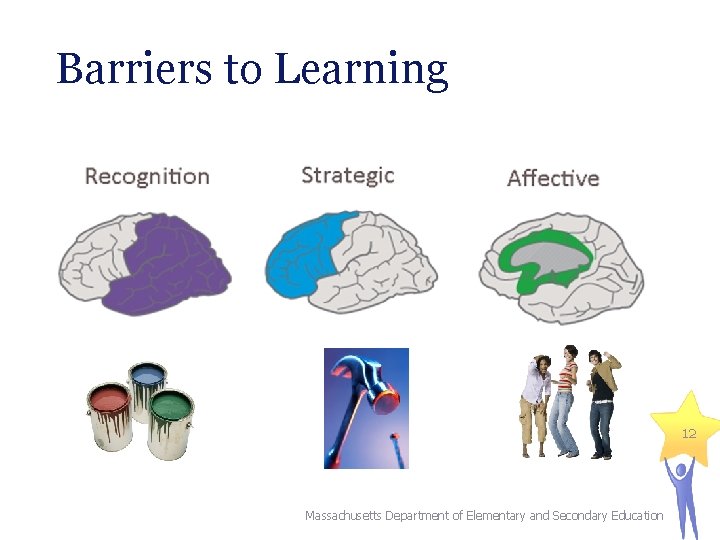
Barriers to Learning 12 Massachusetts Department of Elementary and Secondary Education
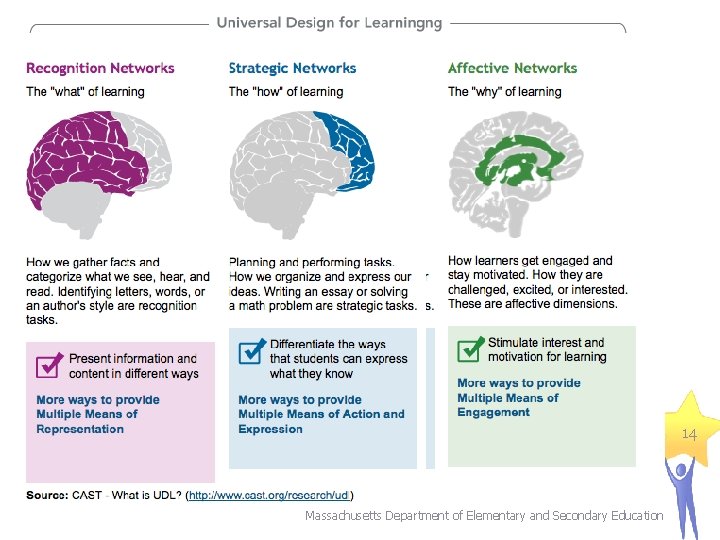
Activity Organize into groups Bring your list Each group starts at one piece of chart paper Try to categorize barriers as being: Cognitive/Recognition (ways of thinking and perceiving) Affective (ways of feeling and relating) Strategic (ways of acting and expressing) 13 Massachusetts Department of Elementary and Secondary Education
14 Massachusetts Department of Elementary and Secondary Education
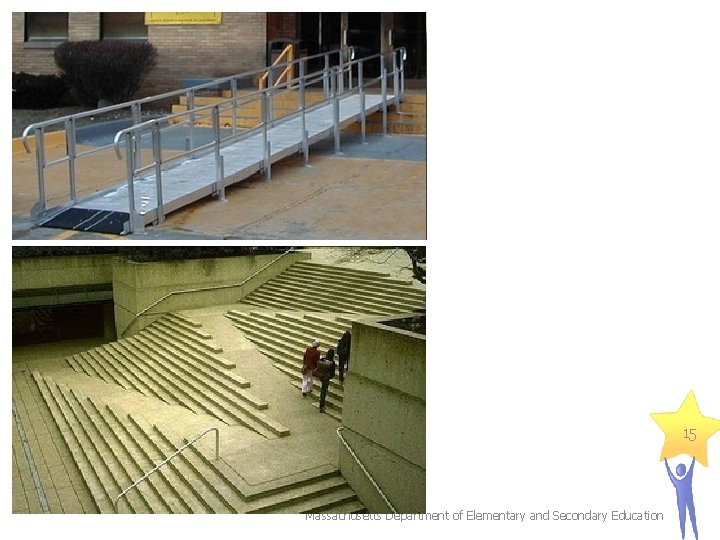
15 Massachusetts Department of Elementary and Secondary Education
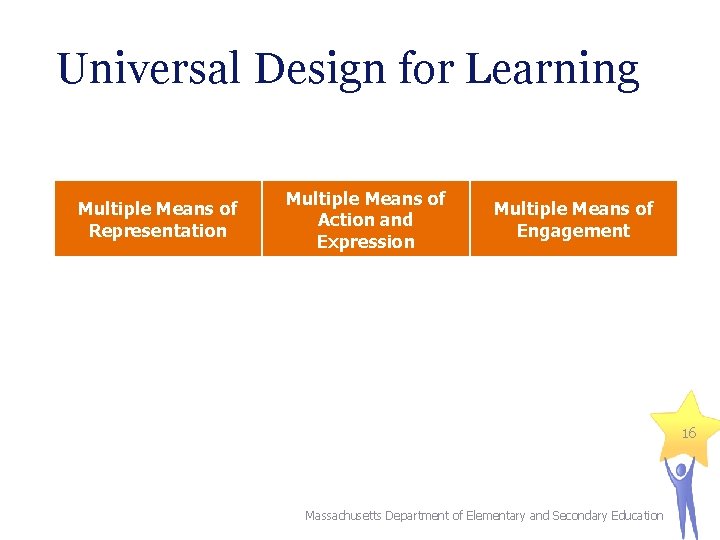
Universal Design for Learning Multiple Means of Representation Multiple Means of Action and Expression Multiple Means of Engagement 16 Massachusetts Department of Elementary and Secondary Education
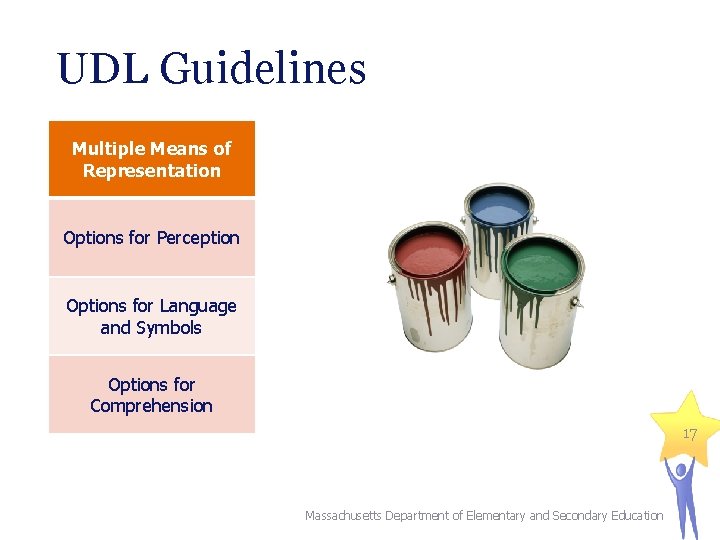
UDL Guidelines Multiple Means of Representation Options for Perception Options for Language and Symbols Options for Comprehension 17 Massachusetts Department of Elementary and Secondary Education
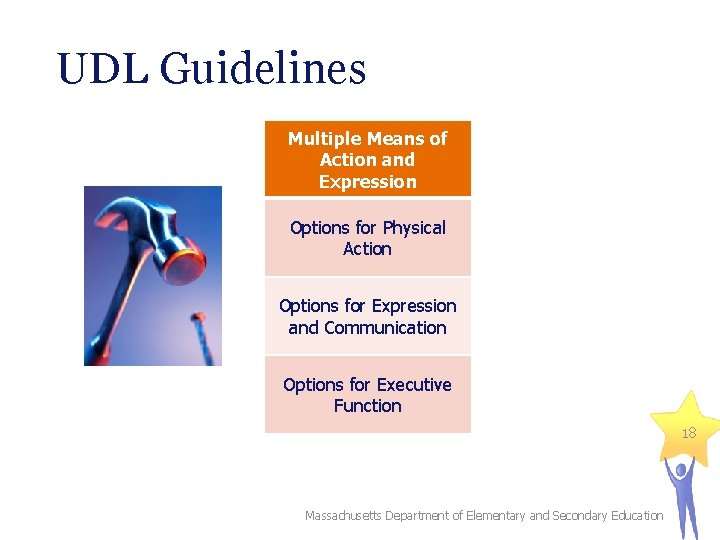
UDL Guidelines Multiple Means of Action and Expression Options for Physical Action Options for Expression and Communication Options for Executive Function 18 Massachusetts Department of Elementary and Secondary Education
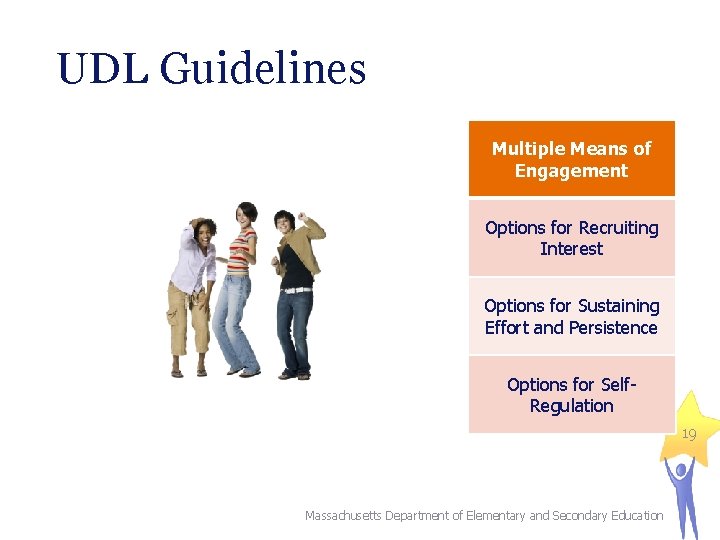
UDL Guidelines Multiple Means of Engagement Options for Recruiting Interest Options for Sustaining Effort and Persistence Options for Self. Regulation 19 Massachusetts Department of Elementary and Secondary Education
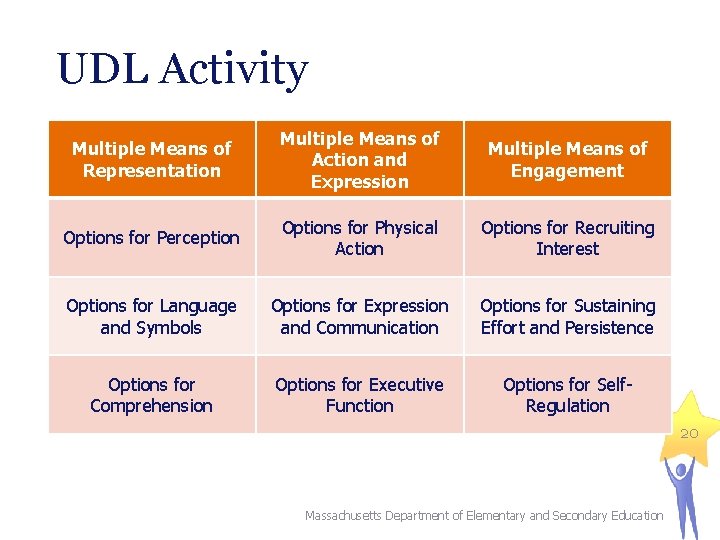
UDL Activity Multiple Means of Representation Multiple Means of Action and Expression Multiple Means of Engagement Options for Perception Options for Physical Action Options for Recruiting Interest Options for Language and Symbols Options for Expression and Communication Options for Sustaining Effort and Persistence Options for Comprehension Options for Executive Function Options for Self. Regulation 20 Massachusetts Department of Elementary and Secondary Education
Positive Behavior Supports 21 Massachusetts Department of Elementary and Secondary Education
Are multiple modes of engagement (UDL) sufficient for classroom behavior supports? “When a teacher does not have a behavior management plan in place, at-risk students are more likely to demonstrate poor academic achievement and to be referred for special education services. ” (Donovan & Cross, 2002) 22 Massachusetts Department of Elementary and Secondary Education
Behavior Supports (cont. ) Schools need an effective way to support teachers’ classroom management. Previous research suggests teacher’s use of evidencebased classroom management practices may be increased by: in-depth training and consultation i. e. , modeling, role play, and self-assessment; (Slider, Noell, & Williams, 2006) in combination with self-monitoring and performance feedback (Reinke, Lewis- Palmer, & Merrell, 2008) Massachusetts Department of Elementary and Secondary Education 23
Discussion Question Scenario: You are assigned to a classroom with a history of behavior challenges as measured by several data sources (ie. office referrals, suspensions, poor attendance). In addition to consulting with other educators, how would you prepare for the first day of class? 24 Massachusetts Department of Elementary and Secondary Education
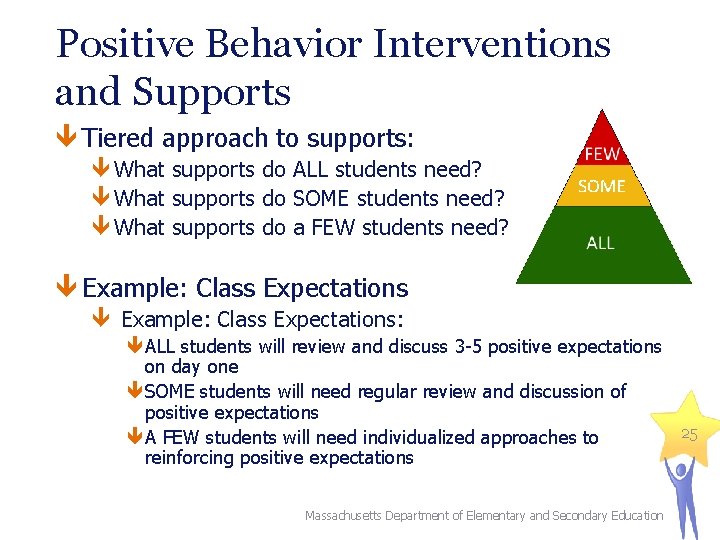
Positive Behavior Interventions and Supports Tiered approach to supports: What supports do ALL students need? What supports do SOME students need? What supports do a FEW students need? Example: Class Expectations: ALL students will review and discuss 3 -5 positive expectations on day one SOME students will need regular review and discussion of positive expectations 25 A FEW students will need individualized approaches to reinforcing positive expectations Massachusetts Department of Elementary and Secondary Education
Positive Behavior Interventions and Supports Best Practice for PBIS: Plan for a tiered system of supports: what will ALL/SOME/A FEW students need? Implemented across district/school/classrooms Team-based decision-making Data-driven: each time a teacher incorporates a strategy it must have an assessment component attached to it that assists in determining its effectiveness. Massachusetts Department of Elementary and Secondary Education 26
Positive Behavior Interventions and Supports - Discussion Revisit the previous scenario. How would you adapt your preparation to include the concepts of Positive Behavior Interventions and Supports? Apply a tiered approach to class expectations. How would you set these up? introduce them? reinforce them? 27 Massachusetts Department of Elementary and Secondary Education
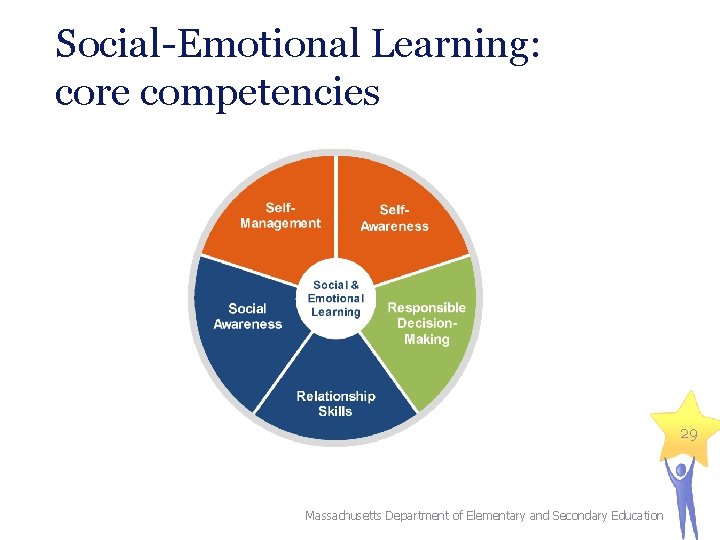
Social-Emotional Learning Direct instruction in social and emotional competencies – knowledge, skills, attitudes and behaviors that individuals need to make successful choices. 28 Massachusetts Department of Elementary and Secondary Education
Social-Emotional Learning: core competencies 29 Massachusetts Department of Elementary and Secondary Education
Social-Emotional Learning: Activity Review the 10 Teaching Practices that Promote SEL document. Identify which of the Core Competencies each practice addresses. (There may be some overlap) Discuss: how could you incorporate these practices into the “new classroom” scenario from above? Massachusetts Department of Elementary and Secondary Education 30
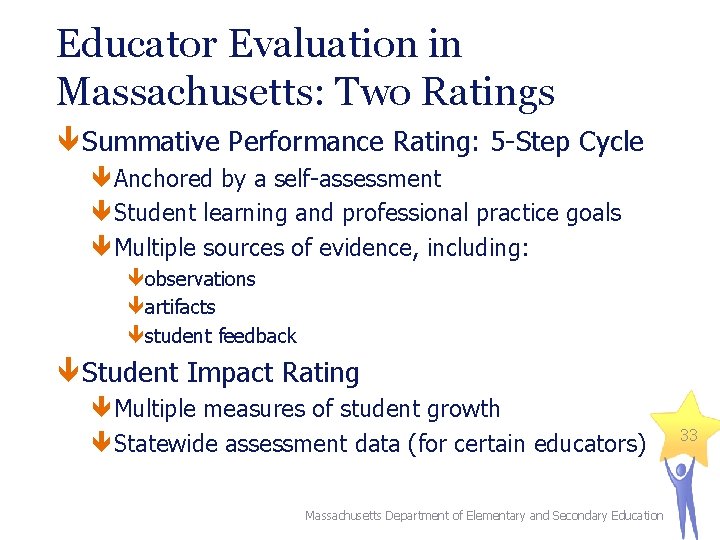
Educator Effectiveness Guidebook for Inclusive Practice Tools support UDL, PBIS, and SEL Aligned to the MA Educator Evaluation Framework Goal-setting Observations Artifacts of Practice Student Feedback Common Assessments 31 Massachusetts Department of Elementary and Secondary Education
Sample Guidebook Tool Case Study Goals: Instruction Case Study Goals: Behavior Support Directions: Read the first case study and goal. Answer the discussion protocol questions. 32 Massachusetts Department of Elementary and Secondary Education
Educator Evaluation in Massachusetts: Two Ratings Summative Performance Rating: 5 -Step Cycle Anchored by a self-assessment Student learning and professional practice goals Multiple sources of evidence, including: observations artifacts student feedback Student Impact Rating Multiple measures of student growth Statewide assessment data (for certain educators) Massachusetts Department of Elementary and Secondary Education 33
Assignment/Planning Review the full set of Guidebook tools at http: //www. doe. mass. edu/edeval/guidebook/ Select a Guidebook tool to try in your Field Based Experience. Be prepared to share experience with inclusive practice at the next session. 34 Massachusetts Department of Elementary and Secondary Education
Remember 18% of students in Massachusetts are eligible for special education services. Approximately 60% of those students spent the majority of their school day in classrooms with their non-disabled peers. Beginning teachers, regardless of licensure, will invariably be working with students with diverse needs. 35 Massachusetts Department of Elementary and Secondary Education
Final thoughts In Massachusetts, students with learning or communication disabilities who are educated, full-time, in general education settings are nearly five times as likely to graduate high school in four years or fewer than are similar students in substantially separate placements. 36 Massachusetts Department of Elementary and Secondary Education
37 Massachusetts Department of Elementary and Secondary Education