
Inclusive Leadership Donna M Korbel Assistant Vice President

Inclusive Leadership Donna M. Korbel Assistant Vice President for Student Affairs Director, Center for Students with Disabilities AHEAD Equity & Excellence Conference, 2019
Inclusive Leadership: Overview • Why are we talking about this? • What is it? • Why is it important? • How can I put it into practice?
AHEAD’s Leadership Charge • As disability professionals, our focus is centered on access and inclusion for disabled people in higher education. Regardless of our title in our disability offices, we are all leaders who have a responsibility to motivate and mobilize the entire campus community around a shared vision of disability as an aspect of diversity and access as a matter of social justice. • Achieving this vision requires energizing all campus stakeholders to recognize and own their capacity to promote an accessible and inclusive campus experience as recognized through open-minded attitudes, physical accessibility, digital and technological accessibility and processes that allow access.
Diversity Doesn’t Stick Without Inclusion
Diversity & Inclusion – Not The Same Thing • Diversity= Representation • Without inclusion crucial connections that attract diverse talent, encourage participation, and foster innovation won’t happen. • Inclusion • Speaks to the environment • “A sense of belonging that one or a group of individuals feels when able to participate in the majority culture on campus as valued members” - Davis (3/17/17)
Inclusive Leadership Defined “Inclusion is a system for making sure the organization is welcoming at every level to every individual. Inclusion is about diversity of thought. . Inclusion is about growth, and individuality, regardless of race, heritage, or gender, is the new normal. All leaders need to embrace this in order to influence more. ” (Forbes, 11/27/17)
Inclusive Leadership Current Concepts: Broad target groups: • Different cultural backgrounds • Experiences • Sexual orientation or gender Of particular interest of us: • Individuals at risk of being excluded • Some form of disability Approach based on: • Human rights as presented in the Universal Declaration of Human Rights
Behavior of Inclusive Leaders • Ensuring team members speak up and are heard • Safe environment to propose novel ideas • Empowering team members to make decisions • Taking advice and implementing feedback • Giving actionable feedback • Sharing credit for team success
Employees with Inclusive Leaders report : • 89% feel welcome and included in their team • 87% feel free to express their views and opinions • 74% of ideas are heard & recognized
Believe That Everything is Connected Inclusive leaders must be aware • Appreciate everyone’s contribution • Inspire innovation by involving people at risk of being excluded • Prepared to give up powers • Share responsibility & tap into the wisdom of the group to benefit everyone • Take conscious steps to break down barriers for people at risk of being excluded
Leadership Approach That • Appreciates diversity • Invites & welcomes everyone’s individual contribution • Encourages full engagement in decision making & shaping reality • Create change & innovate while balancing everyone’s needs
Areas for Development • Practicing self awareness • Living a shared vision • Building relationships • Creating change by valuing the world they live in
Theoretical Basis Servant Leadership- Robert K Greenleaf Human being at the center • Leadership must care for the welfare of the employees & parties which the organization is serving Main goal of the leaders is to serve • Shared power • Puts needs of employees first & helps people develop and perform as highly as possible Simply put, the leaders exist to serve the people
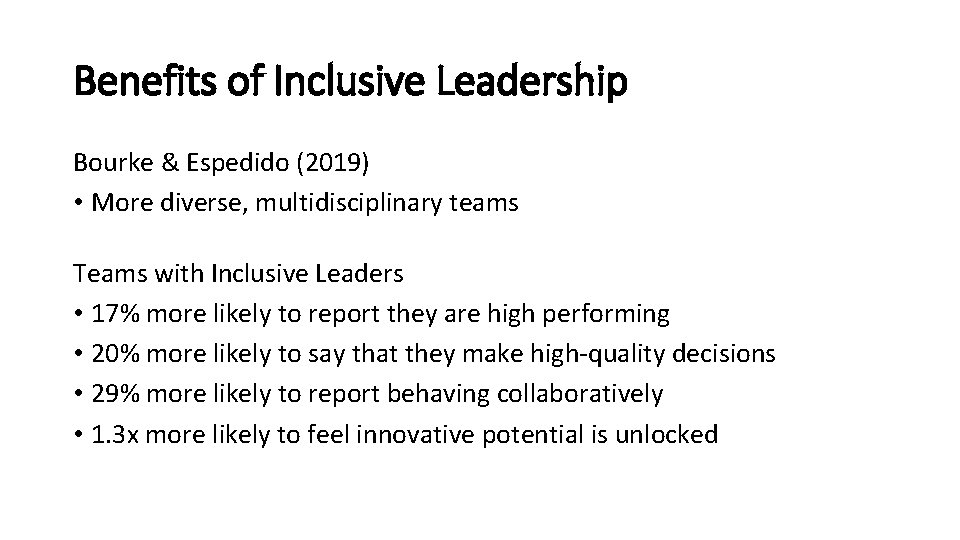
Benefits of Inclusive Leadership Bourke & Espedido (2019) • More diverse, multidisciplinary teams Teams with Inclusive Leaders • 17% more likely to report they are high performing • 20% more likely to say that they make high-quality decisions • 29% more likely to report behaving collaboratively • 1. 3 x more likely to feel innovative potential is unlocked
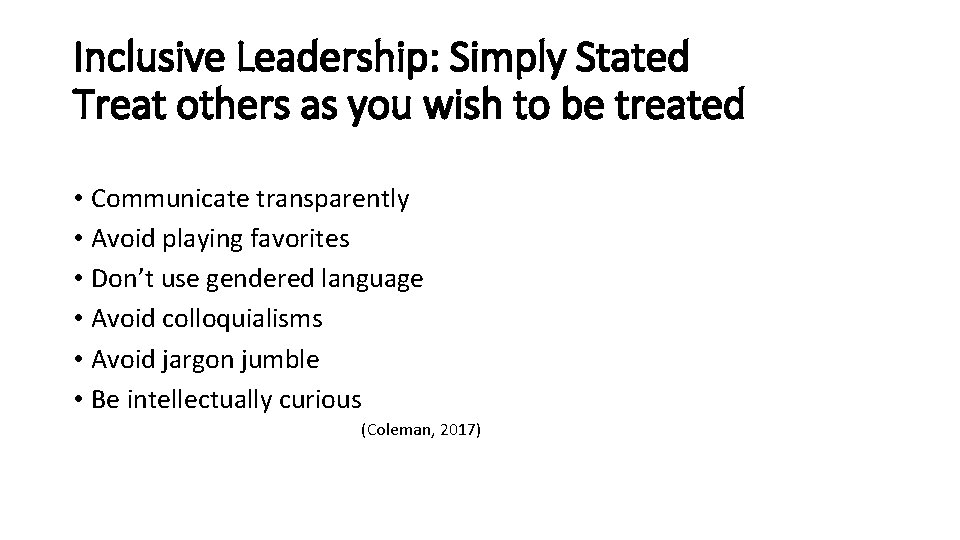
Inclusive Leadership: Simply Stated Treat others as you wish to be treated • Communicate transparently • Avoid playing favorites • Don’t use gendered language • Avoid colloquialisms • Avoid jargon jumble • Be intellectually curious (Coleman, 2017)
- Slides: 15