
INCLUSIVE EDUCATION ETH 306 W Video Conference 16


- Slides: 50
INCLUSIVE EDUCATION ETH 306 W Video Conference 16 march 2018 (09: 00 -12: 00) Presenters: Dr JMC Motitswe Mr. Linda Mkhuma Dr M. K Malahlela
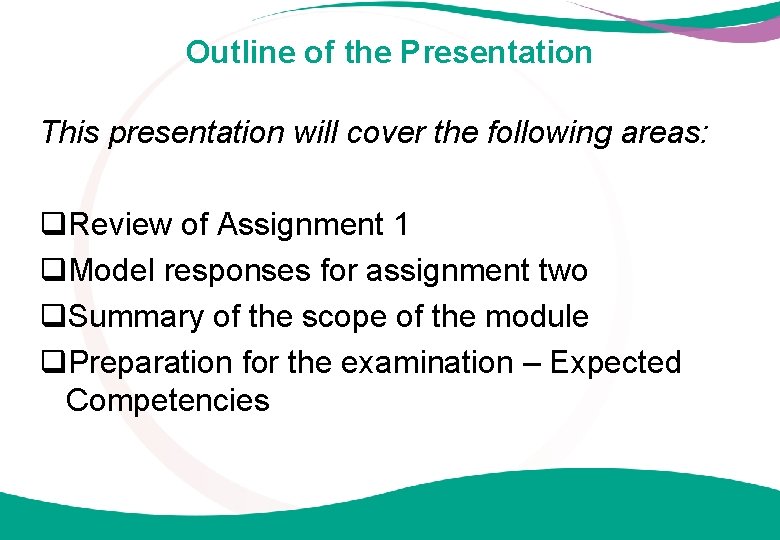
Outline of the Presentation This presentation will cover the following areas: q. Review of Assignment 1 q. Model responses for assignment two q. Summary of the scope of the module q. Preparation for the examination – Expected Competencies
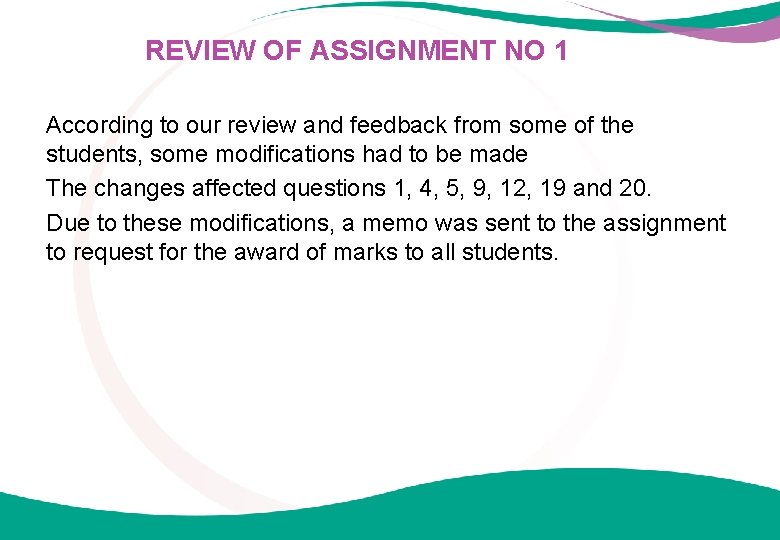
REVIEW OF ASSIGNMENT NO 1 According to our review and feedback from some of the students, some modifications had to be made The changes affected questions 1, 4, 5, 9, 12, 19 and 20. Due to these modifications, a memo was sent to the assignment to request for the award of marks to all students.
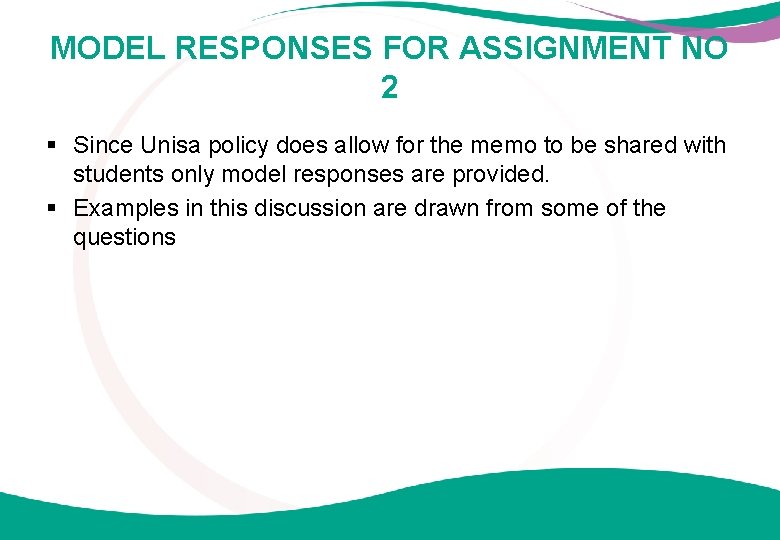
MODEL RESPONSES FOR ASSIGNMENT NO 2 § Since Unisa policy does allow for the memo to be shared with students only model responses are provided. § Examples in this discussion are drawn from some of the questions
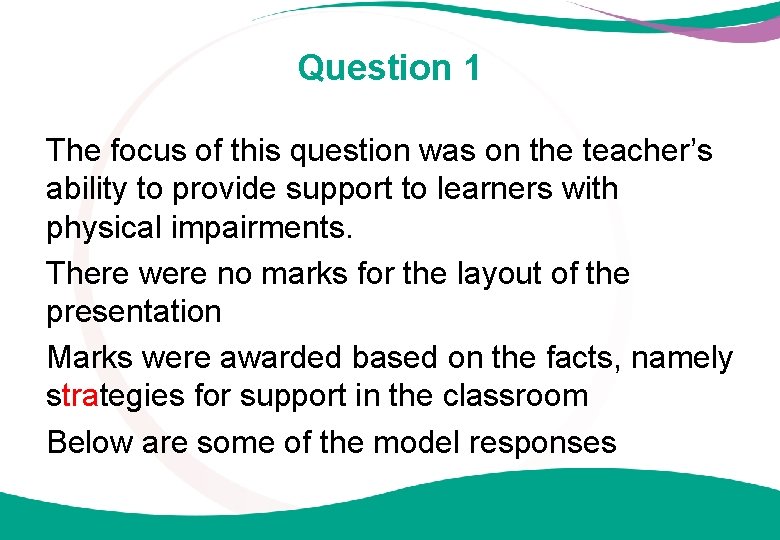
Question 1 The focus of this question was on the teacher’s ability to provide support to learners with physical impairments. There were no marks for the layout of the presentation Marks were awarded based on the facts, namely strategies for support in the classroom Below are some of the model responses
• Give the learners tasks and responsibilities-with due regard to physical abilities. • Arrange the furniture in the playroom in such a way that the cerebral palsied learners can move about freely. • Also make sure that the washbasin and the toilet are easily accessible. • Store apparatus and positions activities in places where the learners will be able to reach them. • Organise floor and table games which the cerebral palsied learners can manage and which will encourage participation. It is always advisable to build up learners’ self-esteem. • Physically disabled learners feel different from other people. If the learners have difficulty with their handwriting, you could try to provide a typewriter; arrange an oral examination for the learner.
• Provide aids where necessary so that the learners can learn to help themselves. For example, you can provide a special spoon to eat with and a frame around the table so that the learner do not knock things down easily. You can stick the plate, paint and paper for a given activity to the table with Prestik. • Encourage the learners to become independent by giving them opportunity to do things unaided. • Encourage the learners to use disabled limbs. Present activities which require the use of the disabled as well (in case of a hemiplegic).
• Let the learners join in all the activities and feel an important participant in group activities, with due allowance for motor problems. For example, when some learners cannot dance like bees during music lesson, they can hold the flowers for the other bees to dance around. • Create a physical and emotionally secure space for the learners so that they can explore confidently.
Support to Learners with Auditory Impairments • Use an overhead projector to present material • Assign a peer to take notes using carbon paper for the hearing –impaired learner and to point to speakers during a group discussion. • Speak clearly in a normal tone of voice and at a moderate pace. • Use visual signals to gain the student’s attention. • Ask questions to check understanding of orally presented directions and content. • Rephrase content or questions to make it more understandable to hearing impaired students. • Supplement information presented orally with visual aids. • Give test directions, assignments, and lecture outlines in writing. • Cue the student visually to indicate that someone is talking over the intercom.
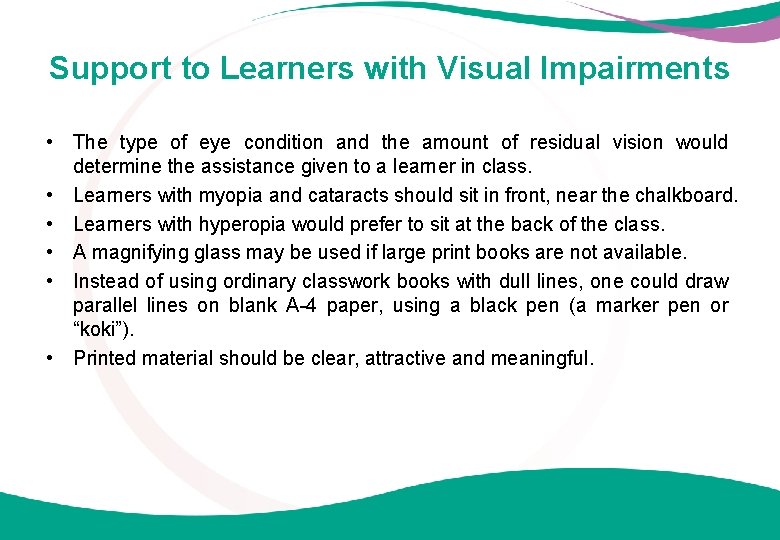
Support to Learners with Visual Impairments • The type of eye condition and the amount of residual vision would determine the assistance given to a learner in class. • Learners with myopia and cataracts should sit in front, near the chalkboard. • Learners with hyperopia would prefer to sit at the back of the class. • A magnifying glass may be used if large print books are not available. • Instead of using ordinary classwork books with dull lines, one could draw parallel lines on blank A-4 paper, using a black pen (a marker pen or “koki”). • Printed material should be clear, attractive and meaningful.
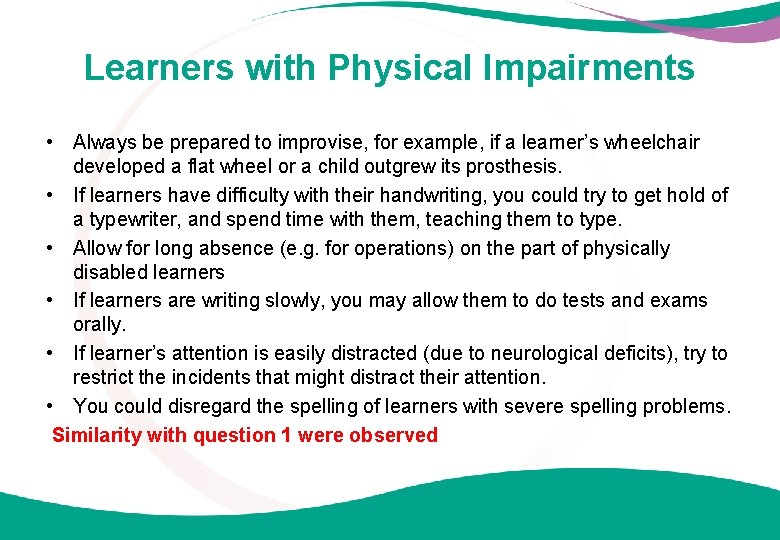
Learners with Physical Impairments • Always be prepared to improvise, for example, if a learner’s wheelchair developed a flat wheel or a child outgrew its prosthesis. • If learners have difficulty with their handwriting, you could try to get hold of a typewriter, and spend time with them, teaching them to type. • Allow for long absence (e. g. for operations) on the part of physically disabled learners • If learners are writing slowly, you may allow them to do tests and exams orally. • If learner’s attention is easily distracted (due to neurological deficits), try to restrict the incidents that might distract their attention. • You could disregard the spelling of learners with severe spelling problems. Similarity with question 1 were observed
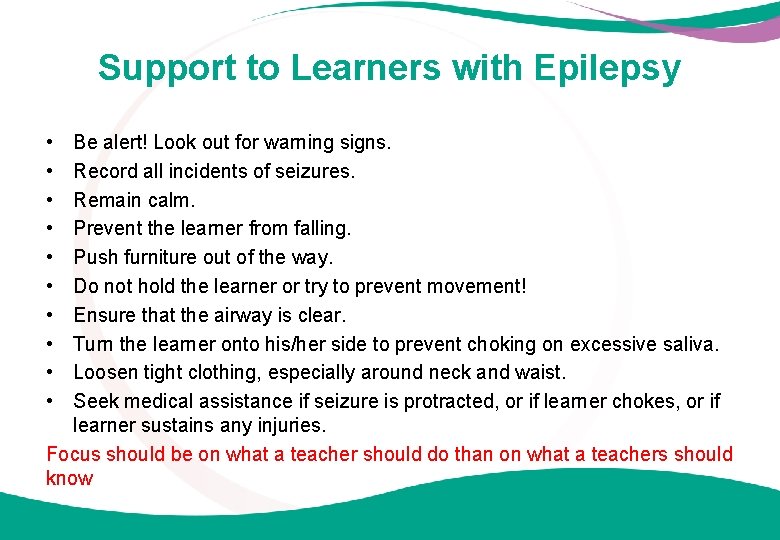
Support to Learners with Epilepsy • • • Be alert! Look out for warning signs. Record all incidents of seizures. Remain calm. Prevent the learner from falling. Push furniture out of the way. Do not hold the learner or try to prevent movement! Ensure that the airway is clear. Turn the learner onto his/her side to prevent choking on excessive saliva. Loosen tight clothing, especially around neck and waist. Seek medical assistance if seizure is protracted, or if learner chokes, or if learner sustains any injuries. Focus should be on what a teacher should do than on what a teachers should know
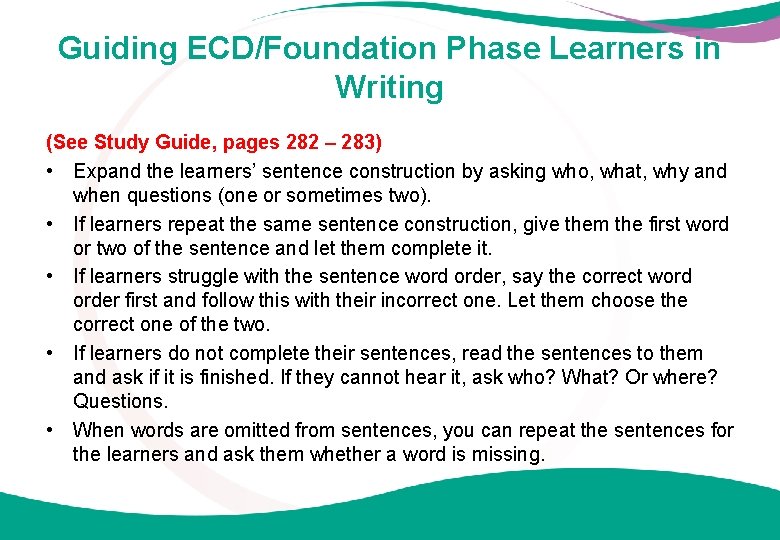
Guiding ECD/Foundation Phase Learners in Writing (See Study Guide, pages 282 – 283) • Expand the learners’ sentence construction by asking who, what, why and when questions (one or sometimes two). • If learners repeat the same sentence construction, give them the first word or two of the sentence and let them complete it. • If learners struggle with the sentence word order, say the correct word order first and follow this with their incorrect one. Let them choose the correct one of the two. • If learners do not complete their sentences, read the sentences to them and ask if it is finished. If they cannot hear it, ask who? What? Or where? Questions. • When words are omitted from sentences, you can repeat the sentences for the learners and ask them whether a word is missing.
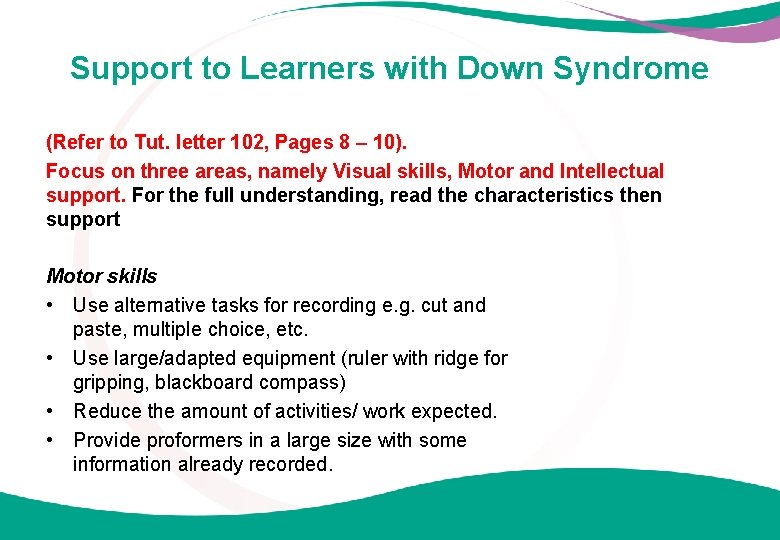
Support to Learners with Down Syndrome (Refer to Tut. letter 102, Pages 8 – 10). Focus on three areas, namely Visual skills, Motor and Intellectual support. For the full understanding, read the characteristics then support Motor skills • Use alternative tasks for recording e. g. cut and paste, multiple choice, etc. • Use large/adapted equipment (ruler with ridge for gripping, blackboard compass) • Reduce the amount of activities/ work expected. • Provide proformers in a large size with some information already recorded.
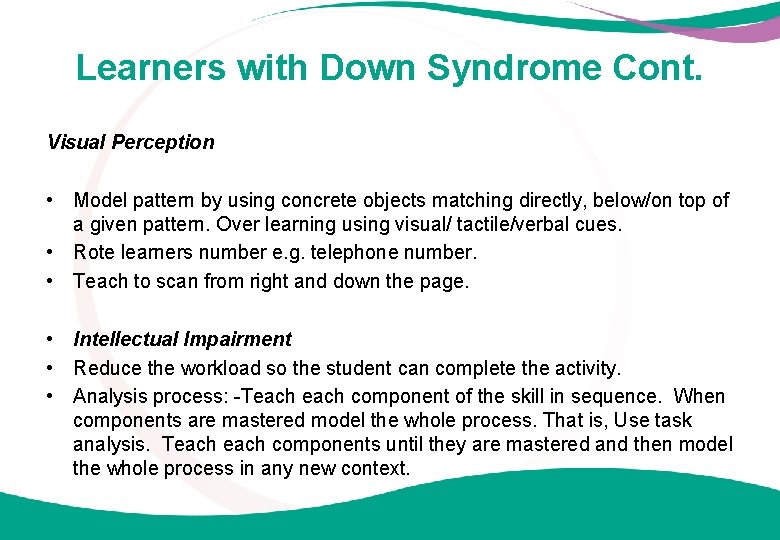
Learners with Down Syndrome Cont. Visual Perception • Model pattern by using concrete objects matching directly, below/on top of a given pattern. Over learning using visual/ tactile/verbal cues. • Rote learners number e. g. telephone number. • Teach to scan from right and down the page. • Intellectual Impairment • Reduce the workload so the student can complete the activity. • Analysis process: -Teach component of the skill in sequence. When components are mastered model the whole process. That is, Use task analysis. Teach components until they are mastered and then model the whole process in any new context.
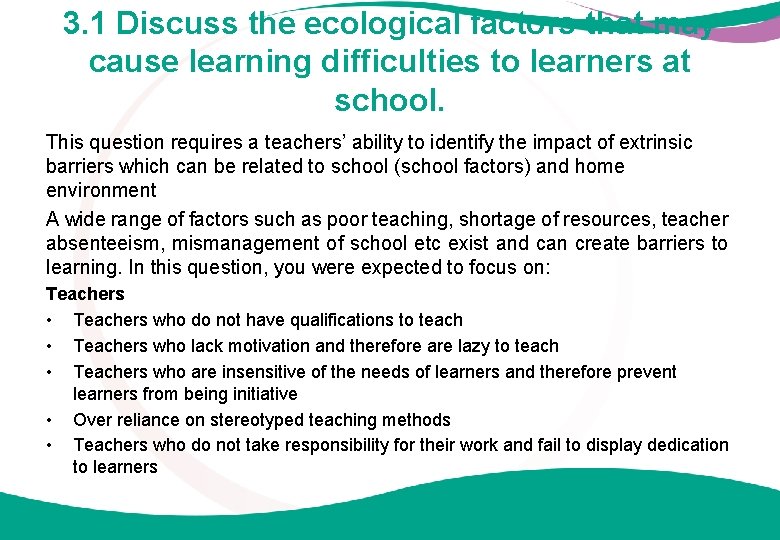
3. 1 Discuss the ecological factors that may cause learning difficulties to learners at school. This question requires a teachers’ ability to identify the impact of extrinsic barriers which can be related to school (school factors) and home environment A wide range of factors such as poor teaching, shortage of resources, teacher absenteeism, mismanagement of school etc exist and can create barriers to learning. In this question, you were expected to focus on: Teachers • Teachers who do not have qualifications to teach • Teachers who lack motivation and therefore are lazy to teach • Teachers who are insensitive of the needs of learners and therefore prevent learners from being initiative • Over reliance on stereotyped teaching methods • Teachers who do not take responsibility for their work and fail to display dedication to learners
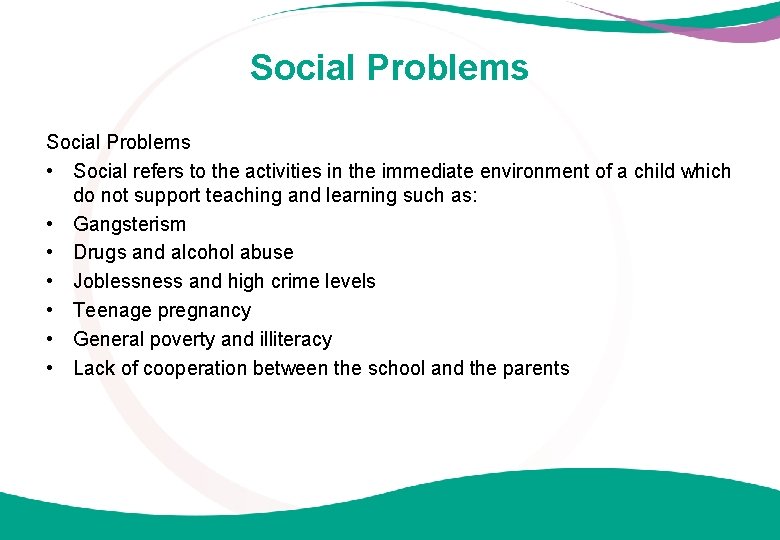
Social Problems • Social refers to the activities in the immediate environment of a child which do not support teaching and learning such as: • Gangsterism • Drugs and alcohol abuse • Joblessness and high crime levels • Teenage pregnancy • General poverty and illiteracy • Lack of cooperation between the school and the parents
Cultural Problems Cultural Environment Cultural factors may include a number of factors such: • • • Cultural diversity in the community Language complexities amongst learners Language differences between learners and their teachers Cultural differences that are in the language of learning and teaching Cultural values which do not promote the culture of learning and teaching
Read pages 360 -363 of your study and respond to the following questions in your own words What are the essential elements in a child’s life that can give him or her security? (P. 32 Tut. letter 101/2018) Security • Learners develop security from a number of stable relationships within their immediate environments such as: • Healthy relationship with family members and sibling which include cousins, uncles, aunts and grandparents • A relationship with familiar environments such as local community, church, the manner in which things are done etc. • Getting to know the parents’ expectations also assist the child to know what to and or what not to and that lessons the feeling of inadequacy and anxiety • When parents and adults discuss rules, a child is likely to be less stressed about security • Assurance that his/her opinions are welcome
Parents &Teachers’ Role in Learners’ Security What specific roles should parents and teachers play to ensure that a child feels secure at home and at school? • Since teachers act in the full role of a parent, their role should also be stable, clearly defined and discussed with the child • Finding assurance from adults also assure that child that his/act actions are appreciated and valued • Discipline should be consistent • A child should be supported to develop a coherent self-image and a sense of identity at home and at school • The actions of adults and expectations from the child should be predictable and communicated with the child • Measured freedom where the child knows the extent of his/her freedom and limitations creates security
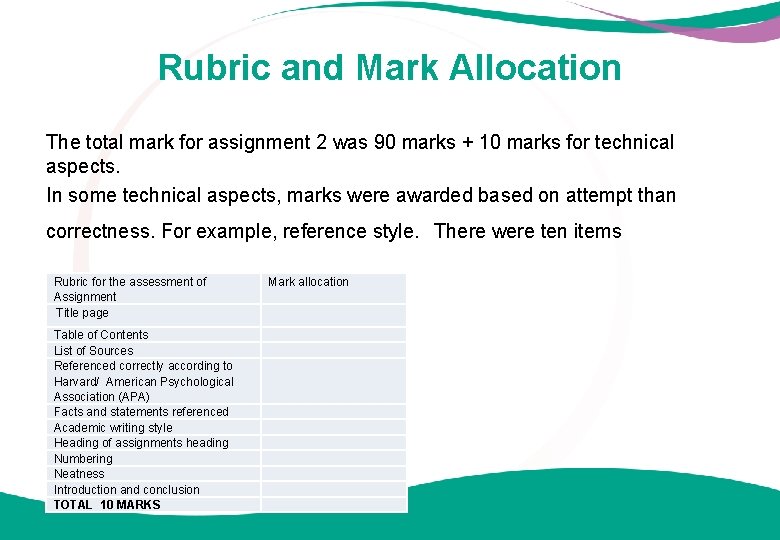
Rubric and Mark Allocation The total mark for assignment 2 was 90 marks + 10 marks for technical aspects. In some technical aspects, marks were awarded based on attempt than correctness. For example, reference style. There were ten items Rubric for the assessment of Assignment Title page Mark allocation Table of Contents List of Sources Referenced correctly according to Harvard/ American Psychological Association (APA) Facts and statements referenced Academic writing style Heading of assignments heading Numbering Neatness Introduction and conclusion TOTAL 10 MARKS
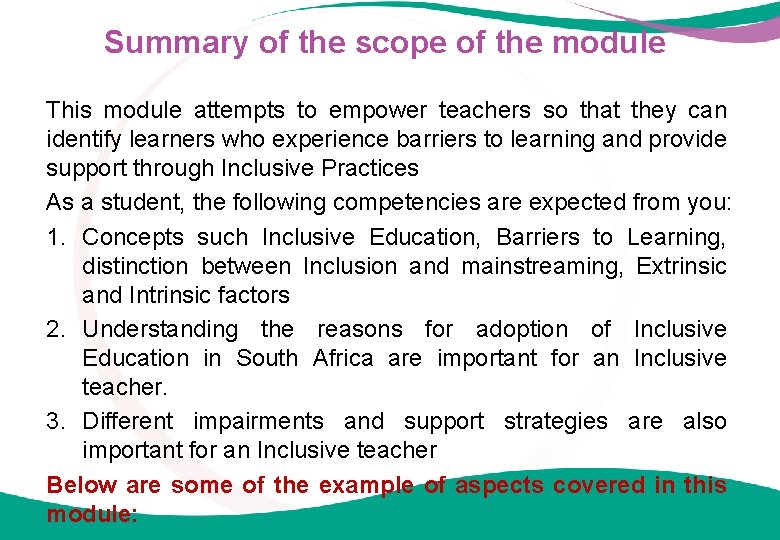
Summary of the scope of the module This module attempts to empower teachers so that they can identify learners who experience barriers to learning and provide support through Inclusive Practices As a student, the following competencies are expected from you: 1. Concepts such Inclusive Education, Barriers to Learning, distinction between Inclusion and mainstreaming, Extrinsic and Intrinsic factors 2. Understanding the reasons for adoption of Inclusive Education in South Africa are important for an Inclusive teacher. 3. Different impairments and support strategies are also important for an Inclusive teacher Below are some of the example of aspects covered in this module:
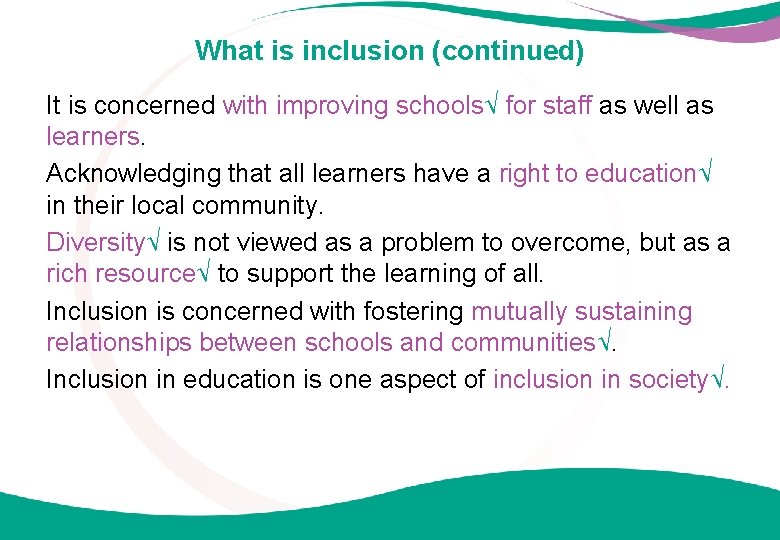
What is inclusion (continued) It is concerned with improving schools√ for staff as well as learners. Acknowledging that all learners have a right to education√ in their local community. Diversity√ is not viewed as a problem to overcome, but as a rich resource√ to support the learning of all. Inclusion is concerned with fostering mutually sustaining relationships between schools and communities√. Inclusion in education is one aspect of inclusion in society√.
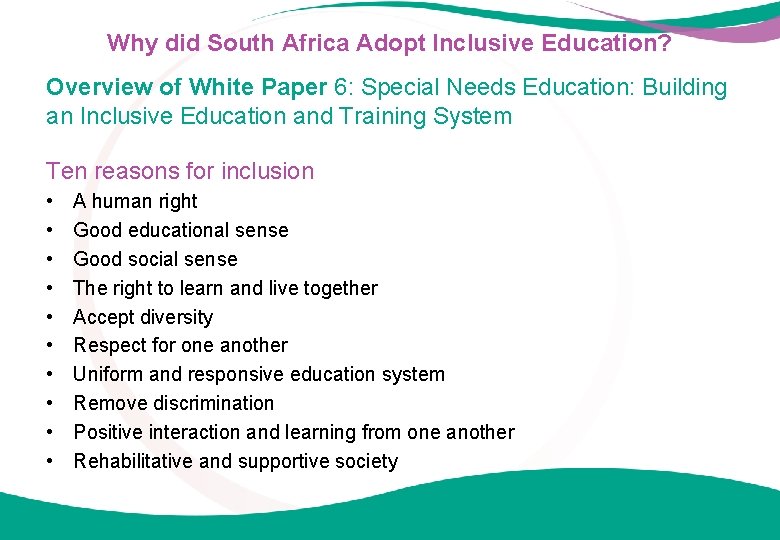
Why did South Africa Adopt Inclusive Education? Overview of White Paper 6: Special Needs Education: Building an Inclusive Education and Training System Ten reasons for inclusion • • • A human right Good educational sense Good social sense The right to learn and live together Accept diversity Respect for one another Uniform and responsive education system Remove discrimination Positive interaction and learning from one another Rehabilitative and supportive society
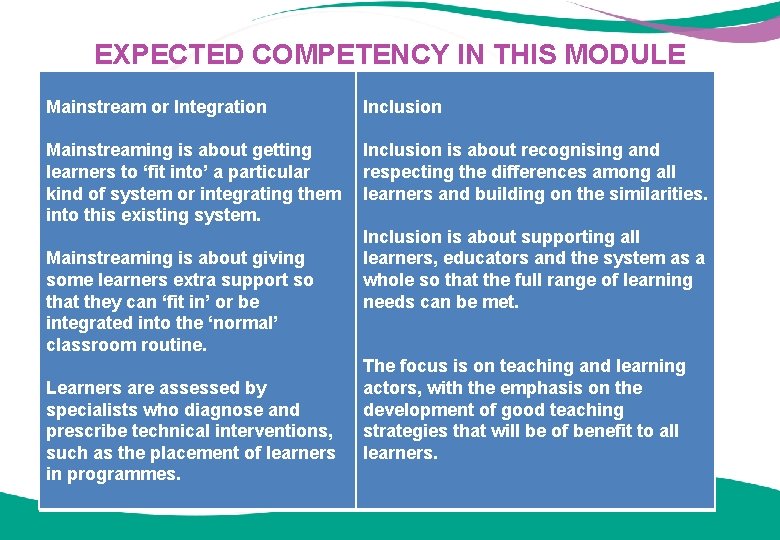
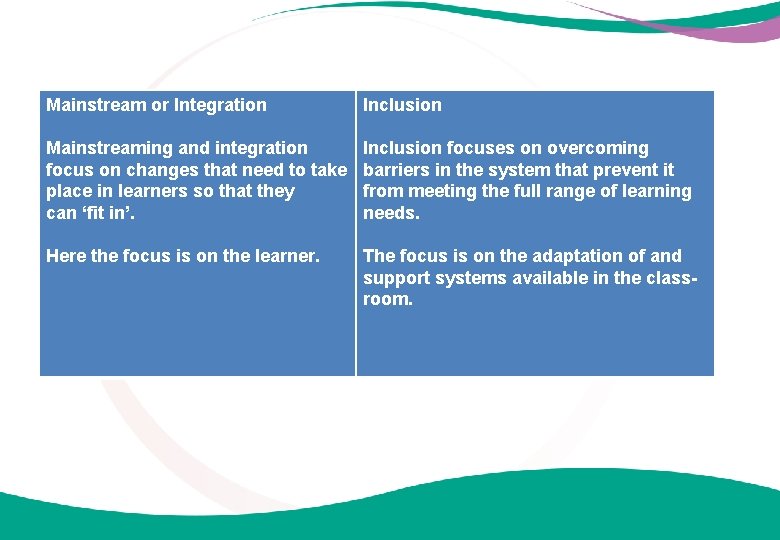
EXPECTED COMPETENCY IN THIS MODULE Mainstream or Integration Inclusion Mainstreaming is about getting Inclusion is about recognising and learners to ‘fit into’ a particular respecting the differences among all kind of system or integrating them learners and building on the similarities. into this existing system. Inclusion is about supporting all Mainstreaming is about giving learners, educators and the system as a some learners extra support so whole so that the full range of learning that they can ‘fit in’ or be needs can be met. integrated into the ‘normal’ classroom routine. The focus is on teaching and learning Learners are assessed by actors, with the emphasis on the specialists who diagnose and development of good teaching prescribe technical interventions, strategies that will be of benefit to all such as the placement of learners. in programmes.
Mainstream or Integration Inclusion Mainstreaming and integration focus on changes that need to take place in learners so that they can ‘fit in’. Inclusion focuses on overcoming barriers in the system that prevent it from meeting the full range of learning needs. Here the focus is on the learner. The focus is on the adaptation of and support systems available in the class- room.
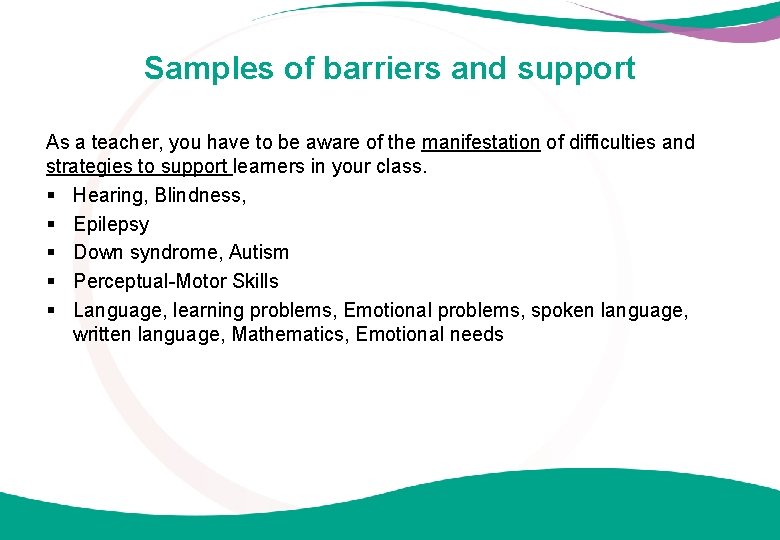
Samples of barriers and support As a teacher, you have to be aware of the manifestation of difficulties and strategies to support learners in your class. § Hearing, Blindness, § Epilepsy § Down syndrome, Autism § Perceptual-Motor Skills § Language, learning problems, Emotional problems, spoken language, written language, Mathematics, Emotional needs
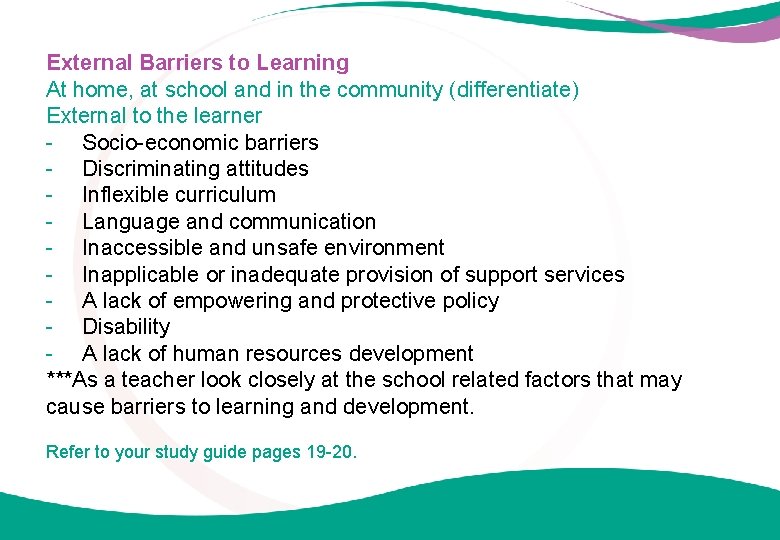
External Barriers to Learning At home, at school and in the community (differentiate) External to the learner - Socio-economic barriers - Discriminating attitudes - Inflexible curriculum - Language and communication - Inaccessible and unsafe environment - Inapplicable or inadequate provision of support services - A lack of empowering and protective policy - Disability - A lack of human resources development ***As a teacher look closely at the school related factors that may cause barriers to learning and development. Refer to your study guide pages 19 -20.
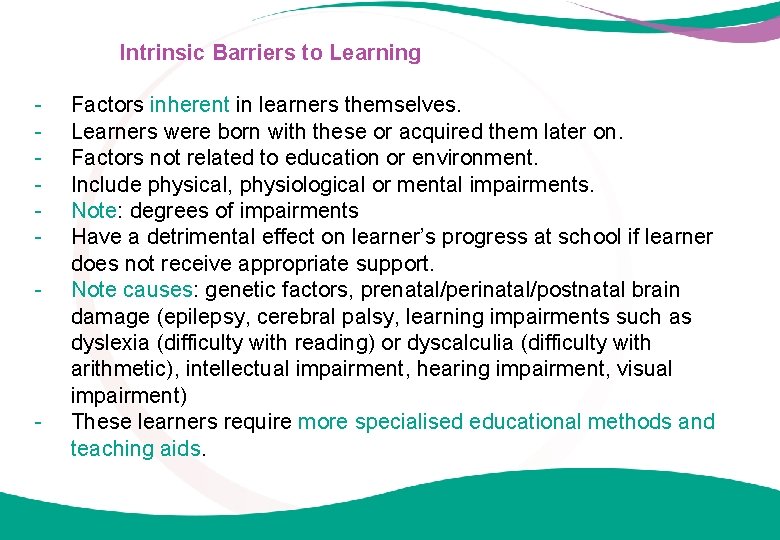
Intrinsic Barriers to Learning - - Factors inherent in learners themselves. Learners were born with these or acquired them later on. Factors not related to education or environment. Include physical, physiological or mental impairments. Note: degrees of impairments Have a detrimental effect on learner’s progress at school if learner does not receive appropriate support. Note causes: genetic factors, prenatal/perinatal/postnatal brain damage (epilepsy, cerebral palsy, learning impairments such as dyslexia (difficulty with reading) or dyscalculia (difficulty with arithmetic), intellectual impairment, hearing impairment, visual impairment) These learners require more specialised educational methods and teaching aids.
Hearing/Auditory Impairments: Characteristics - Often misinterprets instructions - Turns head to listen - Watched the teacher’s lips - Cannot understand the teacher if the teacher’s head is turned away or the teacher’s lips are covered - Finds it difficult to locate the source of a sound - Speaks too loudly or too softly - Speaks monotonously - Speaks too quickly or too slowly - Experiences unusual emotional problems - Is often inattentive
Auditory/Hearing Impairments (Characteristics continued) - Stares out of the window if the teacher stands at the back of the class while giving instructions - May have difficulty hearing the bell ring - Finds it difficult to associate with friends - Cannot follow instructions given in a large hall such as a school assembly hall - Cannot follow what is being said in a noisy or rowdy group - Experiences problems with auditory memory - Finds it difficult to retell a story - Finds it difficult to discriminate aurally between pairs of words starting and ending with different sounds
What will you do if a learner has an epileptic seizure in your class? - Be alert! Look out for warning signs. Record all incidents of seizures. Remain calm. Prevent the learner from falling. Push furniture out of the way. DO NOT HOLD THE LEARNER OR TRY TO PREVENT MOVEMENT! Ensure that the airway is clear. Turn the learner onto his/her side to prevent choking on excessive saliva. Loosen tight clothing, especially around neck and waist. Seek medical assistance if seizure is protracted, or if learner chokes, or if learner sustains any injuries.
Behavioural Problems as a Barrier - - Antisocial behaviour Taking others’ property Aggression Bossiness Egocentricity Destructiveness Antagonism towards members of the opposite sex Social aggression Negatively influence learner’s development and learning Explain each of the above.
Behaviour modification techniques: - Reinforcement - Ignoring Time-out / Withdrawal (special circumstances, with circumspection and warn the learner beforehand) Self-chosen time-out / withdrawal Prevention Redirection Discussion / conversation (and find a workable solution) Special time (spend time alone with the learner) Revise pages 230 -255
Perceptual-motor skills Gross motor abilities refer to the poor of coordination in learners’ larger muscles of the body. This may result in clumsiness when walking and in balance. Due this poor coordination, learners may be unable to participate in play activities and movement games. Spatial perception refers to the ability to identify relations between objects using concepts such as far away, close, big etc. When learners have not developed these skills appropriately they may have problems in understanding concepts such as beneath, in front of behind etc which are necessary when one wants to point to a direction or make estimates such as length, distance time etc. Laterality is not a skill which learners can learn but it is a concept. It is about identifying left or right sides starting from the side of the learner’s body. If this skill is not well developed in three year olds it may affect areas such writing from right to left on a page and other areas where sides of the body are used to give direction.
Having a child with impairment affects various parents in different ways. Discuss this statement by referring to five patterns of parental attitudes before there is acceptance of the child with impairment. - Grief - Guilt - Anxiety - Resentment - Denial - Anger - Overprotection - Rejection - Compensation - Feeling rejected as parents Read pages 41 -45
Unmet emotional needs: The need for love and affection - relationships (bond) with mother and father - attachment - basis for all other relationships The need for security (including the need for economic security) - feelings of security - stable relationships - know what is expected - self-image - Identify: Who am I?
Down syndrome is the result of an oddity of genes in the twenty -first chromosome. Children with this syndrome usually have a slow rate of learning. Motor skills’ challenges are common. Poor manipulation due to: - Hypotonia (low muscle tone) in arms and hands - Shorter limbs and digits - Reduced stamina Implications of motor skills’ challenges are that: - Handwriting may be oversized or undersized and light/sketchy - Manual skills such as cutting, using concrete materials and equipment may be less accurate and completed more slowly.
Visual Perception: - Difficulty ordering a sequence - Reversal of images - Random visual scanning Implications of visual perception difficulties are: - Difficulty in perceiving and predicting a pattern/sequence - Unable to reliably read a number e. g. 43 becomes 34, 6 for 8 etc - Will miss information when presented in a cluttered or random manner. Cognitive characteristics include: - Learners exhibit a wide range of abilities - Comprehension/interpretation of verbal and written instructions appear to be more advanced than actual ability/level. - Abstract thinking is limited - Learners are unable to transfer knowledge to a new situation - Learners are unable to separate pieces of information and form links
Implications of cognitive characteristics are: - Asynchrony across subject areas i. e. may be more skilled in reading than in mathematics. A learner with Down syndrome varies in her/his abilities and skills compared to her/his peers. Comparisons are difficult - Working pace is usually slow due in part to intellectual disability and poor motor skills. - Appears to understand/confirm he/she understands but fails to comprehend the activity. - The learner will misinterpret words with more than one meaning e. g. light can relate weight or illumination - Unable to interpret and complete tasks Memory - Short term (working) memory is poor. - Long-term recall is poor. - Difficulty recalling and following the sequence e. g. using a calculator.
Implications of limited memory are that learners may: - Be unable to store information long enough to process and respond to it. - Use incorrect responses to previously known skills. - Experience difficulty getting stared as they are unsure of the sequence. Attending skills - Learner’s work is incomplete - Adult intervention is frequently required to keep the learners on the task - Learners will exhibit a range of problem behaviors. They may not follow the whole class verbal instructions. They tend to complete the last section of the activity. - Learners may pick up an element of the instruction and go off on a tangent in their thinking.
Support Strategies (motor skill problems experienced by learners with Down Syndrome): Use alternative tasks for recording e. g. cut and paste, multiple choice, etc. Use large/adapted equipment (ruler with ridge for gripping, blackboard compass) Reduce the amount of activities/ work expected. Provide proformas in a large size with some information already recorded.
“Autism or Autistic Spectrum Disorder (ASD) is a lifelong, complex, pervasive developmental impairment, which appears to have a genetic predisposition and stems from a multi-faceted origin, causing disturbances in brain development and functioning. ” Typical behaviours may include the following: - Little or no eye contact - Abnormalities in the development of cognitive skills; for example, poor learning skills or resistance to normal teaching methods - Unusual responses to sensory inputs, such as covering the ears - Sense of touch, taste, sight, hearing and/or smell may be heightened or diminished - Bizarre eating patterns - High pain threshold
Crying or laughing for no apparent reason - Self-injurious behavior such as head banging, scratching and biting - Abnormal sleep patterns - The development of speech and language may be abnormal, delayed or absent. - A person shows minimal reaction to verbal input and sometimes acts as though deaf. - The repetition of words, questions, phrases and/or sentences over and over again - Endless monologues about their special interests without adapting to the needs of the listener - Words and phrases may be used incorrectly. - The production of speech may be unusual. A flat monotonous tone or inappropriate variations in tone are often noted. -
- Those who are verbal, may be fascinated with words and word games, but do not use their vocabulary as a tool for social integration and reciprocal communication. They have difficulty in initiating or taking part in conversations. Imaginative play may be limited or poor; for example, they cannot play with a wooden block as if it is a toy car. A tendency to focus on minor or trivial aspects of things in the environment instead of an imaginative understanding of the meaning of the whole scene They may display a limited range of imaginative activities, which a teacher may well find have actually been copied off the television or elsewhere. They pursue activities repetitively and cannot be influenced by suggestions of change. Their play may appear complex, but close observation shows its rigidity and stereotyped pattern.
- - Unusual habits such as rocking, spinning, finger-flicking, continual fiddling with objects, spinning objects, tapping and scratching on objects, or arranging objects in lines or patterns Inappropriate use of toys in play Holding onto objects; for instance, carrying a piece of wool the whole day Noticeable physical over-activity or extreme under-activity Tantrums may occur for no reason. Changes in routine of environment; for example, a change in the route to the school or altering the placement of equipment in the classroom may cause distress.
- Interests and range of activities may be limited; for example, they are only interested in puzzles. - A small percentage of learners have abilities that are outstanding in relation to their overall functioning; for example, ] exceptional memory in a specific field of interest or exceptional art ability. - Despite these definitive feature NO TWO autistic learners are the same. - Every learner is unique and will have a unique profile. Current research is promoting the view of autism as human diversity, natural human evolution and giftedness.
Demarcation or “scoping” for examinations and assessments NB: In terms of a decision reached by the College, lecturers may not demarcate or “scope” specific work for examination purposes. Examination question s should be based on all the work covering the notional hours of modules. Lecturers should encourage students to learn everything. In cases where competencies or skills are assessed differently during the tuition period, the various methods of assessment w ill be spelled out clearly by the lecturer in Tutorial Letter 201. According to Assessment Procedure Manual 2013, paragraph 4. 5. 2(e), the examination memoranda (guidelines, rubrics, and so on) shall not be made available to students.
How to contact us: 1. Dr JMC Motitswe Tel: 012 484 1121 Email: motitjmc@unisa Address: UNISA Sunnyside Campus, Building no. 10, Office 00 -096, Pretoria 0003 2. Mr. Lindokuhle Mkhuma Tel: 012484 1034 E-mail: mkhumi@unisa. ac. za Address: UNISA Sunnyside Campus, Building no. 10, Office 00 -091, Pretoria 0003 3. Dr M. K Malahlela Tel: 012 481 2755 E-mail: malahmk@unisa. ac. za Address: UNISA Sunnyside Campus, Building no. 10, Office 00 -097, Pretoria 0003