
Inclusive diffraction off nuclei in the dipole picture
- Slides: 9
Inclusive diffraction off nuclei in the dipole picture Cyrille Marquet Theory Unit, CERN
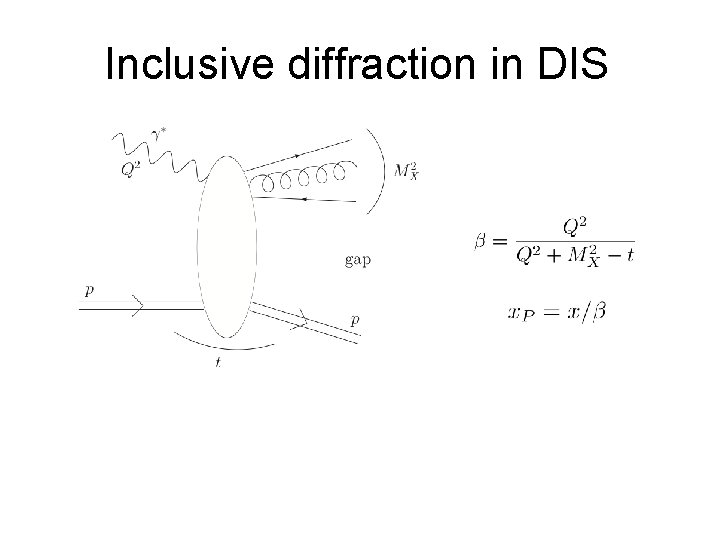
Inclusive diffraction in DIS
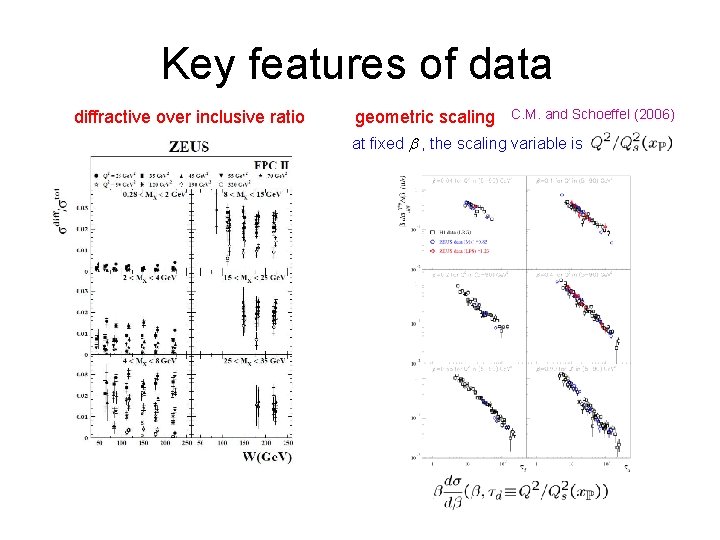
Key features of data diffractive over inclusive ratio geometric scaling C. M. and Schoeffel (2006) at fixed , the scaling variable is
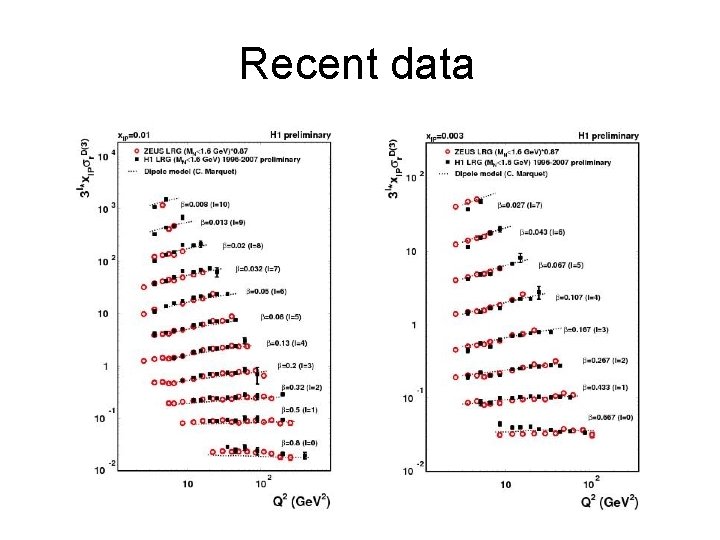
Recent data
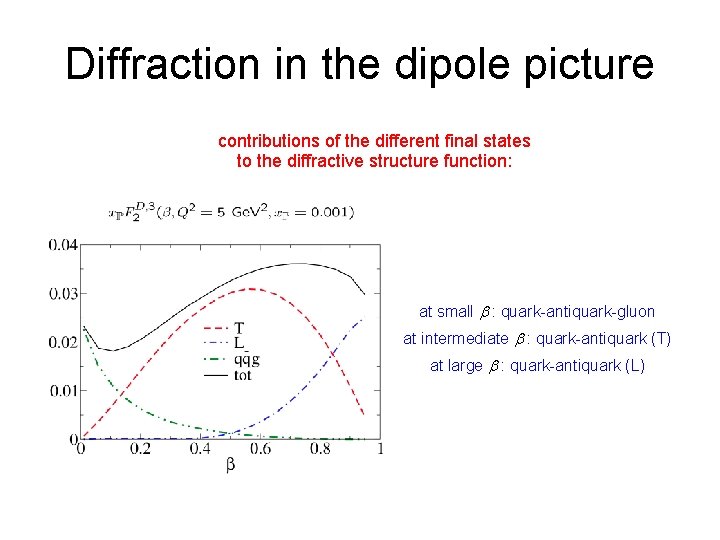
Diffraction in the dipole picture contributions of the different final states to the diffractive structure function: at small : quark-antiquark-gluon at intermediate : quark-antiquark (T) at large : quark-antiquark (L)
Nuclear diffractive structure functions Kowalski, Lappi, C. M. and Venugopalan (2008)
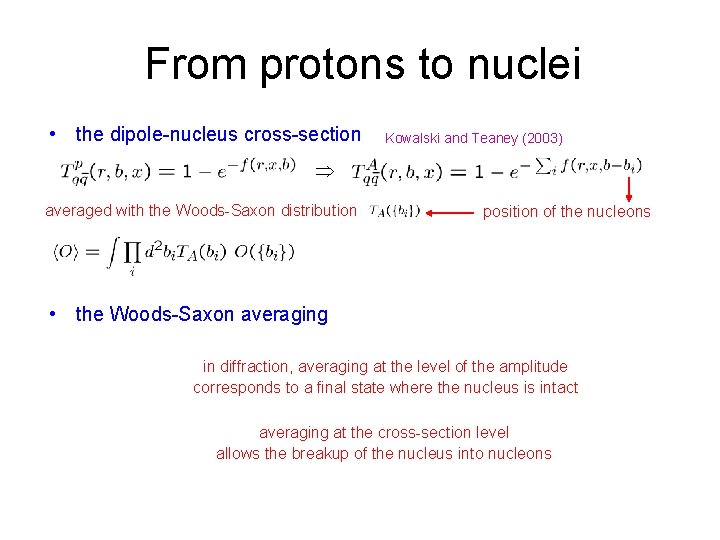
From protons to nuclei • the dipole-nucleus cross-section Kowalski and Teaney (2003) averaged with the Woods-Saxon distribution position of the nucleons • the Woods-Saxon averaging in diffraction, averaging at the level of the amplitude corresponds to a final state where the nucleus is intact averaging at the cross-section level allows the breakup of the nucleus into nucleons
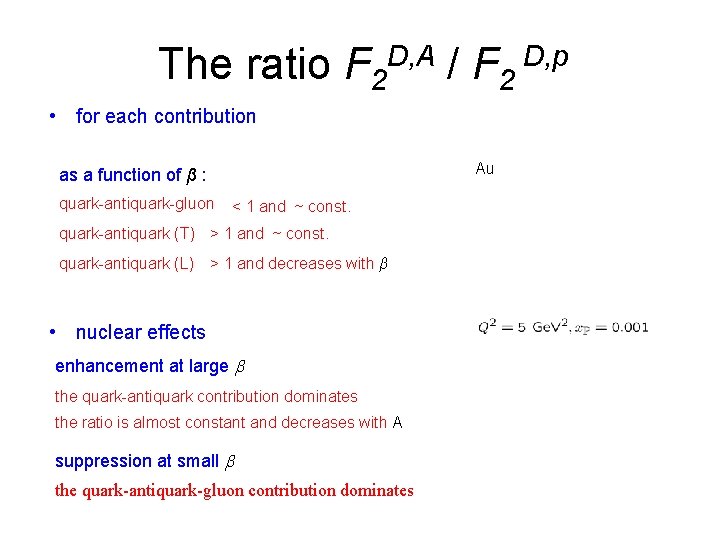
The ratio F 2 D, A / F 2 D, p • for each contribution Au as a function of β : quark-antiquark-gluon < 1 and ~ const. quark-antiquark (T) > 1 and ~ const. quark-antiquark (L) > 1 and decreases with β • nuclear effects enhancement at large the quark-antiquark contribution dominates the ratio is almost constant and decreases with A suppression at small the quark-antiquark-gluon contribution dominates
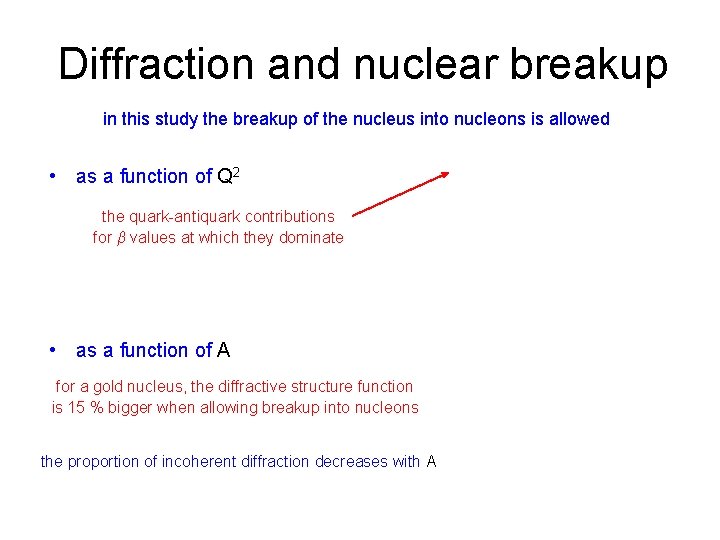
Diffraction and nuclear breakup in this study the breakup of the nucleus into nucleons is allowed • as a function of Q 2 the quark-antiquark contributions for β values at which they dominate • as a function of A for a gold nucleus, the diffractive structure function is 15 % bigger when allowing breakup into nucleons the proportion of incoherent diffraction decreases with A