
Inclusive Curriculum Development considering the needs of all


- Slides: 31
Inclusive Curriculum Development: considering the needs of all students Phil Gravestock P. Gravestock@wlv. ac. uk The University of Opportunity
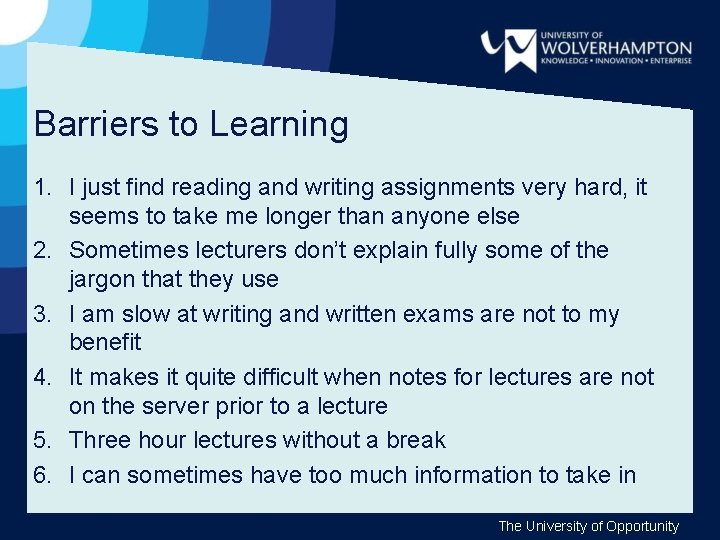
Barriers to Learning 1. I just find reading and writing assignments very hard, it seems to take me longer than anyone else 2. Sometimes lecturers don’t explain fully some of the jargon that they use 3. I am slow at writing and written exams are not to my benefit 4. It makes it quite difficult when notes for lectures are not on the server prior to a lecture 5. Three hour lectures without a break 6. I can sometimes have too much information to take in The University of Opportunity
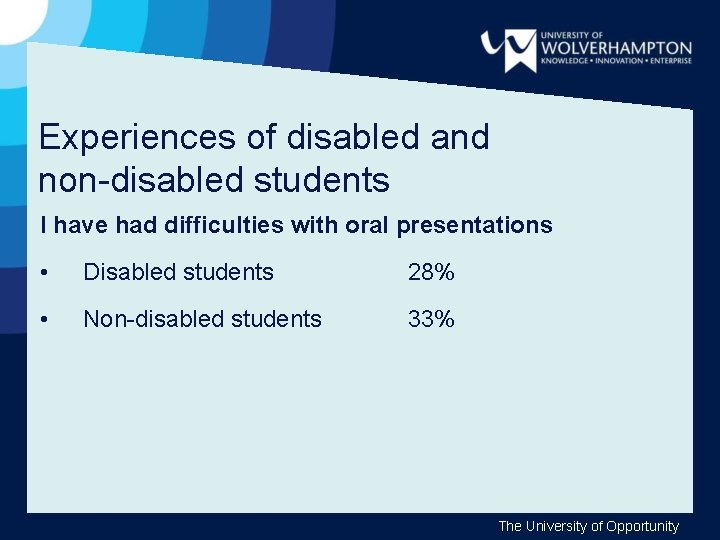
Experiences of disabled and non-disabled students I have had difficulties with oral presentations • Disabled students 28% • Non-disabled students 33% The University of Opportunity
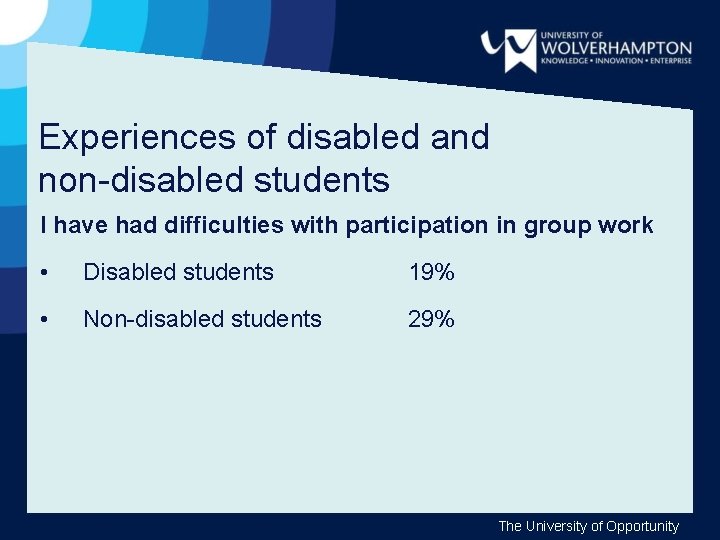
Experiences of disabled and non-disabled students I have had difficulties with participation in group work • Disabled students 19% • Non-disabled students 29% The University of Opportunity
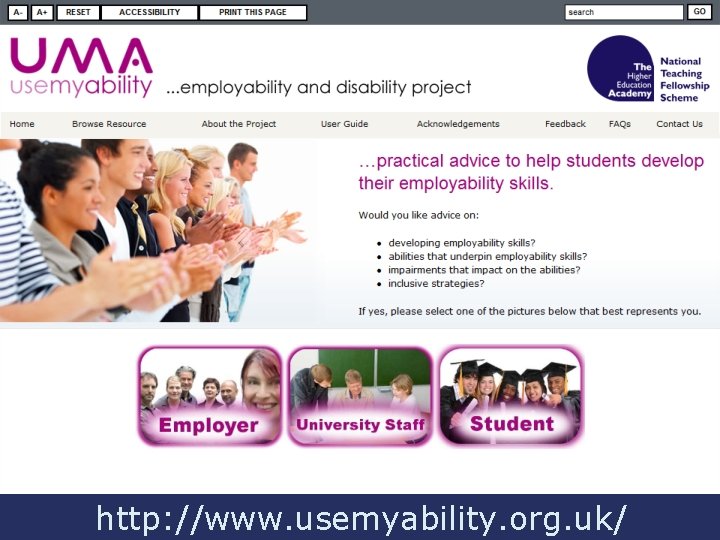
Usemyability Screenshot from the Home page of the Usemyability project website (http: //www. usemyability. org. uk/), funded by the Higher Education Academy. The screenshot shows links for employers, university staff and students, who may be accessing the site. http: //www. usemyability. org. uk/
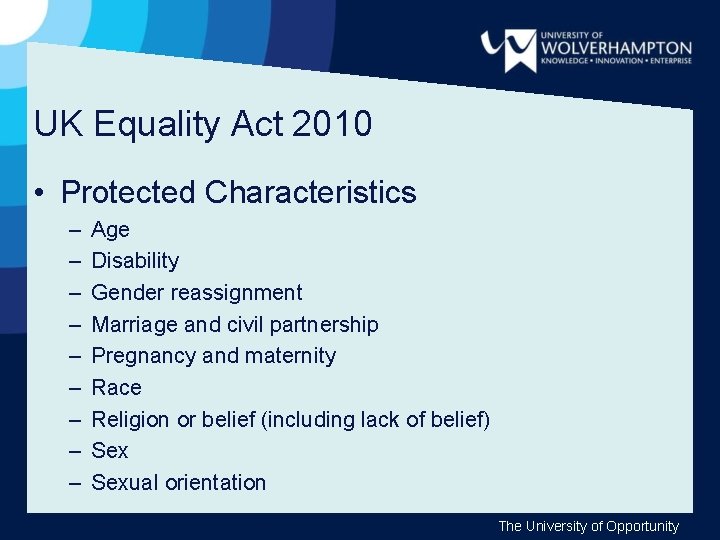
UK Equality Act 2010 • Protected Characteristics – – – – – Age Disability Gender reassignment Marriage and civil partnership Pregnancy and maternity Race Religion or belief (including lack of belief) Sexual orientation The University of Opportunity
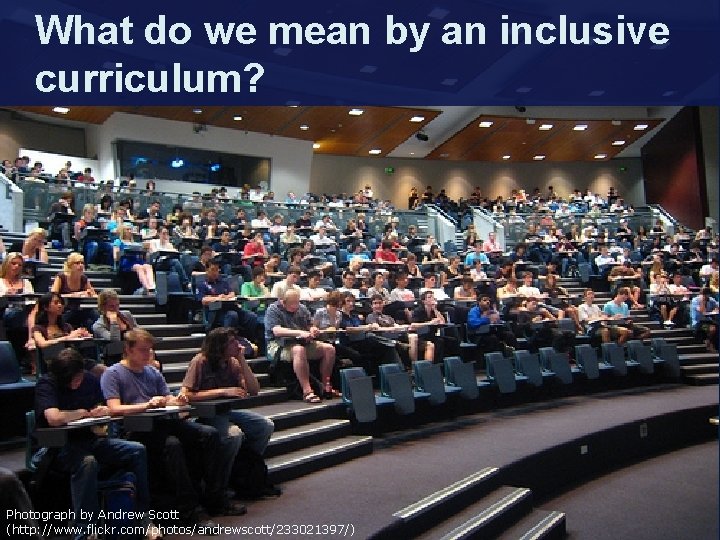
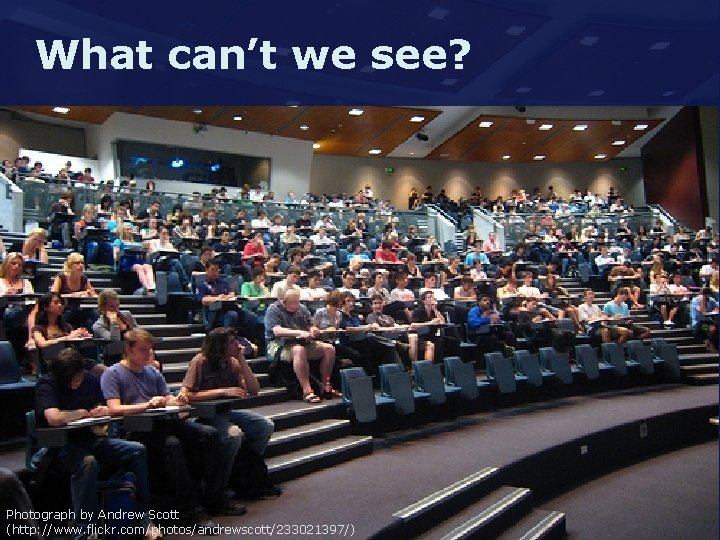
What do we mean by an inclusive curriculum? Return to the photograph of a tiered lecture theatre with students. Photograph by Andrew Scott (http: //www. flickr. com/photos/andrewscott/233021397/) What do we mean by an inclusive curriculum? Photograph by Andrew Scott (http: //www. flickr. com/photos/andrewscott/233021397/)
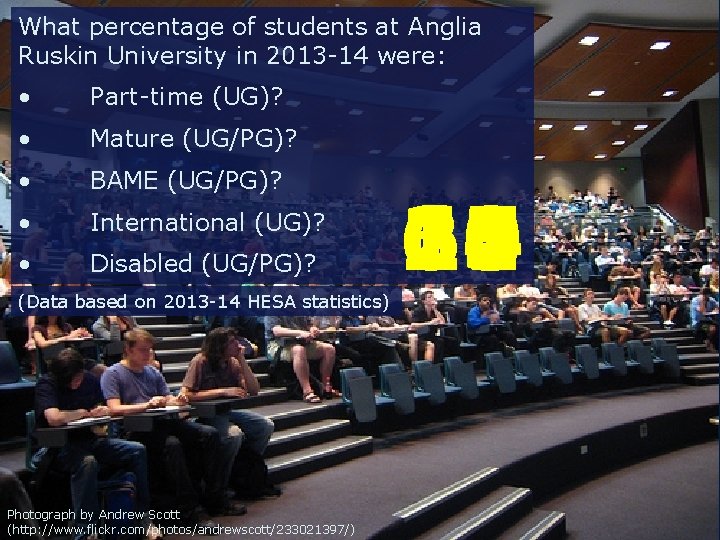
What percentage of students at Anglia Ruskin University in 2013 -14 were: • Part-time (UG)? Lecture theatre • Photograph: Mature of(UG/PG)? • Photograph a tiered lecture theatre with students. The photograph is taken • • • from the point of view of the lecturer, looking from one side of the stage area towards students. BAMEthe(UG/PG)? Photograph by Andrew Scott (http: //www. flickr. com/photos/andrewscott/233021397/ International (UG)? 10 24 65 11 23 • What percentage Disabled (UG/PG)? of students at Anglia (Data based on 2013 -14 HESA statistics) Ruskin in 2013 -14 were: • – Part-time (UG)? 23 – Mature (UG/PG)? 65 – BAME (UG/PG)? 24 – International (UG)? 11 – Disabled (UG/PG)? 10 Photograph by Andrew Scott (http: //www. flickr. com/photos/andrewscott/233021397/) (Data based on 2013 -14 HESA statistics)
What see? Whatcan’t we we see? Return to the photograph of a tiered lecture theatre with students. Photograph by Andrew Scott (http: //www. flickr. com/photos/andrewscott/233021397/)
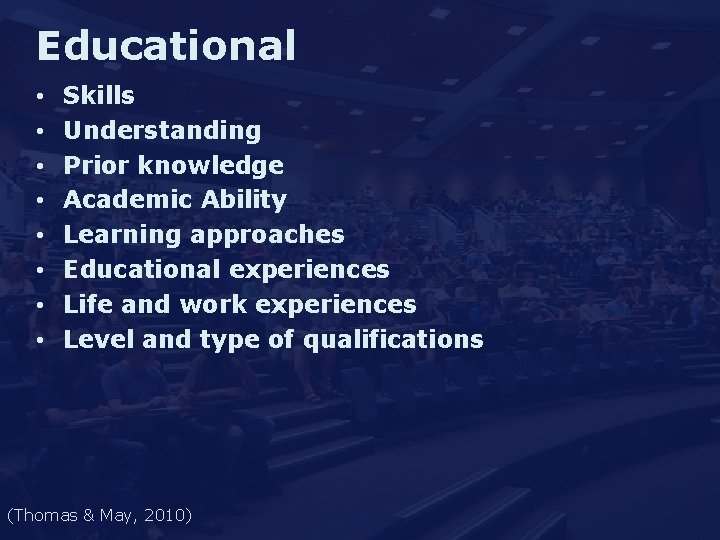
Educational • • Skills Understanding Prior knowledge Academic Ability Learning approaches Educational experiences Life and work experiences Level and type of qualifications (Thomas & May, 2010)
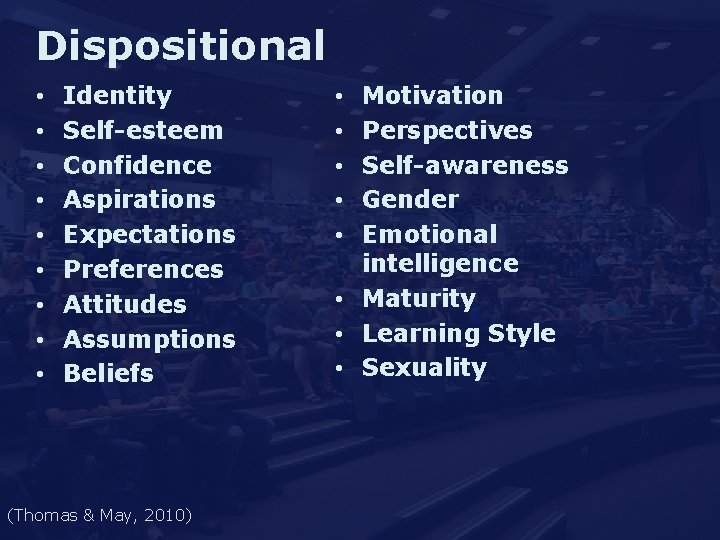
Dispositional • • • Identity Self-esteem Confidence Aspirations Expectations Preferences Attitudes Assumptions Beliefs (Thomas & May, 2010) Motivation Perspectives Self-awareness Gender Emotional intelligence • Maturity • Learning Style • Sexuality • • •
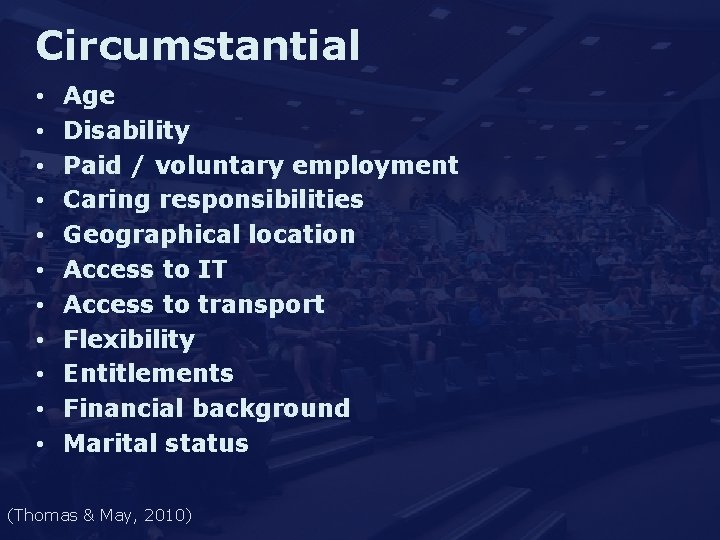
Circumstantial • • • Age Disability Paid / voluntary employment Caring responsibilities Geographical location Access to IT Access to transport Flexibility Entitlements Financial background Marital status (Thomas & May, 2010)
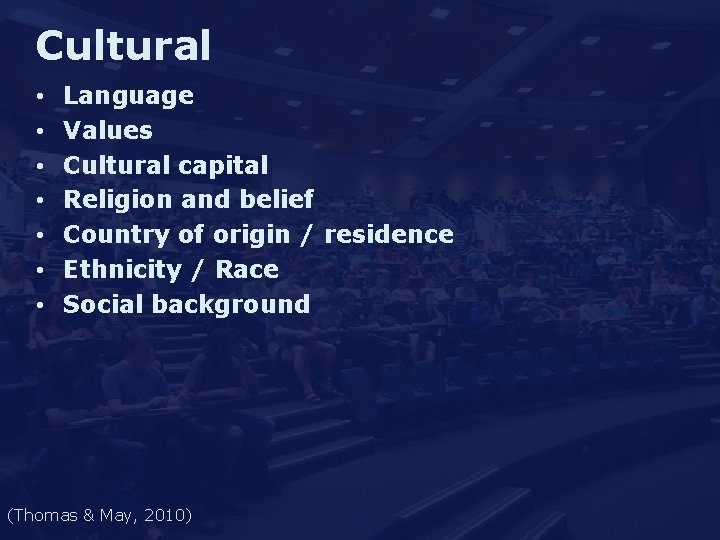
Cultural • • Language Values Cultural capital Religion and belief Country of origin / residence Ethnicity / Race Social background (Thomas & May, 2010)
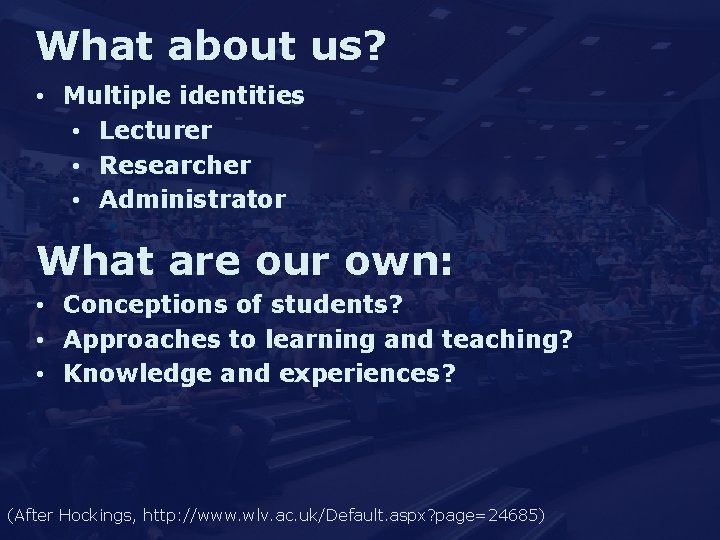
What about us? • Multiple identities • Lecturer • Researcher • Administrator What are our own: • Conceptions of students? • Approaches to learning and teaching? • Knowledge and experiences? (After Hockings, http: //www. wlv. ac. uk/Default. aspx? page=24685)
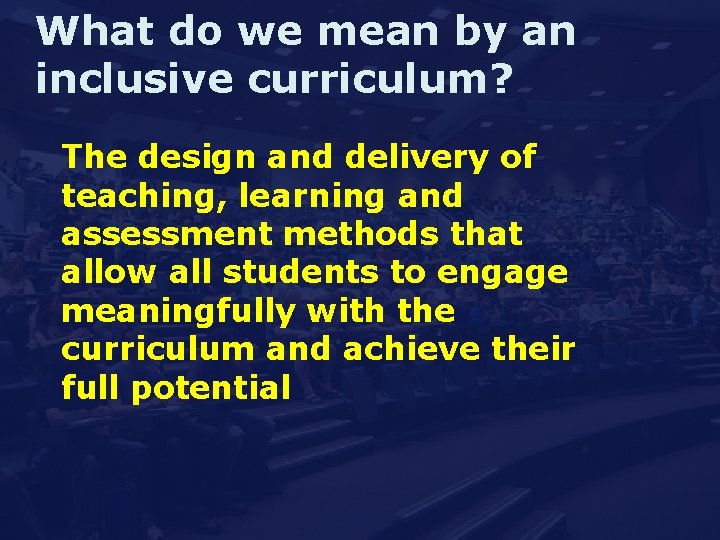
What do we mean by an inclusive curriculum? The design and delivery of teaching, learning and assessment methods that allow all students to engage meaningfully with the curriculum and achieve their full potential
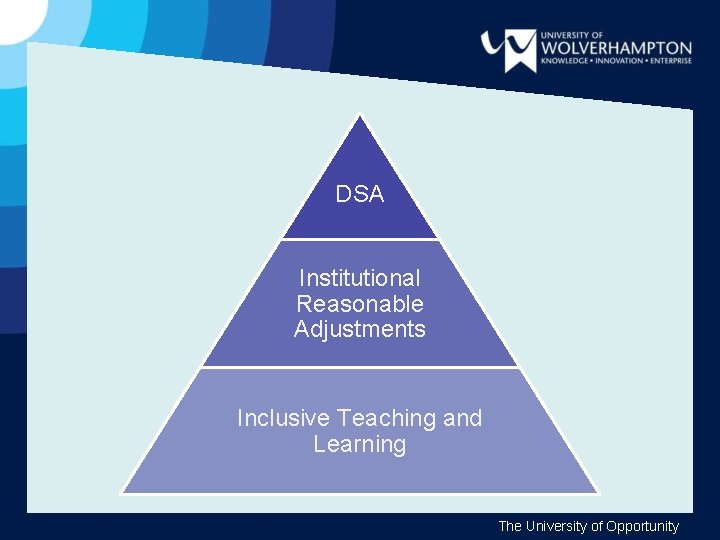
Importance of inclusive learning and teaching DSA • Diagram showing a triangle split into three sections. The three sections are divided by horizontal lines, forming three sections of equal. Institutional height. The top section at the apex Reasonable of the triangle relates to the DSA (Disabled Students’ Allowances) and is the. Adjustments smallest of the sections in terms of area; the middle section is labelled ‘Institutional Reasonable Adjustments’; and the bottom – largest area – Teaching and section is labelled. Inclusive ‘Inclusive Teaching and Learning’. Learning The University of Opportunity
Universal Design Universal Educational Design • Photograph of a dropped kerb-stone. • Photograph by Christian A. Calmeyer (http: //www. flickr. com/photos/chrisac/304327 4497/) Photograph by Christian A. Calmeyer (http: //www. flickr. com/photos/chrisac/3043274497/)
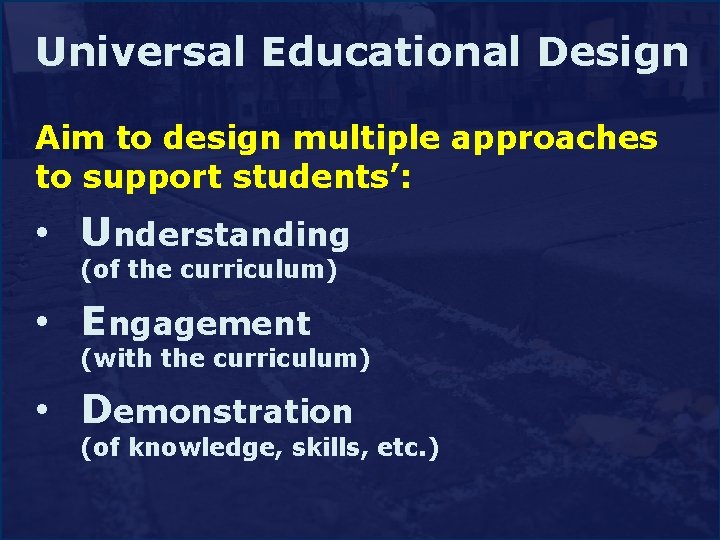
Universal Design Universal Educational Design Aim design multiple approaches Aim to to design multiple approaches to support tostudents’: support students’: • Understanding (of the curriculum) • Engagement (with the curriculum) ngagement • U • E the curriculum) • (with Demonstration (of knowledge, skills, etc. ) • Demonstration (of knowledge, skills, etc. )
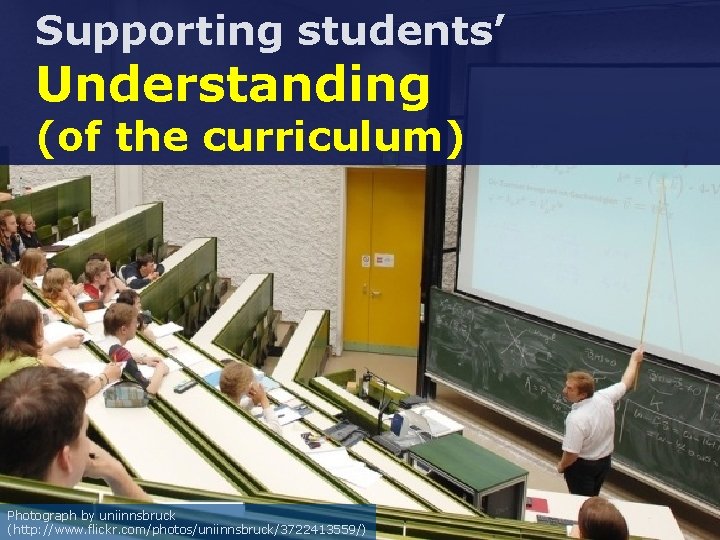
Supporting students’ understanding Understanding of the curriculum (of the curriculum) Photograph of tiered lecture theatre, looking towards the front of theatre from the point of view of a student. The lecturer is using a long pointer to point towards something on a display screen. Underneath the display screen is a blackboard with various chalk diagrams. Photograph by uniinnsbruck (http: //www. flickr. com/photos/uniinnsbruck/372 2413559/) Photograph by uniinnsbruck (http: //www. flickr. com/photos/uniinnsbruck/3722413559/)
Prompt questions: • Do students understand the terminology being used for: – Higher education (e. g. level, course, module, semester)? – Teaching and learning (e. g. seminar, lecture, blended, independent learning, collaborative learning, group work)? – Assessments (e. g. essay, report, examination, poster, in-class test)? – Regulations (e. g. plagiarism, complaint, appeal, CATS, ECTS)? • How are your students inducted into higher education and into different levels? • Is your documentation accessible? The University of Opportunity
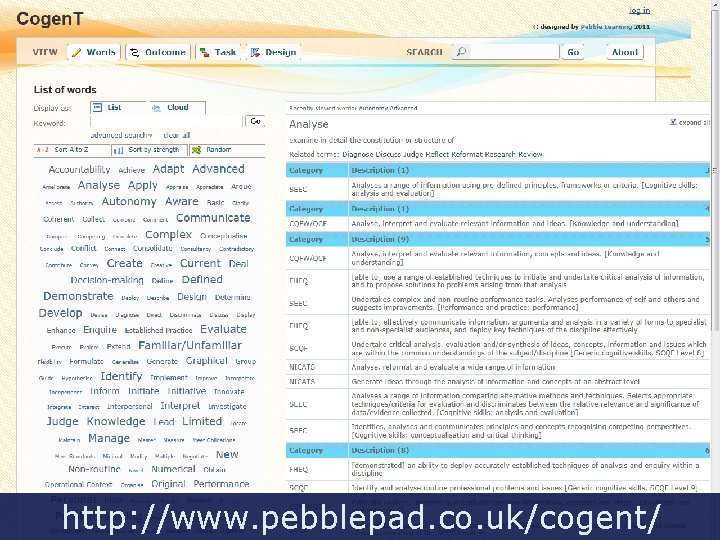
Co-gen. T Screenshot of the Co-generative Toolkit (Cogen. T) website (http: //www. pebblepad. co. uk/cogent). The view shows the vocabulary view in Co-gen. T, with a word cloud on the left-hand side. On the right hand side are level descriptors for the word ‘Analyse’. Views are seen for descriptors at levels 3 -6. http: //www. pebblepad. co. uk/cogent/
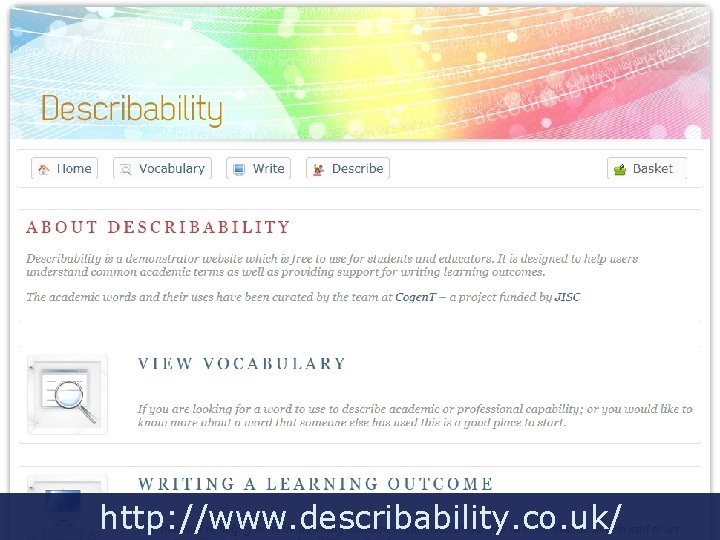
Describability Screenshot of the Describability website home page (http: //www. describability. co. uk/). The view shows the information about Describability and links to view the vocabulary and to write a learning outcome. http: //www. describability. co. uk/
Quote Exploration of high-level processes cannot, by “Exploration of high-level processes cannot, by definition, be spoon feeding; only content definition, be spoon feeding; information can be delivered by the spoonful. ” only(2006) content information can T. Haggis be delivered by the spoonful. T. Haggis (2006)
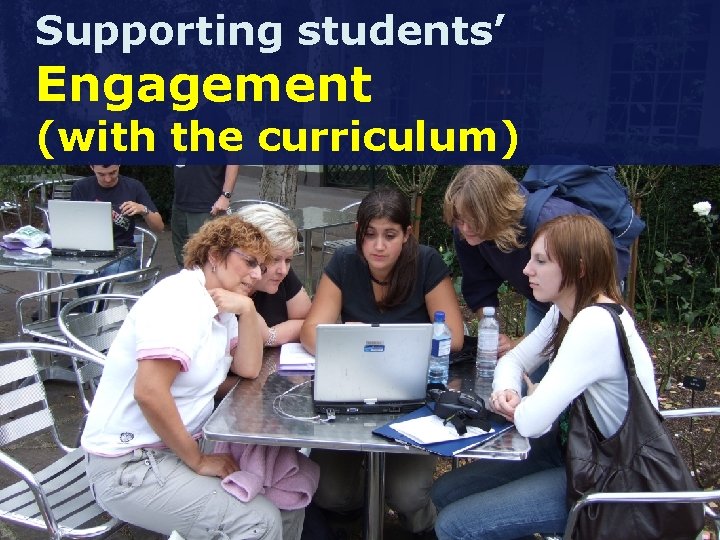
Supporting students’ engagement (with the Engagement curriculum) (with the curriculum) Photograph taken outside of a group of five students (all female, mixed age) looking at a laptop screen on a silver table. Four of the students are sitting, one is standing. In the background is a male student also sitting at a table with a laptop.
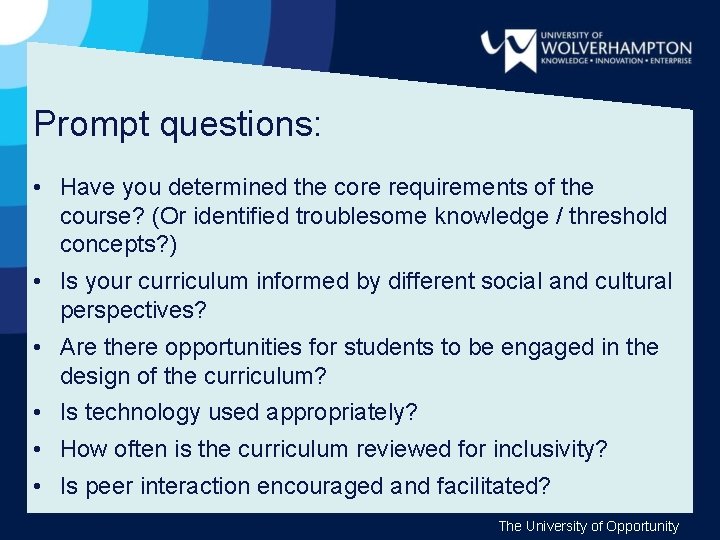
Prompt questions: • Have you determined the core requirements of the course? (Or identified troublesome knowledge / threshold concepts? ) • Is your curriculum informed by different social and cultural perspectives? • Are there opportunities for students to be engaged in the design of the curriculum? • Is technology used appropriately? • How often is the curriculum reviewed for inclusivity? • Is peer interaction encouraged and facilitated? The University of Opportunity
Digital story: Winchcombe and Tewkesbury – voices of the flood. This digital story was created by students during their induction, and investigating the 2007 floods in Gloucestershire.
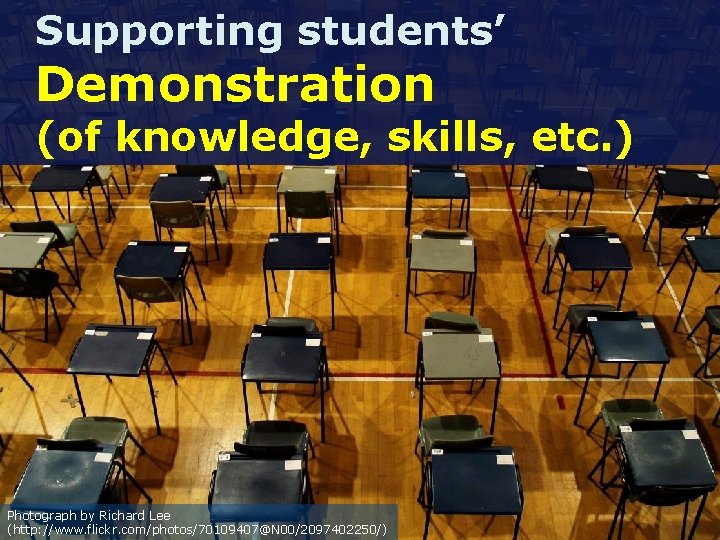
Supporting students’ demonstration Demonstration (of knowledge, skills, etc. ) Photograph of an examination hall, with individual desks and chair. No students are sitting at the desks. There is a single white rectangular card in the top right-hand corner of each desk, which possibly represents an identification card for the students. Photograph by Richard Lee (http: //www. flickr. com/photos/70109407@N 00/ 2097402250/) Photograph by Richard Lee (http: //www. flickr. com/photos/70109407@N 00/2097402250/)
Prompt questions: • Does the assessment task allow all students to demonstrate achievement of the learning outcomes? • Is the language of the assessment task inclusive? • Do students understand what they are being asked to do? • Is your feedback accessible? • Are your assessments designed to reduce / eliminate additional or alternative tasks • Are the assessment criteria written at the same level as the learning outcomes? The University of Opportunity
Assessment Approaches Assessment approaches • Contingent “Special arrangements” (e. g. extra time, • • Contingent amanuensis, separate room). Essentially – “Special arrangements” (e. g. extra time, assimilation into an existing system amanuensis, separate room). Essentially assimilation into an existing system • Alternative Generally offered as an option for a few • • Alternative students (e. g. viva voce instead of a written – Generally offered as an option for a few students assignment) (e. g. viva voce instead of a written assignment) • • Inclusive • Flexible of assessment methods made – Flexiblerange of assessment methods made available are capable of availableto toall, which are capable of assessing the same learning outcomes in different ways • (Waterfield & West, 2007)
Conclusions • Reflect upon the question: what features, or the processes of interaction, are preventing some students from accessing the curriculum effectively? • Aim to design multiple approaches to support students’: – Understanding – Engagement – Demonstration • Small changes can make a big difference The University of Opportunity
Thank you Phil Gravestock P. Gravestock@wlv. ac. uk The University of Opportunity