
Inclusionary Zoning By Carmen Charles Summer Law Student
Inclusionary Zoning By : Carmen Charles – Summer Law Student at ACTO S
Overview S What is it? S Who does it? S Case Studies – US, AUSTRALIA, CANADA S Bill 204 S Issues with IZ S Discussion

S Definitions S Inclusionary Housing: policies that support the delivery of affordable housing integrated within a community or a development (usually aimed at low to moderate income people) S Inclusionary Zoning: specific land use policy requirements which deliver affordable housing outcomes as a condition of development S IZ needs to be introduced by the provinces because municipalities lack the legal right to implement IZ without provincial enabling legislation
S Objective of IZ is to increase the supply of low – moderate income units S This includes BOTH rental and ownership units S In addition, IZ helps facilitate diversity and combats NYMBISM S 2 Main types of IZ : Voluntary, and Mandatory
S Voluntary S S S Generally characterized as a “partnership” between the private- public sector Developer chooses whether to include IZ in new developments or not Can include “incentives” for developers to “want” to build affordable housing S S Density bonusing, reduced development fees, fast track approvals Mandatory S S Legislated by state or municipality – is a precondition of building Often met with more resistance by developers S Both models have successes and failures
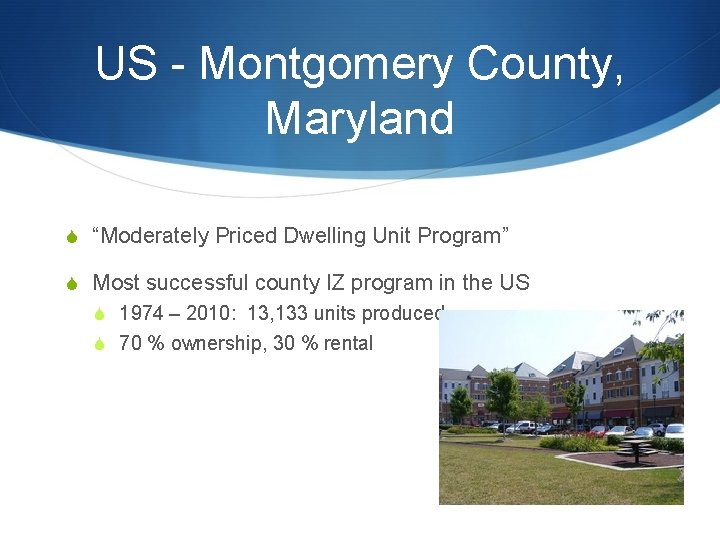
US - Montgomery County, Maryland S “Moderately Priced Dwelling Unit Program” S Most successful county IZ program in the US S 1974 – 2010: 13, 133 units produced S 70 % ownership, 30 % rental
Montgomery S Specifics: S Non profit sector gets 40 % of right of first refusal for IZ programs S They control the lease/ownership criteria S Different income tiers different population S Different layers of subsidies are used S Density bonusing isn’t set – can reach up to 22 % if 15 % of units are affordable S Ownership units remain affordable for at least 30 years S Rentals have 99 year lease
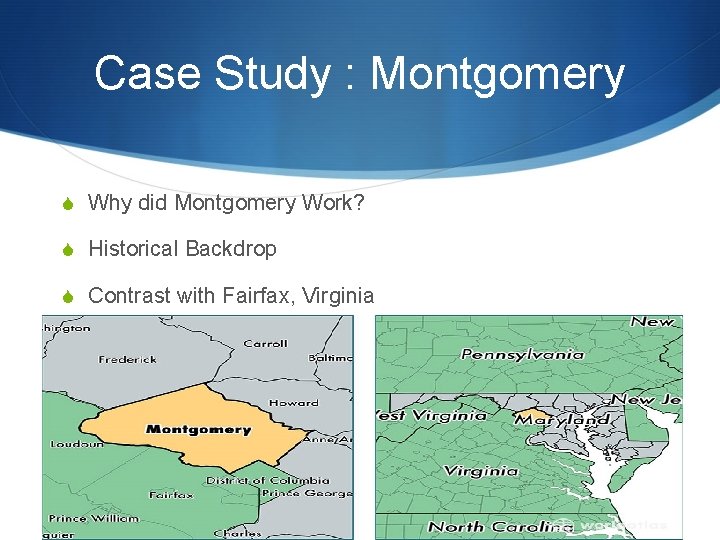
Case Study : Montgomery S Why did Montgomery Work? S Historical Backdrop S Contrast with Fairfax, Virginia
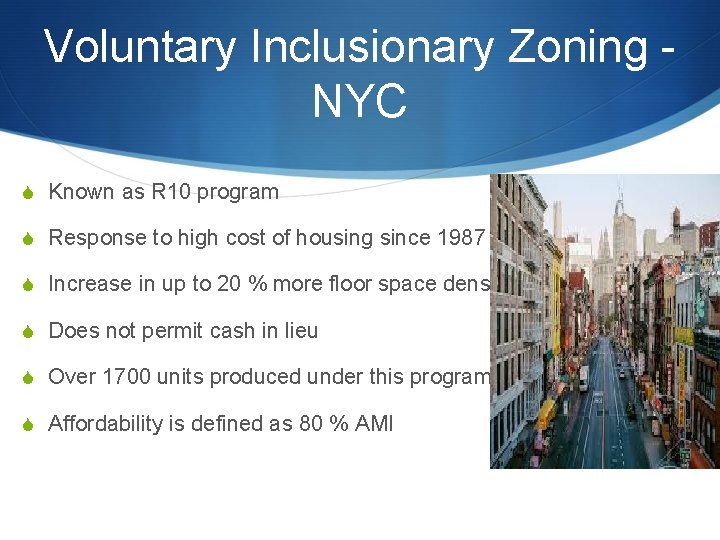
Voluntary Inclusionary Zoning NYC S Known as R 10 program S Response to high cost of housing since 1987 S Increase in up to 20 % more floor space density S Does not permit cash in lieu S Over 1700 units produced under this program S Affordability is defined as 80 % AMI
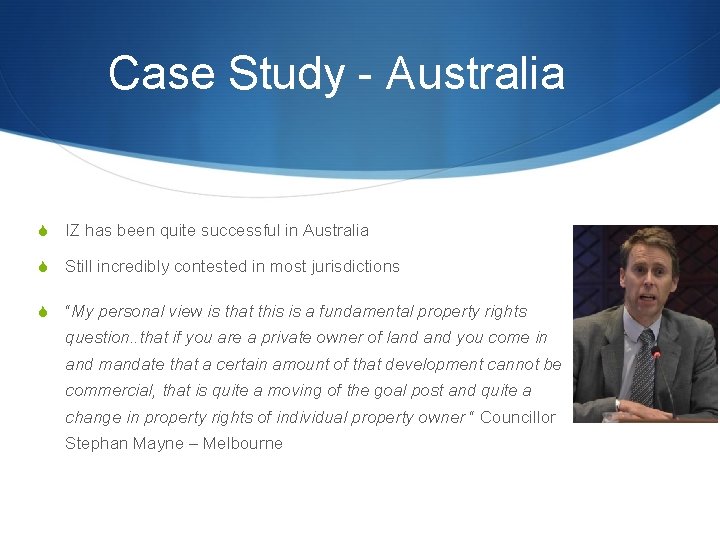
Case Study - Australia S IZ has been quite successful in Australia S Still incredibly contested in most jurisdictions S “My personal view is that this is a fundamental property rights question. . that if you are a private owner of land you come in and mandate that a certain amount of that development cannot be commercial, that is quite a moving of the goal post and quite a change in property rights of individual property owner “ Councillor Stephan Mayne – Melbourne
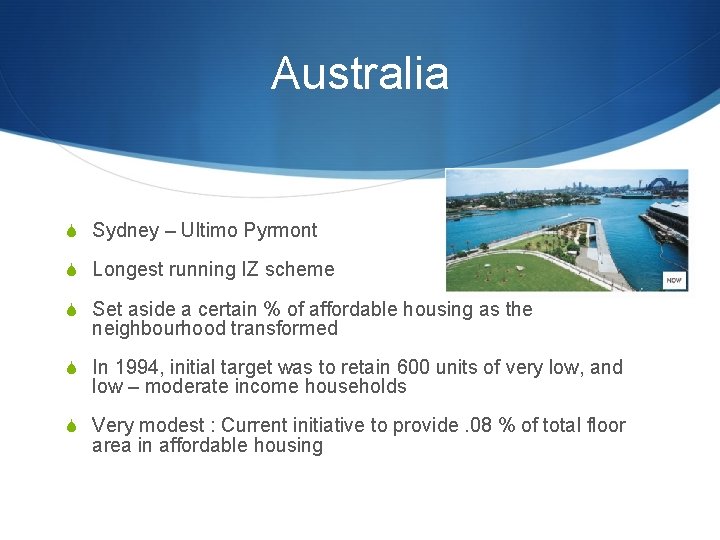
Australia S Sydney – Ultimo Pyrmont S Longest running IZ scheme S Set aside a certain % of affordable housing as the neighbourhood transformed S In 1994, initial target was to retain 600 units of very low, and low – moderate income households S Very modest : Current initiative to provide. 08 % of total floor area in affordable housing
Canada S 3 major cities have enacted inclusionary housing; Toronto, Montreal and Vancouver S These practices are not mandatory S All 3 focus on mixed communities

Comparison of Inclusionary Zoning Policies Montreal US Vancouver Toronto
Montreal S Most comprehensive of the three policies S Provide at least 30 % of new units as “affordable” in major residential developments S Applied to developments of 200 and more S Usually applied to developments needing major change to permitted land use S Policy virtually never used in Toronto
Ontario S In 1991, the City initiated a study that found requiring a modest amount of affordable units would make strides towards their affordable housing objectives S The city couldn’t implement this until the Province updated the Planning Act S In late 1980 s, Burlington implemented IZ – required 25 % of all new residential buildings to provide affordable housing. S Developer Reemark challenged Burlington at the OMB and won
Bill 204 – The Promoting Affordable Housing Act, 2016 S The proposed bill includes provisions that will allow “municipalities to implement inclusionary zoning, which mandates that affordable housing units be included in new residential projects and willing municipalities” S S. 37 of the Planning Act S Mandatory? Voluntary? S Still a lot of ambiguity
Issues with IZ S Definition of “affordable”? S Fees in lieu could possibly allow developers to “buy out” of the program, defeating the purpose of inclusionary zoning S Longevity issues S Not “deep subsidy” S IZ can be viewed as an “indirect tax” on developers discouraging them from building in areas facing supply shortages S Need other programs to make this work well S How does the province use the Homelessness

S Questions?
- Slides: 18