
INCLUSION OF STUDENTS THAT ARE GIFTED IN THE
- Slides: 44
INCLUSION OF STUDENTS THAT ARE GIFTED IN THE REGULAR CLASSROOM AND STUDENTS WITH LEARNING CHALLENGES IN THE GIFTED PROGRAM 2014
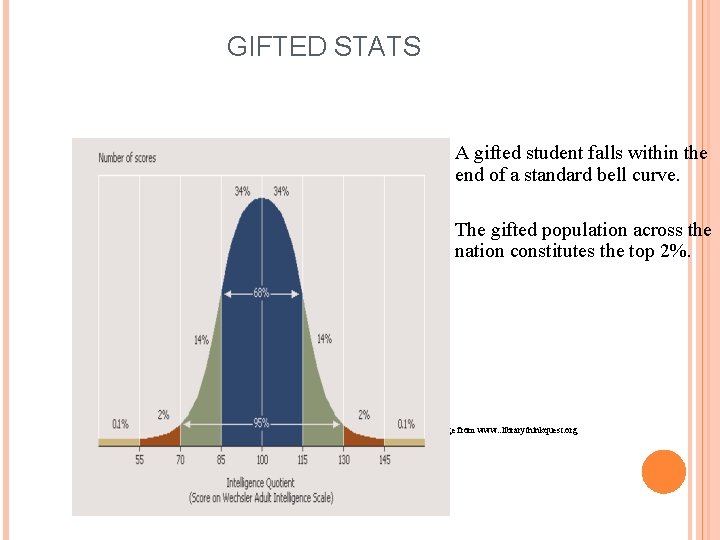
GIFTED STATS A gifted student falls within the end of a standard bell curve. The gifted population across the nation constitutes the top 2%. Image from www. . librarythinkquest. org 2
CHARACTERISTICS OF GIFTED STUDENTS With a partner/team, create a list of traits of Gifted students.
COMMON MISCONCEPTIONS ABOUT GIFTED STUDENTS: Adapted from Judy Galbraith’s book The gifted Kids’ Survival Guide Many people think that all gifted students: Know the answers Pay attention Are interested Work hard Answer questions Enjoy same-age peers Learn easily Listen well Are well-organized Are self-satisfied
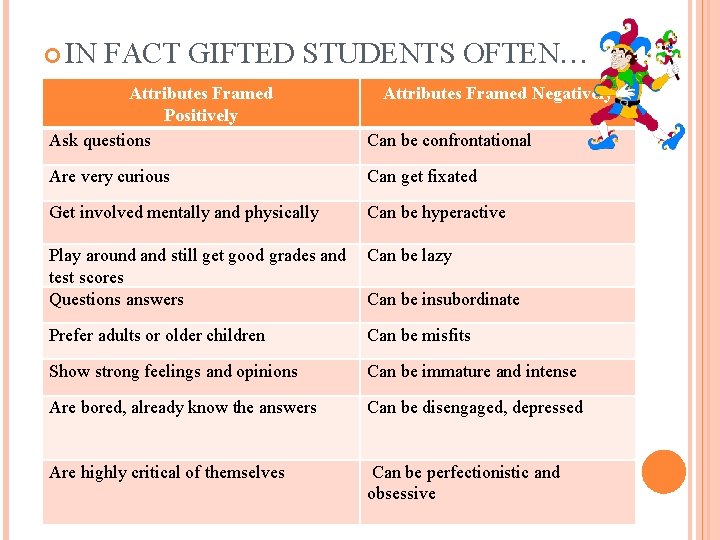
IN FACT GIFTED STUDENTS OFTEN… Attributes Framed Positively Ask questions Attributes Framed Negatively Can be confrontational Are very curious Can get fixated Get involved mentally and physically Can be hyperactive Play around and still get good grades and test scores Questions answers Can be lazy Prefer adults or older children Can be misfits Show strong feelings and opinions Can be immature and intense Are bored, already know the answers Can be disengaged, depressed Are highly critical of themselves Can be perfectionistic and obsessive Can be insubordinate
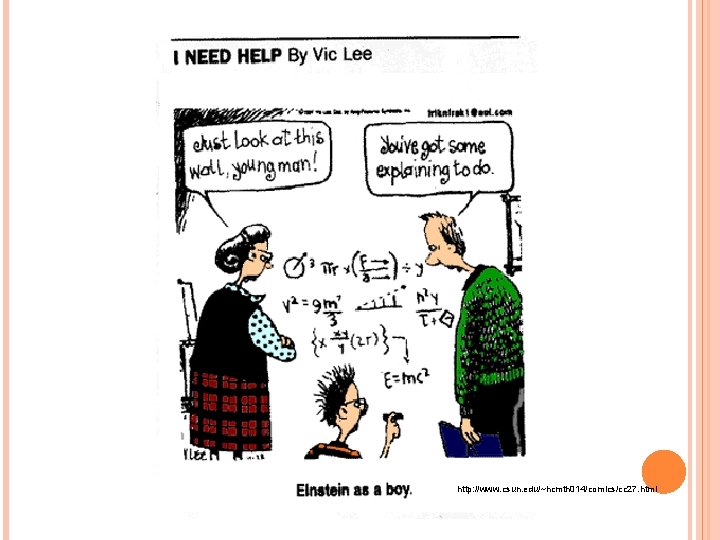
http: //www. csun. edu/~hcmth 014/comics/cc 27. html
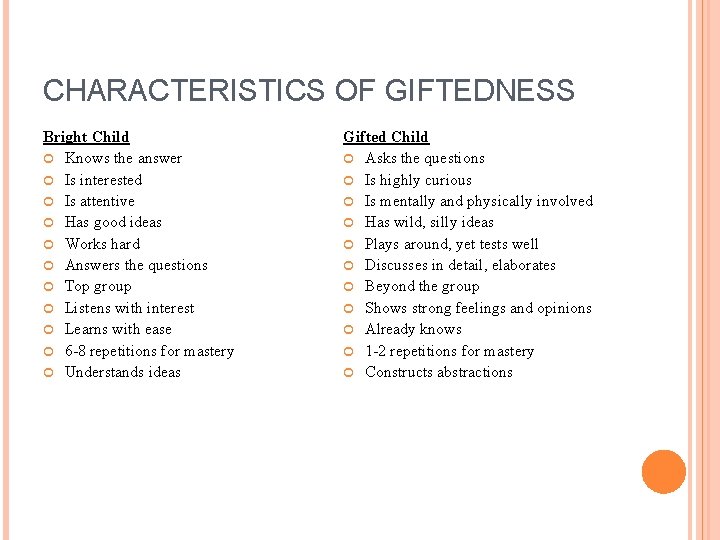
CHARACTERISTICS OF GIFTEDNESS Bright Child Knows the answer Is interested Is attentive Has good ideas Works hard Answers the questions Top group Listens with interest Learns with ease 6 -8 repetitions for mastery Understands ideas Gifted Child Asks the questions Is highly curious Is mentally and physically involved Has wild, silly ideas Plays around, yet tests well Discusses in detail, elaborates Beyond the group Shows strong feelings and opinions Already knows 1 -2 repetitions for mastery Constructs abstractions
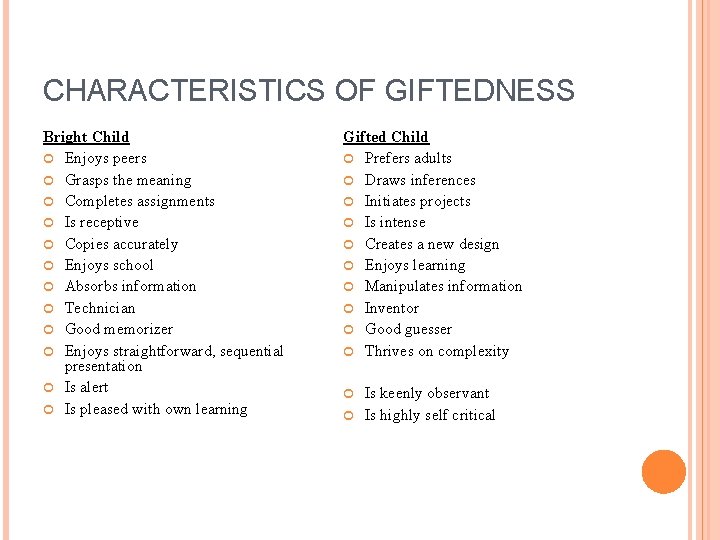
CHARACTERISTICS OF GIFTEDNESS Bright Child Enjoys peers Grasps the meaning Completes assignments Is receptive Copies accurately Enjoys school Absorbs information Technician Good memorizer Enjoys straightforward, sequential presentation Is alert Is pleased with own learning Gifted Child Prefers adults Draws inferences Initiates projects Is intense Creates a new design Enjoys learning Manipulates information Inventor Good guesser Thrives on complexity Is keenly observant Is highly self critical
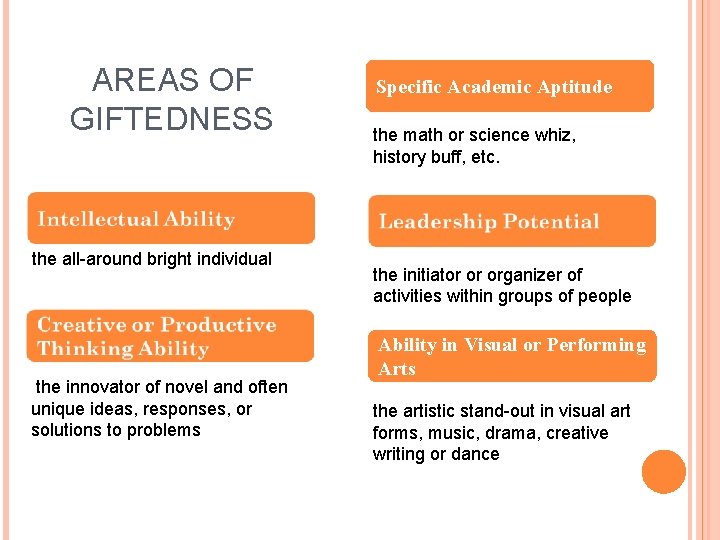
AREAS OF GIFTEDNESS the all-around bright individual the innovator of novel and often unique ideas, responses, or solutions to problems Specific Academic Aptitude the math or science whiz, history buff, etc. the initiator or organizer of activities within groups of people Ability in Visual or Performing Arts the artistic stand-out in visual art forms, music, drama, creative writing or dance
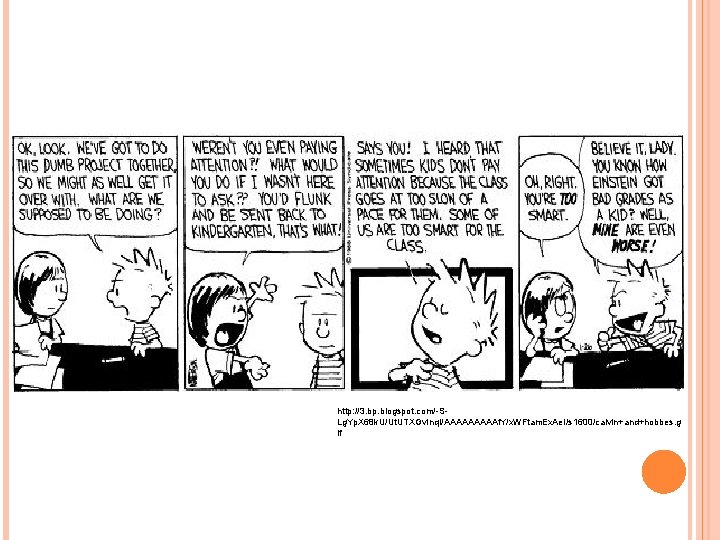
http: //3. bp. blogspot. com/-SLg. Yp. X 68 k. U/Ut. UTXGv. Inq. I/AAAAAf. Y/x. WFtam. Ex. Ae. I/s 1600/calvin+and+hobbes. g if
ASYNCHRONOUS DEVELOPMENT Gifted students develop unevenly academically socially emotionally Many adults treat gifted children like little adults because of their advanced vocabularies and complex speech patterns. But emotionally and socially they are often closer to their true age.
GIFTED CHILDREN ARE INTELLECTUALLY, EMOTIONALLY, SOCIALLY AND CULTURALLY DIVERSE! Gifted children are sweet, kind-hearted, funny, fun-loving, social, creative, impulsive, sensitive, competitive, cooperative, reclusive, leaders, loners… They also come from different cultures and ethnic backgrounds, but many minority students are underrepresented in gifted populations.
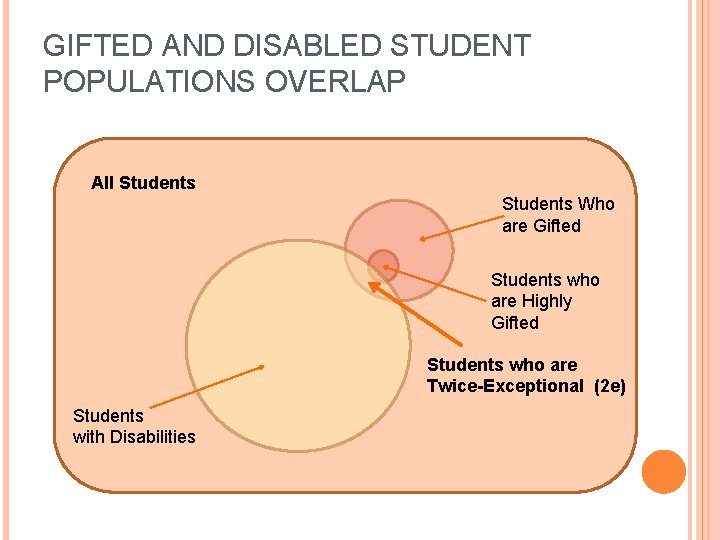
GIFTED AND DISABLED STUDENT POPULATIONS OVERLAP All Students Who are Gifted Students who are Highly Gifted Students who are Twice-Exceptional (2 e) Students with Disabilities
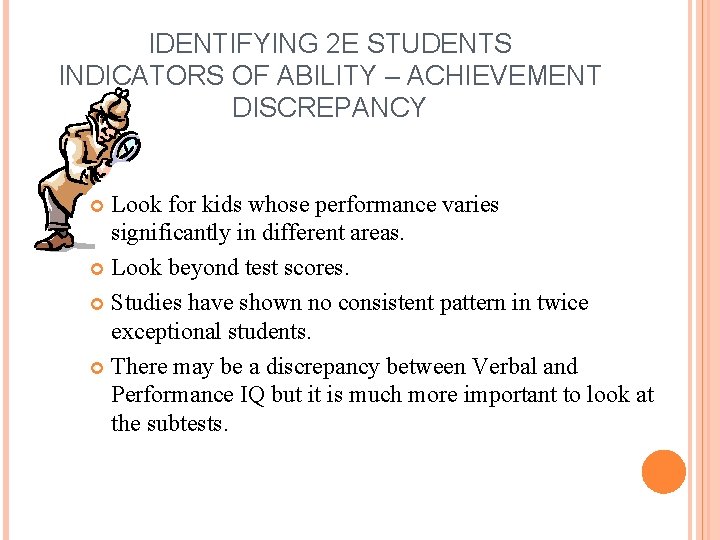
IDENTIFYING 2 E STUDENTS INDICATORS OF ABILITY – ACHIEVEMENT DISCREPANCY Look for kids whose performance varies significantly in different areas. Look beyond test scores. Studies have shown no consistent pattern in twice exceptional students. There may be a discrepancy between Verbal and Performance IQ but it is much more important to look at the subtests.
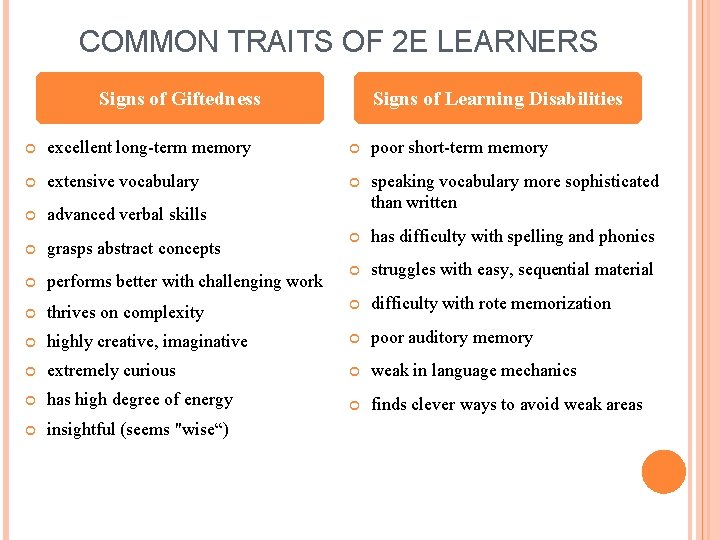
COMMON TRAITS OF 2 E LEARNERS Signs of Giftedness Signs of Learning Disabilities excellent long-term memory poor short-term memory extensive vocabulary advanced verbal skills speaking vocabulary more sophisticated than written grasps abstract concepts has difficulty with spelling and phonics performs better with challenging work struggles with easy, sequential material thrives on complexity difficulty with rote memorization highly creative, imaginative poor auditory memory extremely curious weak in language mechanics has high degree of energy finds clever ways to avoid weak areas insightful (seems "wise“)
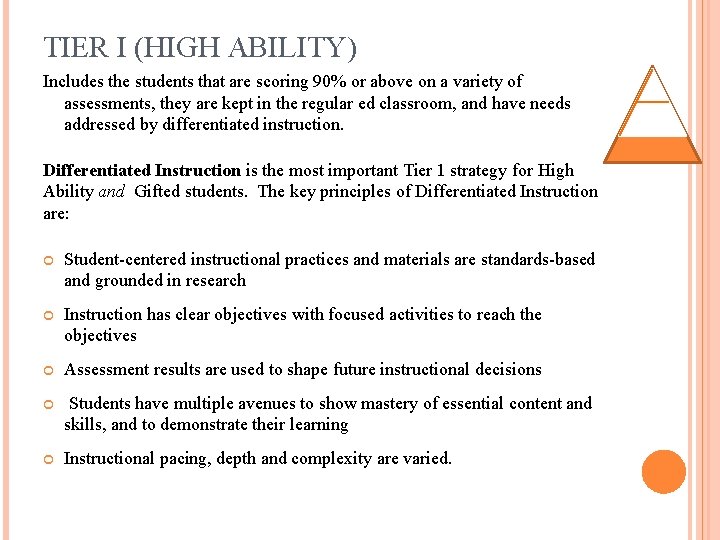
TIER I (HIGH ABILITY) Includes the students that are scoring 90% or above on a variety of assessments, they are kept in the regular ed classroom, and have needs addressed by differentiated instruction. Differentiated Instruction is the most important Tier 1 strategy for High Ability and Gifted students. The key principles of Differentiated Instruction are: Student-centered instructional practices and materials are standards-based and grounded in research Instruction has clear objectives with focused activities to reach the objectives Assessment results are used to shape future instructional decisions Students have multiple avenues to show mastery of essential content and skills, and to demonstrate their learning Instructional pacing, depth and complexity are varied.
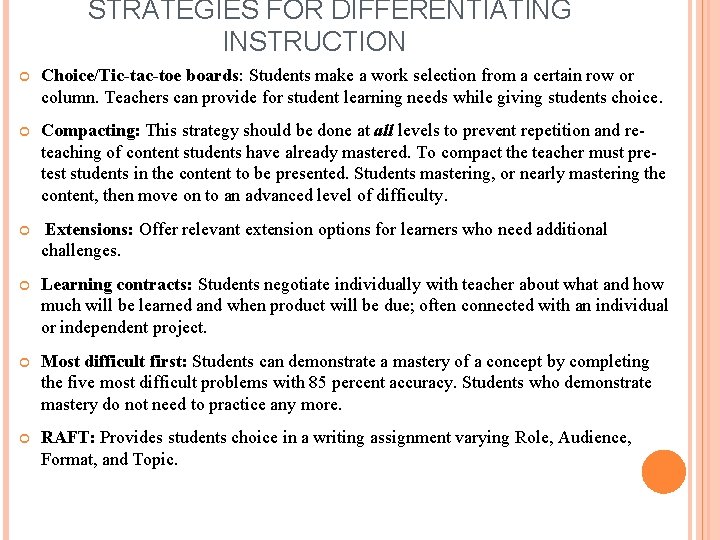
STRATEGIES FOR DIFFERENTIATING INSTRUCTION Choice/Tic-tac-toe boards: Students make a work selection from a certain row or column. Teachers can provide for student learning needs while giving students choice. Compacting: This strategy should be done at all levels to prevent repetition and reteaching of content students have already mastered. To compact the teacher must pretest students in the content to be presented. Students mastering, or nearly mastering the content, then move on to an advanced level of difficulty. Extensions: Offer relevant extension options for learners who need additional challenges. Learning contracts: Students negotiate individually with teacher about what and how much will be learned and when product will be due; often connected with an individual or independent project. Most difficult first: Students can demonstrate a mastery of a concept by completing the five most difficult problems with 85 percent accuracy. Students who demonstrate mastery do not need to practice any more. RAFT: Provides students choice in a writing assignment varying Role, Audience, Format, and Topic.
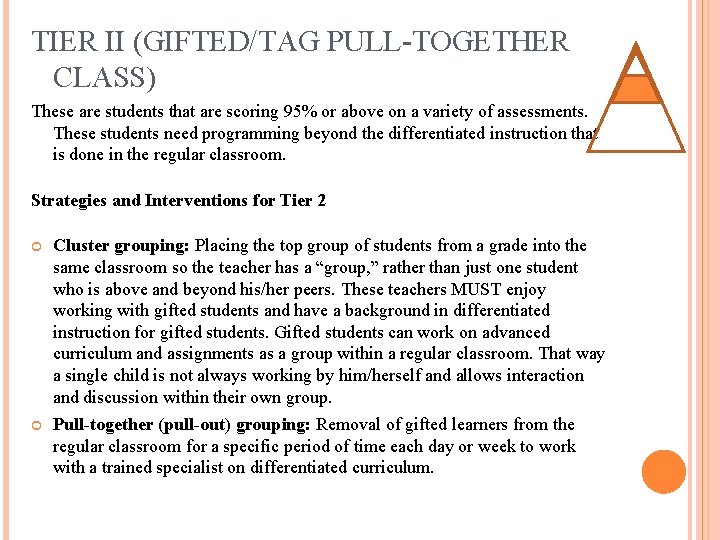
TIER II (GIFTED/TAG PULL-TOGETHER CLASS) These are students that are scoring 95% or above on a variety of assessments. These students need programming beyond the differentiated instruction that is done in the regular classroom. Strategies and Interventions for Tier 2 Cluster grouping: Placing the top group of students from a grade into the same classroom so the teacher has a “group, ” rather than just one student who is above and beyond his/her peers. These teachers MUST enjoy working with gifted students and have a background in differentiated instruction for gifted students. Gifted students can work on advanced curriculum and assignments as a group within a regular classroom. That way a single child is not always working by him/herself and allows interaction and discussion within their own group. Pull-together (pull-out) grouping: Removal of gifted learners from the regular classroom for a specific period of time each day or week to work with a trained specialist on differentiated curriculum.
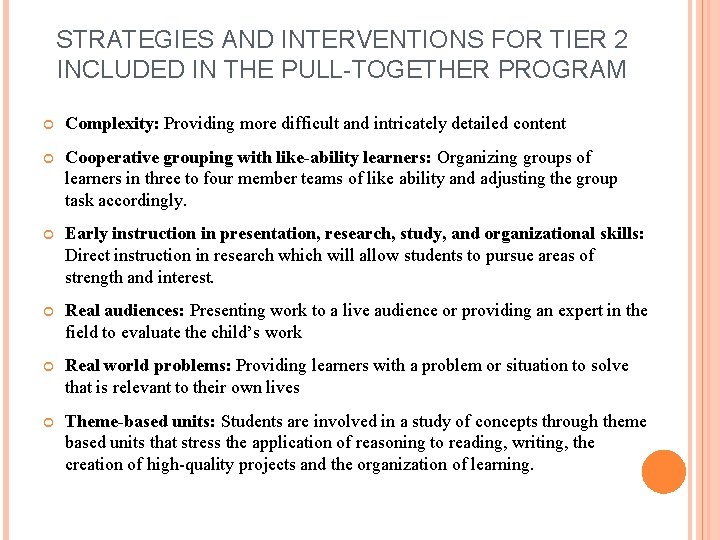
STRATEGIES AND INTERVENTIONS FOR TIER 2 INCLUDED IN THE PULL-TOGETHER PROGRAM Complexity: Providing more difficult and intricately detailed content Cooperative grouping with like-ability learners: Organizing groups of learners in three to four member teams of like ability and adjusting the group task accordingly. Early instruction in presentation, research, study, and organizational skills: Direct instruction in research which will allow students to pursue areas of strength and interest. Real audiences: Presenting work to a live audience or providing an expert in the field to evaluate the child’s work Real world problems: Providing learners with a problem or situation to solve that is relevant to their own lives Theme-based units: Students are involved in a study of concepts through theme based units that stress the application of reasoning to reading, writing, the creation of high-quality projects and the organization of learning.
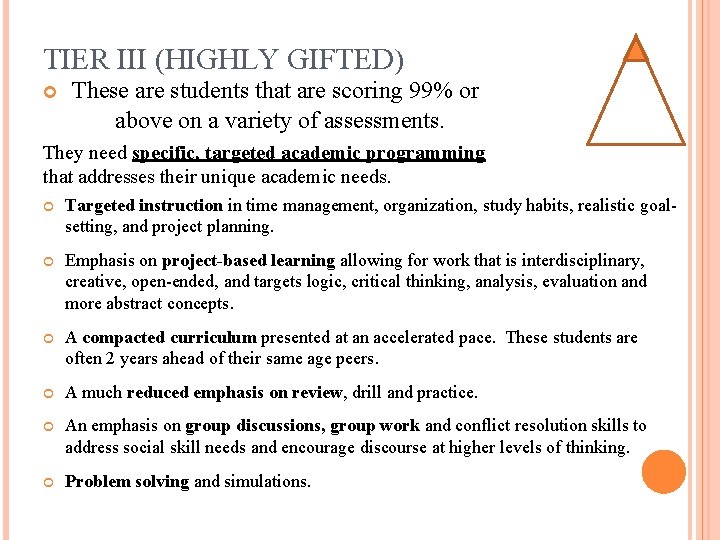
TIER III (HIGHLY GIFTED) These are students that are scoring 99% or above on a variety of assessments. They need specific, targeted academic programming that addresses their unique academic needs. Targeted instruction in time management, organization, study habits, realistic goalsetting, and project planning. Emphasis on project-based learning allowing for work that is interdisciplinary, creative, open-ended, and targets logic, critical thinking, analysis, evaluation and more abstract concepts. A compacted curriculum presented at an accelerated pace. These students are often 2 years ahead of their same age peers. A much reduced emphasis on review, drill and practice. An emphasis on group discussions, group work and conflict resolution skills to address social skill needs and encourage discourse at higher levels of thinking. Problem solving and simulations.
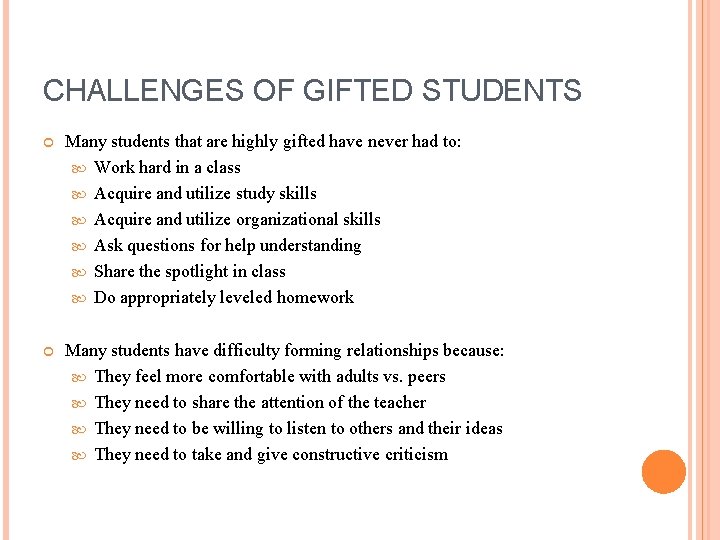
CHALLENGES OF GIFTED STUDENTS Many students that are highly gifted have never had to: Work hard in a class Acquire and utilize study skills Acquire and utilize organizational skills Ask questions for help understanding Share the spotlight in class Do appropriately leveled homework Many students have difficulty forming relationships because: They feel more comfortable with adults vs. peers They need to share the attention of the teacher They need to be willing to listen to others and their ideas They need to take and give constructive criticism
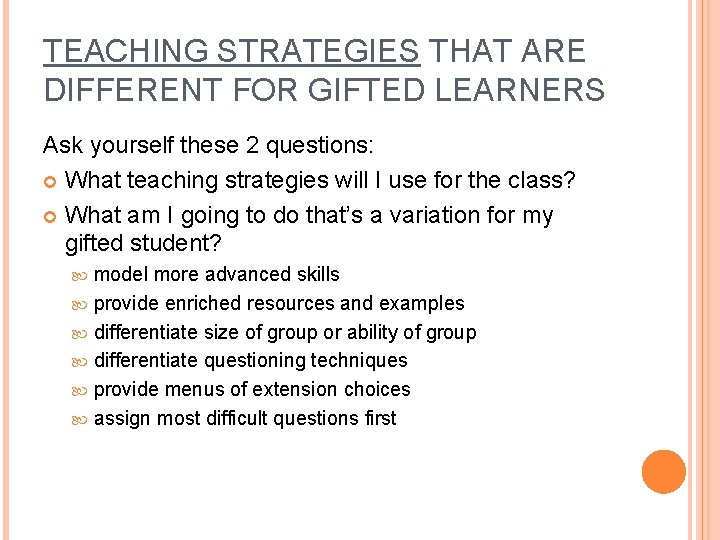
TEACHING STRATEGIES THAT ARE DIFFERENT FOR GIFTED LEARNERS Ask yourself these 2 questions: What teaching strategies will I use for the class? What am I going to do that’s a variation for my gifted student? model more advanced skills provide enriched resources and examples differentiate size of group or ability of group differentiate questioning techniques provide menus of extension choices assign most difficult questions first
EVALUATIONS FOR GIFTED LEARNERS Ask yourself these 2 questions: How (specifically) is the activity being evaluated for the rest of the class? How can the evaluation task or evaluation criteria be differed for my gifted student?
SO HOW CAN I BE MORE SUPPORTIVE? 24
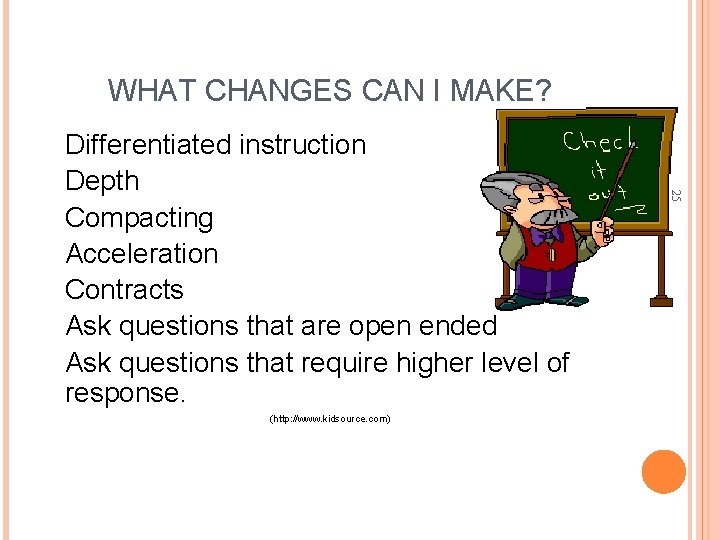
WHAT CHANGES CAN I MAKE? Differentiated instruction 25 Depth Compacting Acceleration Contracts Ask questions that are open ended Ask questions that require higher level of response. (http: //www. kidsource. com)
WHAT CHANGES CAN I MAKE…. Group interactions and simulations Guided self-management Creative projects that synthesize knowledge and ability to manipulate ideas Group gifted students together for class work 26
ACCELERATION ACCESS TO HIGHER LEVEL LEARNING ACTIVITIES THAN TYPICALLY PROVIDED IN REGULAR EDUCATION TO STUDENTS OF THE SAME AGE • • • 27 • Early Admission to Kindergarten and/or First Grade Skipping Subject-Matter Acceleration Curriculum Compacting Honors Level Courses College Level Options • Advanced Placement • College in the High School • Concurrent/Dual Enrollment
ACCELERATION CONT. Credit by examination Early entrance into Middle School, High School, or College Early Graduation 28
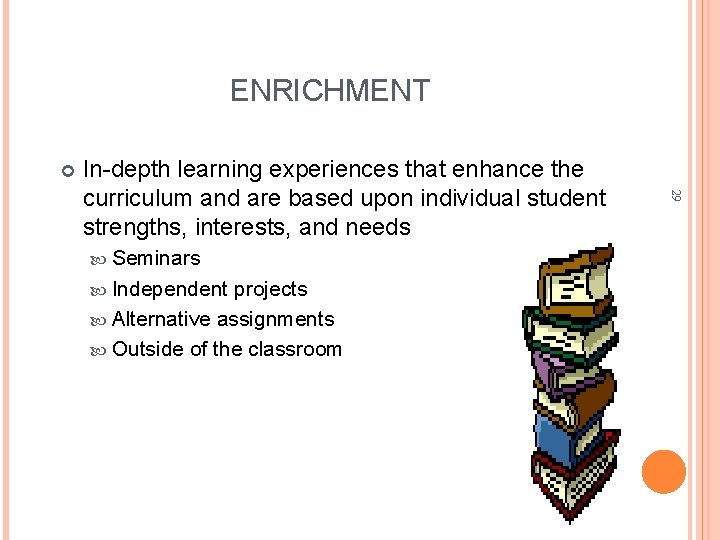
ENRICHMENT Seminars Independent projects Alternative assignments Outside of the classroom 29 In-depth learning experiences that enhance the curriculum and are based upon individual student strengths, interests, and needs
CURRICULUM DIFFERENTIATION Effective differentiation requires consideration given to grouping practices grouping - Arranging students by interest or need Cluster grouping – Ability grouping within a heterogeneous classroom Cooperative learning groups – More than just group work 30 Flexible
DIFFERENTIATION IS TWOFOLD Group/class 31 The curriculum, instruction and/or assessment is modified to better suit the needs of the class or group An honors level class must be different from a regular level class Individual The curriculum, instruction and/or assessment are modified to meet the needs of the individual students in the class
DIFFERENTIATION Content of core learning, using both acceleration and enrichment strategies Exposure to challenging and specialized resources Stress higher-level thinking, creativity, and problem solving skills Set high standards that demand rigorous expectations for student work and performance demonstration 32 Extension
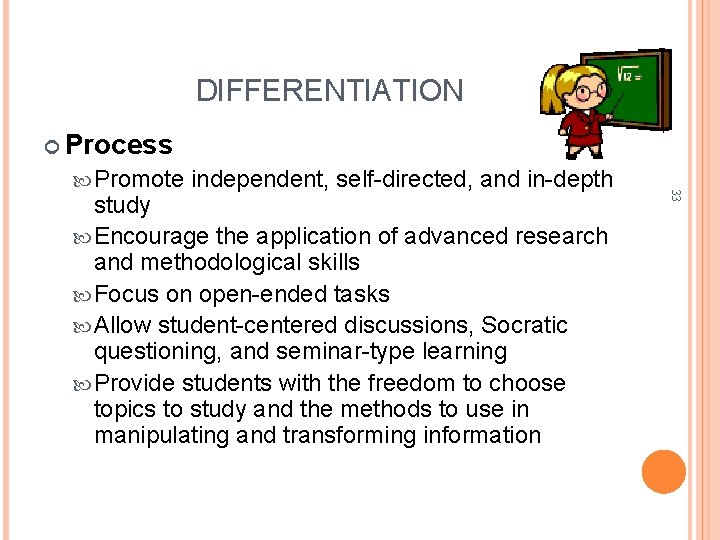
DIFFERENTIATION Process independent, self-directed, and in-depth study Encourage the application of advanced research and methodological skills Focus on open-ended tasks Allow student-centered discussions, Socratic questioning, and seminar-type learning Provide students with the freedom to choose topics to study and the methods to use in manipulating and transforming information 33 Promote
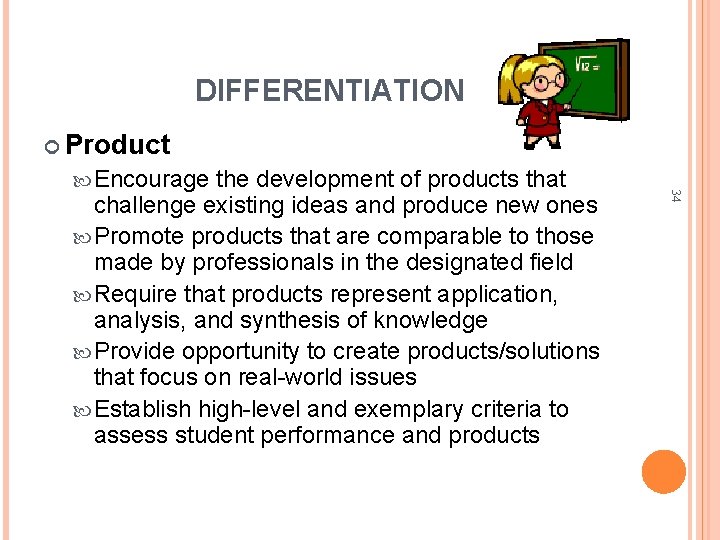
DIFFERENTIATION Product the development of products that challenge existing ideas and produce new ones Promote products that are comparable to those made by professionals in the designated field Require that products represent application, analysis, and synthesis of knowledge Provide opportunity to create products/solutions that focus on real-world issues Establish high-level and exemplary criteria to assess student performance and products 34 Encourage
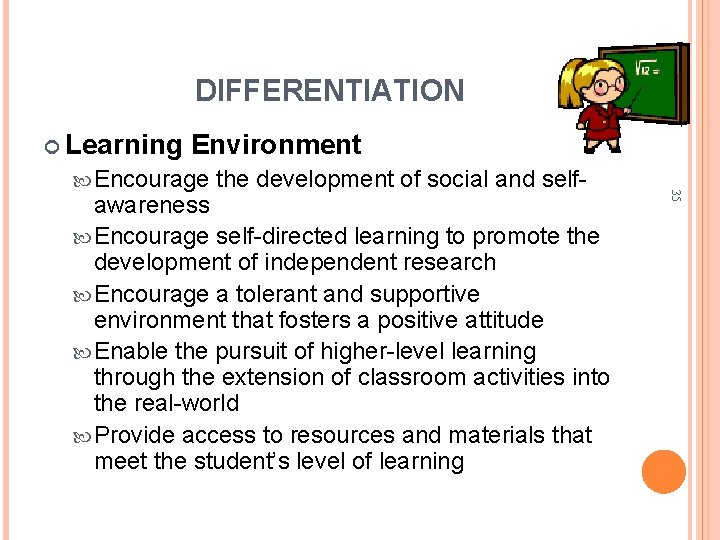
DIFFERENTIATION Learning Environment the development of social and self- awareness Encourage self-directed learning to promote the development of independent research Encourage a tolerant and supportive environment that fosters a positive attitude Enable the pursuit of higher-level learning through the extension of classroom activities into the real-world Provide access to resources and materials that meet the student’s level of learning 35 Encourage
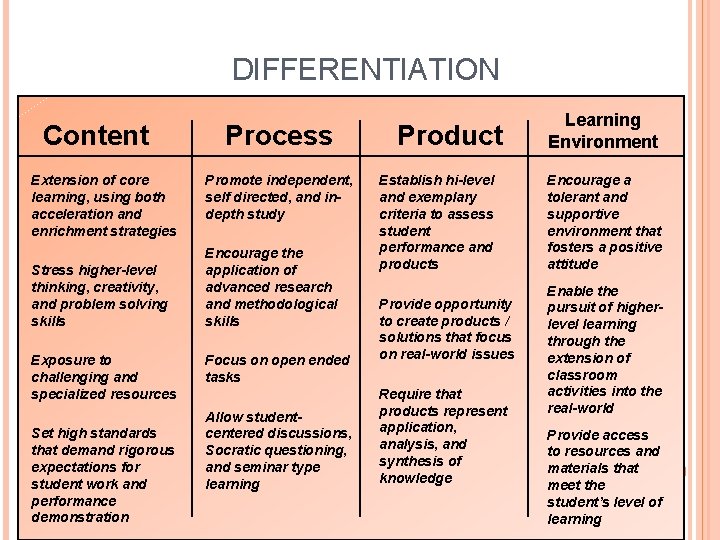
DIFFERENTIATION Content Stress higher-level thinking, creativity, and problem solving skills Exposure to challenging and specialized resources Set high standards that demand rigorous expectations for student work and performance demonstration Promote independent, self directed, and indepth study Encourage the application of advanced research and methodological skills Focus on open ended tasks Allow studentcentered discussions, Socratic questioning, and seminar type learning Product Establish hi-level and exemplary criteria to assess student performance and products Provide opportunity to create products / solutions that focus on real-world issues Require that products represent application, analysis, and synthesis of knowledge Encourage a tolerant and supportive environment that fosters a positive attitude 36 Extension of core learning, using both acceleration and enrichment strategies Process Learning Environment Enable the pursuit of higherlevel learning through the extension of classroom activities into the real-world Provide access to resources and materials that meet the student’s level of learning
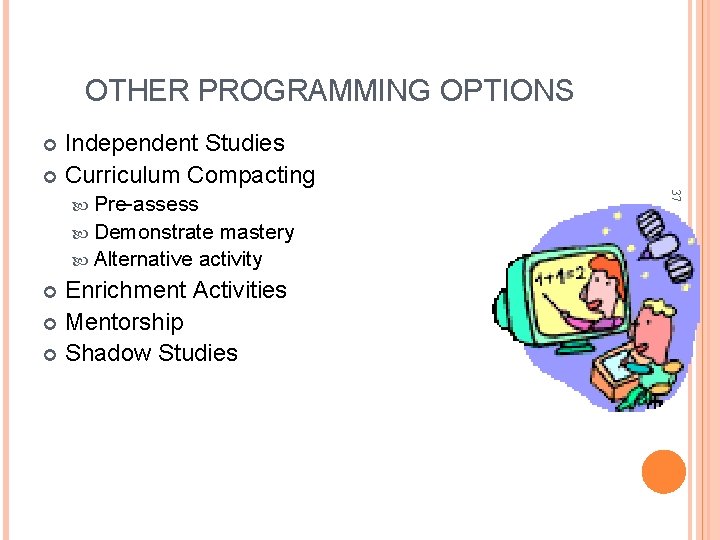
OTHER PROGRAMMING OPTIONS Independent Studies Curriculum Compacting Demonstrate mastery Alternative activity Enrichment Activities Mentorship Shadow Studies 37 Pre-assess
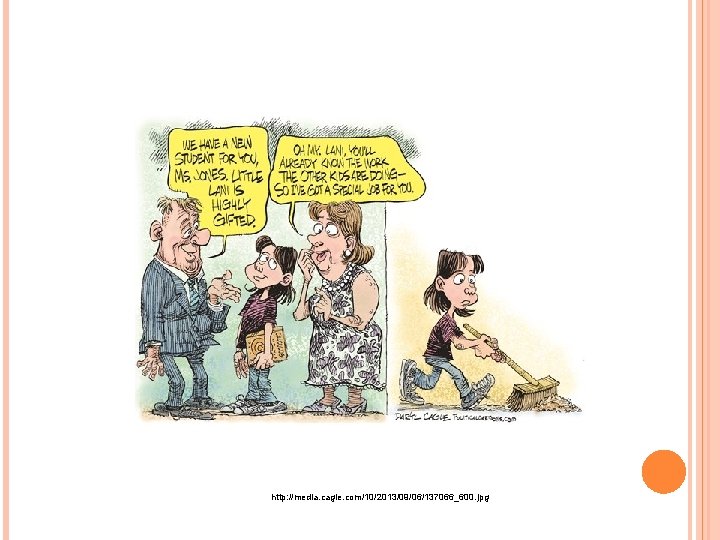
REMEMBER… 38 Remember for gifted children, you are replacing their curriculum with material they have not mastered not just adding more work because they have finished their assignments early.
http: //media. cagle. com/10/2013/09/06/137066_600. jpg
REMEMBER… Remember for gifted children, you are replacing their curriculum with material they have not mastered not just adding more work because they have finished their assignments early. Remember we need to add breadth and depth to a gifted child’s curriculum. Remember we need to match the material to the child and not the child the material. 40
WHAT RESOURCES ARE OUT THERE TO HELP ME? 41
RESOURCES http: //www. eds-resources. com/edgifted. html http: //differentiationcentral. com//Lesson_Plans. html 42 http: //www. hoagiesgifted. org/investigations. htm
REFERENCES Pennsylvania 43 Department of Education Kidsource website School history website Dr. Edmund Sass’s website Georgia Learning Connections website Szabos, J 1989. Challenge. Good Apple 34. Ephrata Area School District Gifted Presentation
SUPPORTS District/School Gifted Teacher District Gifted Supervisor Doreen Milot, IU 29 Gifted Liaison dlm@iu 29. org 570 -544 -9131 Ext. 1273