
Inclusion criteria and longterm results of bilateral presbyopia
Inclusion criteria and long-term results of bilateral presbyopia correction by SUPRACOR method Anisimova S. Yu, Anisimov S. I. , Anisimova N. S. , Semyonov S. V. , Novak I. V. , Fastovtsova L. G. Eye center VOSTOK-PROZRENIE, Moscow, Russia No financial interest

Purpose To determine inclusion criteria and evaluate longterm results of SUPRACOR treatment, performed bilaterally in cases of presbyopia with ametropia
Materials and methods o 92 patients (182 eyes): presbyopia combined with hyperopia. Observation period 6 years o 16 patients (32 eyes): presbyopia combined with myopia. Observation period 3 years
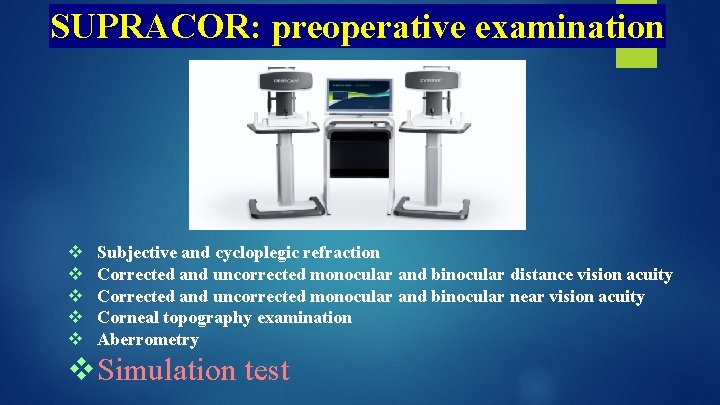
SUPRACOR: preoperative examination v v v Subjective and cycloplegic refraction Corrected and uncorrected monocular and binocular distance vision acuity Corrected and uncorrected monocular and binocular near vision acuity Corneal topography examination Aberrometry v Simulation test
SUPRACOR inclusion criteria for all patients ☛ 44 – 60 years old ☛ Sph from +0. 25 D to + 5. 0 D ☛ Sph from -2. 0 D to -5. 0 D ☛ Cyl up 2. 0 D ☛ Angle Kappa not more than 10 degrees ☛ Best corrected distance vision acuity 0. 1 - 0. 0 (logmar) ☛ Difference between subjective and cycloplegic refraction ☛ Near vision addition + 1. 5 D and more. ☛ Photopic pupil diameter not more than 2. 9 mm. ☛ Mesopic pupil diameter not more than 6. 5 mm. ☛ No LASIK contraindications 0. 75 D and less
SUPRACOR simulation test Simulation test of post/op distance vision acuity: Add sph+0. 5 to best correction of distance vision. “so the distance vision may look like after the surgery” If the patient doesn’t like the result=>do not perform SUPRACOR!
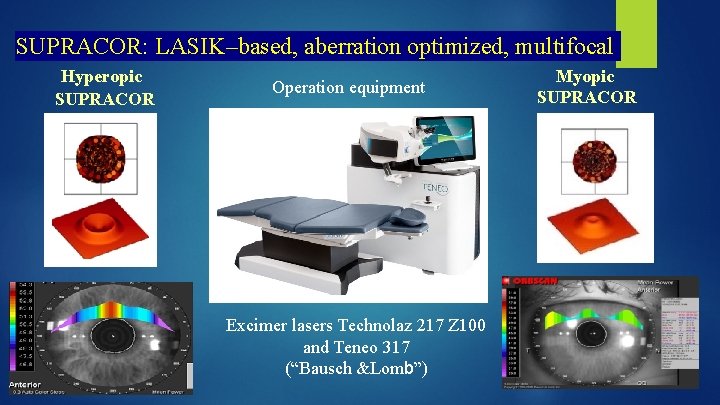
SUPRACOR: LASIK–based, aberration optimized, multifocal Myopic Hyperopic Operation equipment SUPRACOR Excimer lasers Technolaz 217 Z 100 and Teneo 317 (“Bausch &Lomb”)
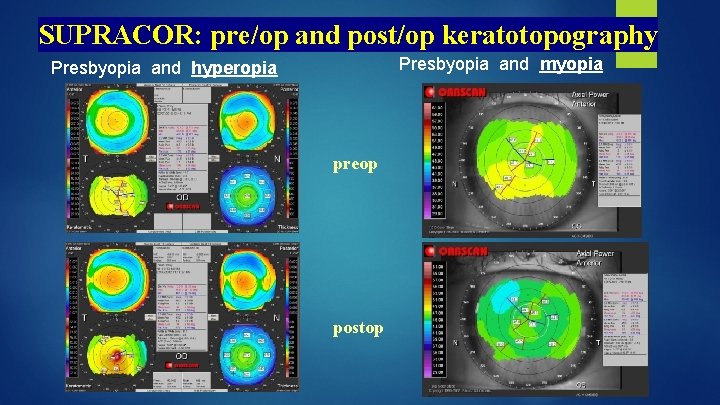
SUPRACOR: pre/op and post/op keratotopography Presbyopia and myopia Presbyopia and hyperopia preop postop
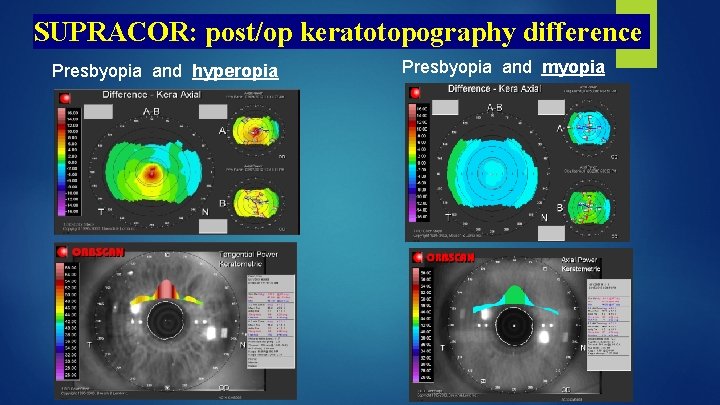
SUPRACOR: post/op keratotopography difference Presbyopia and hyperopia . Presbyopia and myopia
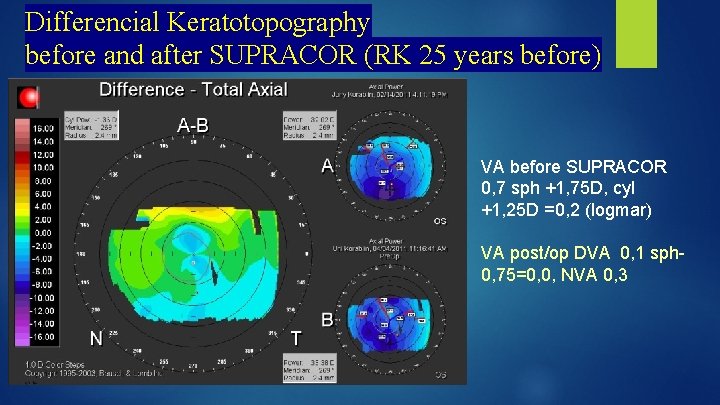
Differencial Keratotopography before and after SUPRACOR (RK 25 years before) VA before SUPRACOR 0, 7 sph +1, 75 D, cyl +1, 25 D =0, 2 (logmar) VA post/op DVA 0, 1 sph 0, 75=0, 0, NVA 0, 3
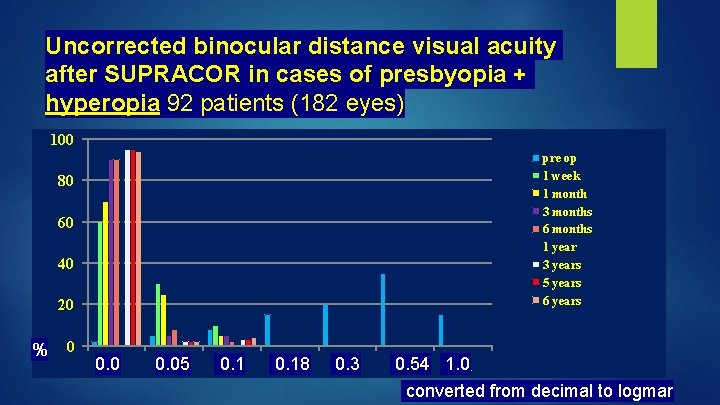
Uncorrected binocular distance visual acuity after SUPRACOR in cases of presbyopia + hyperopia 92 patients (182 eyes) 100 pre op 1 week 1 month 3 months 6 months 1 year 3 years 5 years 6 years 80 60 40 20 % 0 0. 01 0. 05 0. 9 0. 1 0. 8 0. 18 0. 7 0. 3 0. 54 1. 0 0. 3 0. 1 converted from decimal to logmar
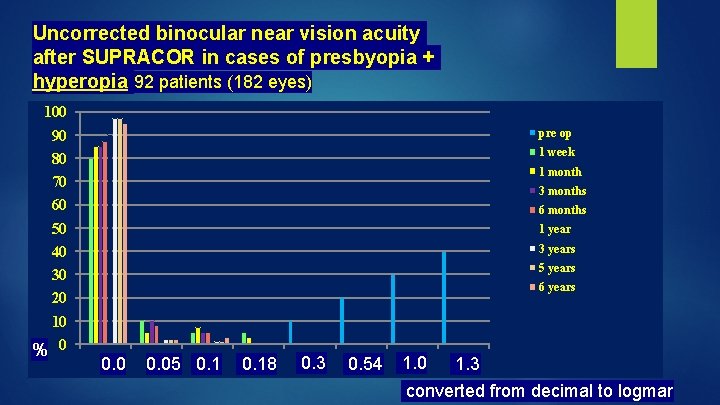
Uncorrected binocular near vision acuity after SUPRACOR in cases of presbyopia + hyperopia 92 patients (182 eyes) 100 90 80 70 60 50 40 30 20 10 % 0 pre op 1 week 1 month 3 months 6 months 1 year 3 years 5 years 6 years 1 0. 0 0. 9 0. 8 0. 05 0. 1 0. 7 0. 18 0. 5 0. 3 0. 54 0. 1 1. 0 0, 05 1. 3 converted from decimal to logmar
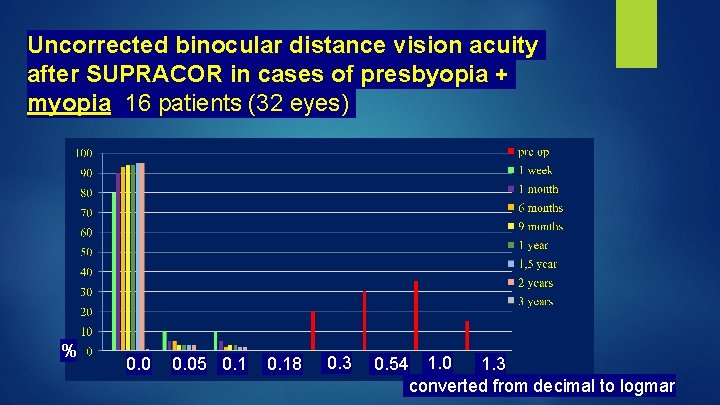
Uncorrected binocular distance vision acuity after SUPRACOR in cases of presbyopia + myopia 16 patients (32 eyes) % 0. 05 0. 18 0. 3 0. 54 1. 0 1. 3 converted from decimal to logmar
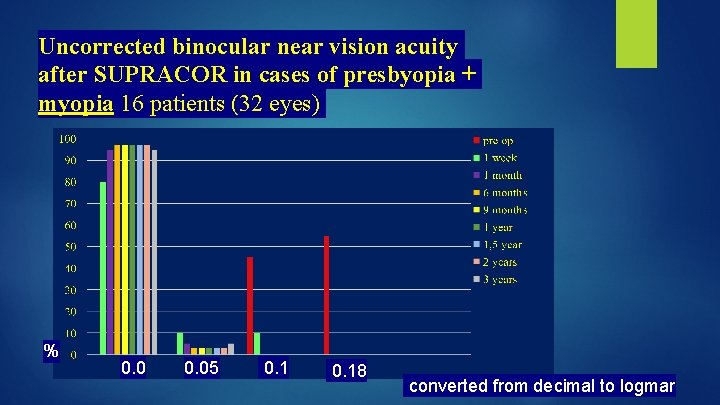
Uncorrected binocular near vision acuity after SUPRACOR in cases of presbyopia + myopia 16 patients (32 eyes) % 0. 05 0. 18 converted from decimal to logmar
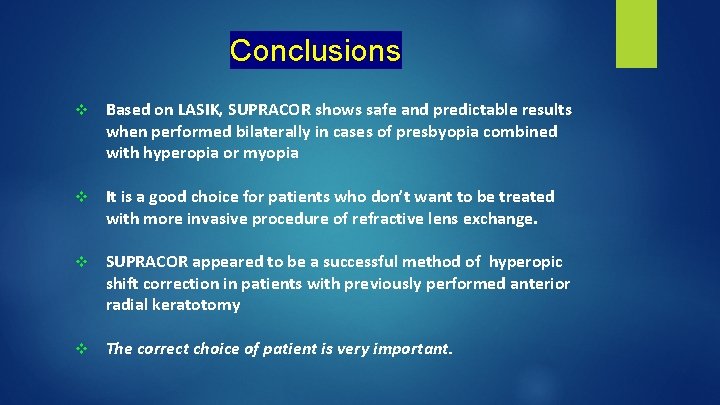
Conclusions v Based on LASIK, SUPRACOR shows safe and predictable results when performed bilaterally in cases of presbyopia combined with hyperopia or myopia v It is a good choice for patients who don’t want to be treated with more invasive procedure of refractive lens exchange. v SUPRACOR appeared to be a successful method of hyperopic shift correction in patients with previously performed anterior radial keratotomy v The correct choice of patient is very important.

Thank you for your attention!
- Slides: 16