
Including Cognitive Disabilities in International Standards David Fourney
Including Cognitive Disabilities in International Standards David Fourney Department of Computer Science, University of Saskatchewan, Saskatoon, Saskatchewan, Canada david. fourney@usask. ca UNIVERSITY OF Department SASKATCHEWAN Saskatoon, Canada. of Computer Science, USERLab, Saskatchewan, http: //userlab. usask. ca
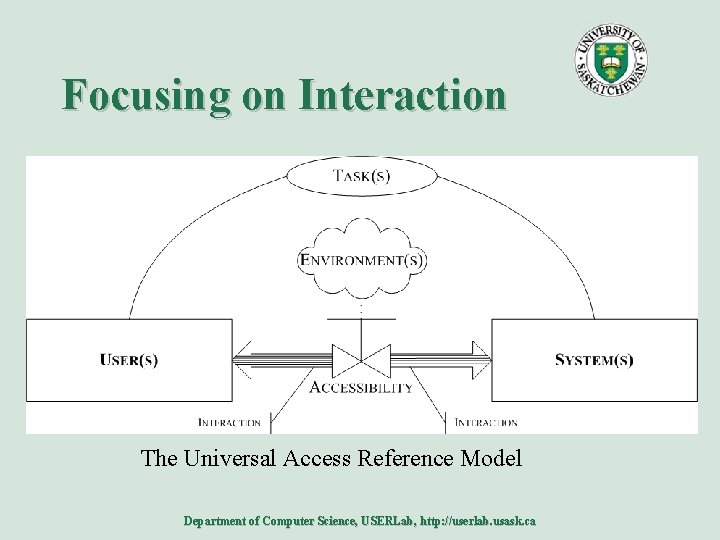
Focusing on Interaction The Universal Access Reference Model Department of Computer Science, USERLab, http: //userlab. usask. ca
Making Interactions Accessible è ISO 9241 -171 uses sensory substitution è If product uses mouse > Provide keyboard access è If product uses monitor > Support screen readers è What are the cognitive skills? è What substitutions can be done? è What simplifications can be done? èA taxonomy of cognitive skills is just the beginning Department of Computer Science, USERLab, http: //userlab. usask. ca
Conclusion è è è Questions: è Is there a common framework / taxonomy of users’ cognitive needs / conditions that can be used to structure guidance intended to meet these needs / conditions? è Are there any guidelines and best practices that are well accepted by the research community and/or consumers with cognitive disabilities that can be adapted into international standards guidance? We can compile our knowledge and develop a taxonomy or list of guidelines. Let’s keep an open mind and watch for the assumptions of cognitive capacities that we make. Department of Computer Science, USERLab, http: //userlab. usask. ca

Department of Computer Science, USERLab, http: //userlab. usask. ca
Supplementary slides Department of Computer Science, USERLab, http: //userlab. usask. ca
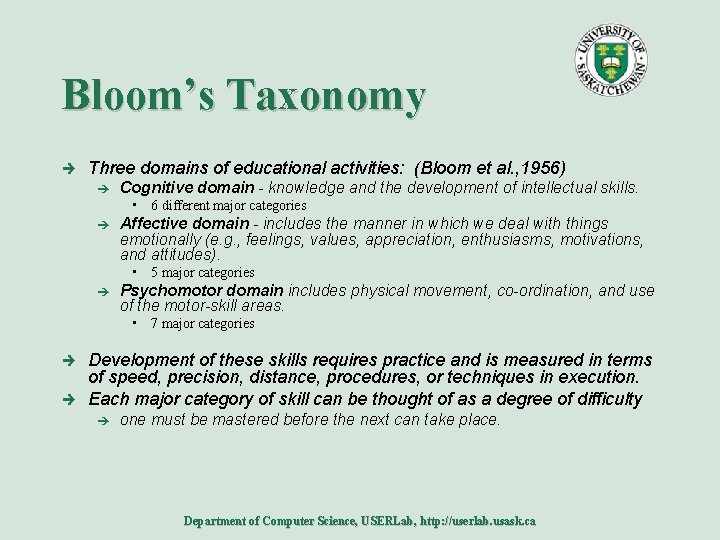
Bloom’s Taxonomy è Three domains of educational activities: (Bloom et al. , 1956) è Cognitive domain - knowledge and the development of intellectual skills. • 6 different major categories è Affective domain - includes the manner in which we deal with things emotionally (e. g. , feelings, values, appreciation, enthusiasms, motivations, and attitudes). • 5 major categories è Psychomotor domain includes physical movement, co-ordination, and use of the motor-skill areas. • 7 major categories è è Development of these skills requires practice and is measured in terms of speed, precision, distance, procedures, or techniques in execution. Each major category of skill can be thought of as a degree of difficulty è one must be mastered before the next can take place. Department of Computer Science, USERLab, http: //userlab. usask. ca
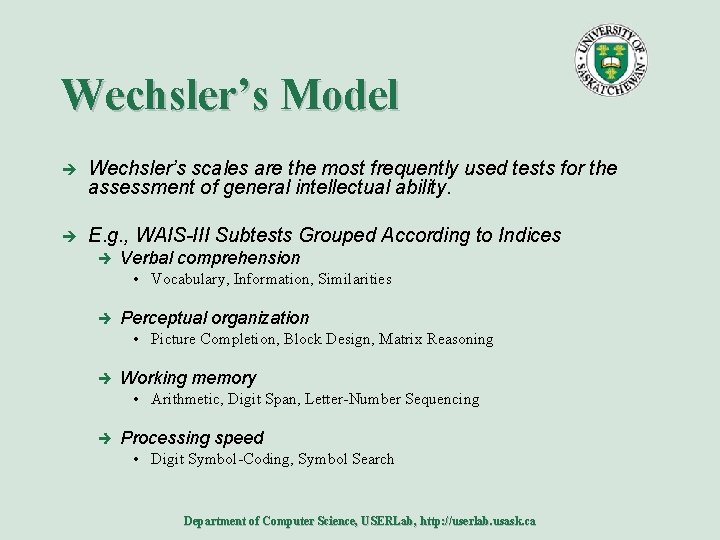
Wechsler’s Model è Wechsler’s scales are the most frequently used tests for the assessment of general intellectual ability. è E. g. , WAIS-III Subtests Grouped According to Indices è Verbal comprehension • Vocabulary, Information, Similarities è Perceptual organization • Picture Completion, Block Design, Matrix Reasoning è Working memory • Arithmetic, Digit Span, Letter-Number Sequencing è Processing speed • Digit Symbol-Coding, Symbol Search Department of Computer Science, USERLab, http: //userlab. usask. ca
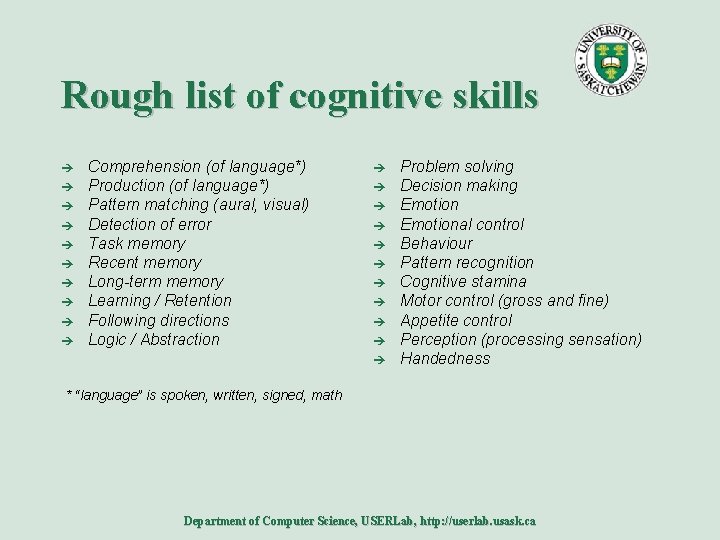
Rough list of cognitive skills è è è è è Comprehension (of language*) Production (of language*) Pattern matching (aural, visual) Detection of error Task memory Recent memory Long-term memory Learning / Retention Following directions Logic / Abstraction è è è Problem solving Decision making Emotional control Behaviour Pattern recognition Cognitive stamina Motor control (gross and fine) Appetite control Perception (processing sensation) Handedness * “language” is spoken, written, signed, math Department of Computer Science, USERLab, http: //userlab. usask. ca
- Slides: 9