
Inclining ExperimentCapt S Nathan 1 INCLINING EXPERIMENT Purpose

- Slides: 19
Inclining Experiment-Capt. S. Nathan 1
INCLINING EXPERIMENT Purpose • Chapter 2 of the Code on Intact Stability for all Types of Ships, details the information that must be provided to the master of all ships in order that stability calculations may be accurately conducted to ensure the ship’s safe operation. • A key element of this information is the Inclining Test Report that details the calculation procedure conducted to determine the ship’s light KG and displacement. • It requires that every passenger ship regardless of size and every cargo ship of 24 m or over be inclined on completion in order to determine the value of the KG in the light condition. This must be determined accurately because the light KG and displacement values are the basis from which the KG is determined for every other condition. An error in the KG calculated for any condition of loading will result in all stability parameters dependant on this value being incorrect also i. e. GM, GZ values and dynamical stability parameters will be in error. • During the experiment the longitudinal position of the centre of gravity (LCG) for the light condition will also be determined. Inclining Experiment-Capt. S. Nathan 2
Lightship condition: the ship complete in all respects, but without consumables, stores, cargo, crew and effects, and without any liquids on board except that machinery and piping fluids, such as lubricants and hydraulics are at operating levels. Inclining Experiment-Capt. S. Nathan 3
Fluctuations in a ship's lightweight over a period • Regular dry-docking of the ship will decrease the animal and vegetable growth on the shell of time plating. It has been known to form as much as 5 cm of extra weight around the hull. Over the years in service, there will be increases in • Regular tank-cleaning programmes will decrease the amount of oil sediment and mud in the lightweight due to: the bottom of tanks. Regular routine inspections should also decrease the accumulation of rubbish. • Accretion of paintwork. Formation of oxidation or rust. Over years in service, there will also be decreases in the lightweight due to: • Build up of cargo residue. Sediment in bottom of • Oxidation or corrosion of the steel shell plating, and steel decks exposed to the sea and to oil tanks. Mud in bottom of ballast tanks. the weather. Wear and tear on moving parts. Dunnage. • Galvanic corrosion at localities having dissimilar metals joined together. • Gradual accumulation up of rubbish. Lashing • Corrosion and loss of weight is prevalent and vulnerable in the boot topping area of the material. side-shell of a vessel, especially in way of the machinery spaces. Feedback has shown that • Retrofits on accommodation fittings and in the sideshell thickness can decrease over the years from being 18 mm thickness to being navigational aids. only 10 mm in thickness. This would result in an appreciable loss of weight. • Barnacle attachment or animal growth on the shell plating. • Wear and tear occurs on structures such as masts and derricks, windlass, winches, hawse pipes and capstans. • Vegetable growth on shell plating. • These additions and reductions will all have their own individual centres of gravity and moments of weight. The result will be an overall change in the lightweight itself, plus a new value for the KG corresponding to this new lightweight. • Additional engine room spares. • Each item in the above list will change the weight of an empty ship. It can also be accumulative. • One example of increase in lightweight over a period of years is the 'Herald of Free Enterprise, ' which capsized in 1987. At the time of capsize it was shown that the lightweight had increased by 270 t, compared to when newly built. • It has been documented that the lightweight of a vessel can amount to an average addition of 0. 5% of the lightweight for each year of the ship's life. • The above indicate that sometimes the lightweight will increase, for example due to plate renewal or animal and vegetable growth. Other times it will decrease, for example due to wear and tear or build up of corrosion. There will be fluctuations. It would seem judicial to plan for an inclining experiment perhaps every 5 years. This will re-establish Inclining Experiment-Capt. S. Nathan 4 for the age of the ship exactly the current lightweight.
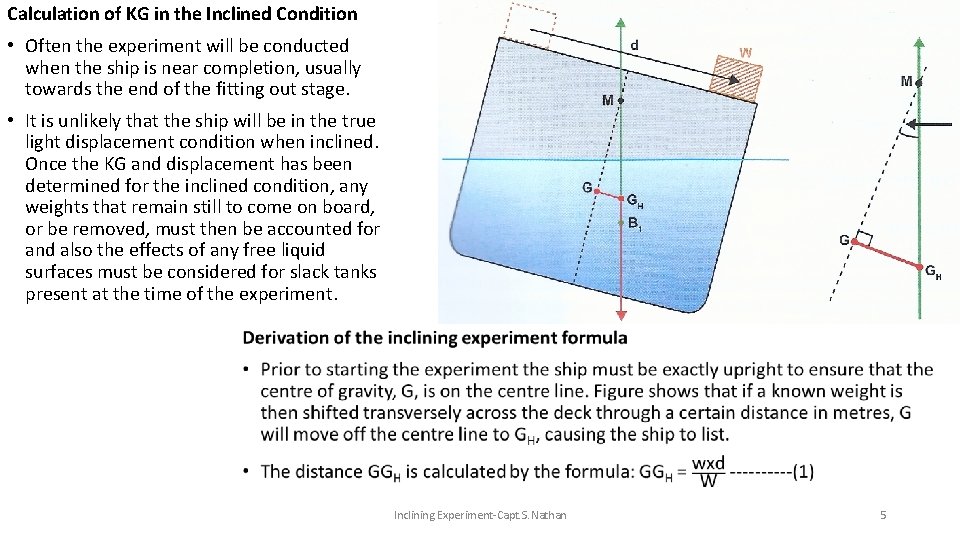
Calculation of KG in the Inclined Condition • Often the experiment will be conducted when the ship is near completion, usually towards the end of the fitting out stage. • It is unlikely that the ship will be in the true light displacement condition when inclined. Once the KG and displacement has been determined for the inclined condition, any weights that remain still to come on board, or be removed, must then be accounted for and also the effects of any free liquid surfaces must be considered for slack tanks present at the time of the experiment. Inclining Experiment-Capt. S. Nathan 5
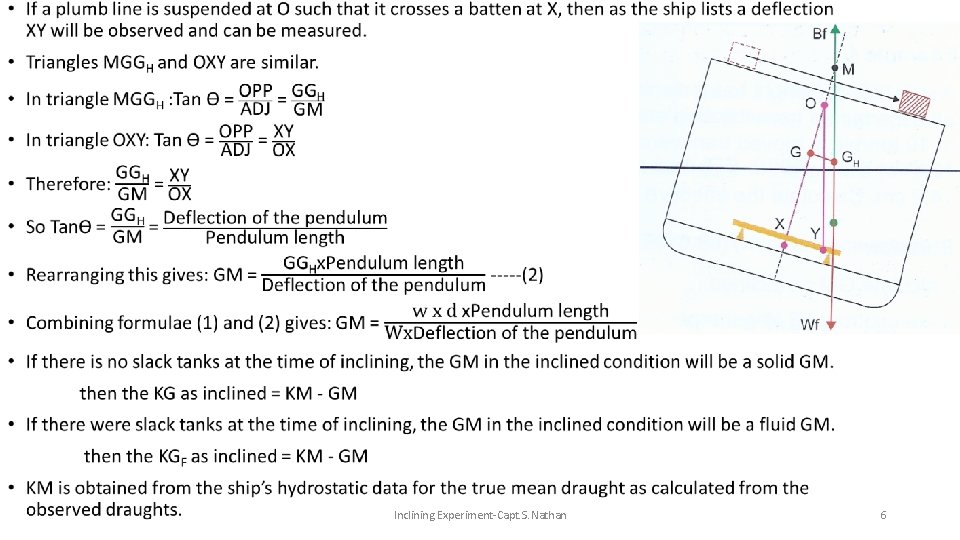
• Inclining Experiment-Capt. S. Nathan 6
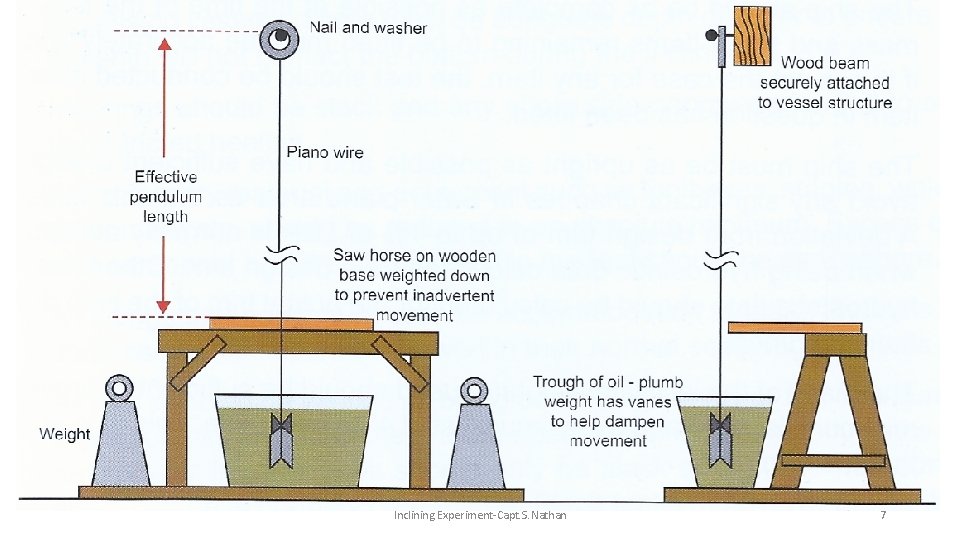
Inclining Experiment-Capt. S. Nathan 7
1. 2. 3. 4. 5. 6. 7. 8. 9. 10. 11. 12. 13. 14. Preparations for the Inclining Test The ship should be as complete as possible at the time of the test. There must be adequate depth of water to ensure that the ship will not contact the bottom during the inclination. The ship should be moored in a quiet, sheltered area free from external forces such as propeller wash from passing ships. The ship should be moored as to allow unrestricted heeling. There should be no significant tide. Any tide will prevent moorings from being maintained slack. If under-keel clearance is small the effect of squat may lead to erroneous draught readings. Ideally the experiment should be conducted in a sheltered dock. All temporary material and equipment such as toolboxes, staging, welding equipment etc. should be removed. All fittings and equipment such as accommodation ladders, lifeboats and derricks/cranes should be stowed in their normal seagoing positions. All tanks should be verified as being completely empty or full. The number of slack tanks should be kept to an absolute minimum and their FSC accurately determined. Ideally tanks with rectangular free surfaces should only be slack so that the free surface effect can be accurately determined. Slack tanks must have the contents accurately determined with respect to liquid mass and Kg. Decks should be free of water. Any water trapped on deck will move during the test and reduce the accuracy of the result. Snow and ice must also be removed. Her draft should be such that abrupt changes will not occur in her water plane, when inclined. An accurate list is to be made of any items Inclining of weight yet to be placed onboard and those to be removed 8 from Experiment-Capt. S. Nathan the ship together with their KG and LCG.
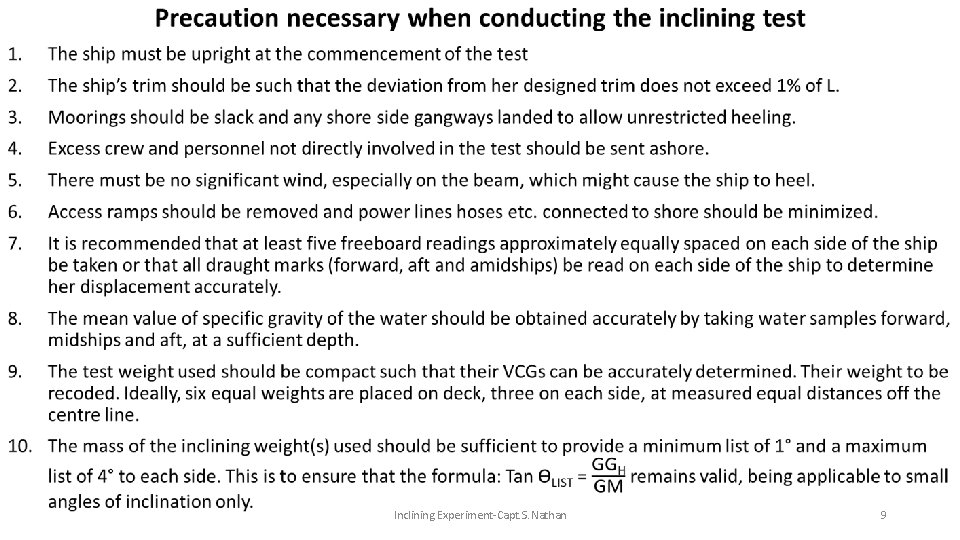
• Inclining Experiment-Capt. S. Nathan 9
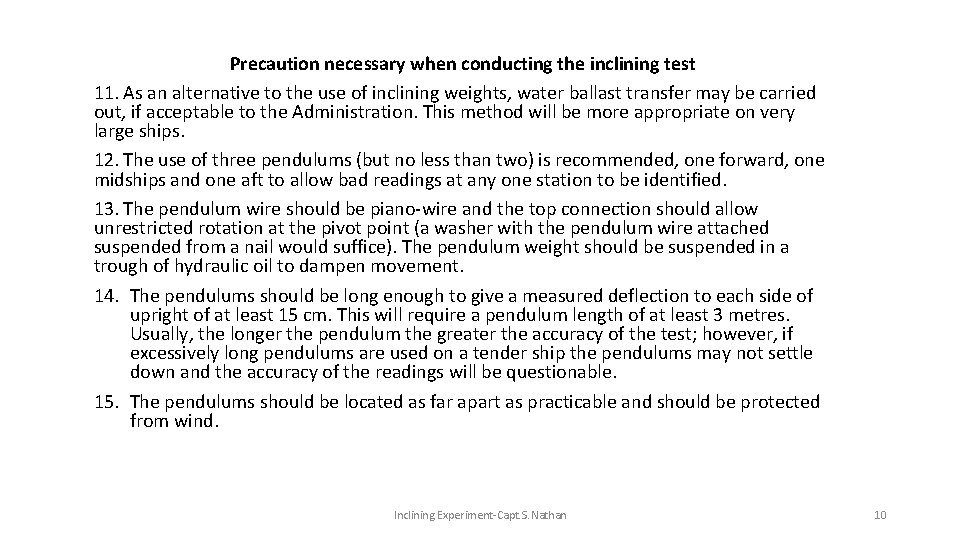
Precaution necessary when conducting the inclining test 11. As an alternative to the use of inclining weights, water ballast transfer may be carried out, if acceptable to the Administration. This method will be more appropriate on very large ships. 12. The use of three pendulums (but no less than two) is recommended, one forward, one midships and one aft to allow bad readings at any one station to be identified. 13. The pendulum wire should be piano-wire and the top connection should allow unrestricted rotation at the pivot point (a washer with the pendulum wire attached suspended from a nail would suffice). The pendulum weight should be suspended in a trough of hydraulic oil to dampen movement. 14. The pendulums should be long enough to give a measured deflection to each side of upright of at least 15 cm. This will require a pendulum length of at least 3 metres. Usually, the longer the pendulum the greater the accuracy of the test; however, if excessively long pendulums are used on a tender ship the pendulums may not settle down and the accuracy of the readings will be questionable. 15. The pendulums should be located as far apart as practicable and should be protected from wind. Inclining Experiment-Capt. S. Nathan 10
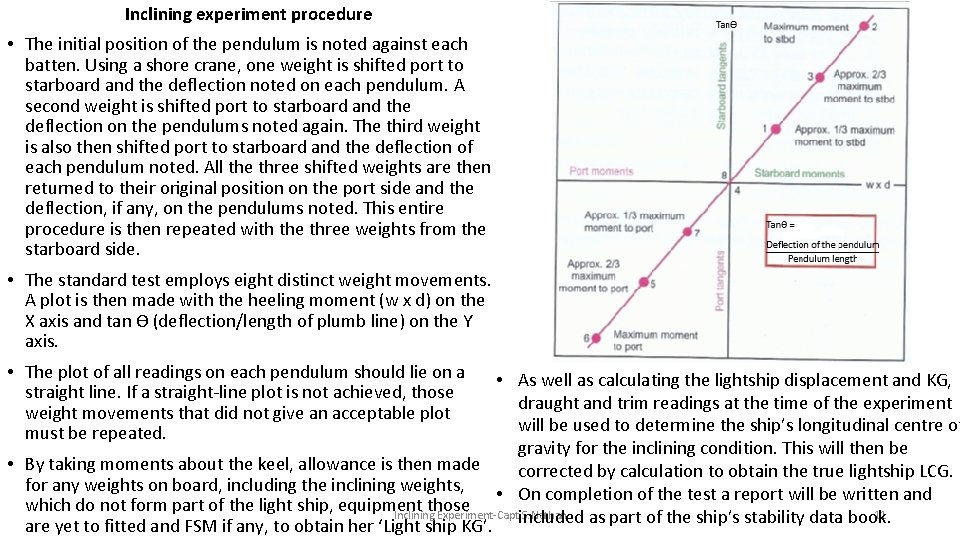
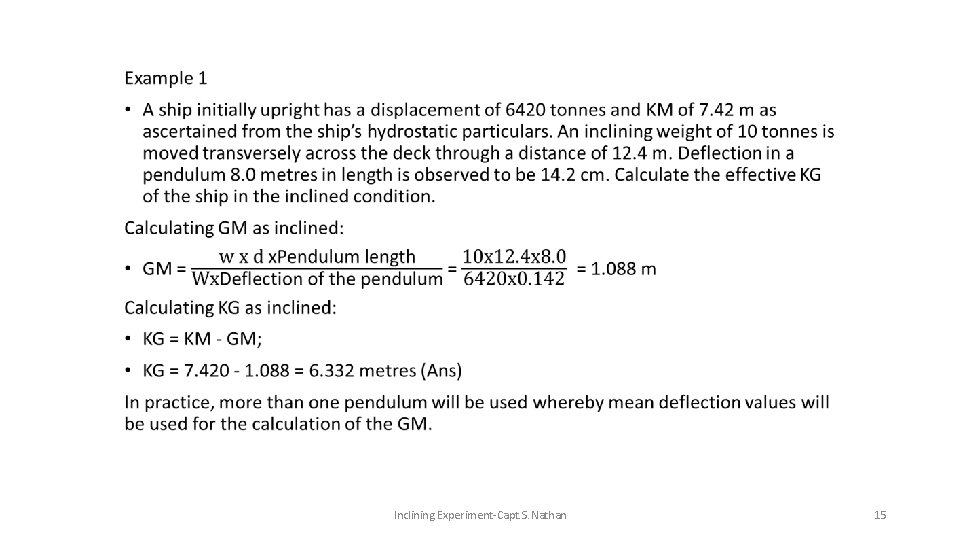
Inclining experiment procedure • The initial position of the pendulum is noted against each batten. Using a shore crane, one weight is shifted port to starboard and the deflection noted on each pendulum. A second weight is shifted port to starboard and the deflection on the pendulums noted again. The third weight is also then shifted port to starboard and the deflection of each pendulum noted. All the three shifted weights are then returned to their original position on the port side and the deflection, if any, on the pendulums noted. This entire procedure is then repeated with the three weights from the starboard side. • The standard test employs eight distinct weight movements. A plot is then made with the heeling moment (w x d) on the X axis and tan Ɵ (deflection/length of plumb line) on the Y axis. • The plot of all readings on each pendulum should lie on a straight line. If a straight-line plot is not achieved, those weight movements that did not give an acceptable plot must be repeated. • As well as calculating the lightship displacement and KG, draught and trim readings at the time of the experiment will be used to determine the ship’s longitudinal centre of gravity for the inclining condition. This will then be • By taking moments about the keel, allowance is then made corrected by calculation to obtain the true lightship LCG. for any weights on board, including the inclining weights, • On completion of the test a report will be written and which do not form part of the light ship, equipment those Inclining Experiment-Capt. S. Nathan 11 are yet to fitted and FSM if any, to obtain her ‘Light ship KG’. included as part of the ship’s stability data book.
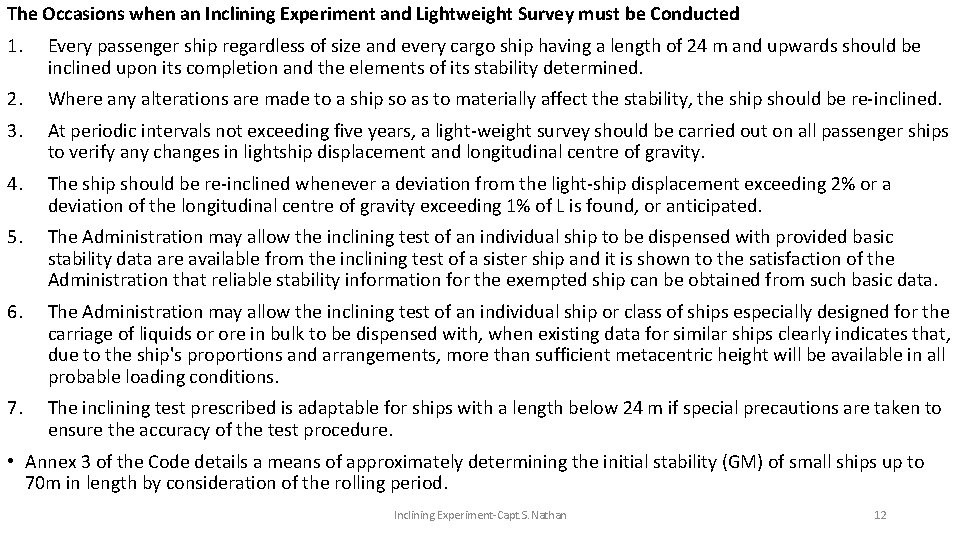
The Occasions when an Inclining Experiment and Lightweight Survey must be Conducted 1. Every passenger ship regardless of size and every cargo ship having a length of 24 m and upwards should be inclined upon its completion and the elements of its stability determined. 2. Where any alterations are made to a ship so as to materially affect the stability, the ship should be re-inclined. 3. At periodic intervals not exceeding five years, a light-weight survey should be carried out on all passenger ships to verify any changes in lightship displacement and longitudinal centre of gravity. 4. The ship should be re-inclined whenever a deviation from the light-ship displacement exceeding 2% or a deviation of the longitudinal centre of gravity exceeding 1% of L is found, or anticipated. 5. The Administration may allow the inclining test of an individual ship to be dispensed with provided basic stability data are available from the inclining test of a sister ship and it is shown to the satisfaction of the Administration that reliable stability information for the exempted ship can be obtained from such basic data. 6. The Administration may allow the inclining test of an individual ship or class of ships especially designed for the carriage of liquids or ore in bulk to be dispensed with, when existing data for similar ships clearly indicates that, due to the ship's proportions and arrangements, more than sufficient metacentric height will be available in all probable loading conditions. 7. The inclining test prescribed is adaptable for ships with a length below 24 m if special precautions are taken to ensure the accuracy of the test procedure. • Annex 3 of the Code details a means of approximately determining the initial stability (GM) of small ships up to 70 m in length by consideration of the rolling period. Inclining Experiment-Capt. S. Nathan 12
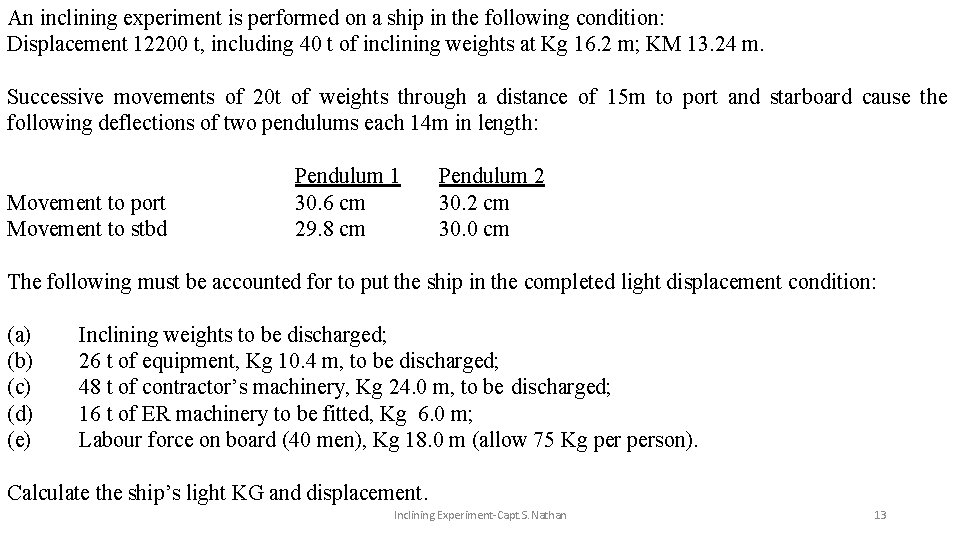
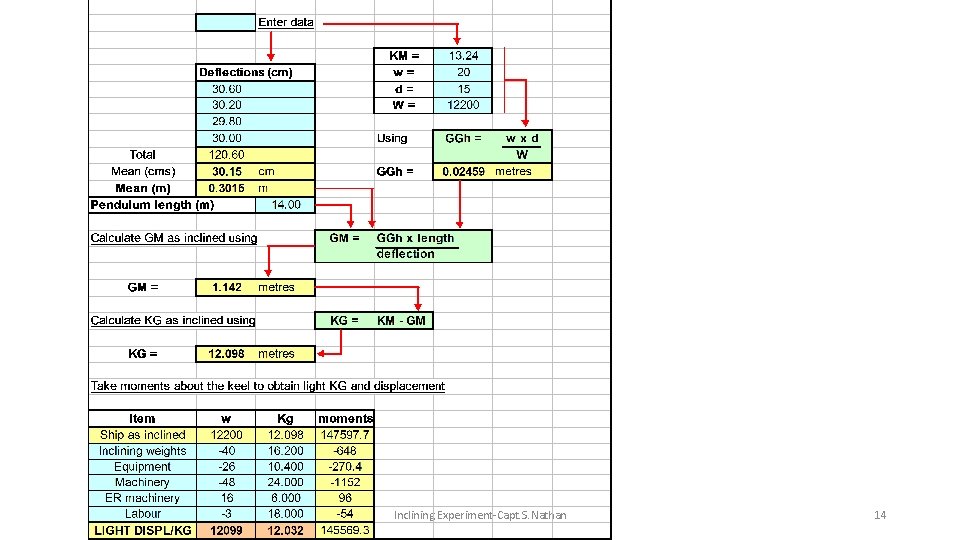
An inclining experiment is performed on a ship in the following condition: Displacement 12200 t, including 40 t of inclining weights at Kg 16. 2 m; KM 13. 24 m. Successive movements of 20 t of weights through a distance of 15 m to port and starboard cause the following deflections of two pendulums each 14 m in length: Movement to port Movement to stbd Pendulum 1 30. 6 cm 29. 8 cm Pendulum 2 30. 2 cm 30. 0 cm The following must be accounted for to put the ship in the completed light displacement condition: (a) (b) (c) (d) (e) Inclining weights to be discharged; 26 t of equipment, Kg 10. 4 m, to be discharged; 48 t of contractor’s machinery, Kg 24. 0 m, to be discharged; 16 t of ER machinery to be fitted, Kg 6. 0 m; Labour force on board (40 men), Kg 18. 0 m (allow 75 Kg person). Calculate the ship’s light KG and displacement. Inclining Experiment-Capt. S. Nathan 13
Inclining Experiment-Capt. S. Nathan 14
• Inclining Experiment-Capt. S. Nathan 15
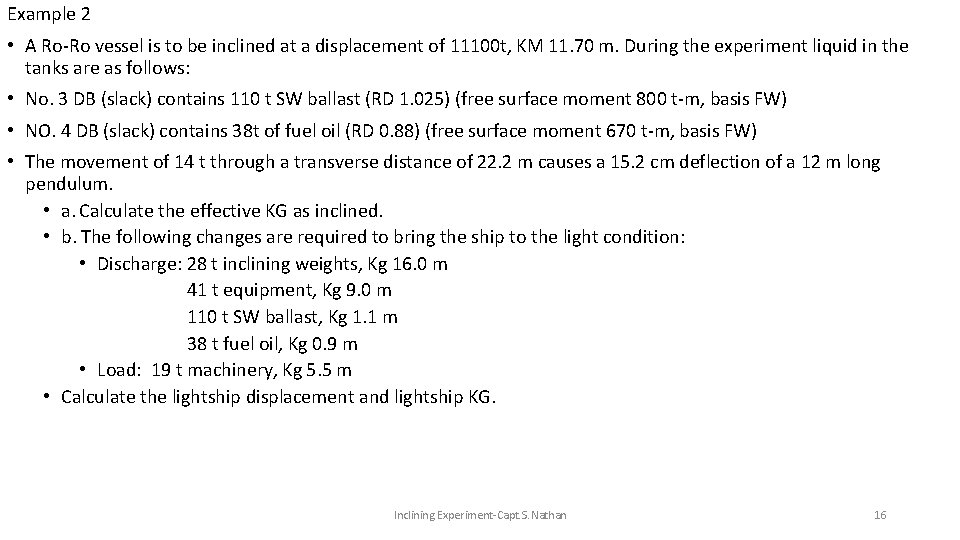
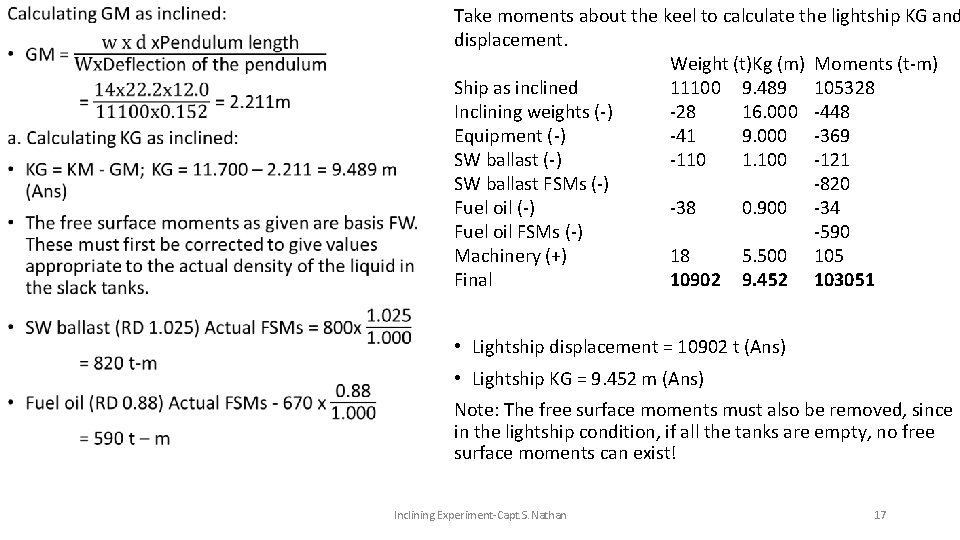
Example 2 • A Ro-Ro vessel is to be inclined at a displacement of 11100 t, KM 11. 70 m. During the experiment liquid in the tanks are as follows: • No. 3 DB (slack) contains 110 t SW ballast (RD 1. 025) (free surface moment 800 t-m, basis FW) • NO. 4 DB (slack) contains 38 t of fuel oil (RD 0. 88) (free surface moment 670 t-m, basis FW) • The movement of 14 t through a transverse distance of 22. 2 m causes a 15. 2 cm deflection of a 12 m long pendulum. • a. Calculate the effective KG as inclined. • b. The following changes are required to bring the ship to the light condition: • Discharge: 28 t inclining weights, Kg 16. 0 m 41 t equipment, Kg 9. 0 m 110 t SW ballast, Kg 1. 1 m 38 t fuel oil, Kg 0. 9 m • Load: 19 t machinery, Kg 5. 5 m • Calculate the lightship displacement and lightship KG. Inclining Experiment-Capt. S. Nathan 16
• Take moments about the keel to calculate the lightship KG and displacement. Weight (t)Kg (m) Moments (t-m) Ship as inclined 11100 9. 489 105328 Inclining weights (-) -28 16. 000 -448 Equipment (-) -41 9. 000 -369 SW ballast (-) -110 1. 100 -121 SW ballast FSMs (-) -820 Fuel oil (-) -38 0. 900 -34 Fuel oil FSMs (-) -590 Machinery (+) 18 5. 500 105 Final 10902 9. 452 103051 • Lightship displacement = 10902 t (Ans) • Lightship KG = 9. 452 m (Ans) Note: The free surface moments must also be removed, since in the lightship condition, if all the tanks are empty, no free surface moments can exist! Inclining Experiment-Capt. S. Nathan 17
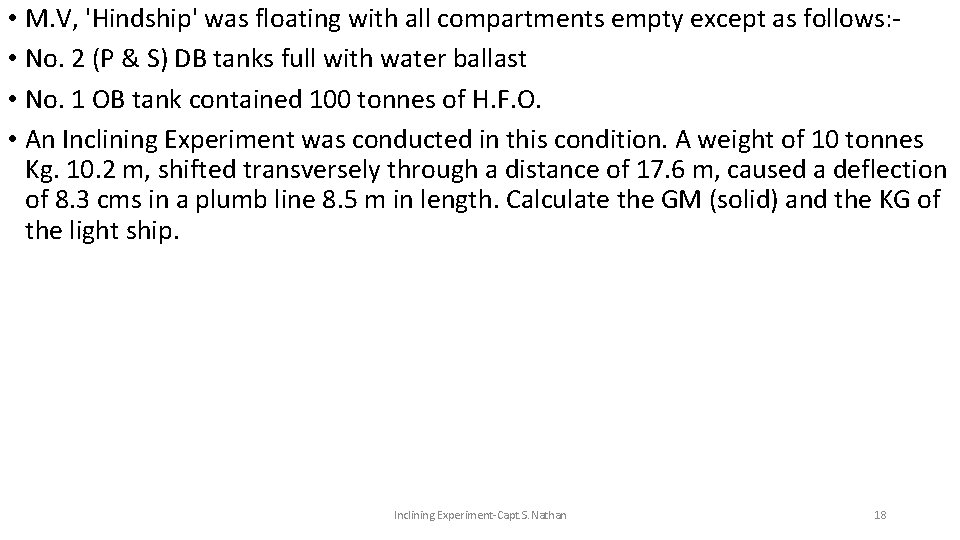
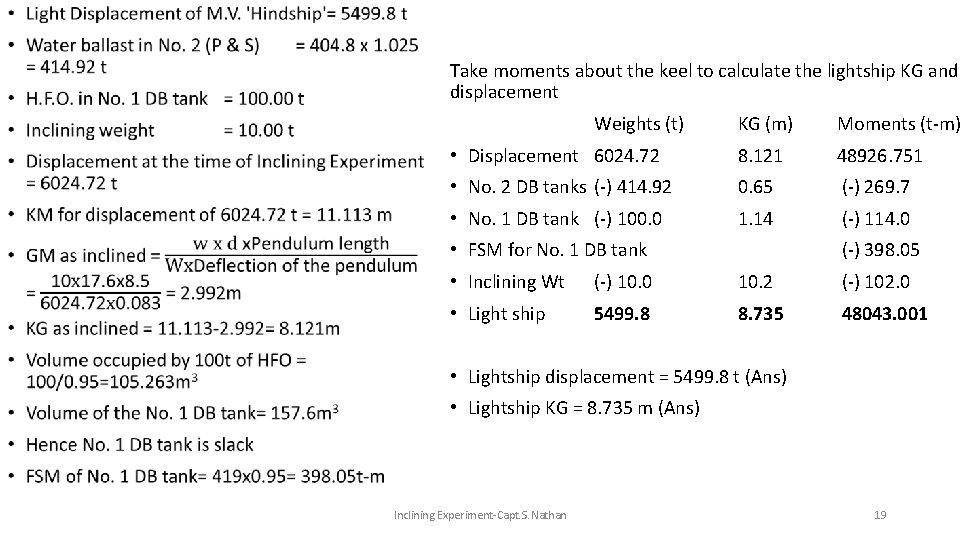
• M. V, 'Hindship' was floating with all compartments empty except as follows: • No. 2 (P & S) DB tanks full with water ballast • No. 1 OB tank contained 100 tonnes of H. F. O. • An Inclining Experiment was conducted in this condition. A weight of 10 tonnes Kg. 10. 2 m, shifted transversely through a distance of 17. 6 m, caused a deflection of 8. 3 cms in a plumb line 8. 5 m in length. Calculate the GM (solid) and the KG of the light ship. Inclining Experiment-Capt. S. Nathan 18
• Take moments about the keel to calculate the lightship KG and displacement Weights (t) KG (m) Moments (t-m) • Displacement 6024. 72 8. 121 48926. 751 • No. 2 DB tanks (-) 414. 92 0. 65 (-) 269. 7 • No. 1 DB tank (-) 100. 0 1. 14 (-) 114. 0 • FSM for No. 1 DB tank (-) 398. 05 • Inclining Wt (-) 10. 0 10. 2 (-) 102. 0 • Light ship 5499. 8 8. 735 48043. 001 • Lightship displacement = 5499. 8 t (Ans) • Lightship KG = 8. 735 m (Ans) Inclining Experiment-Capt. S. Nathan 19