
InClass Extended Example Ch 6 4 Form teams
- Slides: 27
In-Class Extended Example Ch. 6. 4 • Form teams of two to three neighbors • Hand out printouts of Iterator. html – http: //docs. oracle. com/javase/7/docs/api/java/util/Iterator. h tml • Close books • We will go through the steps for designing an IDM for Iterator • After each step, we will stop & discuss as a class 23 -Feb-21 © Ammann & Offutt 1
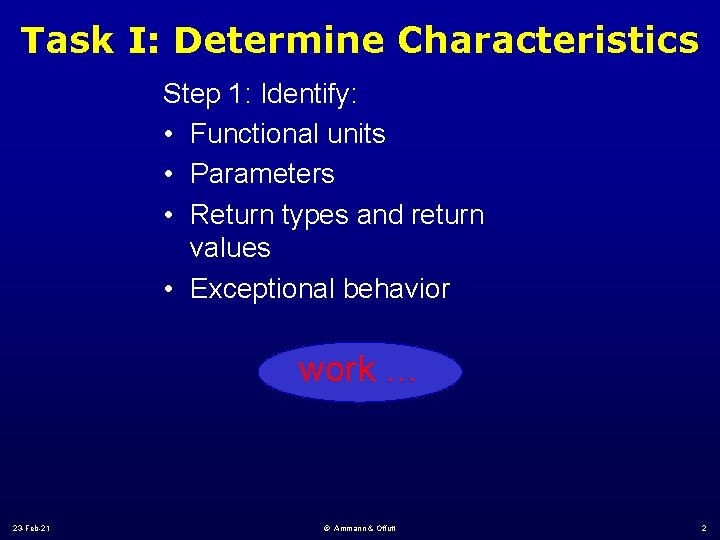
Task I: Determine Characteristics Step 1: Identify: • Functional units • Parameters • Return types and return values • Exceptional behavior work … 23 -Feb-21 © Ammann & Offutt 2
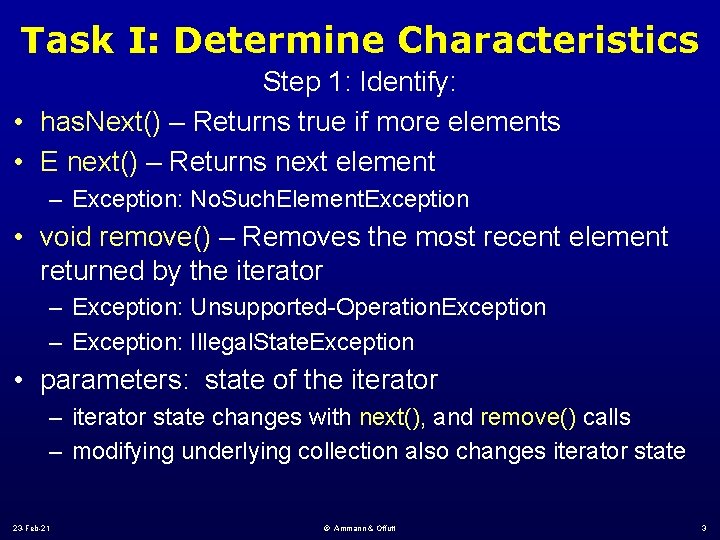
Task I: Determine Characteristics Step 1: Identify: • has. Next() – Returns true if more elements • E next() – Returns next element – Exception: No. Such. Element. Exception • void remove() – Removes the most recent element returned by the iterator – Exception: Unsupported-Operation. Exception – Exception: Illegal. State. Exception • parameters: state of the iterator – iterator state changes with next(), and remove() calls – modifying underlying collection also changes iterator state 23 -Feb-21 © Ammann & Offutt 3
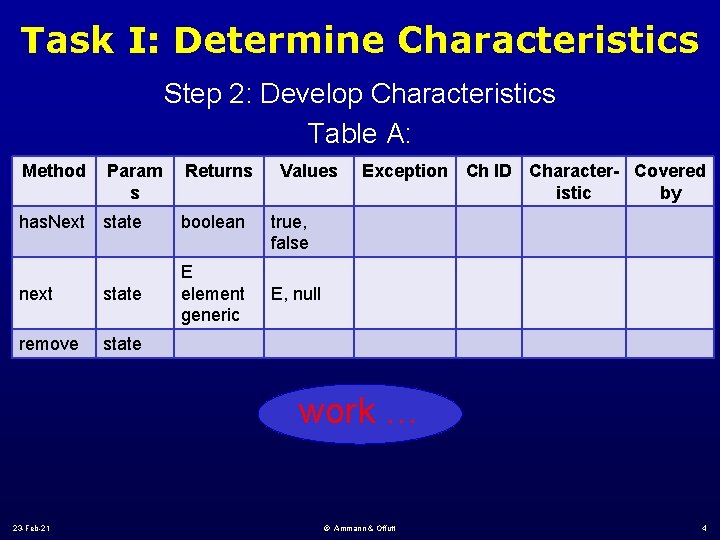
Task I: Determine Characteristics Step 2: Develop Characteristics Table A: Method Param s Returns has. Next state boolean next state E element generic remove state Values Exception Ch ID Character- Covered istic by true, false E, null work … 23 -Feb-21 © Ammann & Offutt 4
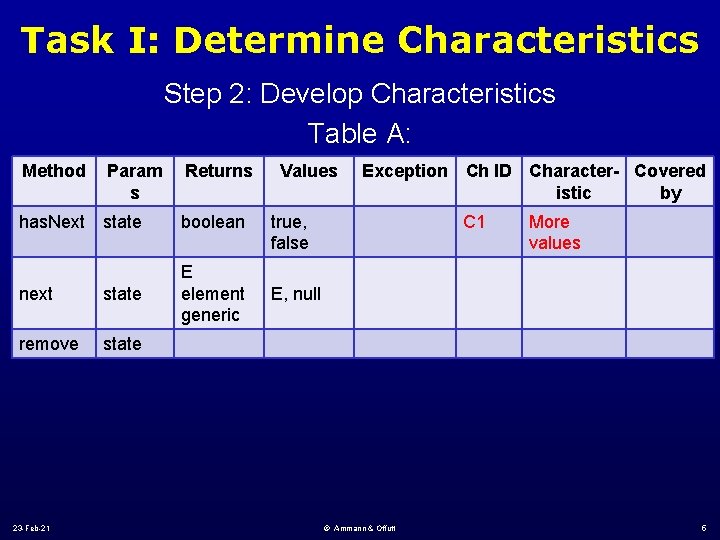
Task I: Determine Characteristics Step 2: Develop Characteristics Table A: Method Param s Returns has. Next state boolean next state E element generic remove state 23 -Feb-21 Values Exception Ch ID Character- Covered istic by true, false C 1 More values E, null © Ammann & Offutt 5
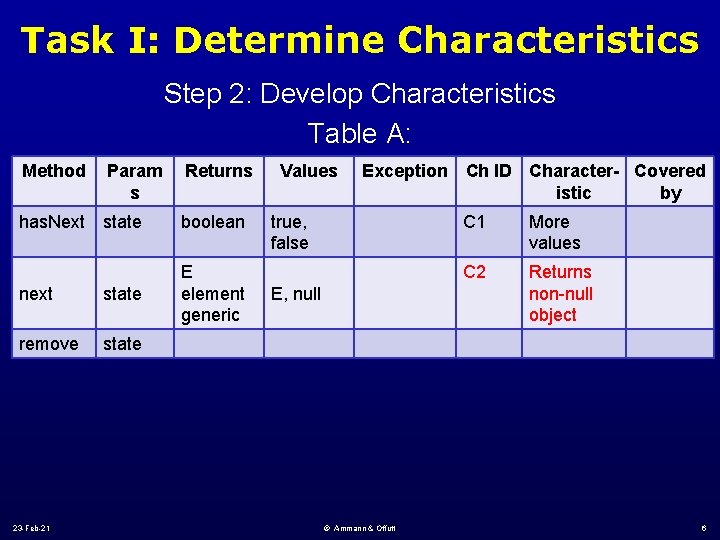
Task I: Determine Characteristics Step 2: Develop Characteristics Table A: Method Param s Returns has. Next state boolean next state E element generic remove state 23 -Feb-21 Values Exception Ch ID Character- Covered istic by true, false E, null © Ammann & Offutt C 1 More values C 2 Returns non-null object 6
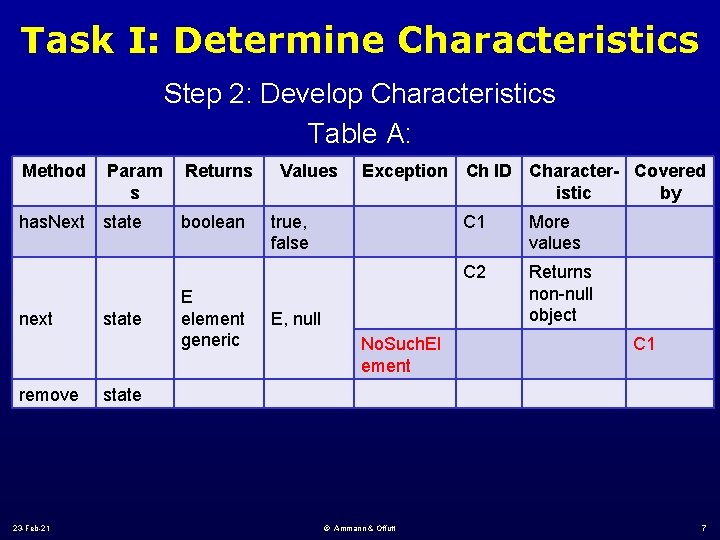
Task I: Determine Characteristics Step 2: Develop Characteristics Table A: Method Param s has. Next state next remove 23 -Feb-21 state Returns boolean E element generic Values Exception Ch ID Character- Covered istic by true, false E, null No. Such. El ement C 1 More values C 2 Returns non-null object C 1 state © Ammann & Offutt 7
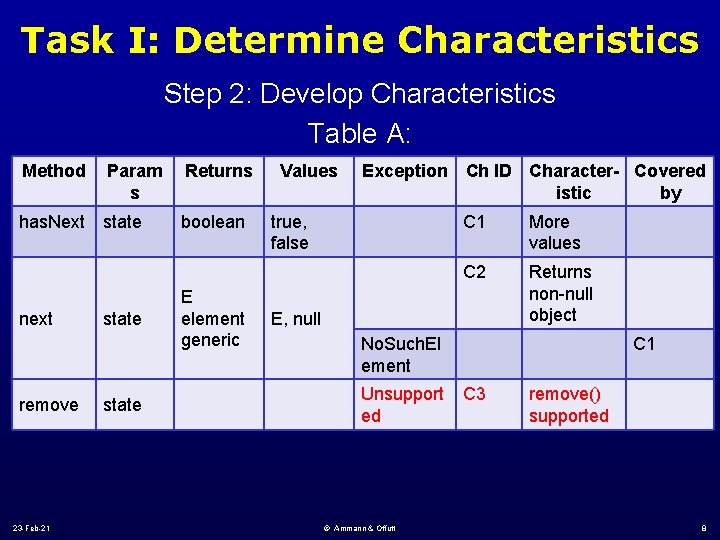
Task I: Determine Characteristics Step 2: Develop Characteristics Table A: Method Param s has. Next state next remove 23 -Feb-21 state Returns boolean E element generic Values Exception Ch ID Character- Covered istic by true, false C 1 More values C 2 Returns non-null object E, null No. Such. El ement Unsupport ed © Ammann & Offutt C 1 C 3 remove() supported 8
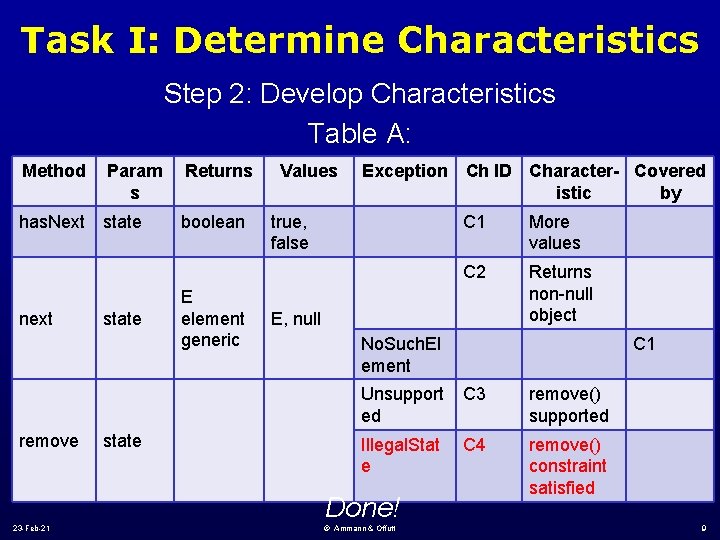
Task I: Determine Characteristics Step 2: Develop Characteristics Table A: Method Param s has. Next state next remove state Returns boolean E element generic Values Exception Ch ID Character- Covered istic by true, false More values C 2 Returns non-null object E, null No. Such. El ement C 1 Unsupport ed C 3 remove() supported Illegal. Stat e C 4 remove() constraint satisfied Done! 23 -Feb-21 C 1 © Ammann & Offutt 9
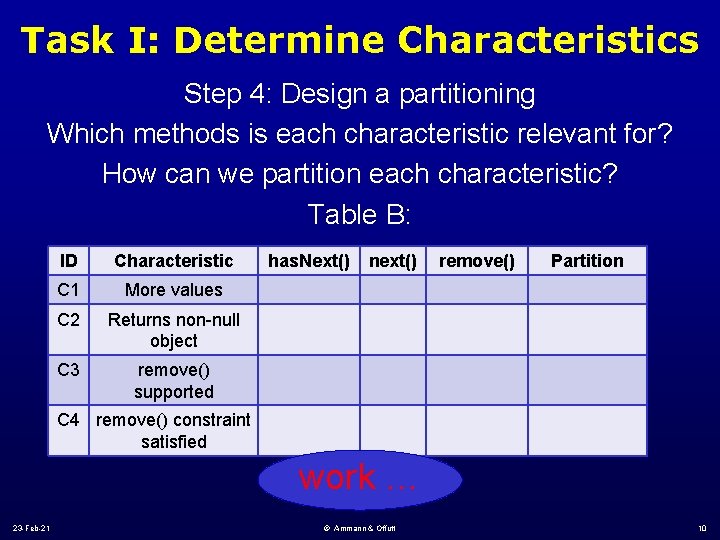
Task I: Determine Characteristics Step 4: Design a partitioning Which methods is each characteristic relevant for? How can we partition each characteristic? Table B: ID Characteristic C 1 More values C 2 Returns non-null object C 3 remove() supported has. Next() next() remove() Partition C 4 remove() constraint satisfied work … 23 -Feb-21 © Ammann & Offutt 10
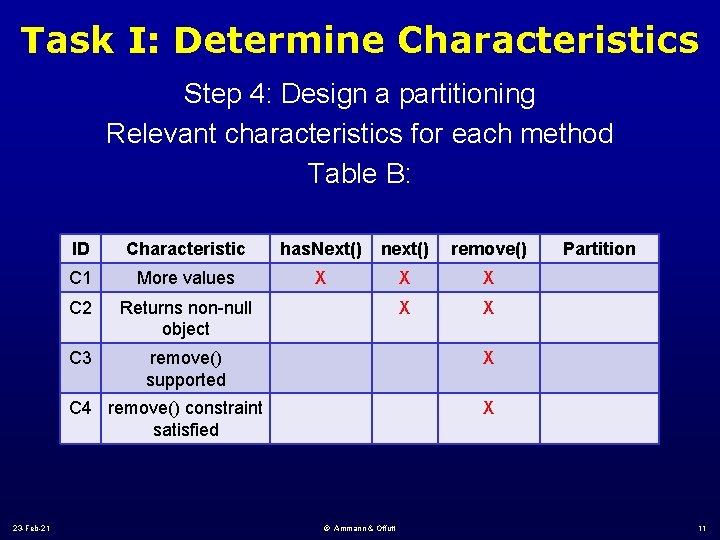
Task I: Determine Characteristics Step 4: Design a partitioning Relevant characteristics for each method Table B: ID Characteristic has. Next() next() remove() C 1 More values X X X C 2 Returns non-null object X X C 3 remove() supported X C 4 remove() constraint satisfied 23 -Feb-21 Partition X © Ammann & Offutt 11
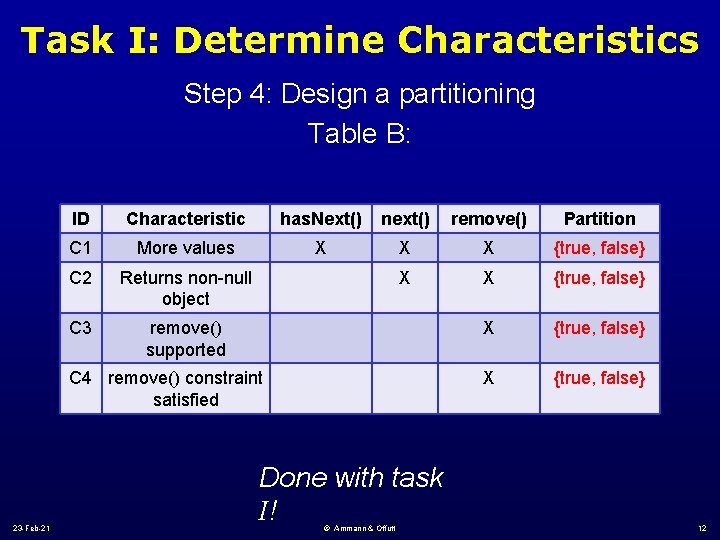
Task I: Determine Characteristics Step 4: Design a partitioning Table B: ID Characteristic has. Next() next() remove() Partition C 1 More values X X X {true, false} C 2 Returns non-null object X X {true, false} C 3 remove() supported X {true, false} C 4 remove() constraint satisfied 23 -Feb-21 Done with task I! © Ammann & Offutt 12
Task II: Define Test Requirements • Step 1: Choose coverage criterion • Step 2: Choose base cases if needed work … 23 -Feb-21 © Ammann & Offutt 13
Task II: Define Test Requirements • Step 1: Base coverage criterion (BCC) • Step 2: Happy path (all true) • Step 3: Test requirements … 23 -Feb-21 © Ammann & Offutt 14
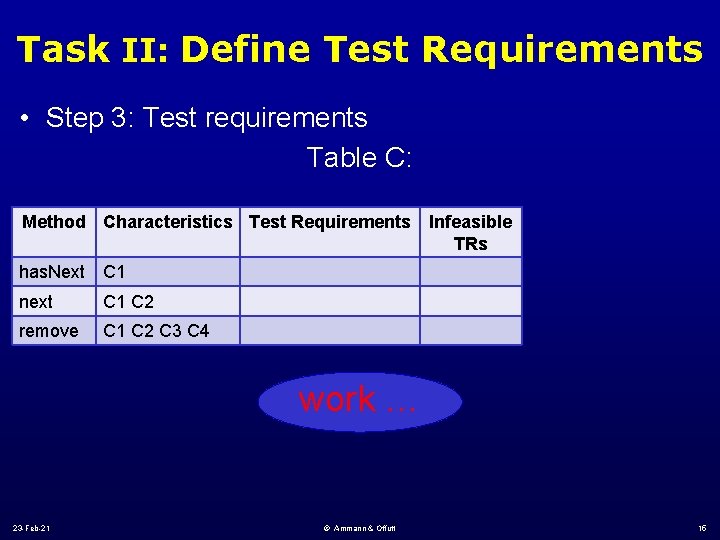
Task II: Define Test Requirements • Step 3: Test requirements Table C: Method Characteristics Test Requirements Infeasible TRs has. Next C 1 next C 1 C 2 remove C 1 C 2 C 3 C 4 work … 23 -Feb-21 © Ammann & Offutt 15
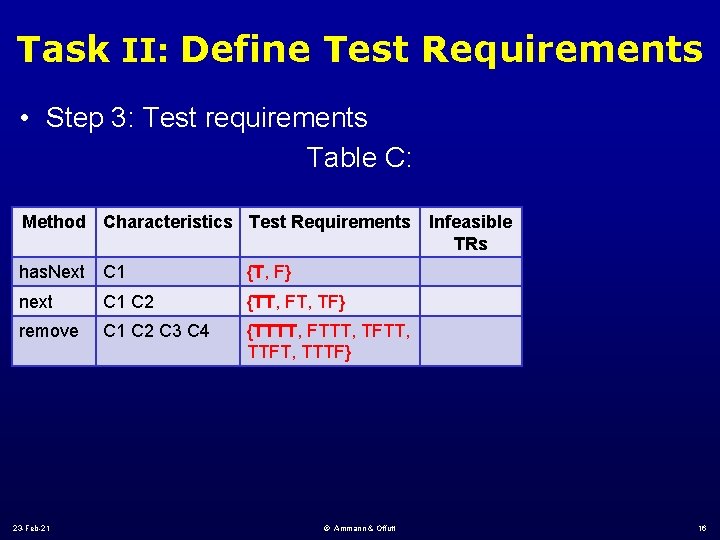
Task II: Define Test Requirements • Step 3: Test requirements Table C: Method Characteristics Test Requirements has. Next C 1 {T, F} next C 1 C 2 {TT, FT, TF} remove C 1 C 2 C 3 C 4 {TTTT, FTTT, TFTT, TTFT, TTTF} 23 -Feb-21 © Ammann & Offutt Infeasible TRs 16
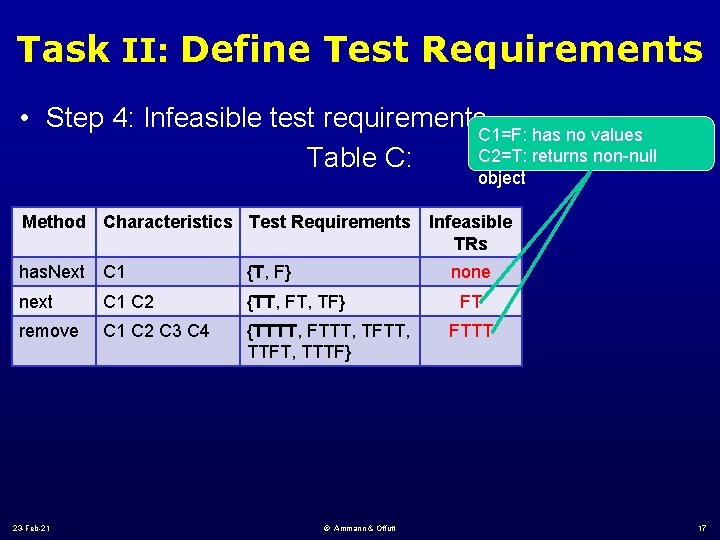
Task II: Define Test Requirements • Step 4: Infeasible test requirements. C 1=F: has no values C 2=T: returns non-null Table C: object Method Characteristics Test Requirements has. Next C 1 {T, F} next C 1 C 2 {TT, FT, TF} remove C 1 C 2 C 3 C 4 {TTTT, FTTT, TFTT, TTFT, TTTF} 23 -Feb-21 Infeasible TRs none © Ammann & Offutt FT FTTT 17
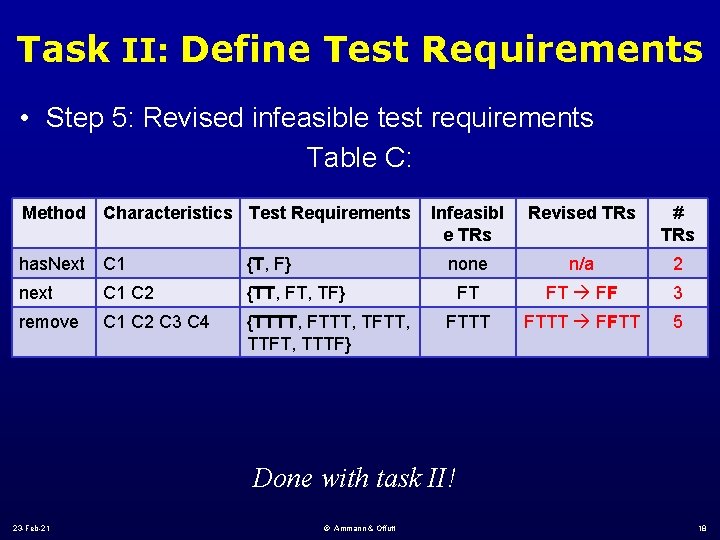
Task II: Define Test Requirements • Step 5: Revised infeasible test requirements Table C: Method Characteristics Test Requirements has. Next C 1 {T, F} next C 1 C 2 {TT, FT, TF} remove C 1 C 2 C 3 C 4 {TTTT, FTTT, TFTT, TTFT, TTTF} Infeasibl e TRs Revised TRs # TRs none n/a 2 FT FT FF 3 FTTT FFTT 5 Done with task II! 23 -Feb-21 © Ammann & Offutt 18
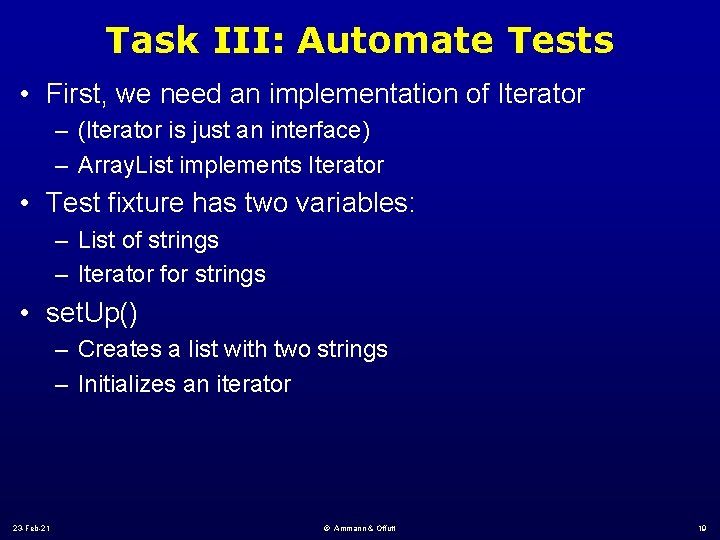
Task III: Automate Tests • First, we need an implementation of Iterator – (Iterator is just an interface) – Array. List implements Iterator • Test fixture has two variables: – List of strings – Iterator for strings • set. Up() – Creates a list with two strings – Initializes an iterator 23 -Feb-21 © Ammann & Offutt 19
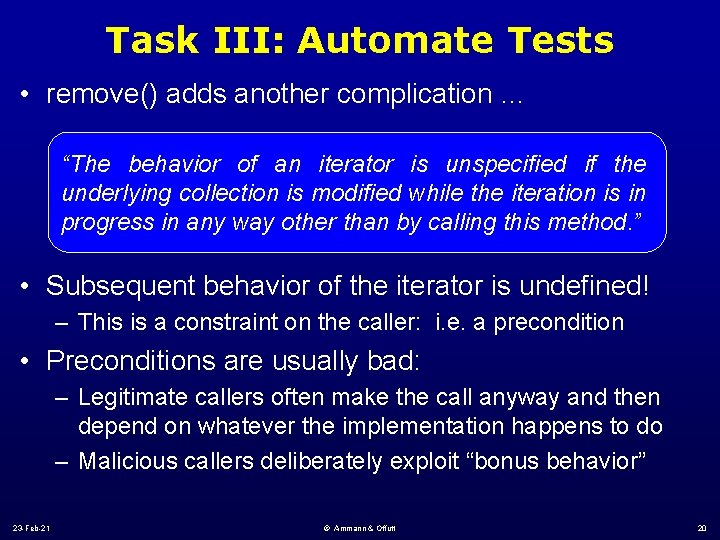
Task III: Automate Tests • remove() adds another complication … “The behavior of an iterator is unspecified if the underlying collection is modified while the iteration is in progress in any way other than by calling this method. ” • Subsequent behavior of the iterator is undefined! – This is a constraint on the caller: i. e. a precondition • Preconditions are usually bad: – Legitimate callers often make the call anyway and then depend on whatever the implementation happens to do – Malicious callers deliberately exploit “bonus behavior” 23 -Feb-21 © Ammann & Offutt 20
Task III: Automate Tests A merely competent tester would not test preconditions All specified behaviors have been tested! A good tester … … with a mental discipline of quality … would ask … What happens if a test violates the precondition? 23 -Feb-21 © Ammann & Offutt 21
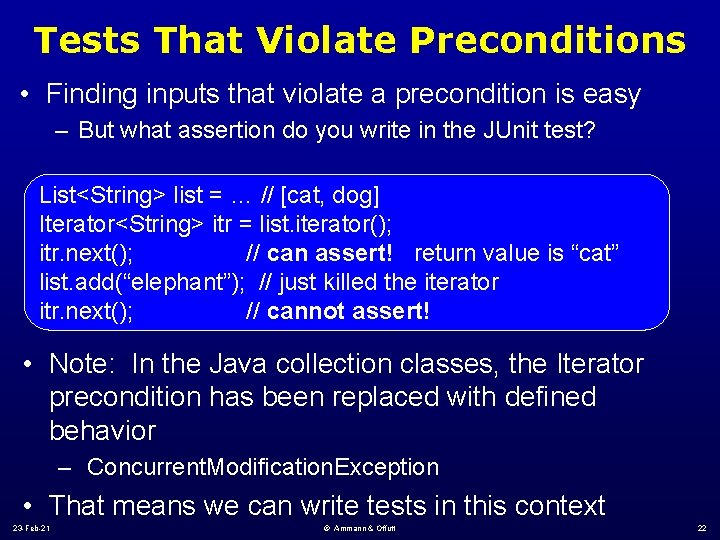
Tests That Violate Preconditions • Finding inputs that violate a precondition is easy – But what assertion do you write in the JUnit test? List<String> list = … // [cat, dog] Iterator<String> itr = list. iterator(); itr. next(); // can assert! return value is “cat” list. add(“elephant”); // just killed the iterator itr. next(); // cannot assert! • Note: In the Java collection classes, the Iterator precondition has been replaced with defined behavior – Concurrent. Modification. Exception • That means we can write tests in this context 23 -Feb-21 © Ammann & Offutt 22
Task I: Determine Characteristics Cycle back to add another exception—Table A revised: Method Param s Returns Values Exception Ch ID Character- Covered istic by work … 23 -Feb-21 © Ammann & Offutt 23
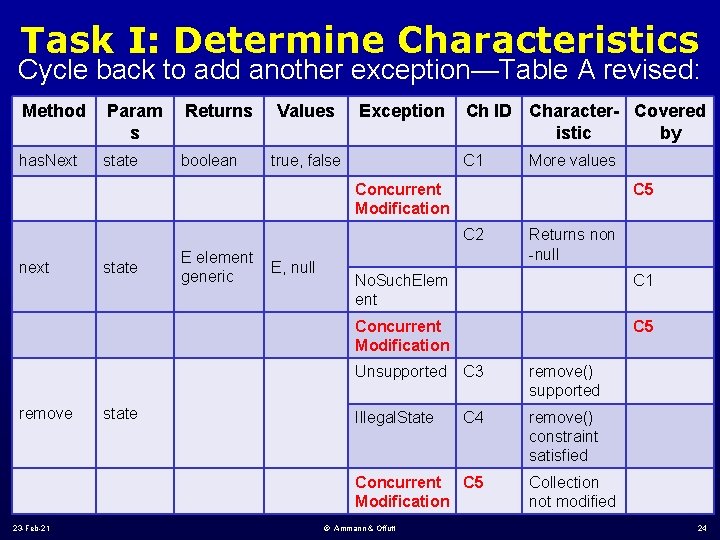
Task I: Determine Characteristics Cycle back to add another exception—Table A revised: Method Param s Returns has. Next state boolean Values Exception true, false Ch ID Character- Covered istic by C 1 More values Concurrent Modification C 5 C 2 next remove state E element generic E, null No. Such. Elem ent C 1 Concurrent Modification C 5 Unsupported C 3 remove() supported Illegal. State C 4 remove() constraint satisfied Concurrent C 5 Modification 23 -Feb-21 Returns non -null © Ammann & Offutt Collection not modified 24
Task II: Define Test Requirements • Cycle back to Step 5: Revised infeasible test requirements Table C revised: Method Characteristics Test Requirements Infeasibl e TRs Revised TRs # TRs work … 23 -Feb-21 © Ammann & Offutt 25
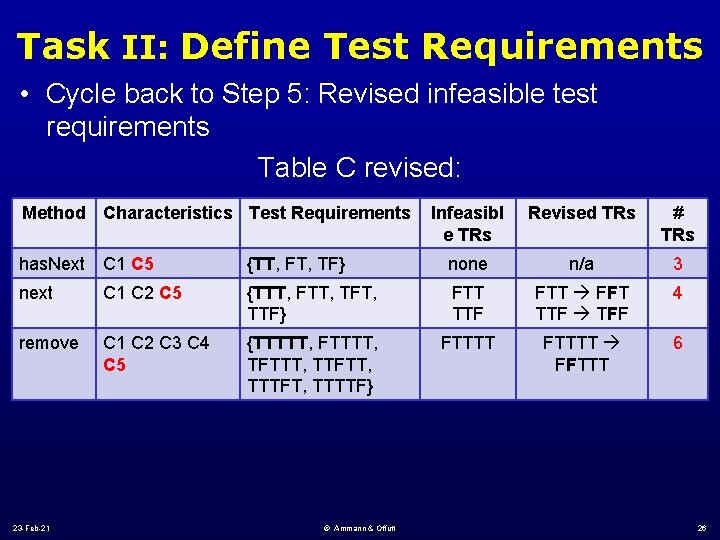
Task II: Define Test Requirements • Cycle back to Step 5: Revised infeasible test requirements Table C revised: Method Characteristics Test Requirements Infeasibl e TRs Revised TRs # TRs has. Next C 1 C 5 {TT, FT, TF} none n/a 3 next C 1 C 2 C 5 {TTT, FTT, TFT, TTF} FTT TTF FTT FFT TTF TFF 4 remove C 1 C 2 C 3 C 4 C 5 {TTTTT, FTTTT, TFTTT, TTFTT, TTTFT, TTTTF} FTTTT FFTTT 6 23 -Feb-21 © Ammann & Offutt 26
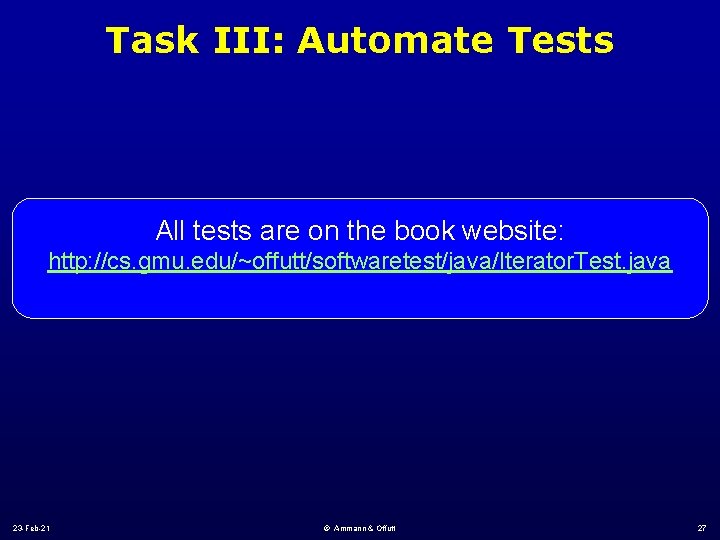
Task III: Automate Tests All tests are on the book website: http: //cs. gmu. edu/~offutt/softwaretest/java/Iterator. Test. java 23 -Feb-21 © Ammann & Offutt 27