
Incidents First Aid Reporting and Investigation PRESENTED BY
Incidents First Aid, Reporting, and Investigation PRESENTED BY
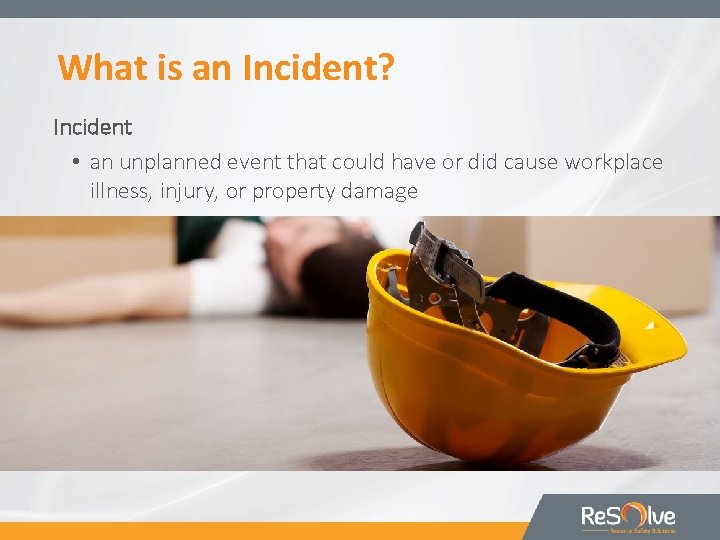
What is an Incident? Incident • an unplanned event that could have or did cause workplace illness, injury, or property damage
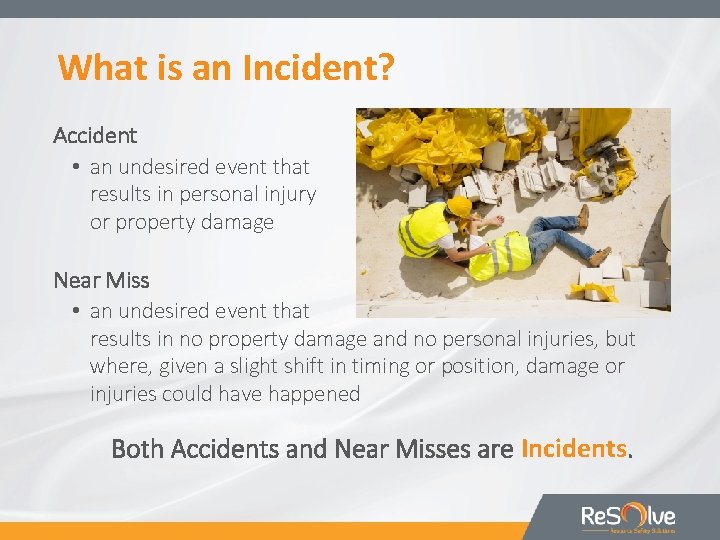
What is an Incident? Accident • an undesired event that results in personal injury or property damage Near Miss • an undesired event that results in no property damage and no personal injuries, but where, given a slight shift in timing or position, damage or injuries could have happened Both Accidents and Near Misses are Incidents.
Incident Reporting All incidents must be reported. Near misses indicate hazards that could easily lead to an accident. First aid cases can lead to medical cases. They must be reported so the hazards that cause them can be addressed.
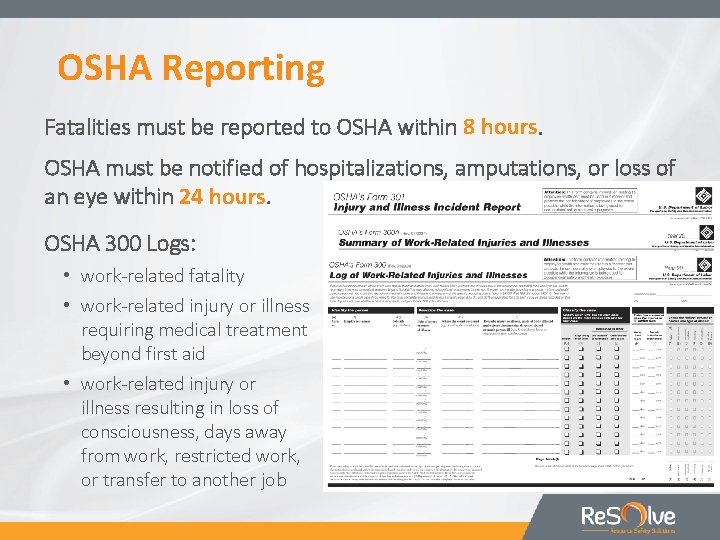
OSHA Reporting Fatalities must be reported to OSHA within 8 hours. OSHA must be notified of hospitalizations, amputations, or loss of an eye within 24 hours. OSHA 300 Logs: • work-related fatality • work-related injury or illness requiring medical treatment beyond first aid • work-related injury or illness resulting in loss of consciousness, days away from work, restricted work, or transfer to another job
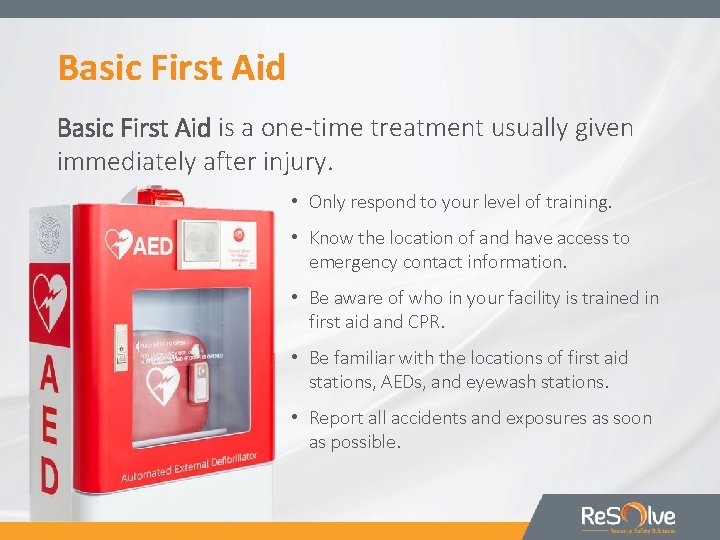
Basic First Aid is a one-time treatment usually given immediately after injury. • Only respond to your level of training. • Know the location of and have access to emergency contact information. • Be aware of who in your facility is trained in first aid and CPR. • Be familiar with the locations of first aid stations, AEDs, and eyewash stations. • Report all accidents and exposures as soon as possible.
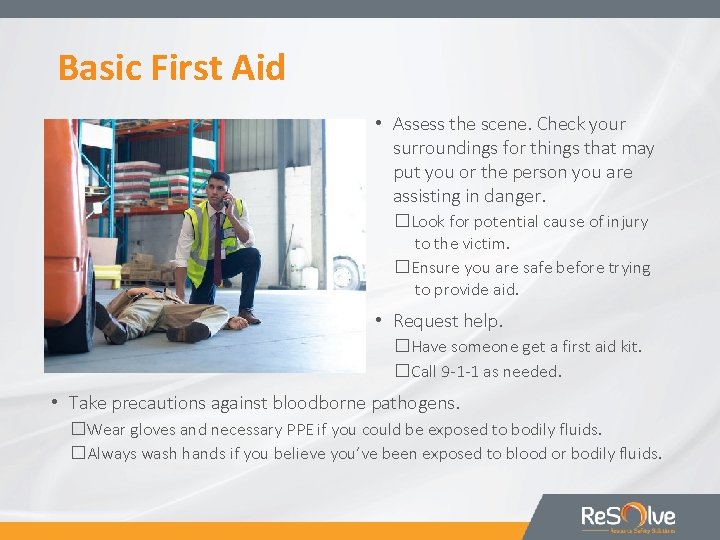
Basic First Aid • Assess the scene. Check your surroundings for things that may put you or the person you are assisting in danger. �Look for potential cause of injury to the victim. �Ensure you are safe before trying to provide aid. • Request help. �Have someone get a first aid kit. �Call 9 -1 -1 as needed. • Take precautions against bloodborne pathogens. �Wear gloves and necessary PPE if you could be exposed to bodily fluids. �Always wash hands if you believe you’ve been exposed to blood or bodily fluids.
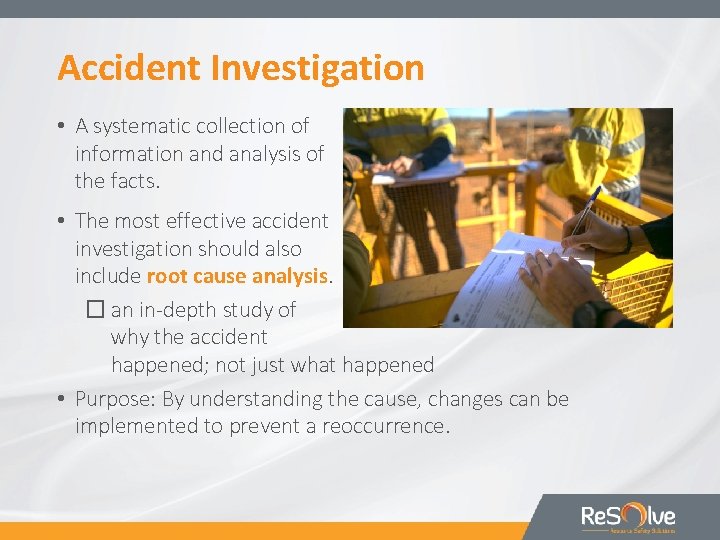
Accident Investigation • A systematic collection of information and analysis of the facts. • The most effective accident investigation should also include root cause analysis. � an in-depth study of why the accident happened; not just what happened • Purpose: By understanding the cause, changes can be implemented to prevent a reoccurrence.
Accident Investigation Example: A newly-hired worker was operating a forklift when it spun out of control and crashed, destroying property and injuring another worker. An investigation is conducted. What happened? The brakes on the forklift were bad, and the operator was driving too fast. Many companies stop here. They fix the brakes and move forward. The same conditions are likely to reoccur and will lead to another accident. In this case, they need to ask: • Why were the brakes bad? • Why hadn’t they been fixed? • Why was the operator driving too fast?
Accident Investigation Why were the brakes bad? Why hadn’t they been fixed? The brakes had not been checked in some time. There was no regular maintenance schedule for the equipment. Why was the operator driving too fast? There was no consensus on a speed limit in the facility. Their company training had no specific speed limit or facility rules outlined. To address the causes of the incident: • A pre-inspection checklist was developed forklift operators. • The company implemented a detailed maintenance program. • The operator training was updated to outline facility-specific rules for safe operation of the forklift. • The speed limit was posted throughout the facility. By making these changes, they reduced the probability of having the same type of incident occur again.

www. resolveok. com
- Slides: 11