
Incident Summary for CCE Safety Committee Meeting November
Incident Summary for CCE Safety Committee Meeting November 7, 2019
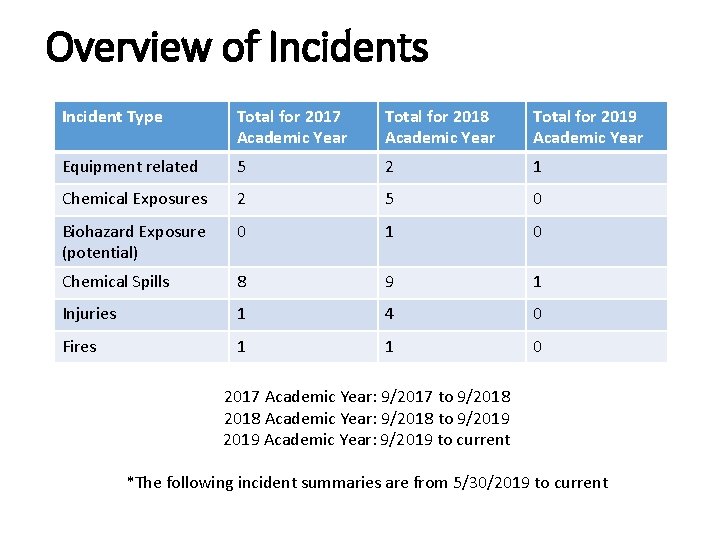
Overview of Incidents Incident Type Total for 2017 Academic Year Total for 2018 Academic Year Total for 2019 Academic Year Equipment related 5 2 1 Chemical Exposures 2 5 0 Biohazard Exposure (potential) 0 1 0 Chemical Spills 8 9 1 Injuries 1 4 0 Fires 1 1 0 2017 Academic Year: 9/2017 to 9/2018 Academic Year: 9/2018 to 9/2019 Academic Year: 9/2019 to current *The following incident summaries are from 5/30/2019 to current
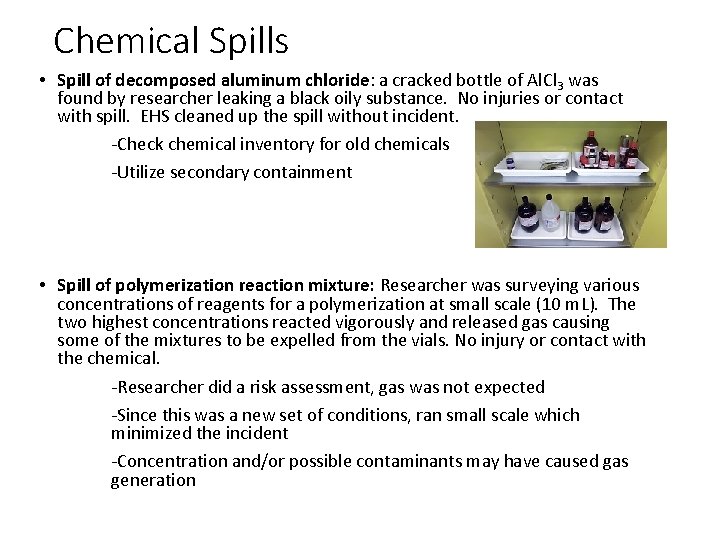
Chemical Spills • Spill of decomposed aluminum chloride: a cracked bottle of Al. Cl 3 was found by researcher leaking a black oily substance. No injuries or contact with spill. EHS cleaned up the spill without incident. -Check chemical inventory for old chemicals -Utilize secondary containment • Spill of polymerization reaction mixture: Researcher was surveying various concentrations of reagents for a polymerization at small scale (10 m. L). The two highest concentrations reacted vigorously and released gas causing some of the mixtures to be expelled from the vials. No injury or contact with the chemical. -Researcher did a risk assessment, gas was not expected -Since this was a new set of conditions, ran small scale which minimized the incident -Concentration and/or possible contaminants may have caused gas generation
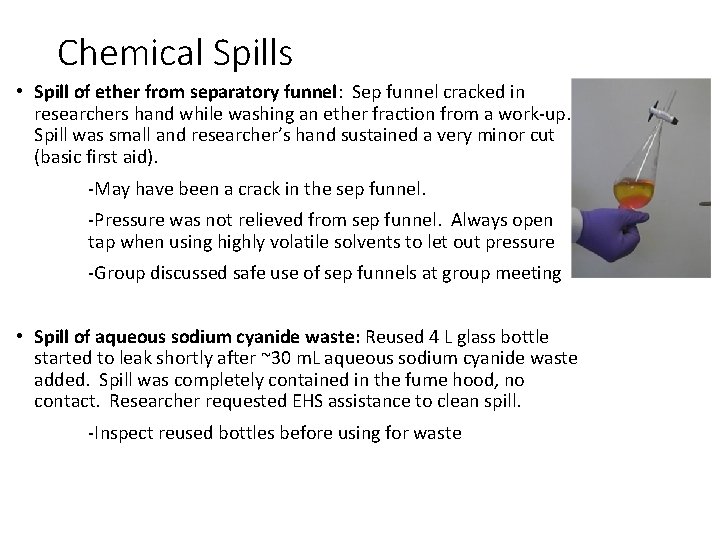
Chemical Spills • Spill of ether from separatory funnel: Sep funnel cracked in researchers hand while washing an ether fraction from a work-up. Spill was small and researcher’s hand sustained a very minor cut (basic first aid). -May have been a crack in the sep funnel. -Pressure was not relieved from sep funnel. Always open tap when using highly volatile solvents to let out pressure -Group discussed safe use of sep funnels at group meeting • Spill of aqueous sodium cyanide waste: Reused 4 L glass bottle started to leak shortly after ~30 m. L aqueous sodium cyanide waste added. Spill was completely contained in the fume hood, no contact. Researcher requested EHS assistance to clean spill. -Inspect reused bottles before using for waste
Chemical Spills • Silica Ampoule burst: A sealed silica ampoule containing a mixture of iron, selenium, lithium selenide, and carbon burst when removed from oven and immersed in a water bath. This dispersed the contents of the ampule in the lab. Lab evacuated, researcher went back into lab with face mask to clean spill. No injuries occurred. -Quantity of material small (~500 mg total) minimizing incident -Same reaction has been performed many times by group, first ampoule failure. Root cause likely a faulty tube. -Researcher followed written SOP, including all PPE (lab coat, nitrile gloves, leather glove, and face shield. -Using a mask for protection often requires fit testing -Spills with a potential inhalation hazard, H 2 Se in this case, should not be cleaned by lab. Safety will provide clean up assistance.
Condensed Oxygen • Researcher was performing a reaction under vacuum using a Schlenk line. One of the reactants (sulfuric acid, 3 m. L) was frozen in liquid nitrogen and when they raised the reactant tube (10 m. L) outside of the LN 2 bath, they observed blue. Researcher closed fume hood sash, evacuated lab, and reported to Safety and Security. -Oxygen potentially condensed into tube due to leak. -Schlenk line and reaction set-up was not leak checked before work began. Had many connections in system. -Reaction tube was left out of LN 2 bath, so after 45 minutes of warming, lab was entered by Safety, no blue remained. -We determined that the volatiles condensed at a much higher temperature than LN 2, so replaced with a dry ice/acetone bath
Overall Lessons Learned • Regularly check condition of chemicals • Always examine glassware (including waste bottles) before use • Talk about safety in group meetings • Perform experiments at smallest scale reasonably possible • Consider alternatives to eliminate hazards • Follow SOPs and train researchers to them -Training done in the lab is key to safety
- Slides: 7