
INCIDENT RESPONSE SYSTEM IRS FOR DISASTER MANAGEMENT By
INCIDENT RESPONSE SYSTEM (IRS) FOR DISASTER MANAGEMENT By Maj Gen V K Datta AVSM, SM**, VSM, **PPMG Senior Specialist (CB&ME) National Disaster Management Authority, Govt of India,
REFERENCE MATERIAL Officers to be familiar with the contents of: • Disaster Management (DM) Act - 2005 • Guidelines – Incident Response System (July 2010) v Duties of appointments v Departmental Plans • National Disaster Management Plan – 2016
OBJECTIVES • To incorporate IRS for Emergency Response in case of any Disaster at State and District level. • To highlight the Standard Operating Procedures. • To highlight the Roles and Responsibilities of various stakeholders involved in managing disasters as per IRS. • To enhance Coordination and Synergize efforts of various Emergency Support Functions at the District/State Level.

SHORTCOMINGS AND LESSONS LEARNT
SHORTCOMINGS IN INDIAN DISASTER RESPONSE 1. Delay in Assessment of situation and Information Dissemination. 2. Breakdown of communications both electronic and surface. 3. Delay in mobilization of men, material, relief stores and machines to provide and restore basic life line services. 4. Need is for enhancement of awareness and capacity building of first responders.

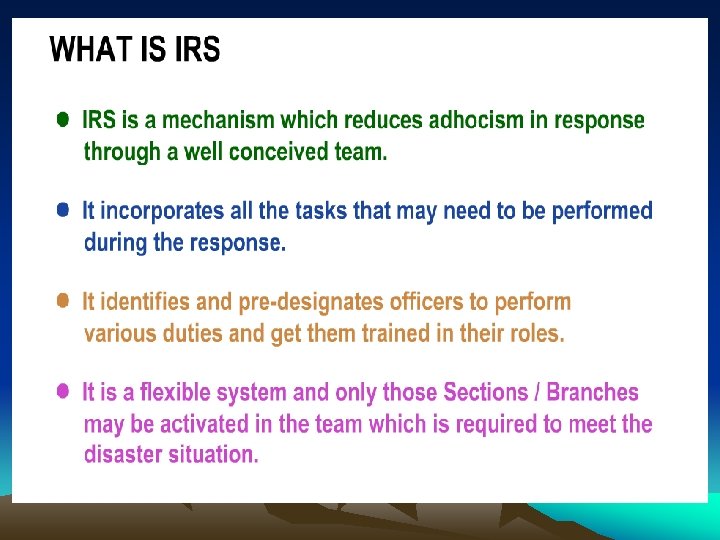
WHAT IS IRS ?
THE IRS IS AN IMPORTANT TOOL FOR MINIMIZING LOSS OF LIFE AND PROPERTY BY “STRENGTHENING AND STANDARDISING” THE DISASTER RESPONSE MECHANISM IN INDIA.
Advantages of Incident Response System • Rapid mobilization of resources, optimum utilization, cost effective resource management. • System of single, unified and Area command to suit disaster situation. • Management by objective. • Briefing, planning and operation as per Incident Action Plan. • Unity and chain of command, transfer of responsibility. • Integrated communication. • Personnel accountability.
FEATURES OF IRS 1. Flexibility 2. Span of control 3. Multi Tasking 4. Accountability 5. Management by objectives & Incident Action Plan 6. Resource Management 7. Common Terminology 8. Unity of command chain of command 9. Transfer of Command 10. Unified Command 11. Medical Plan 12. Communication Plan 13. Demobilization Plan

BACKGROUND OF IRS
GOI DECIDED TO ADAPT WORLDS BEST PRACTICES FOR RESPONSE TO DISASTERS AND TRAINING WAS CONDUCTED TO OFFICIALS ON THE INCIDENT COMMAND SYSTEM
THE ICS DID NOT SUIT THE INDIAN ADMINISTRATIVE STRUCTURE AND A NEED WAS FELT TO REDESIGN THE CONCEPT THEREFORE THE INCIDENT RESPONSE SYSTEM GUIDELINES WERE ISSUED BY NDMA
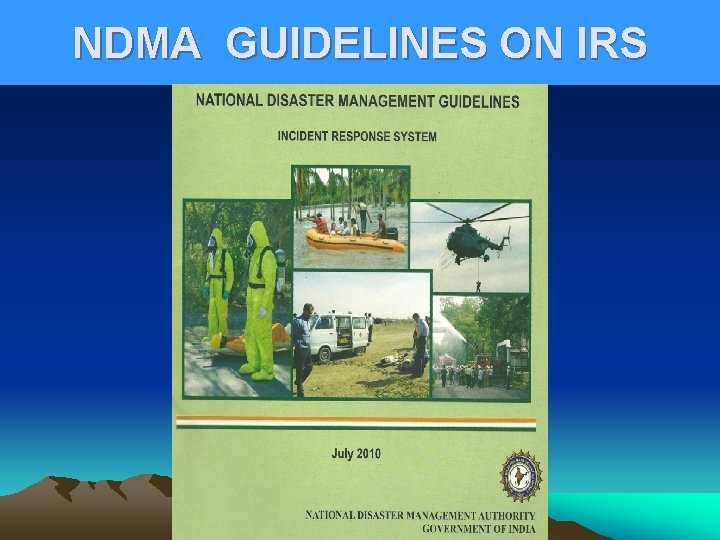
NDMA GUIDELINES ON IRS
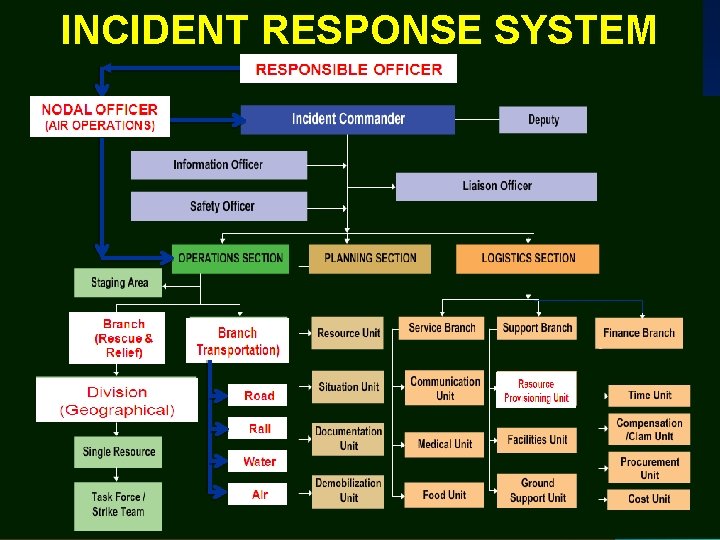
INCIDENT RESPONSE SYSTEM
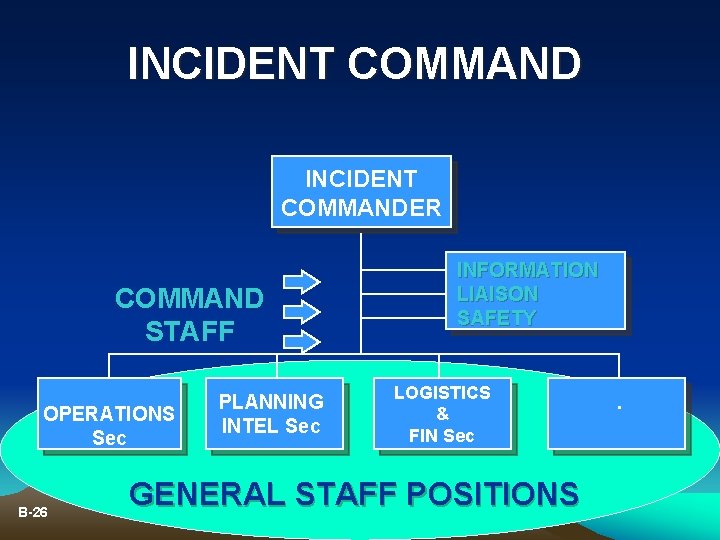
INCIDENT COMMANDER COMMAND STAFF OPERATIONS Sec B-26 PLANNING INTEL Sec INFORMATION LIAISON SAFETY LOGISTICS & FIN Sec GENERAL STAFF POSITIONS .
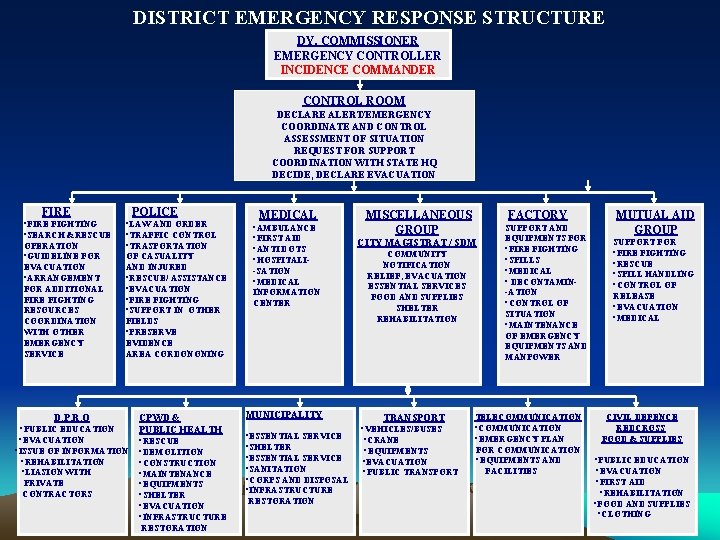
DISTRICT EMERGENCY RESPONSE STRUCTURE DY. COMMISSIONER EMERGENCY CONTROLLER INCIDENCE COMMANDER CONTROL ROOM DECLARE ALERT/EMERGENCY COORDINATE AND CONTROL ASSESSMENT OF SITUATION REQUEST FOR SUPPORT COORDINATION WITH STATE HQ DECIDE, DECLARE EVACUATION FIRE • FIRE FIGHTING • SEARCH &RESCUE OPERATION • GUIDELINE FOR EVACUATION • ARRANGEMENT FOR ADDITIONAL FIRE FIGHTING RESOURCES COORDINATION WITH OTHER EMERGENCY SERVICE POLICE • LAW AND ORDER • TRAFFIC CONTROL • TRASPORTATION OF CASUALITY AND INJURED • RESCUE/ ASSISTANCE • EVACUATION • FIRE FIGHTING • SUPPORT IN OTHER FIELDS • PRESERVE EVIDENCE AREA CORDONONING D. P. R. O • PUBLIC EDUCATION • EVACUATION • ISSUE OF INFORMATION • REHABILITATION • LIASION WITH PRIVATE CONTRACTORS CPWD & PUBLIC HEALTH • RESCUE • DEMOLITION • CONSTRUCTION • MAINTENANCE • EQUIPMENTS • SHELTER • EVACUATION • INFRASTRUCTURE RESTORATION MEDICAL • AMBULANCE • FIRST AID • ANTI DOTS • HOSPITALI-SATION • MEDICAL INFORMATION CENTER MUNICIPALITY • ESSENTIAL SERVICE • SHELTER • ESSENTIAL SERVICE • SANITATION • CORPS AND DISPOSAL • INFRASTRUCTURE RESTORATION MISCELLANEOUS GROUP FACTORY CITY MAGISTRAT / SDM COMMUNITY NOTIFICATION RELIEF, EVACUATION ESSENTIAL SERVICES FOOD AND SUPPLIES SHELTER REHABILITATION TRANSPORT • VEHICLES/BUSES • CRANE • EQUIPMENTS • EVACUATION • PUBLIC TRANSPORT SUPPORT AND EQUIPMENTS FOR • FIRE FIGHTING • SPILLS • MEDICAL • DECONTAMIN-ATION • CONTROL OF SITUATION • MAINTENANCE OF EMERGENCY EQUIPMENTS AND MANPOWER TELECOMMUNICATION • EMERGENCY PLAN FOR COMMUNICATION • EQUIPMENTS AND FACILITIES MUTUAL AID GROUP SUPPORT FOR • FIRE FIGHTING • RESCUE • SPILL HANDLING • CONTROL OF RELEASE • EVACUATION • MEDICAL CIVIL DEFENCE REDCROSS FOOD & SUPPLIES • PUBLIC EDUCATION • EVACUATION • FIRST AID • REHABILITATION • FOOD AND SUPPLIES • CLOTHING
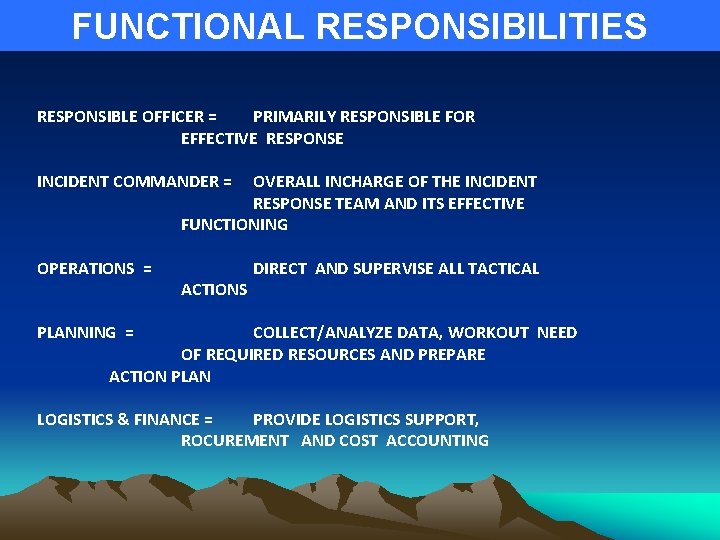
FUNCTIONAL RESPONSIBILITIES RESPONSIBLE OFFICER = PRIMARILY RESPONSIBLE FOR EFFECTIVE RESPONSE INCIDENT COMMANDER = OVERALL INCHARGE OF THE INCIDENT RESPONSE TEAM AND ITS EFFECTIVE FUNCTIONING OPERATIONS = ACTIONS DIRECT AND SUPERVISE ALL TACTICAL PLANNING = COLLECT/ANALYZE DATA, WORKOUT NEED OF REQUIRED RESOURCES AND PREPARE ACTION PLAN LOGISTICS & FINANCE = PROVIDE LOGISTICS SUPPORT, ROCUREMENT AND COST ACCOUNTING
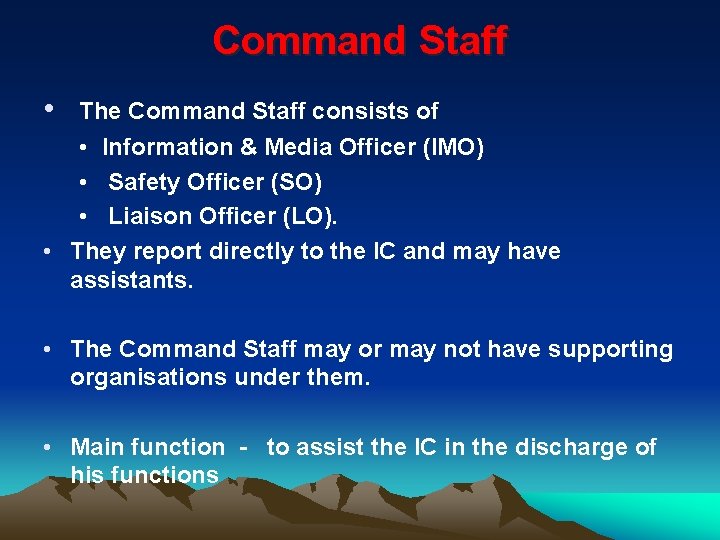
Command Staff • The Command Staff consists of • Information & Media Officer (IMO) • Safety Officer (SO) • Liaison Officer (LO). • They report directly to the IC and may have assistants. • The Command Staff may or may not have supporting organisations under them. • Main function - to assist the IC in the discharge of his functions
General Staff • General Staff - three components • Operations Section (OS) • Planning Section (PS) • Logistics Section (LS)
General Staff Operations Section (OS) • The OS is responsible for directing the required tactical actions to meet incident objectives. • Expansion of the OS depends on – Enormity of the situation – Number of different types and kinds of functional Groups required in the response management.
General Staff - Planning Section (PS) • Responsible for – Collection, evaluation and display of incident information – Maintaining and tracking resources – Preparing the Incident Action Plan (IAP) and other necessary incident related documentation. • They will assess the requirement of additional resources, propose from where it can be mobilised and keep IC informed. • Preparation - demobilisation plan.
General Staff - Logistics Section (LS) • Responsible for providing facilities, services, materials, equipment and other resources in support of the incident response. • The Section Chief participates in development and implementation of the IAP, activates and supervises Branches and Units of his section • Finance Branch to ensure prompt and smooth procurement and supply of resources as per financial rules.
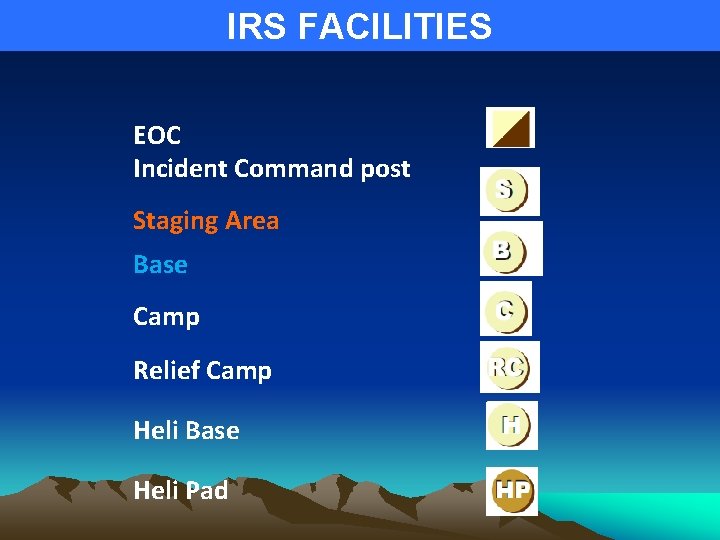
IRS FACILITIES EOC Incident Command post Staging Area Base Camp Relief Camp Heli Base Heli Pad
IRS ENTITIES • • • EOC STAGING AREA CAMP/BASE HELIBASE/HELIPADS INCIDENT COMMAND POST RALLAYING POINTS MEDICAL AID POSTS DECONTAMINATION POINTS RELIEF CAMPS/SHELTERS
EMERGENCY OPERATION CENTER • Adequate space with proper infrastructure to accommodate the participating agencies and departments • Communication facilities with last mile connectivity • A vehicle mounted with HF, VHF and satellite telephone for deployment in the affected site to provide immediate connectivity with the headquarters and ICP • A representative of central teams (NDRF, Armed Forces) whenever they are deployed to integrate their resources, expertise and to resolve conflicts that may arise during the response effort • Provision and plan for dovetailing the NDRF, Armed Forces communication capabilities with the local communication set up. • There will be proper plan so that all are able to connect with each other in case of large scale disasters or failure of the local communication systems;
EMERGENCY OPERATION CENTER • Map depicting affected site, resources deployed, facilities established like Incident Command Post, Staging Area, Incident Base, Camp, Relief Camp, Helibase, Helipad, etc. • DM plans of all line departments • DM plans of the State and the District – Directories with contact details of all emergency services and nodal officers – Connectivity with all District headquarters and police stations; – Database of NGOs working in different geographical areas; – Demographic details of the State and Districts;
EMERGENCY OPERATION CENTER • Online / Web based DSS with the availability of at least the following components: – Proactive planning facilities; – Comprehensive resource management system; – Geographic Information System (GIS) for decision support; and – �� Modeling capability for predicting casualties and resources for large scale incidents including CBRN emergencies. • Resource inventories of all line departments and connectivity with database of India • Disaster Resource Network (IDRN) , India Disaster Knowledge Network (IDKN) and �� Corporate Disaster Resource Network (CDRN);
EMERGENCY OPERATION CENTER (Contd…) EOC IS NOT AN INCIDENT COMMAND POST
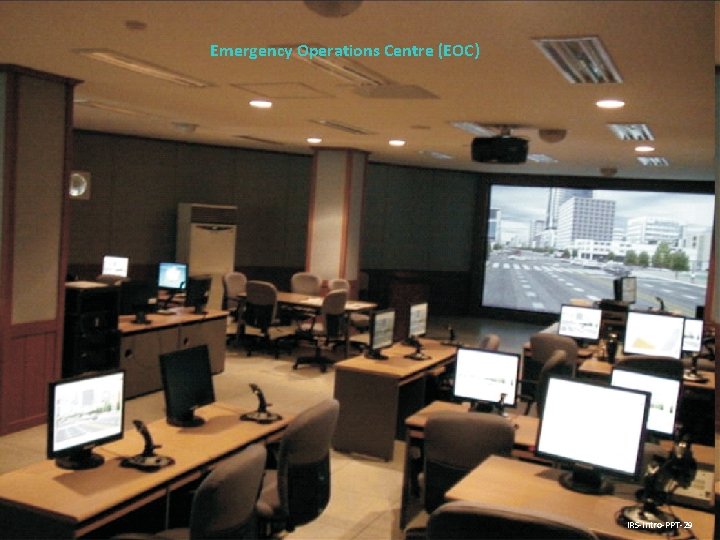
Emergency Operations Centre (EOC) IRS-Intro-PPT-29
Staging Area • An area where resources are collected and kept ready for deployment for field operations. These may include things like food, vehicles and other materials and equipment. • The SA will be established at a suitable area near the affected site for immediate, effective and quick deployment of resources. • More than one SA may be established if required. • If resources are mobilised at other locations to be ultimately despatched to the affected areas, these locations are also known as SAs.
Base • Normally base is the location where all uncommitted / out-of-service equipment and personnel to support operations are located. • It will be designated by incident name. • The management of the Incident Base comes under the Facility Unit of Logistics unit.
Incident Command Post • The ICP is the location at which the primary command functions and coordination are performed. • The IC will be located at the ICP. • This also applies to situations with multi-agencies or multijurisdictional incidents operating under a single or Unified command. • Normally ICP is not relocated
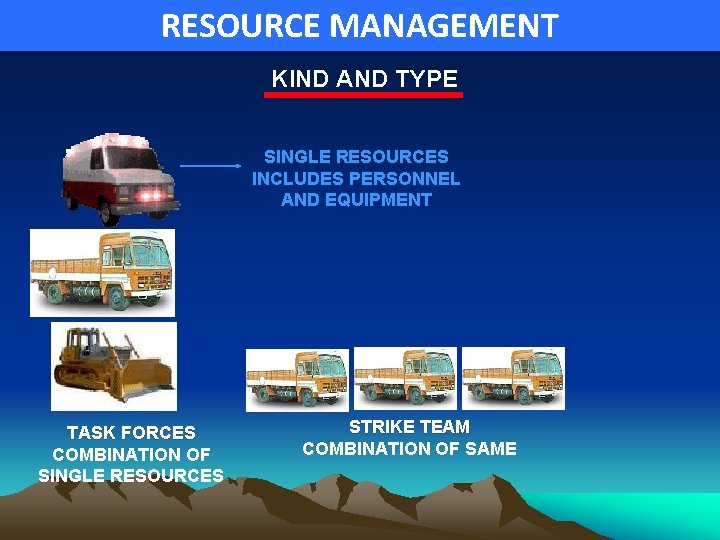
RESOURCE MANAGEMENT KIND AND TYPE SINGLE RESOURCES INCLUDES PERSONNEL AND EQUIPMENT TASK FORCES COMBINATION OF SINGLE RESOURCES STRIKE TEAM COMBINATION OF SAME
Unified command When incident become larger or When complexity of the incident require involvement of multiple agencies
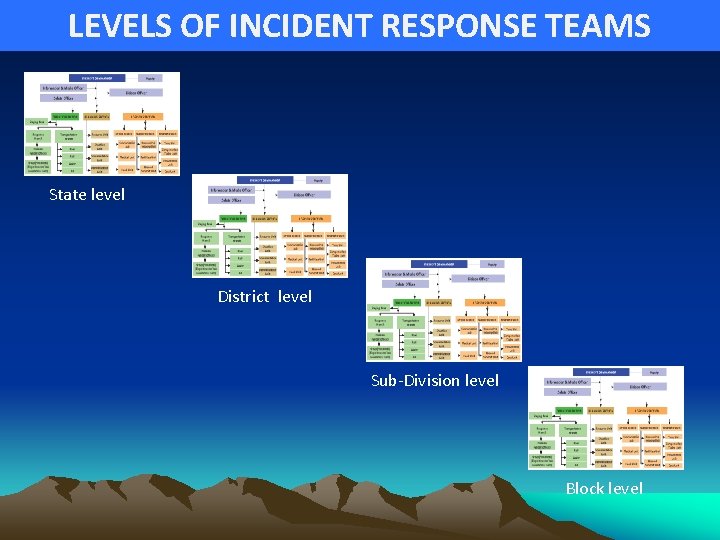
LEVELS OF INCIDENT RESPONSE TEAMS State level District level Sub-Division level Block level
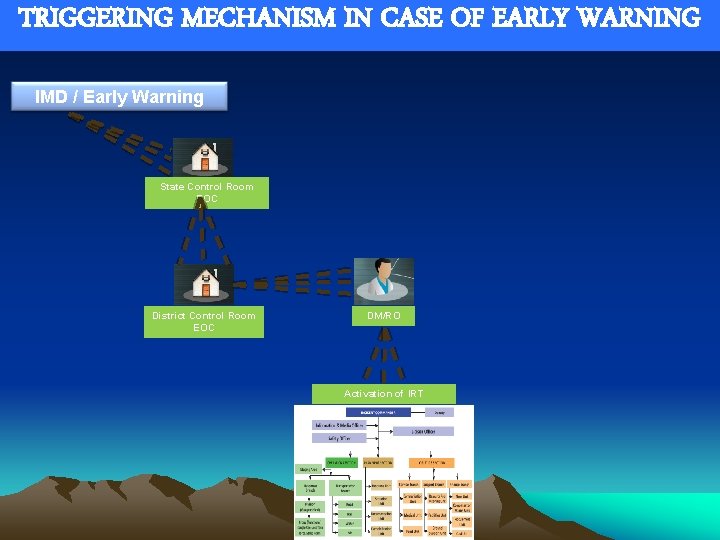
TRIGGERING MECHANISM IN CASE OF EARLY WARNING IMD / Early Warning State Control Room EOC District Control Room EOC DM/RO Activation of IRT
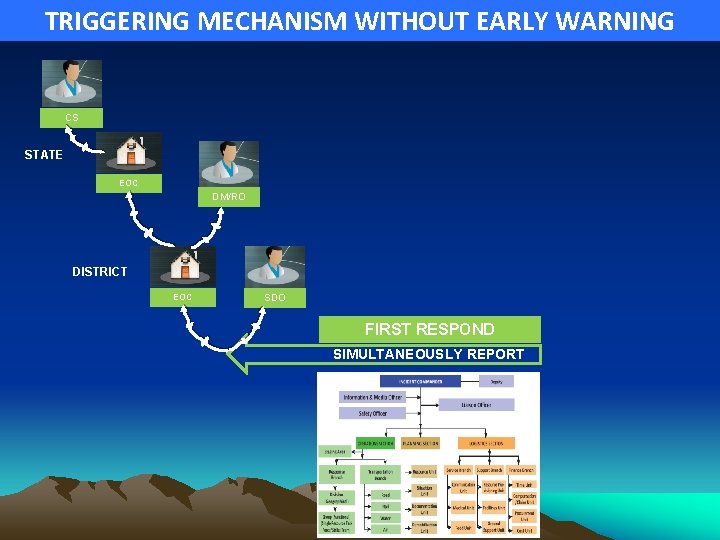
TRIGGERING MECHANISM WITHOUT EARLY WARNING CS STATE EOC DM/RO DISTRICT EOC SDO FIRST RESPOND SIMULTANEOUSLY REPORT
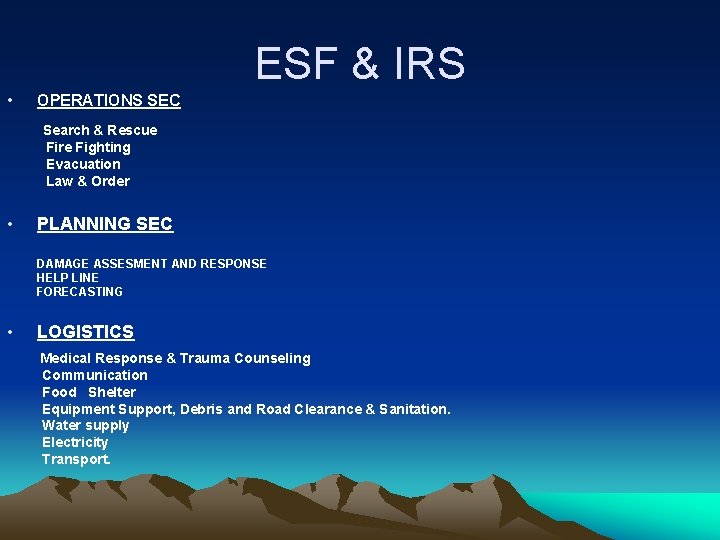
ESF & IRS • OPERATIONS SEC Search & Rescue Fire Fighting Evacuation Law & Order • PLANNING SEC DAMAGE ASSESMENT AND RESPONSE HELP LINE FORECASTING • LOGISTICS Medical Response & Trauma Counseling Communication Food Shelter Equipment Support, Debris and Road Clearance & Sanitation. Water supply Electricity Transport.
Stake holders in a District 1. 2. 3. 4. 5. 6. 7. DC/ District Magistrate. SP /Commissioner Police. District Medical Officer/Civil Surgeon. District Fire Officer. State Electricity Board. Water Supply Department. District Supply Officer.
Stake Holders – Cont CEO/Operational Head of Identified Industrial Units. 9. Public Works Department. 10. Local NGOs 11. Civil Defence 12. Home Guards 13. National Disaster Response Force 14. District Public Relations Officer. 15. Army/PMF unit located in the District if required. 16. Any Other identified stakeholder. 8.


Thanks
- Slides: 43