
Incident Investigation January 8 2014 Incident vs Accident
- Slides: 23
Incident Investigation January 8, 2014
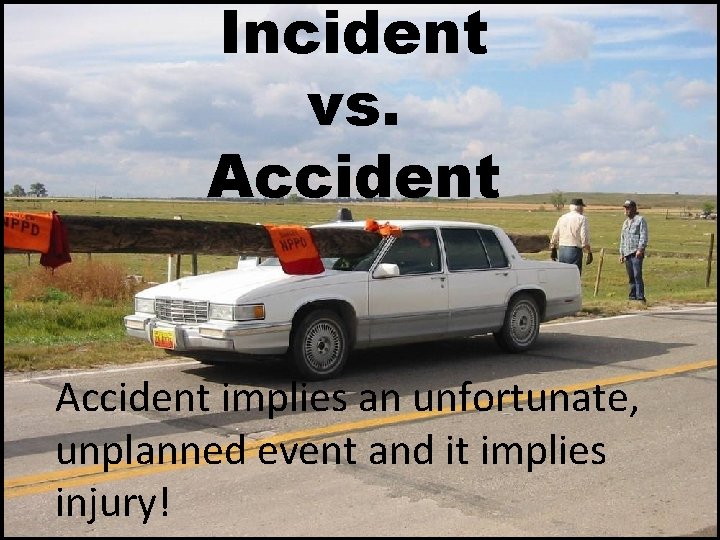
Incident vs. Accident implies an unfortunate, unplanned event and it implies injury!
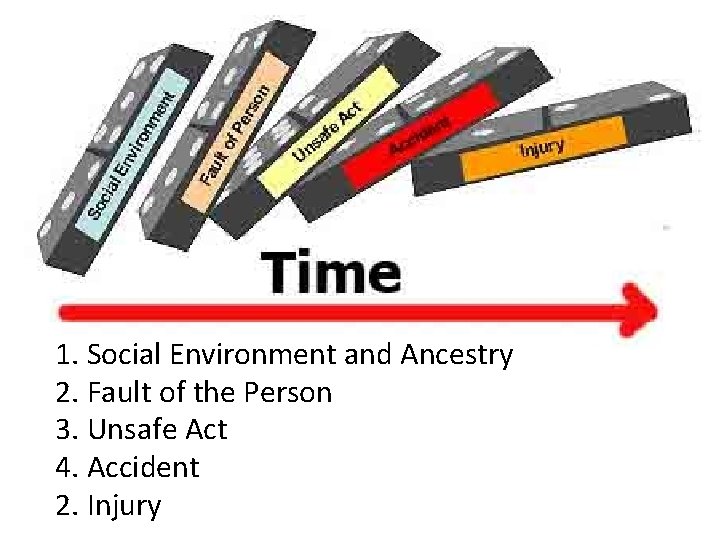
1. Social Environment and Ancestry 2. Fault of the Person 3. Unsafe Act 4. Accident 2. Injury
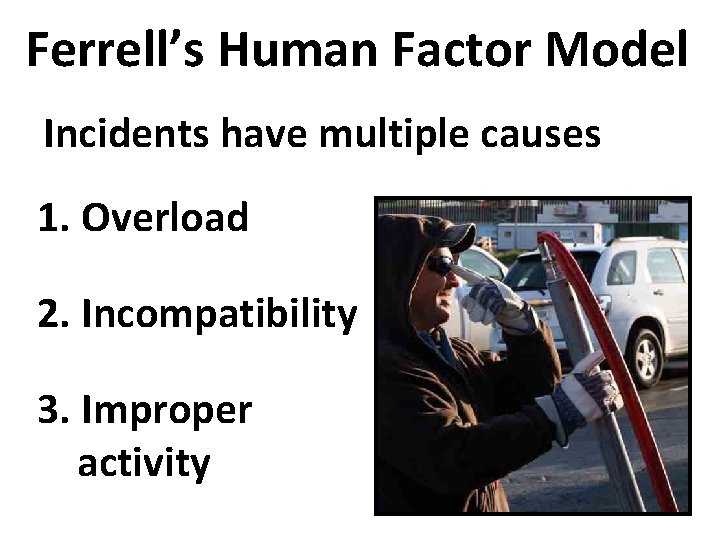
Ferrell’s Human Factor Model Incidents have multiple causes 1. Overload 2. Incompatibility 3. Improper activity
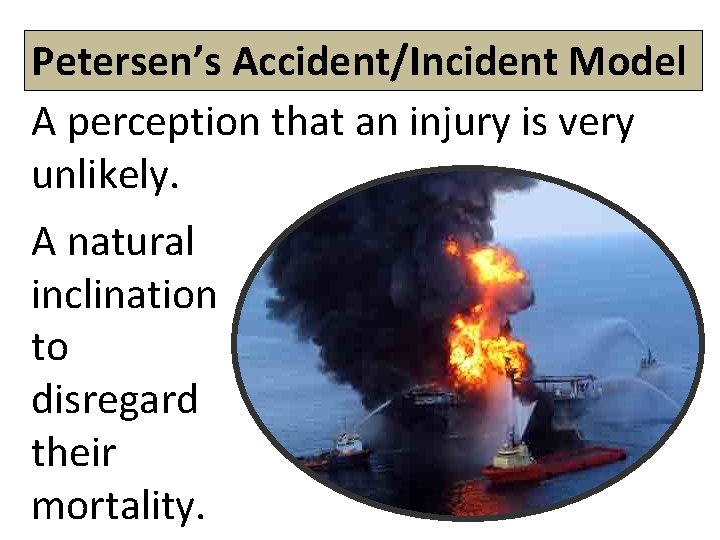
Petersen’s Accident/Incident Model A perception that an injury is very unlikely. A natural inclination to disregard their mortality.
Safety Truths 1. Management must assume responsibility for a safe workplace. 2. The supervisor is the key person in incident prevention (investigation). 3. Incidents have both direct and indirect costs. 4. All incidents should be investigated.
Why we fail to achieve a safety culture Management does not establish a comprehensive safety policy. Responsibility and authority with regard to safety is not clearly defined. Safety procedures; as measurement, inspection, correction and investigation. . . Lack of proper procedures orientation. Employee not given sufficient training.
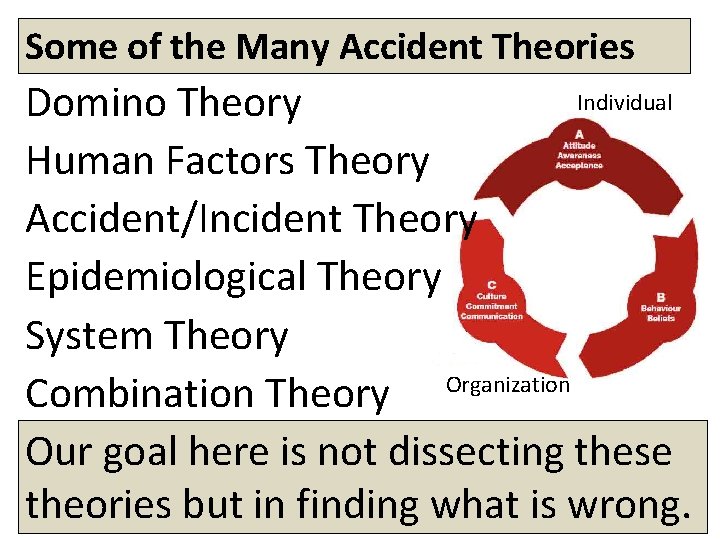
Some of the Many Accident Theories Individual Domino Theory Human Factors Theory Accident/Incident Theory Epidemiological Theory System Theory Combination Theory Organization Our goal here is not dissecting these theories but in finding what is wrong.
There are two or three good methods for identification of hazards in the workplace! Job Hazard Analysis & Worksite Safety Audits. Incident Investigation & analysis. 1. Near Miss or non-injury incident. 2. Property Damage / Vehicle Incident. 3. Injury / Fatality Incident. 2. Public – Property / Injury / Fatality.
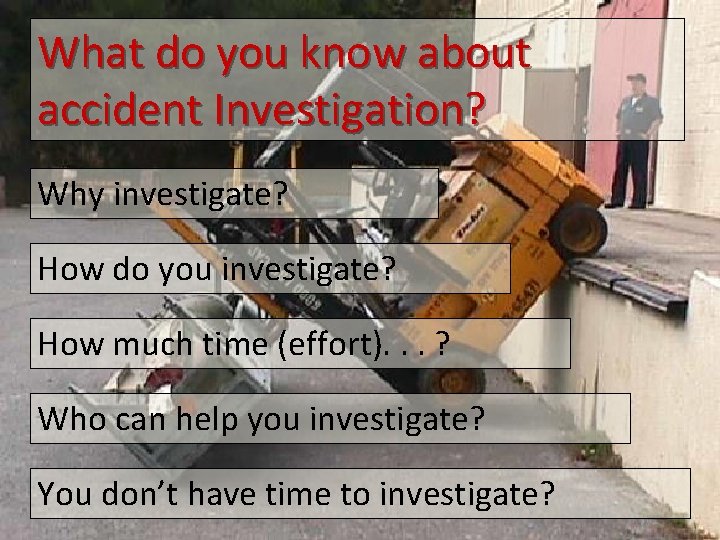
Whatdo doyou youknowaboutaccident Investigation? Why investigate? How do you investigate? How much time (effort). . . ? Who can help you investigate? You don’t have time to investigate?
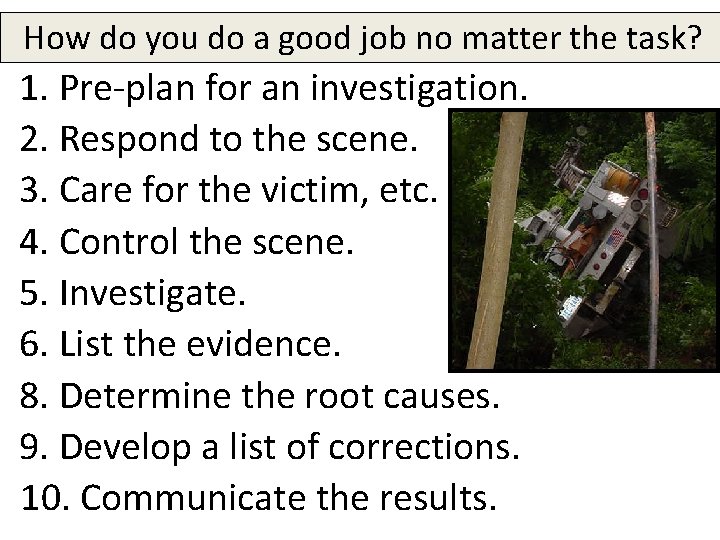
How do you do a good job no matter the task? 1. Pre-plan for an investigation. 2. Respond to the scene. 3. Care for the victim, etc. 4. Control the scene. 5. Investigate. 6. List the evidence. 8. Determine the root causes. 9. Develop a list of corrections. 10. Communicate the results.
Pre-plan for an investigation. Who is going to investigate? Who is going to investigate if you are not available. . . Are they trained? Do you have an investigation kit at hand? Do you have the forms or checklist you will need? Do you have the ability to handle the stress?
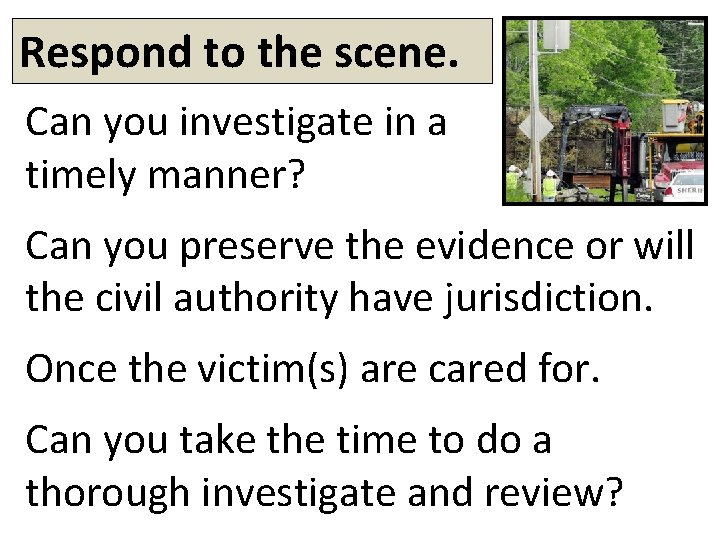
Respond to the scene. Can you investigate in a timely manner? Can you preserve the evidence or will the civil authority have jurisdiction. Once the victim(s) are cared for. Can you take the time to do a thorough investigate and review?
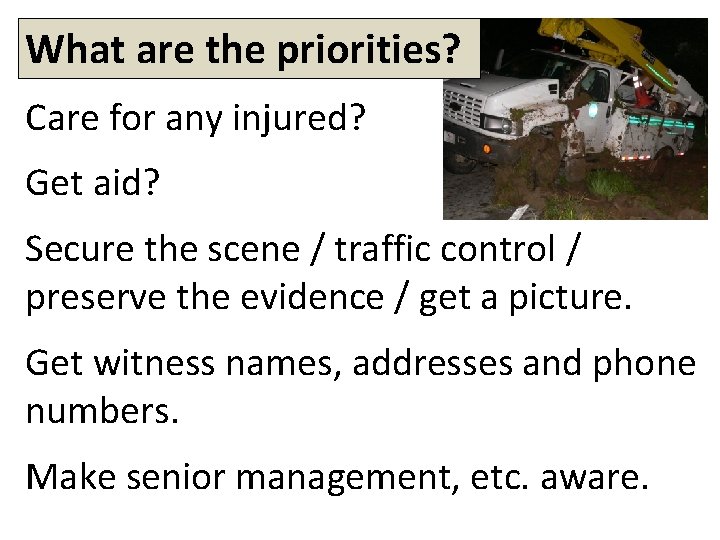
What are the priorities? Care for any injured? Get aid? Secure the scene / traffic control / preserve the evidence / get a picture. Get witness names, addresses and phone numbers. Make senior management, etc. aware.
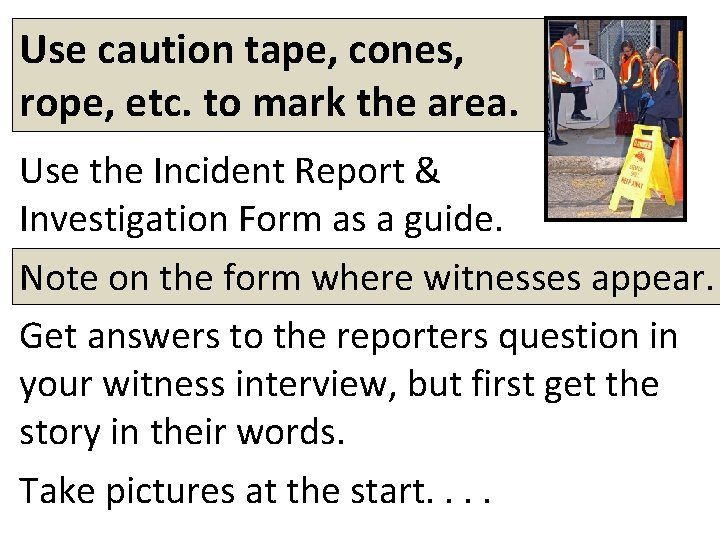
Use caution tape, cones, rope, etc. to mark the area. Use the Incident Report & Investigation Form as a guide. Note on the form where witnesses appear. Get answers to the reporters question in your witness interview, but first get the story in their words. Take pictures at the start. .
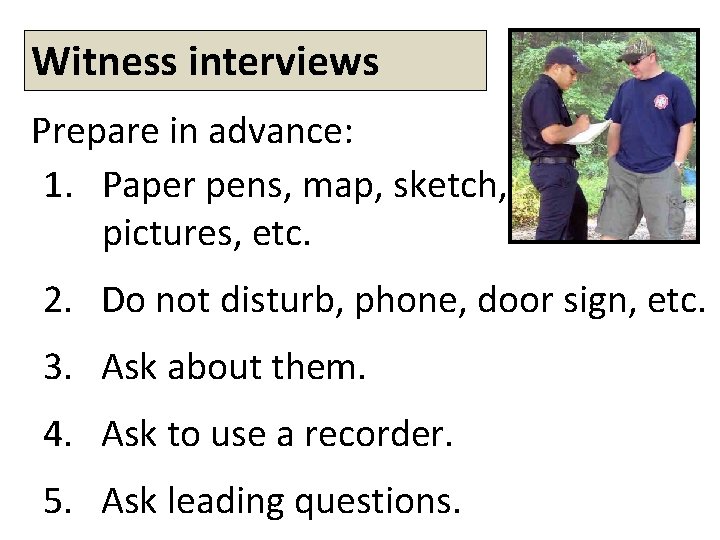
Witness interviews Prepare in advance: 1. Paper pens, map, sketch, pictures, etc. 2. Do not disturb, phone, door sign, etc. 3. Ask about them. 4. Ask to use a recorder. 5. Ask leading questions.
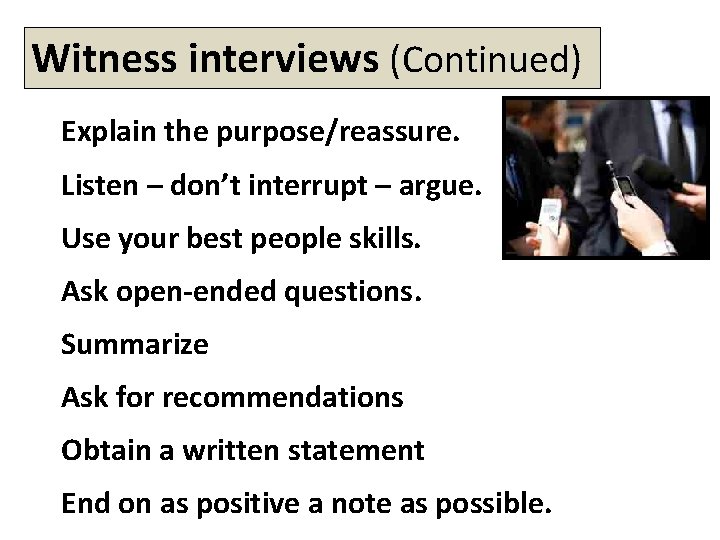
Witness interviews (Continued) Explain the purpose/reassure. Listen – don’t interrupt – argue. Use your best people skills. Ask open-ended questions. Summarize Ask for recommendations Obtain a written statement End on as positive a note as possible.
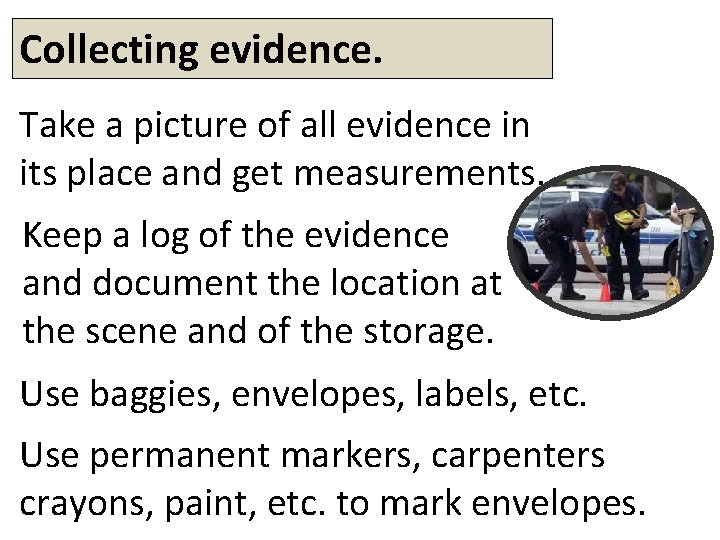
Collecting evidence. Take a picture of all evidence in its place and get measurements. Keep a log of the evidence and document the location at the scene and of the storage. Use baggies, envelopes, labels, etc. Use permanent markers, carpenters crayons, paint, etc. to mark envelopes.
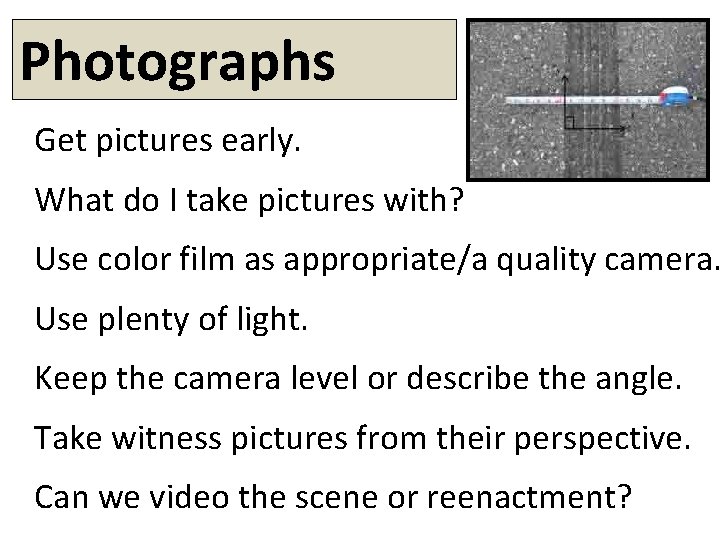
Photographs Get pictures early. What do I take pictures with? Use color film as appropriate/a quality camera. Use plenty of light. Keep the camera level or describe the angle. Take witness pictures from their perspective. Can we video the scene or reenactment?
An Investigation kit? Gloves, first aid kit. Caution tape, warning signals, etc. Camera or cameras, flash, lighting, batteries. Flashlights, area lighting. Forms, note paper, graph paper, clipboard. Measuring devices. Pens, etc, markers, chalk, baggies, recorder?
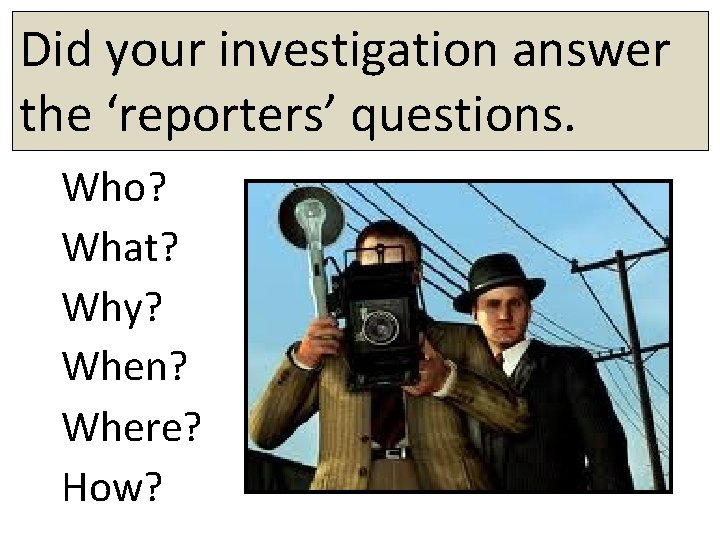
Did your investigation answer the ‘reporters’ questions. Who? What? Why? When? Where? How?
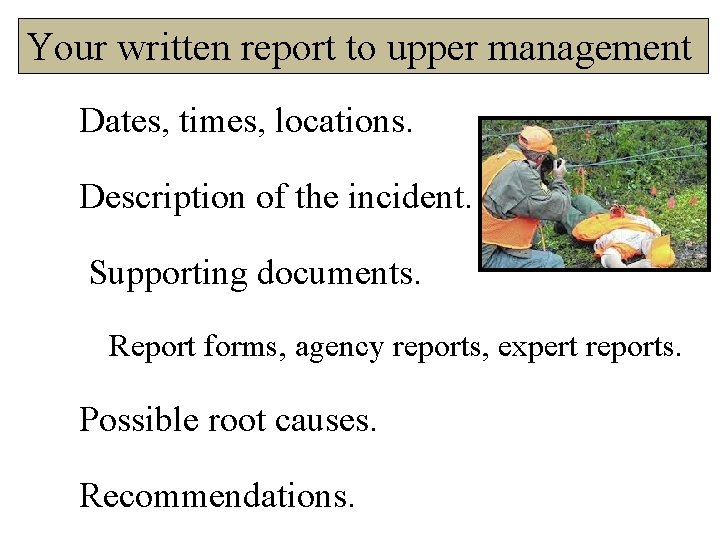
Your written report to upper management Dates, times, locations. Description of the incident. Supporting documents. Report forms, agency reports, expert reports. Possible root causes. Recommendations.
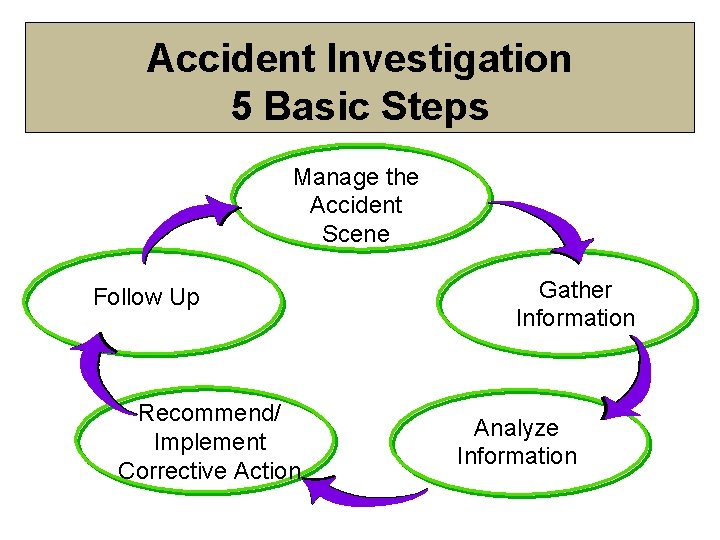
Accident Investigation 5 Basic Steps Manage the Accident Scene Follow Up Recommend/ Implement Corrective Action Gather Information Analyze Information