
Incentives for Hospital Performance The Leapfrog Hospital Rewards

- Slides: 40
Incentives for Hospital Performance: The Leapfrog Hospital Rewards Program. TM February 14, 2007 Suzanne Delbanco, Ph. D. , CEO Catherine Eikel, Director of Programs Guy D’Andrea, Consultant © 2006 The Leapfrog Group
Presentation Topics • Emergence of Value-Based Purchasing (VBP) • Opportunity for Hospital Quality & Value Improvements • Aligning Incentives Works • Tools for VBP: – Performance Measures: Leapfrog Hospital Insights – Rewards: Leapfrog Hospital Rewards Program™ © 2006 The Leapfrog Group
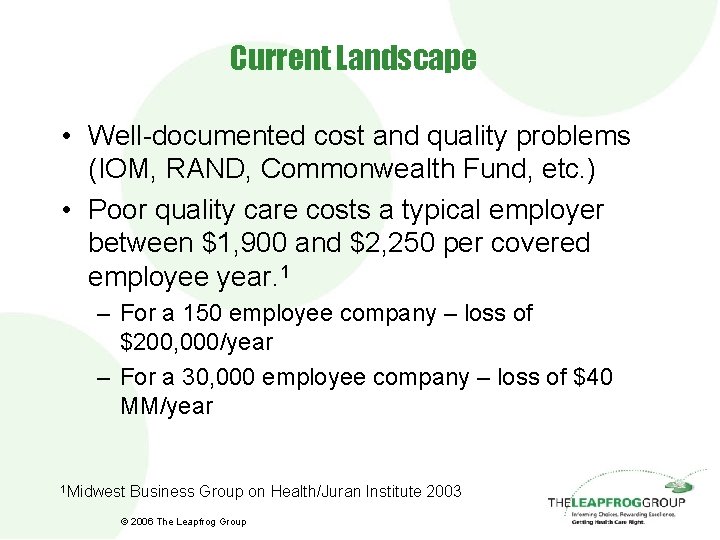
Current Landscape • Well-documented cost and quality problems (IOM, RAND, Commonwealth Fund, etc. ) • Poor quality care costs a typical employer between $1, 900 and $2, 250 per covered employee year. 1 – For a 150 employee company – loss of $200, 000/year – For a 30, 000 employee company – loss of $40 MM/year 1 Midwest Business Group on Health/Juran Institute 2003 © 2006 The Leapfrog Group
Current Landscape • Increasing focus on fixing the “toxic payment system” (high quality lower cost) • Numerous private sector initiatives (269 listed in Leapfrog Compendium) • President’s Executive Order, August 2006 • Secretary Leavitt’s Value-Driven Health Care Initiative – Launched November 2006 – 150 companies have already pledged their support • Deficit Reduction Act – VBP in Medicare © 2006 The Leapfrog Group
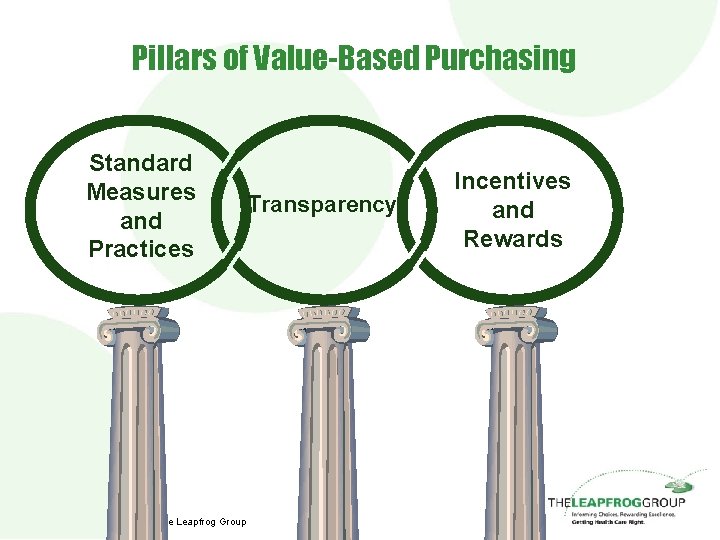
Pillars of Value-Based Purchasing Standard Measures and Practices © 2006 The Leapfrog Group Transparency Incentives and Rewards
The Opportunity for Improvement © 2006 The Leapfrog Group
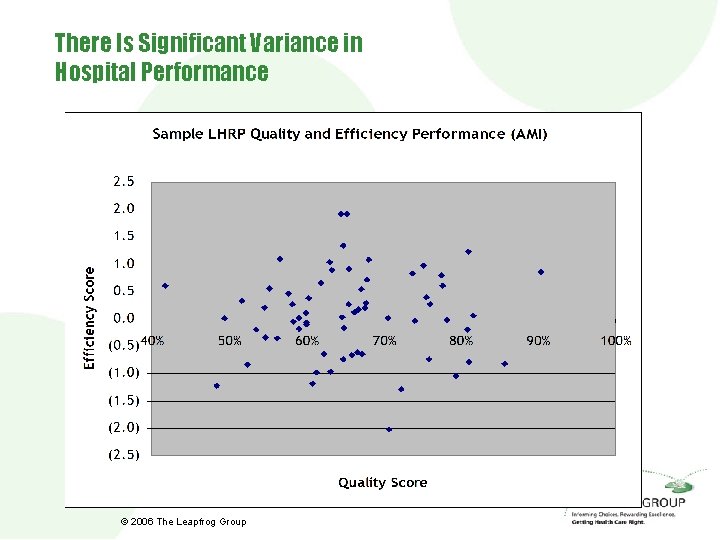
There Is Significant Variance in Hospital Performance © 2006 The Leapfrog Group
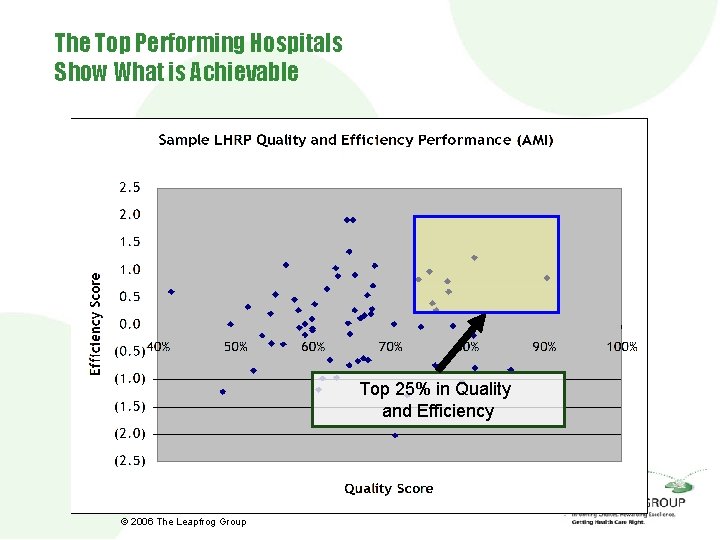
The Top Performing Hospitals Show What is Achievable Top 25% in Quality and Efficiency © 2006 The Leapfrog Group
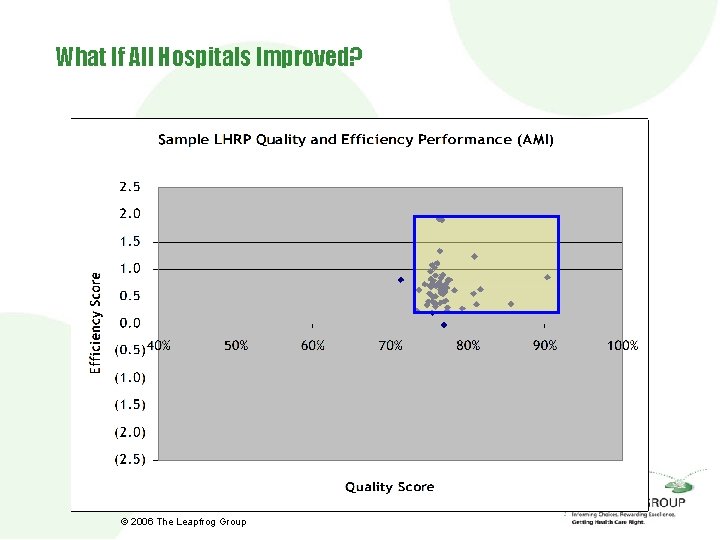
What If All Hospitals Improved? © 2006 The Leapfrog Group
Aligning Incentives Works © 2006 The Leapfrog Group
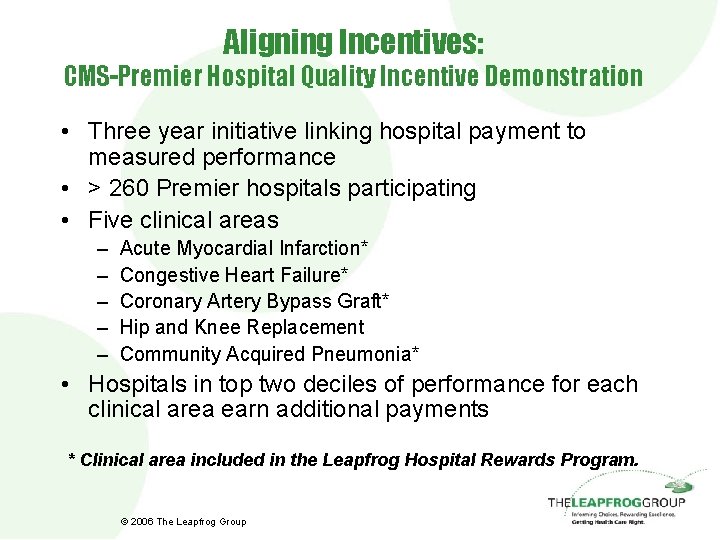
Aligning Incentives: CMS-Premier Hospital Quality Incentive Demonstration • Three year initiative linking hospital payment to measured performance • > 260 Premier hospitals participating • Five clinical areas – – – Acute Myocardial Infarction* Congestive Heart Failure* Coronary Artery Bypass Graft* Hip and Knee Replacement Community Acquired Pneumonia* • Hospitals in top two deciles of performance for each clinical area earn additional payments * Clinical area included in the Leapfrog Hospital Rewards Program. © 2006 The Leapfrog Group
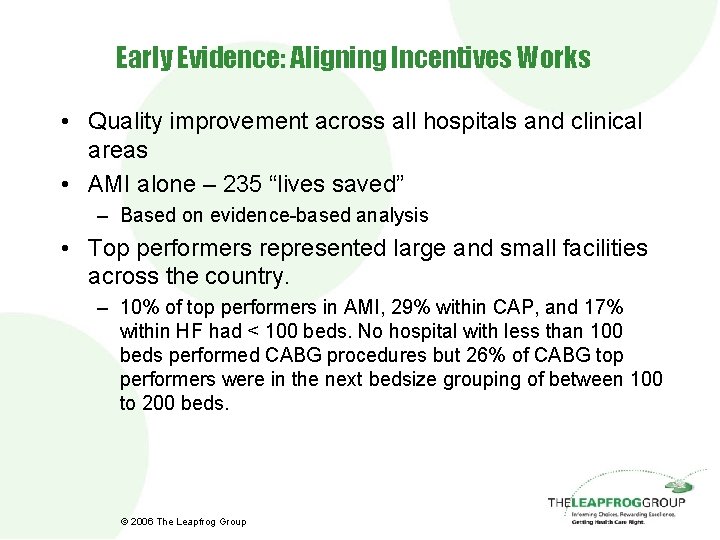
Early Evidence: Aligning Incentives Works • Quality improvement across all hospitals and clinical areas • AMI alone – 235 “lives saved” – Based on evidence-based analysis • Top performers represented large and small facilities across the country. – 10% of top performers in AMI, 29% within CAP, and 17% within HF had < 100 beds. No hospital with less than 100 beds performed CABG procedures but 26% of CABG top performers were in the next bedsize grouping of between 100 to 200 beds. © 2006 The Leapfrog Group
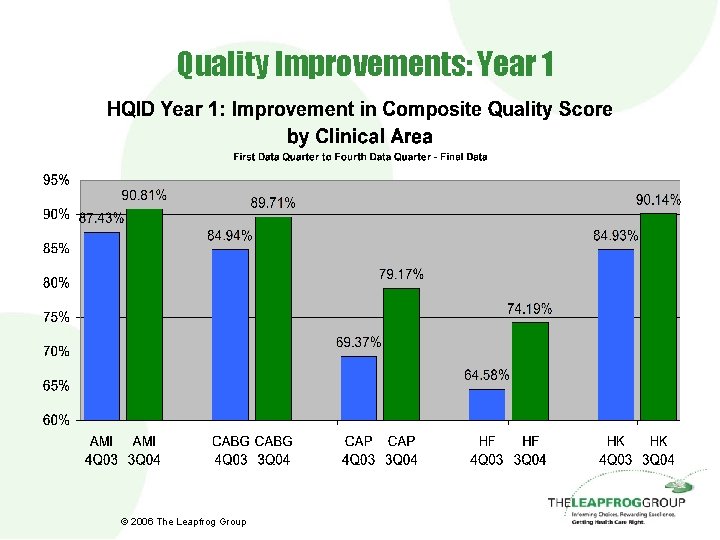
Quality Improvements: Year 1 © 2006 The Leapfrog Group
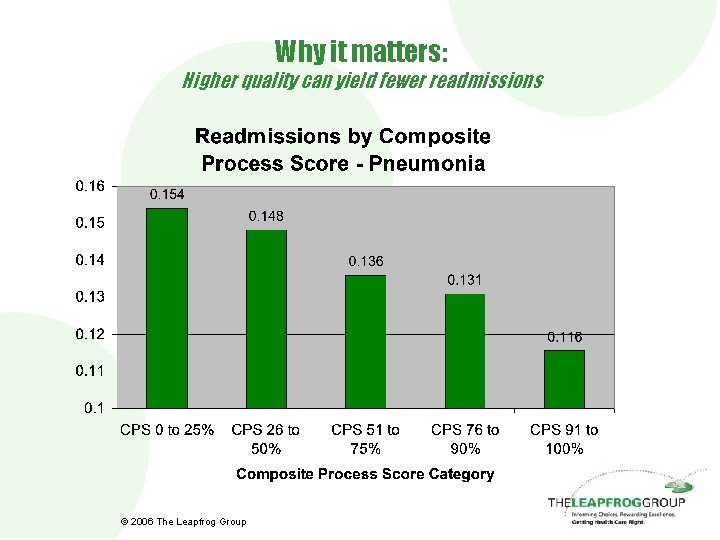
Why it matters: Higher quality can yield fewer readmissions © 2006 The Leapfrog Group
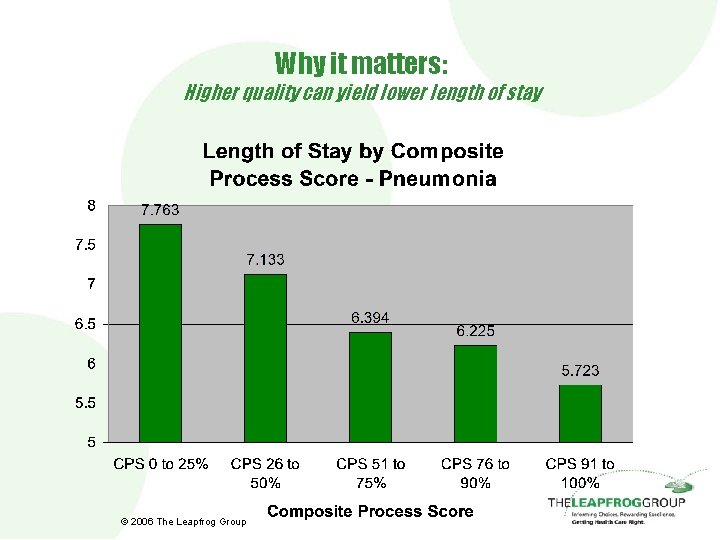
Why it matters: Higher quality can yield lower length of stay © 2006 The Leapfrog Group
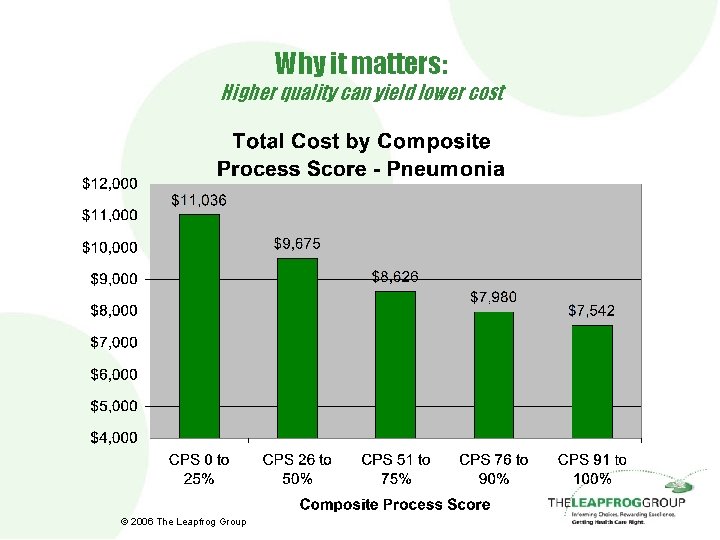
Why it matters: Higher quality can yield lower cost © 2006 The Leapfrog Group
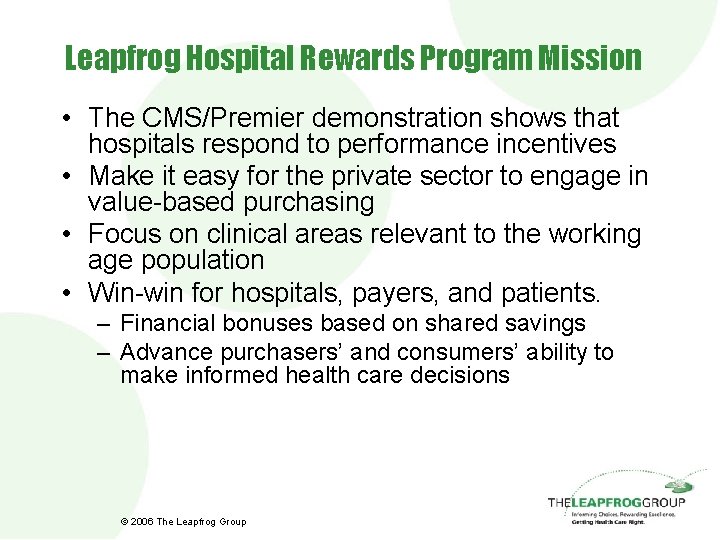
Leapfrog Hospital Rewards Program Mission • The CMS/Premier demonstration shows that hospitals respond to performance incentives • Make it easy for the private sector to engage in value-based purchasing • Focus on clinical areas relevant to the working age population • Win-win for hospitals, payers, and patients. – Financial bonuses based on shared savings – Advance purchasers’ and consumers’ ability to make informed health care decisions © 2006 The Leapfrog Group
Tools for VBP: Measurement & Rewards © 2006 The Leapfrog Group
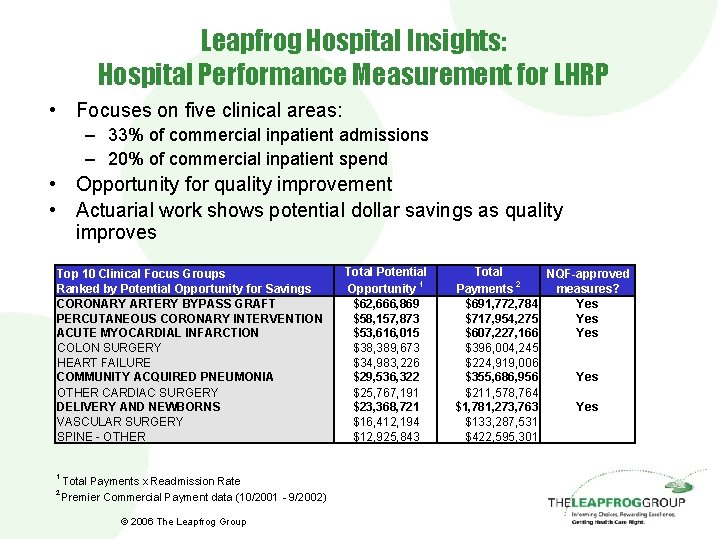
Leapfrog Hospital Insights: Hospital Performance Measurement for LHRP • Focuses on five clinical areas: – 33% of commercial inpatient admissions – 20% of commercial inpatient spend • Opportunity for quality improvement • Actuarial work shows potential dollar savings as quality improves Top 10 Clinical Focus Groups Ranked by Potential Opportunity for Savings CORONARY ARTERY BYPASS GRAFT PERCUTANEOUS CORONARY INTERVENTION ACUTE MYOCARDIAL INFARCTION COLON SURGERY HEART FAILURE COMMUNITY ACQUIRED PNEUMONIA OTHER CARDIAC SURGERY DELIVERY AND NEWBORNS VASCULAR SURGERY SPINE - OTHER 1 2 Total Payments x Readmission Rate Premier Commercial Payment data (10/2001 - 9/2002) © 2006 The Leapfrog Group Total Potential 1 Opportunity $62, 666, 869 $58, 157, 873 $53, 616, 015 $38, 389, 673 $34, 983, 226 $29, 536, 322 $25, 767, 191 $23, 368, 721 $16, 412, 194 $12, 925, 843 Total NQF-approved 2 Payments measures? $691, 772, 784 Yes $717, 954, 275 Yes $607, 227, 166 Yes $396, 004, 245 $224, 919, 006 $355, 686, 956 Yes $211, 578, 764 $1, 781, 273, 763 Yes $133, 287, 531 $422, 595, 301
What is Leapfrog Hospital Insights? • Leapfrog Hospital Insights is The Leapfrog Group’s new, most comprehensive voluntary hospital public reporting initiative • Expands health care transparency by gathering hospital quality & efficiency information • Provides hospitals with data feedback that enables hospital performance comparisons & guides future improvement efforts © 2006 The Leapfrog Group
Leapfrog Hospital Insights: Quality & Efficiency Measures • Helps to determine hospital value by measuring hospital performance on two areas: quality and efficiency • Uses nationally accepted and standardized measures: – JCAHO, Leapfrog Survey, National Quality Forum – Efficiency: first nationally collected/calculated efficiency measure © 2006 The Leapfrog Group
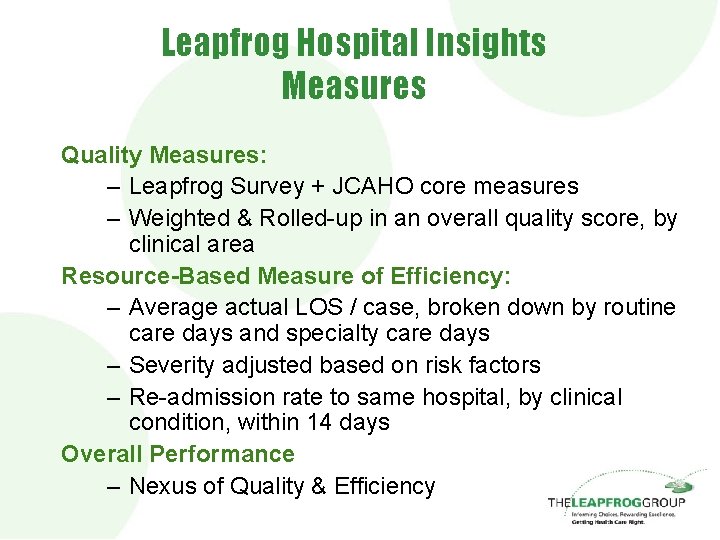
Leapfrog Hospital Insights Measures Quality Measures: – Leapfrog Survey + JCAHO core measures – Weighted & Rolled-up in an overall quality score, by clinical area Resource-Based Measure of Efficiency: – Average actual LOS / case, broken down by routine care days and specialty care days – Severity adjusted based on risk factors – Re-admission rate to same hospital, by clinical condition, within 14 days Overall Performance – Nexus of Quality & Efficiency
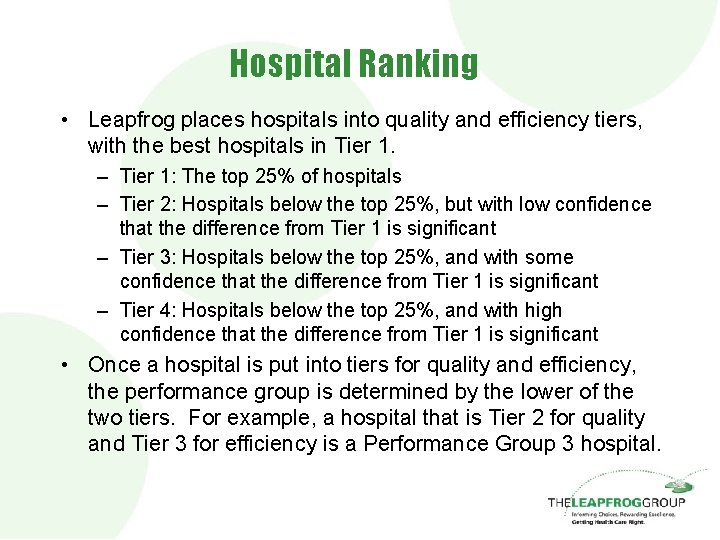
Hospital Ranking • Leapfrog places hospitals into quality and efficiency tiers, with the best hospitals in Tier 1. – Tier 1: The top 25% of hospitals – Tier 2: Hospitals below the top 25%, but with low confidence that the difference from Tier 1 is significant – Tier 3: Hospitals below the top 25%, and with some confidence that the difference from Tier 1 is significant – Tier 4: Hospitals below the top 25%, and with high confidence that the difference from Tier 1 is significant • Once a hospital is put into tiers for quality and efficiency, the performance group is determined by the lower of the two tiers. For example, a hospital that is Tier 2 for quality and Tier 3 for efficiency is a Performance Group 3 hospital.
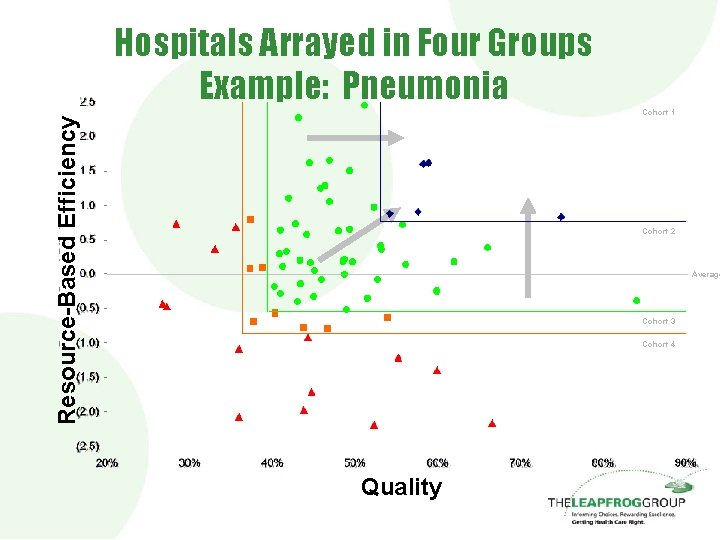
Hospitals Arrayed in Four Groups Example: Pneumonia Resource-Based Efficiency Cohort 1 Cohort 2 Average Cohort 3 Cohort 4 Quality
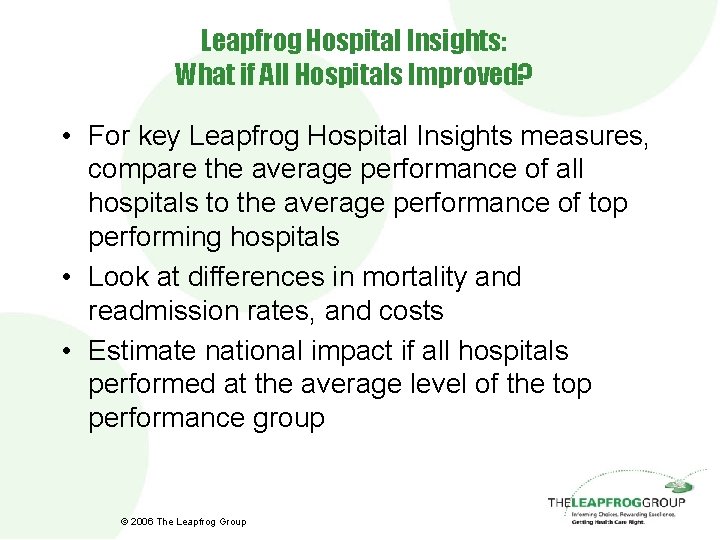
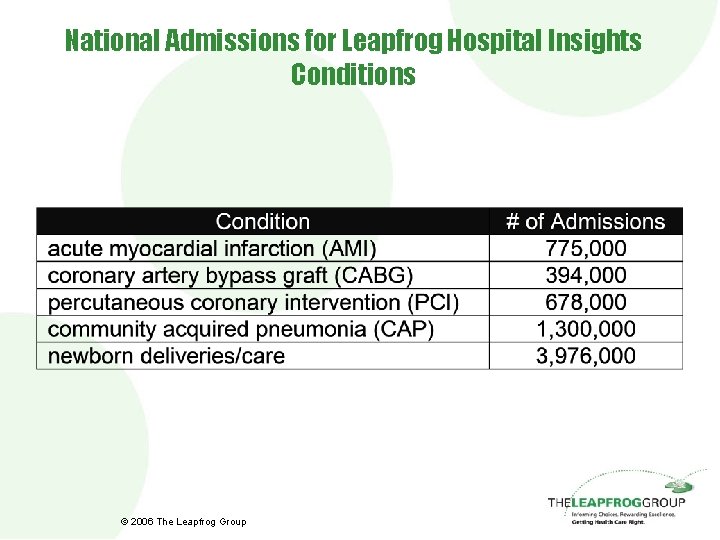
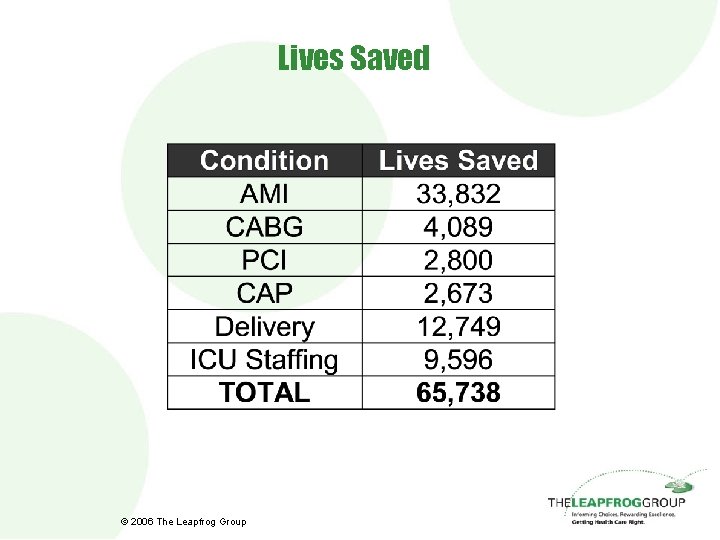
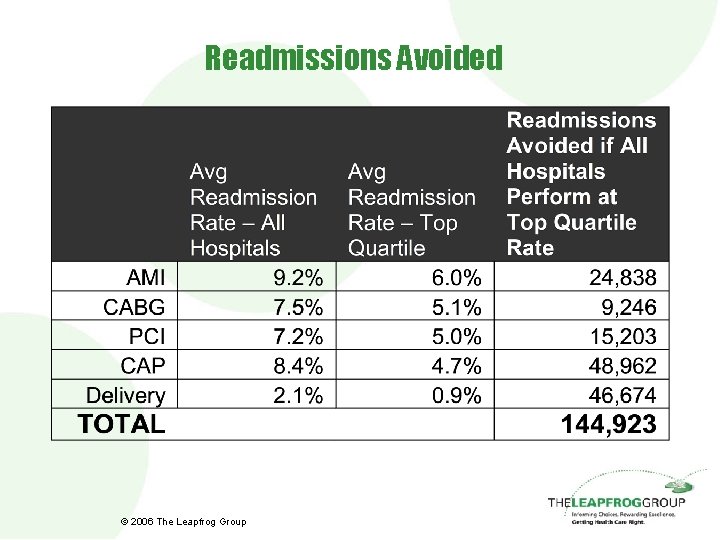
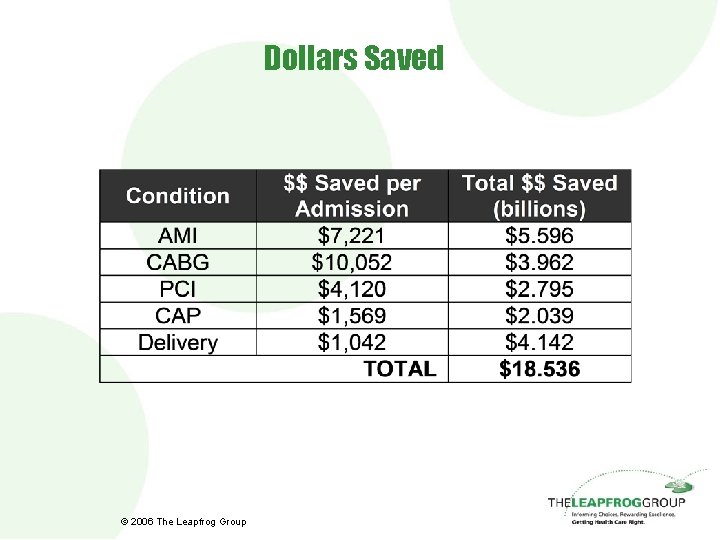
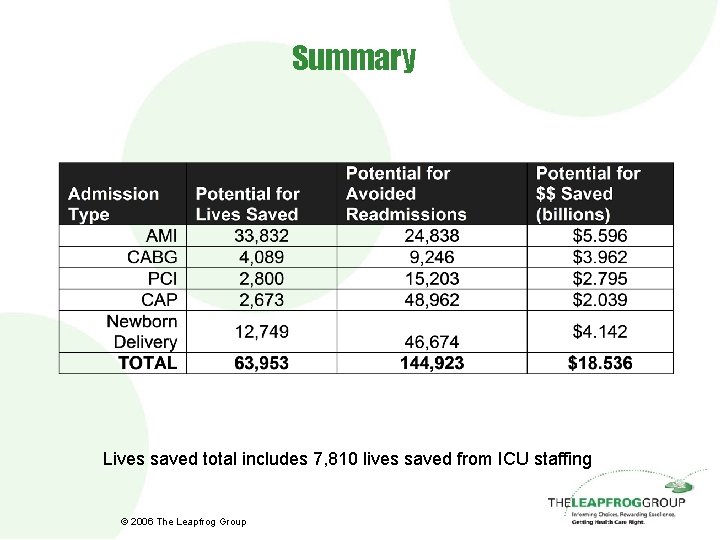
Leapfrog Hospital Insights: What if All Hospitals Improved? • For key Leapfrog Hospital Insights measures, compare the average performance of all hospitals to the average performance of top performing hospitals • Look at differences in mortality and readmission rates, and costs • Estimate national impact if all hospitals performed at the average level of the top performance group © 2006 The Leapfrog Group
National Admissions for Leapfrog Hospital Insights Conditions © 2006 The Leapfrog Group
Lives Saved © 2006 The Leapfrog Group
Readmissions Avoided © 2006 The Leapfrog Group
Dollars Saved © 2006 The Leapfrog Group
Leapfrog Hospital Rewards Program™: A Tool for Aligning Incentives © 2006 The Leapfrog Group
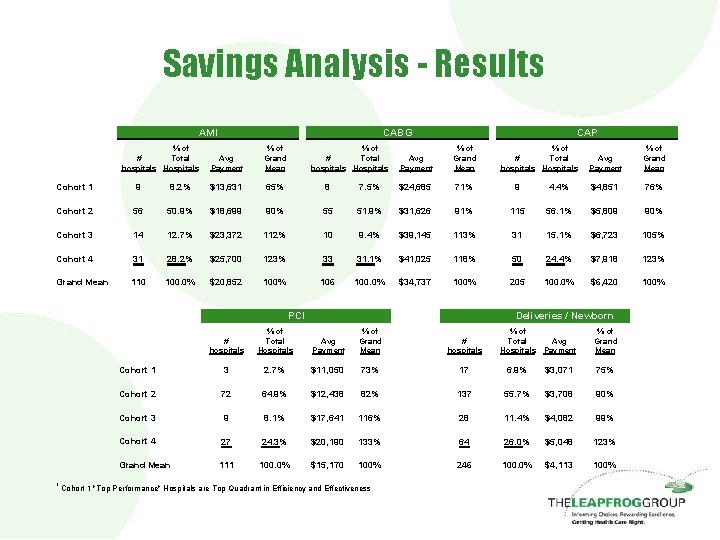
Savings Analysis - Results AMI % of # Total hospitals Hospitals CABG Avg Payment % of Grand Mean % of # Total hospitals Hospitals CAP Avg Payment % of Grand Mean % of # Total hospitals Hospitals Avg Payment % of Grand Mean Cohort 1 9 8. 2% $13, 631 65% 8 7. 5% $24, 685 71% 9 4. 4% $4, 851 76% Cohort 2 56 50. 9% $18, 699 90% 55 51. 9% $31, 626 91% 115 56. 1% $5, 809 90% Cohort 3 14 12. 7% $23, 372 112% 10 9. 4% $39, 145 113% 31 15. 1% $6, 723 105% Cohort 4 31 28. 2% $25, 700 123% 33 31. 1% $41, 025 118% 50 24. 4% $7, 918 123% Grand Mean 110 100. 0% $20, 852 100% 106 100. 0% $34, 737 100% 205 100. 0% $6, 420 100% PCI 1 Deliveries / Newborn # hospitals % of Total Hospitals Avg Payment % of Grand Mean # hospitals Cohort 1 3 2. 7% $11, 050 73% 17 6. 9% $3, 071 75% Cohort 2 72 64. 9% $12, 438 82% 137 55. 7% $3, 708 90% Cohort 3 9 8. 1% $17, 641 116% 28 11. 4% $4, 082 99% Cohort 4 27 24. 3% $20, 190 133% 64 26. 0% $5, 048 123% Grand Mean 111 100. 0% $15, 170 100% 246 100. 0% $4, 113 100% Cohort 1 "Top Performance" Hospitals are Top Quadrant in Efficiency and Effectiveness % of Total Avg Hospitals Payment % of Grand Mean
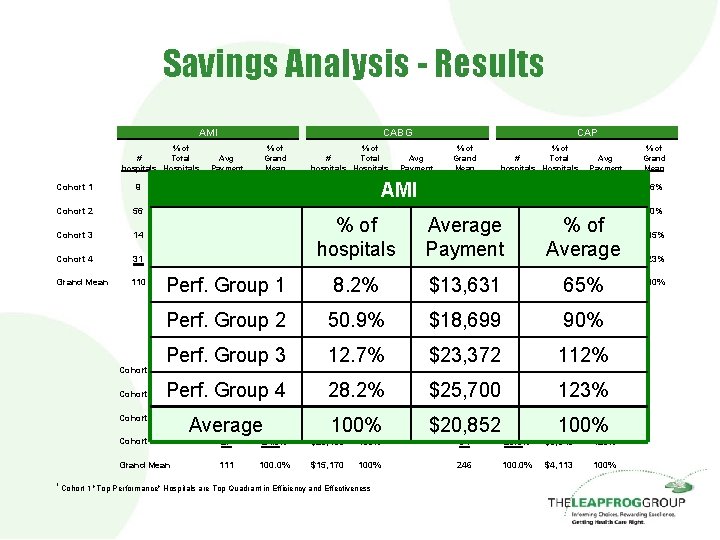
Savings Analysis - Results AMI % of # Total hospitals Hospitals CABG Avg Payment % of Grand Mean % of # Total hospitals Hospitals 9 8. 2% $13, 631 65% 8 7. 5% Cohort 2 56 50. 9% $18, 699 90% 55 51. 9% Cohort 3 14 12. 7% $23, 372 112% Cohort 4 31 28. 2% $25, 700 123% Grand Mean 110 100. 0% Perf. Group 2 PCI Cohort 1 Cohort 2 1 $31, 626 % of # Total hospitals Hospitals 100. 0% 8. 2% 50. 9% # hospitals Avg Payment % of Grand Mean 3 2. 7% $11, 050 73% Perf. Group 4 72 64. 9% $12, 438 % of Grand Mean 9 4. 4% $4, 851 76% 91% 115 56. 1% $5, 809 90% 31 15. 1% % 9. 4% of $39, 145 Average 113% hospitals Payment 33 31. 1% $41, 025 118% 106 Avg Payment 71% 10 % of Total Hospitals Perf. Group 3 Avg Payment $24, 685 AMI Cohort 1 Perf. $20, 852 Group 100% 1 CAP % of Grand Mean 100% $13, 631 $34, 737 $18, 699 # hospitals 105% 50 % of $6, 723 Average 24. 4% $7, 918 205 100. 0% $6, 420 65% 100% 90% Deliveries / Newborn % of Total Avg Hospitals Payment 12. 7% $23, 372 6. 9% $3, 071 28. 2% 82% $25, 700 137 55. 7% $3, 708 17 % of Grand Mean 112% 75% 123% 90% Cohort 3 Average 9 8. 1% $17, 641 116% $20, 852 28 11. 4% $4, 082 99% Cohort 4 27 24. 3% $20, 190 133% 64 26. 0% $5, 048 123% Grand Mean 111 100. 0% $15, 170 100% 246 100. 0% $4, 113 100% Cohort 1 "Top Performance" Hospitals are Top Quadrant in Efficiency and Effectiveness 100% 123%
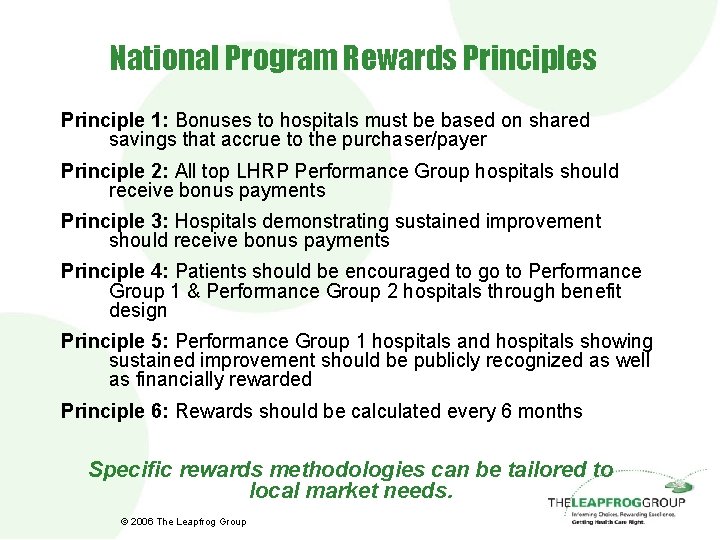
National Program Rewards Principle 1: Bonuses to hospitals must be based on shared savings that accrue to the purchaser/payer Principle 2: All top LHRP Performance Group hospitals should receive bonus payments Principle 3: Hospitals demonstrating sustained improvement should receive bonus payments Principle 4: Patients should be encouraged to go to Performance Group 1 & Performance Group 2 hospitals through benefit design Principle 5: Performance Group 1 hospitals and hospitals showing sustained improvement should be publicly recognized as well as financially rewarded Principle 6: Rewards should be calculated every 6 months Specific rewards methodologies can be tailored to local market needs. © 2006 The Leapfrog Group
LHRP Rewards Structure • Direct financial rewards based on shared savings model — “rewards pool” • Program sponsors may contribute additional dollars to rewards pool • Bonus payments are derived from a percentage of savings accrued (50% recommended) • Savings are calculated by comparing hospital performance from one period to the next (6 month cycle) (weighted for volume) © 2006 The Leapfrog Group
LHRP Rewards Structure (cont’d) • Savings calculated separately for each clinical area • Savings calculated separately for each payer, using payer-specific cost data • Different hospital LHRP savings calculations and rewards methodologies – Per diem reimbursement – Case rate/DRG payments (under development) © 2006 The Leapfrog Group
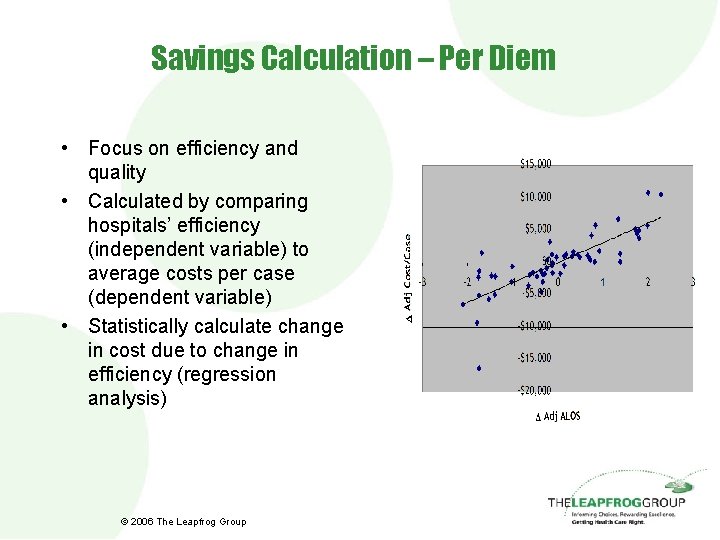
Savings Calculation – Per Diem • Focus on efficiency and quality • Calculated by comparing hospitals’ efficiency (independent variable) to average costs per case (dependent variable) • Statistically calculate change in cost due to change in efficiency (regression analysis) © 2006 The Leapfrog Group
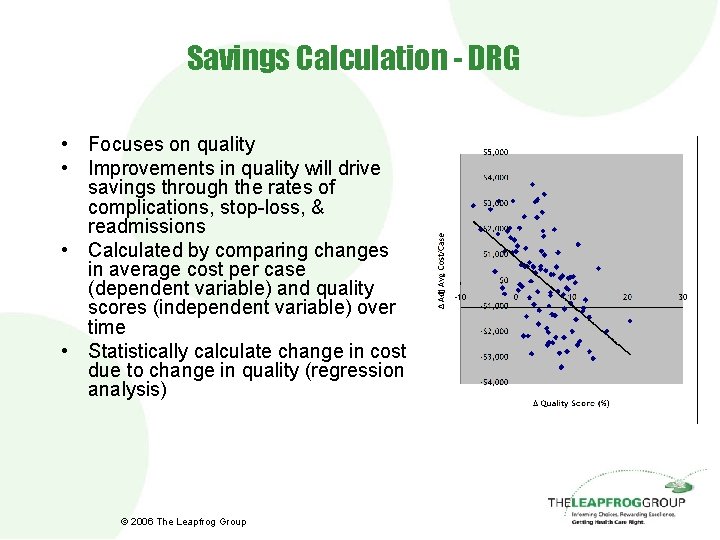
Savings Calculation - DRG • Focuses on quality • Improvements in quality will drive savings through the rates of complications, stop-loss, & readmissions • Calculated by comparing changes in average cost per case (dependent variable) and quality scores (independent variable) over time • Statistically calculate change in cost due to change in quality (regression analysis) © 2006 The Leapfrog Group
Other Types of Rewards • Rewards Principles also allow for encourage nonfinancial and indirect financial rewards for hospital performance • Examples of non-financial rewards: – public recognition in your community (media attention, awarding certificates/plaques, etc. ) • Examples of indirect financial rewards: – shifting market share to high performing hospitals; improved efficiency could yield greater profitability over time © 2006 The Leapfrog Group
Summary Lives saved total includes 7, 810 lives saved from ICU staffing © 2006 The Leapfrog Group
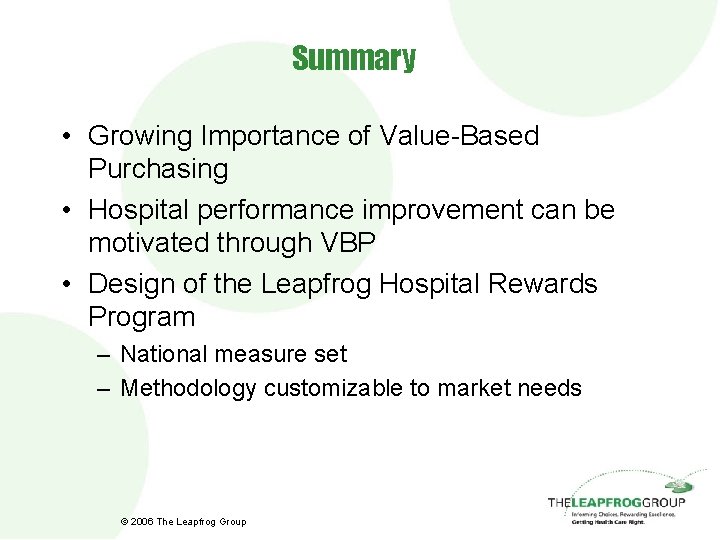
Summary • Growing Importance of Value-Based Purchasing • Hospital performance improvement can be motivated through VBP • Design of the Leapfrog Hospital Rewards Program – National measure set – Methodology customizable to market needs © 2006 The Leapfrog Group