
Inbond manufacturing The game changer 117 Customs Act
In-bond manufacturing – The game changer! 1/17
Customs Act, 1962 2/17 Ø Public Bonded Warehouses – CWC, CONCOR, etc. (Sec. 57). Ø Private Bonded Warehouses (Sec. 58) Ø Permission for carrying out operations in warehouse (Sec. 65). Ø Warehouse (Custody and Handling of Goods) Regulations, 2016. Ø Warehoused Goods (Removal) Regulations, 2016. BOND OFFICER
Sec. 65 of the Customs Act, 1962 3/17 With the permission of the Commissioner, the owner of warehoused goods can carryout any manufacturing process or other operations in relation to warehoused goods. Warehousing period as per Section 61. Ex-bond Bill of Entry to be filed for removal of the goods. Rate of Customs Duty / Rate of exchange as applicable on the date of filing Ex-bond Bill of Entry.
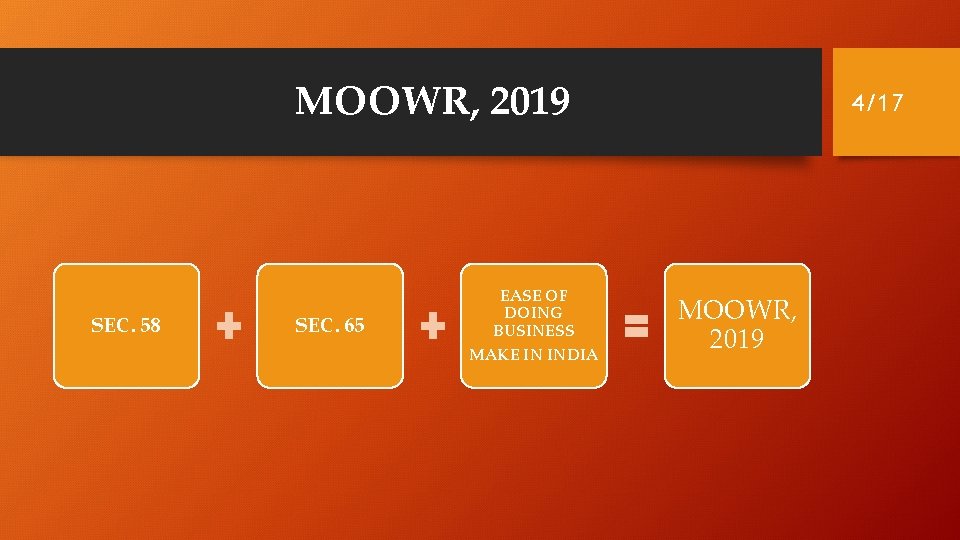
MOOWR, 2019 SEC. 58 SEC. 65 EASE OF DOING BUSINESS MAKE IN INDIA 4/17 MOOWR, 2019

Who can apply? 5/17 Ø Persons already having a licenced private bonded warehouse under Sec. 58. Ø Others can apply simultaneously under Sec. 58 & Sec. 65. Ø Permission can be obtained for any premises. Such premises must be added as an additional palce of business under GST. Ø The existing factory premises can also be applied for as a warehouse. Ø A person who is not at all exporting can also apply.
Benefits. 6/17 Ø Imported inputs, can be brought into the warehouse without payment of Customs Duties (BCD and IGST) and stored in the warehouse. Ø If the imported goods are exported (either as such, after subjecting to manufacturing or other processes), no need to pay Customs duties on the imported inputs. Ø Capital goods can also be imported and brought to the warehouse without payment of Customs Duties, which shall be payable only when the capital goods are removed from the warehouse.
Benefits. 7/17 Ø No need to pay any interest till the permitted warehousing period. Ø Payment of Customs duties postponed to a future date. Ø Paves way for greater cash flow. Ø Self appointed warehouse keeper and no physical control by “Bond officer”.
Procedures. 9/17 Ø Application in form “Annexure-A” to be given before Commissioner. Ø Records to be maintained in form “Annexure-B”. Ø Bond to be executed in form “Annexure-C”. (3 times the duty) Ø If resultant goods are exported – Shipping Bill and GST invoice to be prepared. No need to pay Customs duties on imported goods. Ø If resultant goods are cleared for domestic consumption – GST invoice to be prepared. Ex-bond BOE to be filed and customs duties to be paid on imported goods, at the time of supply of goods for domestic consumption.
Procedures. 9/17 Ø Domestic procurements can be made as usual on payment of applicable GST. Ø Imported goods can also be cleared for domestic concumption as such (trading). Ø Goods otherwise exempted from customs duties can also be imported and brought into the warehouse. Ø Prior permission of proper officer, for removal, export, removal to another warehouse – not required.
Procedures. 11/17 Ø Inform input-output norms. Ø Permision once granted, valid unless it is cancelled or surrendered. No renewal required. Ø A “warehouse keeper” to be appointed by the applicant, who has knowledge in warehousing and customs procedures. Ø Signage – Customs Bonded warehouse. Ø Computerised stores records. Ø Proper security measures.
Procedures. 12/17 Ø Transportation from Customs Station to warehouse, warehouse to another warehouse, warehouse to Customs Station (export) shall be made under a secure One Time Lock (OTL). Ø Upon receipt of goods in warehouse, the OTL shall be verified any discrepancy to be notified. Ø Endoresement of receipt of goods in BOE and Transport documents and intimation to Bond officer. Ø Filing of monthly return in Form B, in case of non 65 operations.
Warehousing period. 14/17 Ø Capital goods – till they are cleared from the warehouse. Ø Other than capital goods (inputs) – till their consumption or clearance from the warehouse. (At the time of clearance of the resultant products – Para 8 of Circular 34/2019). Ø For trading though warehousing period is one year, interest payable after 90 days. Ø BOE shall be filed and Customs duties shall be paid for the warehoused inputs / capital goods, as above. No interest. Any further delay in payment of customs duties would invite interest.
Treatment of waste. Ø Waste attributable to the final products cleared for home consumption. - Appropraite GST to be paid on sale. - Import duties to be paid for the inputs contained in waste (even if destroyed) Ø Waste attributable to the final products exported. - Import duties on inputs need not be paid, if destroyed. - Otherwise, import duty to be paid, “as if the waste is imported”. - Upon sale, appropriate GST to be paid. 13/17
Questions in mind. 13/17 Ø Same inputs used in manufacture and trading? What would be the warehousing period? Ø Power to waive interest in case of import for trading purposes, when can be exercised? Ø When final products are cleared for home consumption, but the waste arising therefrom is yet to be cleared, how to pay import duties on imported inputs, contained in waste? Ø Clearance of imported goods for job work purposes allowed? Ø What is the rate of exchange / rates of customs duties to be adopted?
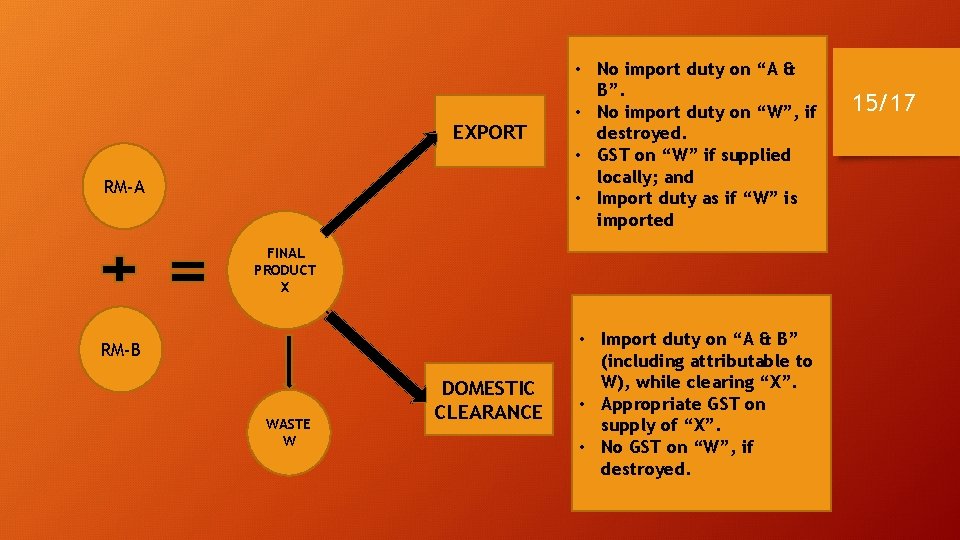
EXPORT RM-A • No import duty on “A & B”. • No import duty on “W”, if destroyed. • GST on “W” if supplied locally; and • Import duty as if “W” is imported FINAL PRODUCT X RM-B WASTE W DOMESTIC CLEARANCE • Import duty on “A & B” (including attributable to W), while clearing “X”. • Appropriate GST on supply of “X”. • No GST on “W”, if destroyed. 15/17
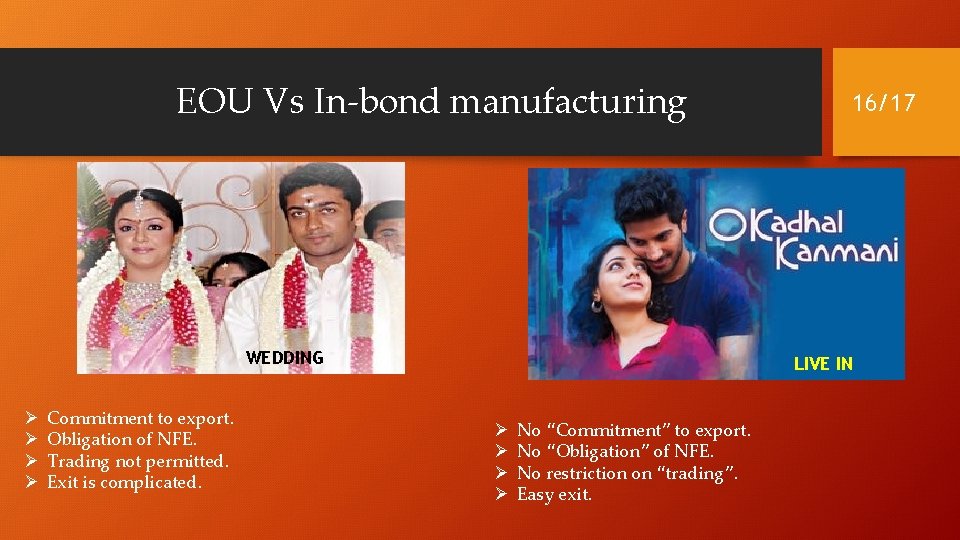
EOU Vs In-bond manufacturing WEDDING Ø Ø Commitment to export. Obligation of NFE. Trading not permitted. Exit is complicated. 16/17 LIVE IN Ø Ø No “Commitment” to export. No “Obligation” of NFE. No restriction on “trading”. Easy exit.
17/17 THANK YOU
- Slides: 17