
Ina Blau and Avner Caspi The Open University

Ina Blau and Avner Caspi The Open University
E-Learning via audio conferencingis it as efficient as f 2 f learning? Medium, method and learning: • Medium will never influence learning (Clark, 1994) • Media and instructional methods are inextricably interconnected (Kozma, 1994) Is that really so? !
From businesses e-communication to e-learning 1. Media Richness Theory (Daft & Lengel, 1984; Daft, Lengel & Treviño, 1987) lean communication medium

From businesses e-communication to e-learning 2. Media Naturalness Hypothesis (Kock, 2005) communication ambiguity, cognitive effort => “virtual” medium efficiency = natural medium efficiency

Learning satisfaction Media Naturalness Hypothesis: more natural medium = more “exiting” communication (physiological arousal )

Disinhibition effect of visual anonymity => fear of criticism => participation, answering questions
Field and laboratory research combination • Research purpose: to study student behavior and learning in audio conferencing vs. f 2 f √ Field research focused on student behavior • Laboratory research focused on learning
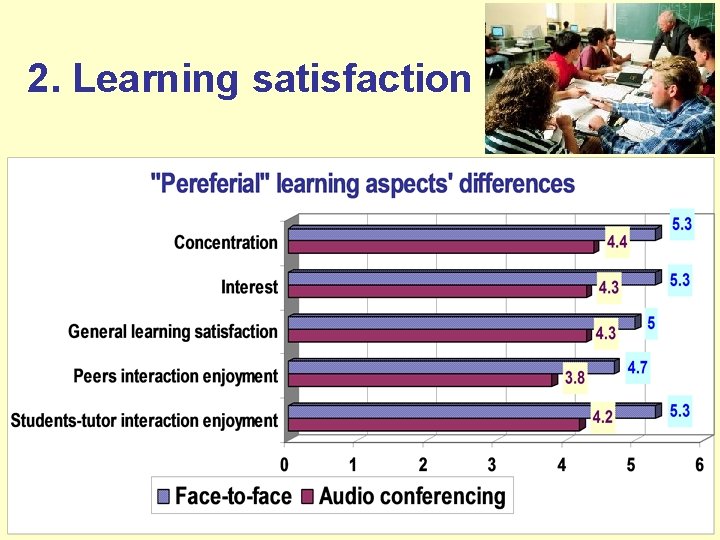
Laboratory research purposes To compare offline and online learning in: 1. Achievement and learning perception 2. Learning satisfaction 3. Participation and answering teacher’s questions

Research hypothesizes: Media Naturalness • • Achievement and learning perception: no differences Learning satisfaction: lower online Visual Anonymity • Participation and answering questions: higher online
Method • 42 undergraduates randomly allocated to f 2 f vs. audio conferencing conditions • Learning 20 minute interactive lessons from the same teacher in triads • Achievement measured by pretest - posttest, learning perception and satisfaction by questionnaire, participation and answering by quantitative content analysis
Results: 1. Learning efficiency As hypothesized, we found no significant differences in achievement and learning perception
2. Learning satisfaction
3. Participation and answering
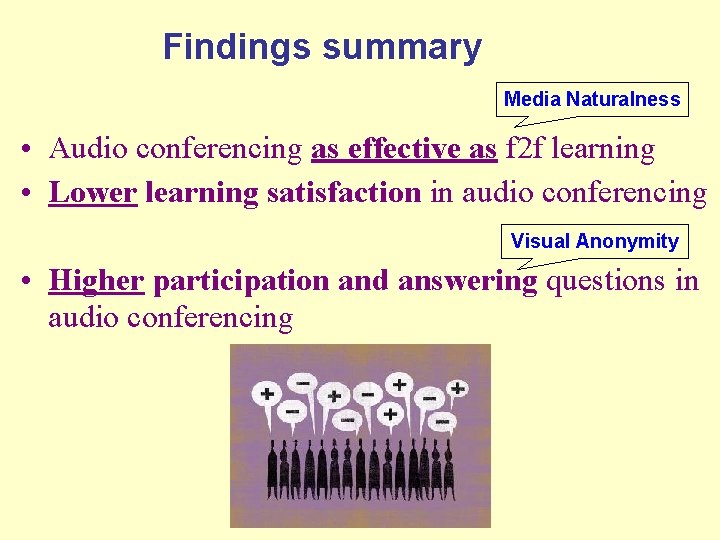
Findings summary Media Naturalness • Audio conferencing as effective as f 2 f learning • Lower learning satisfaction in audio conferencing Visual Anonymity • Higher participation and answering questions in audio conferencing
Two different learning aspects: • Cognitive aspect: no significant difference • Socio-emotional aspect: lower learning satisfaction online, higher participation and answering questions online
Theoretical contributions: • Media Richness Theory Media Naturalness Hypothesis • Media per se may influence learning Practical contributions: • Effective learning tool • Promoting participation and answering questions
References: • Clark, R. E. (1994). Media will never influence learning. Educational Technology Research and Development 42 (2), 21 -29. • Daft, R. L. , & Lengel, R. H. (1984). Information richness: A new approach to managerial behavior and organization design. In: B. M. Staw & L. L. Cummings (Eds. ), Research in organizational behavior (Vol. 6, pp. 191 -233). Greenwich, CT: JAI. • Daft, R. L. , Lengel, R. H. , & Treviño, L. K. (1987). Message equivocality, media selection, and manager performance: Implications for information systems. MIS Quarterly, 11, 355 -368. • Dennis, A. R. , & Valacich, J. S. (1999). Rethinking media richness: Toward a theory of media synchronicity. Proceedings of the 32 nd Hawaii International Conference on System Sciences (pp. 1 -10). Los Alamitos, CA: IEEE Computer Society Press. • Kock, N. (2005). Media richness or media naturalness? The evolution of our biological communication apparatus and its influence on our behavior toward ecommunication tools. IEEE Transactions on Professional Communication, 48 (2), 117 -130. • Kozma, R. B. (1994). Will media influence learning? Reframing the debate. Educational Technology Research and Development, 42 (2), 7 -19.
- Slides: 17