
In the U S fossil fuel combustion provides
In the U. S. , fossil fuel combustion provides • 70% of electricity • 85% of total energy Fossil fuels produce large amounts of CO 2 The supply of fossil fuels is finite, and may be running out (estimates vary) • 150 years left for coal • 50 years left for oil
Energy Transformations First Law of Thermodynamics: Energy is neither created nor destroyed – Conservation of Energy – Conservation of Mass Energy can be converted from one form into another
Energy Transformation Second Law of Thermodynamics The entropy of the universe always increases during a spontaneous process It is impossible to completely convert heat into work without making some other changes in the universe Organized energy is always being transformed into chaotic motion or heat energy Randomness is decreased only through a nonspontaneous process (work must be performed)
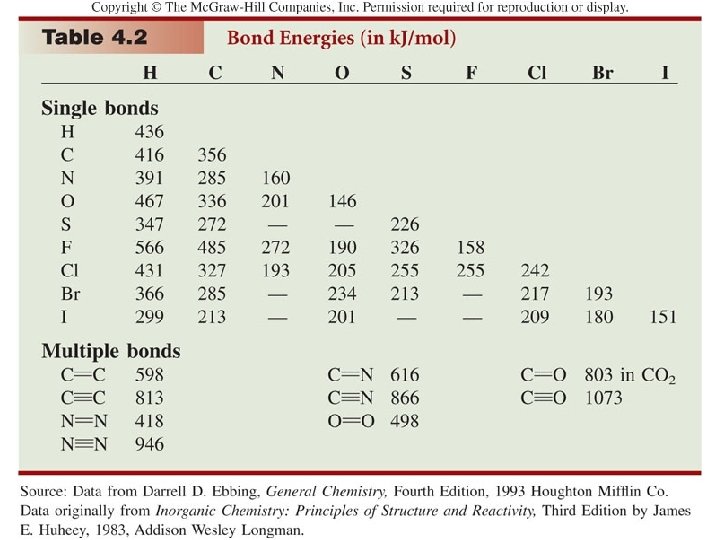
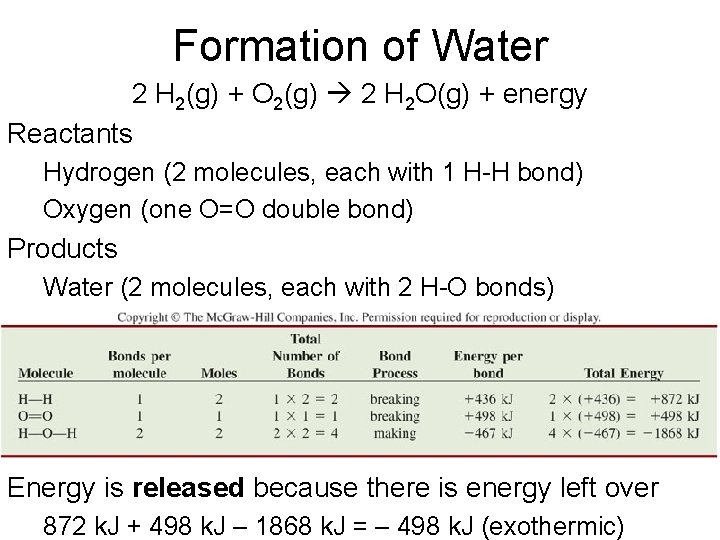
Formation of Water 2 H 2(g) + O 2(g) 2 H 2 O(g) + energy Reactants Hydrogen (2 molecules, each with 1 H-H bond) Oxygen (one O=O double bond) Products Water (2 molecules, each with 2 H-O bonds) Energy is released because there is energy left over 872 k. J + 498 k. J – 1868 k. J = – 498 k. J (exothermic)
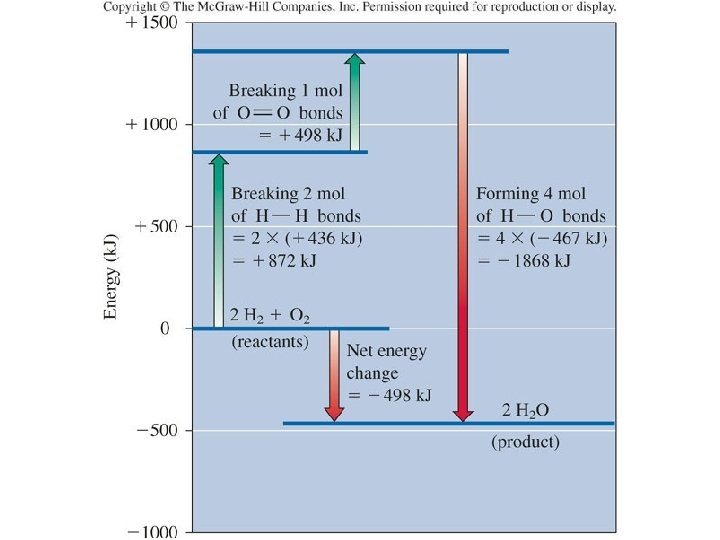
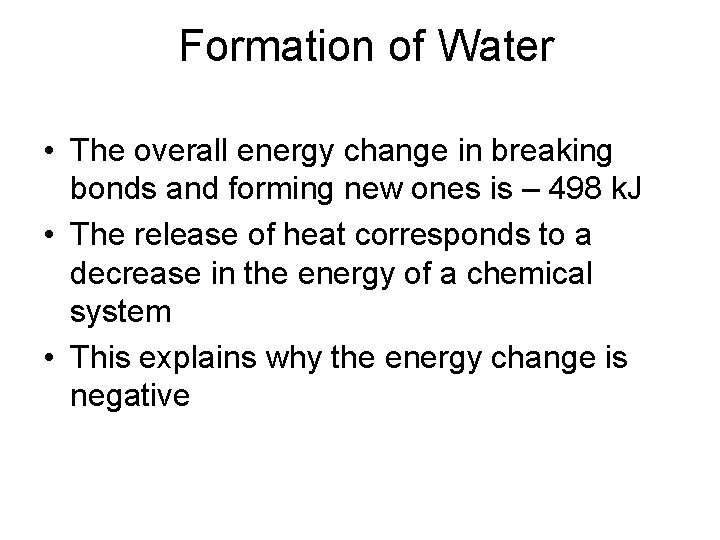
Formation of Water • The overall energy change in breaking bonds and forming new ones is – 498 k. J • The release of heat corresponds to a decrease in the energy of a chemical system • This explains why the energy change is negative
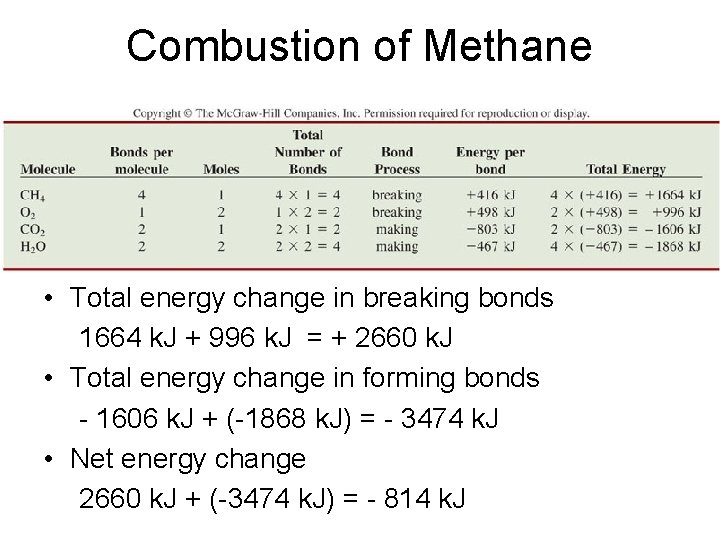
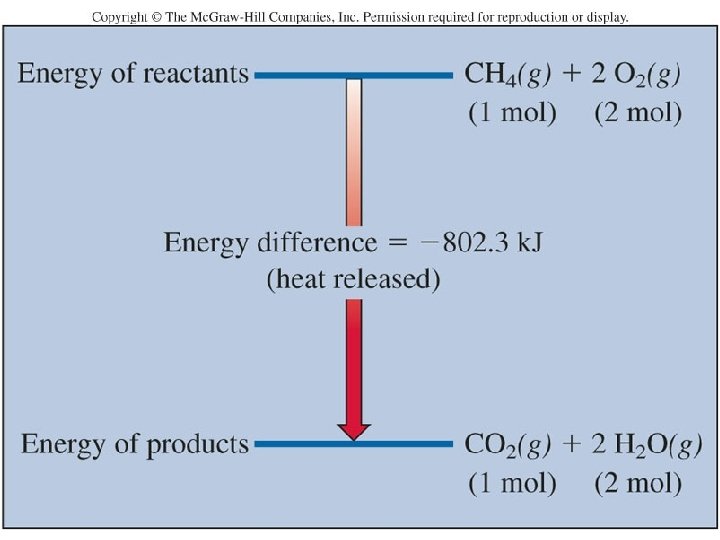
Combustion of Methane • Total energy change in breaking bonds 1664 k. J + 996 k. J = + 2660 k. J • Total energy change in forming bonds - 1606 k. J + (-1868 k. J) = - 3474 k. J • Net energy change 2660 k. J + (-3474 k. J) = - 814 k. J
From Fuel Sources to Chemical Bonds This theoretical value (- 814 k. J) compares very favorably with the experimental value (- 802. 3 k. J). But it’s not the same. Why not? • In real chemical reactions, not all the bonds are broken – just the pertinent ones • In real molecules, not all bonds the same type are energetically equal • The O-H bond in water is not the same strength as the O-H bonds in hydrogen peroxide, H 2 O 2 • But we can calculate the energy of any reaction as if these assumptions were true, and get pretty close to the real answer
From Fuel Sources to Chemical Bonds • Combustion of Propane, C 3 H 8 -2024 k. J/mol • Combustion of Ethanol, C 2 H 5 OH -1281 k. J/mol
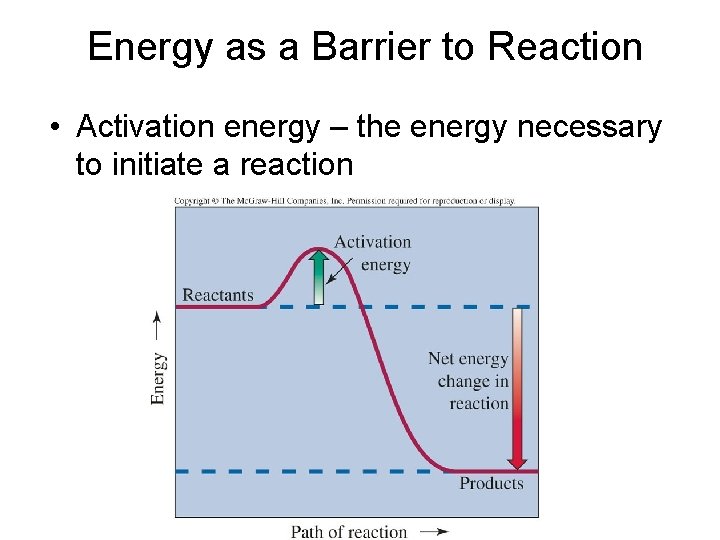
Energy as a Barrier to Reaction • Activation energy – the energy necessary to initiate a reaction
Energy as a Barrier to Reaction • Low activation energies – fast reaction rates • High activation energies – slow reaction rates • Useful fuels react at rates that are neither too fast nor too slow • Smaller ‘bits’ react faster than large ‘bits’ • Increased temperatures help reactants to get over activation energy barrier
Energy Consumption • Pre-Historic man had only body and food for fuel – Used ~2000 kcal/day of energy • Currently, Americans have access to a lot more technology – Use 650, 000 kcal/day of energy – 65 barrels of oil or 16 tons of coal person per year
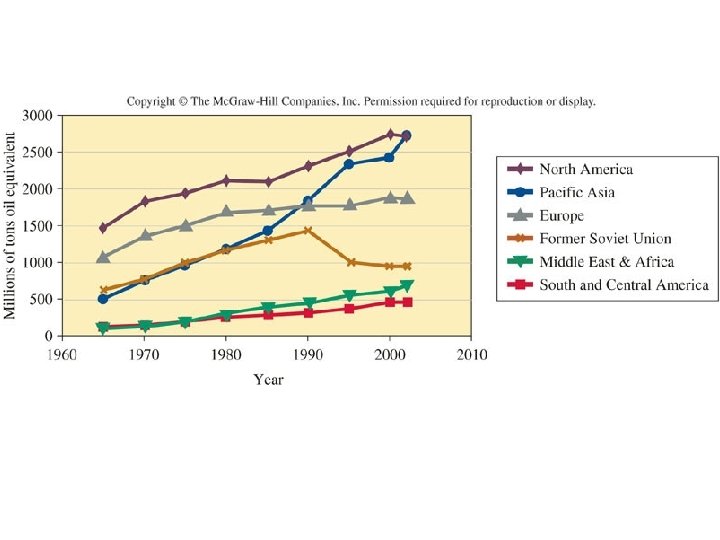
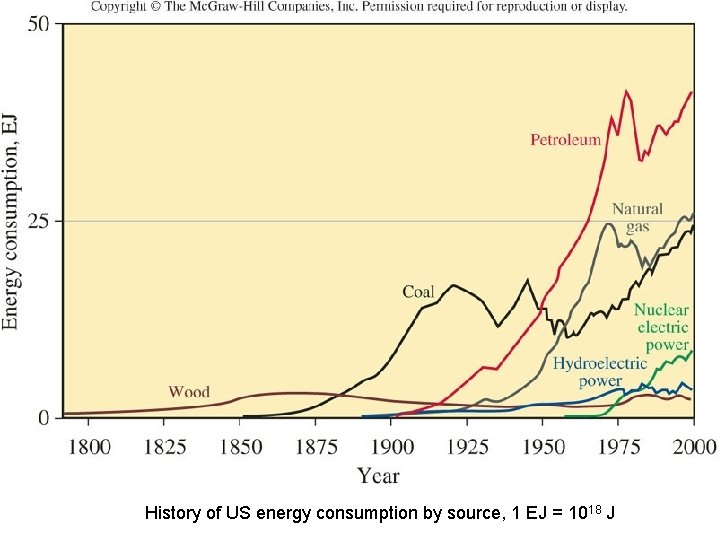
History of US energy consumption by source, 1 EJ = 1018 J
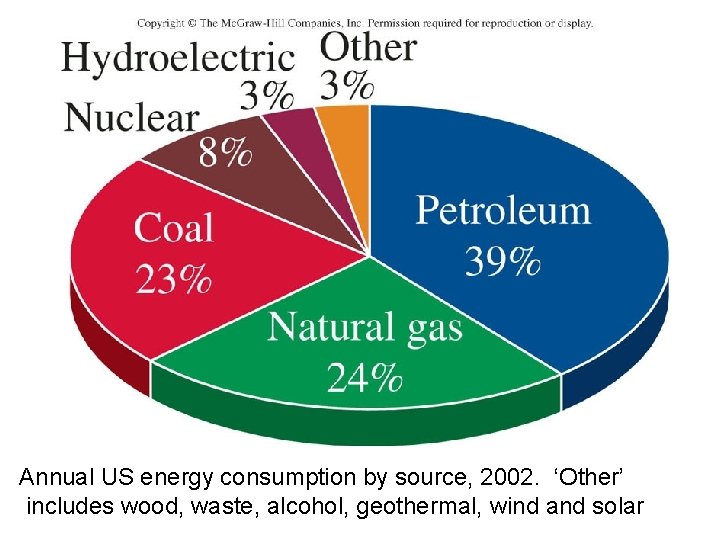
Annual US energy consumption by source, 2002. ‘Other’ includes wood, waste, alcohol, geothermal, wind and solar
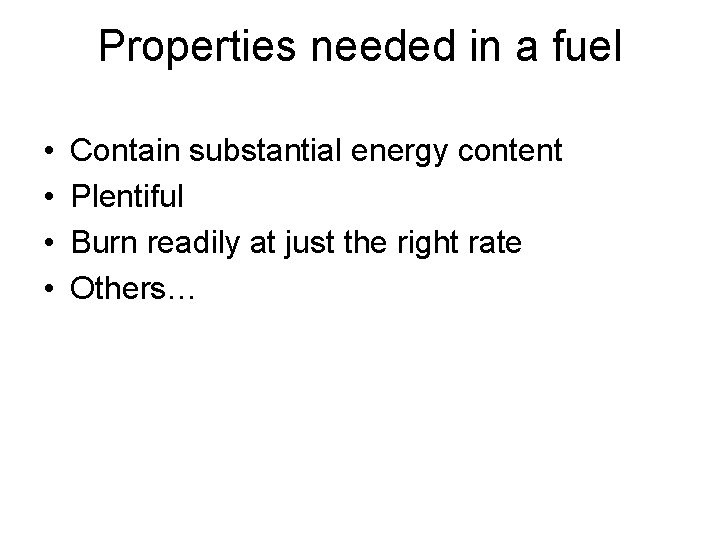
Properties needed in a fuel • • Contain substantial energy content Plentiful Burn readily at just the right rate Others…
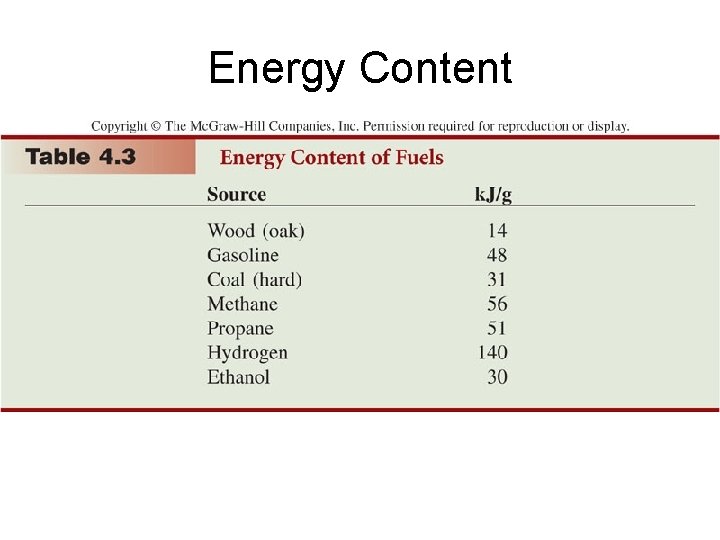
Energy Content
Fossil Fuels • “You will die but the carbon will not; its career does not end with you…it will return to the soil, and there a plant may take it up again in time, sending it once more on a cycle of plant and animal life” – Jacob Bronowski in Biography of an Atom – And the Universe. Organic matter (plants, animals) decays upon death, producing CO 2 and H 2 O, just like in combustion But in some cases, decaying matter doesn’t have enough O 2 around to complete the reaction Other reactions take place deep in the earth at high temperatures and pressures, producing coal, petroleum and natural gas.
Fossil Fuels: Coal • Was known in ancient times – used in funeral pyres as early as 3000 B. C. • Mining for coal was not common until ~1300 A. D. , in Britain • During the Industrial Revolution (beginning in the 1700 s), coal became the chief fuel source in Britain, and later the rest of the world – Fuel was needed in vast quantities to power the new Steam Engines – Wood was already in short supply
Fossil Fuels: Coal • Coal is a better energy source than wood – Coal yields 30 k. J per gram – Wood yields 12 k. J per gram • Coal has higher ratio of carbon (85% by mass) – Fuels with a higher carbon ratio produce more energy when they are burned – An approximate molecular formula for coal is C 135 H 96 O 9 NS
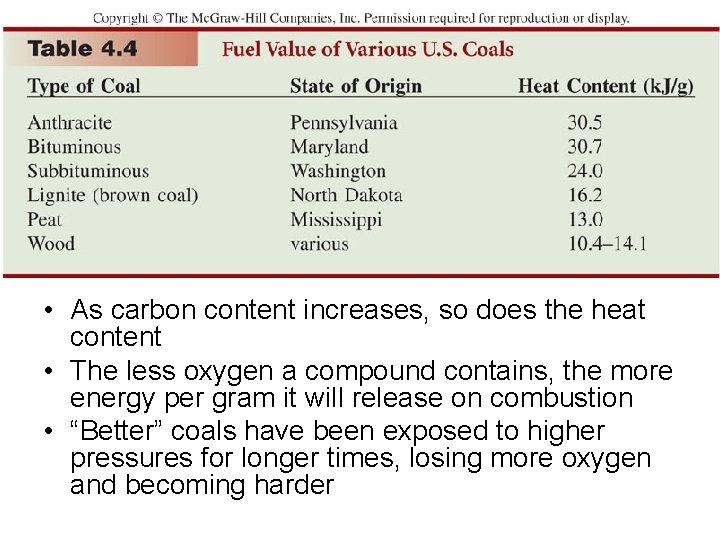
• As carbon content increases, so does the heat content • The less oxygen a compound contains, the more energy per gram it will release on combustion • “Better” coals have been exposed to higher pressures for longer times, losing more oxygen and becoming harder
Fossil Fuels: Coal • Drawback #1: Difficult to obtain – Underground mining dangerous and expensive – Since 1900 more than 100, 000 workers killed in American mine disasters – but how many worldwide? And how many have been made sick, or died from “black lung”? • Drawback #2: Coal is a dirty fuel – Soot – Sulfur and nitrogen oxides – Mercury – Carbon dioxide
Fossil Fuels: Coal • The benefit of coal: the global supply is large – 20 -40 times greater than petroleum • Because of this, coal is expected to become a much more important fuel in the next 100 -150 years • It will become important to find ways to better use coal – more cleanly, more safely
- Slides: 25