
In The ThreeRing Conception of Giftedness Renzulli defined
- Slides: 1
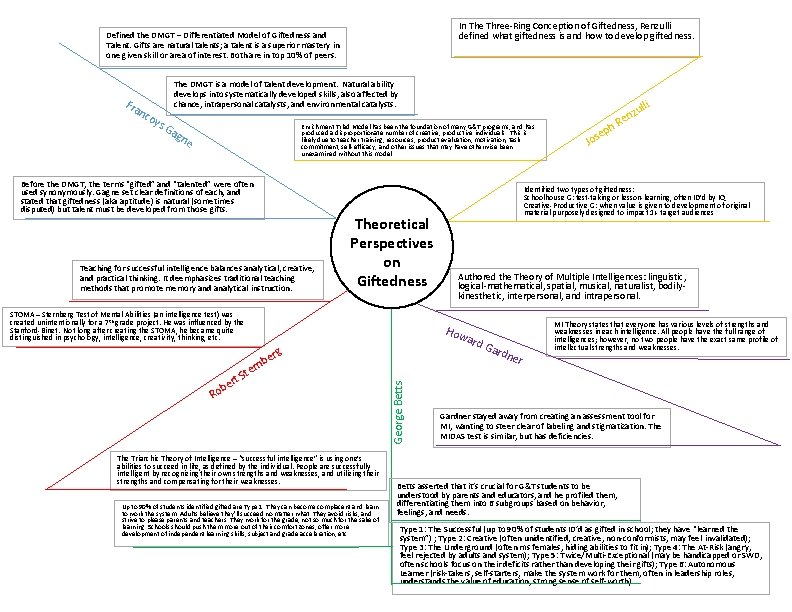
In The Three-Ring Conception of Giftedness, Renzulli defined what giftedness is and how to develop giftedness. Defined the DMGT – Differentiated Model of Giftedness and Talent. Gifts are natural talents; a talent is a superior mastery in one given skill or area of interest. Both are in top 10% of peers. Fra n co The DMGT is a model of talent development. Natural ability develops into systematically developed skills, also affected by chance, intrapersonal catalysts, and environmental catalysts. ys Ga Enrichment Triad Model has been the foundation of many G&T programs, and has produced a disproportionate number of creative, productive individuals. This is likely due to teacher training, resources, product evaluation, motivation, task commitment, self-efficacy, and other issues that may have otherwise been unexamined without this model. gn e Before the DMGT, the terms “gifted” and “talented” were often used synonymously. Gagne set clear definitions of each, and stated that giftedness (aka aptitude) is natural (sometimes disputed) but talent must be developed from those gifts. Teaching for successful intelligence balances analytical, creative, and practical thinking. It deemphasizes traditional teaching methods that promote memory and analytical instruction. Theoretical Perspectives on Giftedness STOMA – Sternberg Test of Mental Abilities (an intelligence test) was created unintentionally for a 7 th grade project. He was influenced by the Stanford-Binet. Not long after creating the STOMA, he became quite distinguished in psychology, intelligence, creativity, thinking, etc. S n ter Ro The Triarchic Theory of Intelligence – “successful intelligence” is using one’s abilities to succeed in life, as defined by the individual. People are successfully intelligent by recognizing their own strengths and weaknesses, and utilizing their strengths and compensating for their weaknesses. Up to 90% of students identified gifted are Type 1. They can become complacent and learn to work the system. Adults believe they’ll succeed no matter what. They avoid risks, and strive to please parents and teachers. They work for the grade, not so much for the sake of learning. Schools should push them more out of their comfort zones, offer more development of independent learning skills, subject and grade acceleration, etc. ep Authored the Theory of Multiple Intelligences: linguistic, logical-mathematical, spatial, musical, naturalist, bodilykinesthetic, interpersonal, and intrapersonal. ard rg be Jos Identified two types of giftedness: Schoolhouse G: test-taking or lesson-learning, often ID’d by IQ Creative-Productive G: when value is given to development of original material purposely designed to impact 1+ target audiences How George Betts rt be i ull z en h. R Gar dne r MI Theory states that everyone has various levels of strengths and weaknesses in each intelligence. All people have the full range of intelligences; however, no two people have the exact same profile of intellectual strengths and weaknesses. Gardner stayed away from creating an assessment tool for MI, wanting to steer clear of labeling and stigmatization. The MIDAS test is similar, but has deficiencies. Betts asserted that it’s crucial for G&T students to be understood by parents and educators, and he profiled them, differentiating them into 6 subgroups based on behavior, feelings, and needs. Type 1: The Successful (up to 90% of students ID’d as gifted in school; they have “learned the system”) ; Type 2: Creative (often unidentified, creative, non-conformists, may feel invalidated); Type 3: The Underground (often ms females, hiding abilities to fit in); Type 4: The At-Risk (angry, feel rejected by adults and system); Type 5: Twice/Multi-Exceptional (may be handicapped or SWD, often schools focus on their deficits rather than developing their gifts); Type 6: Autonomous Learner (risk-takers, self-starters, make the system work for them, often in leadership roles, understands the value of education, strong sense of self-worth).