
In The Name of GOD SYSTEMS OF PHARMACEUTICAL


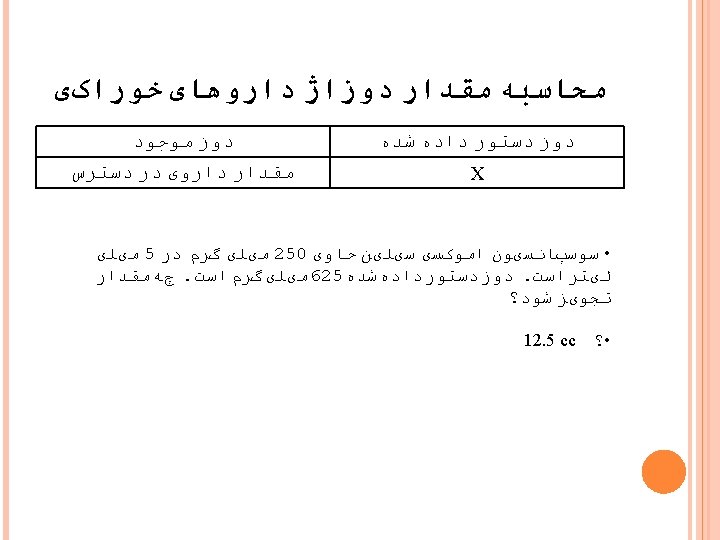
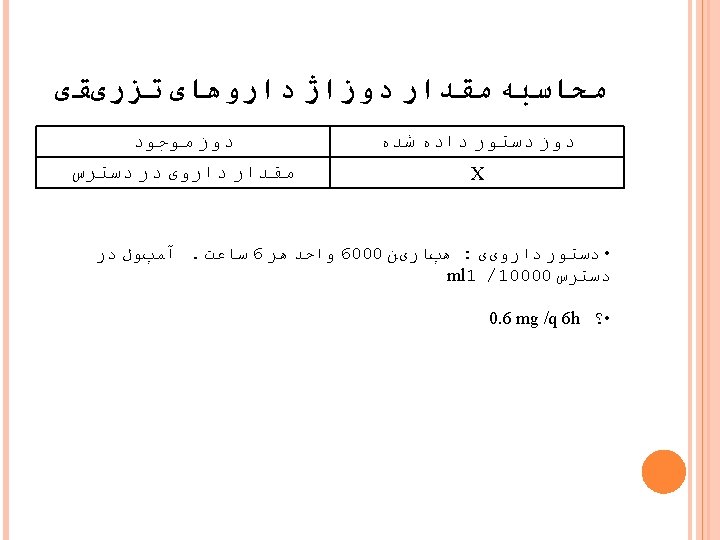
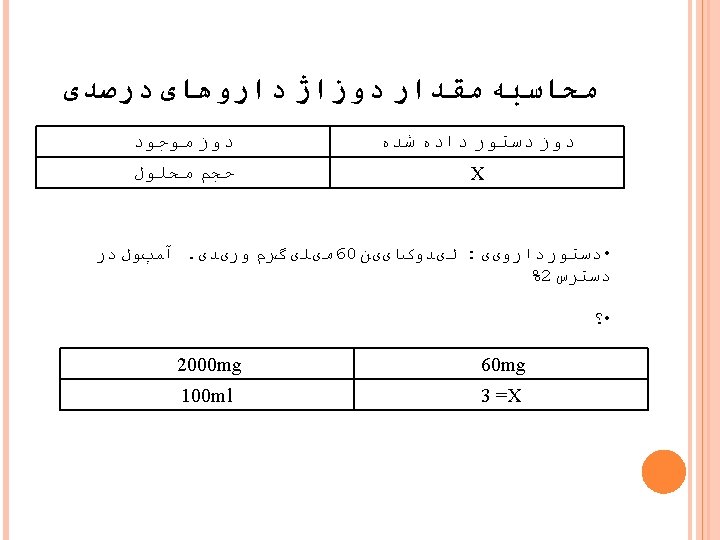
- Slides: 128
In The Name of GOD
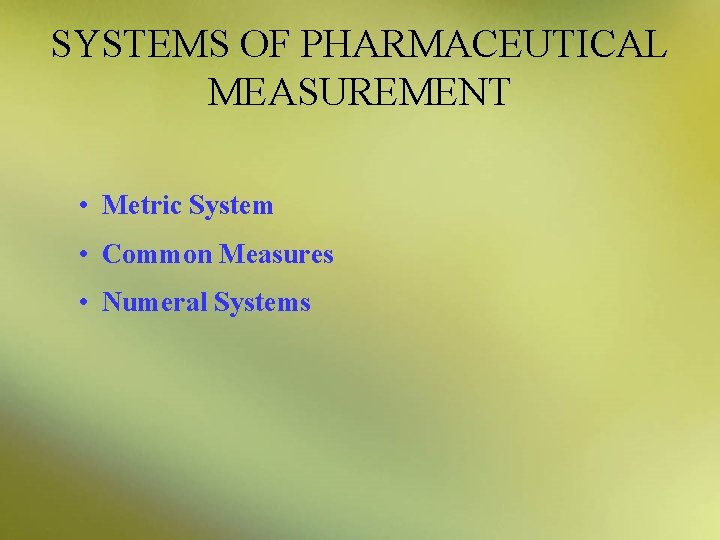
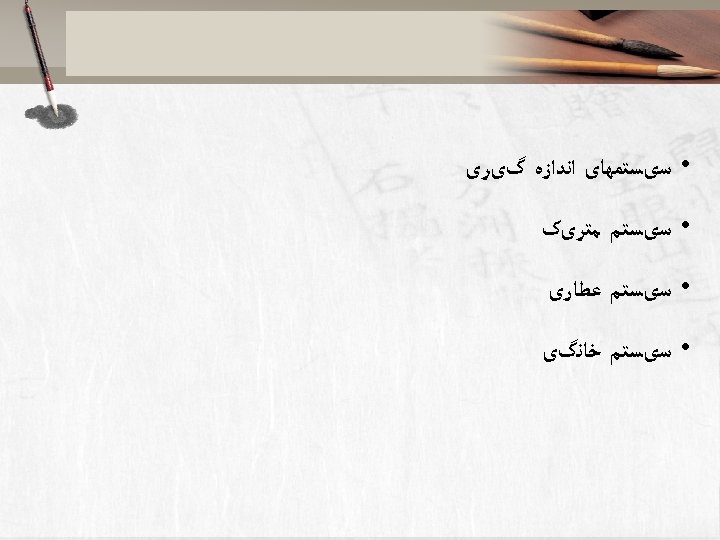
SYSTEMS OF PHARMACEUTICAL MEASUREMENT • Metric System • Common Measures • Numeral Systems
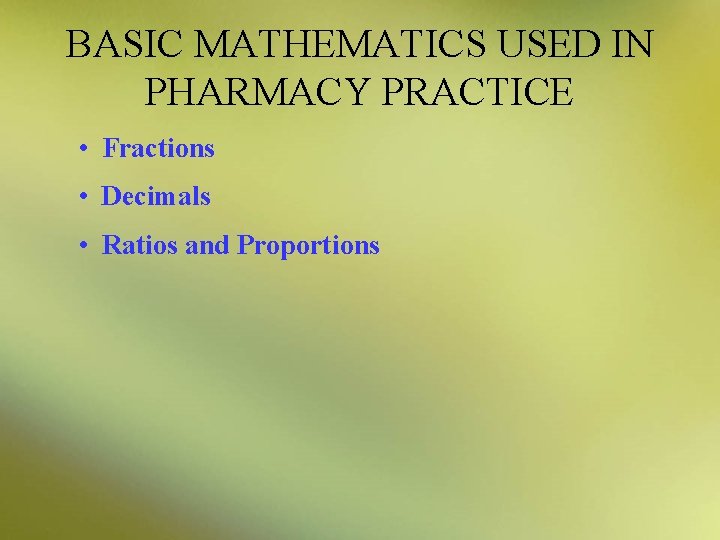
BASIC MATHEMATICS USED IN PHARMACY PRACTICE • Fractions • Decimals • Ratios and Proportions
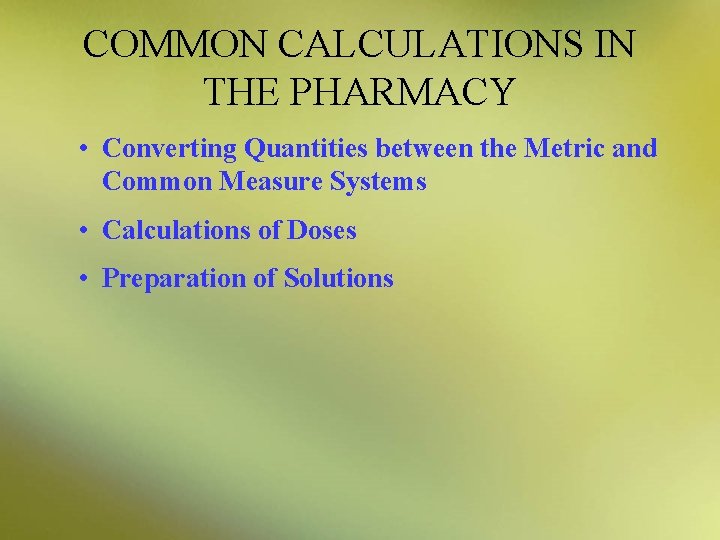
COMMON CALCULATIONS IN THE PHARMACY • Converting Quantities between the Metric and Common Measure Systems • Calculations of Doses • Preparation of Solutions
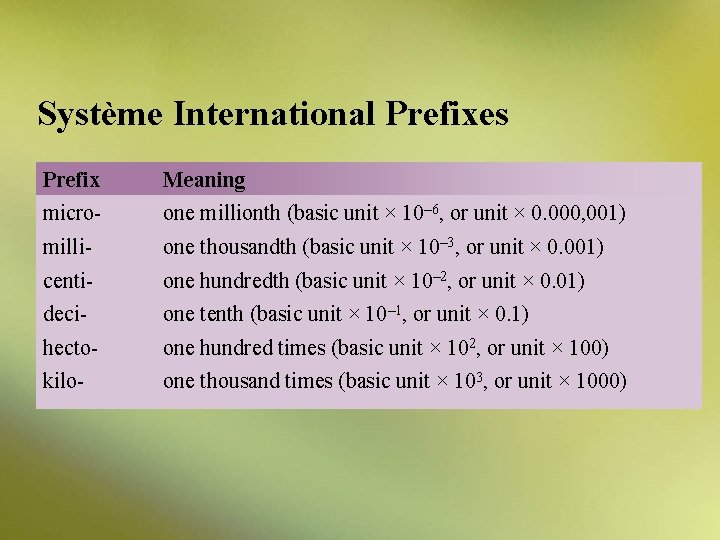
Système International Prefixes Prefix Meaning micro- one millionth (basic unit × 10– 6, or unit × 0. 000, 001) milli- one thousandth (basic unit × 10– 3, or unit × 0. 001) centi- one hundredth (basic unit × 10– 2, or unit × 0. 01) deci- one tenth (basic unit × 10– 1, or unit × 0. 1) hecto- one hundred times (basic unit × 102, or unit × 100) kilo- one thousand times (basic unit × 103, or unit × 1000)
Common Metric Units: Weight Basic Unit Equivalent 1 gram (g) 1000 milligrams (mg) 1 milligram (mg) 1 kilogram (kg) 1000 micrograms (mcg), one thousandth of a gram (g) 1000 grams (g)
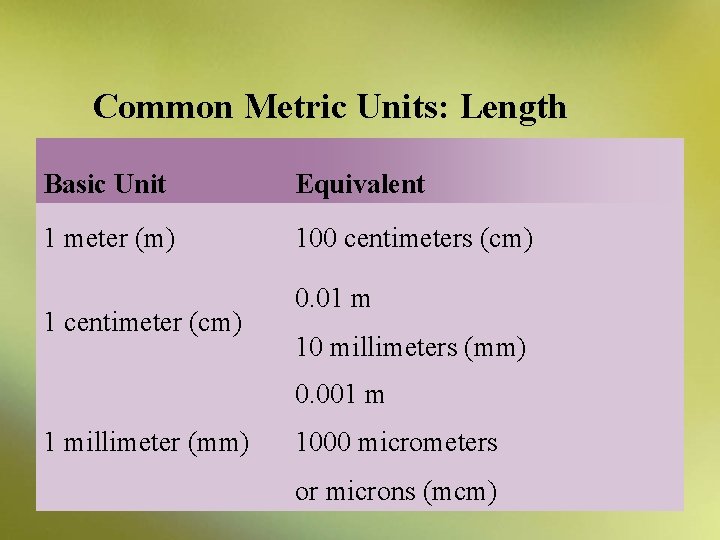
Common Metric Units: Length Basic Unit Equivalent 1 meter (m) 100 centimeters (cm) 1 centimeter (cm) 0. 01 m 10 millimeters (mm) 0. 001 m 1 millimeter (mm) 1000 micrometers or microns (mcm)
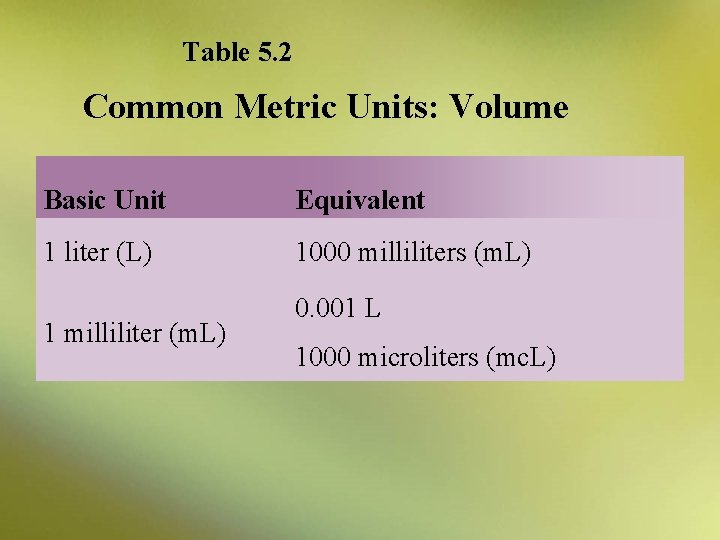
Table 5. 2 Common Metric Units: Volume Basic Unit Equivalent 1 liter (L) 1000 milliliters (m. L) 1 milliliter (m. L) 0. 001 L 1000 microliters (mc. L)
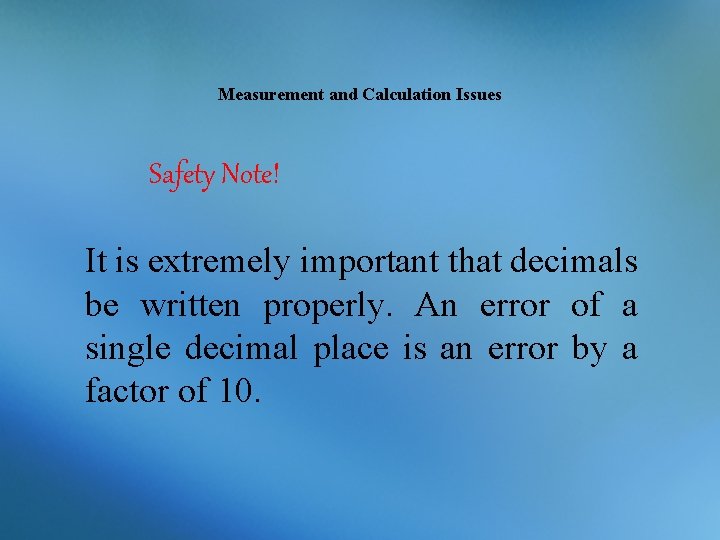
Measurement and Calculation Issues Safety Note! It is extremely important that decimals be written properly. An error of a single decimal place is an error by a factor of 10.
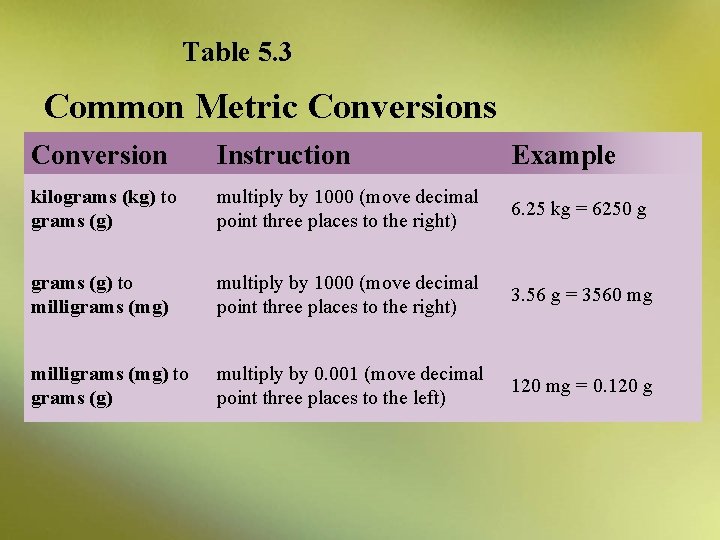
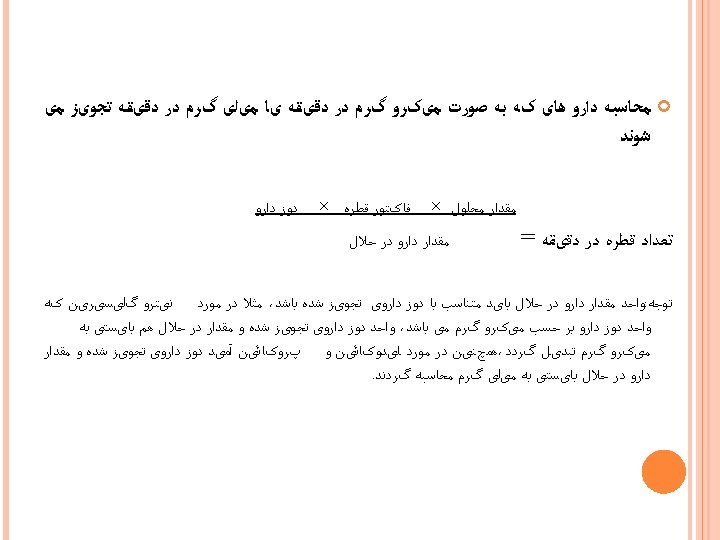
Table 5. 3 Common Metric Conversions Conversion Instruction Example kilograms (kg) to grams (g) multiply by 1000 (move decimal point three places to the right) 6. 25 kg = 6250 g grams (g) to milligrams (mg) multiply by 1000 (move decimal point three places to the right) 3. 56 g = 3560 mg milligrams (mg) to grams (g) multiply by 0. 001 (move decimal point three places to the left) 120 mg = 0. 120 g
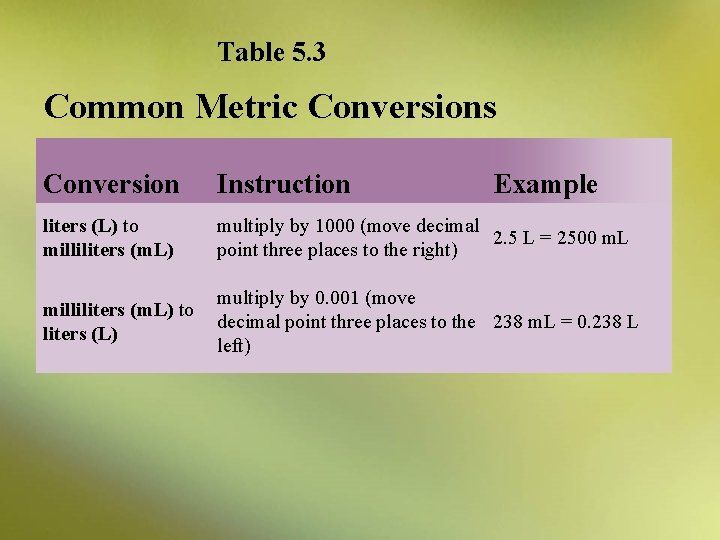
Table 5. 3 Common Metric Conversions Conversion Instruction Example liters (L) to milliliters (m. L) multiply by 1000 (move decimal 2. 5 L = 2500 m. L point three places to the right) multiply by 0. 001 (move milliliters (m. L) to decimal point three places to the 238 m. L = 0. 238 L liters (L) left)
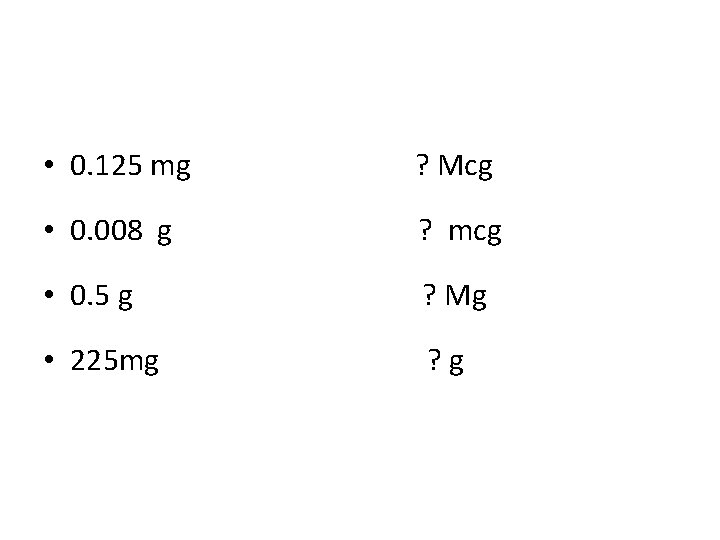
• 0. 125 mg ? Mcg • 0. 008 g ? mcg • 0. 5 g ? Mg • 225 mg ? g
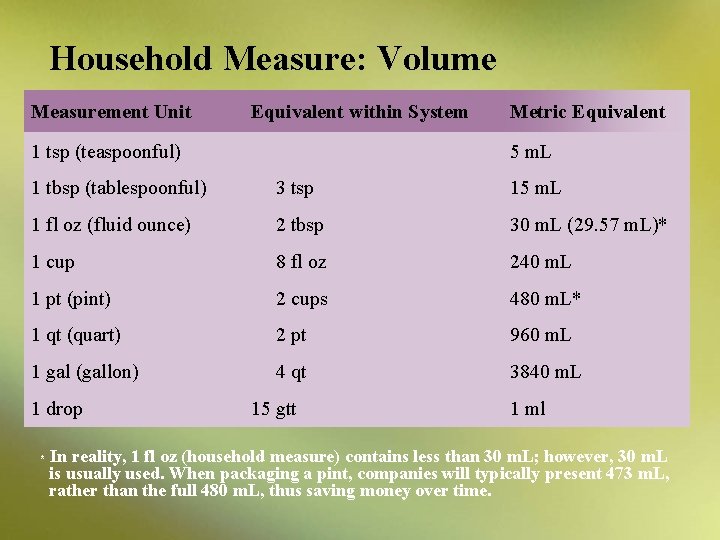
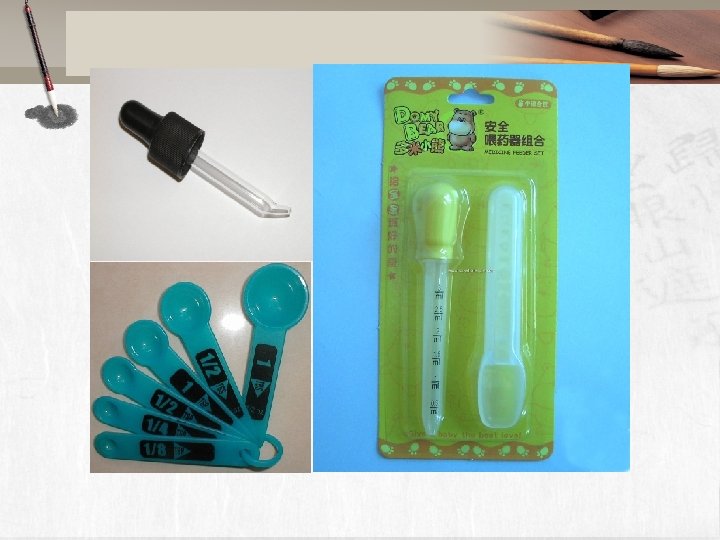
Household Measure: Volume Measurement Unit Equivalent within System 1 tsp (teaspoonful) Metric Equivalent 5 m. L 1 tbsp (tablespoonful) 3 tsp 15 m. L 1 fl oz (fluid ounce) 2 tbsp 30 m. L (29. 57 m. L)* 1 cup 8 fl oz 240 m. L 1 pt (pint) 2 cups 480 m. L* 1 qt (quart) 2 pt 960 m. L 1 gal (gallon) 4 qt 3840 m. L 1 drop 15 gtt 1 ml In reality, 1 fl oz (household measure) contains less than 30 m. L; however, 30 m. L is usually used. When packaging a pint, companies will typically present 473 m. L, rather than the full 480 m. L, thus saving money over time. *
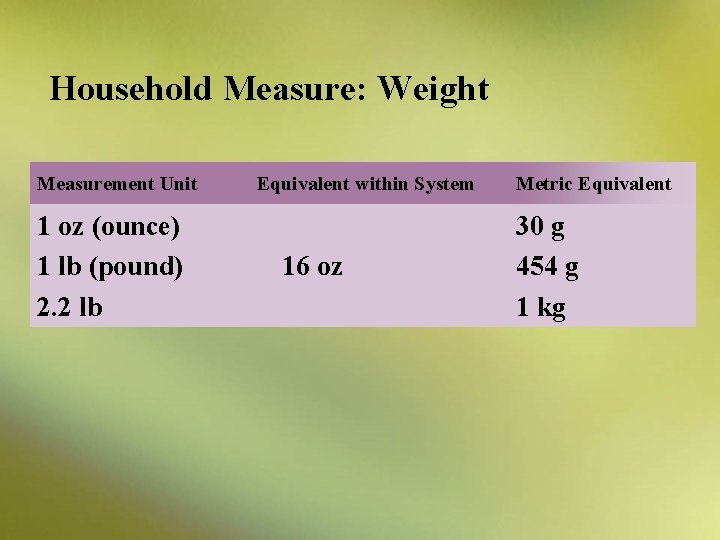
Household Measure: Weight Measurement Unit Equivalent within System Metric Equivalent 1 oz (ounce) 1 lb (pound) 2. 2 lb 30 g 454 g 1 kg 16 oz
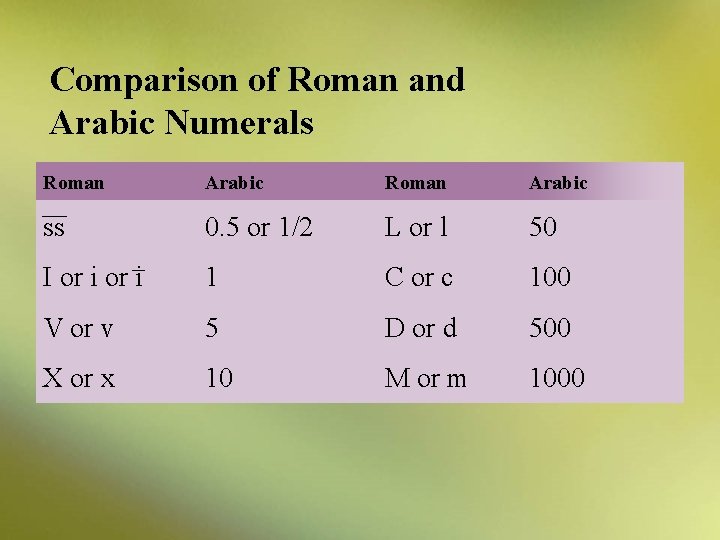
Measurement and Calculation Issues Safety Note! New safety guidelines are discouraging use of Roman numerals.
Comparison of Roman and Arabic Numerals Roman Arabic ss 0. 5 or 1/2 L or l 50 I or i 1 C or c 100 V or v 5 D or d 500 X or x 10 M or m 1000
Terms to Remember • metric system • meter • gram • liter
BASIC MATHEMATICS USED IN PHARMACY PRACTICE • Fractions • Decimals • Ratios and Proportions
Fractions When something is divided into parts, each • part is considered a fraction of the whole.
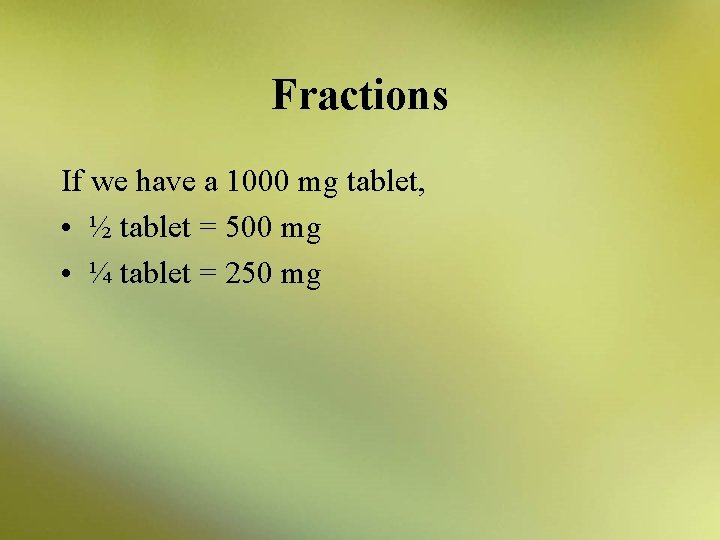
Fractions If we have a 1000 mg tablet, • ½ tablet = 500 mg • ¼ tablet = 250 mg
Terminology fraction a portion of a whole that is represented as a ratio
Numerical Ratios represent the relationship between • two parts of the whole • one part to the whole
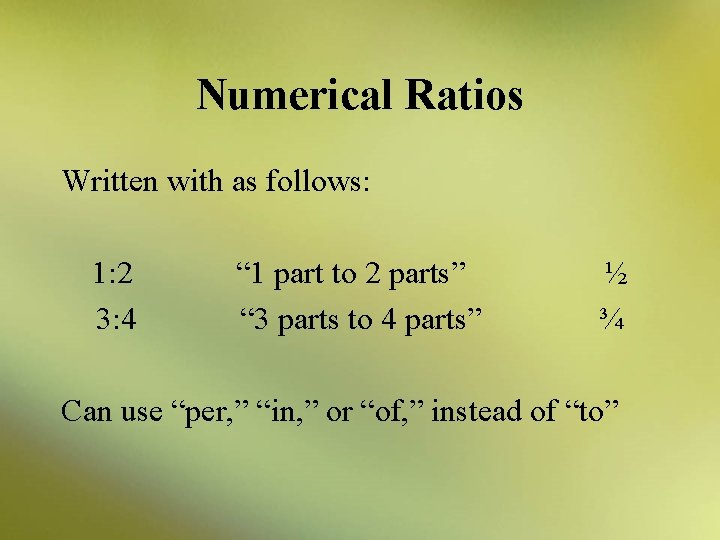
Numerical Ratios Written with as follows: 1: 2 3: 4 “ 1 part to 2 parts” “ 3 parts to 4 parts” ½ ¾ Can use “per, ” “in, ” or “of, ” instead of “to”
Terminology ratio a numerical representation of the relationship between two parts of the whole or between one part and the whole
Numerical Ratios in the Pharmacy 1: 100 concentration of a drug means. . .
Numerical Ratios in the Pharmacy 1: 100 concentration of a drug means. . . there is 1 part drug in 100 parts solution
Proportions • An expression of equality between two ratios. • Noted by : : or = 3: 4 = 15: 20 or 3: 4 : : 15: 20
Terminology proportion an expression of equality between two ratios
Proportions If a proportion is true. . . product of means = product of extremes 3: 4 = 15: 20 3 × 20 = 4 × 15 60 = 60
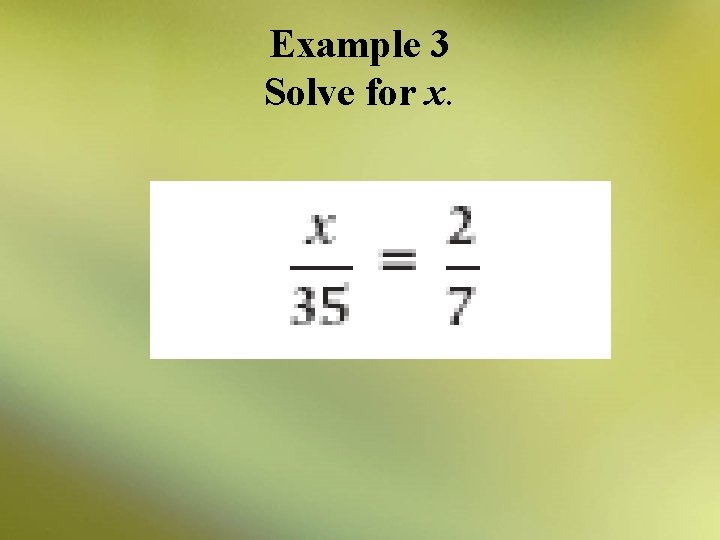
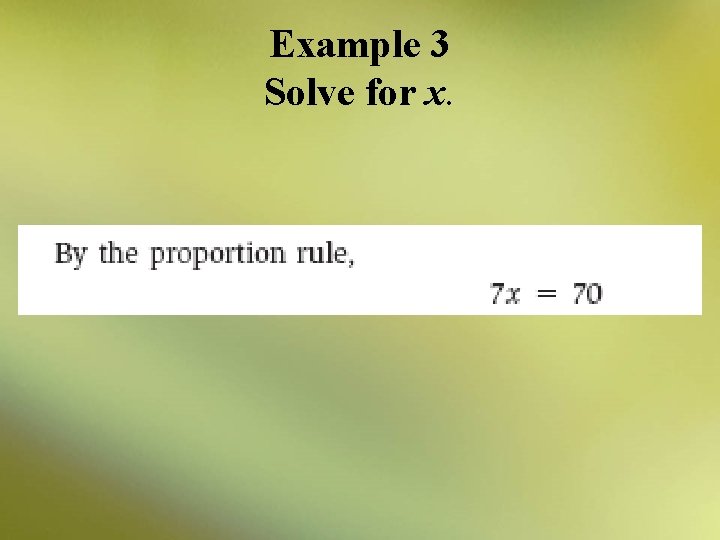
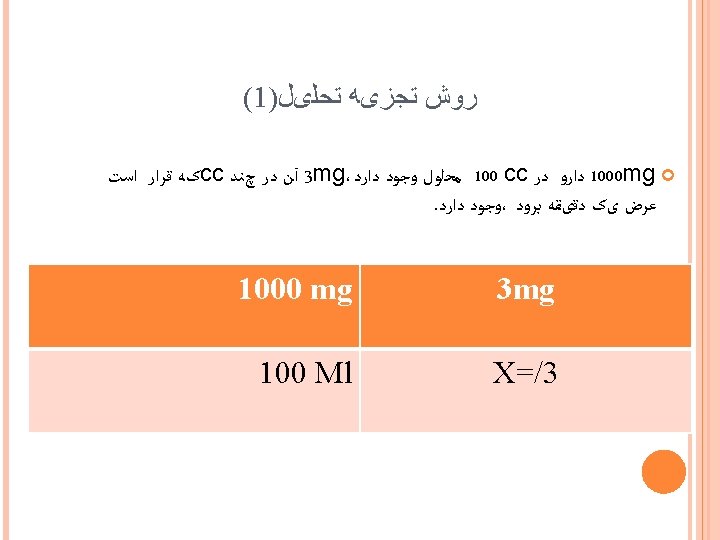
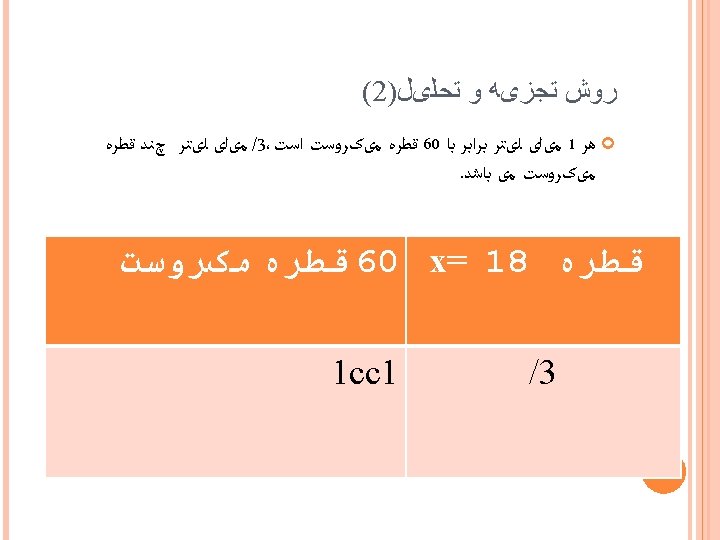
Proportions in the Pharmacy • Proportions are frequently used to calculate drug doses in the pharmacy. • Use the ratio-proportion method any time one ratio is complete and the other is missing a component.
Terminology ratio-proportion method a conversion method based on comparing a complete ratio to a ratio with a missing component
Example 3 Solve for x.
Example 3 Solve for x.
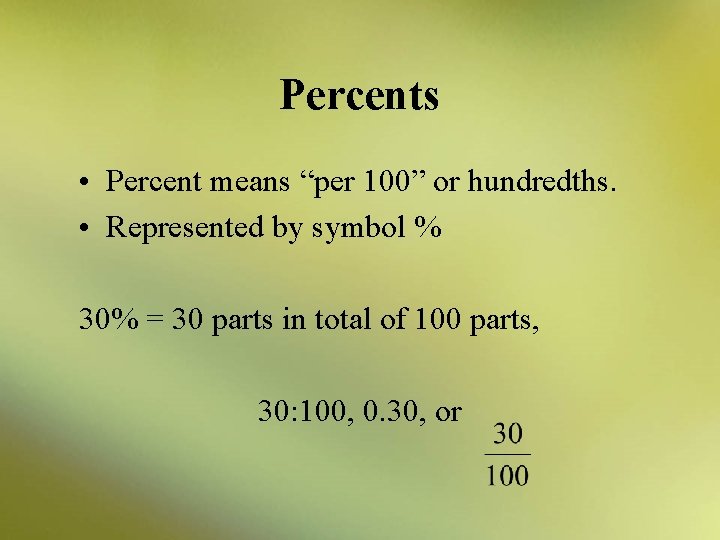
Percents • Percent means “per 100” or hundredths. • Represented by symbol % 30% = 30 parts in total of 100 parts, 30: 100, 0. 30, or
Terminology percent the number of parts per 100; can be written as a fraction, a decimal, or a ratio
Percents in the Pharmacy A 1% solution contains. . . • 1 g of drug per 100 m. L of fluid • Expressed as 1: 100, 1/100, or 0. 01
Percents in the Pharmacy A 1% hydrocortisone cream contains. . . • 1 g of hydrocortisone per 100 g of cream • Expressed as 1: 100, 1/100, or 0. 01
Safety Note! The higher the percentage of a dissolved substance, the greater the strength.
Percents in the Pharmacy • Multiply the first number in the ratio (the solute) while keeping the second number unchanged, you increase the strength. • Divide the first number in the ration while keeping the second number unchanged, you decrease the strength.
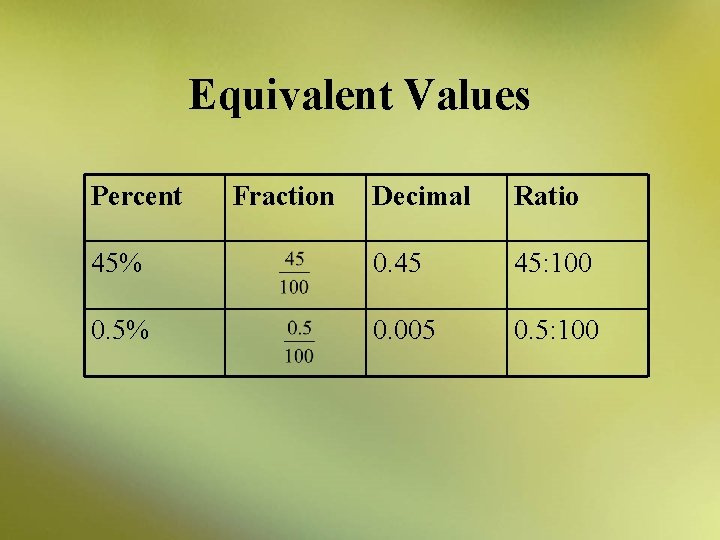
Equivalent Values Percent Fraction Decimal Ratio 45% 0. 45 45: 100 0. 5% 0. 005 0. 5: 100
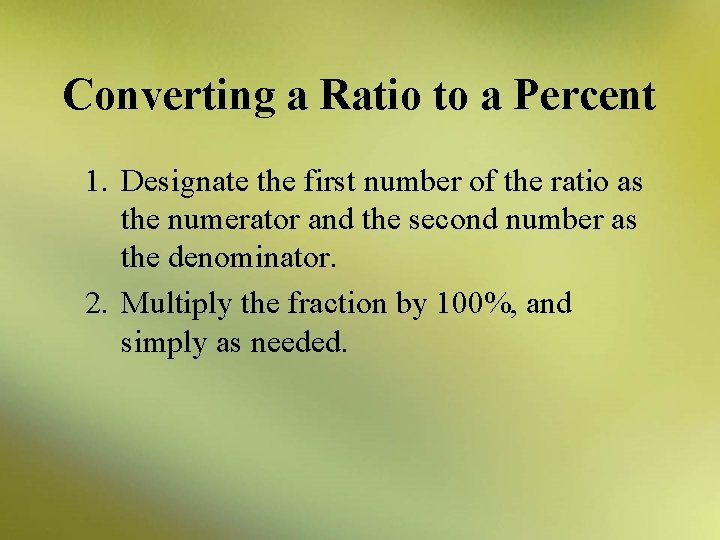
Converting a Ratio to a Percent 1. Designate the first number of the ratio as the numerator and the second number as the denominator. 2. Multiply the fraction by 100%, and simply as needed.
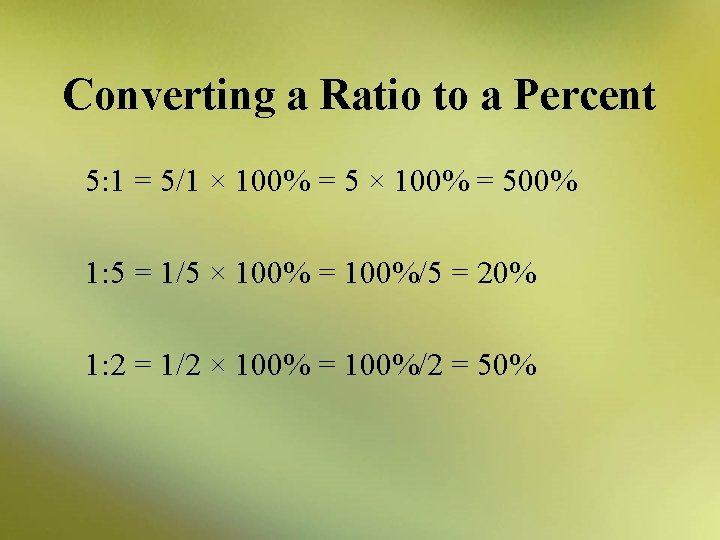
Converting a Ratio to a Percent 5: 1 = 5/1 × 100% = 500% 1: 5 = 1/5 × 100% = 100%/5 = 20% 1: 2 = 1/2 × 100% = 100%/2 = 50%
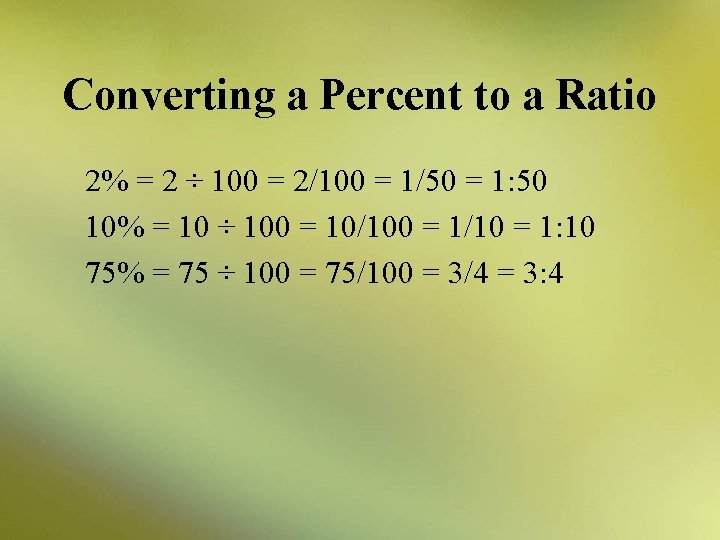
Converting a Percent to a Ratio 2% = 2 ÷ 100 = 2/100 = 1/50 = 1: 50 10% = 10 ÷ 100 = 10/100 = 1/10 = 1: 10 75% = 75 ÷ 100 = 75/100 = 3/4 = 3: 4
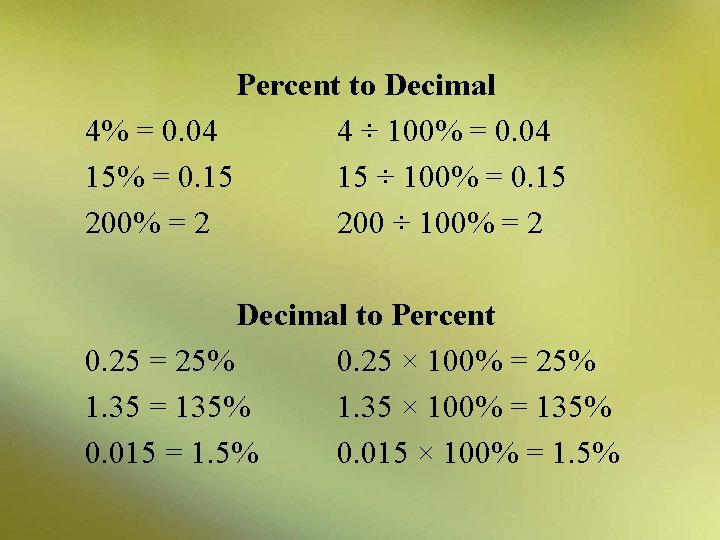
Percent to Decimal 4% = 0. 04 4 ÷ 100% = 0. 04 15% = 0. 15 15 ÷ 100% = 0. 15 200% = 2 200 ÷ 100% = 2 Decimal to Percent 0. 25 = 25% 0. 25 × 100% = 25% 1. 35 = 135% 1. 35 × 100% = 135% 0. 015 = 1. 5% 0. 015 × 100% = 1. 5%
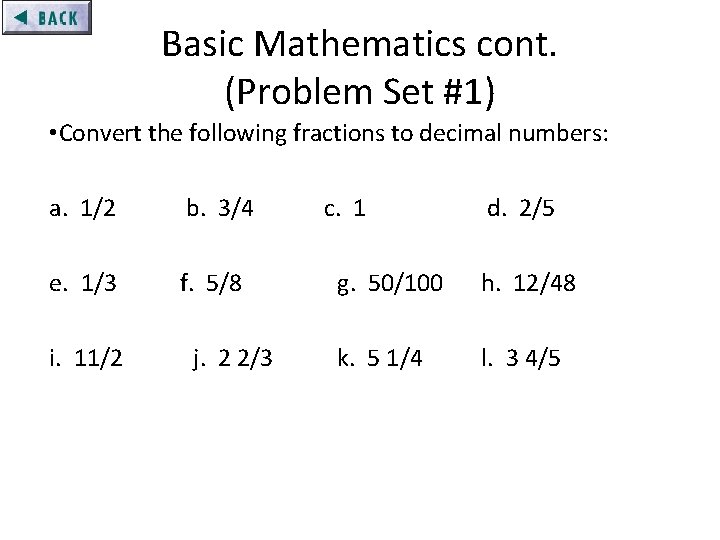
Basic Mathematics cont. (Problem Set #1) • Convert the following fractions to decimal numbers: a. 1/2 b. 3/4 c. 1 d. 2/5 e. 1/3 f. 5/8 g. 50/100 h. 12/48 i. 11/2 k. 5 1/4 l. 3 4/5 j. 2 2/3
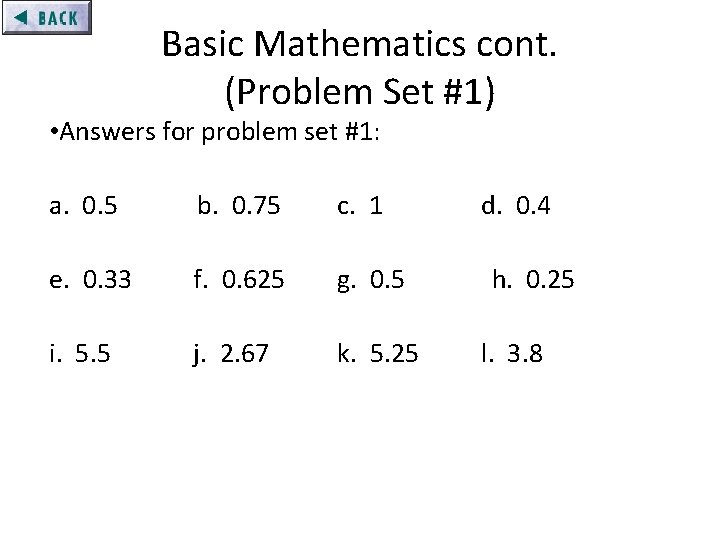
Basic Mathematics cont. (Problem Set #1) • Answers for problem set #1: a. 0. 5 b. 0. 75 c. 1 d. 0. 4 e. 0. 33 f. 0. 625 g. 0. 5 h. 0. 25 i. 5. 5 j. 2. 67 k. 5. 25 l. 3. 8
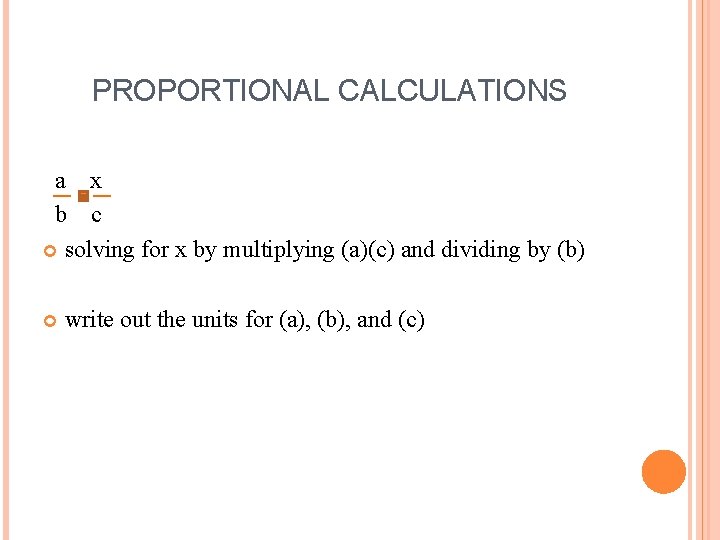
PROPORTIONAL CALCULATIONS a x b c solving for x by multiplying (a)(c) and dividing by (b) write out the units for (a), (b), and (c)
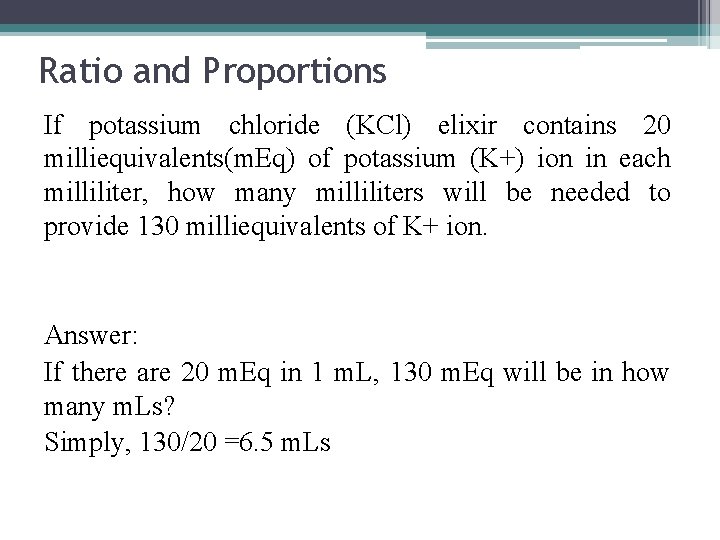
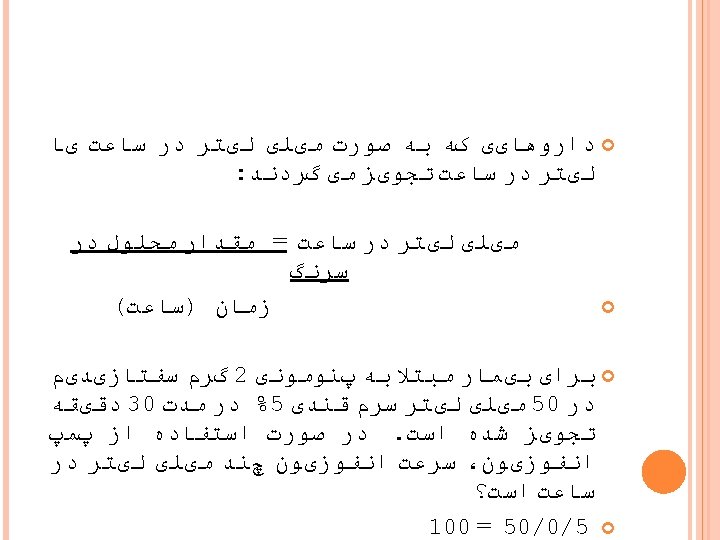
Ratio and Proportions If potassium chloride (KCl) elixir contains 20 milliequivalents(m. Eq) of potassium (K+) ion in each milliliter, how many milliliters will be needed to provide 130 milliequivalents of K+ ion. Answer: If there are 20 m. Eq in 1 m. L, 130 m. Eq will be in how many m. Ls? Simply, 130/20 =6. 5 m. Ls
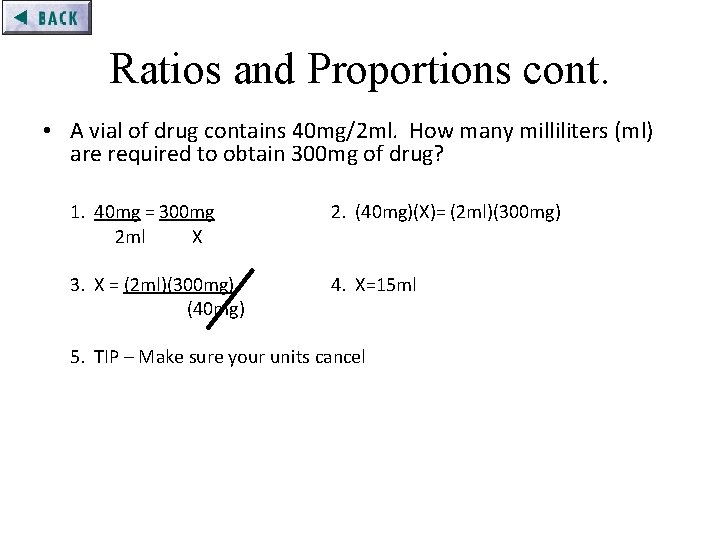
Ratios and Proportions cont. • A vial of drug contains 40 mg/2 ml. How many milliliters (ml) are required to obtain 300 mg of drug? 1. 40 mg = 300 mg 2 ml X 2. (40 mg)(X)= (2 ml)(300 mg) 3. X = (2 ml)(300 mg) 4. X=15 ml (40 mg) 5. TIP – Make sure your units cancel
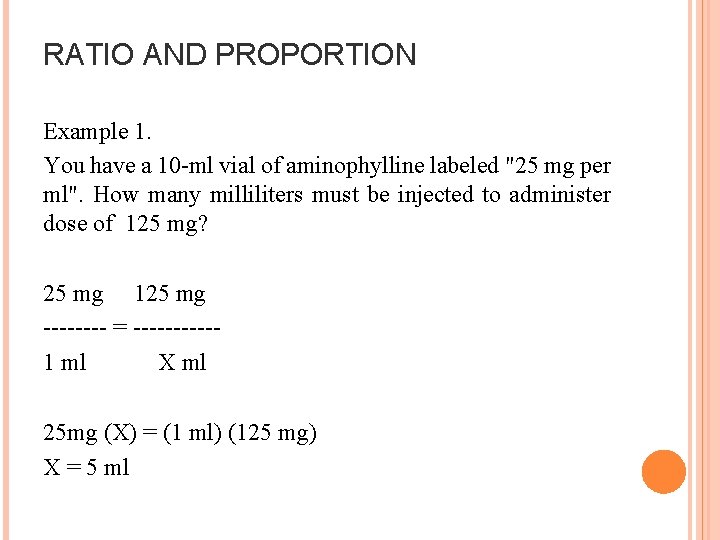
RATIO AND PROPORTION Example 1. You have a 10 -ml vial of aminophylline labeled "25 mg per ml". How many milliliters must be injected to administer dose of 125 mg? 25 mg 125 mg ---- = -----1 ml X ml 25 mg (X) = (1 ml) (125 mg) X = 5 ml
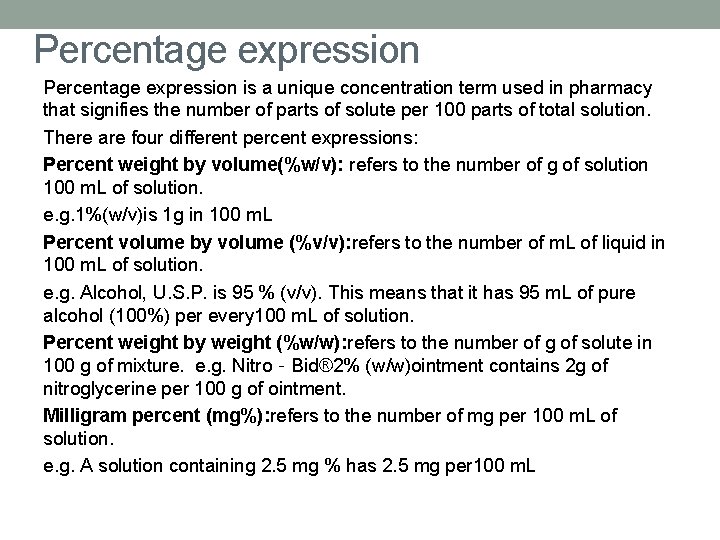
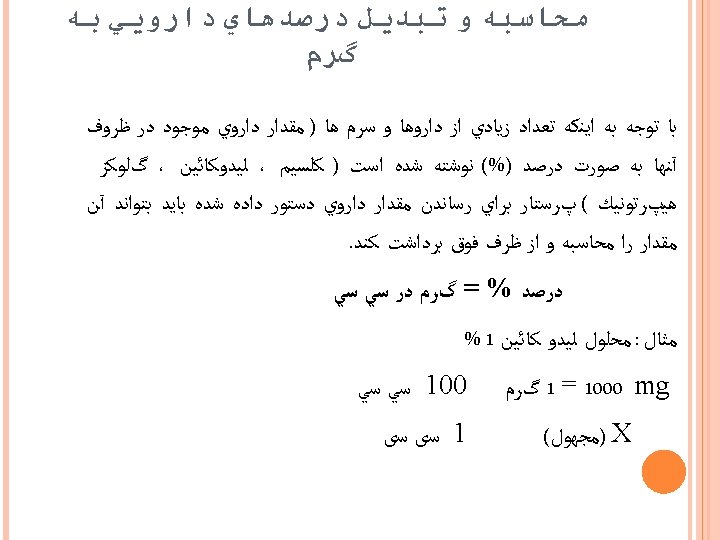
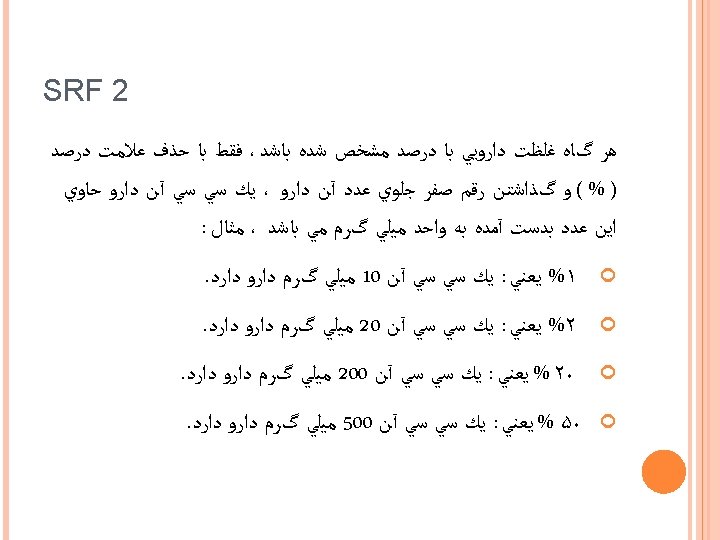
Percentage expression is a unique concentration term used in pharmacy that signifies the number of parts of solute per 100 parts of total solution. There are four different percent expressions: Percent weight by volume(%w/v): refers to the number of g of solution 100 m. L of solution. e. g. 1%(w/v)is 1 g in 100 m. L Percent volume by volume (%v/v): refers to the number of m. L of liquid in 100 m. L of solution. e. g. Alcohol, U. S. P. is 95 % (v/v). This means that it has 95 m. L of pure alcohol (100%) per every 100 m. L of solution. Percent weight by weight (%w/w): refers to the number of g of solute in 100 g of mixture. e. g. Nitro‐Bid® 2% (w/w)ointment contains 2 g of nitroglycerine per 100 g of ointment. Milligram percent (mg%): refers to the number of mg per 100 m. L of solution. e. g. A solution containing 2. 5 mg % has 2. 5 mg per 100 m. L
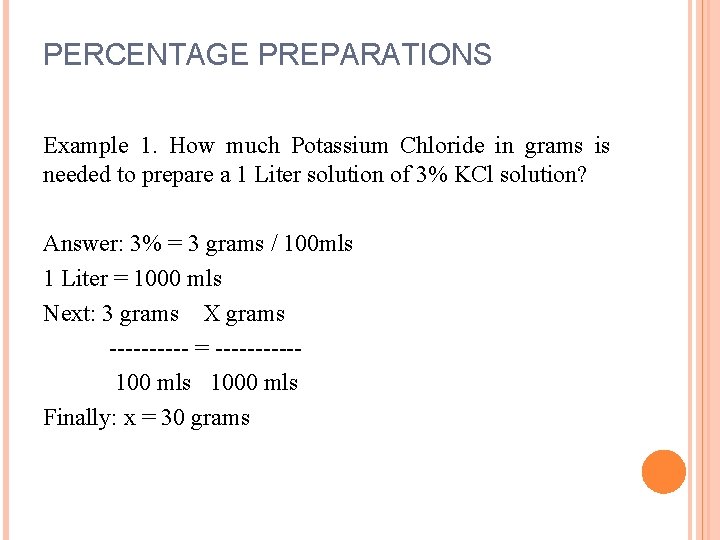
PERCENTAGE PREPARATIONS Example 1. How much Potassium Chloride in grams is needed to prepare a 1 Liter solution of 3% KCl solution? Answer: 3% = 3 grams / 100 mls 1 Liter = 1000 mls Next: 3 grams X grams ----- = ----- 100 mls 1000 mls Finally: x = 30 grams
MOLARITY AND OSMOLARITY The concentration of a solute in a solution is expressed as its “Molarity”. It tells you how much of a solute is present. The units of molarity are “moles” (mols). Osmolarity is a concept that allows you to determine if water will move from one side of a membrane to the other side. That is: will “Osmosis” occur? The units of osmolarity are “osmols” (osm). Water will always move across a membrane into the solution with the higher osmolarity. In order to determine a solutions’ osmolarity you will first need to figure out its molarity.
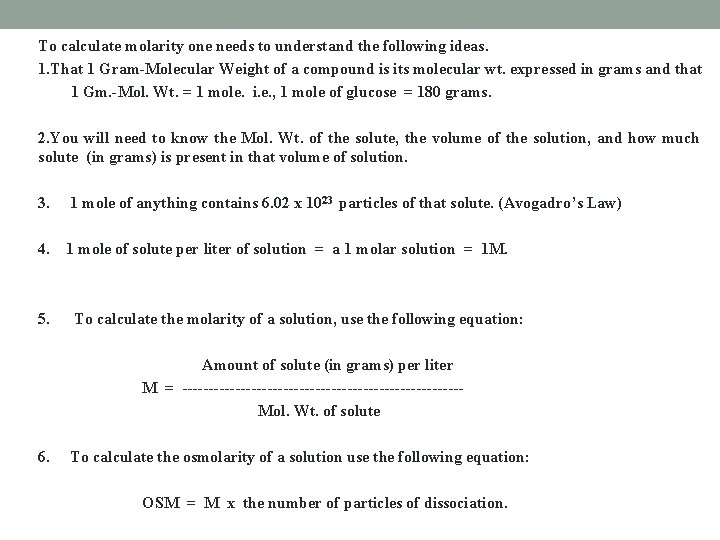
To calculate molarity one needs to understand the following ideas. 1. That 1 Gram-Molecular Weight of a compound is its molecular wt. expressed in grams and that 1 Gm. -Mol. Wt. = 1 mole. i. e. , 1 mole of glucose = 180 grams. 2. You will need to know the Mol. Wt. of the solute, the volume of the solution, and how much solute (in grams) is present in that volume of solution. 3. 1 mole of anything contains 6. 02 x 1023 particles of that solute. (Avogadro’s Law) 4. 1 mole of solute per liter of solution = a 1 molar solution = 1 M. 5. To calculate the molarity of a solution, use the following equation: Amount of solute (in grams) per liter M = -------------------------- Mol. Wt. of solute 6. To calculate the osmolarity of a solution use the following equation: OSM = M x the number of particles of dissociation.
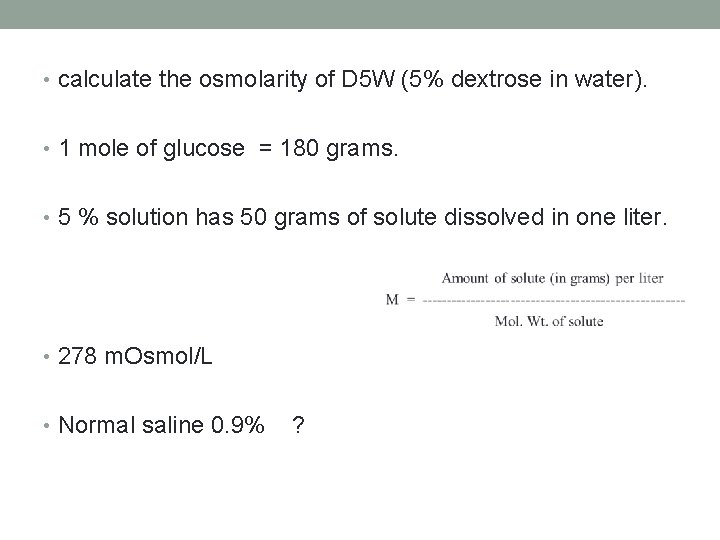
• calculate the osmolarity of D 5 W (5% dextrose in water). • 1 mole of glucose = 180 grams. • 5 % solution has 50 grams of solute dissolved in one liter. • 278 m. Osmol/L • Normal saline 0. 9% ?
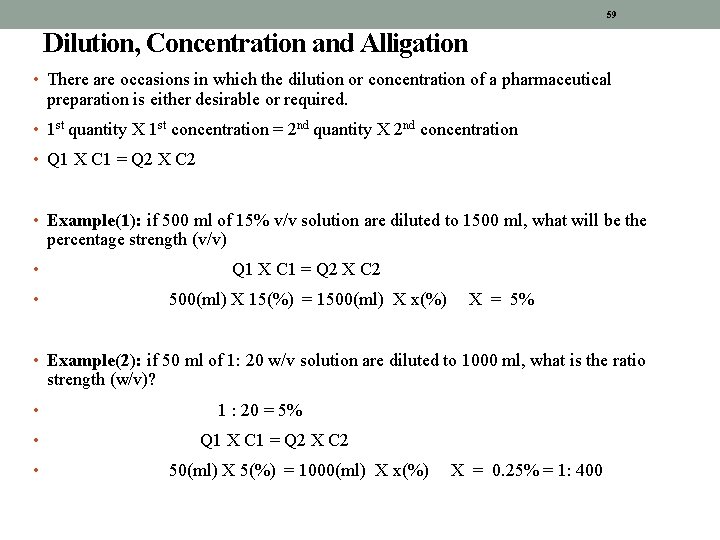
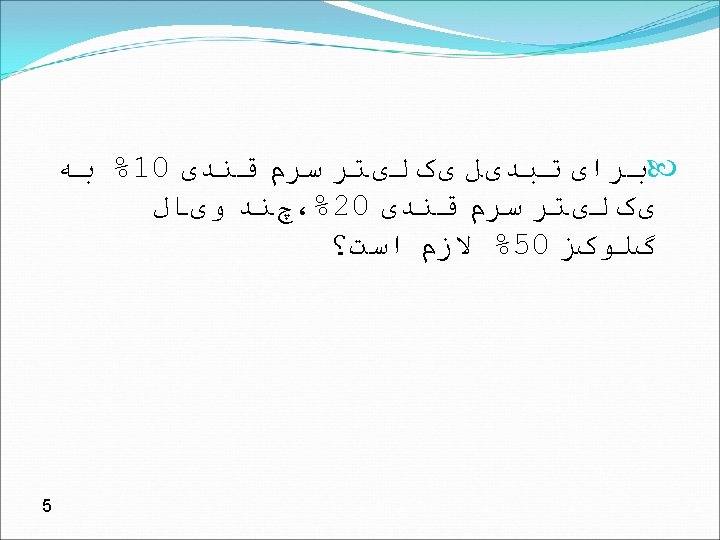
59 Dilution, Concentration and Alligation • There are occasions in which the dilution or concentration of a pharmaceutical preparation is either desirable or required. • 1 st quantity X 1 st concentration = 2 nd quantity X 2 nd concentration • Q 1 X C 1 = Q 2 X C 2 • Example(1): if 500 ml of 15% v/v solution are diluted to 1500 ml, what will be the percentage strength (v/v) • Q 1 X C 1 = Q 2 X C 2 • 500(ml) X 15(%) = 1500(ml) X x(%) X = 5% • Example(2): if 50 ml of 1: 20 w/v solution are diluted to 1000 ml, what is the ratio strength (w/v)? • 1 : 20 = 5% • Q 1 X C 1 = Q 2 X C 2 • 50(ml) X 5(%) = 1000(ml) X x(%) X = 0. 25% = 1: 400
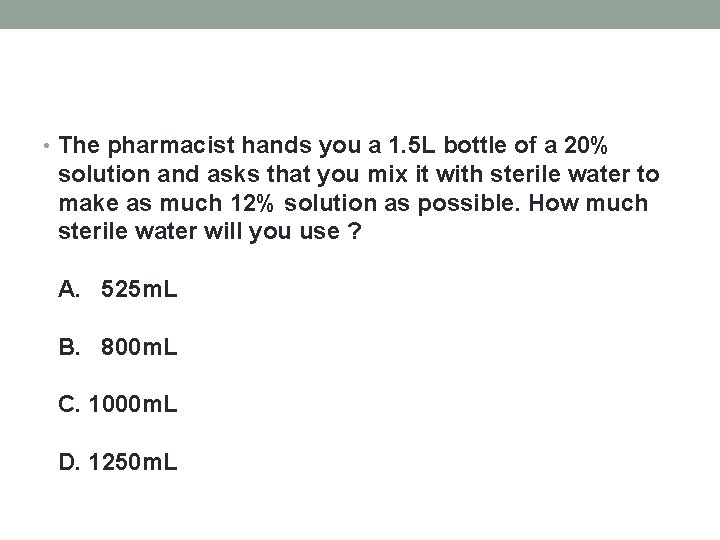
• The pharmacist hands you a 1. 5 L bottle of a 20% solution and asks that you mix it with sterile water to make as much 12% solution as possible. How much sterile water will you use ? A. 525 m. L B. 800 m. L C. 1000 m. L D. 1250 m. L
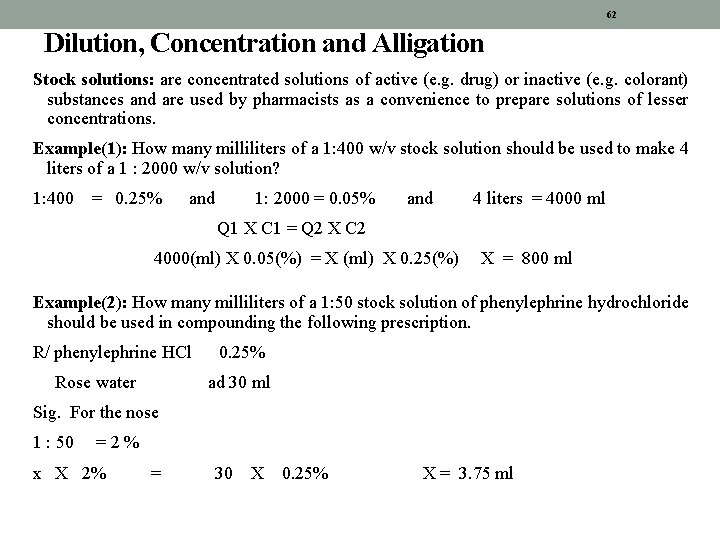
62 Dilution, Concentration and Alligation Stock solutions: are concentrated solutions of active (e. g. drug) or inactive (e. g. colorant) substances and are used by pharmacists as a convenience to prepare solutions of lesser concentrations. Example(1): How many milliliters of a 1: 400 w/v stock solution should be used to make 4 liters of a 1 : 2000 w/v solution? 1: 400 = 0. 25% and 1: 2000 = 0. 05% and 4 liters = 4000 ml Q 1 X C 1 = Q 2 X C 2 4000(ml) X 0. 05(%) = X (ml) X 0. 25(%) X = 800 ml Example(2): How many milliliters of a 1: 50 stock solution of phenylephrine hydrochloride should be used in compounding the following prescription. R/ phenylephrine HCl 0. 25% Rose water ad 30 ml Sig. For the nose 1 : 50 = 2 % x X 2% = 30 X 0. 25% X = 3. 75 ml
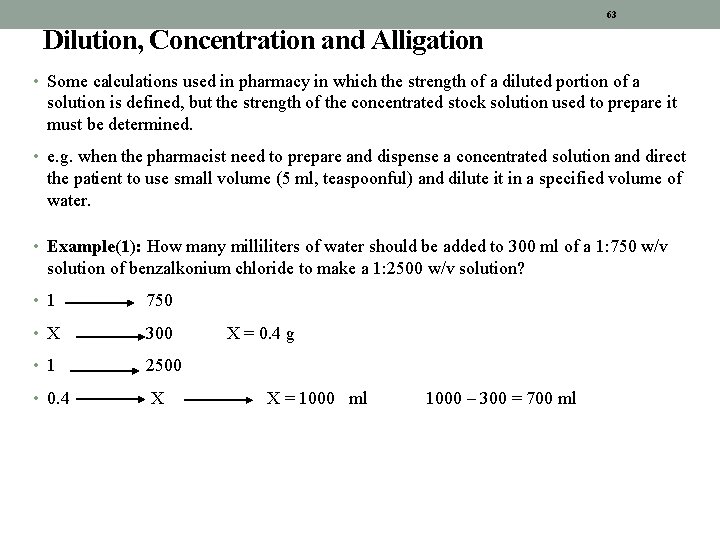
63 Dilution, Concentration and Alligation • Some calculations used in pharmacy in which the strength of a diluted portion of a solution is defined, but the strength of the concentrated stock solution used to prepare it must be determined. • e. g. when the pharmacist need to prepare and dispense a concentrated solution and direct the patient to use small volume (5 ml, teaspoonful) and dilute it in a specified volume of water. • Example(1): How many milliliters of water should be added to 300 ml of a 1: 750 w/v solution of benzalkonium chloride to make a 1: 2500 w/v solution? • 1 750 • X 300 X = 0. 4 g • 1 2500 • 0. 4 X = 1000 ml 1000 – 300 = 700 ml
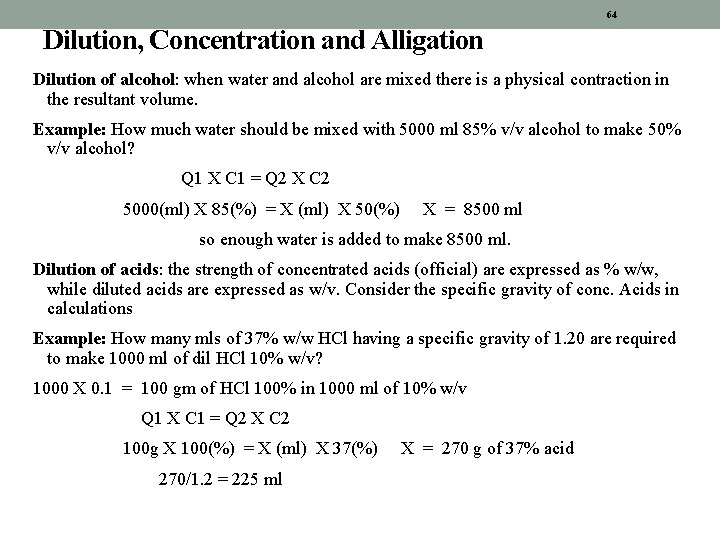
64 Dilution, Concentration and Alligation Dilution of alcohol: when water and alcohol are mixed there is a physical contraction in the resultant volume. Example: How much water should be mixed with 5000 ml 85% v/v alcohol to make 50% v/v alcohol? Q 1 X C 1 = Q 2 X C 2 5000(ml) X 85(%) = X (ml) X 50(%) X = 8500 ml so enough water is added to make 8500 ml. Dilution of acids: the strength of concentrated acids (official) are expressed as % w/w, while diluted acids are expressed as w/v. Consider the specific gravity of conc. Acids in calculations Example: How many mls of 37% w/w HCl having a specific gravity of 1. 20 are required to make 1000 ml of dil HCl 10% w/v? 1000 X 0. 1 = 100 gm of HCl 100% in 1000 ml of 10% w/v Q 1 X C 1 = Q 2 X C 2 100 g X 100(%) = X (ml) X 37(%) X = 270 g of 37% acid 270/1. 2 = 225 ml
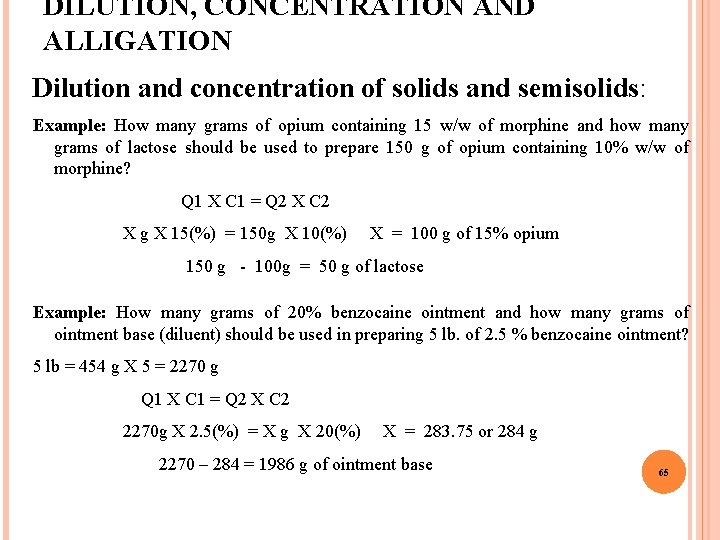
DILUTION, CONCENTRATION AND ALLIGATION Dilution and concentration of solids and semisolids: Example: How many grams of opium containing 15 w/w of morphine and how many grams of lactose should be used to prepare 150 g of opium containing 10% w/w of morphine? Q 1 X C 1 = Q 2 X C 2 X g X 15(%) = 150 g X 10(%) X = 100 g of 15% opium 150 g - 100 g = 50 g of lactose Example: How many grams of 20% benzocaine ointment and how many grams of ointment base (diluent) should be used in preparing 5 lb. of 2. 5 % benzocaine ointment? 5 lb = 454 g X 5 = 2270 g Q 1 X C 1 = Q 2 X C 2 2270 g X 2. 5(%) = X g X 20(%) X = 283. 75 or 284 g 2270 – 284 = 1986 g of ointment base 65
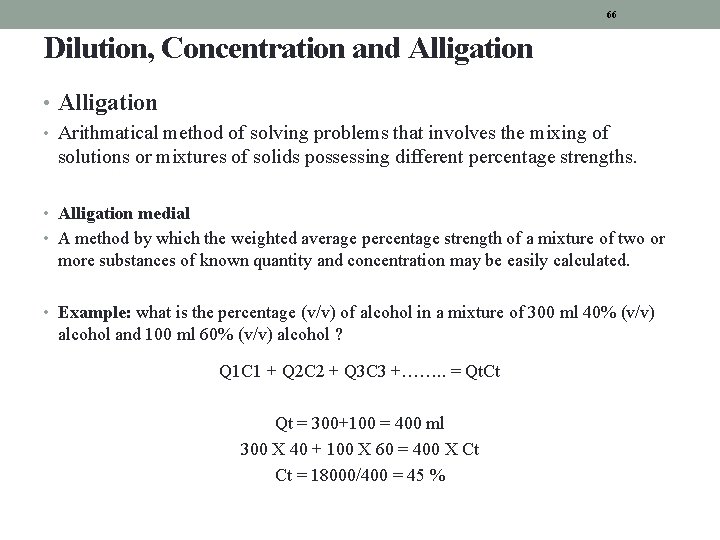
66 Dilution, Concentration and Alligation • Arithmatical method of solving problems that involves the mixing of solutions or mixtures of solids possessing different percentage strengths. • Alligation medial • A method by which the weighted average percentage strength of a mixture of two or more substances of known quantity and concentration may be easily calculated. • Example: what is the percentage (v/v) of alcohol in a mixture of 300 ml 40% (v/v) alcohol and 100 ml 60% (v/v) alcohol ? Q 1 C 1 + Q 2 C 2 + Q 3 C 3 +……. . = Qt. Ct Qt = 300+100 = 400 ml 300 X 40 + 100 X 60 = 400 X Ct Ct = 18000/400 = 45 %
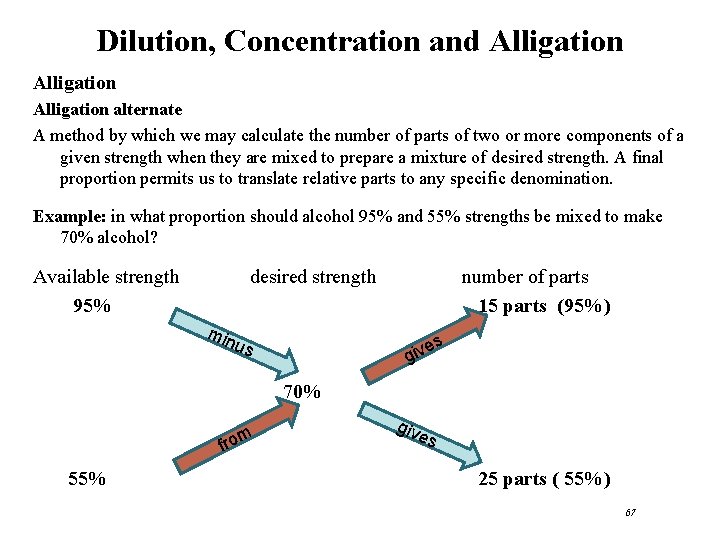
Dilution, Concentration and Alligation alternate A method by which we may calculate the number of parts of two or more components of a given strength when they are mixed to prepare a mixture of desired strength. A final proportion permits us to translate relative parts to any specific denomination. Example: in what proportion should alcohol 95% and 55% strengths be mixed to make 70% alcohol? Available strength desired strength number of parts 95% 15 parts (95%) mi n us es giv 70% f ro m giv es 55% 25 parts ( 55%) 67
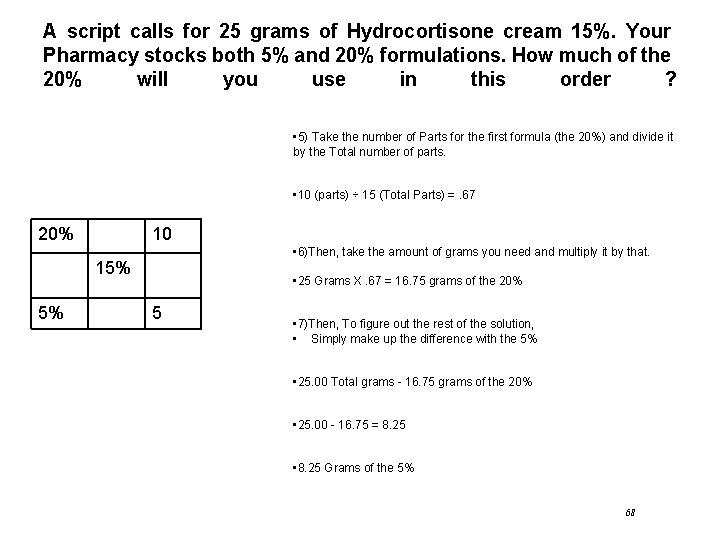
A script calls for 25 grams of Hydrocortisone cream 15%. Your Pharmacy stocks both 5% and 20% formulations. How much of the 20% will you use in this order ? • 5) Take the number of Parts for the first formula (the 20%) and divide it by the Total number of parts. • 10 (parts) ÷ 15 (Total Parts) =. 67 20% 10 • 6)Then, take the amount of grams you need and multiply it by that. 15% 5% • 25 Grams X. 67 = 16. 75 grams of the 20% 5 • 7)Then, To figure out the rest of the solution, • Simply make up the difference with the 5% • 25. 00 Total grams - 16. 75 grams of the 20% • 25. 00 - 16. 75 = 8. 25 • 8. 25 Grams of the 5% 68
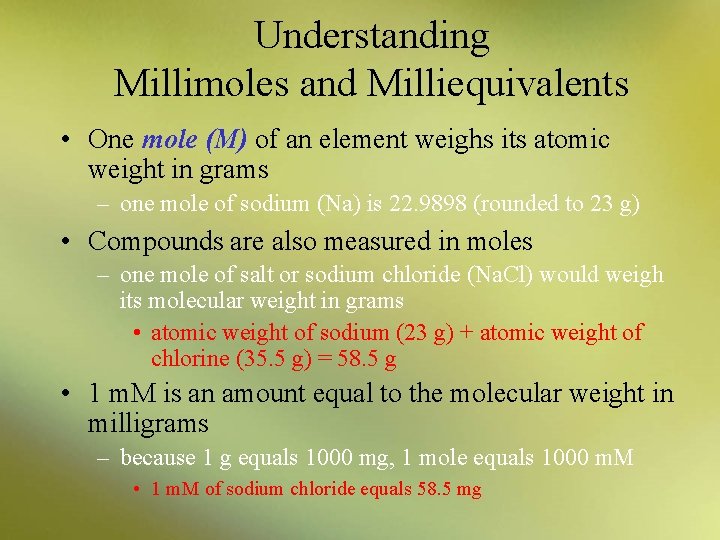
Understanding Millimoles and Milliequivalents • One mole (M) of an element weighs its atomic weight in grams – one mole of sodium (Na) is 22. 9898 (rounded to 23 g) • Compounds are also measured in moles – one mole of salt or sodium chloride (Na. Cl) would weigh its molecular weight in grams • atomic weight of sodium (23 g) + atomic weight of chlorine (35. 5 g) = 58. 5 g • 1 m. M is an amount equal to the molecular weight in milligrams – because 1 g equals 1000 mg, 1 mole equals 1000 m. M • 1 m. M of sodium chloride equals 58. 5 mg
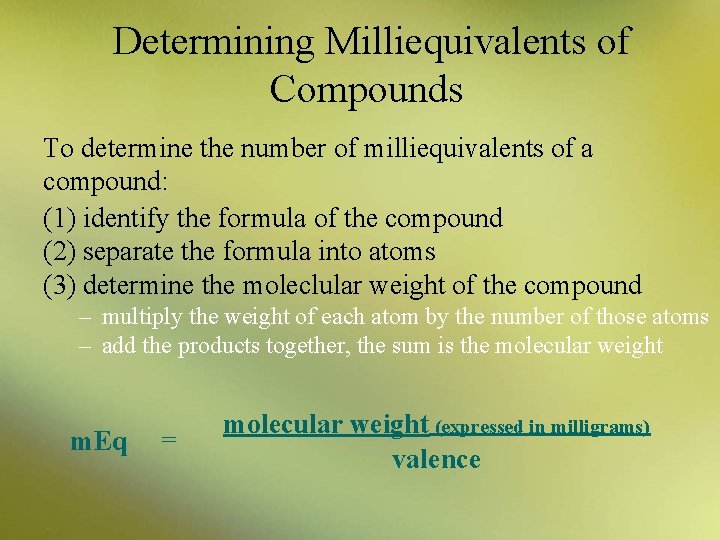
Determining Milliequivalents of Compounds To determine the number of milliequivalents of a compound: (1) identify the formula of the compound (2) separate the formula into atoms (3) determine the moleclular weight of the compound – multiply the weight of each atom by the number of those atoms – add the products together, the sum is the molecular weight m. Eq = molecular weight (expressed in milligrams) valence
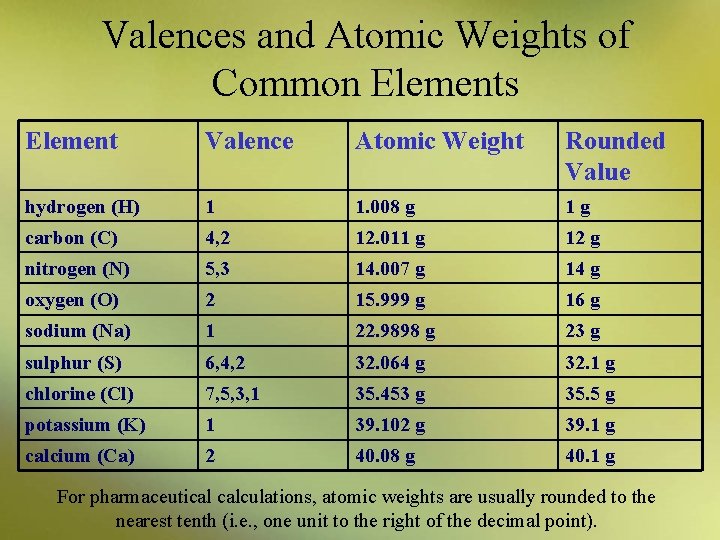
Valences and Atomic Weights of Common Elements Element Valence Atomic Weight Rounded Value hydrogen (H) 1 1. 008 g 1 g carbon (C) 4, 2 12. 011 g 12 g nitrogen (N) 5, 3 14. 007 g 14 g oxygen (O) 2 15. 999 g 16 g sodium (Na) 1 22. 9898 g 23 g sulphur (S) 6, 4, 2 32. 064 g 32. 1 g chlorine (Cl) 7, 5, 3, 1 35. 453 g 35. 5 g potassium (K) 1 39. 102 g 39. 1 g calcium (Ca) 2 40. 08 g 40. 1 g For pharmaceutical calculations, atomic weights are usually rounded to the nearest tenth (i. e. , one unit to the right of the decimal point).
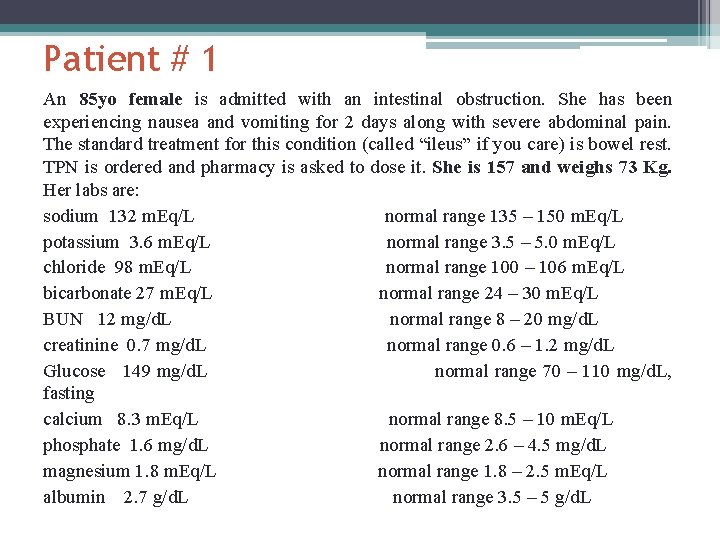
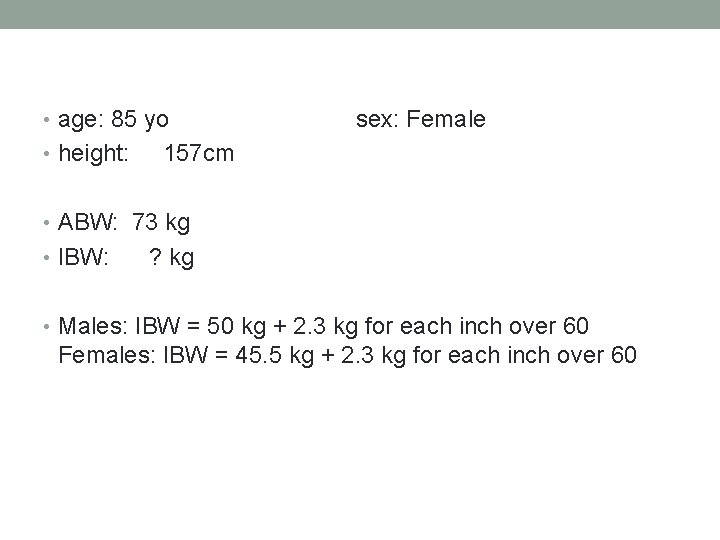
Patient # 1 An 85 yo female is admitted with an intestinal obstruction. She has been experiencing nausea and vomiting for 2 days along with severe abdominal pain. The standard treatment for this condition (called “ileus” if you care) is bowel rest. TPN is ordered and pharmacy is asked to dose it. She is 157 and weighs 73 Kg. Her labs are: sodium 132 m. Eq/L normal range 135 – 150 m. Eq/L potassium 3. 6 m. Eq/L normal range 3. 5 – 5. 0 m. Eq/L chloride 98 m. Eq/L normal range 100 – 106 m. Eq/L bicarbonate 27 m. Eq/L normal range 24 – 30 m. Eq/L BUN 12 mg/d. L normal range 8 – 20 mg/d. L creatinine 0. 7 mg/d. L normal range 0. 6 – 1. 2 mg/d. L Glucose 149 mg/d. L normal range 70 – 110 mg/d. L, fasting calcium 8. 3 m. Eq/L normal range 8. 5 – 10 m. Eq/L phosphate 1. 6 mg/d. L normal range 2. 6 – 4. 5 mg/d. L magnesium 1. 8 m. Eq/L normal range 1. 8 – 2. 5 m. Eq/L albumin 2. 7 g/d. L normal range 3. 5 – 5 g/d. L
• age: 85 yo • height: sex: Female 157 cm • ABW: 73 kg • IBW: ? kg • Males: IBW = 50 kg + 2. 3 kg for each inch over 60 Females: IBW = 45. 5 kg + 2. 3 kg for each inch over 60
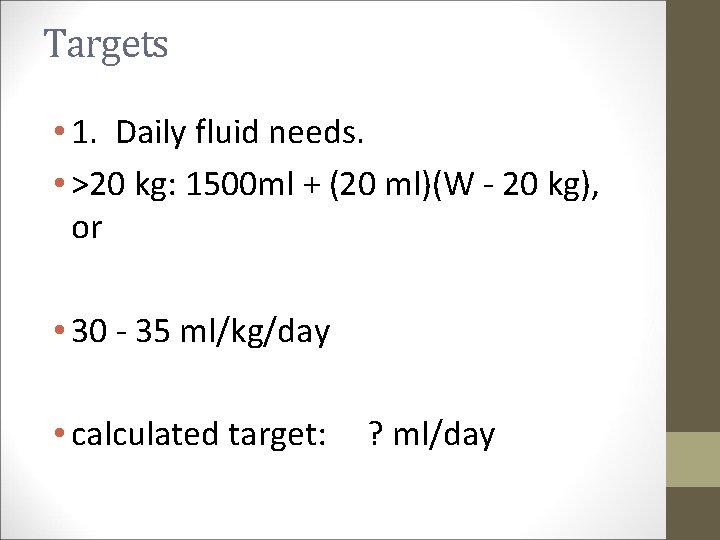
Targets • 1. Daily fluid needs. • >20 kg: 1500 ml + (20 ml)(W - 20 kg), or • 30 - 35 ml/kg/day • calculated target: ? ml/day
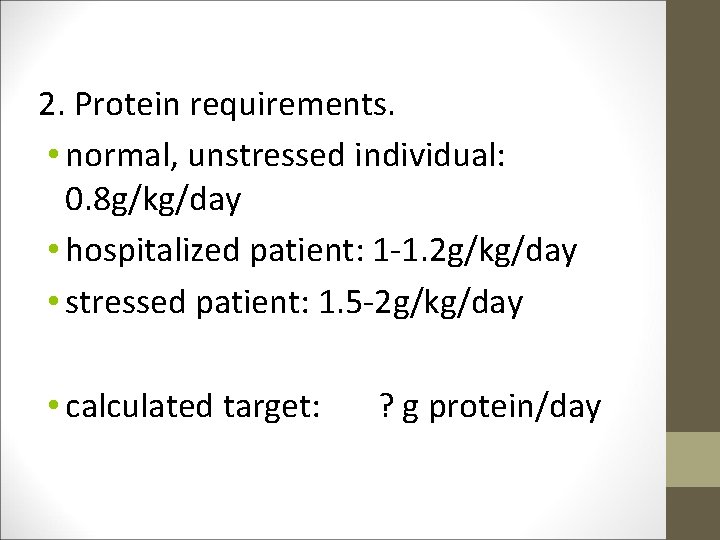
2. Protein requirements. • normal, unstressed individual: 0. 8 g/kg/day • hospitalized patient: 1 -1. 2 g/kg/day • stressed patient: 1. 5 -2 g/kg/day • calculated target: ? g protein/day
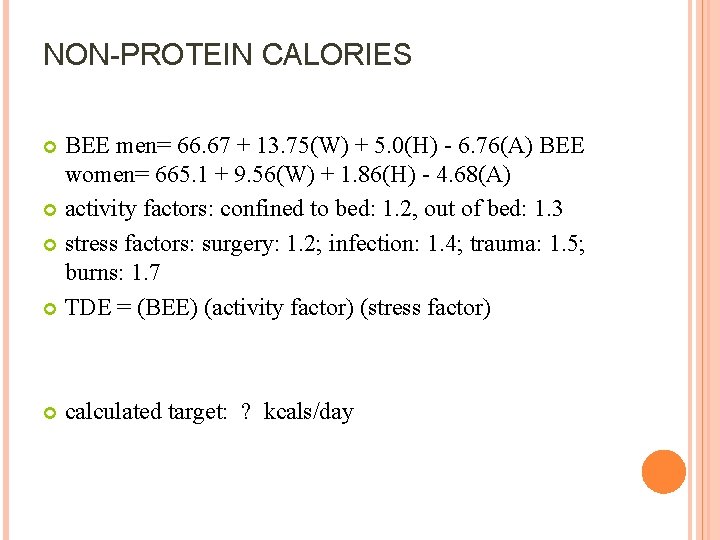
NON-PROTEIN CALORIES BEE men= 66. 67 + 13. 75(W) + 5. 0(H) - 6. 76(A) BEE women= 665. 1 + 9. 56(W) + 1. 86(H) - 4. 68(A) activity factors: confined to bed: 1. 2, out of bed: 1. 3 stress factors: surgery: 1. 2; infection: 1. 4; trauma: 1. 5; burns: 1. 7 TDE = (BEE) (activity factor) (stress factor) calculated target: ? kcals/day
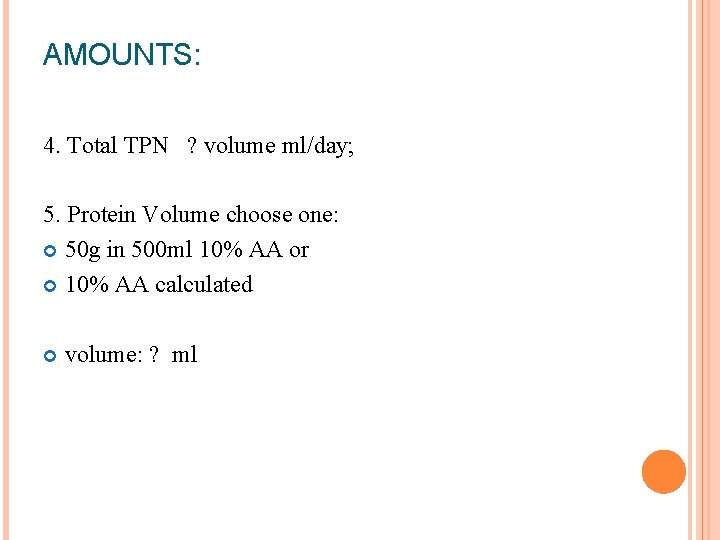
AMOUNTS: 4. Total TPN ? volume ml/day; 5. Protein Volume choose one: 50 g in 500 ml 10% AA or 10% AA calculated volume: ? ml
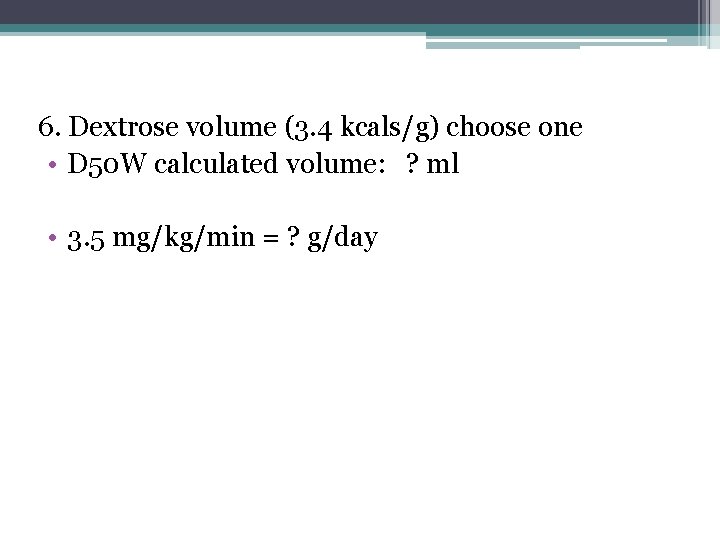
6. Dextrose volume (3. 4 kcals/g) choose one • D 50 W calculated volume: ? ml • 3. 5 mg/kg/min = ? g/day
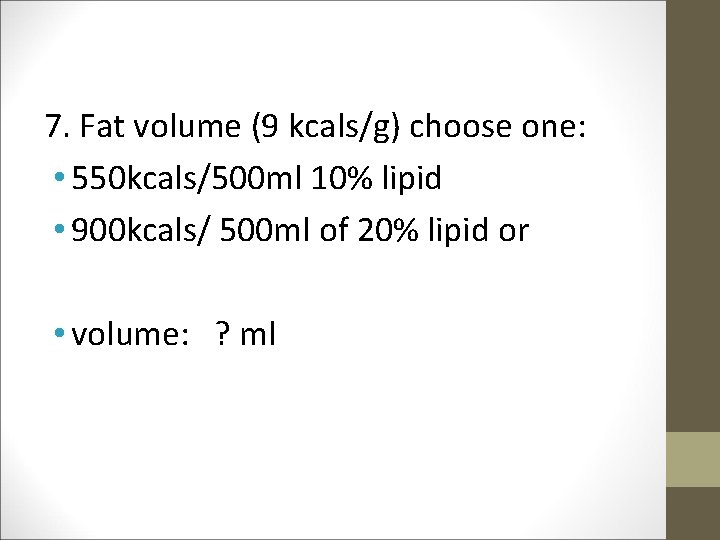
7. Fat volume (9 kcals/g) choose one: • 550 kcals/500 ml 10% lipid • 900 kcals/ 500 ml of 20% lipid or • volume: ? ml
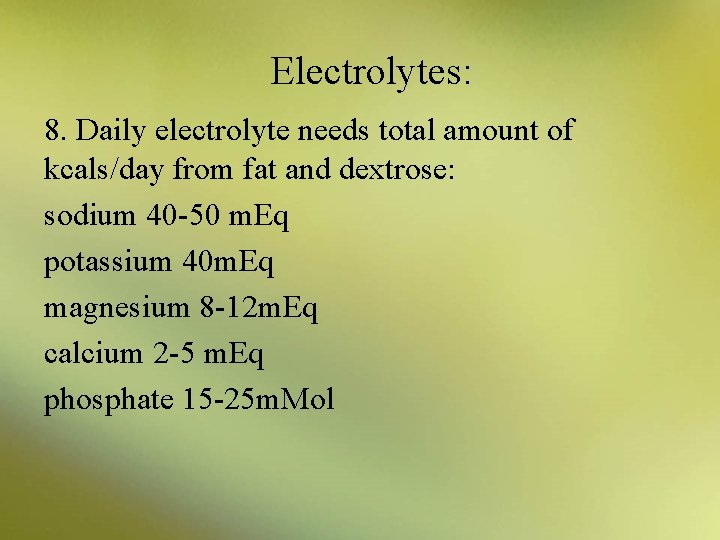
Electrolytes: 8. Daily electrolyte needs total amount of kcals/day from fat and dextrose: sodium 40 -50 m. Eq potassium 40 m. Eq magnesium 8 -12 m. Eq calcium 2 -5 m. Eq phosphate 15 -25 m. Mol
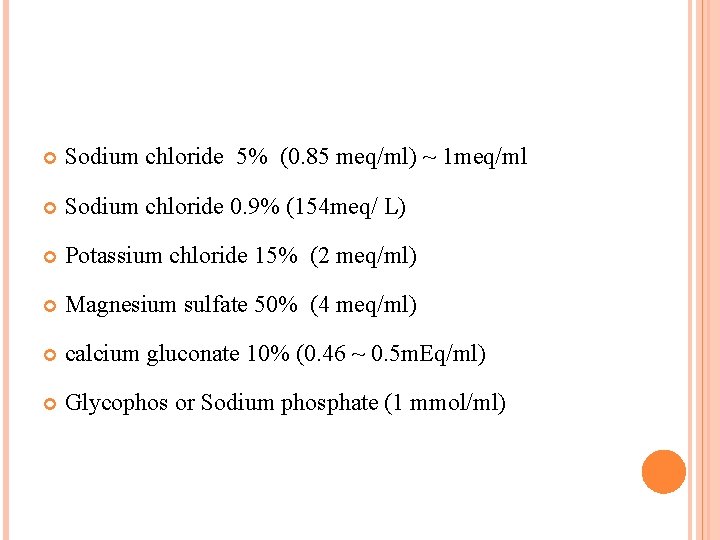
Sodium chloride 5% (0. 85 meq/ml) ~ 1 meq/ml Sodium chloride 0. 9% (154 meq/ L) Potassium chloride 15% (2 meq/ml) Magnesium sulfate 50% (4 meq/ml) calcium gluconate 10% (0. 46 ~ 0. 5 m. Eq/ml) Glycophos or Sodium phosphate (1 mmol/ml)
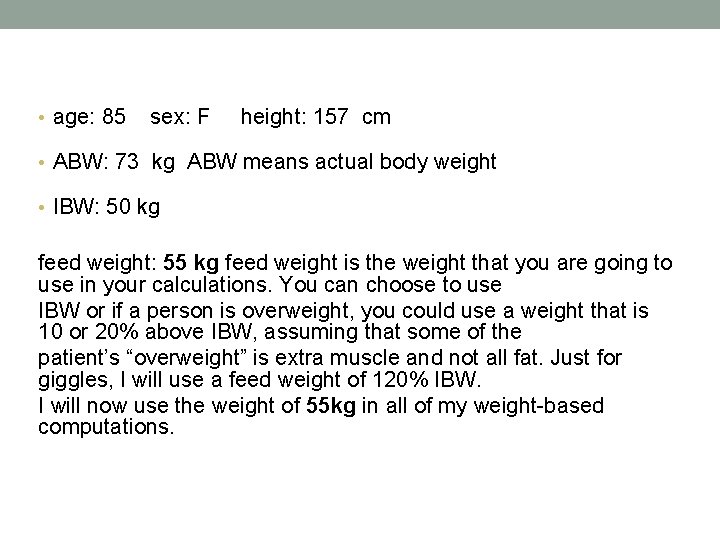
• age: 85 sex: F height: 157 cm • ABW: 73 kg ABW means actual body weight • IBW: 50 kg feed weight: 55 kg feed weight is the weight that you are going to use in your calculations. You can choose to use IBW or if a person is overweight, you could use a weight that is 10 or 20% above IBW, assuming that some of the patient’s “overweight” is extra muscle and not all fat. Just for giggles, I will use a feed weight of 120% IBW. I will now use the weight of 55 kg in all of my weight-based computations.
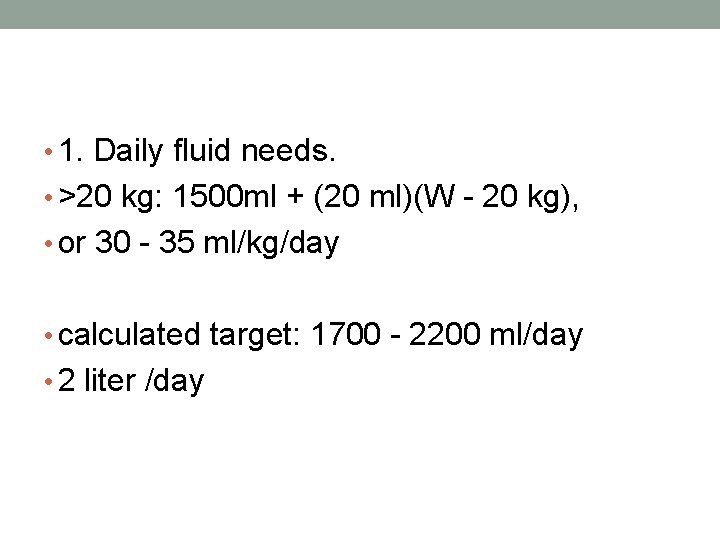
• 1. Daily fluid needs. • >20 kg: 1500 ml + (20 ml)(W - 20 kg), • or 30 - 35 ml/kg/day • calculated target: 1700 - 2200 ml/day • 2 liter /day
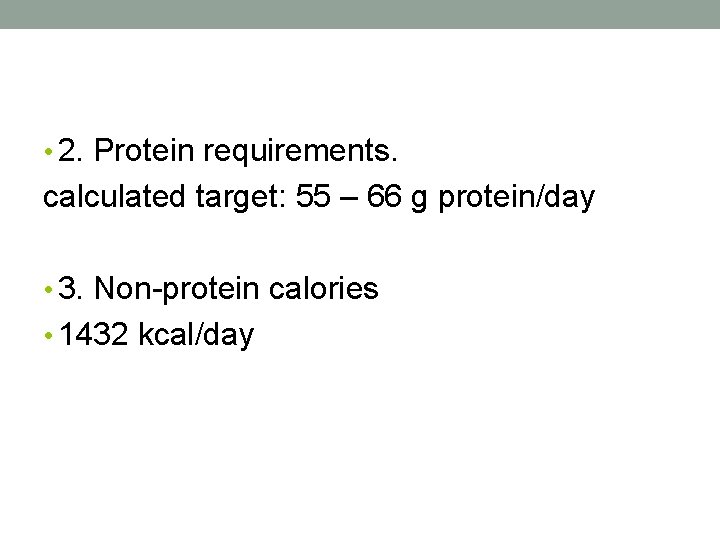
• 2. Protein requirements. calculated target: 55 – 66 g protein/day • 3. Non-protein calories • 1432 kcal/day
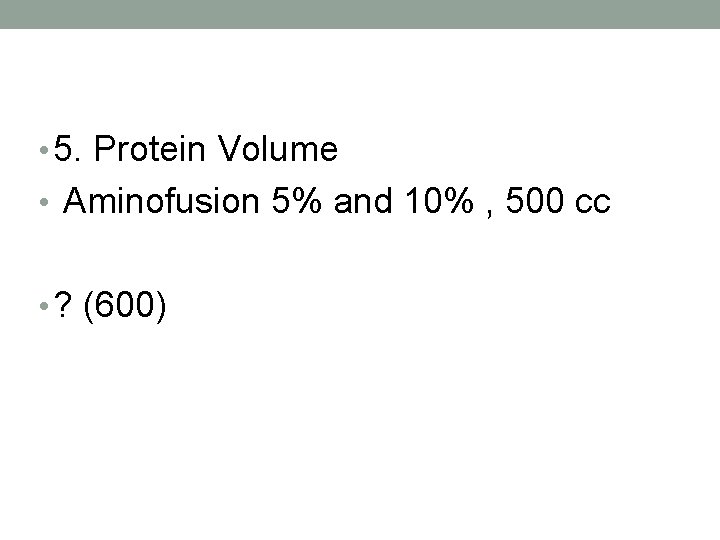
• 5. Protein Volume • Aminofusion 5% and 10% , 500 cc • ? (600)
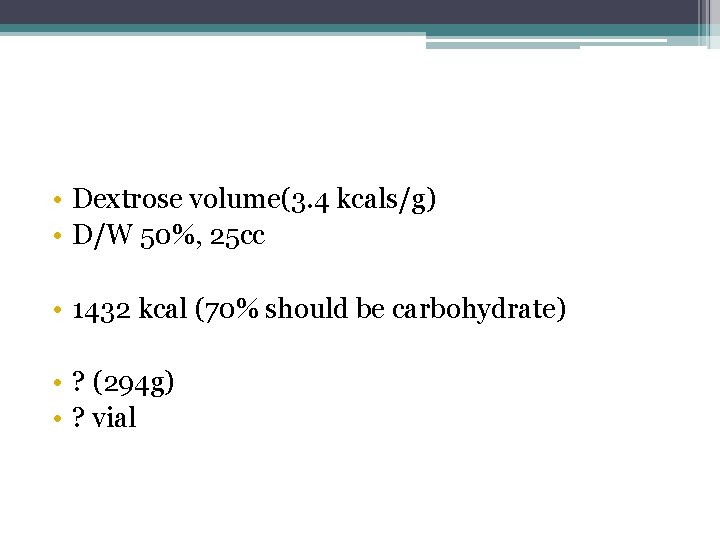
• Dextrose volume(3. 4 kcals/g) • D/W 50%, 25 cc • 1432 kcal (70% should be carbohydrate) • ? (294 g) • ? vial
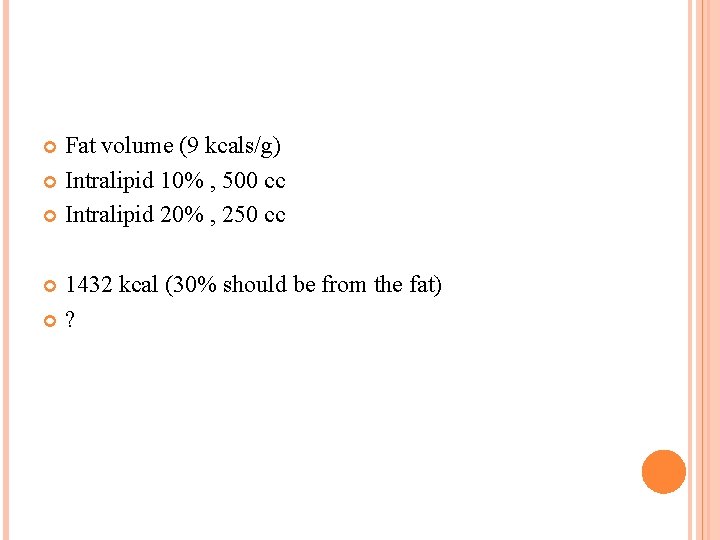
Fat volume (9 kcals/g) Intralipid 10% , 500 cc Intralipid 20% , 250 cc 1432 kcal (30% should be from the fat) ?
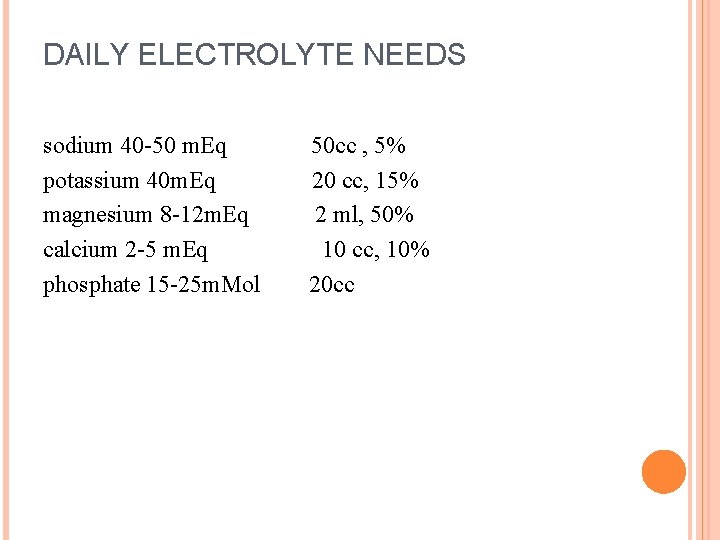
DAILY ELECTROLYTE NEEDS sodium 40 -50 m. Eq 50 cc , 5% potassium 40 m. Eq 20 cc, 15% magnesium 8 -12 m. Eq 2 ml, 50% calcium 2 -5 m. Eq 10 cc, 10% phosphate 15 -25 m. Mol 20 cc
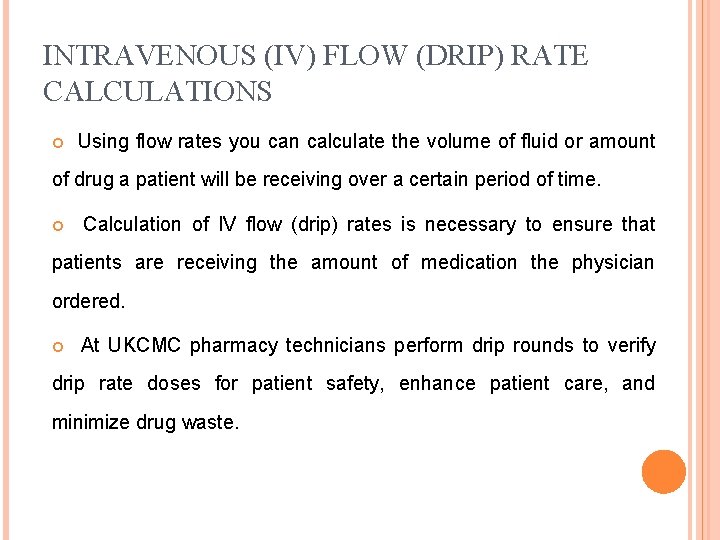
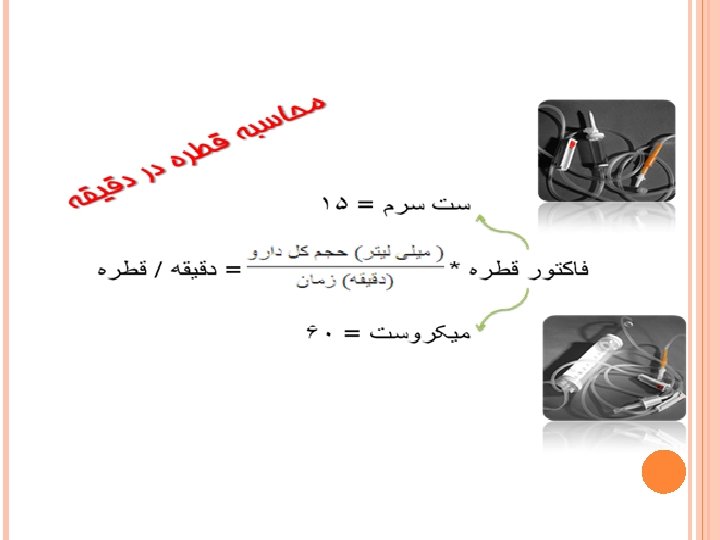
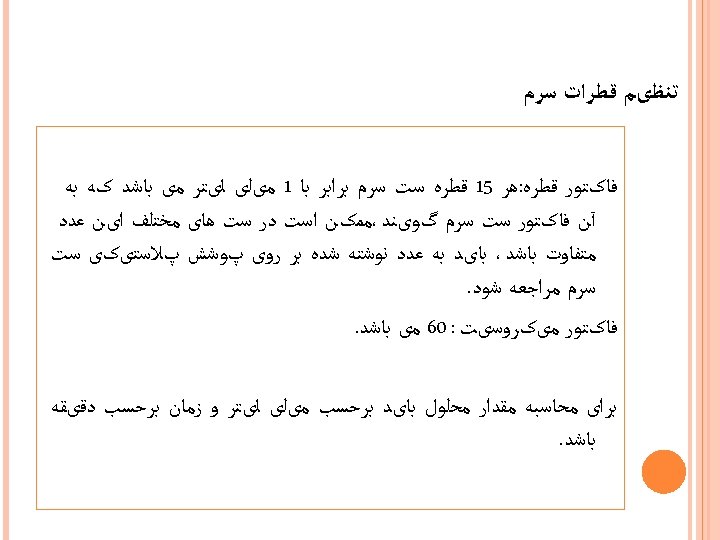
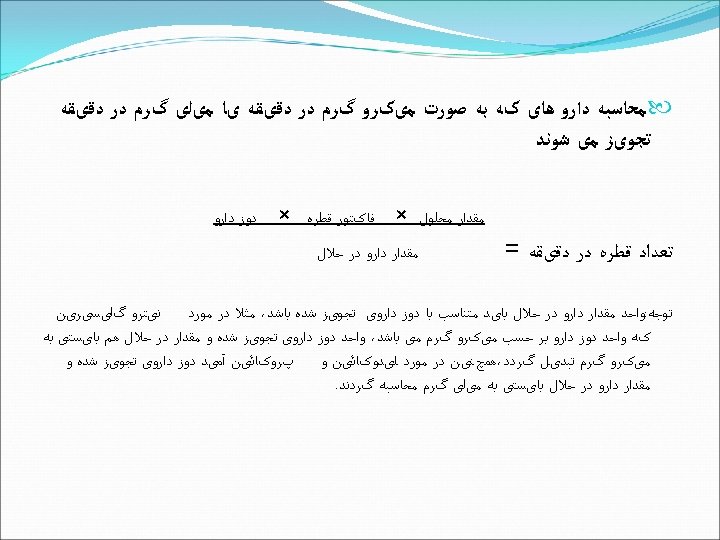
INTRAVENOUS (IV) FLOW (DRIP) RATE CALCULATIONS Using flow rates you can calculate the volume of fluid or amount of drug a patient will be receiving over a certain period of time. Calculation of IV flow (drip) rates is necessary to ensure that patients are receiving the amount of medication the physician ordered. At UKCMC pharmacy technicians perform drip rounds to verify drip rate doses for patient safety, enhance patient care, and minimize drug waste.
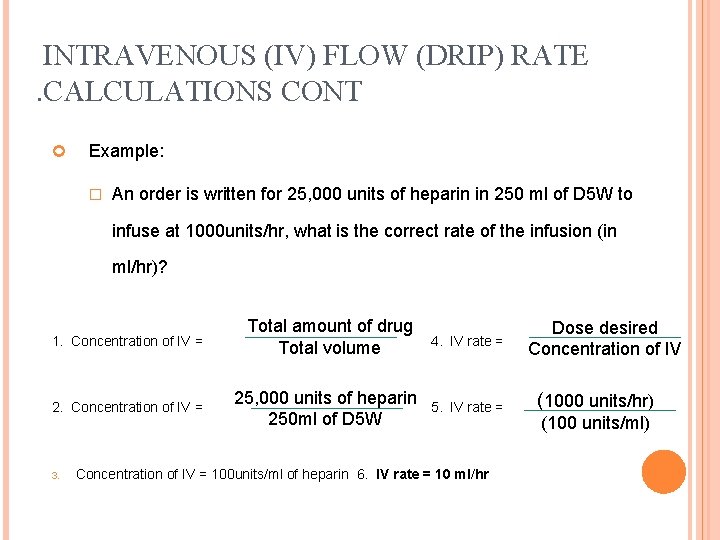
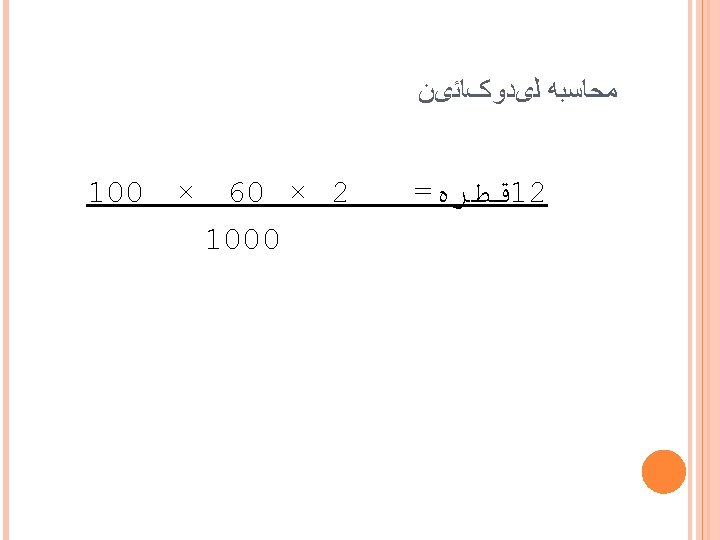
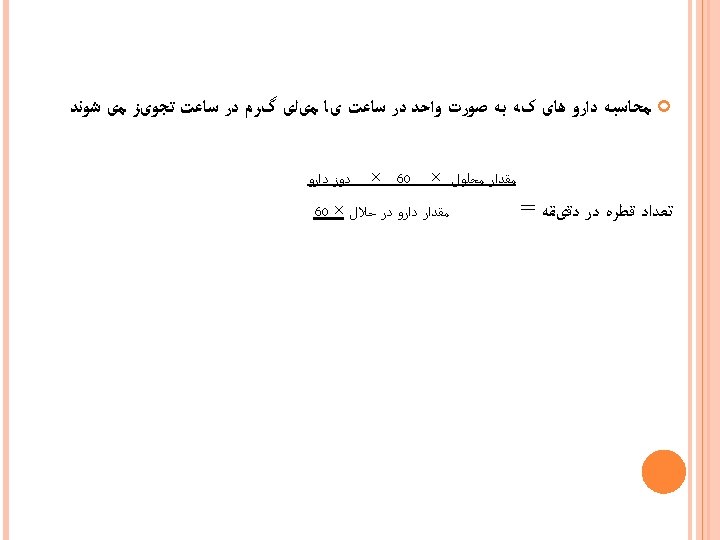
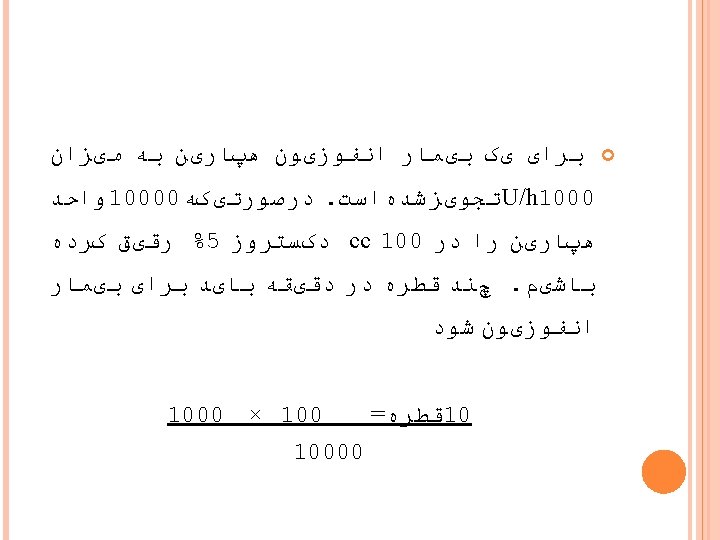
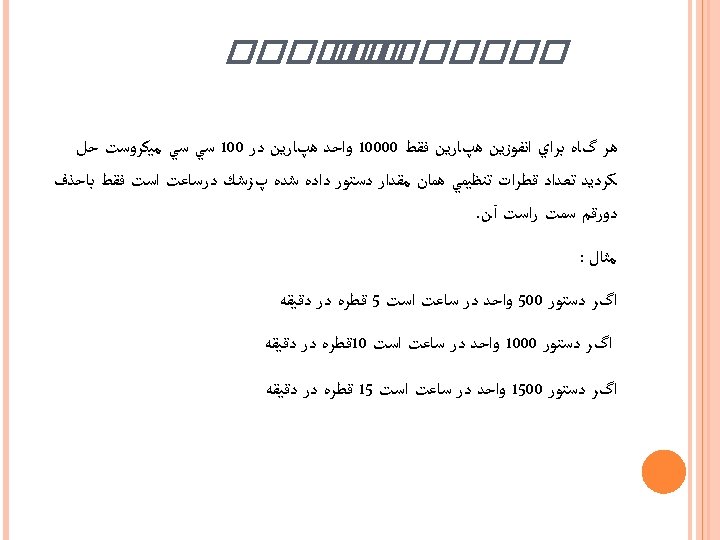
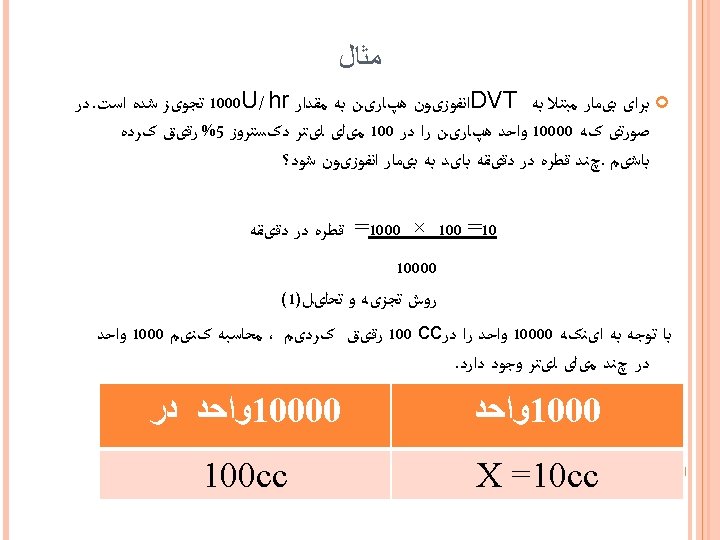
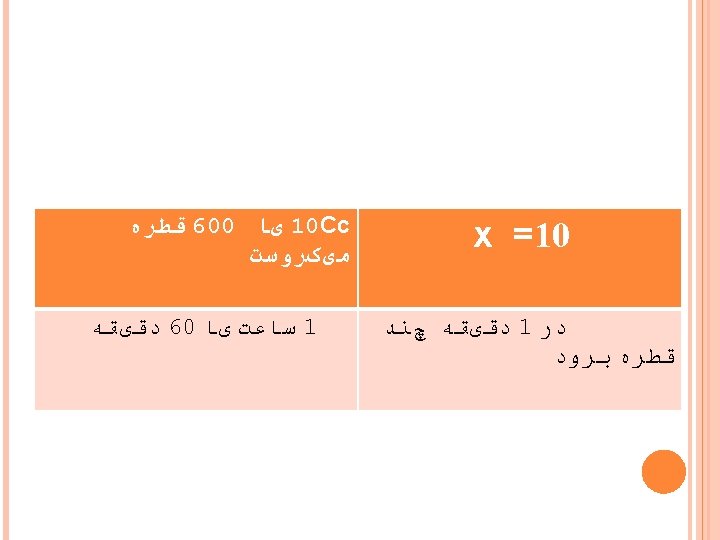
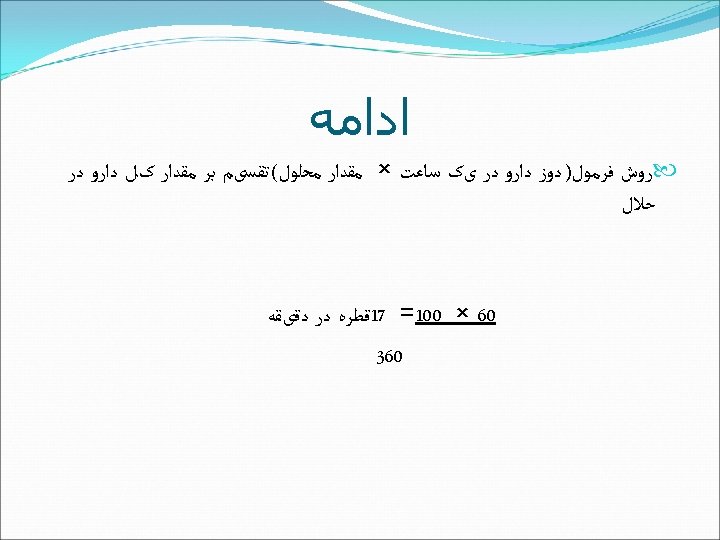
INTRAVENOUS (IV) FLOW (DRIP) RATE. CALCULATIONS CONT Example: � An order is written for 25, 000 units of heparin in 250 ml of D 5 W to infuse at 1000 units/hr, what is the correct rate of the infusion (in ml/hr)? 1. Concentration of IV = Total amount of drug Total volume 4. IV rate = 2. Concentration of IV = 25, 000 units of heparin 250 ml of D 5 W 5. IV rate = 3. Concentration of IV = 100 units/ml of heparin 6. IV rate = 10 ml/hr Dose desired Concentration of IV (1000 units/hr) (100 units/ml)
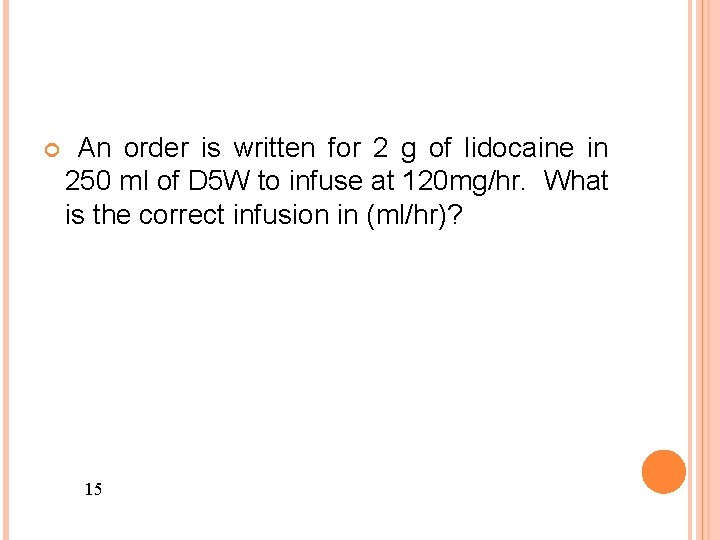
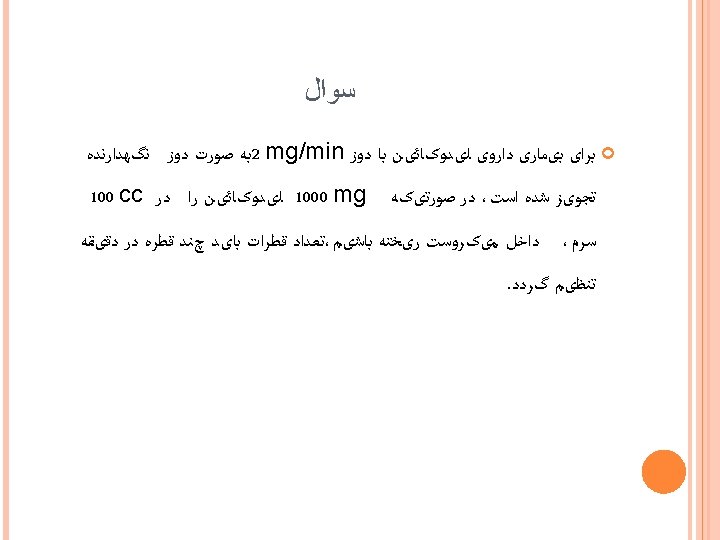
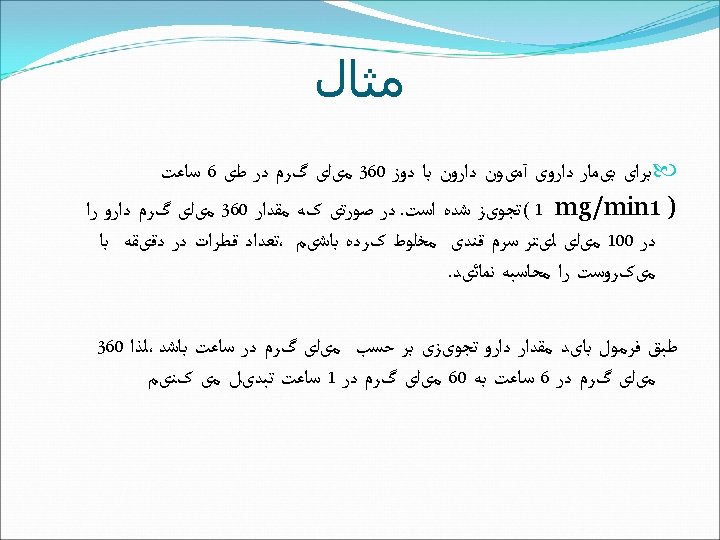
An order is written for 2 g of lidocaine in 250 ml of D 5 W to infuse at 120 mg/hr. What is the correct infusion in (ml/hr)? 15
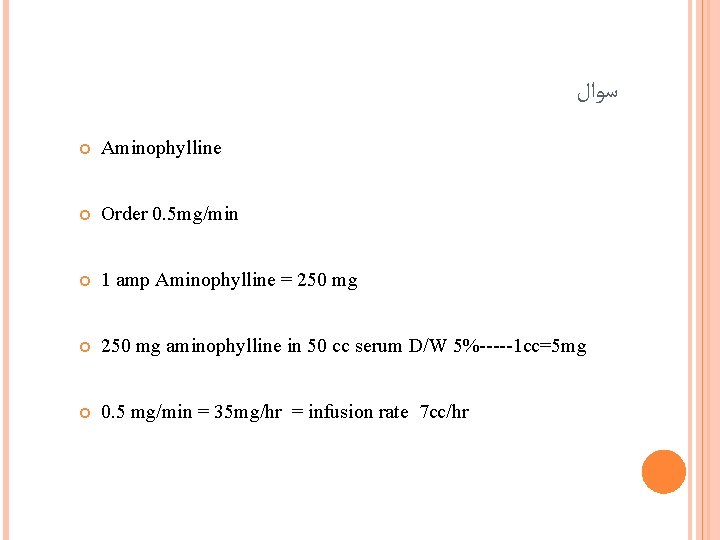
ﺳﻮﺍﻝ Aminophylline Order 0. 5 mg/min 1 amp Aminophylline = 250 mg aminophylline in 50 cc serum D/W 5%-----1 cc=5 mg 0. 5 mg/min = 35 mg/hr = infusion rate 7 cc/hr
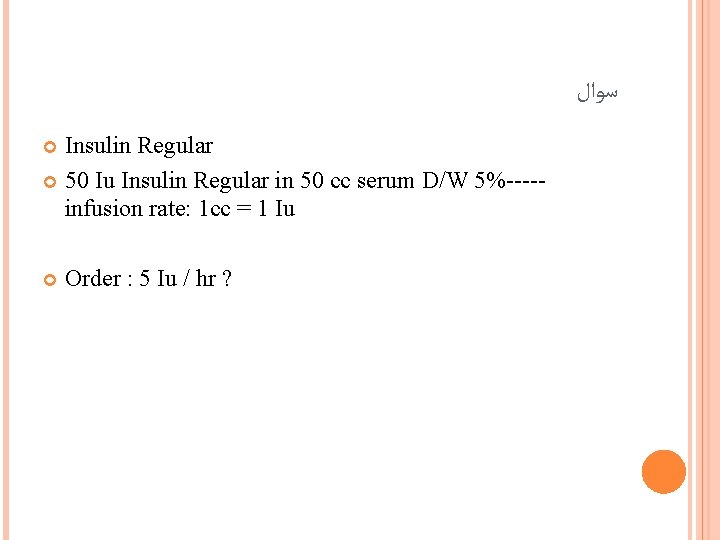
ﺳﻮﺍﻝ Insulin Regular 50 Iu Insulin Regular in 50 cc serum D/W 5%----infusion rate: 1 cc = 1 Iu Order : 5 Iu / hr ?
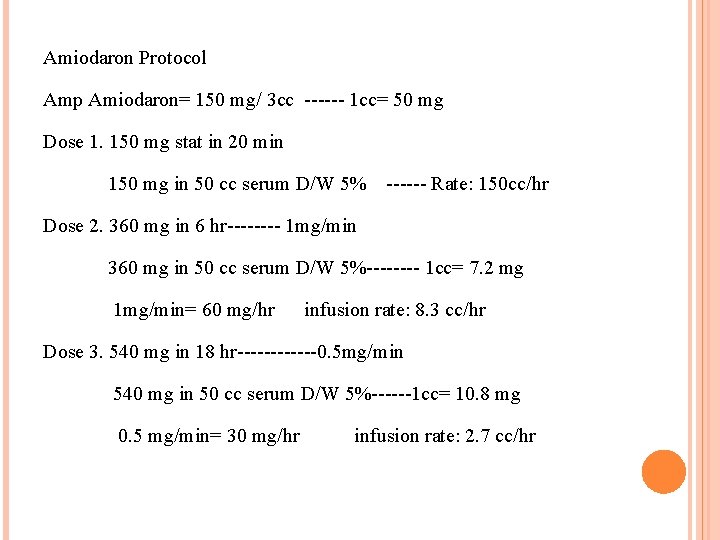
Amiodaron Protocol Amp Amiodaron= 150 mg/ 3 cc ------ 1 cc= 50 mg Dose 1. 150 mg stat in 20 min 150 mg in 50 cc serum D/W 5% ------ Rate: 150 cc/hr Dose 2. 360 mg in 6 hr---- 1 mg/min 360 mg in 50 cc serum D/W 5%---- 1 cc= 7. 2 mg 1 mg/min= 60 mg/hr infusion rate: 8. 3 cc/hr Dose 3. 540 mg in 18 hr------0. 5 mg/min 540 mg in 50 cc serum D/W 5%------1 cc= 10. 8 mg 0. 5 mg/min= 30 mg/hr infusion rate: 2. 7 cc/hr
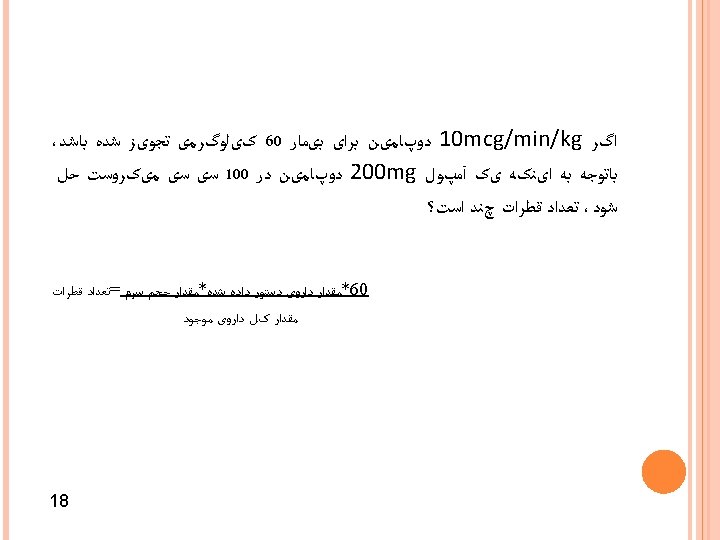
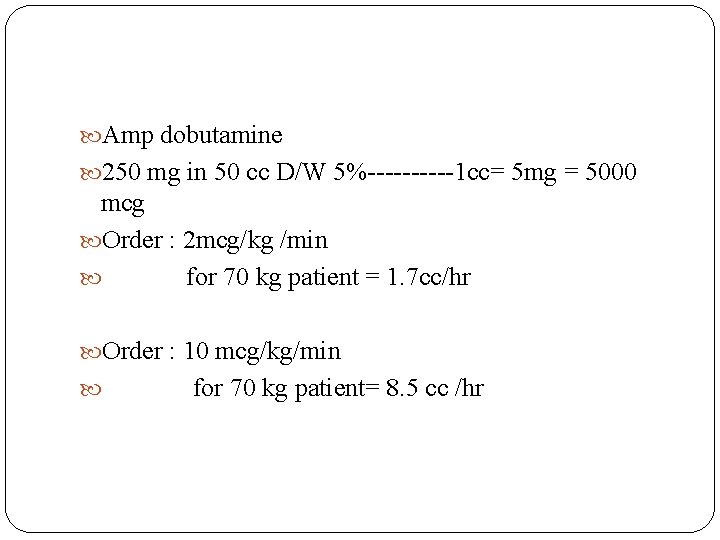
Amp dobutamine 250 mg in 50 cc D/W 5%-----1 cc= 5 mg = 5000 mcg Order : 2 mcg/kg /min for 70 kg patient = 1. 7 cc/hr Order : 10 mcg/kg/min for 70 kg patient= 8. 5 cc /hr