
In the name of God Role of RET


- Slides: 33
In the name of God
Role of RET proto-oncogene in management of patients with MTC and their relatives Layegh p. assistant professor of endocrinology & metabolism Mashhad University of Medical Sciences( MUMS)
What is RET proto-oncogene? �The RET gene was first identified in 1985 by transfection of NIH/3 T 3 fibroblast cells with human lymphoma DNA. The transformed NIH/3 T 3 cells proved to harbor a fusion gene , which was absent in the original tumor. this fusion gene contained part of a gene that encoded a tyrosine kinase domain, and that gene from which the tyrosine kinase domain was part was thereafter called RET. �RET is localized on chromosome 10 and contains 21 exons.
�REarranged during Transfection (RET) gene encodes a receptor tyrosin kinase that has an important role in many essential processes of cells. �Gain of function mutation in RET stimulates proliferation and blocks apoptosis.
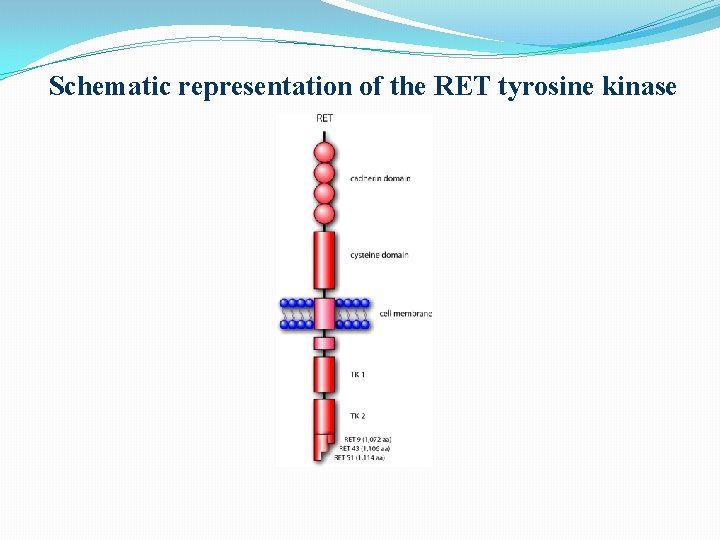
Schematic representation of the RET tyrosine kinase
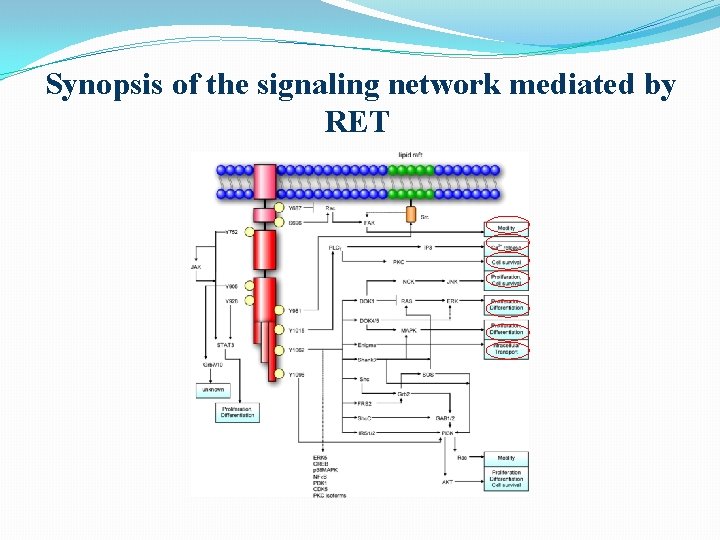
Synopsis of the signaling network mediated by RET
Case presentation �A 55 year-old woman presented with a neck mass from 2 years ago. There was a 45 mm hypoechoic nodule in R. thyroid lobe and also a 12 mm hypoechoic nodule in L. lobe. FNA was done and reported as follicular neoplasm(FN).
Case presentation (cont. ) �Based on cytology and the size more than 4 cm, total thyroidectomy (TTX) was performed. Bilateral medullary thyroid carcinoma(MTC) was reported by pathologist. �Size of nodule in R. lobe was 4*3. 2*1. 3 and 0. 3*1 cm in L. lobe. there was angiolymphatic and perineural invasion and extrathyroidal adipose tissue was involved.
Case presentation(cont. ) �Metastasis to lymph nodes with extra nodal extension was also seen. (8 of 12 were involved) �IHC staining comfirmed diagnosis of MTC
�All recommendations in management of this patient are based on ATA guidline 2015 untile mentioned otherwise
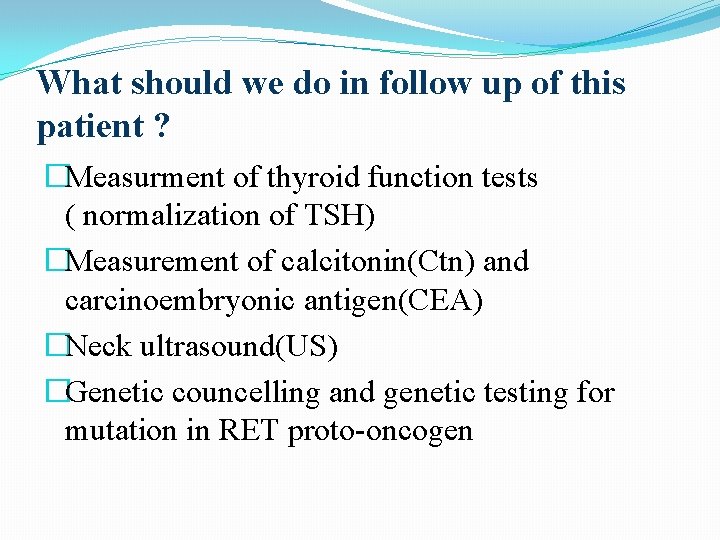
What should we do in follow up of this patient ? �Measurment of thyroid function tests ( normalization of TSH) �Measurement of calcitonin(Ctn) and carcinoembryonic antigen(CEA) �Neck ultrasound(US) �Genetic councelling and genetic testing for mutation in RET proto-oncogen
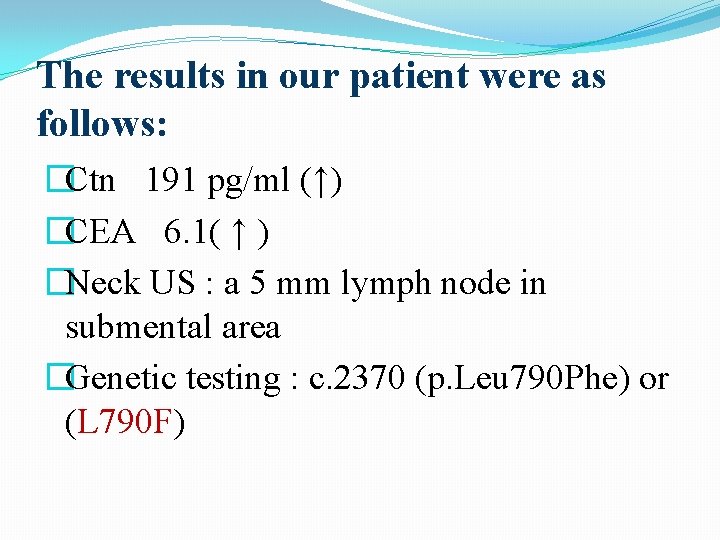
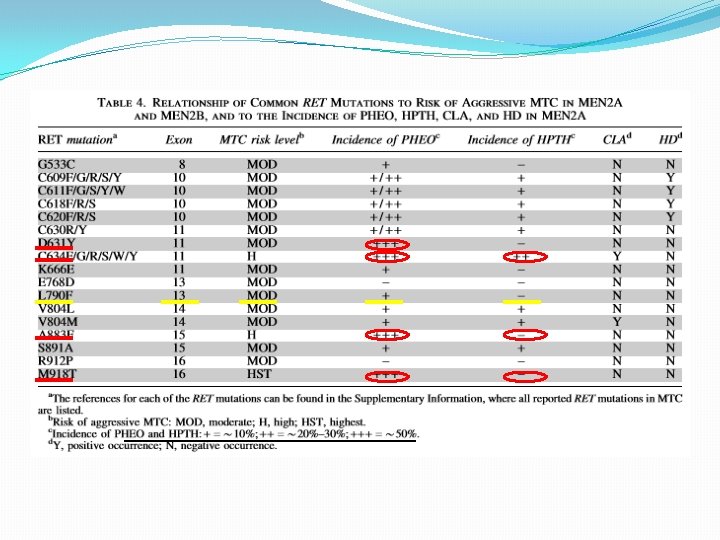
The results in our patient were as follows: �Ctn 191 pg/ml (↑) �CEA 6. 1( ↑ ) �Neck US : a 5 mm lymph node in submental area �Genetic testing : c. 2370 (p. Leu 790 Phe) or (L 790 F)
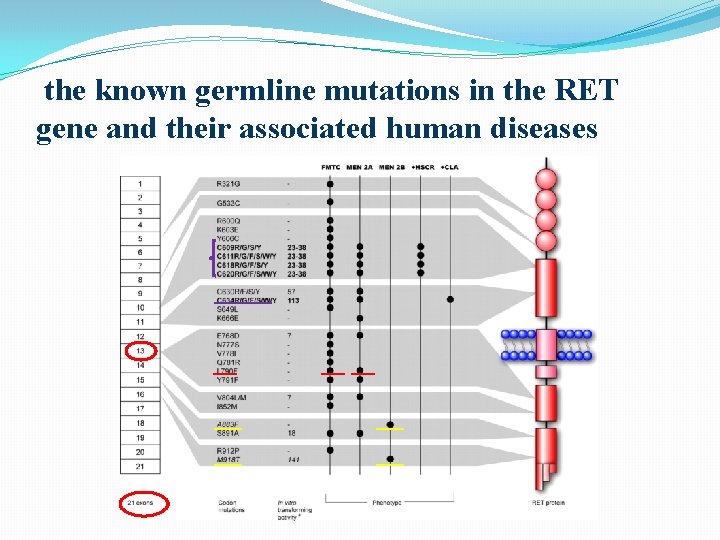
the known germline mutations in the RET gene and their associated human diseases
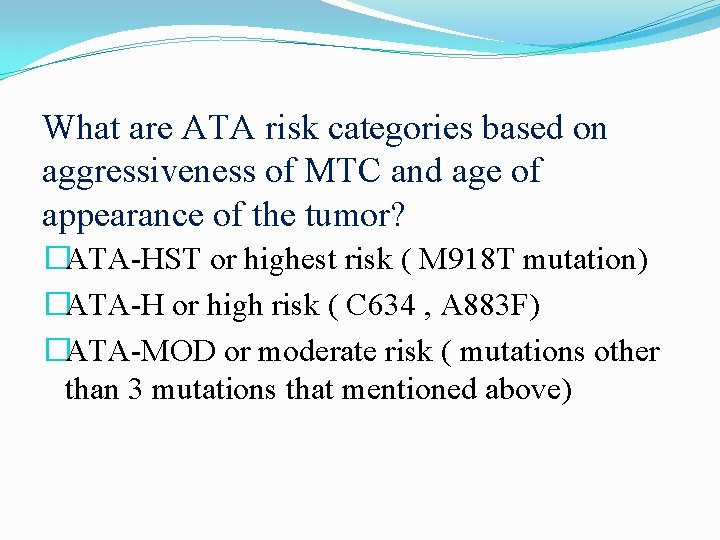
What are ATA risk categories based on aggressiveness of MTC and age of appearance of the tumor? �ATA-HST or highest risk ( M 918 T mutation) �ATA-H or high risk ( C 634 , A 883 F) �ATA-MOD or moderate risk ( mutations other than 3 mutations that mentioned above)
�What about the MTC risk category of our patient ?
�She had RET mutation in L 790 F , so her ATA risk category is in ATA-MOD risk
What is the next steps in management of this patient ? �Because of hereditary MTC in our patient(FMTC/MEN 2 A), evaluation for pheochromocytoma(PHEO) and hyperparathyroidism(HPTH) was performed. the results for both lab. tests were negative.
�Based on Ctn level more than 150 pg/ml, the patient evaluated by neck and chest CT, threephase contrast-enhanced CT of the liver and bone scintigraphy( because of complaining from scattered bone pains ) �MRI of the pelvis and axial skeleton was not done( because bone complaints was not continued) �Fortunately, all of these evaluations were negative.
What is the future plan for this patient ? �Repeating ph. examination and imaging studies every 6 -12 months �Measurement of Ctn and CEA every 3 -6 months and calculation of doubeling times for decision-making
�Because of hereditary MTC in our patient , genetic counseling and genetic testing recommend for her first-degree relatives. �In genetic testing of her children , one of her sons (25 year-old) and his 2 year-old dauther were positive for RET mutation of L 790 F.
What must we do for her son ? �Check Ctn and if it is normal repeat it annually �If Ctn is elevated , first evaluate for PHEO and treat it if presents �If Ctn is elevated and evaluation for PHEO is negative , TTX±lymph node dissection must be done �Because of L 790 F mutation he had FMTC( a variant of MEN 2 A) or Classic MEN 2 A , so hyperparathyroidism also was checked
What about her grandchild? �In children with ATA-MOD risk category , begin ph. examination , neck US and measurement of Ctn around 5 years of age and repeat them every 6 -12 months. �The timing of TTX should be based on the detection of an elevated Ctn. �Screening for PHEO and HPTH must be done at 16 years of age
�If the parents do not wish to embark on lengthly period of evaluation ( years or even decades) , TTX may perform in childhood.
�How to follow up children in ATAHST and ATA-H categories?
Childern with ATA-HST category (codon M 918 T, MEN 2 B): �TTX must be done in the first year of life , perhaps even in the first months of life �Because Ctn level is extremely high in the first months of life , it has a limited value in determining the time of TTX in ATA-HST infants. �Screen for PHEO, should begin by age 11 years �this category of ATA has no risk for HPTH
In children with ATA-H category: (codon 883 and 634) �Evaluation with ph. examination , neck US and Ctn level should begin by age 3 years and repeat annually if the results are negative �TTX must be performed in 5 years of age or earlier based on Ctn level. �Screen for PHEO and HPTH begins at 11 year of age
�Recently , an update on MEN 2 from Germany(2018) that focused on MTC, notes that the classification into one of the three RET mutation risk groups for predicting aggressiveness and prognosis had limited impact and patients with RET mutation in different risk categories exhibit a broad spectrum of MTC aggressiveness during follow up , with no relevant difference in survival.
�They conclude that the different risk -related RET mutations, after the initial onset of MTC, give rise to equally aggressive tumors �Once MTC developed , the clinical course was statistically equivalent in terms of distant metastases and survival
�Important clinical implication is : the follow- up for a patient with a moderate –risk mutation must be as intensive as the follow-up of an individual with a high-risk mutation.
�Also, the authors that recently report a 3 -year-old girl with bilateral MTC ( mutation in codon 634) have suggested to lowering the timing of initial screening for carriers of codon 634
How to follow up after TTX in this father and his dauther? �After TTX , check for Ctn: �If Ctn is more than 150 pg/ml : evaluate for metastases and treat based on involued site �If Ctn is less than 150 pg/ml : check for Ctn and CEA every 3 -6 months and calculate doubling time for decision-making
Thank you for your attention