
IN THE NAME OF GOD Nonsurgical Retreatment Narges

- Slides: 84
IN THE NAME OF GOD Nonsurgical Retreatment Narges Simdar/Assistant professor, Department of Endodontics 1
• Nonsurgical root canal therapy has become a routine procedure in modern dentistry. • Clinicians should be able to diagnose persistent endodontic disease and be aware of the options for treatment. Narges Simdar/Assistant professor, Department of Endodontics 2
Etiology of Posttreatment Disease • There are many causes for “failure” of initial endodontic therapy that have been described in the endodontic literature. These include iatrogenic procedural errors such as: • poor access cavity design • untreated canals (both major and accessory) • canals that are poorly cleaned and obturated • complications of instrumentation (ledges, perforations, or separated instruments) • overextensions of root filling materials. • Coronal leakage has also been blamed for posttreatment disease, as has persistent intracanal and extracanal infection and radicular cysts. • Occasionally, the cause of posttreatment disease may take years to become discernable or may ultimately never be known. Narges Simdar/Assistant professor, Department of Endodontics 3
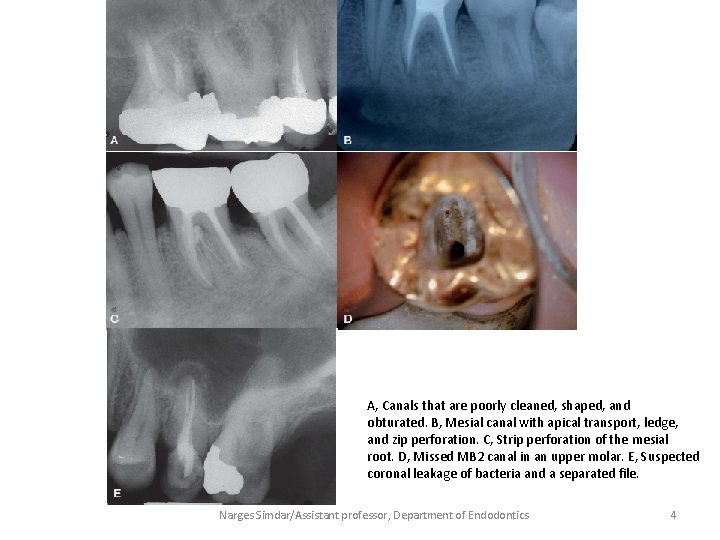
A, Canals that are poorly cleaned, shaped, and obturated. B, Mesial canal with apical transport, ledge, and zip perforation. C, Strip perforation of the mesial root. D, Missed MB 2 canal in an upper molar. E, Suspected coronal leakage of bacteria and a separated file. Narges Simdar/Assistant professor, Department of Endodontics 4
• The clinician may place the etiologic factors into four groups. • 1. Persistent or reintroduced intraradicular microorganisms • 2. Extraradicular infection • 3. Foreign body reaction • 4. True cysts Narges Simdar/Assistant professor, Department of Endodontics 5
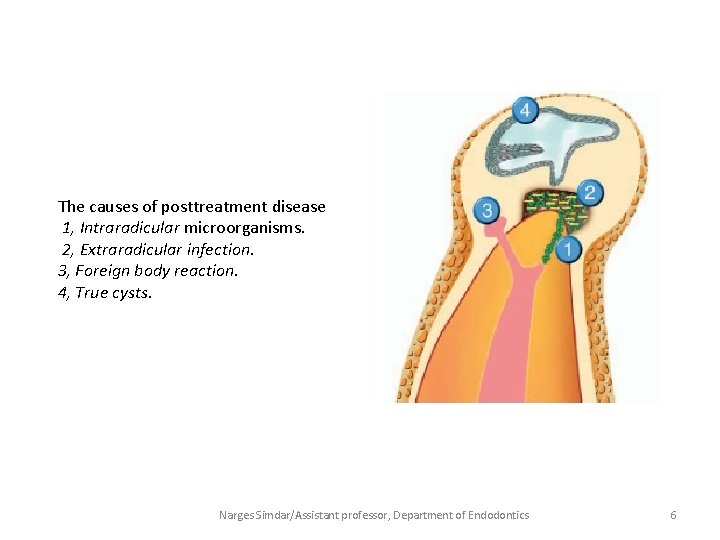
The causes of posttreatment disease 1, Intraradicular microorganisms. 2, Extraradicular infection. 3, Foreign body reaction. 4, True cysts. Narges Simdar/Assistant professor, Department of Endodontics 6
• 1. Persistent or reintroduced intraradicular microorganisms • A very commonly isolated species is Enterococcus faecalis, which has been shown to be very resistant to canal disinfection regimes. • Though posttreatment disease has been primarily blamed on bacteria in the root canal system, fungi, notably Candida albicans, are found frequently in persistent endodontic infections and may be responsible for the recalcitrant lesion. Narges Simdar/Assistant professor, Department of Endodontics 7
• 2. Extraradicular infection Occasionally, bacterial cells Extrusion of infected dentin chips, or by contamination with overextended, infected endodontic instruments. • producing an extracellular matrix or protective plaque. • It has also been shown that two species of microorganisms, Actinomyces israelii and Propionibacterium propionicum can exist in the periapical tissues and may prevent healing after root canal therapy. Narges Simdar/Assistant professor, Department of Endodontics 8
• 3. Foreign body reaction Occasionally, persistent endodontic. • Several materials have been associated with inflammatory responses, including lentil beans and cellulose fibers from paper points. • In the seemingly endless debate about which endodontic obturation technique is superior, there has been much discussion about the effect of overextended root canal filling materials upon apical healing. • Gutta-percha and sealers are usually well tolerated by the apical tissues, and if the tissues have not been inoculated with microorganisms by vigorous overinstrumentation, healing in the presence of overextended filling materials can still occur. Narges Simdar/Assistant professor, Department of Endodontics 9
• 4. True cysts Cysts form in the periradicular tissues when retained embryonic epithelium begins to proliferate due to the presence of chronic inflammation. • The epithelial cell rests of Malassez are the source of the epithelium, and cyst formation may be an attempt to help separate the inflammatory stimulus from the surrounding bone. Narges Simdar/Assistant professor, Department of Endodontics 10
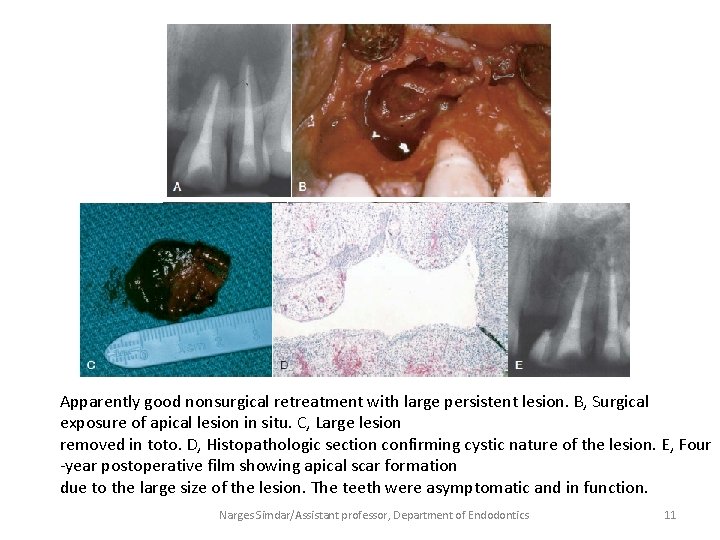
Apparently good nonsurgical retreatment with large persistent lesion. B, Surgical exposure of apical lesion in situ. C, Large lesion removed in toto. D, Histopathologic section confirming cystic nature of the lesion. E, Four -year postoperative film showing apical scar formation due to the large size of the lesion. The teeth were asymptomatic and in function. Narges Simdar/Assistant professor, Department of Endodontics 11
• There are two types of periapical cysts: the periapical true cyst and the periapical pocket cyst. True cysts have a contained cavity or lumen within a continuous epithelial lining. • With pocket cysts, the lumen is open to the root canal of the affected tooth. • True cysts, owing to their selfsustaining nature, probably do not heal following nonsurgical endodontic therapyand usually require surgical enucleation. Narges Simdar/Assistant professor, Department of Endodontics 12
Diagnosis of Posttreatment Disease • The proper diagnosis is probably the most important portion of any endodontic procedure. • To make a correct diagnosis, clinicians must rule out non-odontogenic etiology, perform all appropriate tests, properly interpret the patient’s responses to these tests, derive a definitive diagnosis, and decide on treatment options. Narges Simdar/Assistant professor, Department of Endodontics 13
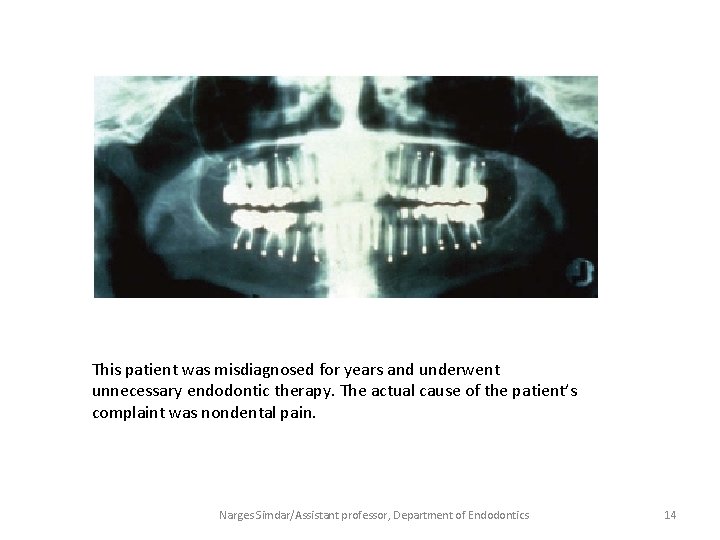
This patient was misdiagnosed for years and underwent unnecessary endodontic therapy. The actual cause of the patient’s complaint was nondental pain. Narges Simdar/Assistant professor, Department of Endodontics 14
• When performing a diagnosis in endodontic cases where there is no history of previous endodontic therapy, both a pulpal and periradicular diagnosis are necessary. • In cases of persistent disease, the diagnosis may not be straight forward; the clinician may be dealing with partially treated pulp canals, missed canals, or many other types of problems associated with the previous treatment. • These must be included in the diagnostic description for each case. Narges Simdar/Assistant professor, Department of Endodontics 15
• The subjective information is collected by questioning the patient and then actively listening to the responses. • the next step is to gather all of the objective information needed to obtain an accurate diagnosis, including clinical and radiographic examinations. Narges Simdar/Assistant professor, Department of Endodontics 16
• In cases with previous endodontic therapy, radiographs are very useful in evaluation of caries, defective restorations, periodontal health, the quality of the obturation, existence of missed canals, impediments to instrumentation, periradicular pathosis, perforations, fractures, resorption, and canal anatomy. Narges Simdar/Assistant professor, Department of Endodontics 17
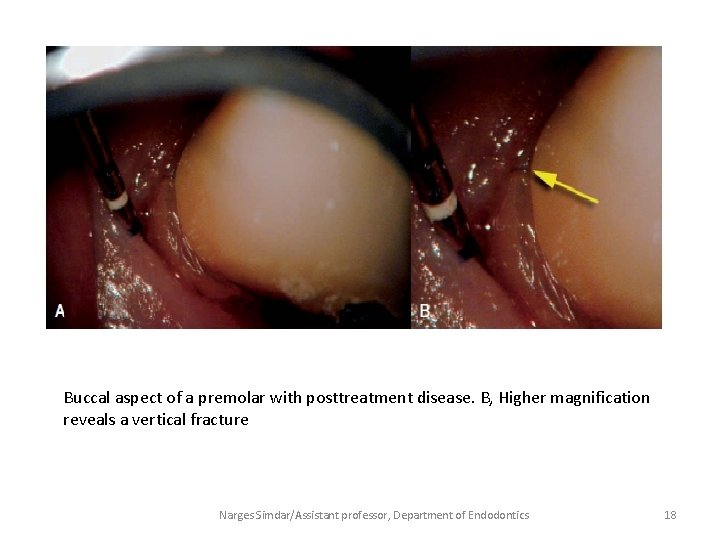
Buccal aspect of a premolar with posttreatment disease. B, Higher magnification reveals a vertical fracture Narges Simdar/Assistant professor, Department of Endodontics 18
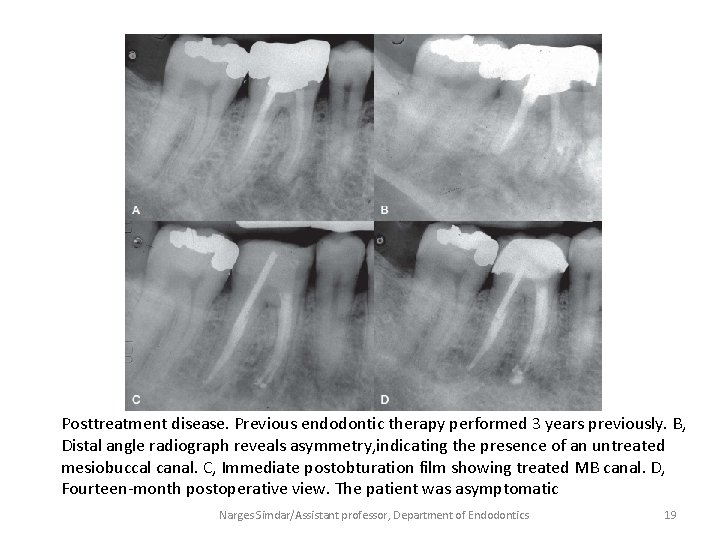
Posttreatment disease. Previous endodontic therapy performed 3 years previously. B, Distal angle radiograph reveals asymmetry, indicating the presence of an untreated mesiobuccal canal. C, Immediate postobturation film showing treated MB canal. D, Fourteen-month postoperative view. The patient was asymptomatic Narges Simdar/Assistant professor, Department of Endodontics 19
• Bitewing radiographs are useful in determining periodontal bone height and to look for caries or fractures. • All sinus tracts should be traced with a cone of guttapercha followed by a radiograph to localize their origin. • Most useful are the periradicular tests that include percussion, bite, and palpation. • These will allow the diagnostician to begin developing a sense of the status of the periradicular tissues. • Pulp vitality tests are often of little value when examining teeth with previous endodontic therapy, but if the patient’s chief complaint reveals the need for these tests, they must be performed. Narges Simdar/Assistant professor, Department of Endodontics 20
Treatment Planning • Once the diagnosis is complete, the cause of the persistent disease will usually become apparent. • Occasionally a patient will have persistent symptoms that mimic posttreatment disease, but these symptoms are actually the result of nonendodontic conditions such as occlusal trauma, concurrent periodontal disease, or nondental pain conditions. • Appropriate diagnostic procedures should allow the clinician to sift through these options and treat accordingly. • The patient harboring true endodontic posttreatment disease has four basic options for treatment: • 1. D o nothing • 2. Extract the tooth • 3. Nonsurgical retreatment • 4. Surgical retreatment Narges Simdar/Assistant professor, Department of Endodontics 21
• Extraction of the tooth is usually considered a viable option. • Recent advances in both prosthetic reconstruction techniques and dental implantology have made extraction and replacement a more desirable option in certain cases. • This alternative, however, provides results that are inferior, more expensive, and much more time consuming than preserving the natural tooth. Narges Simdar/Assistant professor, Department of Endodontics 22
• The cost of implant treatment is high and usually not covered under dental benefit plans, so the net financial impact on the patient is large. • Implant esthetics can be inferior to that of natural teeth in the esthetic zone of the mouth, and there are patients that are just not candidates for implant procedures. • Fixed partial dentures are another replacement alternative with a very long history of successful use, but there are negative outcomes possible also. Narges Simdar/Assistant professor, Department of Endodontics 23
• Removable partial dentures are a less desirable option to the patient because they are generally less comfortable, usually require a long period of patient adaptation, and frequently result in damage to adjacent oral tissues (teeth, gingiva, and mucosa) if not meticulously cleaned. Narges Simdar/Assistant professor, Department of Endodontics 24
• The surgical options can be further broken down into periradicular curettage, apical root resection (with or without root filling), root amputation or hemisection, and intentional replantation (extraction/replantation). • A situation sometimes arises that will require both nonsurgical and surgical types of treatment to effect healing. Narges Simdar/Assistant professor, Department of Endodontics 25
• If the cause of the posttreatment disease is persistent extraradicular infection, foreign body reaction, or the presence of a true cyst, nonsurgical root canal therapy has little likelihood of allowing healing to occur, and surgical methods should be employed. Narges Simdar/Assistant professor, Department of Endodontics 26
• The choice of nonsurgical retreatment versus apical surgery becomes the focus of the decision in most instances. • The reported healing rates of nonsurgical retreatment range between 74% and 98%, but with apical surgery alone, only 59% heal completely. • When apical surgery is preceded by orthograde retreatment, however, the incidence of complete healing rises to 80%. • In general, nonsurgical retreatment will be the preferred choice, since it seems to provide the most benefit with the lowest risk. Narges Simdar/Assistant professor, Department of Endodontics 27
• Nonsurgical retreatment is usually less invasive than surgery and has a less traumatic postoperative course. • There is less likelihood of incurring damage to adjacent vital structures such as nerves, adjacent teeth, and sinus cavities. • However, nonsurgical retreatment may be more costly than surgical treatment, especially if large restorations must be sacrificed during disassembly procedures prior to the retreatment. • In addition, the amount of time needed for retreatment is usually longer than surgical intervention. Narges Simdar/Assistant professor, Department of Endodontics 28
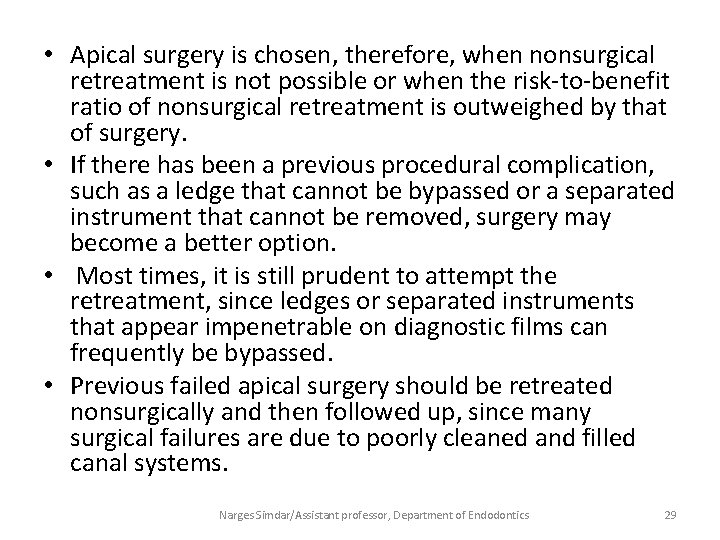
• Apical surgery is chosen, therefore, when nonsurgical retreatment is not possible or when the risk-to-benefit ratio of nonsurgical retreatment is outweighed by that of surgery. • If there has been a previous procedural complication, such as a ledge that cannot be bypassed or a separated instrument that cannot be removed, surgery may become a better option. • Most times, it is still prudent to attempt the retreatment, since ledges or separated instruments that appear impenetrable on diagnostic films can frequently be bypassed. • Previous failed apical surgery should be retreated nonsurgically and then followed up, since many surgical failures are due to poorly cleaned and filled canal systems. Narges Simdar/Assistant professor, Department of Endodontics 29
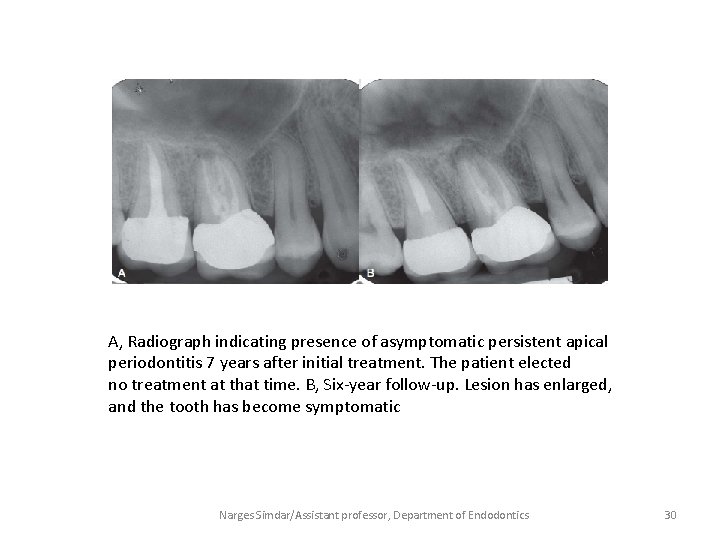
A, Radiograph indicating presence of asymptomatic persistent apical periodontitis 7 years after initial treatment. The patient elected no treatment at that time. B, Six-year follow-up. Lesion has enlarged, and the tooth has become symptomatic Narges Simdar/Assistant professor, Department of Endodontics 30
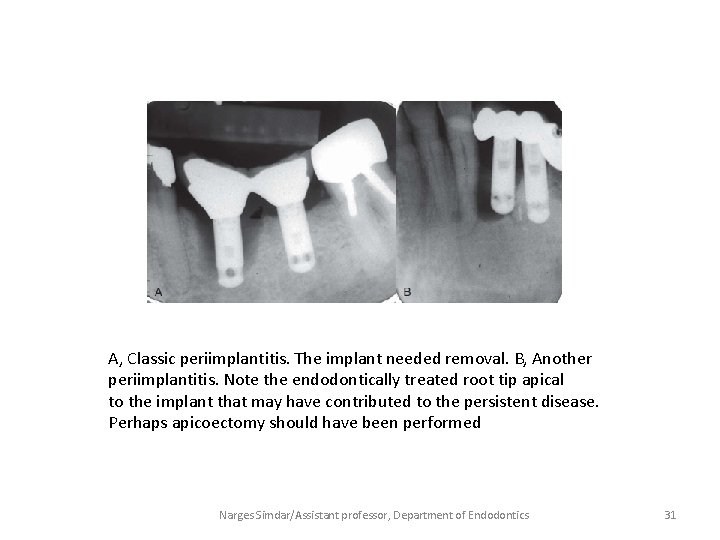
A, Classic periimplantitis. The implant needed removal. B, Another periimplantitis. Note the endodontically treated root tip apical to the implant that may have contributed to the persistent disease. Perhaps apicoectomy should have been performed Narges Simdar/Assistant professor, Department of Endodontics 31
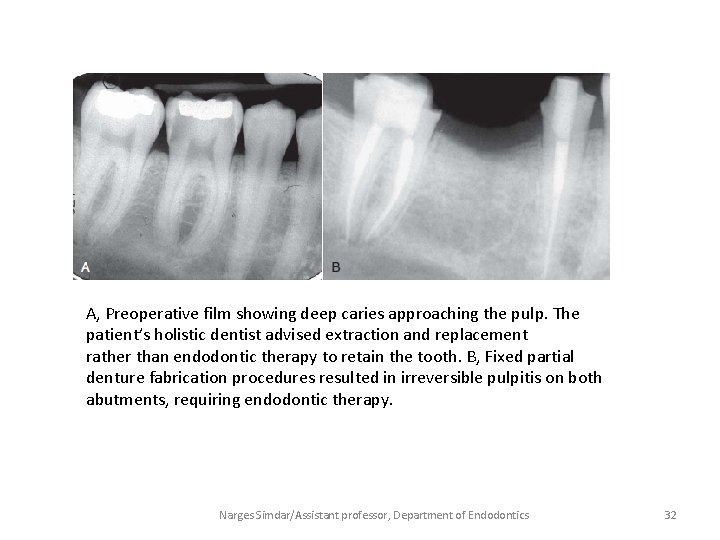
A, Preoperative film showing deep caries approaching the pulp. The patient’s holistic dentist advised extraction and replacement rather than endodontic therapy to retain the tooth. B, Fixed partial denture fabrication procedures resulted in irreversible pulpitis on both abutments, requiring endodontic therapy. Narges Simdar/Assistant professor, Department of Endodontics 32
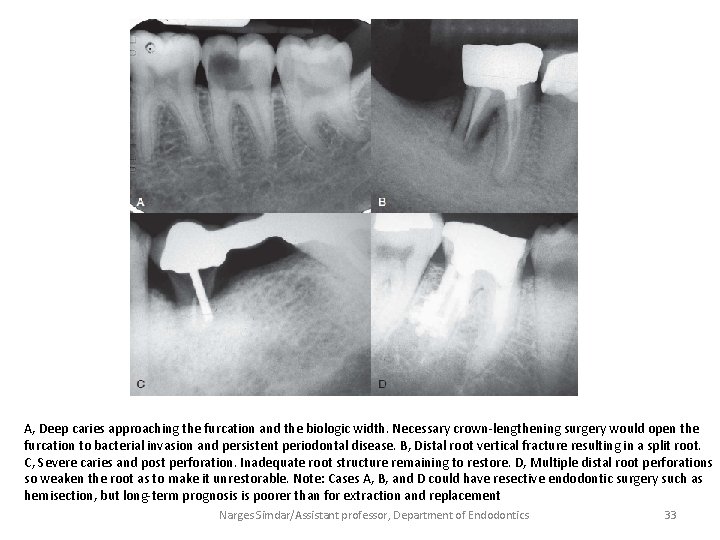
A, Deep caries approaching the furcation and the biologic width. Necessary crown-lengthening surgery would open the furcation to bacterial invasion and persistent periodontal disease. B, Distal root vertical fracture resulting in a split root. C, Severe caries and post perforation. Inadequate root structure remaining to restore. D, Multiple distal root perforations so weaken the root as to make it unrestorable. Note: Cases A, B, and D could have resective endodontic surgery such as hemisection, but long-term prognosis is poorer than for extraction and replacement Narges Simdar/Assistant professor, Department of Endodontics 33
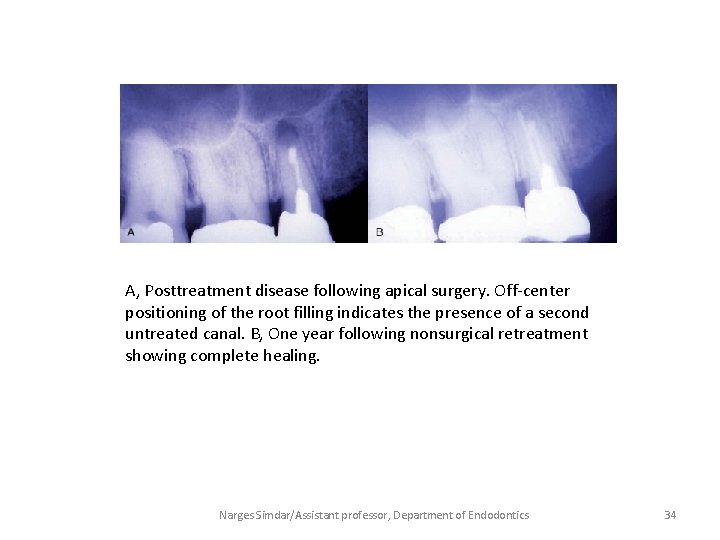
A, Posttreatment disease following apical surgery. Off-center positioning of the root filling indicates the presence of a second untreated canal. B, One year following nonsurgical retreatment showing complete healing. Narges Simdar/Assistant professor, Department of Endodontics 34
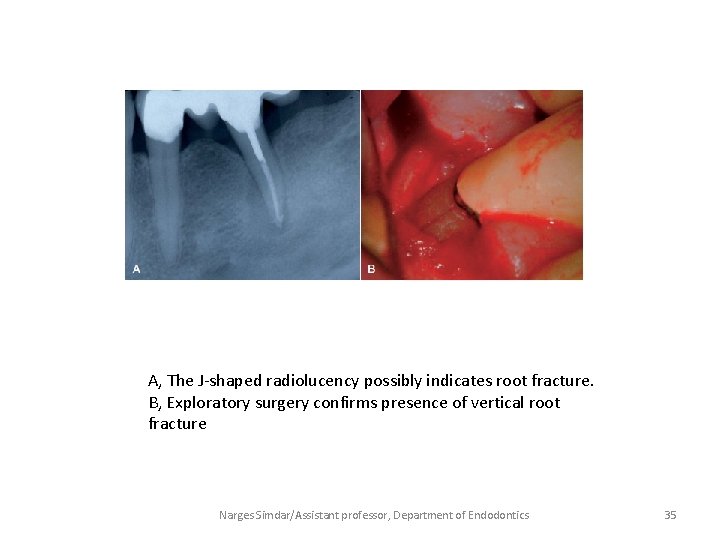
A, The J-shaped radiolucency possibly indicates root fracture. B, Exploratory surgery confirms presence of vertical root fracture Narges Simdar/Assistant professor, Department of Endodontics 35
Nonsurgical Endodontic Retreatment • The primary difference between nonsurgical management of primary endodontic disease versus posttreatment disease is the need to regain access to the apical area of the root canal space in the previously treated tooth. • After that, all of the principles of endodontic therapy apply to the completion of the retreatment case. Narges Simdar/Assistant professor, Department of Endodontics 36
• Coronal access needs to be completed, all previous root filling materials need to be removed, canal obstructions must be managed, and impediments to achieving full working length must be overcome. • Only then can cleaning and shaping procedures be instituted that will allow for effective obturation and case completion. Narges Simdar/Assistant professor, Department of Endodontics 37
Coronal Access Cavity Preparation • Retreatment access has been called coronal disassembly because of the frequent need to take apart or remove the previous coronal and radicular restoration. • Following initial endodontic therapy, most teeth require and receive a full coverage restoration, and many times that restoration is supported by a post and core. Narges Simdar/Assistant professor, Department of Endodontics 38
• The goal of the access preparation is to establish straight-line access to the root canal system while conserving as much tooth structure as possible. • The ideal access preparation allows for instruments to enter the canals without being deflected by the access cavity walls. • This is reasonably easy to achieve when the tooth is completely intact and a pulp chamber is present, since surface and internal anatomic landmarks can guide the search for the canals. Narges Simdar/Assistant professor, Department of Endodontics 39
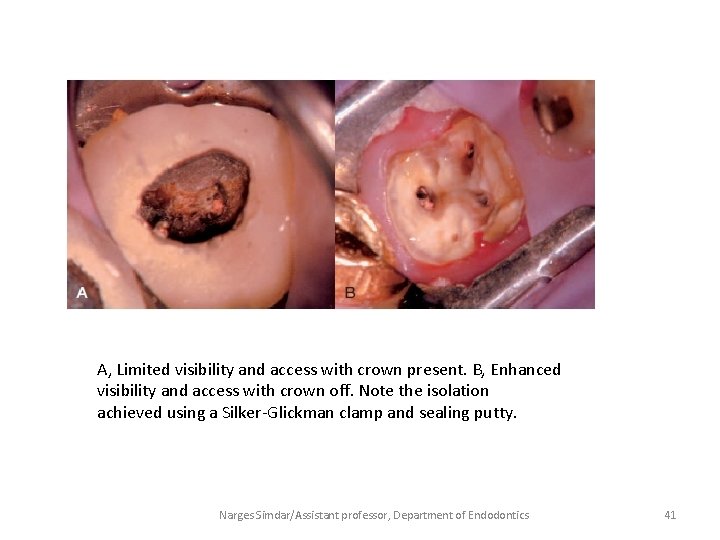
• When the crown is considered to be satisfactory, the decision becomes more complex. If the restoration is maintained, the cost for replacement can be avoided, isolation is easier, the occlusion is preserved, and the esthetics will be minimally changed. • Even if the crown requires replacement, the clinician may elect to retain it during the endodontic retreatment to allow for better isolation with the rubber dam. • Unfortunately, retreatment may be more difficult with the crown in place, because this could lead to an increased chance for an iatrogenic mishap due to restricted visibility. Narges Simdar/Assistant professor, Department of Endodontics 40
A, Limited visibility and access with crown present. B, Enhanced visibility and access with crown off. Note the isolation achieved using a Silker-Glickman clamp and sealing putty. Narges Simdar/Assistant professor, Department of Endodontics 41
• To preserve the restoration, two approaches can be taken: • access through the crown or crown removal and replacement when retreatment is completed. Narges Simdar/Assistant professor, Department of Endodontics 42
• The simplest choice is to prepare an access cavity through the existing crown, although there is a significant risk of damaging the restoration, resulting in the need to replace it. • If the clinician decides to access through the existing restoration, there are several choices of access burs to use, depending on what material the preparation will be cut through. • If the access will be primarily cut through metal (amalgam alloy or cast metal) or composite resin, carbide fissure burs are usually chosen. Narges Simdar/Assistant professor, Department of Endodontics 43
• For example, when a porcelain fused to metal (PFM) crown is encountered, a round diamond is used to cut through the porcelain layer. • Once the metal substructure is encountered, an end-cutting bur, such as the Transmetal bur or the Great White bur can be used to cut through to and remove the core material efficiently. Narges Simdar/Assistant professor, Department of Endodontics 44
• An important consideration for the clinician is the potential for porcelain fracture, which may occur during the preparation or possibly at a later date after completion of the treatment. • This damage is especially common with porcelain jacket crowns. Narges Simdar/Assistant professor, Department of Endodontics 45
• A different approach to conservative crown removal involves drilling a small hole through the crown in order to allow a device to thread a screw through the hole. • This approach creates a lifting force that separates the crown and the tooth. • The instruments that work in this manner are the Metalift the Kline Crown Remover and the Higa Bridge Remover. Narges Simdar/Assistant professor, Department of Endodontics 46
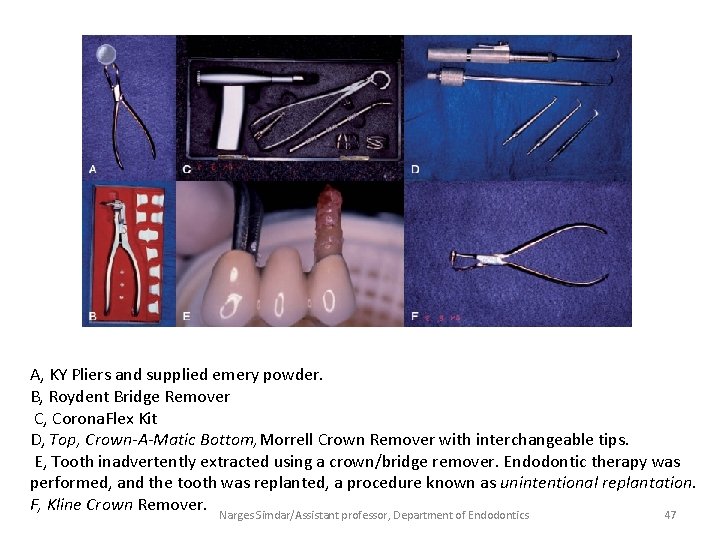
A, KY Pliers and supplied emery powder. B, Roydent Bridge Remover C, Corona. Flex Kit D, Top, Crown-A-Matic Bottom, Morrell Crown Remover with interchangeable tips. E, Tooth inadvertently extracted using a crown/bridge remover. Endodontic therapy was performed, and the tooth was replanted, a procedure known as unintentional replantation. F, Kline Crown Remover. Narges Simdar/Assistant professor, Department of Endodontics 47
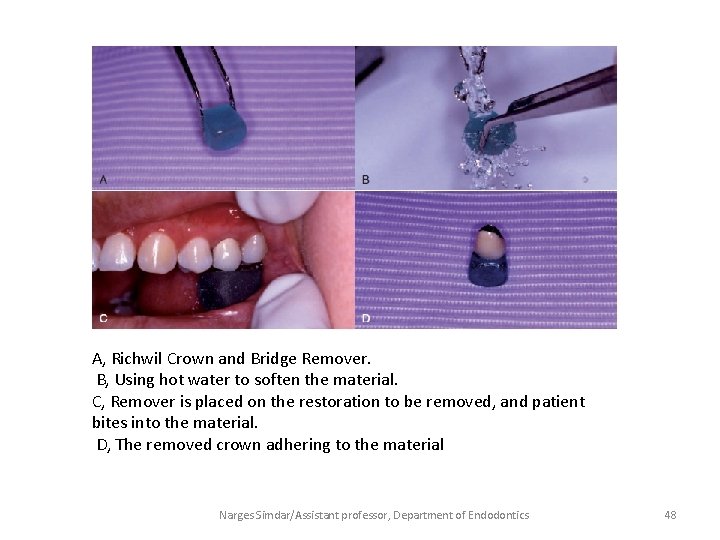
A, Richwil Crown and Bridge Remover. B, Using hot water to soften the material. C, Remover is placed on the restoration to be removed, and patient bites into the material. D, The removed crown adhering to the material Narges Simdar/Assistant professor, Department of Endodontics 48
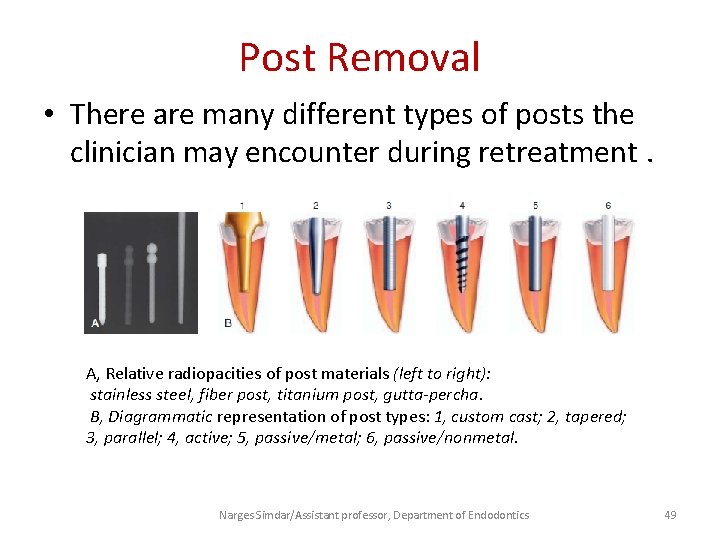
Post Removal • There are many different types of posts the clinician may encounter during retreatment. A, Relative radiopacities of post materials (left to right): stainless steel, fiber post, titanium post, gutta-percha. B, Diagrammatic representation of post types: 1, custom cast; 2, tapered; 3, parallel; 4, active; 5, passive/metal; 6, passive/nonmetal. Narges Simdar/Assistant professor, Department of Endodontics 49
• These can be classified into two categories: • prefabricated posts • custom-cast posts. • Historically, cast posts were more commonly used than prefabricated posts, but over the past 2 decades, cast posts have become much less popular. • The main reason for this decrease is the convenience of placing the prefabricated post immediately after post preparation as opposed to waiting for a laboratory to fabricate the casting. • There is also less likelihood of the interappointment contamination that frequently occurs with temporary post/core/crowns that are needed for cast/custom post-and-core fabrication. • Prefabricated posts come in a variety of shapes, designs, and materials. Narges Simdar/Assistant professor, Department of Endodontics 50
• The shapes can be subclassified into two groups: • parallel sided • tapered. • The design of posts also can be subclassified into active (threaded), passive, vented, fluted, and acid-etched groups. • There also many materials that have been used to fabricate posts: • stainless steel, gold, titanium, ceramic, zirconium, and fiber-reinforced composite posts. Narges Simdar/Assistant professor, Department of Endodontics 51
• Several post systems on the market today, such as the Pro. Post, use acid-etched metal posts that are bonded into the canal with cements such as Panavia or C&B Metabond. • Removal of these posts is extremely difficult and occasionally impossible regardless of which technique is used. • A study has shown that heat generation with ultrasonic vibration may help to decrease retention of resin-cemented posts, but concern for heat-generated periodontal ligament damage may preclude this technique. Narges Simdar/Assistant professor, Department of Endodontics 52
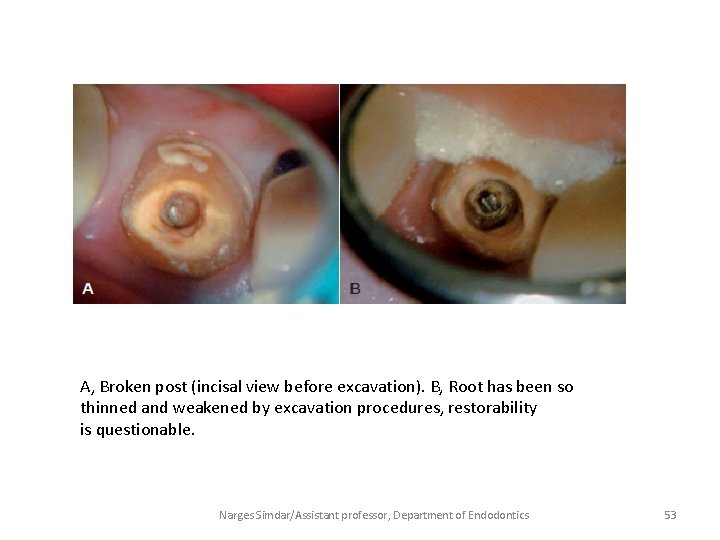
A, Broken post (incisal view before excavation). B, Root has been so thinned and weakened by excavation procedures, restorability is questionable. Narges Simdar/Assistant professor, Department of Endodontics 53
Post Removal Techniques • The first step in post removal is to expose it properly by removal of all adjacent restorative materials. • With preformed posts, the bulk of the core material around the post and within the chamber can be removed with a high-speed handpiece using cylindrical or tapered carbide or diamond burs. Narges Simdar/Assistant professor, Department of Endodontics 54
• If a rubber dam is in place, the area around the post may be flooded with a solvent such as chloroform prior to activating the ultrasonic instrument; this will help dissolve the cement around the post. • Using a solvent in conjunction with removal of cemented obstructions may prove beneficial, since the ultrasonic energy produced will set up shock waves in the solvent and make it penetrate deeper into the canal space, exerting a faster solvent action on the cement. Narges Simdar/Assistant professor, Department of Endodontics 55
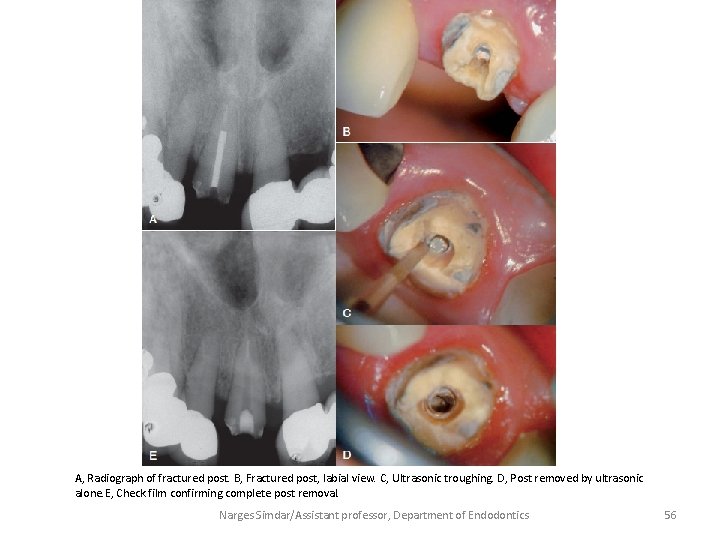
A, Radiograph of fractured post. B, Fractured post, labial view. C, Ultrasonic troughing. D, Post removed by ultrasonic alone. E, Check film confirming complete post removal. Narges Simdar/Assistant professor, Department of Endodontics 56
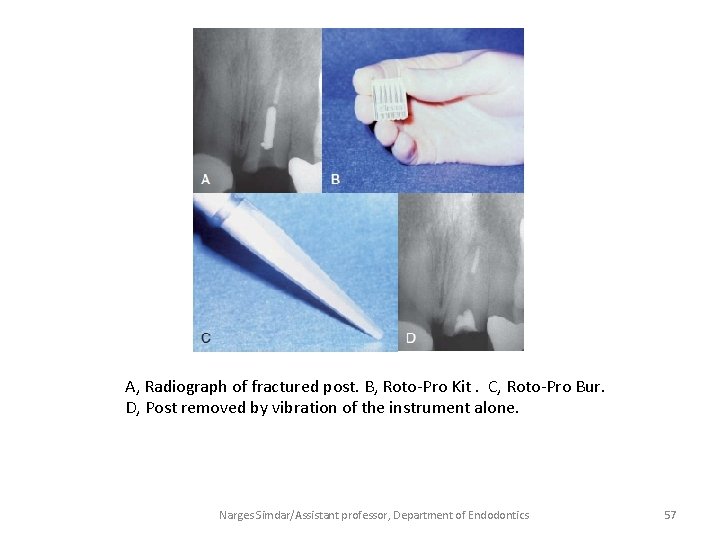
A, Radiograph of fractured post. B, Roto-Pro Kit. C, Roto-Pro Bur. D, Post removed by vibration of the instrument alone. Narges Simdar/Assistant professor, Department of Endodontics 57
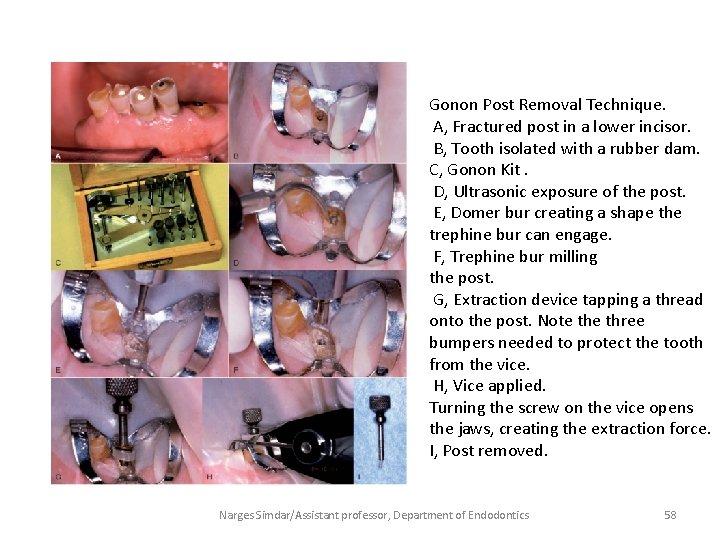
Gonon Post Removal Technique. A, Fractured post in a lower incisor. B, Tooth isolated with a rubber dam. C, Gonon Kit. D, Ultrasonic exposure of the post. E, Domer bur creating a shape the trephine bur can engage. F, Trephine bur milling the post. G, Extraction device tapping a thread onto the post. Note three bumpers needed to protect the tooth from the vice. H, Vice applied. Turning the screw on the vice opens the jaws, creating the extraction force. I, Post removed. Narges Simdar/Assistant professor, Department of Endodontics 58
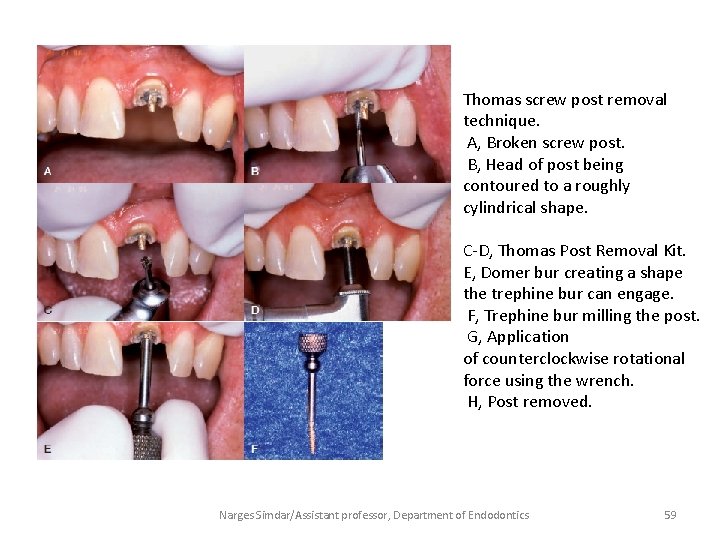
Thomas screw post removal technique. A, Broken screw post. B, Head of post being contoured to a roughly cylindrical shape. C-D, Thomas Post Removal Kit. E, Domer bur creating a shape the trephine bur can engage. F, Trephine bur milling the post. G, Application of counterclockwise rotational force using the wrench. H, Post removed. Narges Simdar/Assistant professor, Department of Endodontics 59
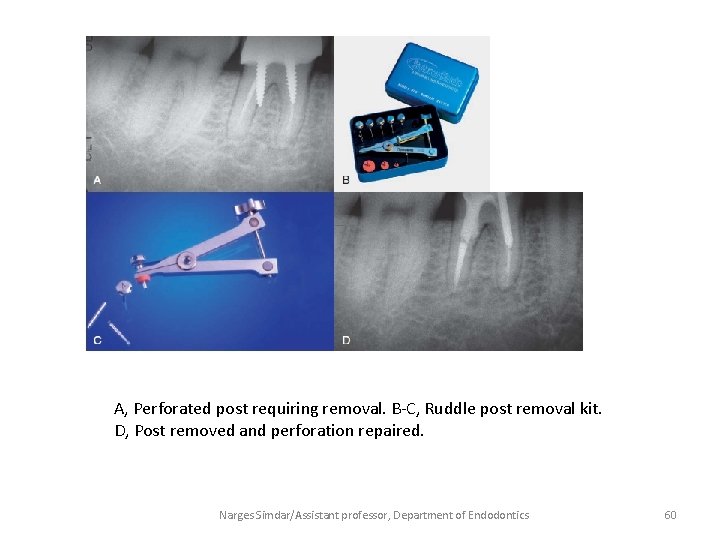
A, Perforated post requiring removal. B-C, Ruddle post removal kit. D, Post removed and perforation repaired. Narges Simdar/Assistant professor, Department of Endodontics 60
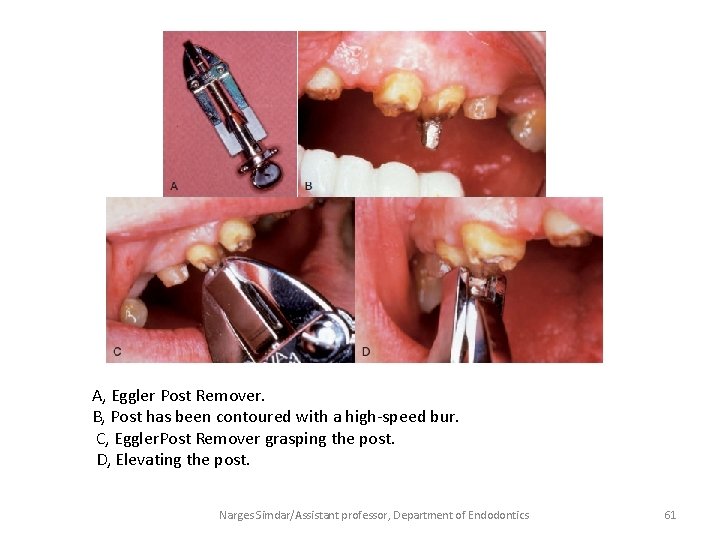
A, Eggler Post Remover. B, Post has been contoured with a high-speed bur. C, Eggler. Post Remover grasping the post. D, Elevating the post. Narges Simdar/Assistant professor, Department of Endodontics 61
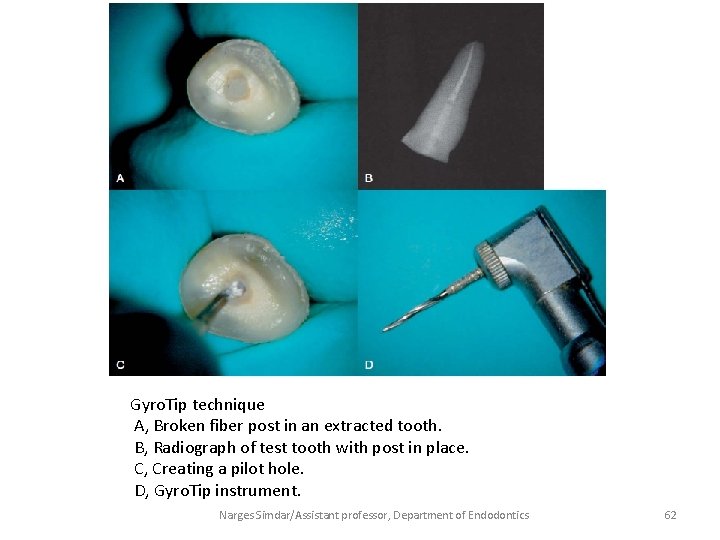
Gyro. Tip technique A, Broken fiber post in an extracted tooth. B, Radiograph of test tooth with post in place. C, Creating a pilot hole. D, Gyro. Tip instrument. Narges Simdar/Assistant professor, Department of Endodontics 62
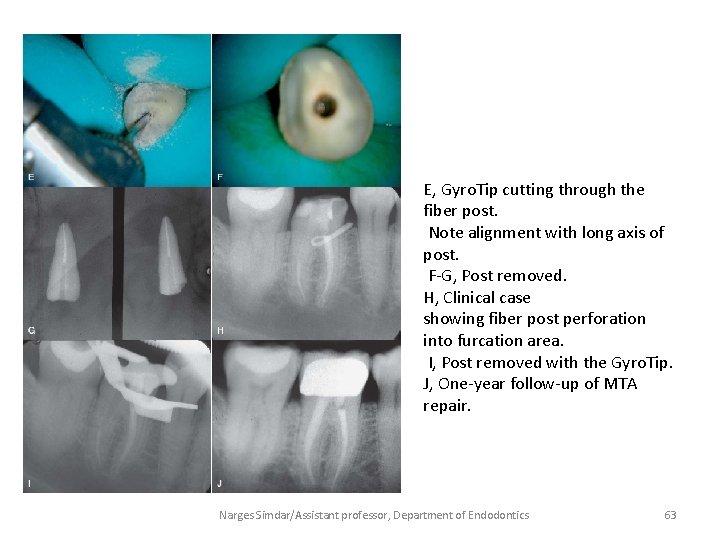
E, Gyro. Tip cutting through the fiber post. Note alignment with long axis of post. F-G, Post removed. H, Clinical case showing fiber post perforation into furcation area. I, Post removed with the Gyro. Tip. J, One-year follow-up of MTA repair. Narges Simdar/Assistant professor, Department of Endodontics 63
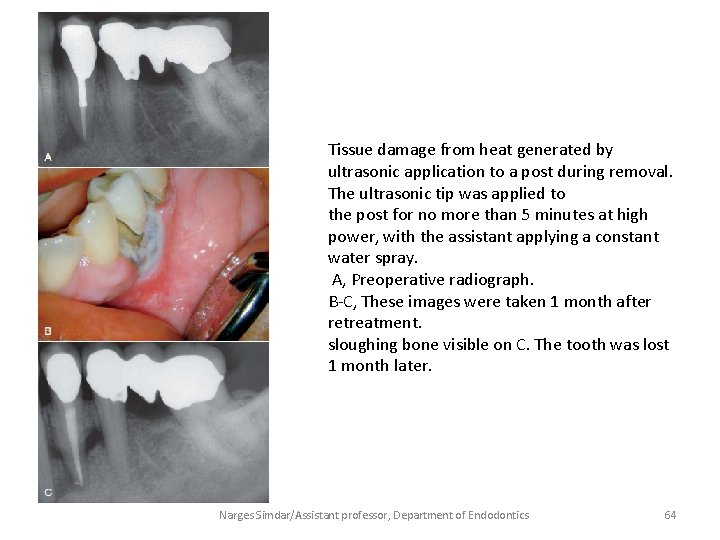
Tissue damage from heat generated by ultrasonic application to a post during removal. The ultrasonic tip was applied to the post for no more than 5 minutes at high power, with the assistant applying a constant water spray. A, Preoperative radiograph. B-C, These images were taken 1 month after retreatment. sloughing bone visible on C. The tooth was lost 1 month later. Narges Simdar/Assistant professor, Department of Endodontics 64
Gutta-percha Removal • One of the great advantages of using guttapercha for root filling is its relative ease of removal. • When the canal contains gutta-percha and sealer or a chloropercha filling, it is relatively easy to remove this material using a combination of heat, solvents, and mechanical instrumentation. Narges Simdar/Assistant professor, Department of Endodontics 65
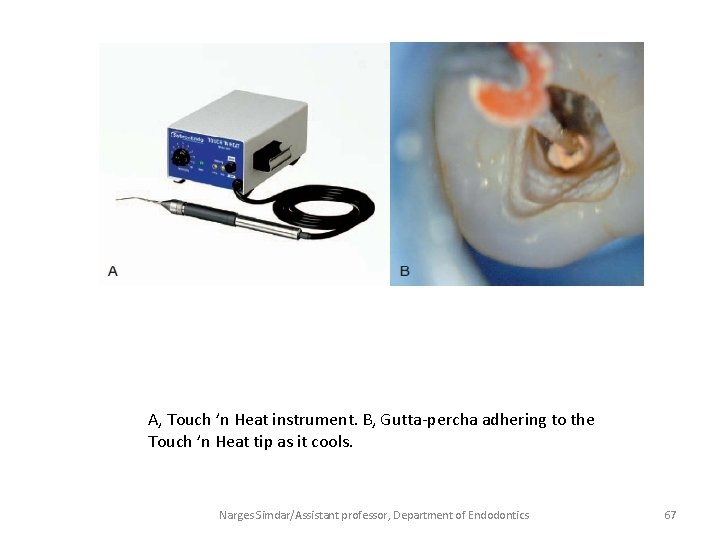
• Upon access, it is usually relatively easy to find the treated canal orifices with the visible pink gutta-percha material inside. • Initial probing with an endodontic explorer into the material can help rule out the possibility that there is a solid core carrier. • If there is no carrier, heat is applied using an endodontic heat carrier that has been heated to a cherry red glow in a torch. • Unfortunately, the carrier begins to cool upon removal from the flame, so many endodontists are now using other heat sources— such as the Touch ’n Heat or Down. Pak to provide constant, consistent heat application to soften the gutta-percha in thesmall Gates-Glidden drills, taking care not to overenlarge the cervical portion of the canal. Narges Simdar/Assistant professor, Department of Endodontics 66
A, Touch ’n Heat instrument. B, Gutta-percha adhering to the Touch ’n Heat tip as it cools. Narges Simdar/Assistant professor, Department of Endodontics 67
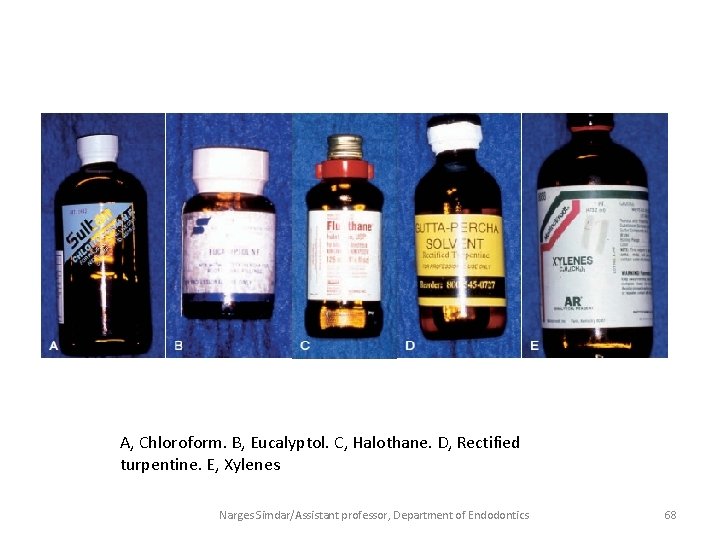
A, Chloroform. B, Eucalyptol. C, Halothane. D, Rectified turpentine. E, Xylenes Narges Simdar/Assistant professor, Department of Endodontics 68
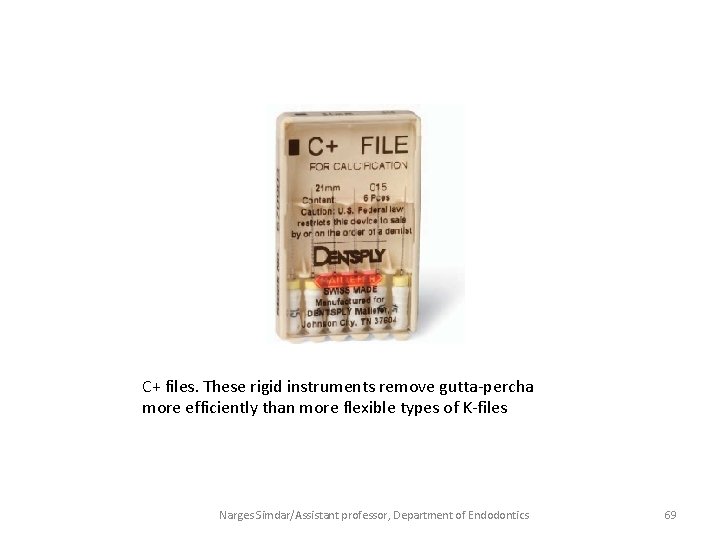
C+ files. These rigid instruments remove gutta-percha more efficiently than more flexible types of K-files Narges Simdar/Assistant professor, Department of Endodontics 69
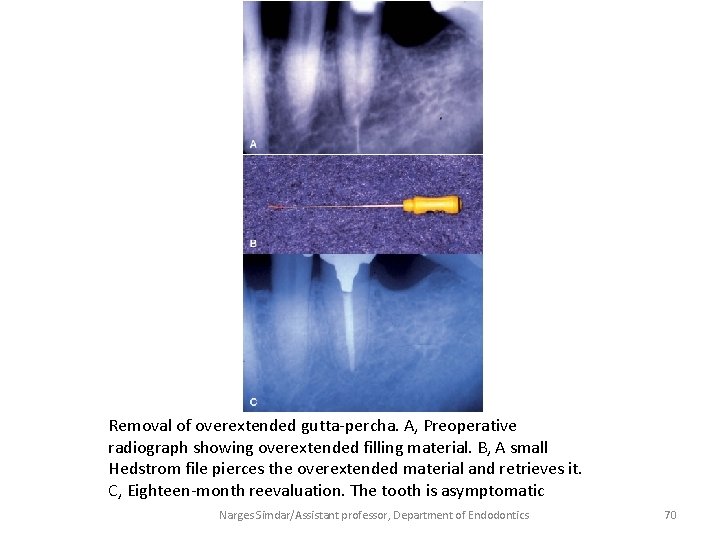
Removal of overextended gutta-percha. A, Preoperative radiograph showing overextended filling material. B, A small Hedstrom file pierces the overextended material and retrieves it. C, Eighteen-month reevaluation. The tooth is asymptomatic Narges Simdar/Assistant professor, Department of Endodontics 70
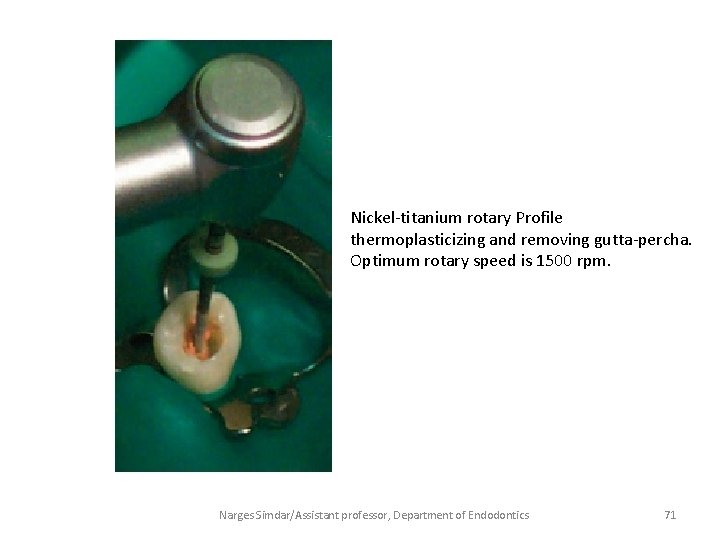
Nickel-titanium rotary Profile thermoplasticizing and removing gutta-percha. Optimum rotary speed is 1500 rpm. Narges Simdar/Assistant professor, Department of Endodontics 71
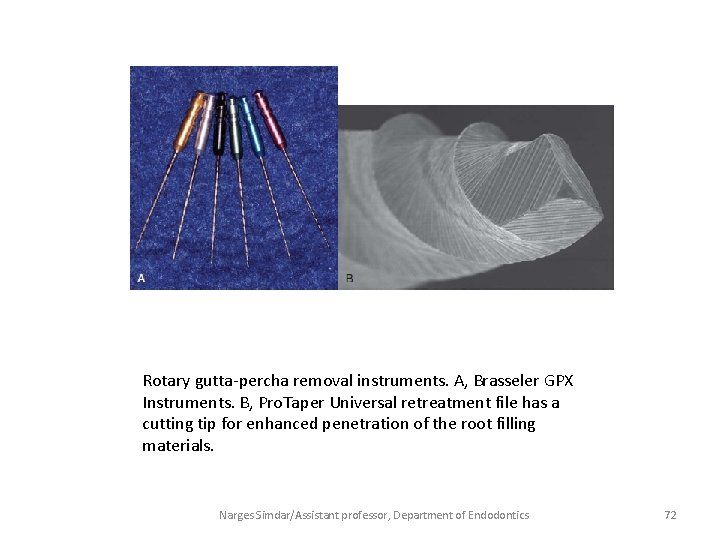
Rotary gutta-percha removal instruments. A, Brasseler GPX Instruments. B, Pro. Taper Universal retreatment file has a cutting tip for enhanced penetration of the root filling materials. Narges Simdar/Assistant professor, Department of Endodontics 72
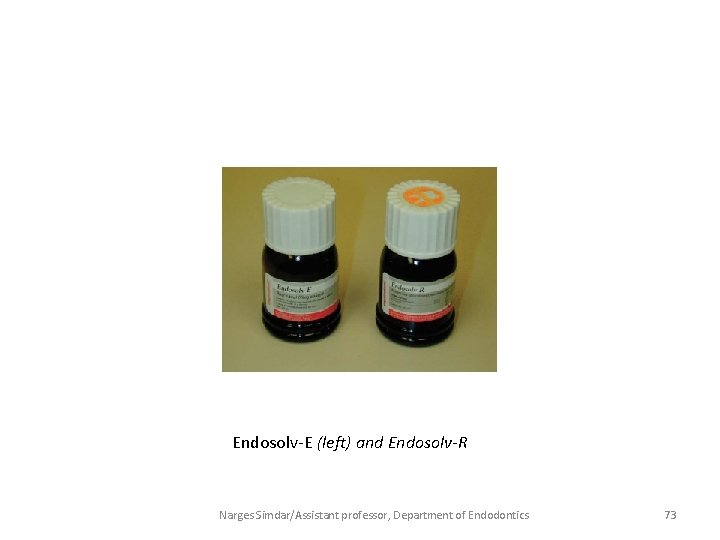
Endosolv-E (left) and Endosolv-R Narges Simdar/Assistant professor, Department of Endodontics 73
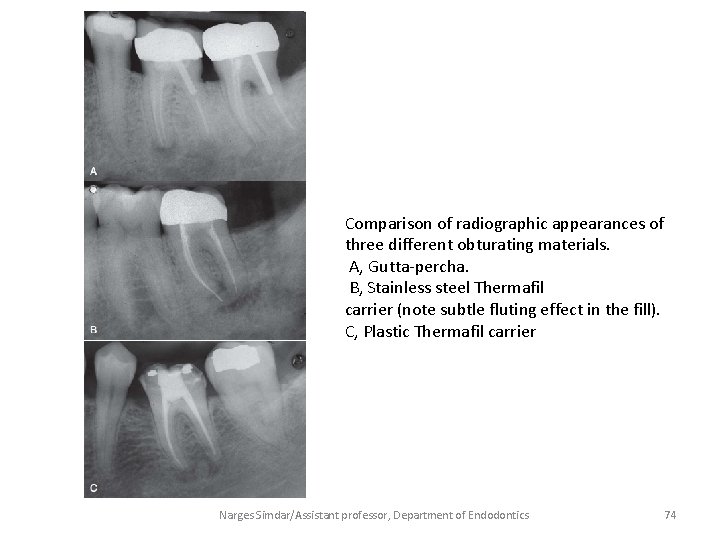
Comparison of radiographic appearances of three different obturating materials. A, Gutta-percha. B, Stainless steel Thermafil carrier (note subtle fluting effect in the fill). C, Plastic Thermafil carrier Narges Simdar/Assistant professor, Department of Endodontics 74
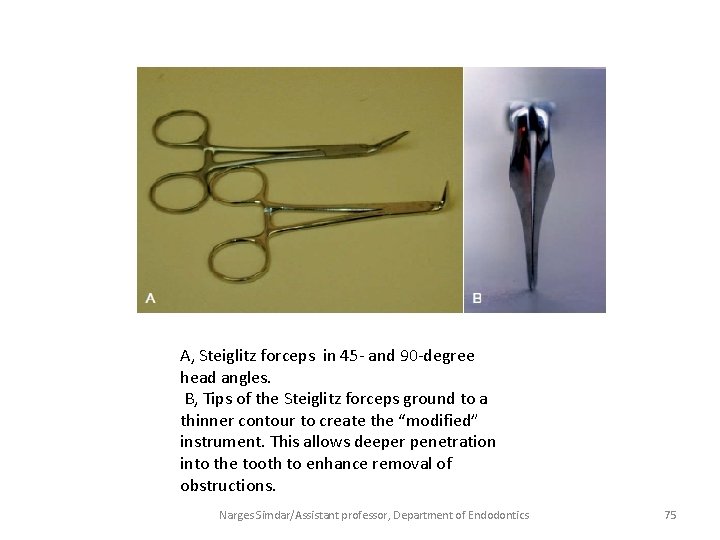
A, Steiglitz forceps in 45 - and 90 -degree head angles. B, Tips of the Steiglitz forceps ground to a thinner contour to create the “modified” instrument. This allows deeper penetration into the tooth to enhance removal of obstructions. Narges Simdar/Assistant professor, Department of Endodontics 75
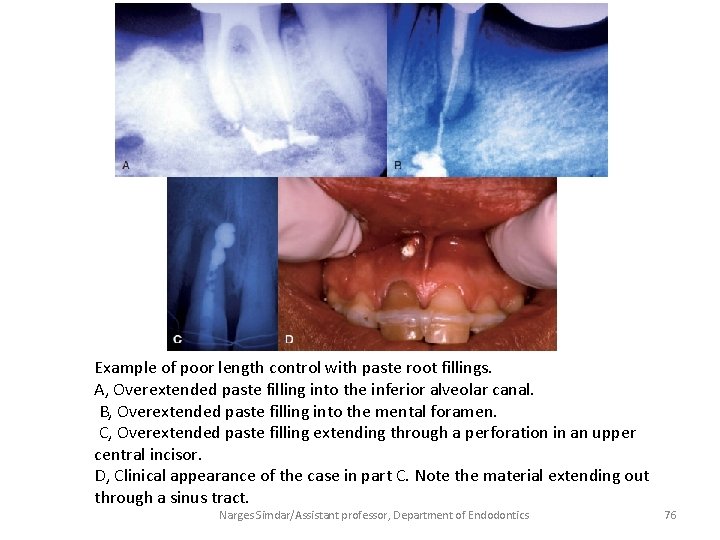
Example of poor length control with paste root fillings. A, Overextended paste filling into the inferior alveolar canal. B, Overextended paste filling into the mental foramen. C, Overextended paste filling extending through a perforation in an upper central incisor. D, Clinical appearance of the case in part C. Note the material extending out through a sinus tract. Narges Simdar/Assistant professor, Department of Endodontics 76
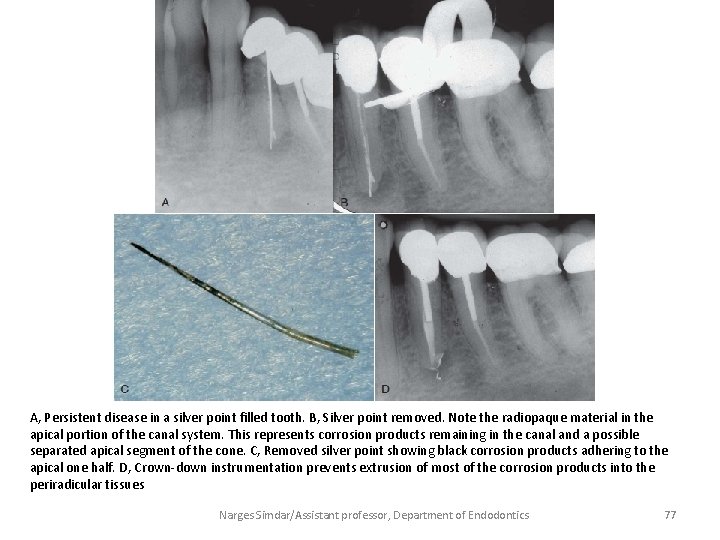
A, Persistent disease in a silver point filled tooth. B, Silver point removed. Note the radiopaque material in the apical portion of the canal system. This represents corrosion products remaining in the canal and a possible separated apical segment of the cone. C, Removed silver point showing black corrosion products adhering to the apical one half. D, Crown-down instrumentation prevents extrusion of most of the corrosion products into the periradicular tissues Narges Simdar/Assistant professor, Department of Endodontics 77
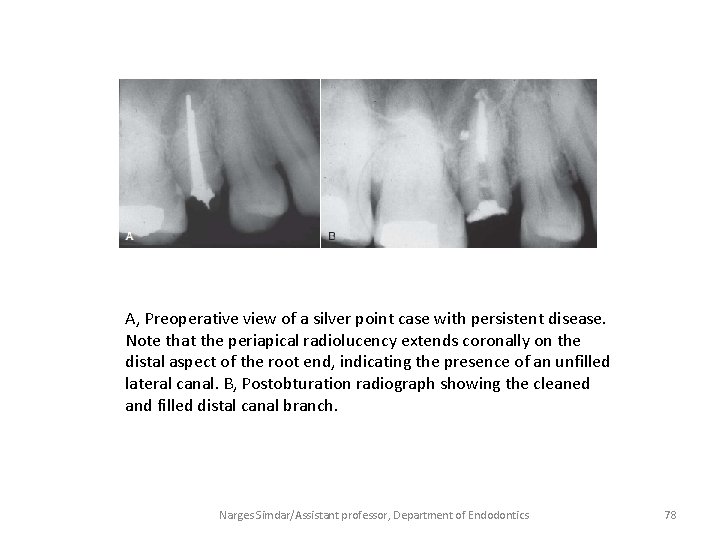
A, Preoperative view of a silver point case with persistent disease. Note that the periapical radiolucency extends coronally on the distal aspect of the root end, indicating the presence of an unfilled lateral canal. B, Postobturation radiograph showing the cleaned and filled distal canal branch. Narges Simdar/Assistant professor, Department of Endodontics 78
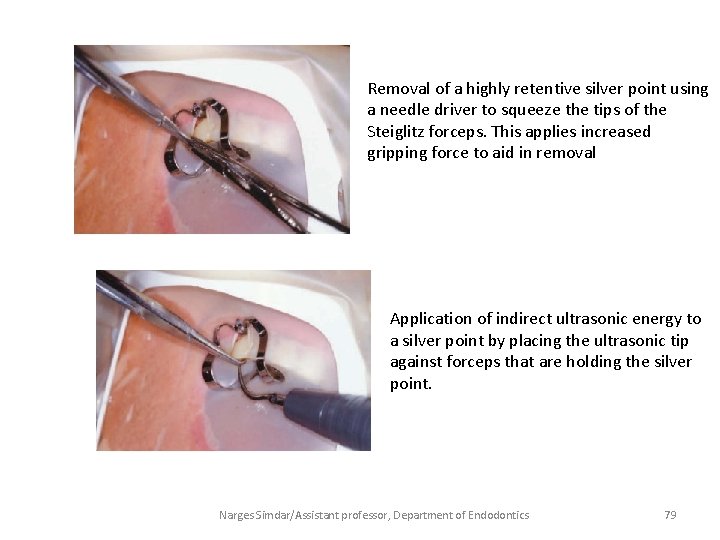
Removal of a highly retentive silver point using a needle driver to squeeze the tips of the Steiglitz forceps. This applies increased gripping force to aid in removal Application of indirect ultrasonic energy to a silver point by placing the ultrasonic tip against forceps that are holding the silver point. Narges Simdar/Assistant professor, Department of Endodontics 79
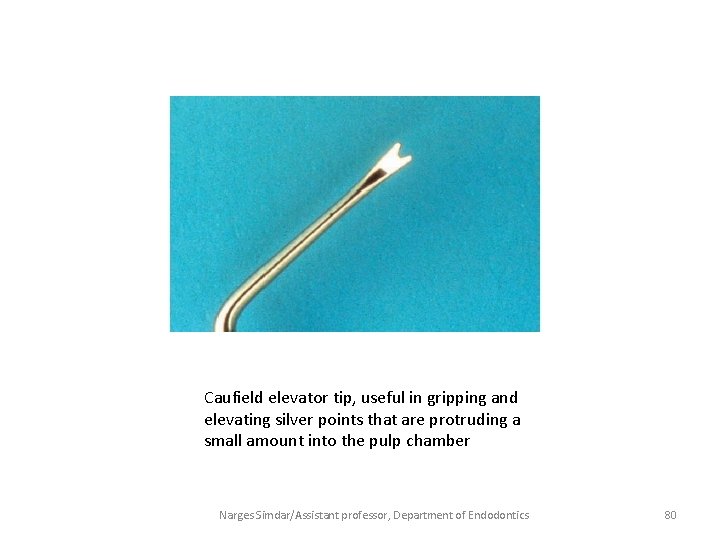
Caufield elevator tip, useful in gripping and elevating silver points that are protruding a small amount into the pulp chamber Narges Simdar/Assistant professor, Department of Endodontics 80
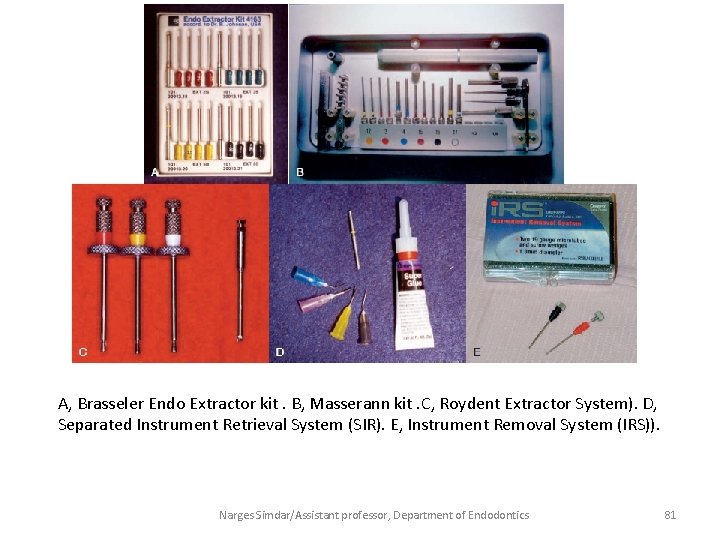
A, Brasseler Endo Extractor kit. B, Masserann kit. C, Roydent Extractor System). D, Separated Instrument Retrieval System (SIR). E, Instrument Removal System (IRS)). Narges Simdar/Assistant professor, Department of Endodontics 81
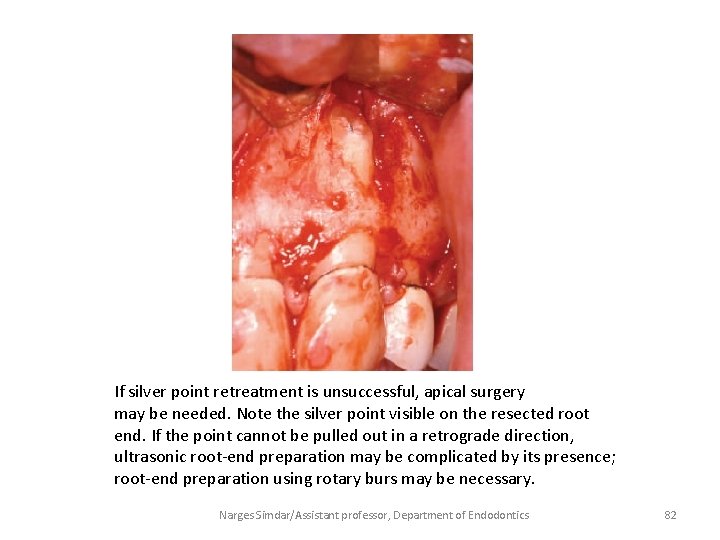
If silver point retreatment is unsuccessful, apical surgery may be needed. Note the silver point visible on the resected root end. If the point cannot be pulled out in a retrograde direction, ultrasonic root-end preparation may be complicated by its presence; root-end preparation using rotary burs may be necessary. Narges Simdar/Assistant professor, Department of Endodontics 82
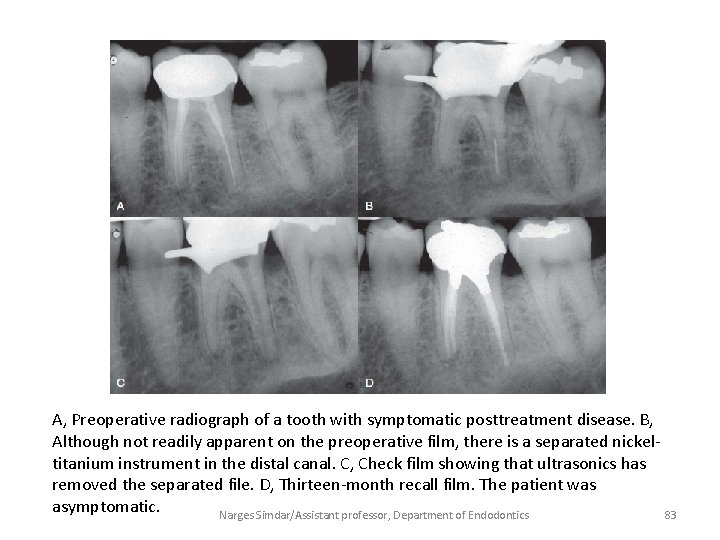
A, Preoperative radiograph of a tooth with symptomatic posttreatment disease. B, Although not readily apparent on the preoperative film, there is a separated nickeltitanium instrument in the distal canal. C, Check film showing that ultrasonics has removed the separated file. D, Thirteen-month recall film. The patient was asymptomatic. Narges Simdar/Assistant professor, Department of Endodontics 83
Narges Simdar/Assistant professor, Department of Endodontics 84