
IN THE NAME OF GOD Cell Viability Cytotoxicity
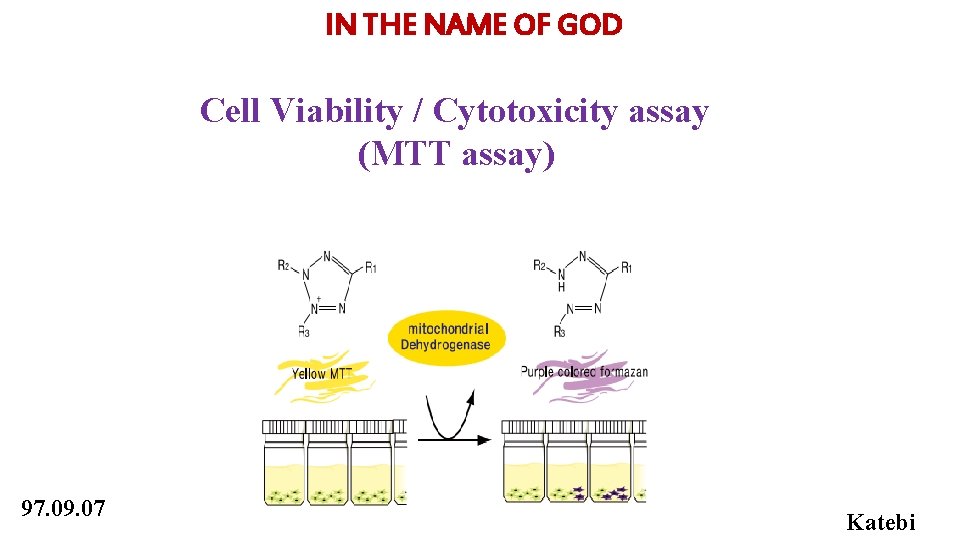
IN THE NAME OF GOD Cell Viability / Cytotoxicity assay (MTT assay) 97. 09. 07 Katebi

Cell Viability / Cytotoxicity assay Based on membrane integrity Trypan blue staining Dye uptake assay Diacetyl fluorescein Labeled chromium uptake assay 51 Cr method Enzyme release assays LDH Based on apoptosis Annexin V Colorimetric assay MTT assay 2
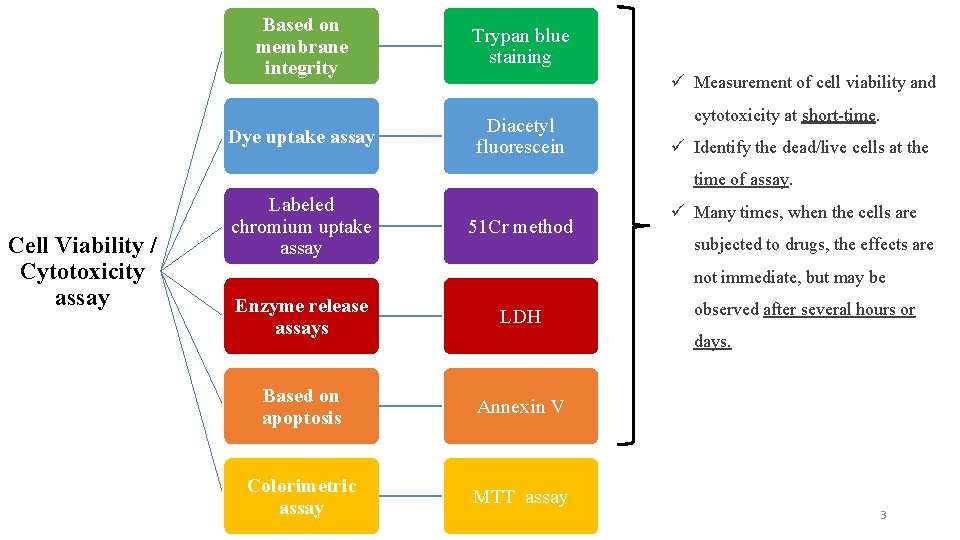
Based on membrane integrity Trypan blue staining Dye uptake assay Diacetyl fluorescein ü Measurement of cell viability and cytotoxicity at short-time. ü Identify the dead/live cells at the time of assay. Cell Viability / Cytotoxicity assay Labeled chromium uptake assay 51 Cr method ü Many times, when the cells are subjected to drugs, the effects are not immediate, but may be Enzyme release assays LDH Based on apoptosis Annexin V Colorimetric assay MTT assay observed after several hours or days. 3
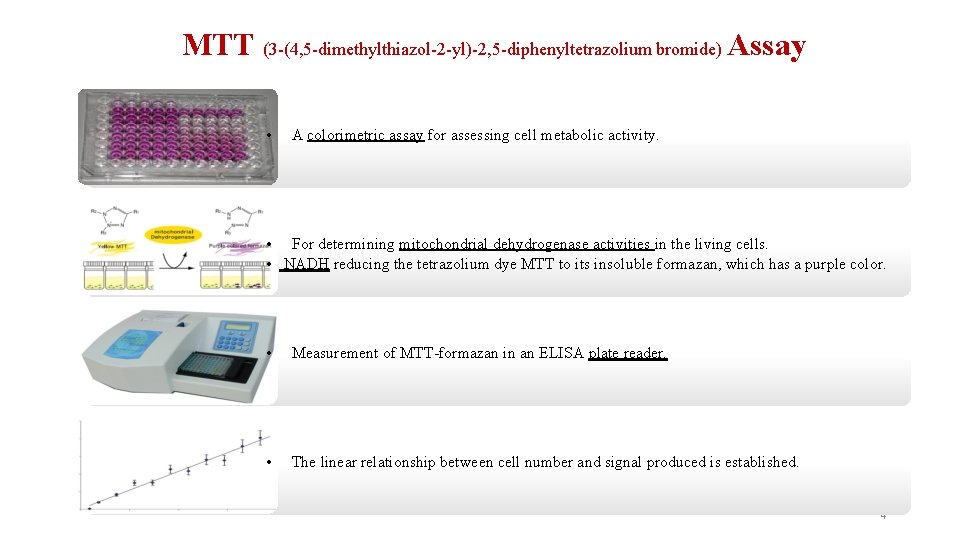
MTT (3 -(4, 5 -dimethylthiazol-2 -yl)-2, 5 -diphenyltetrazolium bromide) Assay • A colorimetric assay for assessing cell metabolic activity. • For determining mitochondrial dehydrogenase activities in the living cells. • NADH reducing the tetrazolium dye MTT to its insoluble formazan, which has a purple color. • Measurement of MTT-formazan in an ELISA plate reader. • The linear relationship between cell number and signal produced is established. 4

MTT and related tetrazolium salts MTT (3 -(4, 5 -dimethylthiazol-2 -yl)2, 5 -diphenyltetrazolium bromide) XTT (2, 3 -bis-(2 -methoxy-4 -nitro-5 sulfophenyl)-2 H-tetrazolium-5 carboxanilide) Insoluble purple formazan product Water soluble product Absorbance 550720 nm Higher sensitivity MTS (3 -(4, 5 -dimethylthiazol-2 -yl)-5 -(3 -carboxymethoxyphenyl)-2(4 -sulfophenyl)-2 Htetrazolium) Water soluble product WSTs (water-soluble tetrazolium salts) Water soluble product Absorbance maximum at 490 nm 5
Application • For assessing cell viability. • To measure cytotoxicity (loss of viable cells). • Drug screening on cell lines and/or patient samples (IC 50). 6
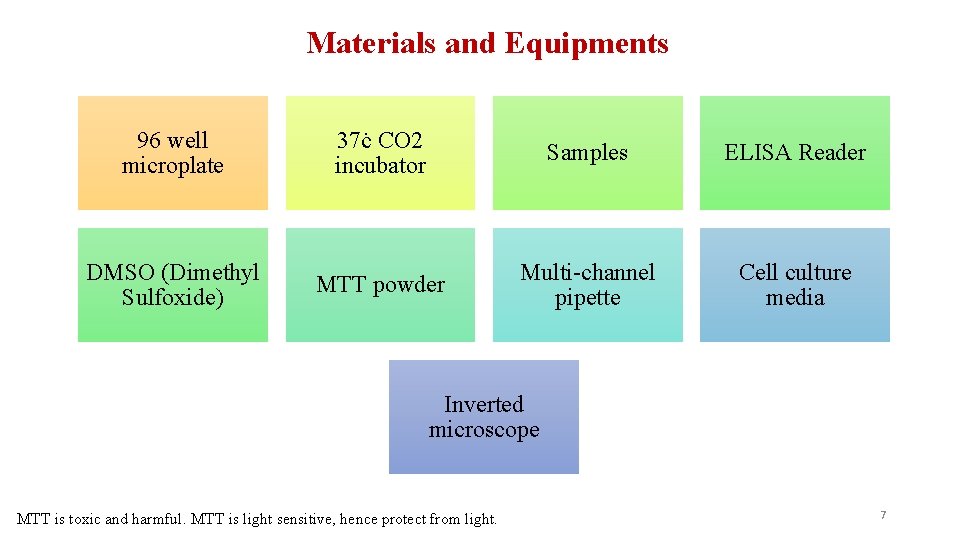
Materials and Equipments 96 well microplate DMSO (Dimethyl Sulfoxide) 37ċ CO 2 incubator Samples ELISA Reader MTT powder Multi-channel pipette Cell culture media Inverted microscope MTT is toxic and harmful. MTT is light sensitive, hence protect from light. 7
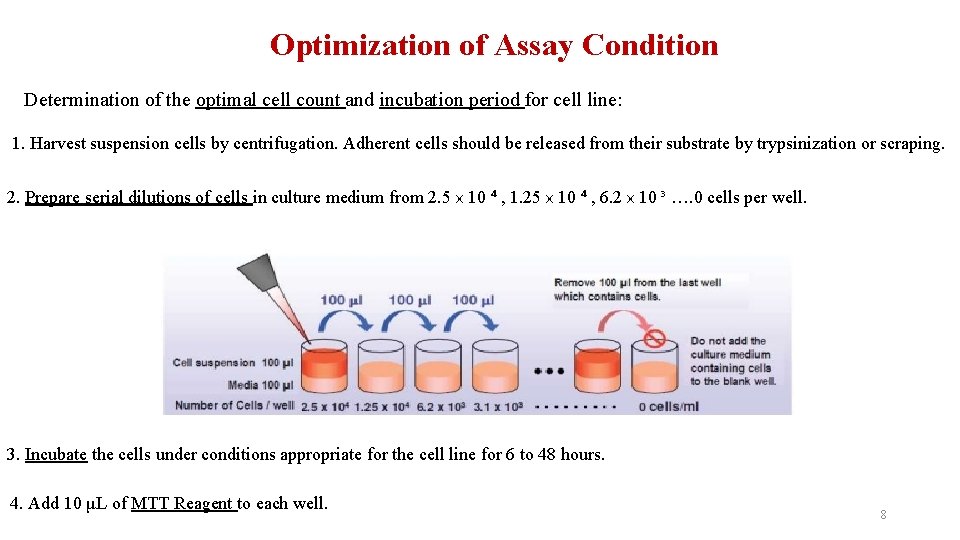
Optimization of Assay Condition Determination of the optimal cell count and incubation period for cell line: 1. Harvest suspension cells by centrifugation. Adherent cells should be released from their substrate by trypsinization or scraping. 2. Prepare serial dilutions of cells in culture medium from 2. 5 x 10 ⁴ , 1. 25 x 10 ⁴ , 6. 2 x 10 ³ …. 0 cells per well. 3. Incubate the cells under conditions appropriate for the cell line for 6 to 48 hours. 4. Add 10 μL of MTT Reagent to each well. 8
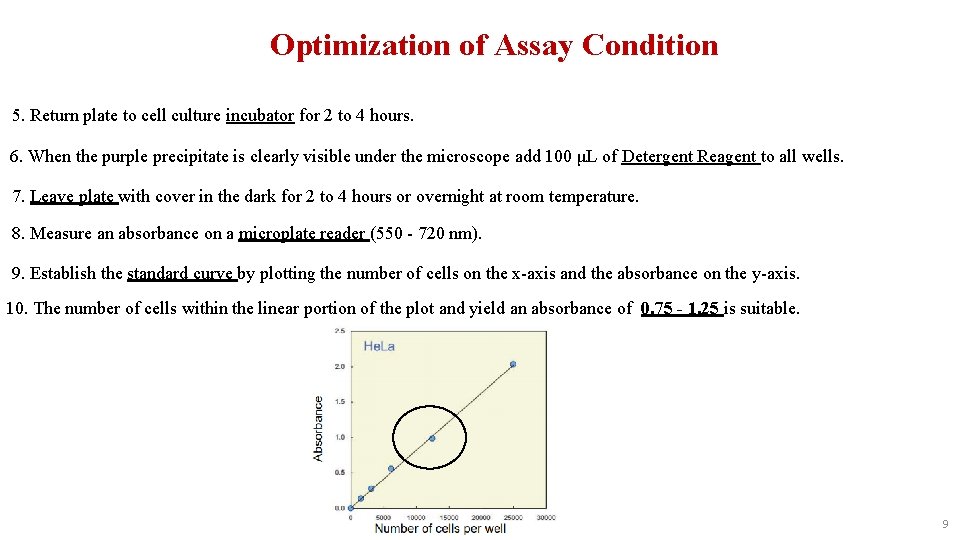
Optimization of Assay Condition 5. Return plate to cell culture incubator for 2 to 4 hours. 6. When the purple precipitate is clearly visible under the microscope add 100 μL of Detergent Reagent to all wells. 7. Leave plate with cover in the dark for 2 to 4 hours or overnight at room temperature. 8. Measure an absorbance on a microplate reader (550 - 720 nm). 9. Establish the standard curve by plotting the number of cells on the x-axis and the absorbance on the y-axis. 10. The number of cells within the linear portion of the plot and yield an absorbance of 0. 75 - 1. 25 is suitable. 9
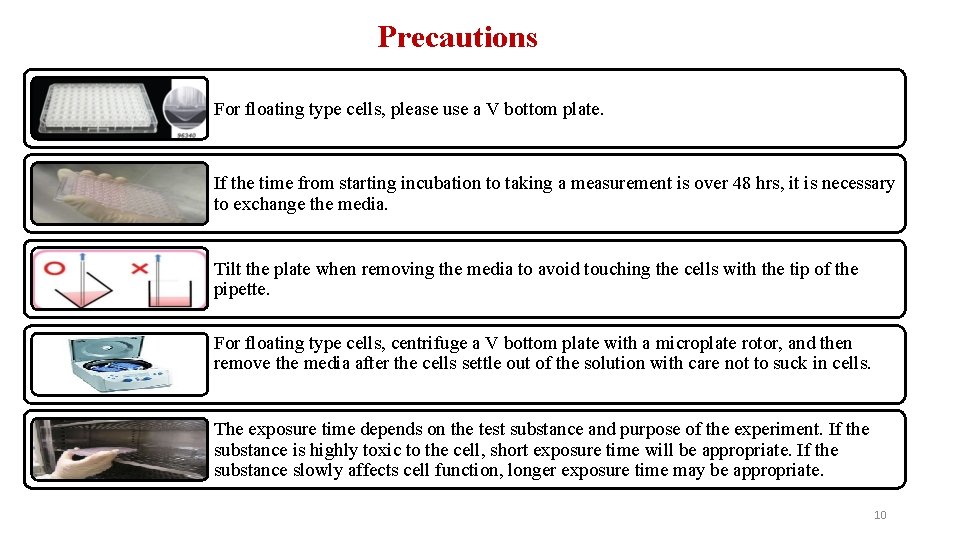
Precautions For floating type cells, please use a V bottom plate. If the time from starting incubation to taking a measurement is over 48 hrs, it is necessary to exchange the media. Tilt the plate when removing the media to avoid touching the cells with the tip of the pipette. For floating type cells, centrifuge a V bottom plate with a microplate rotor, and then remove the media after the cells settle out of the solution with care not to suck in cells. The exposure time depends on the test substance and purpose of the experiment. If the substance is highly toxic to the cell, short exposure time will be appropriate. If the substance slowly affects cell function, longer exposure time may be appropriate. 10
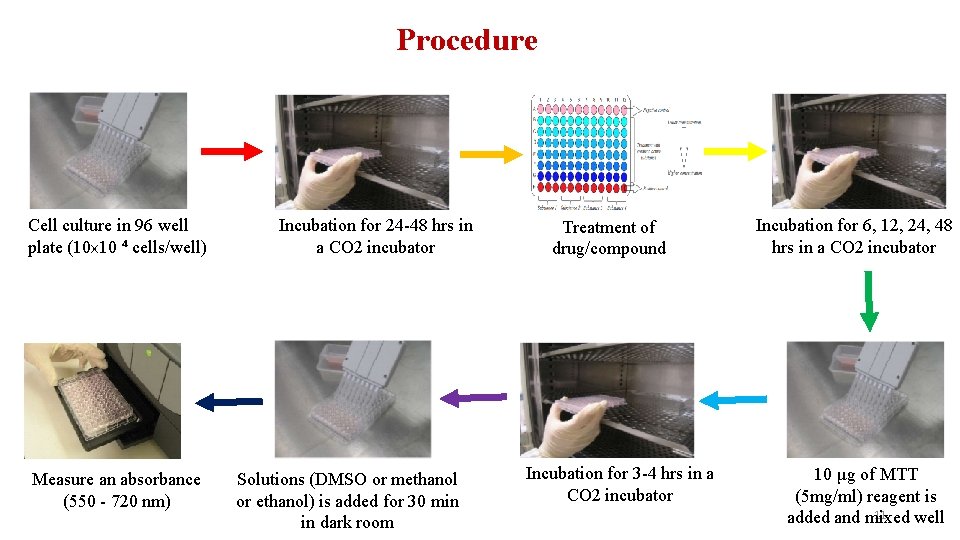
Procedure Cell culture in 96 well plate (10 x 10 ⁴ cells/well) Measure an absorbance (550 - 720 nm) Incubation for 24 -48 hrs in a CO 2 incubator Solutions (DMSO or methanol or ethanol) is added for 30 min in dark room Treatment of drug/compound Incubation for 3 -4 hrs in a CO 2 incubator Incubation for 6, 12, 24, 48 hrs in a CO 2 incubator 10 μg of MTT (5 mg/ml) reagent is 11 added and mixed well
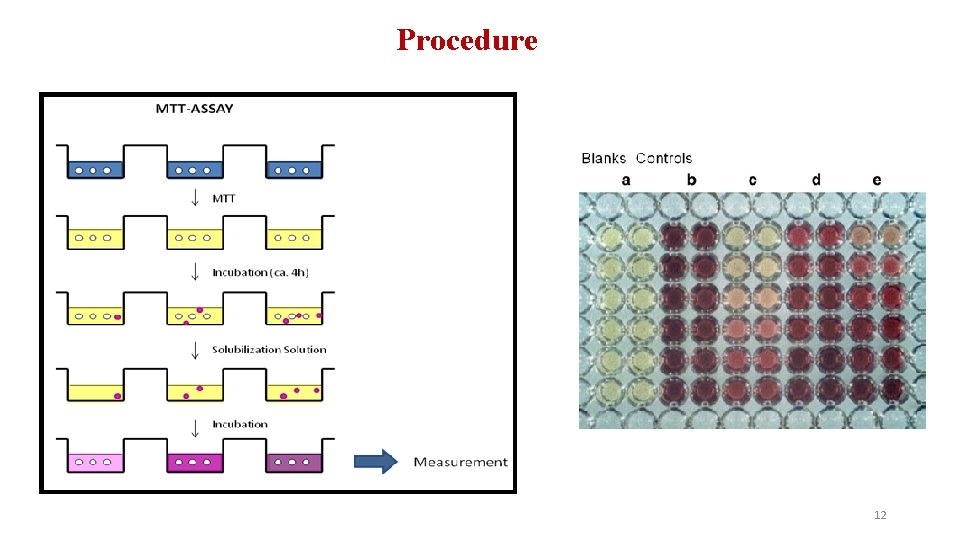
Procedure 12

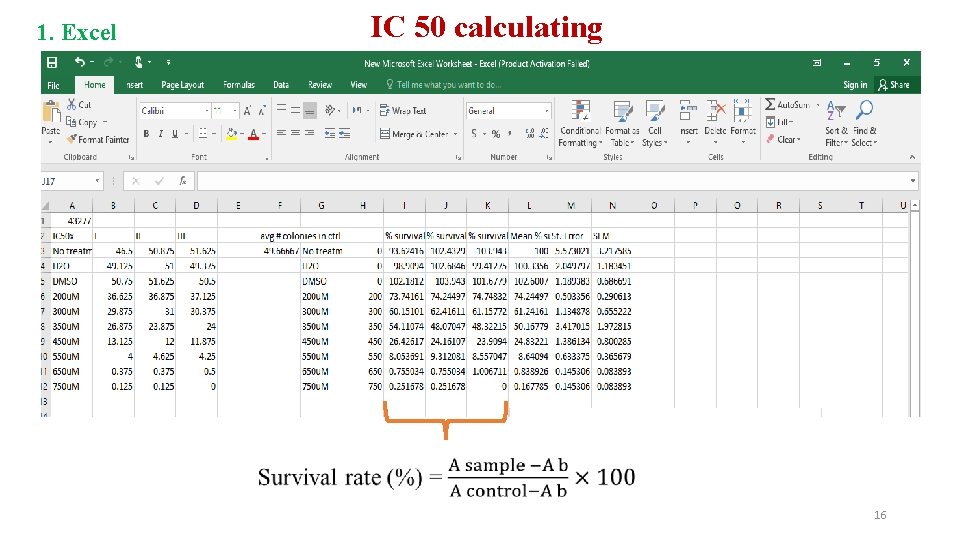
Calculating the Cell Survival Rate Example: Background absorbance: 300 Sample A: 700 Control: 800 2. True relative ratio: (Sample-Background)/(Control-Background) : (700 -300)/(800 -300)=80% A: Absorbance b (blank/background): no cell, as a background control Control: healthy cells with 100% viability, no drug 13
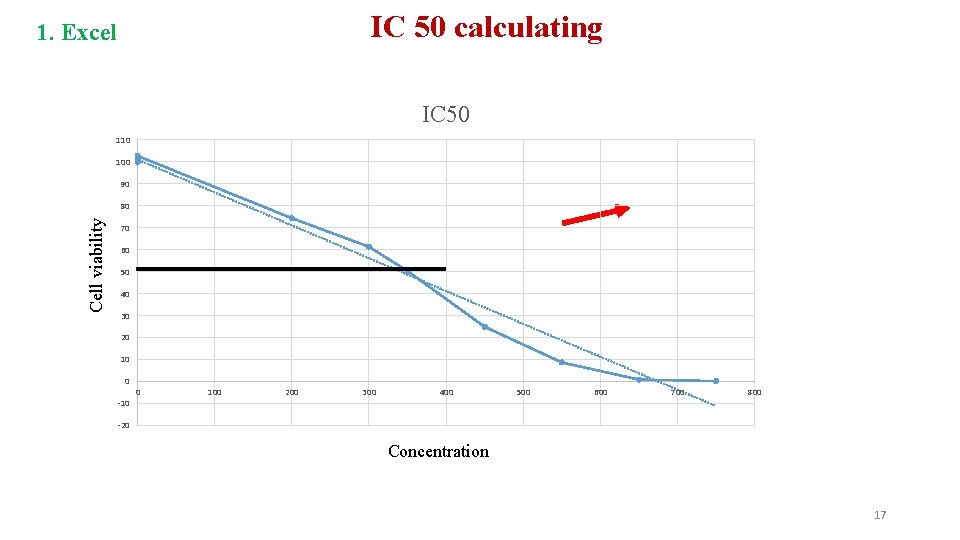
IC 50 in MTT assay Ø Determination of IC 50 values: ü Different dose ranges are required. ü After measurement by plate Reader. Ø The MTT assay is suitable for the measurement of drug sensitivity in established cell lines. For cell lines: the decrease in cell number reflects cell growth inhibition and the drug sensitivity is then usually specified as the concentration of the drug that is required to achieve 50% growth inhibition as compared to the growth of the untreated control (50% inhibitory concentration, IC 50). 14
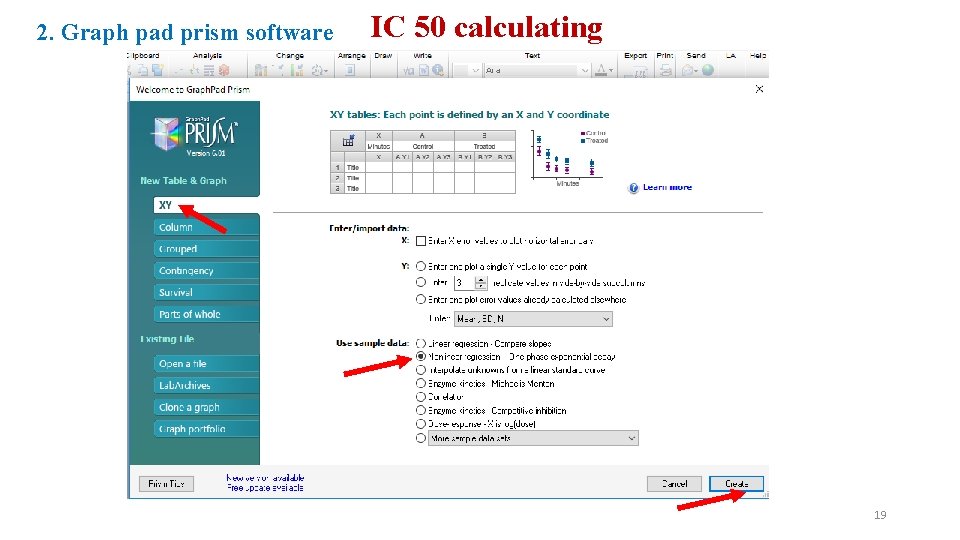
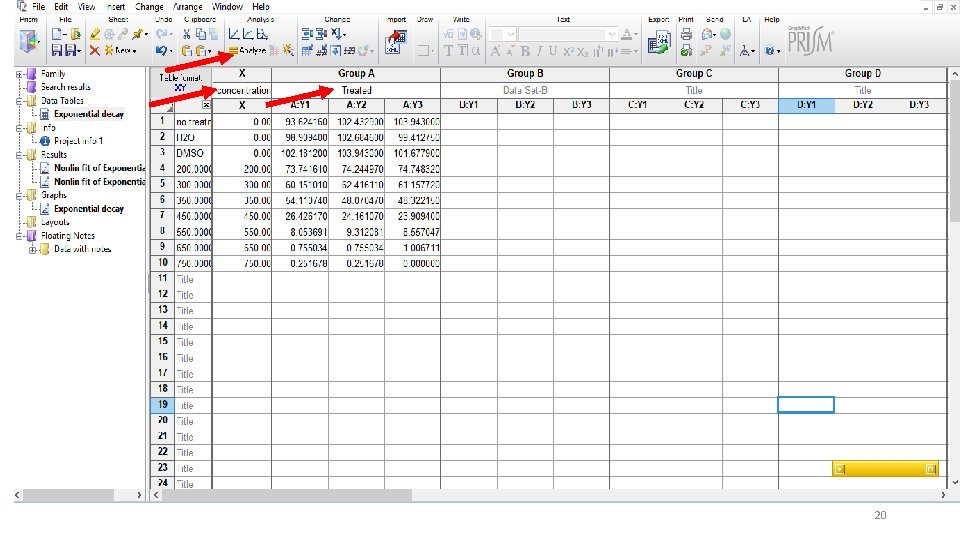
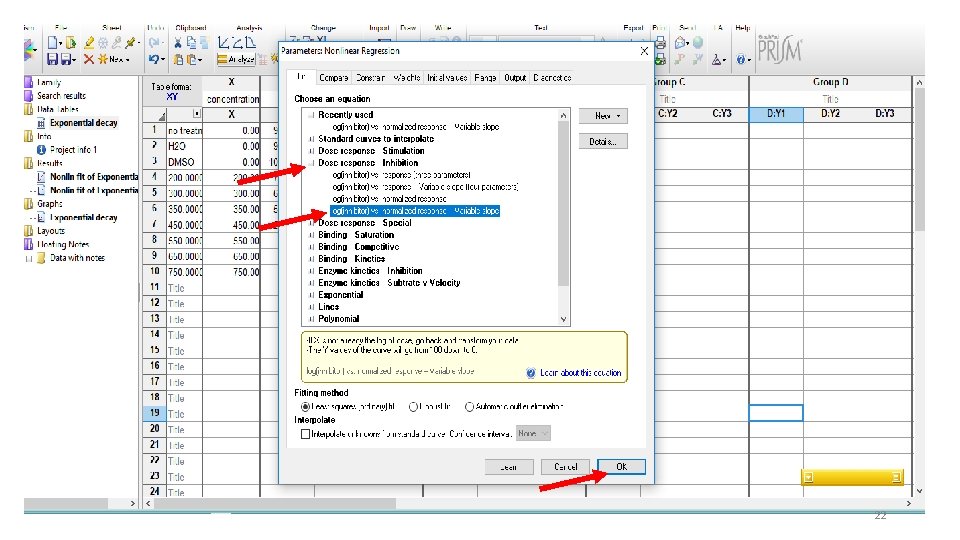
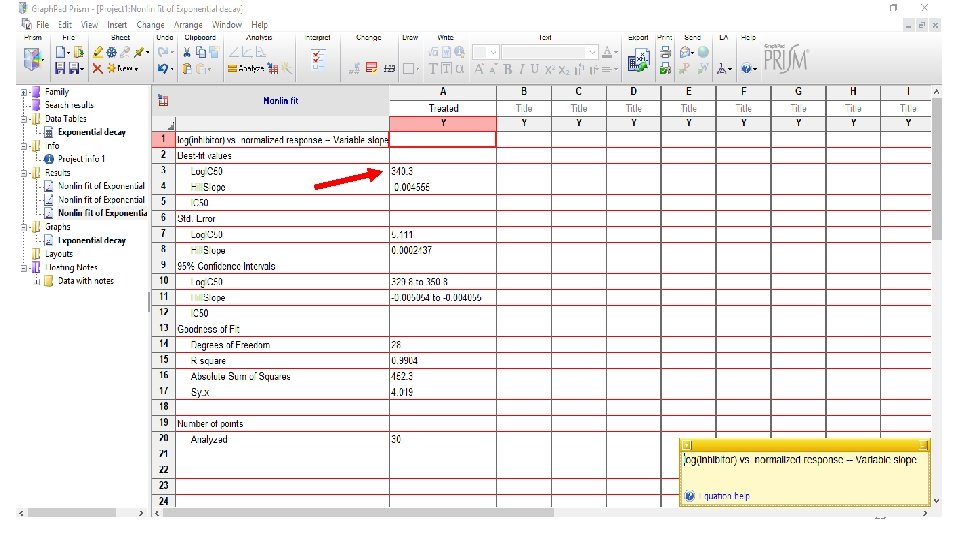
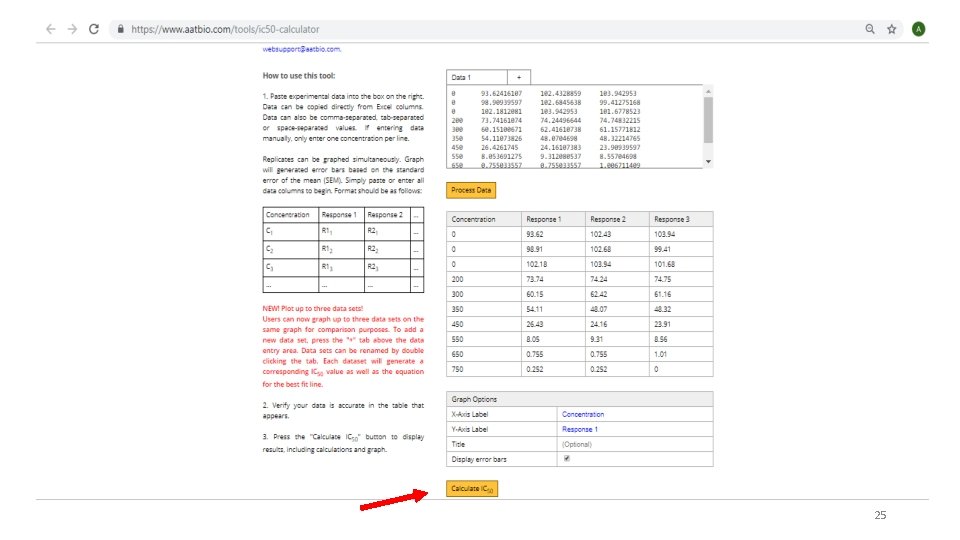
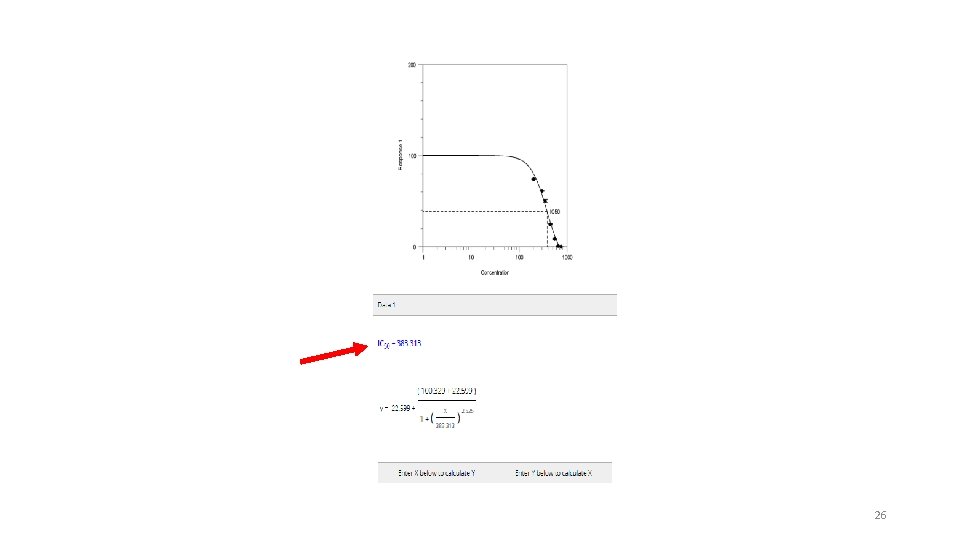
IC 50 calculating 1. • Excel 2. • Graph pad prism software 3. • Online tool (https: //www. aatbio. com/tools/ic 50 -calculator) 15
IC 50 calculating 1. Excel 16
IC 50 calculating 1. Excel IC 50 110 100 90 Cell viability 80 70 60 50 40 30 20 10 0 0 100 200 300 400 500 600 700 800 -10 -20 Concentration 17
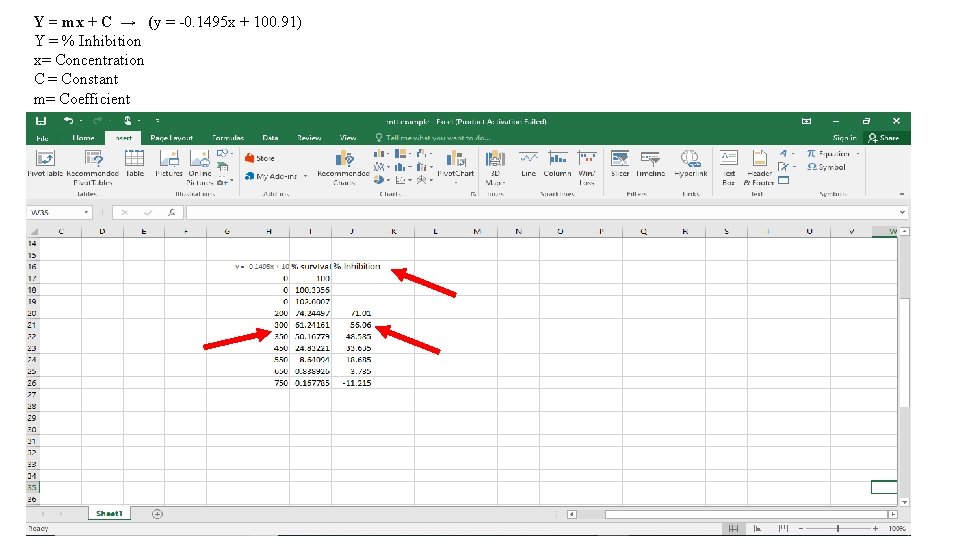
Y = mx + C → (y = -0. 1495 x + 100. 91) Y = % Inhibition x= Concentration C = Constant m= Coefficient 18
2. Graph pad prism software IC 50 calculating 19
20

21
22
23
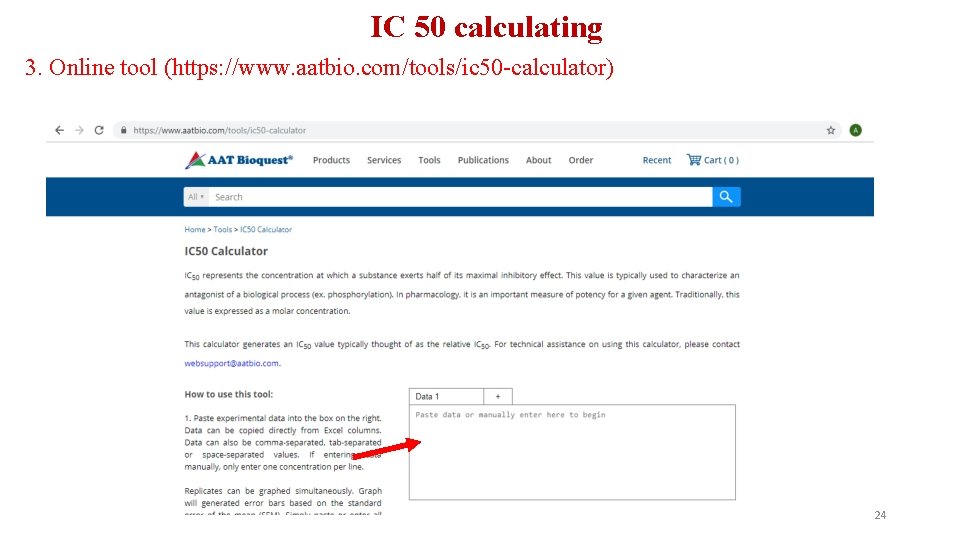
IC 50 calculating 3. Online tool (https: //www. aatbio. com/tools/ic 50 -calculator) 24
25
26
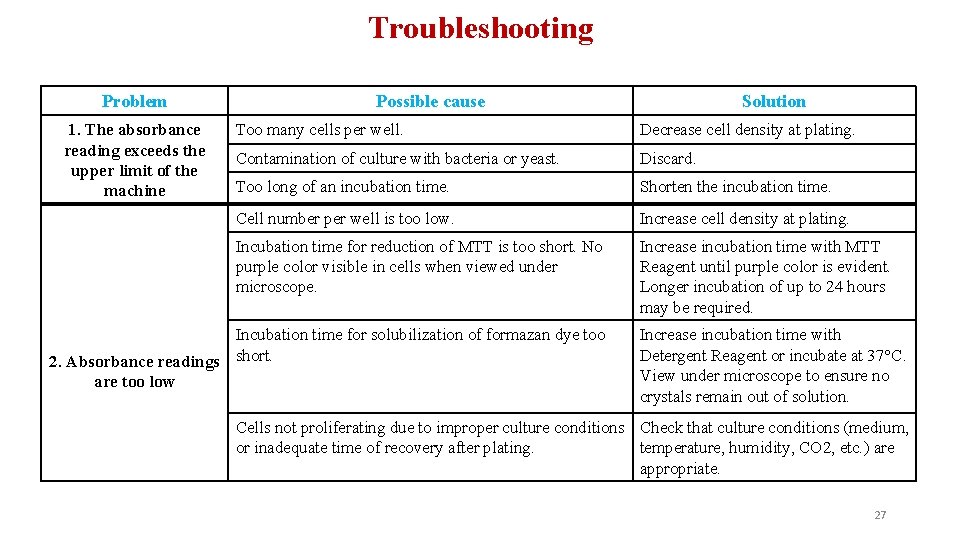
Troubleshooting Problem 1. The absorbance reading exceeds the upper limit of the machine Possible cause Solution Too many cells per well. Decrease cell density at plating. Contamination of culture with bacteria or yeast. Discard. Too long of an incubation time. Shorten the incubation time. Cell number per well is too low. Increase cell density at plating. Incubation time for reduction of MTT is too short. No purple color visible in cells when viewed under microscope. Increase incubation time with MTT Reagent until purple color is evident. Longer incubation of up to 24 hours may be required. Incubation time for solubilization of formazan dye too 2. Absorbance readings short. are too low Increase incubation time with Detergent Reagent or incubate at 37°C. View under microscope to ensure no crystals remain out of solution. Cells not proliferating due to improper culture conditions Check that culture conditions (medium, or inadequate time of recovery after plating. temperature, humidity, CO 2, etc. ) are appropriate. 27
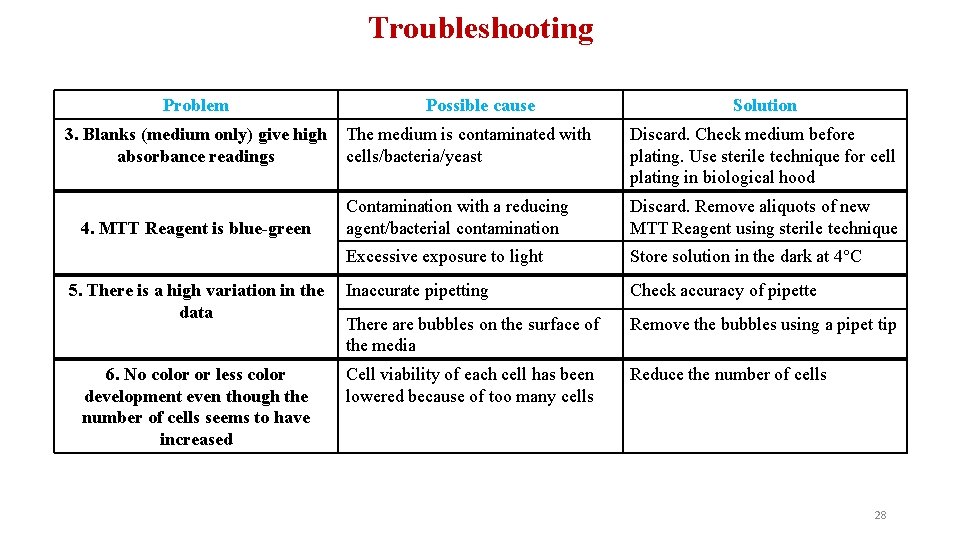
Troubleshooting Problem 3. Blanks (medium only) give high absorbance readings 4. MTT Reagent is blue-green 5. There is a high variation in the data 6. No color or less color development even though the number of cells seems to have increased Possible cause Solution The medium is contaminated with cells/bacteria/yeast Discard. Check medium before plating. Use sterile technique for cell plating in biological hood Contamination with a reducing agent/bacterial contamination Discard. Remove aliquots of new MTT Reagent using sterile technique Excessive exposure to light Store solution in the dark at 4°C Inaccurate pipetting Check accuracy of pipette There are bubbles on the surface of the media Remove the bubbles using a pipet tip Cell viability of each cell has been lowered because of too many cells Reduce the number of cells 28

Thank you 29
- Slides: 29