
In THE NAME Of GOD Case Presentation Hematuria


- Slides: 22
In THE NAME Of GOD
Case Presentation Hematuria due to Cow's milk allergy
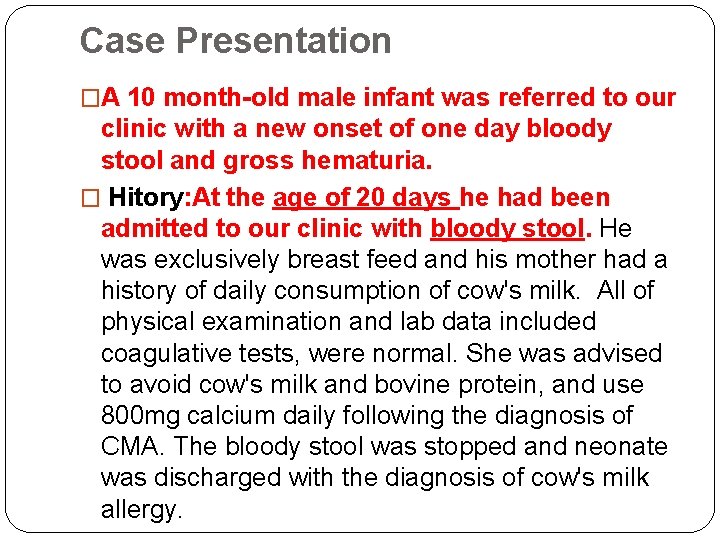
Case Presentation �A 10 month-old male infant was referred to our clinic with a new onset of one day bloody stool and gross hematuria. � Hitory: At the age of 20 days he had been admitted to our clinic with bloody stool. He was exclusively breast feed and his mother had a history of daily consumption of cow's milk. All of physical examination and lab data included coagulative tests, were normal. She was advised to avoid cow's milk and bovine protein, and use 800 mg calcium daily following the diagnosis of CMA. The bloody stool was stopped and neonate was discharged with the diagnosis of cow's milk allergy.
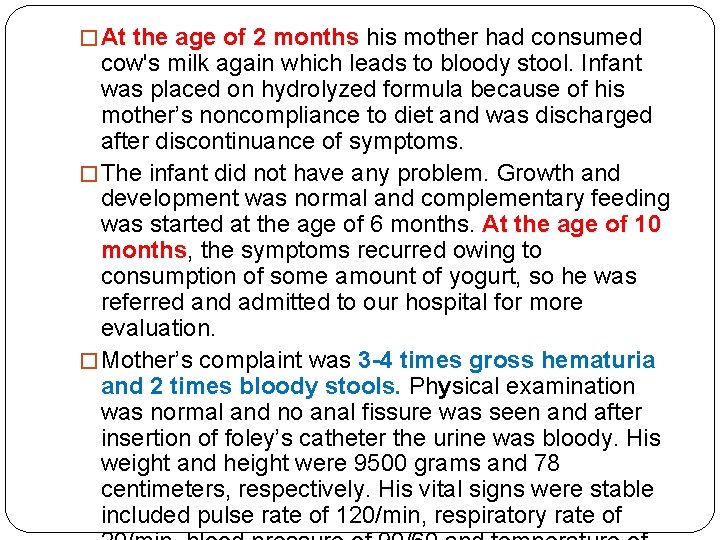
� At the age of 2 months his mother had consumed cow's milk again which leads to bloody stool. Infant was placed on hydrolyzed formula because of his mother’s noncompliance to diet and was discharged after discontinuance of symptoms. � The infant did not have any problem. Growth and development was normal and complementary feeding was started at the age of 6 months. At the age of 10 months, the symptoms recurred owing to consumption of some amount of yogurt, so he was referred and admitted to our hospital for more evaluation. � Mother’s complaint was 3 -4 times gross hematuria and 2 times bloody stools. Physical examination was normal and no anal fissure was seen and after insertion of foley’s catheter the urine was bloody. His weight and height were 9500 grams and 78 centimeters, respectively. His vital signs were stable included pulse rate of 120/min, respiratory rate of
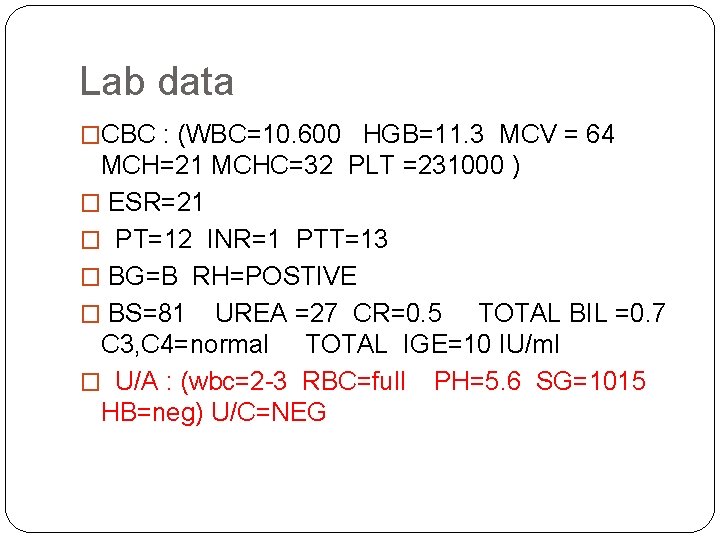
Lab data �CBC : (WBC=10. 600 HGB=11. 3 MCV = 64 MCH=21 MCHC=32 PLT =231000 ) � ESR=21 � PT=12 INR=1 PTT=13 � BG=B RH=POSTIVE � BS=81 UREA =27 CR=0. 5 TOTAL BIL =0. 7 C 3, C 4=normal TOTAL IGE=10 IU/ml � U/A : (wbc=2 -3 RBC=full PH=5. 6 SG=1015 HB=neg) U/C=NEG
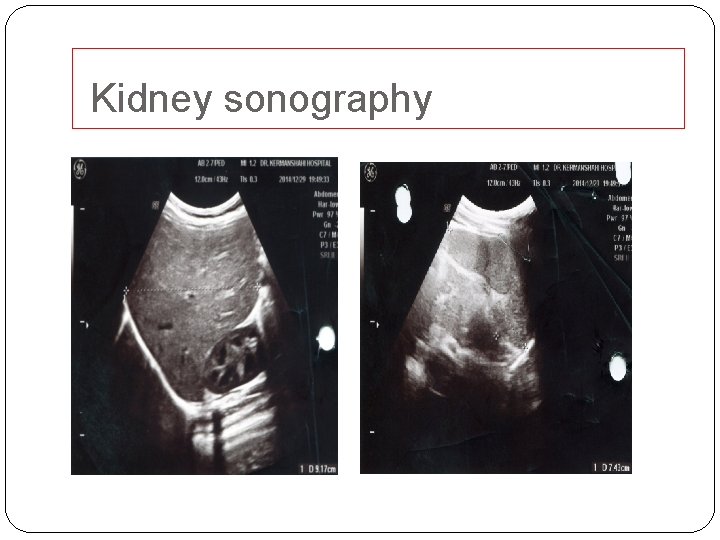
Kidney sonography
Discussion: �All milk proteins are potential allergens and polysensitization to several proteins occurs in most patients. �Cow's milk contains casein (alpha. S 1 -, alpha. S 2 -, beta-, and kappa-caseins) and whey (alphalactalbumin, ( ALA); beta-lactoglobulin, ( BLG); bovine lactoferrin; bovine serum albumin, (BSA); and bovine immunoglobulins) proteins that account for approximately 80 and 20 percent of total protein, respectively
�Cooking diminishes the allergenicity of whey proteins, particularly beta-lactoglobulin, presumably by denaturation of heat-labile proteins that results in loss of conformational epitopes. This may explain why extensively heated milk (eg, milk in baked goods) is better tolerated by many patients Similarly, yogurt cultures, which ferment and acidify milk, diminish the amount of intact whey protein in milk and may result in tolerance of yogurt-based dairy products by individuals with CMA exclusively sensitized to whey proteins "
�Clinical findings of cow's milk allergy (CMA) frequently appear during the first few months of life, often within days or weeks after the introduction of a cow's milk-based formula into the diet, although symptoms may also occur with exclusive breastfeeding if the mother ingests cow's milk. Patients with CMA present with a wide range of Ig. E- and non-Ig. E-mediated clinical syndromes.
Ig. E-mediated food-triggered reactions �Generally occur immediately, within minutes to two hours after ingestion. These reactions can present with skin, oropharyngeal, upper and lower respiratory tract, gastrointestinal tract, and/or cardiovascular signs and symptoms. �Reactions can vary from mild to life-threatening anaphylaxis. Cow's milk is the third most common food, after peanut and tree nuts, responsible for food-induced anaphylaxis in pediatric and mixed age populations (10 to 19 percent of cases)
Mixed Ig. E and non-Ig. E mediated reactions �The mixed reactions may have either humoral and/or cell-mediated mechanisms and may present with acute and or chronic symptoms. �Atopic dermatitis (eczema) — Food allergy plays a pathogenic role in a subset of patients, primarily infants and children, with atopic dermatitis. Milk is second most common allergy (egg allergy is the most common) reported in infants and young children with moderate to severe atopic dermatitis
Non-Ig. E mediated reactions � The non-Ig. E-mediated reactions usually have a delayed onset beyond two hours of ingestion. � Food protein-induced enterocolitis syndrome , Allergic eosinophilic gastrointestinal disorders , Infantile colic , Constipation , Gastroesophageal reflux, Heiner syndrome, Protein-induced proctitis/proctocolitis were non-Ig. E-mediated reactions. � Protein-induced proctitis/proctocolitis( similar to our patient ) usually presents by six months of life with bloody-streaked, mucousy, loose stools and occasionally diarrhea in breastfed or standard formula -fed infants who are otherwise well-appearing. Cow's milk and soy are the major causative foods.
�Hematuria is not mentioned in literature as a symptom of CMA. Cases of allergy and hematuria have reported in articles.
Etiology of hematuria �Irritation of the meatus or perineum, trauma and urinary tract infection (UTI) are the most common causes of gross hematuria in children. �Ig. A nephropathy, nephrolithiasis, sickle cell disease/trait, coagulopathy, glomerular disease including post-infectious glomerulonephritis, malignancy (e. g. Wilms' tumor) and drug-induced hemorrhagic cystitis (e. g. cyclophosphamide) are the least common causes .
�Our patient had no history of trauma or manipulation of genital area. Negative urine culture, normal coagulation and electrophoresis test ruled out UTI, coagulopathy and sickle cell disease/trait, respectively. �According to normal kidney sonography, renal stone and malignancies are not considered. �No evidences of nephritis were observed included normal BUN, normal creatinine, no proteinuria, and being normotensive. �There was no history of drug-induced hemorrhagic cystitis.
� Most important differential diagnosis for this patient was Ig. A nephropathy which could be presented with one or recurrent episodes of gross hematuria in 40 to 50 percent of cases usually following an upper respiratory tract infection. Disease could present at any age. The presence of Ig. A nephropathy would be established only by kidney biopsy � Regarding normal renal function, blood pressure and no significant proteinuria in this patient, there was no indication for renal biopsy. Ig. A nephropathy was not a probable diagnosis. �Stopping both symptoms with elimination of bovine protein from the diet and resurgence following starting again, were the best diagnostic tool.
� The pathophysiology of hematuria is various. Glomerular hematuria may be the result of a structural disruption in the integrity of glomerular basement membrane caused by inflammatory or immunologic processes. Chemicals may cause toxic damage of renal tubules, whereas calculi cause mechanical erosion of mucosal surfaces in the genitourinary tract resulting in hematuria. � We propose glomerular basement membrane disruption as the major cause of hematuria in this patient. It could be resulted by both immunologic processes and non-Ig. E mediated reactions to Cow's milk, such as Heiner syndrom). However, we have no documentation for this claim, repeated attacks of hamaturia and bloody stool after bovine protein consumption is the best provocation test. This confirms diagnosis and finding evidence of precipitating antibodies to cow’s milk in the serum is controversial.
�. AMMANN and E. ROSSI in 1966 had reported a 3 -year-old boy. His mother's family were victims of eczema, asthma, and hay fever. At the age of 4 weeks the patient developed seborrhoeic dermatitis, which later changed into obstinate eczema. At 5 months asthma-bronchitis appeared for the first time, and subsequently the patient suffered repeatedly from genuine asthmatic attacks, for which his family physician prescribed steroid therapy lasting for several months. From the age of 21 onwards episodes of hematuria lasting 1 to 2 days were repeatedly observed
�Lelong M, Pegeon B. report 2 cases of children presenting with episodes of hematuria, frequently following attacks of asthma or of allergic rhinitis in 1989. In both children, a respiratory provocation test with a mite extract triggered of hematuria. One child had an Ig. A nephropathy. In the second, the renal biopsy was normal and the cause of the hematuria remains unknown. These case reports suggest the need to carry out a systematic search for microscopic hematuria in patients with asthma
�Grahm. DM, Mc. Moriss MS, Flynn. JT, had, presented the case of a child with idiopathic episodic gross hematuria in 2002. The child also has significant environmental allergies, and his episodes of hematuria coincide with flares of his allergic symptoms.
�The diagnosis of CMA is based upon the history and laboratory testing, when available (diagnostic tests for non-Ig. E-mediated manifestations of CMA are limited) � The gold-standard for diagnosis is a cliniciansupervised double-blind, placebo controlled oral food challenge �Althoughan open challenge will often suffice.
WITH THANKS