
IN THE NAME OF GOD Acute Pulmonary embolism

IN THE NAME OF GOD
Acute Pulmonary embolism Dr M. Rouzbahani Interventional Cardiologist KUMS
Pulmonary embolism (PE) and deep vein thrombosis (DVT) together constitute one of the “big three” cardiovascular diseases, the other two being myocardial infarction (MI) and stroke. Estimates of the global incidence of VTE range from 1. 2 to 2. 7 per 1000 per year.
There is seasonality in hospitalizations for PE. The highest number of admissions is in the winter, and the lowest number is in the summer. In the United States, PE causes more than 100, 000 deaths annually. Most deaths in hospitalized patients with PE result from right heart failure due to the initial PE or from recurrent PE despite anticoagulation.
Cancer patients have a fourfold increased risk of VTE compared with the general population. When unprovoked VTE occurs, there is an increased likelihood that occult cancer will subsequently be detected, especially during the first 6 months after the diagnosis of VTE.

Molecular Pathophysiology The Virchow triad of stasis, hypercoagulability, and endothelial injury often activates th pathophysiologic cascade leading to VTE. Inflammation is not included in the Virchow triad, but it is a key precipitant.
Infection and its associated inflammation lead to the recruitment of platelets one of the first step necessary for thrombus initiation. High hs. CRP increase risk of VTE Tx with rosovastatin rduced 43% risk o syptomatic VTE.
Cardiopulmonary Dynamics increased pulmonary vascular resistance due to vascular obstruction, neurohumoral agents, or pulmonary artery baroreceptors. increases in pulmonary vascular resistance and pulmonary hypertension result from secretion of vasoconstricting compounds such as serotonin, reflex pulmonary artery vasoconstriction, and hypoxemia.
The overloaded right ventricle releases cardiac biomarkers such as pro–B type natriuretic peptide (pro-BNP), brain natriuretic peptide (BNP), and troponin, all of which portend an increased likelihood of adverse clinical outcomes. The sudden rise in pulmonary artery pressure abruptly increases right ventricular afterload, with consequent elevation of right ventricular wall tension followed by right ventricular dilation and dysfunction.
As the right ventricle dilates, the interventricular septum shifts toward the left, leading to underfilling and decreased left ventricular diastolic distensibility. With hampered filling of the left ventricle, systemic cardiac output and systolic arterial pressure both decline, impairing coronary perfusion and causing myocardial ischemia.

Elevated right ventricular wall tension after massive PE reduces right coronary artery flow and increases right ventricular myocardial oxygen demand, causing ischemia. Perpetuation of this cycle can lead to right ventricular infarction, circulatory collapse, and death.
Classification of Pulmonary Embolism Classification of acute PE can assist with prognostication and clinical management. Massive PE accounts for 5% to 10% of cases. Submassive PE is more common, occurring in approximately 20% to 25% of patients. Low-risk PE constitutes the majority of PE cases, approximately 65% to 70%.
Massive Pulmonary Embolism Patients with massive PE can develop cardiogenic shock and multisystem organ failure. Renal insufficiency, hepatic dysfunction, and altered mentation occur commonly. Massive PE has a high mortality rate. Thrombosis is widespread, affecting at least half of the pulmonary arterial vasculature. Clot typically is present bilaterally, sometimes as a “saddle” PE in the main pulmonary artery.
Massive Pulmonary Embolism Dyspnea usually Is the most prominent symptom. chest pain is unusual; transient cyanosis is common; and systemic arterial hypotension requiring pressor support occurs frequently. Excessive fluid boluses may worsen right-sided heart failure. These patients may require heroic efforts to enable survival, such asextracorporeal membrane oxygenation.
Submassive Pulmonary Embolism Submassive PE patients present with normal systemic arterial pressure. The European Society of Cardiology PE Guidelines now subdivide submassive PE into high-risk and low-risk entities. Patients with submassive PE, high risk, present with both right ventricular hypokinesis and elevated cardiacbiomarkers such as troponin, pro-BNP, or BNP. Those with submassive PE, low risk, present either with right ventricular dysfunction or elevated cardiac biomarkers, but not both.
Submassive Pulmonary Embolism Usually, one third or more of the pulmonary artery vasculature is obstructed in submassive PE patients. Sudden onset of moderate pulmonary arterial hypertension and right ventricular enlargement occur commonly. They are at risk for recurrent PE, even with adequat anticoagulation. Most survive, but some will deteriorate clinically and require escalation of therapy with pressor support or thrombolysis.
Low-Risk Pulmonary Embolism They present with normal systemic arterial pressure, no cardiac biomarker release, and normal right ventricular function. They often prove to have an anatomically small PE and appear clinically stable. Adequate anticoagulation usually leads to an excellent clinical outcome. They may be good candidates for home therapy.
Pulmonary Infarction Pulmonary infarction is characterized by pleuritic chest pain that may be unremitting or may wax andwane. Hemoptysis occasionally accompanies the pleurisy. The embolus typically lodges in the peripheral pulmonary arterial tree, near the pleura. Tissue infarction usually occurs 3 to 7 days after embolism. Signs and symptoms often include fever, leukocytosis, elevated erythrocyte sedimentation rate, and radiologic evidence of infarction.
Paradoxical Embolism Paradoxical embolism may manifest with a sudden stroke, which may be misdiagnosed as “cryptogenic. ” The cause is a DVT that embolizes to the arterial system, usually through a patent foramen ovale. DVT can be small and break away completely from a tiny leg vein, leaving no residual evidence of thrombosis that can be imaged on venous ultrasound examination.
Nonthrombotic Pulmonary Embolism Sources of embolism other than thrombus are uncommon. They include fat, tumor, air, and amniotic fluid. Fat embolism most often occurs after blunt traum complicated by long bone fractures. Air embolus can occur during placement or removal of a central venous catheter. Amniotic fluid embolism may be catastrophic and is characterized by respiratory failure, cardiogenic shock, and disseminated intravascular coagulation. Intravenous drug abusers sometimes self-inject hair, talc, and cotton as contaminants of the drug of abuse; these patients also are susceptible to septic PE, which can cause endocarditis of the tricuspid or pulmonic valve.
Epidemiology Increase Age Obesity Smoking Dm Imobilization Surgery Cancer Pregnancy Ocp
Major Risk Factors for Venous Thromboembolism Advanced age Arterial disease, including carotid and coronary disease Personal or family history of venous thromboembolism Recent surgery, trauma, or immobility, including stroke Congestive heart failure Chronic obstructive pulmonary disease Acute infection Blood transfusion Erythropoietin-stimulating factor Chronic inflammation (e. g. , inflammatory bowel disease) Chronic kidney disease
Major Risk Factors for Venous Thromboembolism Air pollution Long-haul air travel Pregnancy, oral contraceptive pills, or postmenopausal hormone replacement therapy Pacemaker, implantable cardioverter-defibrillator leads, or indwelling central venous catheter Hypercoagulable states Factor V Leiden resulting in activated protein C resistance Prothrombin gene mutation 20210 Antithrombin deficiency Protein C deficiency Protein S deficiency Antiphospholipid antibody syndrome (acquired, not inherited)
Diagnosis PE often occurs concomitantly with other illnesses, especially pneumonia and heart failure, The most useful approach is a clinical assessment of likelihood, based on presenting symptoms and signs, When PE is not among the most likely diagnoses, a normal plasma D-dimer usually can rule out this condition When PE is strongly suspected, a D-dimer need not be obtained, and one can proceed directly to chest computed tomography (CT) imaging.
Clinical Presentation Dyspnea is the most frequent symptom tachypnea is the most frequent sign Severe dyspnea, syncope, or cyanosis portends a major lifethreatening PE, in which the patient often lacks chest pain. Paradoxically, severe pleuritic pain often signifies that the embolism is small, not life-threatening, and located in the distal pulmonary arterial system, near the pleural lining.
PE should be suspected in hypotensive patients who have evidence of: 1 -venous thrombosis or predisposing VTE risk factors 2 -acute cor pulmonale (acute right ventricular failure), with features such as distended neck veins, right-sided S 3 gallop, right ventricular heave, tachycardia, or tachypnea , especially if 3 -there are echocardiographic findings of right ventricular dilation and hypokinesis or electrocardiographic evidence of acute cor pulmonale manifested by a new S 1 Q 3 T 3 pattern new right bundle branch block, or right ventricular ischemia with inferior T wave inversion, or T wave inversion in leads V 1 through V 4.
Most Common Symptomsof Pulmonary Embolism Unexplained dyspnea Chest pain, especially pleuritic or “positional” Anxiety Cough
Most Common Signs of Pulmonary Embolism Tachypnea Tachycardia Low-grade fever Left parasternal lift Jugular venous distention T ricuspid regurgitant murmur Accentuated P 2 Hemoptysis Leg edema, erythema, tenderness
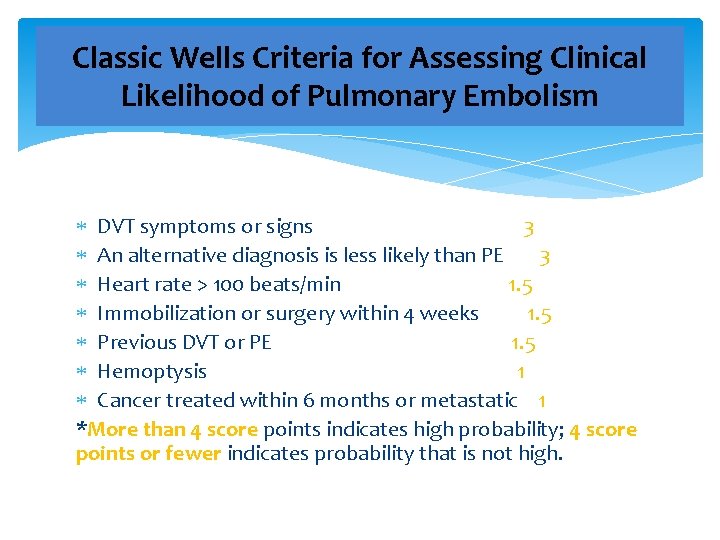
Classic Wells Criteria for Assessing Clinical Likelihood of Pulmonary Embolism DVT symptoms or signs 3 An alternative diagnosis is less likely than PE 3 Heart rate > 100 beats/min 1. 5 Immobilization or surgery within 4 weeks 1. 5 Previous DVT or PE 1. 5 Hemoptysis 1 Cancer treated within 6 months or metastatic 1 *More than 4 score points indicates high probability; 4 score points or fewer indicates probability that is not high.
Differential Diagnosis of Pulmonary Embolism Anxiety, pleurisy, costochondritis Pneumonia, bronchitis Acute coronary syndrome Pericarditis Congestive heart failure Aortic dissection Idiopathic pulmonary hypertension

Diagnostic Methods Other Than Imaging
Plasma D-Dimer Assay elevated plasma concentrations of D-dimers are sensitive for the diagnosis of PE, they are not specific. Even in the absence of PE, levels are elevated for at least 1 week postoperatively and also are abnormally high in patients with MI, sepsis, cancer, or almost any other systemic illness.
The plasma D-dimer assay therefore is ideally suited for screening outpatients or emergency department patients who have suspected PE but no coexisting acute systemic illness. This test generally is not useful for screening acutely ill hospitalized inpatients, because they usually have elevated D-dimer levels. elevated D-dimer independently correlates with increased rates of mortality and subsequent VTE
Electrocardiogram The electrocardiogram (ECG) helps exclude acute MI and acute pericarditis. The most famous sign of right heart strain is S 1 Q 3 T 3, but I have found that the most common sign is T wave inversion in leads V 1 to V 4 Keep in mind that right-sided heart strain is not specific for PE and may be observed in patients with asthma, COPD, or idiopathic pulmonary hypertension. in patients with massive PE, the ECG may not be especially remarkable and may exhibit sinus tachycardia or slight ST-segment and T-wave abnormalities, or may even have an entirely normal appearance.

Imaging Methods
Chest Radiography A near-normal radiographic appearance in the setting of severe respiratory compromise is highly suggestive of massive PE. Focal oligemia (Westermark sign) Hampton hump enlargement of the descending right pulmonary artery The chest radiograph also can help identify patients with diseases that mimic PE, such as lobar pneumonia and pneumothorax, but patients with these illnesses also can have concomitant PE.
Lung Scanning Patients with large PE often have multiple perfusion defects If ventilation scanning is performed on a patient with PE but no intrinsic lung disease, a normal ventilation study result is expected ventilation-perfusion mismatch interpreted as a high probability of PE. Three principal indications for obtaining a lung scan are renal insufficiency, anaphylaxis occurring in reaction to an intravenous contrast agent that cannot be suppressed with high-dose corticosteroids, and pregnancy (lower radiation exposure to the fetus than CT scanning).
Chest Computed Tomography initial imaging test in most patients with suspected PE. The chest CT scan also can detect other pulmonary diseases that manifest in conjunction with PE or explain a clinical presentation that mimics PE. These diseases include pneumonia, atelectasis, pneumothorax, and pleural effusion, which may not be well visualized on the chest radiograph.
Echocardiography About one half of unselected patients with acute PE have normal echocardiographic findings, so this modality is not recommended as a routine diagnostic test for PE. Echocardiography is, however, a rapid, practical, and sensitive technique for detection of right ventricular overload among patients with established PE. Moderate or severe right ventricular hypokinesis, persistent pulmonary hypertension, patent foramen ovale, and free-floating thrombus in the right atrium or right ventricle are associated with a high risk of death or recurrent thromboembolism.
Venous Ultrasonography At least one half of the patients with PE have no imaging evidence of DVT, probably because the entire DVT embolized to the pulmonary arteries Therefore, if the level of clinical suspicion of PE is moderate or high, patients without evidence of DVT should undergo further investigation for PE.
Magnetic Resonance Imaging (MRA) is far less sensitive than CT for the detection of PE, but unlike chest CT or catheter-based pulmonary angiography, MRA does not require ionizing radiation or injection of an iodinated contrast agent. Pulmonary MRA also can assess right ventricular size and function.
Pulmonary Angiography Invasive pulmonary angiography formerly was the reference standard for the diagnosis of PE, but it is now rarely performed as a diagnostic test. Use of this modality is routine, however, to plan interventions such as pharmacomechanical catheter–assisted therapy.
Contrast Phlebography Although contrast phlebography was once the reference standard for DVT diagnosis, this study is nowrarely obtained for diagnostic purposes. Venography is the first step, however, for evaluation of patients with large femoral or iliofemoral DVT who will undergo invasive pharmacomechanical catheter–directed therapy.
Diagnostic Approach The first step in an integrated diagnostic strategy is a directed history and physical examination, CXR , ECG to assess the clinical likelihood of acute PE. The finding of a clinical probability that is not high is followed by D-dimer testing; a normal D-dime usually rules out PE If the D-dimer is elevated or high clinical probability , chest CT usually provides the definitive diagnosis or exclusion of PE.
Anticoagulation Therapy for Acute Pulmonary Embolism
Risk Stratification rapid and accurate risk stratification assumes paramount importance. Low-risk patients have an excellent prognosis with anticoagulation alone High-risk patients may require intensive hemodynamic and respiratory support with pressors, mechanical ventilation, or extracorporeal membrane oxygenation.
In addition to anticoagulation, advanced management options include systemic thrombolysis, pharmacomechanical catheter–assisted therapy, vena cava filter placement, or surgical embolectomy
The three key components for risk stratification are: 1. clinical evaluation 2. assessment of right ventricular size and function 3. analysis of cardiac biomarkers to determine whethere is right ventricular microinfarction.
The Pulmonary Embolism Severity Index (PESI) identifies 11 features from demographics, history, and clinical findings that can be weighted and scored to identify low-risk and high-risk patients
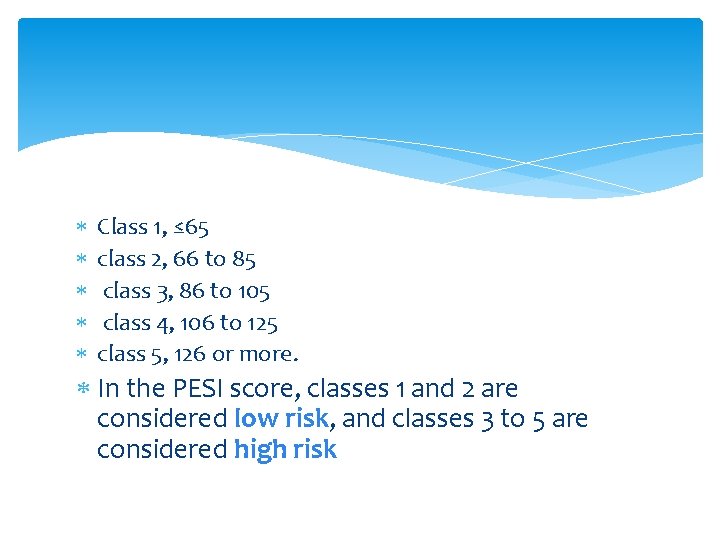
Class 1, ≤ 65 class 2, 66 to 85 class 3, 86 to 105 class 4, 106 to 125 class 5, 126 or more. In the PESI score, classes 1 and 2 are considered low risk, and classes 3 to 5 are considered high risk
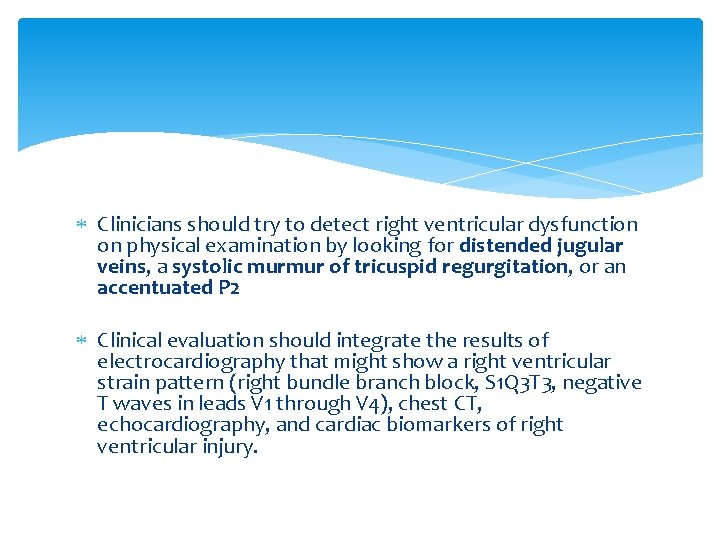
Clinicians should try to detect right ventricular dysfunction on physical examination by looking for distended jugular veins, a systolic murmur of tricuspid regurgitation, or an accentuated P 2 Clinical evaluation should integrate the results of electrocardiography that might show a right ventricular strain pattern (right bundle branch block, S 1 Q 3 T 3, negative T waves in leads V 1 through V 4), chest CT, echocardiography, and cardiac biomarkers of right ventricular injury.
Parenteral Anticoagulation
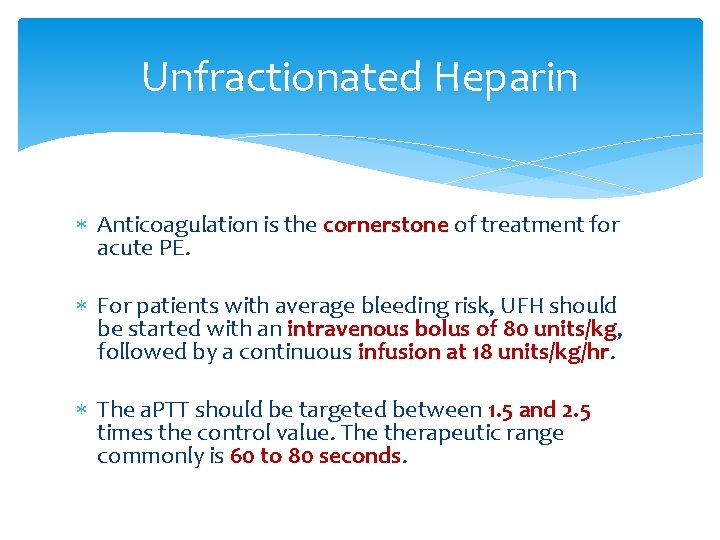
Unfractionated Heparin Anticoagulation is the cornerstone of treatment for acute PE. For patients with average bleeding risk, UFH should be started with an intravenous bolus of 80 units/kg, followed by a continuous infusion at 18 units/kg/hr. The a. PTT should be targeted between 1. 5 and 2. 5 times the control value. The therapeutic range commonly is 60 to 80 seconds.
The short half-life of UFH is advantageous for patients who may require subsequent insertion of an inferior vena cava filter, systemic thrombolysis, catheterdirected pharmacomechanical therapy, or surgical embolectomy.
Low-Molecular-Weight Heparin has greater bioavailability, more predictable dose response, longer half-life These features permit weight-based LMWH dosing without laboratory tests, patients with renal impairment require downward adjustment LMWH is recommended as monotherapy without anticoagulation for cancer patients with VTE.
Fondaparinux specifically inhibits activated factor X fixed-dose, once-daily subcutaneous injection, without the need for coagulation laboratory monitoring or dose adjustment Fondaparinux has a 17 -hour half-life, and its elimination is prolonged in patients with renal impairment. Fondaparinux is licensed for the initial treatment of acute PE and acute DVT. heparin-induced thrombocytopenia,

Warfarin Anticoagulation
Warfarin is a vitamin K antagonist, first approved for clinical use in 1954. The full anticoagulant effect of warfarin becomes evident after 5 to 7 days, patients with VTE, the usual target international normalized ratio (INR) range is between 2. 0 and 3. 0 Self-monitoring of INRs improves patient satisfaction and quality of life and may reduce the rate of thromboembolic events.
Warfarin Overlap with Heparin Dosing and Monitoring of Warfarin “Bridging”
When patients undergo elective surgery or procedures such as colonoscopy, warfarin is temporarily discontinued. To ensure continued anticoagulation perioperatively, “bridging” with LMWH used to be prescribed preoperatively while the warfarin activity washed out. the BRIDGE Trial of atrial fibrillation patients showed that forgoing bridging anticoagulation was noninferior to bridging with LMWH
The group that was not bridged had a 59% reduction in major bleeding complications. Subsequently, the practice of routine bridging for VTE patients has fallen out of favor. Now, with only a few exceptions, such as patients with extreme thrombophilia or patients who have mechanical heart valves, we forgo bridging and simply hold warfarin preoperatively (usually for 4 days) and on the day of surgery.

Novel Oral Anticoagulants NOACs
NOACs have a rapid onset of action and provide full anticoagulation within several hours of ingestion. They are prescribed in fixed doses without laboratory coagulation monitoring and have minimal drug-drug or drug-food interactions. These agents have a short half-life, so do not require bridging when they are stopped for an invasive diagnostic or surgical procedure.
NOACs For VTE treatment, they are noninferior to warfarin for efficacy and are superior to warfarin for safety. Four NOACs are licensed for VTE treatment: dabigatran (an oral thrombin inhibitor)and three factor Xa inhibitor rivaroxaban, apixaban and edoxaban
American College of Chest Physicians Guidelines recommend NOACs rather than warfarin to treat acute VTE patients (without cancer), short-term (3 to 6 months) anticoagulation is planned or extended anticoagulation without a stop date is planned

Managing Bleeding Complications from Anticoagulants
Advanced Therapy (in Addition to Anticoagulation) for Acute Pulmonary Embolism
Patients with massive PE or high-risk submassive PE (with both right ventricular dysfunction and troponin elevation due to right ventricular injury) generally warrant advanced therapy. Options include : full-dose systemic thrombolysis, halfdose systemic thrombolysis, pharmacomechanical catheter–directed therapy (usually with low-dose thrombolysis), surgical embolectomy, and inferior vena cava filter placement.
The hallmarks of successful therapy are reduction of right ventricular pressure overload and prevention of continued release of serotonin and other neurohumoral factors that exacerbate pulmonary hypertension Thrombolysis may also improve pulmonary capillary blood flow and reduce the likelihood of developing CTEPH.
The FDA has approved alteplase for massive PE, in a dose of 100 mg delivered through a peripheral vein as a continuous infusion over 2 hours, without concomitant heparin. Patients who receive thrombolysis up to 14 days after onset of new symptoms or signs can derive benefit, probably because of the effects on the bronchial collateral circulation. Intracranial hemorrhage is the most feared and severe complication.
Catheter–Directed Therapy The 1% to 3% rate of intracranial hemorrhage in patients with PE receiving full-dose systemic thrombolysis good efficacy, with lower rates of major bleeding owing to lower doses of thrombolytic agent Surgical Embolectomy Inferior Vena Cava Filters

Thank you for your attention!
- Slides: 72