
In the airlift bioreactors the medium of the
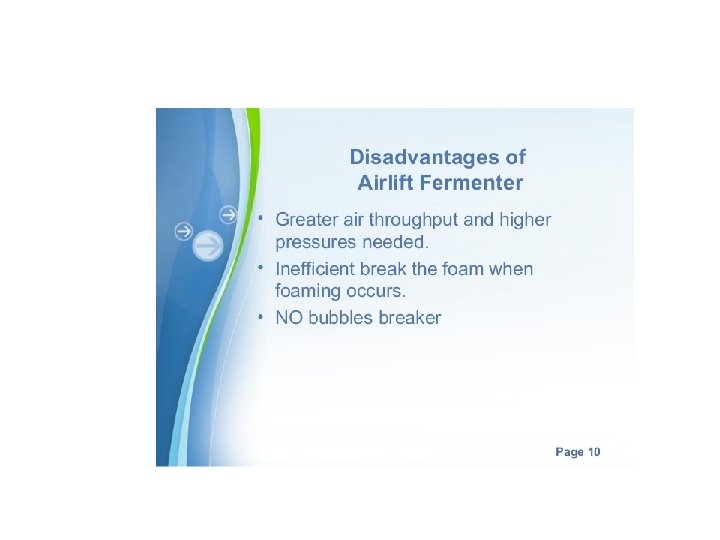
ØIn the airlift bioreactors, the medium of the vessel is divided into two interconnected zones by means of a baffle or draft tube. Ø In one of the two zones referred to a riser, the air/gas is pumped. ØThe other zone that receives no gas is the down comer. Ø The dispersion flows up the riser zone while the down flow occurs in the down comer. Ø There are two types of airlift bioreactors.
ØInternal-loop airlift bioreactor has a single container with a central draft tube that creates interior liquid circulation channels. ØThese bioreactors are simple in design, with volume and circulation at a fixed rate for fermentation.
• External loop airlift bioreactor possesses an external loop so that the liquid circulates through separate independent channels. • These reactors can be suitably modified to suit the requirements of different fermentations. • In general, the airlift bioreactors are more efficient than bubble columns, particularly for more denser suspensions of microorganisms. • This is mainly because in these bioreactors, the mixing of the contents is better compared to bubble columns.
• Airlift bioreactors are commonly employed for aerobic bioprocessing technology. • They ensure a controlled liquid flow in a recycle system by pumping. Due to high efficiency, airlift bioreactors are sometimes preferred e. g. , methanol production, waste water treatment, single-cell protein production. • In general, the performance of the airlift bioreactors is dependent on the pumping (injection) of air and the liquid circulation.

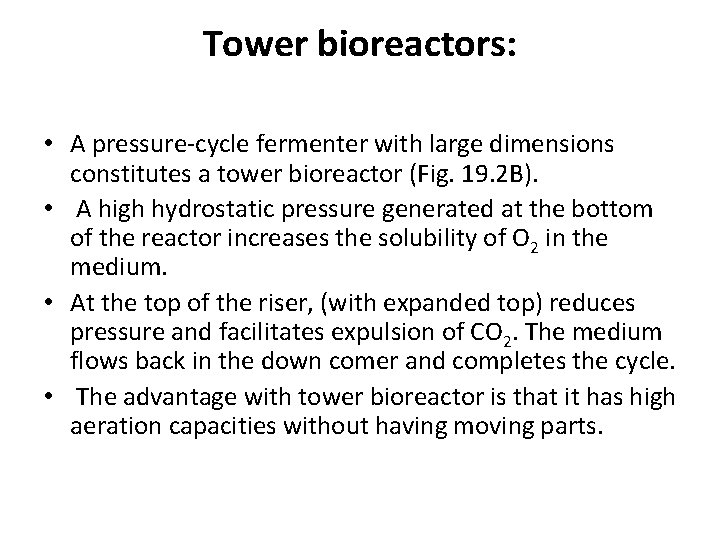
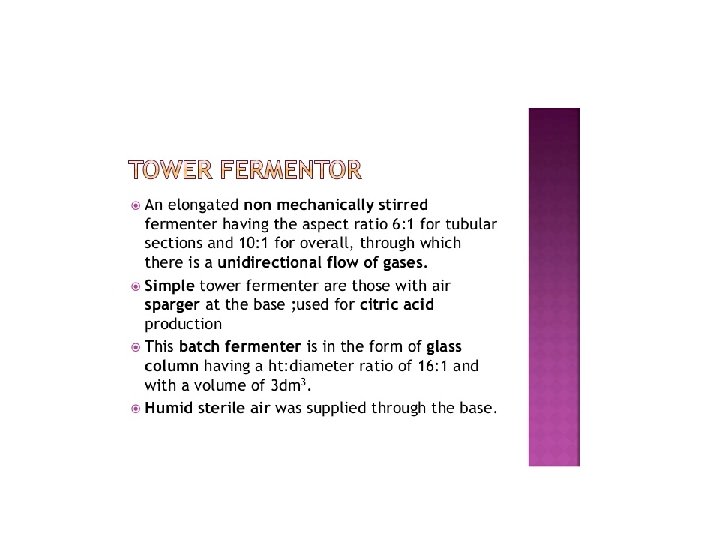
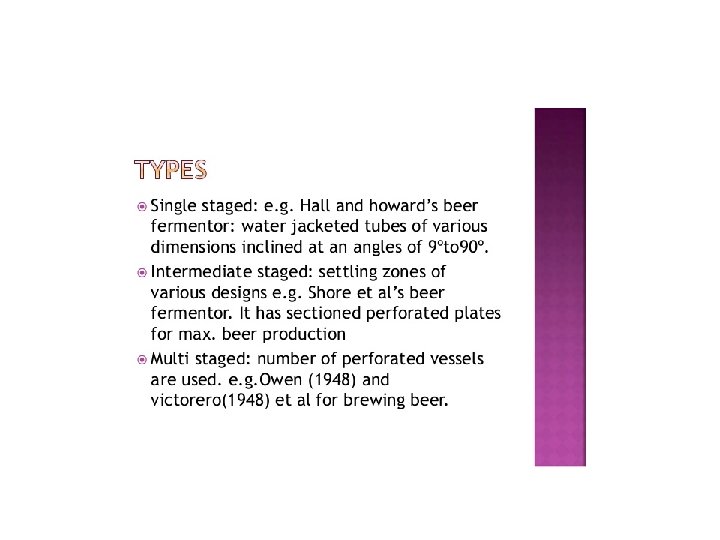
Tower bioreactors: • A pressure-cycle fermenter with large dimensions constitutes a tower bioreactor (Fig. 19. 2 B). • A high hydrostatic pressure generated at the bottom of the reactor increases the solubility of O 2 in the medium. • At the top of the riser, (with expanded top) reduces pressure and facilitates expulsion of CO 2. The medium flows back in the down comer and completes the cycle. • The advantage with tower bioreactor is that it has high aeration capacities without having moving parts.
- Slides: 18