
In Search of Social Regularities Social scientific logic
- Slides: 14
In Search of Social Regularities
Social scientific logic and theory: Searching for regularities in social life • Probabilistic • Social regularities involve aggregate actions and situations of social groups • Elements of social scientific theory are not people, but variables.
Variables • Vary across units of analysis • Unit of analysis – the entity that is being studied in research ØIndividuals ØSmall groups ØSocial organizations ØGeographic units ØSocial artifacts • What to do with units? ØDescribe units using variables ØCompare units to discover patterns ØDevelop theories to explain patterns
• Examples – How can we describe and compare… ØIndividuals – gender, age, level of formal education, type of occupation, attitude toward abortion ØSmall groups – level of cohesion, frequency of interaction, ethnocentrism ØSocial organizations – size, type of ownership, level of formality ØGeographic units – population size, ethnic composition, form of government ØSocial artifacts – function, cost, content
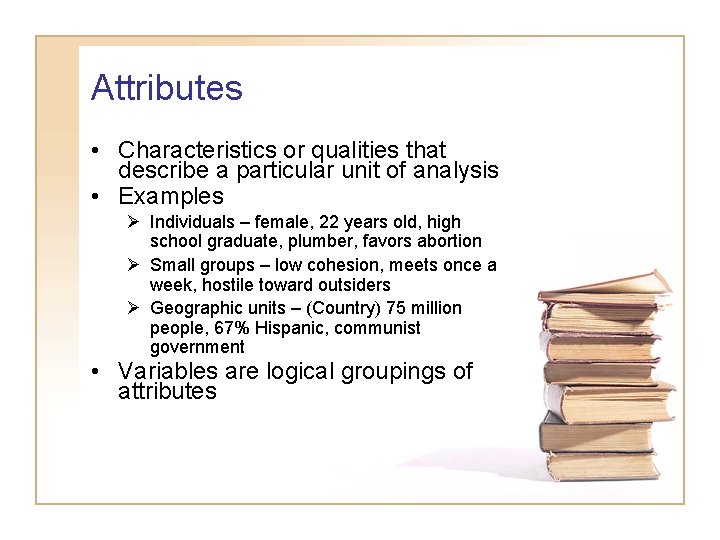
Attributes • Characteristics or qualities that describe a particular unit of analysis • Examples Ø Individuals – female, 22 years old, high school graduate, plumber, favors abortion Ø Small groups – low cohesion, meets once a week, hostile toward outsiders Ø Geographic units – (Country) 75 million people, 67% Hispanic, communist government • Variables are logical groupings of attributes
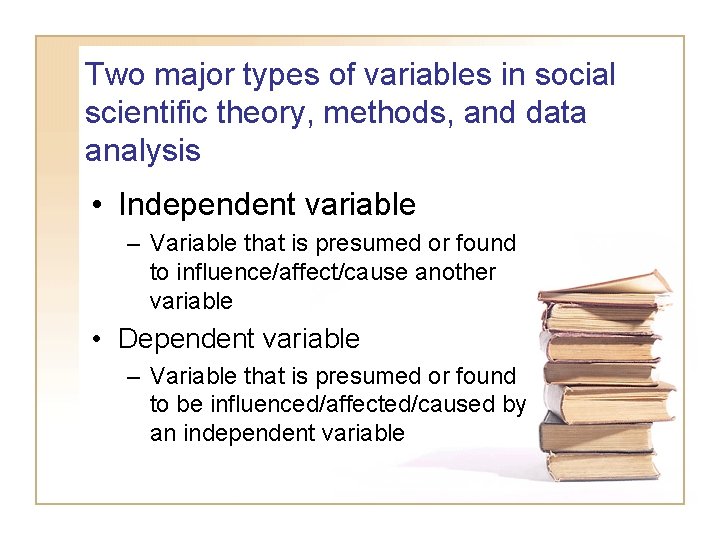
Two major types of variables in social scientific theory, methods, and data analysis • Independent variable – Variable that is presumed or found to influence/affect/cause another variable • Dependent variable – Variable that is presumed or found to be influenced/affected/caused by an independent variable
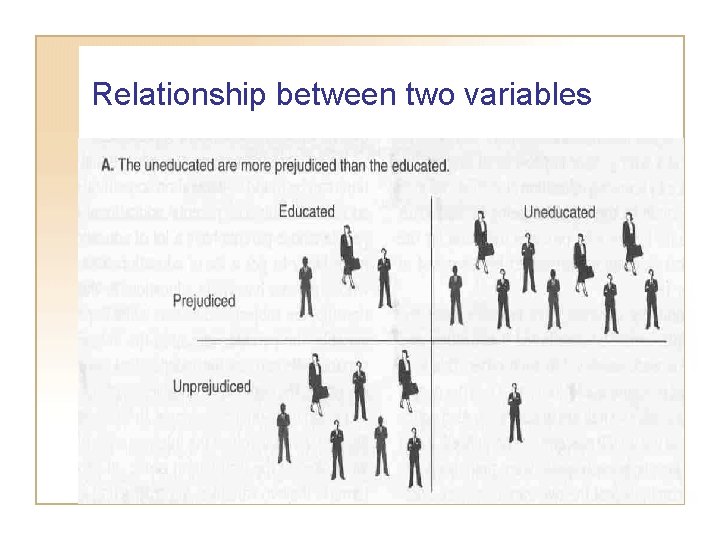
Relationship between two variables
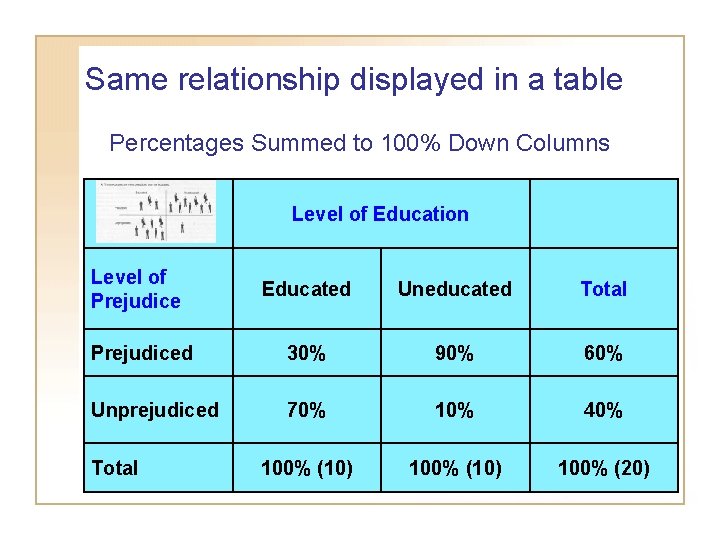
Same relationship displayed in a table Percentages Summed to 100% Down Columns Level of Prejudice Level of Education Educated Uneducated Total Prejudiced 30% 90% 60% Unprejudiced 70% 10% 40% 100% (10) 100% (20) Total
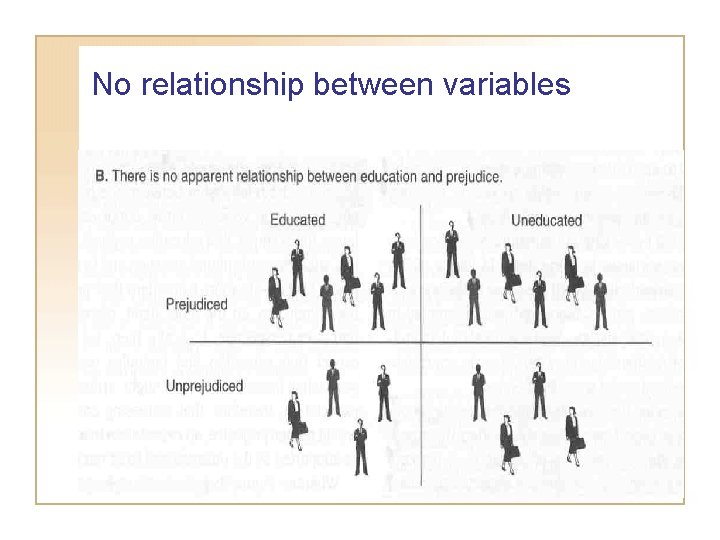
No relationship between variables
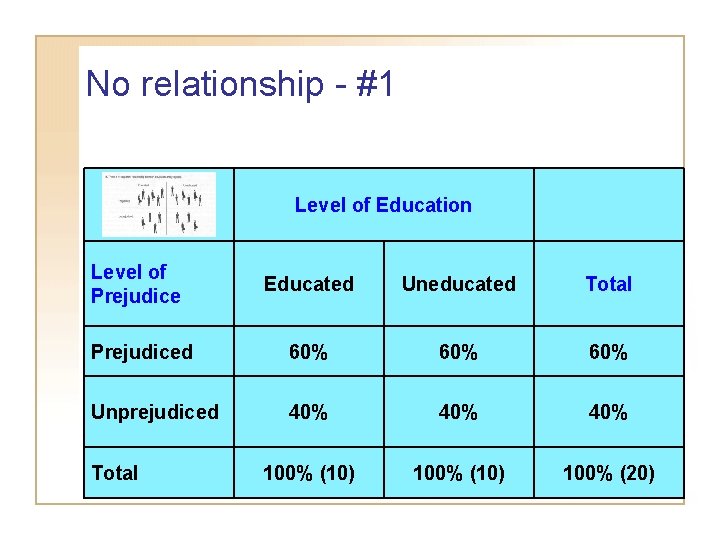
No relationship - #1 Level of Prejudice Level of Education Educated Uneducated Total Prejudiced 60% 60% Unprejudiced 40% 40% 100% (10) 100% (20) Total
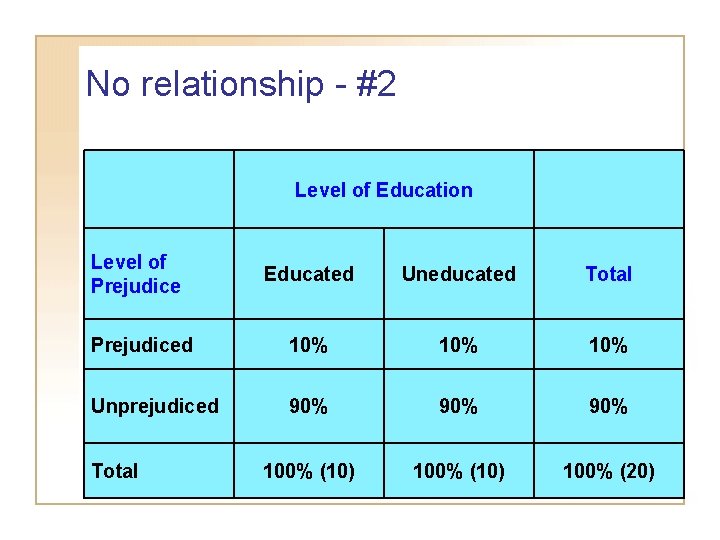
No relationship - #2 Level of Prejudice Level of Education Educated Uneducated Total Prejudiced 10% 10% Unprejudiced 90% 90% 100% (10) 100% (20) Total
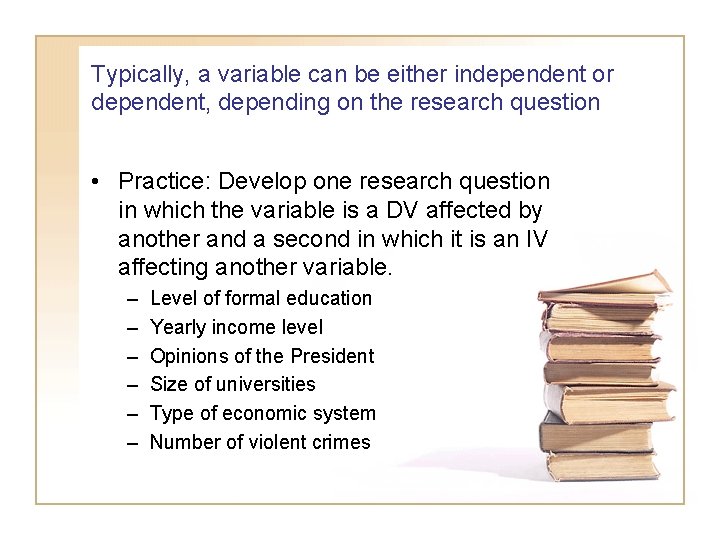
Typically, a variable can be either independent or dependent, depending on the research question • Practice: Develop one research question in which the variable is a DV affected by another and a second in which it is an IV affecting another variable. – – – Level of formal education Yearly income level Opinions of the President Size of universities Type of economic system Number of violent crimes
If a variable cannot be changed by another social variable, it will always be used as an IV For example: – Age (biological age) – Gender assigned at birth However, stated differently, these can change into DVs: – Perceived age – Gender identity, gender transition process
Understanding IVs and DVs is critical, because in social science, we’re interested in discovering regularities/patterns and developing theories to understand/explain them.