
In Search of an Understandable Consensus Algorithm Diego

In Search of an Understandable Consensus Algorithm Diego Ongaro John Ousterhout Stanford University
Motivation (I) n "Consensus algorithms allow a collection of machines to work as a coherent group that can survive the failures of some of its members. " ¨ Very important role in building fault-tolerant distributed systems
Motivation (II) n n Paxos ¨ Current standard for both teaching and implementing consensus algorithms ¨ Very difficult to understand very hard to implement Raft ¨ New protocol (2014) ¨ Much easier to understand ¨ Several open-source implementations

Key features of Raft n n n Strong leader: ¨ Leader does most of the work: n Issues all log updates Leader election: ¨ Uses randomized timers to elect leaders. Membership changes: ¨ New joint consensus approach where the majorities of two different configurations are required
Replicated state machines n Allows a collection of servers to ¨ Maintain identical copies of the same data ¨ Continue operating when some servers are down n A majority of the servers must remain up n Many applications n Typically built around a distributed log
The distributed log (I) n n n Each server stores a log containing commands Consensus algorithm ensures that all logs contain the same commands in the same order State machines always execute commands in the log order ¨ They will remain consistent as long as command executions have deterministic results
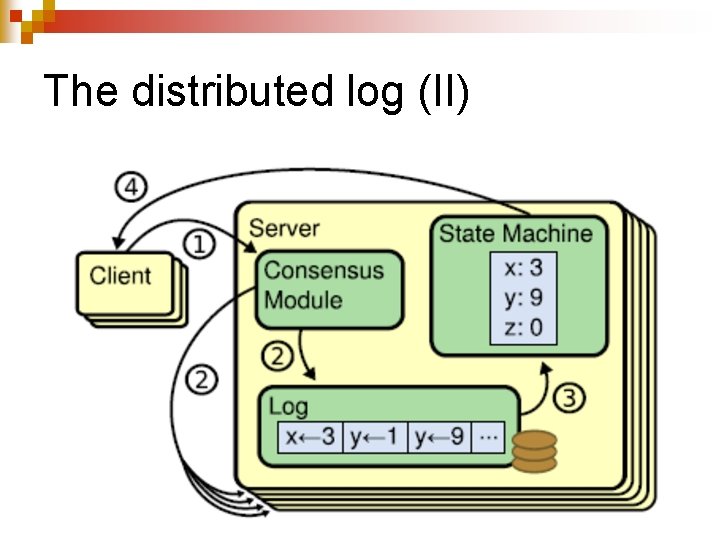
The distributed log (II)
The distributed log (III) n n Client sends a command to one of the servers Server adds the command to its log Server forwards the new log entry to the other servers Once a consensus has been reached, each server state machine process the command sends it reply to the client
Consensus algorithms (I) n Typically satisfy the following properties ¨ Safety: n Never return an incorrect result under all kinds of non-Byzantine failures ¨ Availability: n Remain available as long as a majority of the servers remain operational and can communicate with each other and with clients.
Two types of failures n Non-Byzantine ¨ Failed nodes stop communicating with other nodes n "Clean" failure n Fail-stop behavior n Byzantine ¨ Failed nodes will keep sending messages n Incorrect and potentially misleading n Failed node becomes a traitor
Consensus algorithms (II) Robustness: n Do not depend on timing to ensure the consistency of the logs ¨ Responsiveness: n Commands will typically complete as soon as a majority of the servers have responded to a single round of remote procedure calls ¨One or two slow servers will not impact overall system response times ¨
Paxos limitations (I) n Exceptionally difficult to understand “The dirty little secret of the NSDI* community is that at most five people really, truly understand every part of Paxos ; -). ” – Anonymous NSDI reviewer *The USENIX Symposium on Networked Systems Design and Implementation
Paxos limitations (II) n Very difficult to implement “There are significant gaps between the description of the Paxos algorithm and the needs of a real-world system…the final system will be based on an unproven protocol. ” – Chubby authors
Designing for understandability n Main objective of RAFT ¨ Whenever possible, select the alternative that is the easiest to understand n Techniques that were used include ¨ Dividing problems into smaller problems ¨ Reducing the number of system states to consider n Could logs have holes in them? No
Problem decomposition n n Old technique René Descartes' third rule for avoiding fallacies: The third, to conduct my thoughts in such order that, by commencing with objects the simplest and easiest to know, I might ascend by little and little, and, as it were, step by step, to the knowledge of the more complex
Raft consensus algorithm (I) n Servers start by electing a leader ¨ Sole server habilitated to accept commands from clients ¨ Will enter them in its log and forward them to other servers ¨ Will tell them when it is safe to apply these log entries to their state machines
Raft consensus algorithm (II) n Decomposes the problem into three fairly independent subproblems ¨ Leader election: How servers will pick a—single—leader ¨ Log replication: How the leader will accept log entries from clients, propagate them to the other servers and ensure their logs remain in a consistent state ¨ Safety
Raft basics: the servers n n n A RAFT cluster consists of several servers ¨ Typically five Each server can be in one of three states ¨ Leader ¨ Follower ¨ Candidate (to be the new leader) Followers are passive: ¨ Simply reply to requests coming from their leader
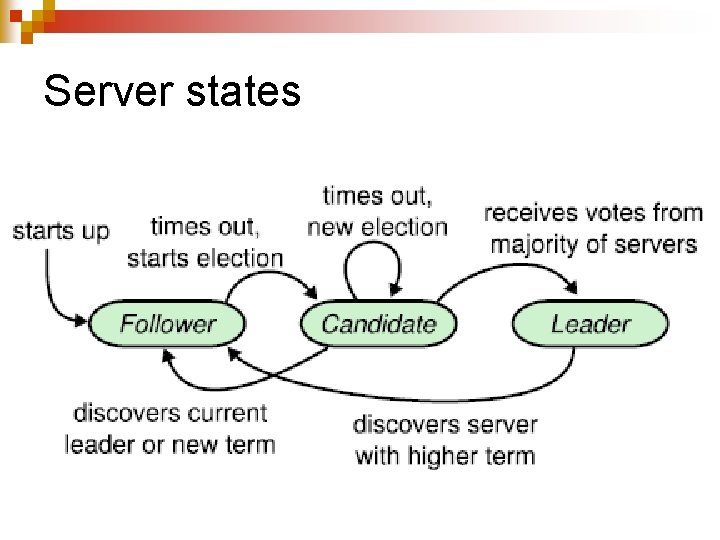
Server states
Raft basics: terms (I) n Epochs of arbitrary length ¨ Start with the election of a leader ¨ End when n No leader can be selected (split vote) n Leader becomes unavailable n Different servers may observe transitions between terms at different times or even miss them
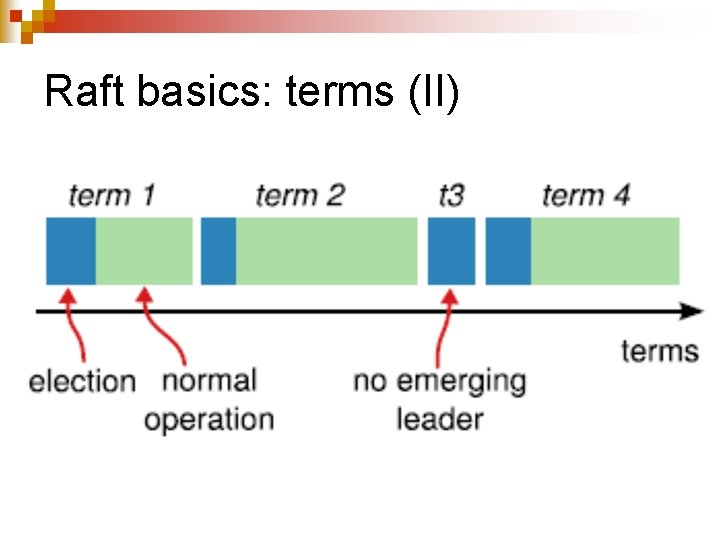
Raft basics: terms (II)
Raft basics: terms (III) n n Terms act as logical clocks ¨ Allow servers to detect and discard obsolete information (messages from stale leaders, …) Each server maintains a current term number ¨ Includes it in all its communications A server receiving a message with a high number updates its own number A leader or a candidate receiving a message with a high number becomes a follower
Raft basics: RPC n Servers communicate through idempotent RPCs ¨ Request. Vote n Initiated by candidates during elections ¨ Append. Entry n Initiated by leaders to ¨Replicate log entries ¨Provide a form of heartbeat § Empty Append. Entry( ) calls
Leader elections n n n Servers start being followers Remain followers as long as they receive valid RPCs from a leader or candidate When a follower receives no communication over a period of time (the election timeout), it starts an election to pick a new leader
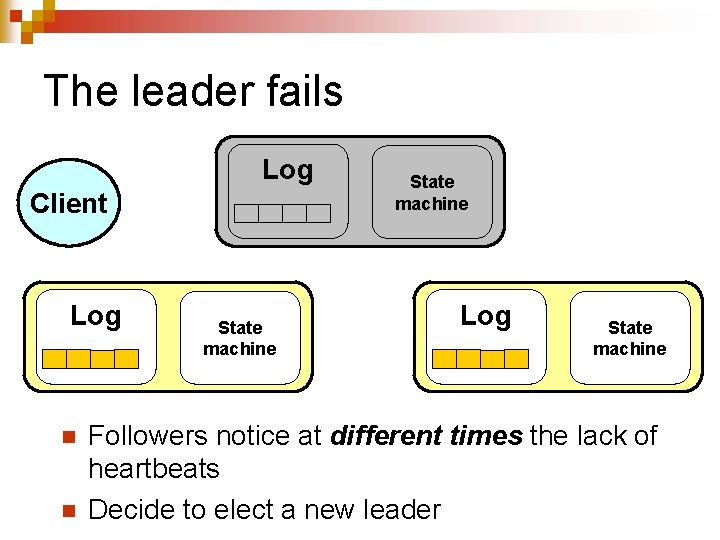
The leader fails Log Client Log n n State machine Log State machine Followers notice at different times the lack of heartbeats Decide to elect a new leader
Starting an election n When a follower starts an election, it ¨ Increments its current term ¨ Transitions to candidate state ¨ Votes for itself ¨ Issues Request. Vote RPCs in parallel to all the other servers in the cluster.
Acting as a candidate n A candidate remains in that state until ¨ It wins the election ¨ Another server becomes the new leader ¨ A period of time goes by with no winner
Winning an election n Must receive votes from a majority of the servers in the cluster for the same term ¨ Each server will vote for at most one candidate in a given term n The first one that contacted it Majority rule ensures that at most one candidate can win the election Winner becomes leader and sends heartbeat messages to all of the other servers ¨ To assert its new role
Hearing from other servers n n n Candidates may receive an Append. Entries RPC from another server claiming to be leader If the leader’s term is at greater than or equal to the candidate’s current term, the candidate recognizes that leader and returns to follower state Otherwise the candidate ignores the RPC and remains a candidate
Split elections n n No candidate obtains a majority of the votes in the servers in the cluster Each candidate will time out and start a new election ¨ After incrementing its term number
Avoiding split elections n n Raft uses randomized election timeouts ¨ Chosen randomly from a fixed interval Increases the chances that a single follower will detect the loss of the leader before the others
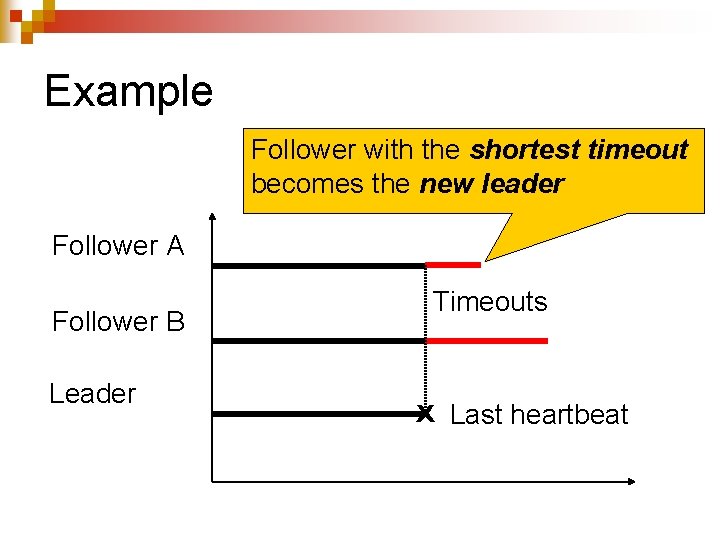
Example Follower with the shortest timeout becomes the new leader Follower A Follower B Leader Timeouts X Last heartbeat
Log replication n Leaders ¨ Accept client commands ¨ Append them to their log (new entry) ¨ Issue Append. Entry RPCs in parallel to all followers ¨ Apply the entry to their state machine once it has been safely replicated n Entry is then committed
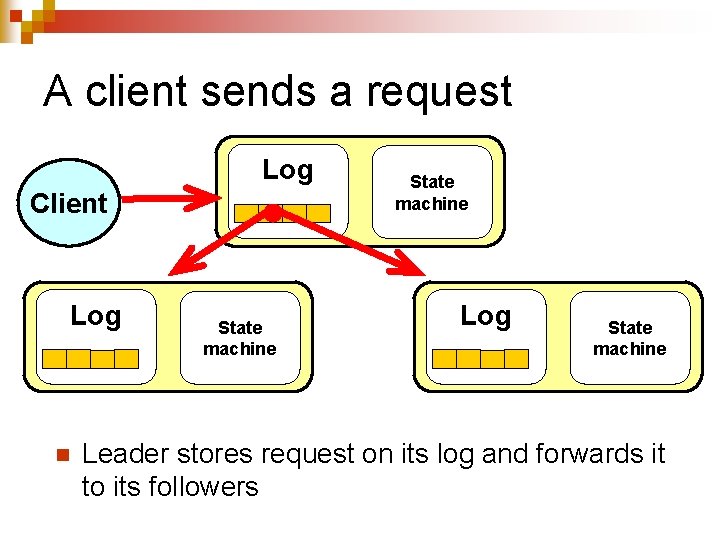
A client sends a request Log Client Log n State machine Log State machine Leader stores request on its log and forwards it to its followers
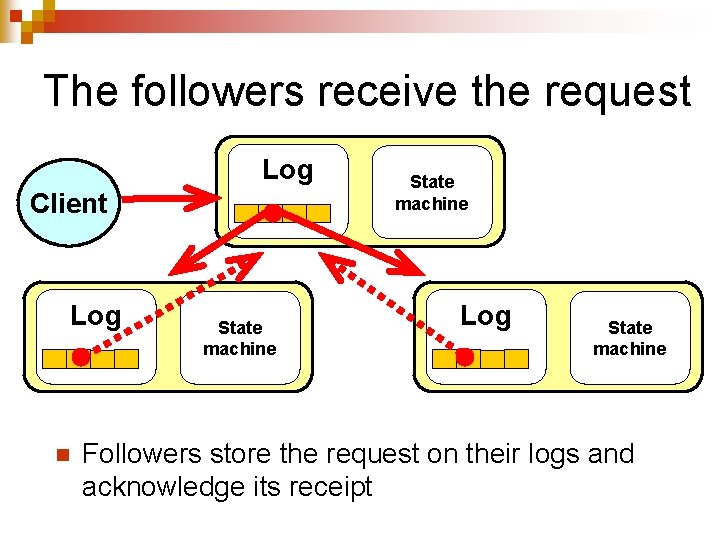
The followers receive the request Log Client Log n State machine Log State machine Followers store the request on their logs and acknowledge its receipt
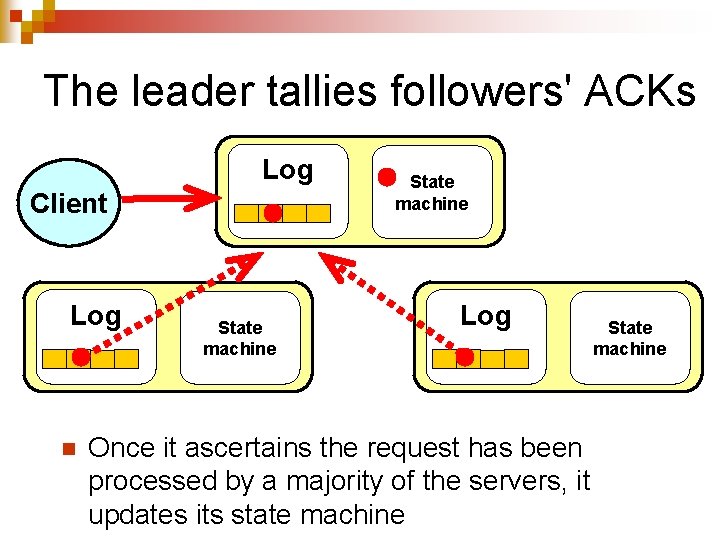
The leader tallies followers' ACKs Log Client Log n State machine Log Once it ascertains the request has been processed by a majority of the servers, it updates its state machine State machine
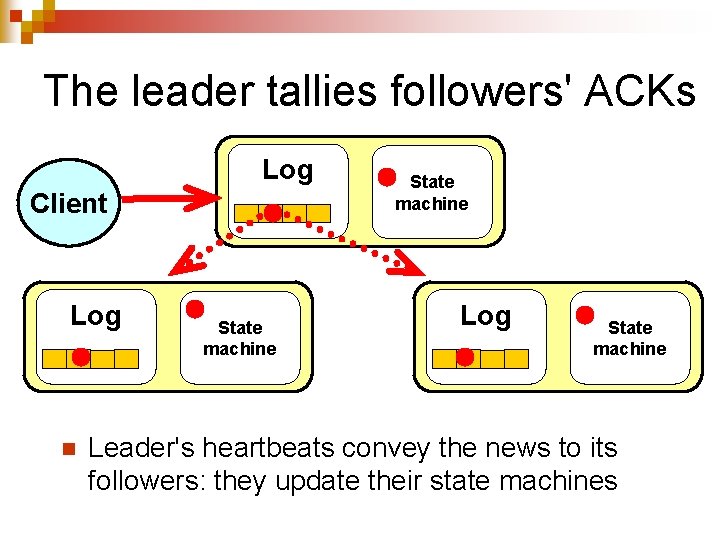
The leader tallies followers' ACKs Log Client Log n State machine Log State machine Leader's heartbeats convey the news to its followers: they update their state machines
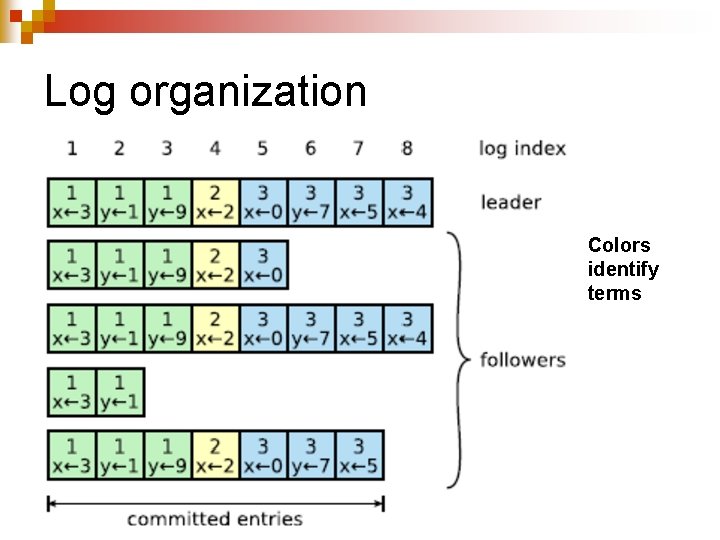
Log organization Colors identify terms
Handling slow followers , … n Leader reissues the Append. Entry RPC ¨ They are idempotent
Committed entries n n Guaranteed to be both ¨ Durable ¨ Eventually executed by all the available state machine Committing an entry also commits all previous entries ¨ All Append. Entry RPCS—including heartbeats —include the index of its most recently committed entry
Why? n Raft commits entries in strictly sequential order ¨ Requires followers to accept log entry appends in the same sequential order n Cannot "skip" entries Greatly simplifies the protocol
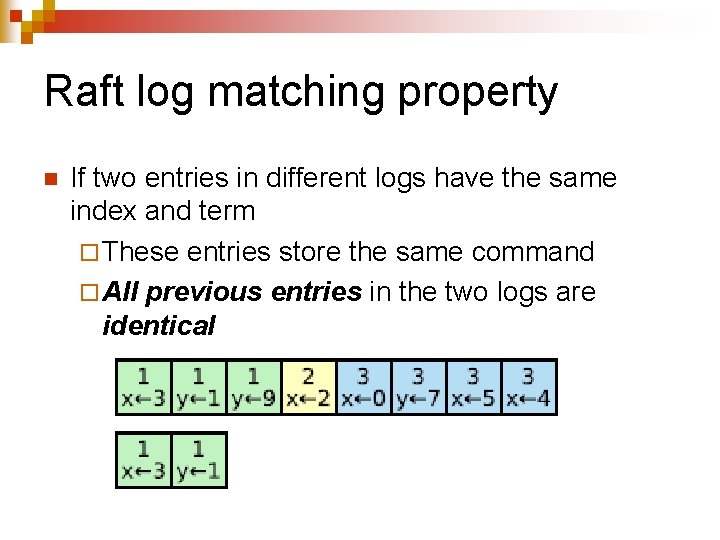
Raft log matching property n If two entries in different logs have the same index and term ¨ These entries store the same command ¨ All previous entries in the two logs are identical
Handling leader crashes (I) n Can leave the cluster in a inconsistent state if the old leader had not fully replicated a previous entry ¨ Some followers may have in their logs entries that the new leader does not have ¨ Other followers may miss entries that the new leader has
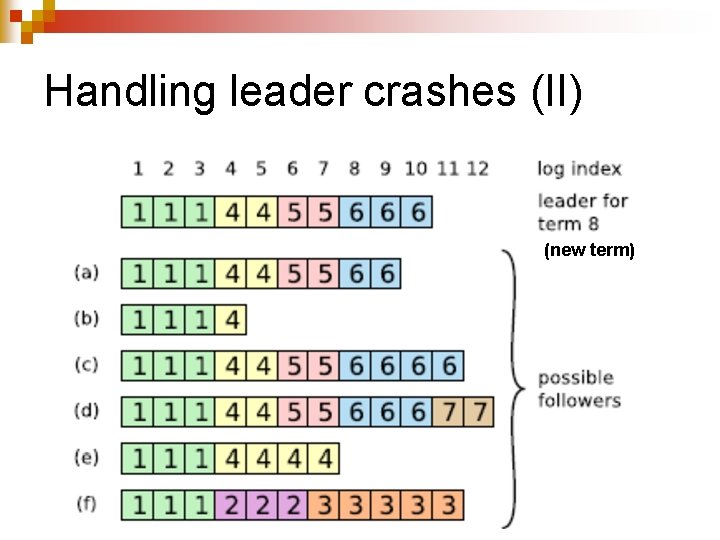
Handling leader crashes (II) (new term)
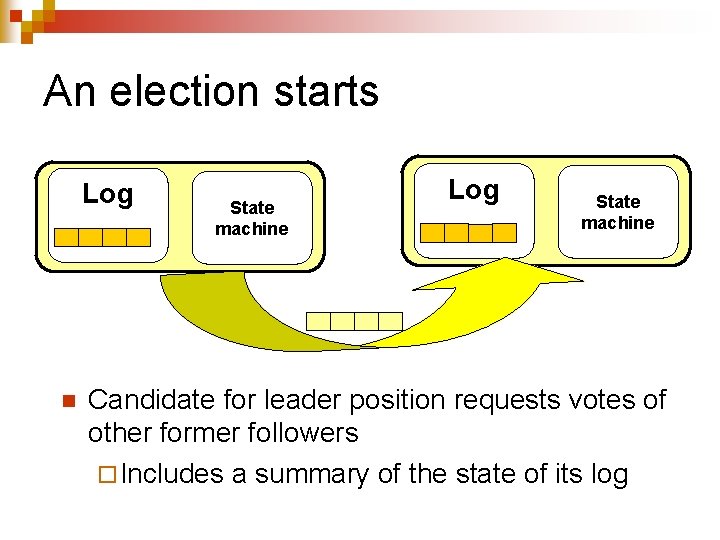
An election starts Log n State machine Log State machine Candidate for leader position requests votes of other former followers ¨ Includes a summary of the state of its log
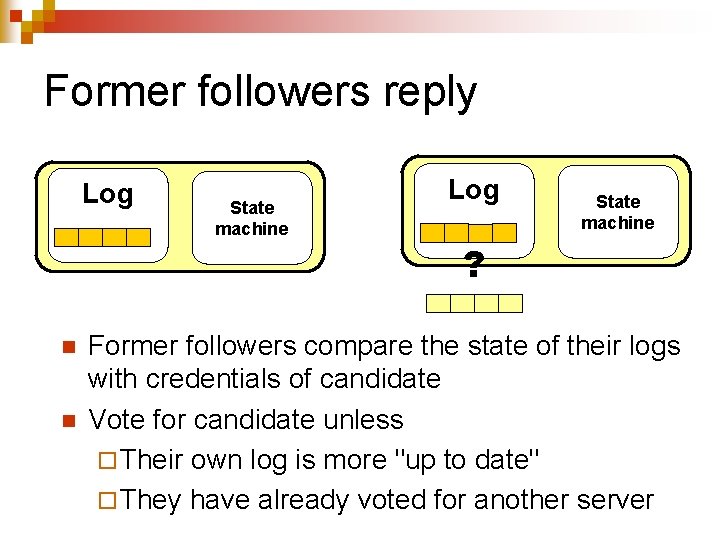
Former followers reply Log n n State machine Log State machine ? Former followers compare the state of their logs with credentials of candidate Vote for candidate unless ¨ Their own log is more "up to date" ¨ They have already voted for another server
Handling leader crashes (III) n Raft solution is to let the new leader to force followers' log to duplicate its own ¨ Conflicting entries in followers' logs will be overwritten
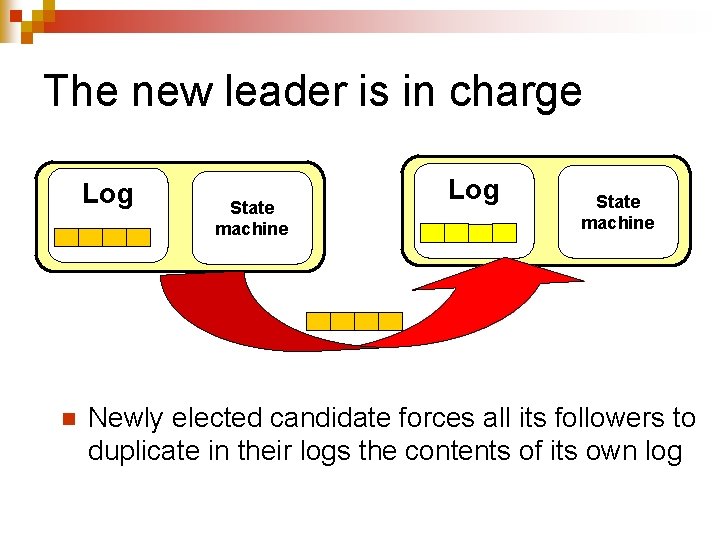
The new leader is in charge Log n State machine Log State machine Newly elected candidate forces all its followers to duplicate in their logs the contents of its own log
How? (I) n n n Leader maintains a next. Index for each follower ¨ Index of entry it will send to that follower New leader sets its next. Index to the index just after its last log entry ¨ 11 in the example Broadcasts it to all its followers
How? (II) n n n Followers that have missed some Append. Entry calls will refuse all further Append. Entry calls Leader will decrement its next. Index for that follower and redo the previous Append. Entry call ¨ Process will be repeated until a point where the logs of the leader and the follower match Will then send to the follower all the log entries it missed
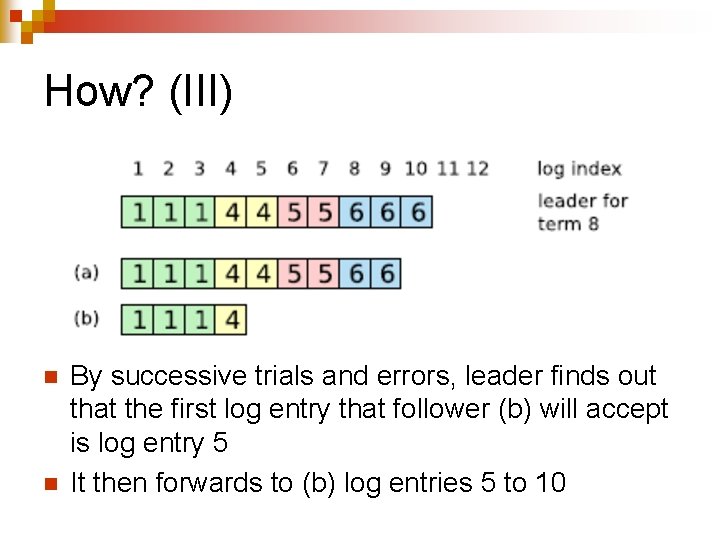
How? (III) n n By successive trials and errors, leader finds out that the first log entry that follower (b) will accept is log entry 5 It then forwards to (b) log entries 5 to 10
Interesting question n How will the leader know which log entries it can commit ¨ Cannot always gather a majority since some of the replies were sent to the old leader n Fortunately for us, any follower accepting an Accept. Entry RPC implicitly acknowledges it has processed all previous Accept. Entry RPCs Followers' logs cannot skip entries
A last observation n Handling log inconsistencies does not require a special sub algorithm ¨ Rolling back Entry. Append calls is enough
Safety n Two main issues ¨ What if the log of a new leader did not contain all previously committed entries? n Must impose conditions on new leaders ¨ How to commit entries from a previous term? n Must tune the commit mechanism
Election restriction (I) n The log of any new leader must contain all previously committed entries ¨ Candidates include in their Request. Vote RPCs information about the state of their log n Details in the paper ¨ Before voting for a candidate, servers check that the log of the candidate is at least as up to date as their own log. n Majority rule does the rest
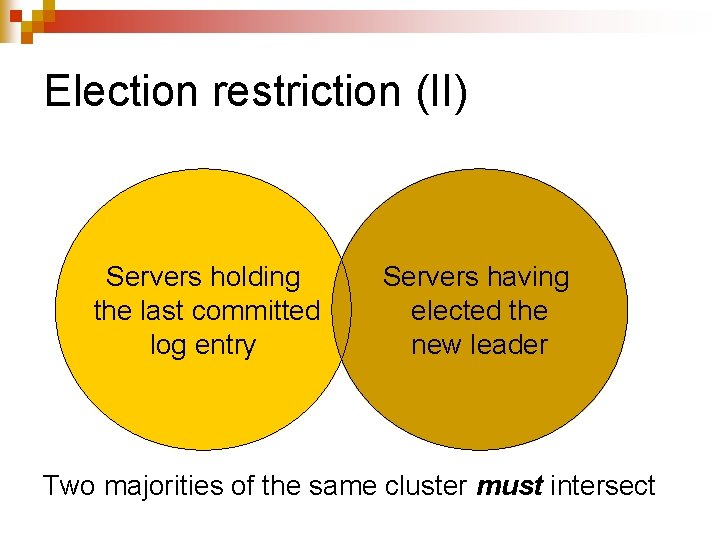
Election restriction (II) Servers holding the last committed log entry Servers having elected the new leader Two majorities of the same cluster must intersect
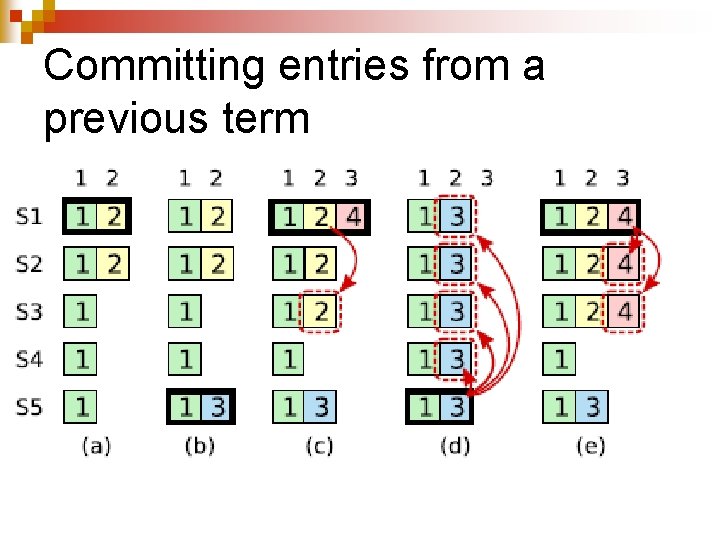
Committing entries from a previous term n n A leader cannot immediately conclude that an entry from a previous term even is committed even if it is stored on a majority of servers. ¨ See next figure Leader should never commits log entries from previous terms by counting replicas Should only do it for entries from the current term Once it has been able to do that for one entry, all prior entries are committed indirectly
Committing entries from a previous term
Explanations n n n In (a) S 1 is leader and partially replicates the log entry at index 2. In (b) S 1 crashes; S 5 is elected leader for term 3 with votes from S 3, S 4, and itself, and accepts a different entry at log index 2. In (c) S 5 crashes; S 1 restarts, is elected leader, and continues replication. ¨ Log entry from term 2 has been replicated on a majority of the servers, but it is not committed.
Explanations n n n If S 1 crashes as in (d), S 5 could be elected leader (with votes from S 2, S 3, and S 4) and overwrite the entry with its own entry from term 3. However, if S 1 replicates an entry from its current term on a majority of the servers before crashing, as in (e), then this entry is committed (S 5 cannot win an election). At this point all preceding entries in the log are committed as well.
Cluster membership changes n n Not possible to do an atomic switch ¨ Changing the membership of all servers at one Will use a two-phase approach: ¨ Switch first to a transitional joint consensus configuration ¨ Once the joint consensus has been committed, transition to the new configuration
The joint consensus configuration n n Log entries are transmitted to all servers, old and new Any server can act as leader Agreements for entry commitment and elections requires majorities from both old and new configurations Cluster configurations are stored and replicated in special log entries
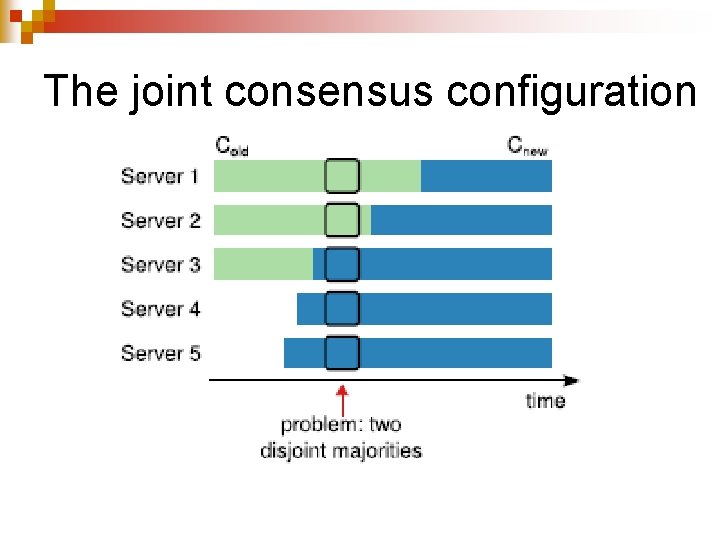
The joint consensus configuration
Implementations n n n Two thousand lines of C++ code, not including tests, comments, or blank lines. About 25 independent third-party open source implementations in various stages of development Some commercial implementations
Understandability n See paper
Correctness n A proof of safety exists
Performance n See paper
Conclusion n Raft is much easier to understand implement than Paxos and has no performance penalty
- Slides: 68