
In It Together Improving Health Literacy for All


- Slides: 66
In It Together: Improving Health Literacy for All Health Literacy Community Training
Training objectives By the end of this training, you will be able to: § Explain what health literacy means § Recognize indications that your clients are experiencing limited health literacy § Apply health literate approaches to improve communication with your clients § Explain the importance of organizational health literacy for your clients § Describe what steps you and your organization can take to promote health literacy and deliver health literate HIV services 2
Definition of health literacy Health Literacy: The degree to which individuals have the capacity to obtain, process, and understand basic health information and services needed to make appropriate health decisions. Demands of the health care system Health Literacy Person’s skills and abilities Citation: (1) U. S. Department of Health and Human Services. 2000. Healthy People 2010. (2) Committee on Health Literacy, Board of Neuroscience and Behavioral Health, Institute of Medicine. Health Literacy: A Prescription to End Confusion. (Nielsen-Bohlman L, Panzer A, Kindig 3 D, eds. ). Washington, D. C. : National Academies Press; 2004. Andrulis and Brach, 2007; Sudore et al. , 2009; ODPHP, 2008
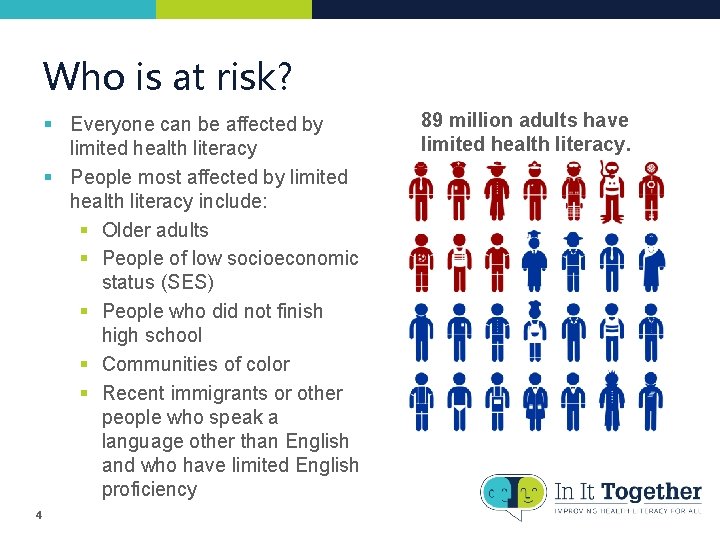
Who is at risk? § Everyone can be affected by limited health literacy § People most affected by limited health literacy include: § Older adults § People of low socioeconomic status (SES) § People who did not finish high school § Communities of color § Recent immigrants or other people who speak a language other than English and who have limited English proficiency 4 89 million adults have limited health literacy.
How does limited health literacy affect people? § Limited knowledge of the body § Limited knowledge of the nature and cause of a disease § Less awareness of how to prevent illness and stay healthy § Less knowledge of their own medical conditions and selfcare instructions § Difficulty understanding numeric medical information § Difficulty understanding when or how to take medication § Difficulty identifying risks and side effects printed on drug labels 5
How does limited health literacy affect health outcomes? People with limited health literacy are: § More likely to describe their health as “poor” § Less likely to use preventive services § Less knowledgeable about medical conditions and treatment § More likely to use emergency services § Often ashamed about their health literacy skill level 6
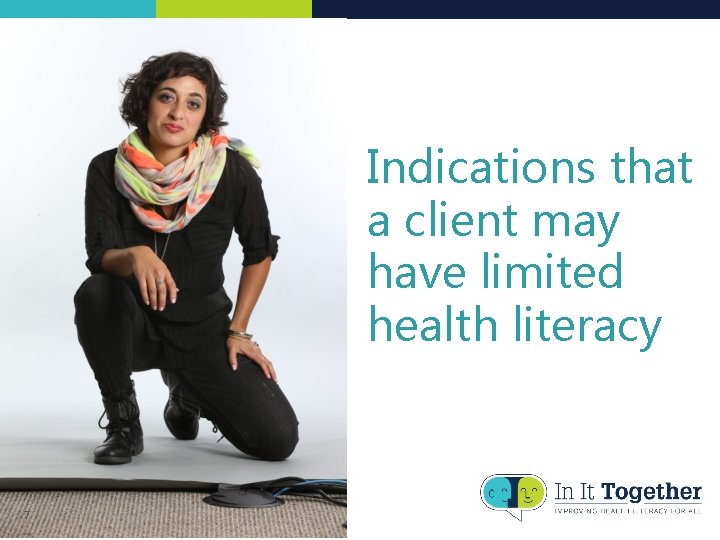
Indications that a client may have limited health literacy 7
General indications § Does not take medications correctly 8
General indications § Does not take medications correctly § Frequently misses appointments § Fails to follow through on tests or referrals 9
General indications § § § 10 Does not take medications correctly Frequently misses appointments Fails to follow through on tests or referrals Does not complete intake forms Cannot provide a detailed history of their illness or treatments
General indications § Does not take medications correctly § Frequently misses appointments § Fails to follow through on tests or referrals § Does not complete intake forms 11 § Cannot provide a detailed history of their illness or treatments § Asks few questions § Avoids reading tasks using commonly accepted reasons § Does not remember information read earlier
Indications among people living with HIV/AIDS § § § § 12 May not be able to articulate the basics of HIV Has a consistently high or unchanged viral load Does not take antiretroviral therapies correctly Has frequent hospitalizations Falls out of care Skips important preventive measures Has poor health outcomes
Universal precautions approach 13
Premise of the universal precautions approach to health literacy § Many people struggle with understanding medications, self-care, instructions, and follow-up plans § Ensure systems are in place to promote better understanding for all clients, not just those you think need extra assistance § Everyone benefits from simple language 14
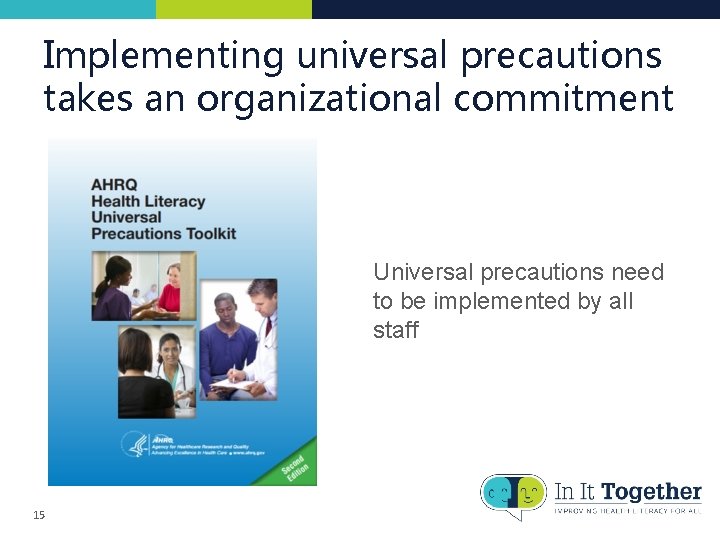
Implementing universal precautions takes an organizational commitment Universal precautions need to be implemented by all staff 15
Social determinants of health Health Equity: the absence of disparities or avoidable differences among socioeconomic and demographic groups or geographical areas in health status and health outcomes 16
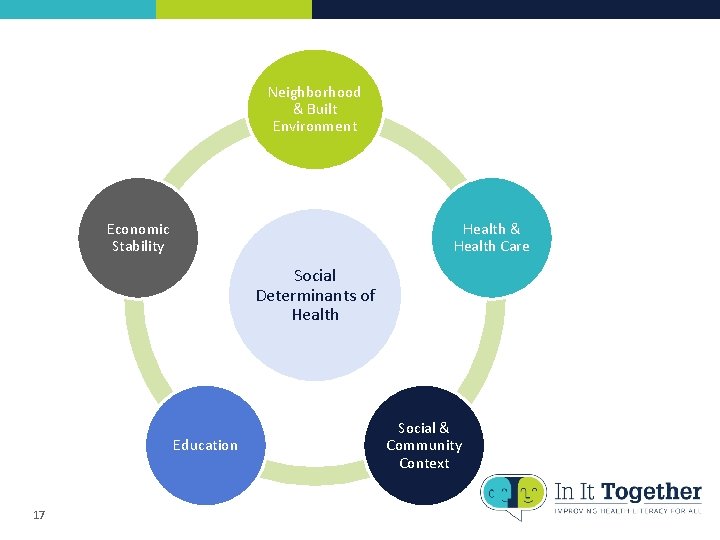
Social determinants of health Neighborhood & Built Environment Economic Stability Health & Health Care Social Determinants of Health Education 17 Social & Community Context
Age Youth and Young Adults § May have limited knowledge of the health care system § May have particular concerns about privacy and confidentiality § May be affected by their parents’/caregivers’ health literacy § May struggle in the transition between pediatric and adult care 18 Older Adults § May have difficulty using print materials § May have difficulty using documents such as forms or charts § May have difficulty interpreting numbers and doing calculations § May be a result of age-related cognitive decline § May not ask many questions
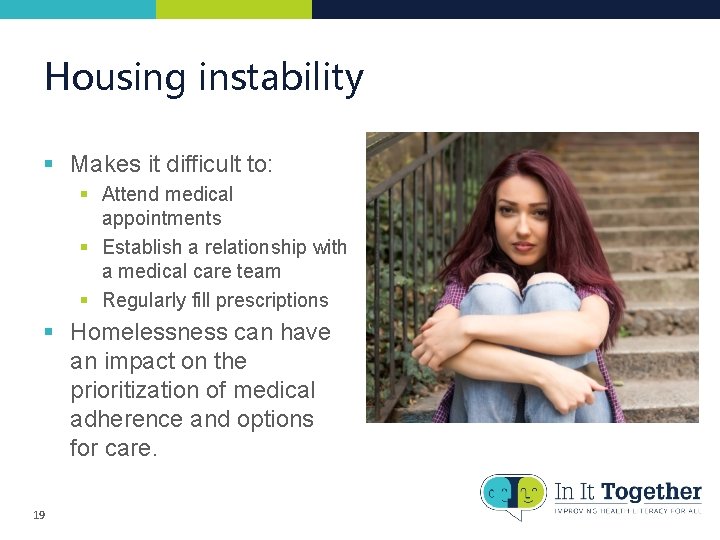
Housing instability § Makes it difficult to: § Attend medical appointments § Establish a relationship with a medical care team § Regularly fill prescriptions § Homelessness can have an impact on the prioritization of medical adherence and options for care. 19
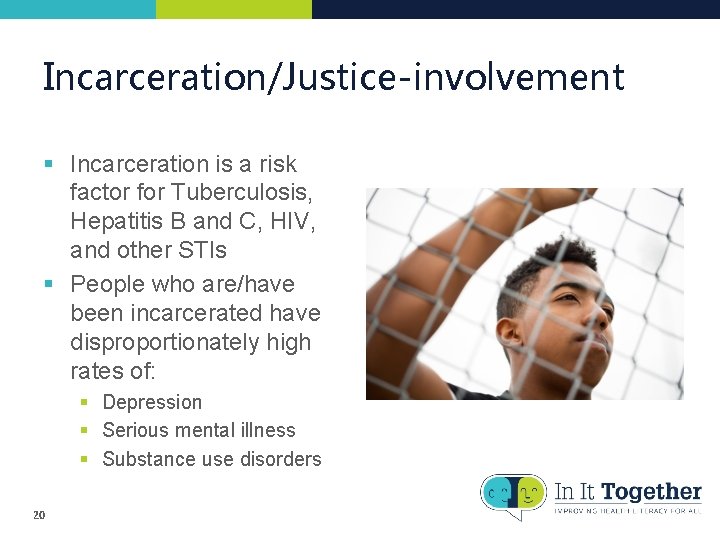
Incarceration/Justice-involvement § Incarceration is a risk factor for Tuberculosis, Hepatitis B and C, HIV, and other STIs § People who are/have been incarcerated have disproportionately high rates of: § Depression § Serious mental illness § Substance use disorders 20
Gender identity and expression § Gender: A complex concept that includes an individual’s sex, sexuality, identities, and social relations § Gender identity: An inner sense of one’s self as masculine or feminine, male or female or both or neither § Gender expression: How a person externally communicates their gender identity to others through clothing, preferences, and behavior § Transgender: A broad term that describes anyone whose gender identity, gender expression, and/or behavior do not match their assigned sex at birth. It is not an indicator of sexual orientation 21 Gender. Spectrum. (2017). Understanding gender: Dimensions of gender. https: //www. genderspectrum. org/quick-links/understanding-gender/
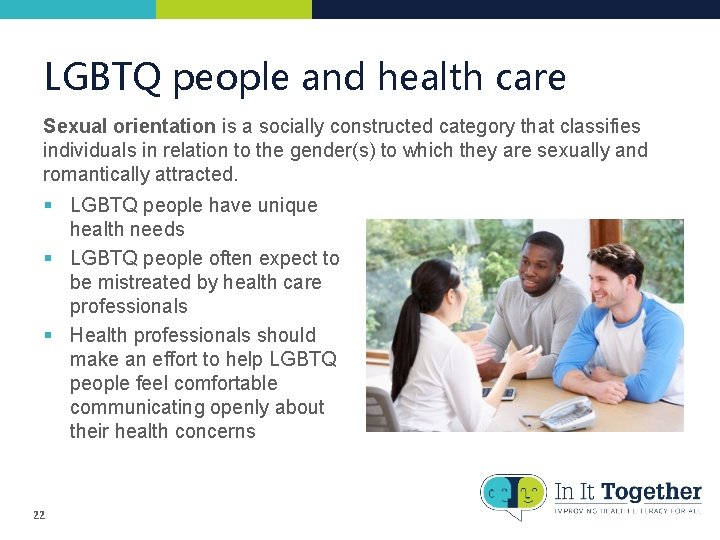
LGBTQ people and health care Sexual orientation is a socially constructed category that classifies individuals in relation to the gender(s) to which they are sexually and romantically attracted. § LGBTQ people have unique health needs § LGBTQ people often expect to be mistreated by health care professionals § Health professionals should make an effort to help LGBTQ people feel comfortable communicating openly about their health concerns 22
Country of origin § People from all countries and cultures of the world live in the U. S. § People may have been born in the U. S. or have emigrated from elsewhere § People from the same ethnic or racial group do not necessarily: § Speak the same language § Use the same dialect § Share the same ideas, experiences, and traditions 23 Kreps, G. L. , & Sparks, L. (2008). Meeting the health literacy needs of immigrant populations. Patient education and counseling, 71(3), 328 -332.
English language skills § Just because a person has limited English proficiency does not necessarily mean that they have limited health literacy § Not all people who speak the same language: § speak the same dialect § can read or write in that language § Most health information on the web is written in English 24 Juckett, G. , & Unger, K. (2014). Appropriate use of medical interpreters. American family physician, 90(7). Mogobe, K. D. , Shaibu, S. , Matshediso, E. , Sabone, M. , Ntsayagae, E. , Nicholas, P. K. , . . . & Webel, A. (2016). Language and Culture in Health Literacy for People Living with HIV: Perspectives of Health Care Providers and Professional Care Team Members. AIDS research and treatment, 2016.
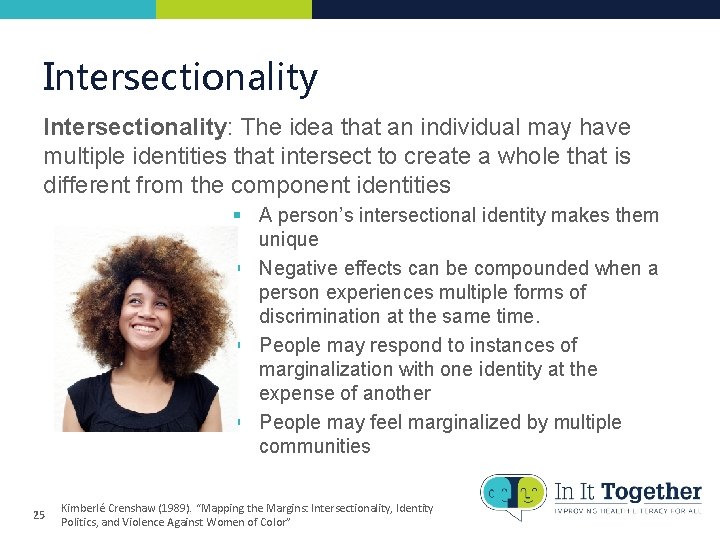
Intersectionality: The idea that an individual may have multiple identities that intersect to create a whole that is different from the component identities § A person’s intersectional identity makes them unique § Negative effects can be compounded when a person experiences multiple forms of discrimination at the same time. § People may respond to instances of marginalization with one identity at the expense of another § People may feel marginalized by multiple communities 25 Kimberlé Crenshaw (1989). “Mapping the Margins: Intersectionality, Identity Politics, and Violence Against Women of Color”
Cultural Diversity § Cultural groups may share characteristics: § § § § Race Ethnicity Language Gender identity/expression Sexual orientation Sexual behavior Country of origin Geographic region No group is homogeneous § Every person has a different lived experience 26
Attitudes, stigma, and their impact on health-seeking behavior
Stigma § Stigma: Negative and usually unfair beliefs § Discrimination: Unfair treatment of a person or group of people 28 § § § Health care facilities Work environments Business establishments Family gatherings Friend groups and social settings § Institutions of faith § Institutions of learning § …and many other places
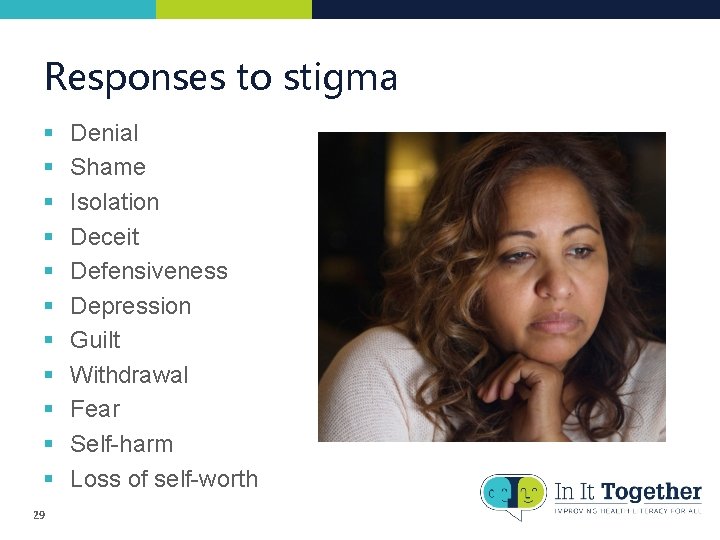
Responses to stigma § § § 29 Denial Shame Isolation Deceit Defensiveness Depression Guilt Withdrawal Fear Self-harm Loss of self-worth
Reluctance to disclose personal information Clients may be reluctant to share personal information due to concerns about: § Confidentiality § Identification as a member of a group § Fears about stigma/discrimination § Feelings of shame or denial 30
Medical mistrust § Lived personal experiences, or knowledge of historic community mistreatment can prevent individuals from seeking assistance § This can create barriers to open communication with health care providers § Take the time to answer questions, and use clear language when talking with clients 31
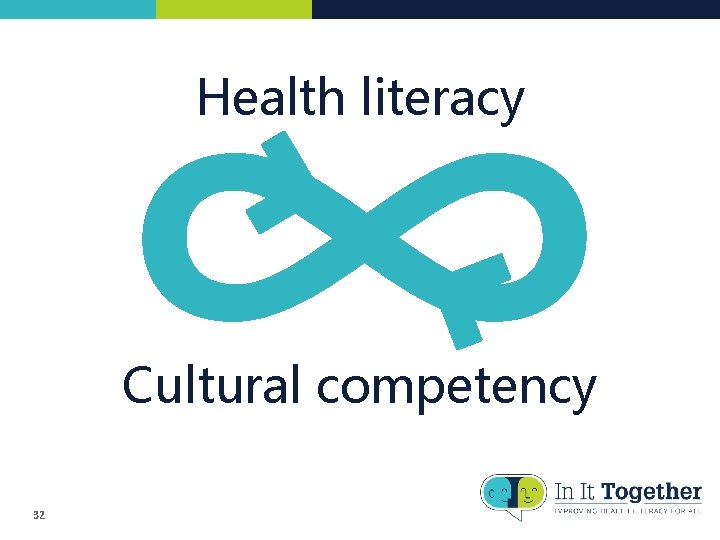
∞ Health literacy Cultural competency 32
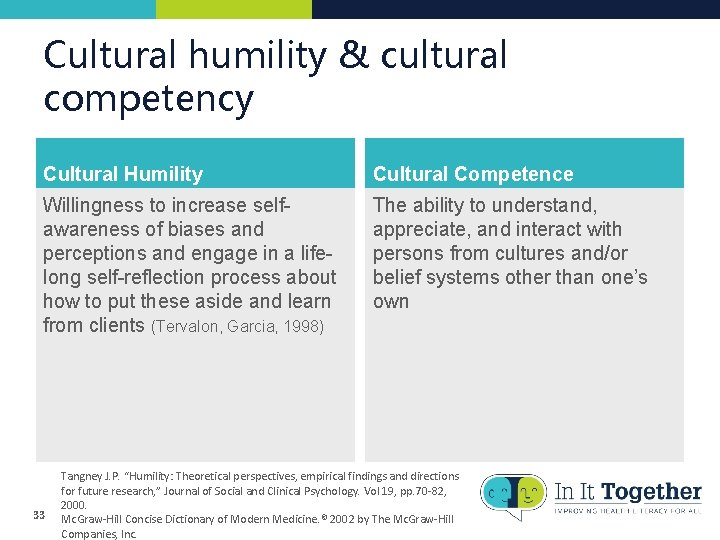
Cultural humility & cultural competency Cultural Humility Cultural Competence Willingness to increase selfawareness of biases and perceptions and engage in a lifelong self-reflection process about how to put these aside and learn from clients (Tervalon, Garcia, 1998) The ability to understand, appreciate, and interact with persons from cultures and/or belief systems other than one’s own 33 Tangney J. P. “Humility: Theoretical perspectives, empirical findings and directions for future research, ” Journal of Social and Clinical Psychology. Vol 19, pp. 70 -82, 2000. Mc. Graw-Hill Concise Dictionary of Modern Medicine. © 2002 by The Mc. Graw-Hill Companies, Inc.
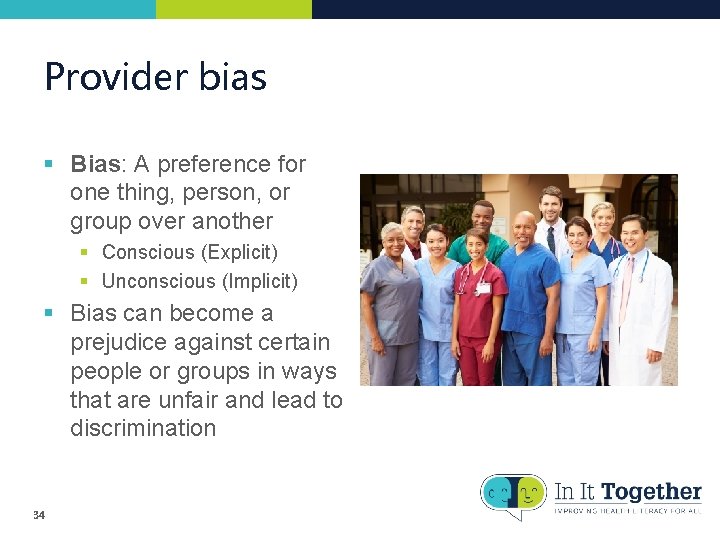
Provider bias § Bias: A preference for one thing, person, or group over another § Conscious (Explicit) § Unconscious (Implicit) § Bias can become a prejudice against certain people or groups in ways that are unfair and lead to discrimination 34
How to reduce implicit provider bias Some research suggests that implicit bias can be diminished by: § Increased exposure to counter-stereotypes § Increased internal motivation § Increased cognitive empathy § Increased emotional regulation § Increased partnership building skills 35
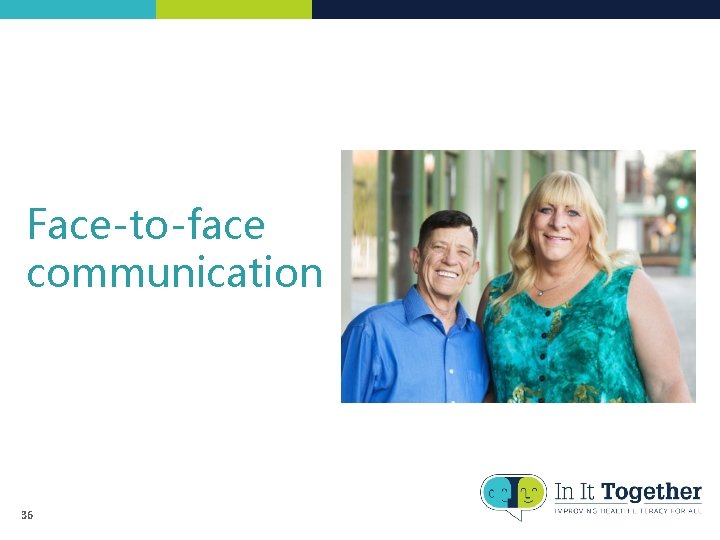
Face-to-face communication 36
General strategies to improve spoken communication § § § § 37 Use plain, non-medical language Limit content to 2 -3 main points Repeat key points multiple times Incorporate words/expressions used by client Be specific Make sure instructions are appropriate for the client’s life Consider client’s cultural context Encourage client to ask questions
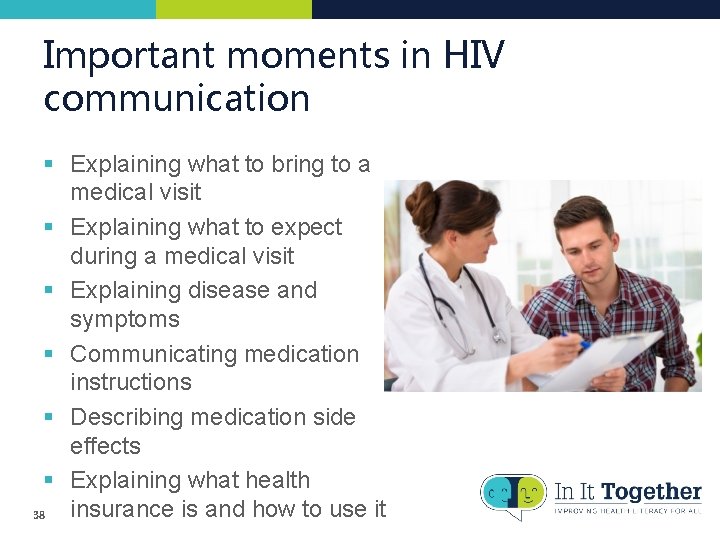
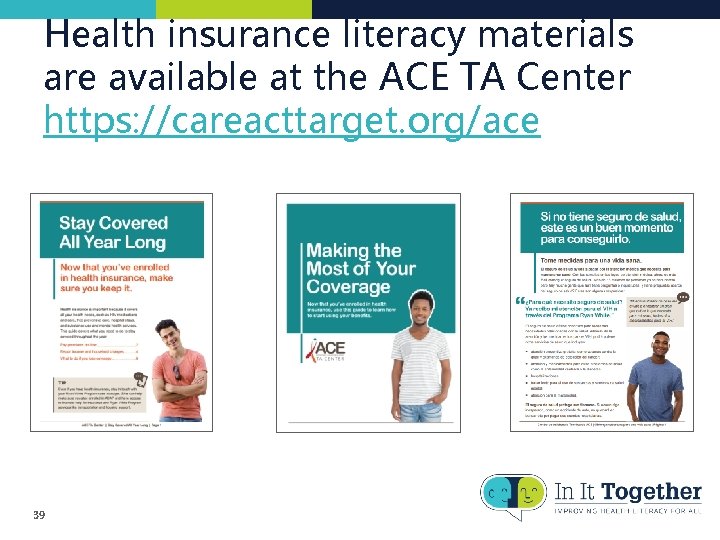
Important moments in HIV communication § Explaining what to bring to a medical visit § Explaining what to expect during a medical visit § Explaining disease and symptoms § Communicating medication instructions § Describing medication side effects § Explaining what health insurance is and how to use it 38
Health insurance literacy materials are available at the ACE TA Center https: //careacttarget. org/ace 39
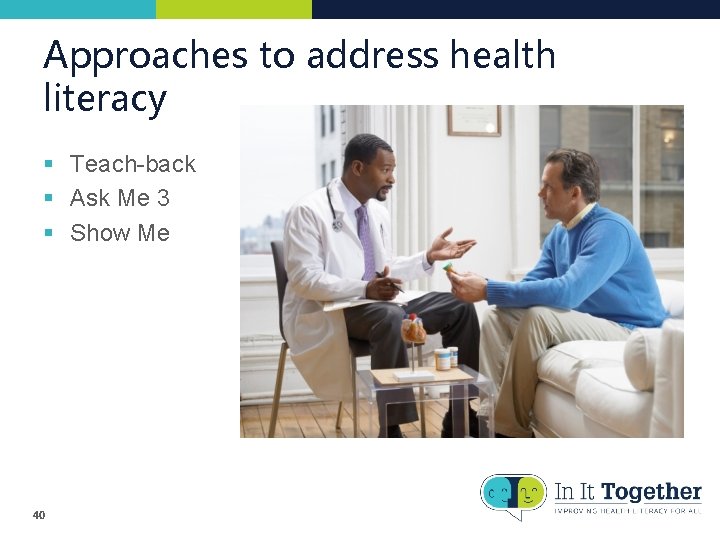
Approaches to address health literacy § Teach-back § Ask Me 3 § Show Me 40
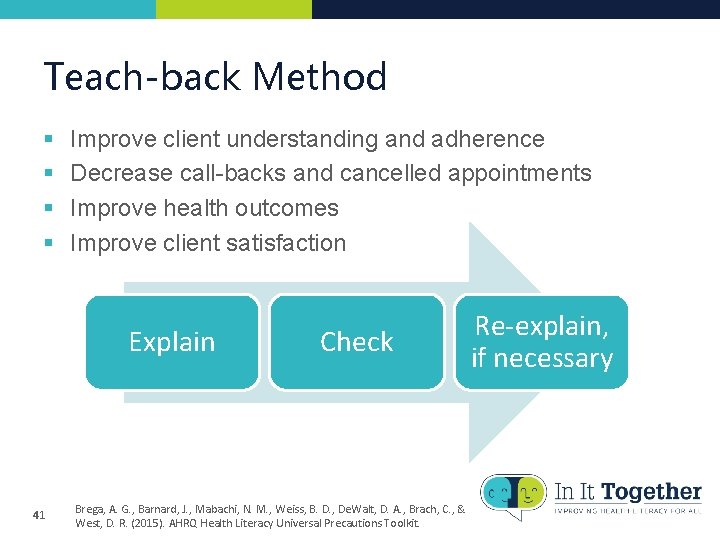
Teach-back Method § § Improve client understanding and adherence Decrease call-backs and cancelled appointments Improve health outcomes Improve client satisfaction Explain 41 Check Brega, A. G. , Barnard, J. , Mabachi, N. M. , Weiss, B. D. , De. Walt, D. A. , Brach, C. , & West, D. R. (2015). AHRQ Health Literacy Universal Precautions Toolkit. Re-explain, if necessary
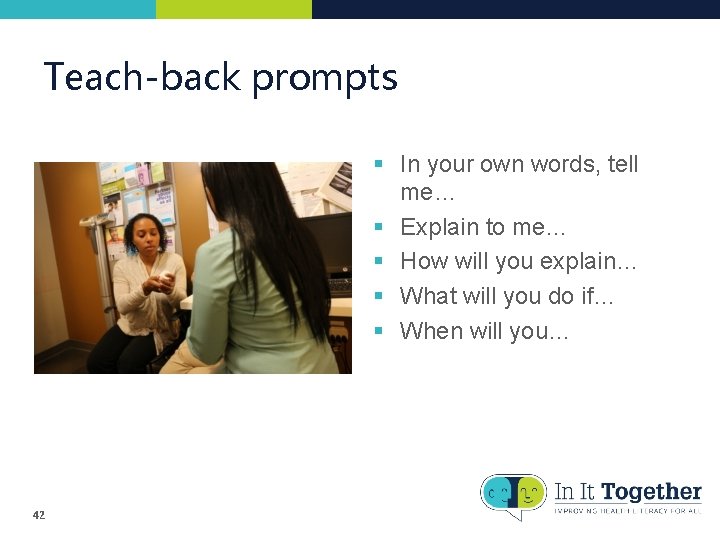
Teach-back prompts § In your own words, tell me… § Explain to me… § How will you explain… § What will you do if… § When will you… 42
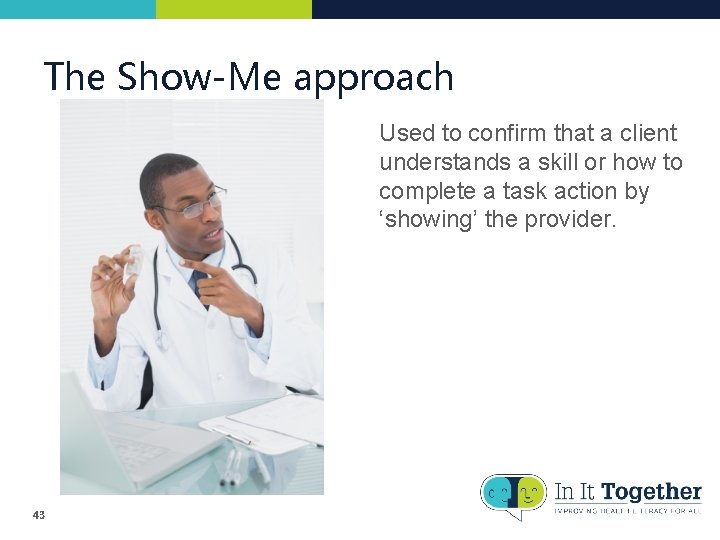
The Show-Me approach Used to confirm that a client understands a skill or how to complete a task action by ‘showing’ the provider. 43
Tips for successfully using the Teach -back or Show-Me approaches § Use open-ended questions § Self-correct if you begin to use jargon § Document use of and client’s response to teach-back and show-me approaches § Include family members or caregivers 44
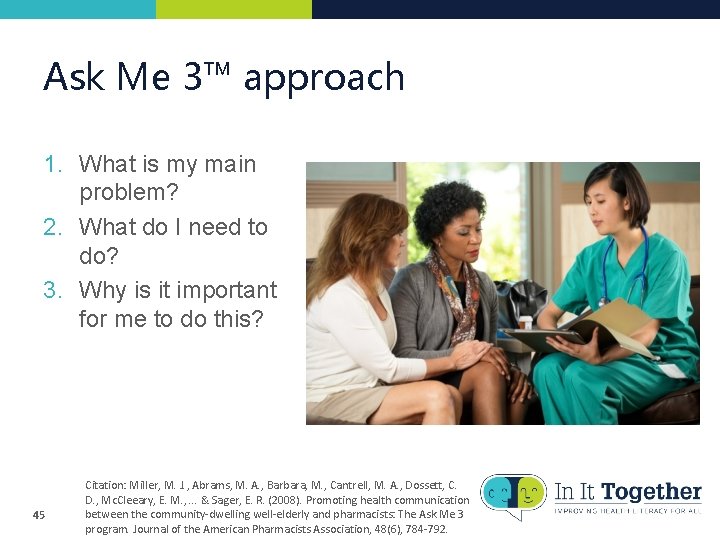
Ask Me 3™ approach 1. What is my main problem? 2. What do I need to do? 3. Why is it important for me to do this? 45 Citation: Miller, M. J. , Abrams, M. A. , Barbara, M. , Cantrell, M. A. , Dossett, C. D. , Mc. Cleeary, E. M. , . . . & Sager, E. R. (2008). Promoting health communication between the community-dwelling well-elderly and pharmacists: The Ask Me 3 program. Journal of the American Pharmacists Association, 48(6), 784 -792.
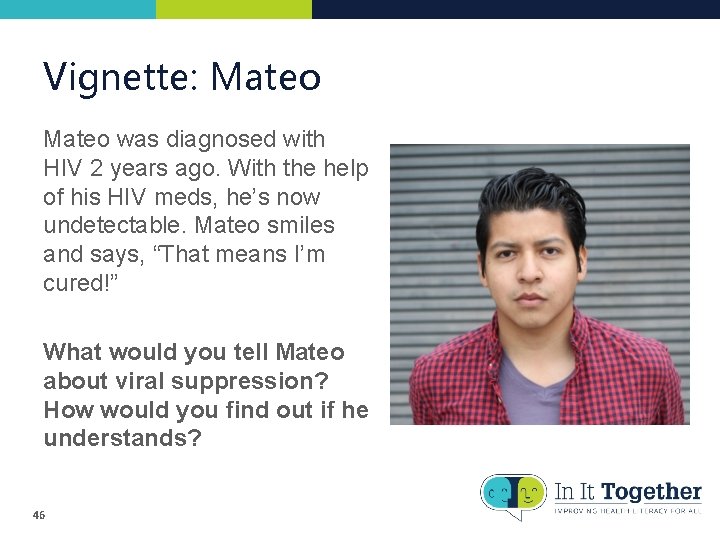
Vignette: Mateo was diagnosed with HIV 2 years ago. With the help of his HIV meds, he’s now undetectable. Mateo smiles and says, “That means I’m cured!” What would you tell Mateo about viral suppression? How would you find out if he understands? 46
Tips for health professionals § § § 47 Focus on client Pay attention to non-verbal messages Listen to seek an overall understanding Be empathetic Ask questions Talk less, listen more
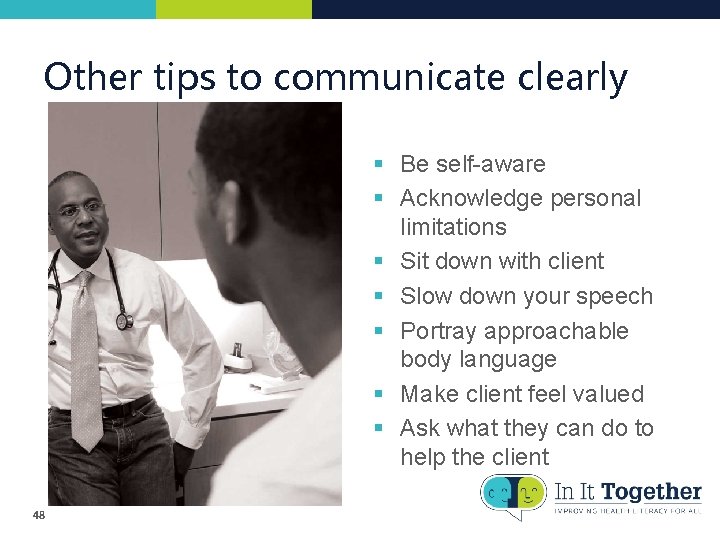
Other tips to communicate clearly § Be self-aware § Acknowledge personal limitations § Sit down with client § Slow down your speech § Portray approachable body language § Make client feel valued § Ask what they can do to help the client 48
How health professionals can foster a care partnership § Respect client’s privacy and the privacy of their medical information § Communicate openly about benefits and risks associated with treatment § Provide client with information to make informed decisions about their care 49
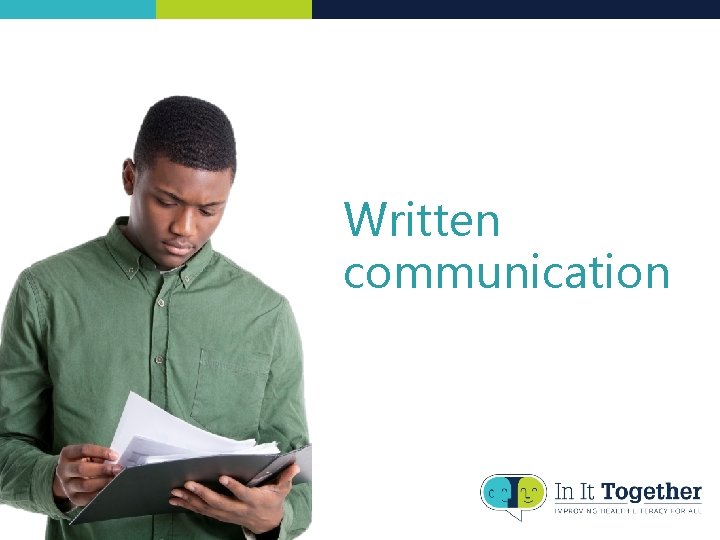
Written communication
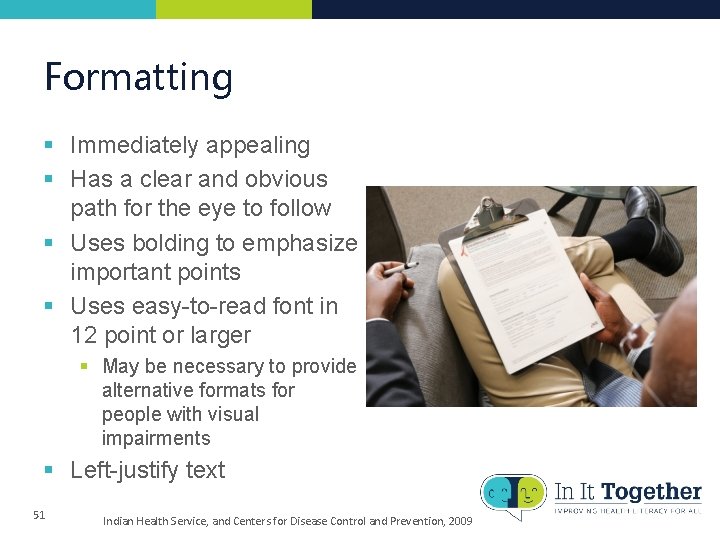
Formatting § Immediately appealing § Has a clear and obvious path for the eye to follow § Uses bolding to emphasize important points § Uses easy-to-read font in 12 point or larger § May be necessary to provide alternative formats for people with visual impairments § Left-justify text 51 Indian Health Service, and Centers for Disease Control and Prevention, 2009
Avoid § § ALL CAPITAL LETTERS Italicized text Underlined text Acronyms and contractions § Technical words or jargon § Passive voice 52 § Passive voice: The results of your lab work will be sent to you § Active voice: We will send your lab results
Word choice 53 § Simple words with 1 or 2 syllables § Short sentences with 10 to 15 words § Strong, vivid words, including verbs § Words or phrases familiar to the audience § At a 6 th grade reading level § Use culturally appropriate words
Content § Focus on the patient’s experience of the condition § Clearly state: § § § 54 What the client needs to do Why the client needs to do it When the client can expect results What warning signs the client needs to watch for What to do if a problem occurs Who to contact with questions
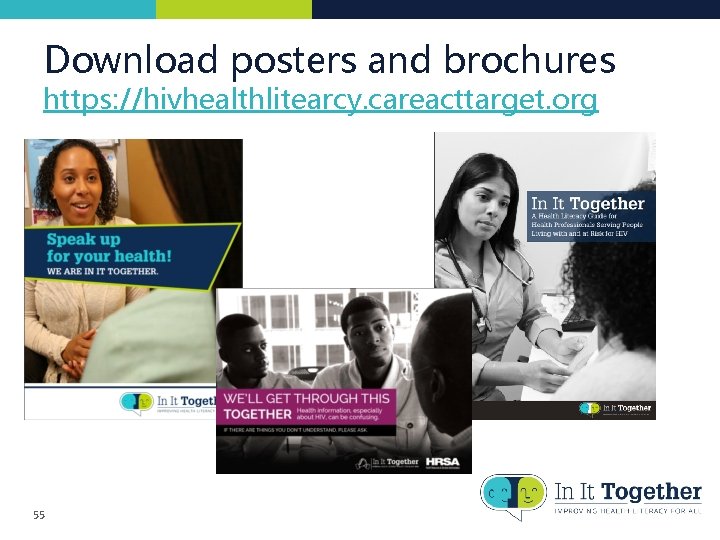
Download posters and brochures https: //hivhealthlitearcy. careacttarget. org 55
Health literate organizations 56
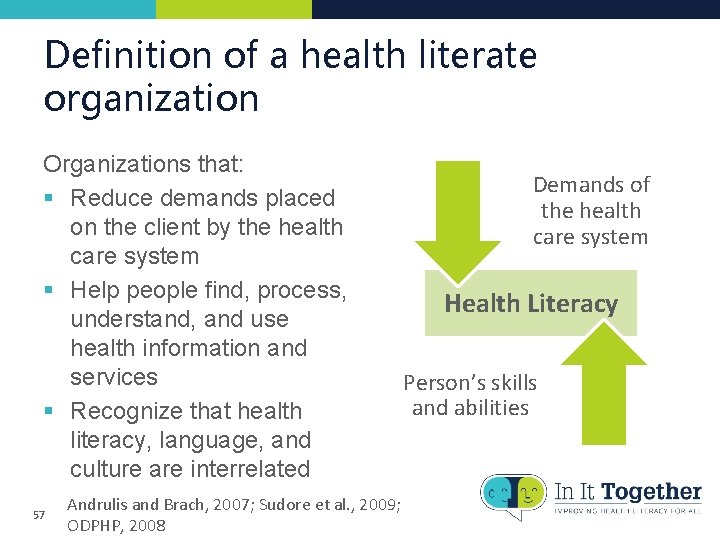
Definition of a health literate organization Organizations that: § Reduce demands placed on the client by the health care system § Help people find, process, understand, and use health information and services § Recognize that health literacy, language, and culture are interrelated 57 Andrulis and Brach, 2007; Sudore et al. , 2009; ODPHP, 2008 Demands of the health care system Health Literacy Person’s skills and abilities
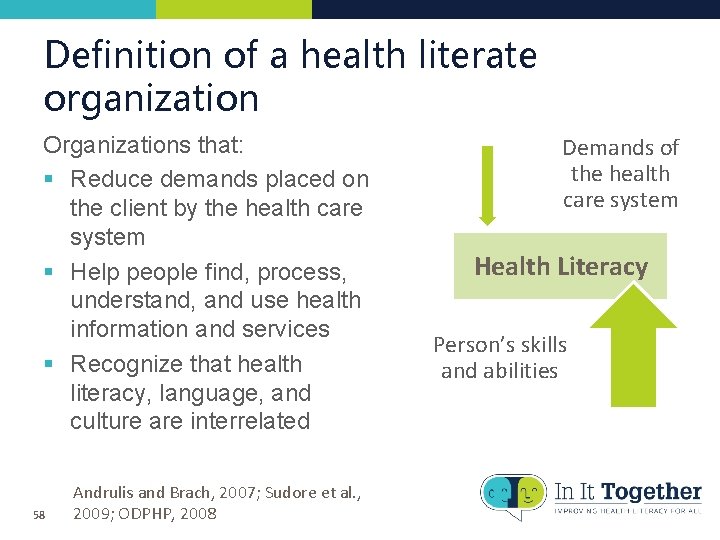
Definition of a health literate organization Organizations that: § Reduce demands placed on the client by the health care system § Help people find, process, understand, and use health information and services § Recognize that health literacy, language, and culture are interrelated 58 Andrulis and Brach, 2007; Sudore et al. , 2009; ODPHP, 2008 Demands of the health care system Health Literacy Person’s skills and abilities
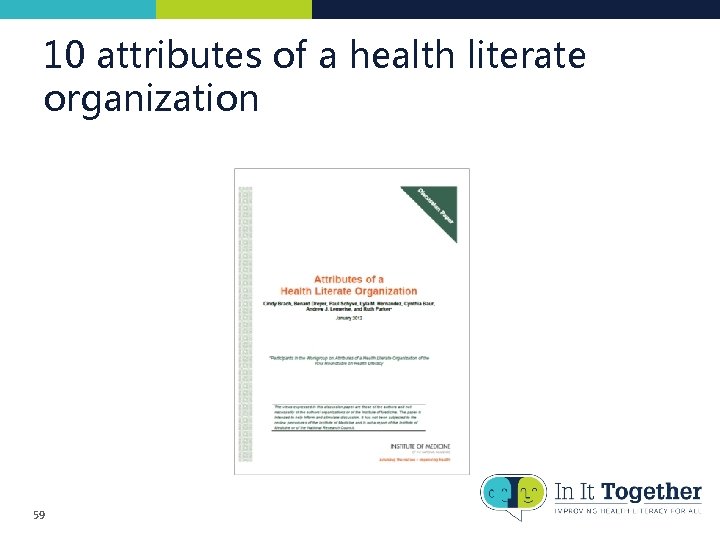
10 attributes of a health literate organization 59
10 attributes of health literate organizations § Attribute 1: Have leadership that makes health literacy integral to its mission, structure, and operations § Attribute 2: Make health literacy a part of planning, evaluation measures, patient safety, and quality improvement § Attribute 3: Prepare the workforce to be health literate and monitors progress 60
10 attributes of health literate organizations § Attribute 4: Include populations served in the design, implementation, and evaluation of health information and services § Attribute 5: Meet needs of populations with different levels of health literacy skills to avoid stigma § Attribute 6: Use health literacy strategies in communications and confirms understanding at all points of contact 61
10 attributes of health literate organizations § Attribute 7: Provide easy access to health information, services. and navigation assistance § Attribute 8: Design and distribute print, audiovisual, and social media content that is easy-to-understand actionable § Attribute 9: Address health literacy in high-risk situations, including care transitions and communications about medicines § Attribute 10: Communicate clearly what health insurance plans cover and how much individuals will have to pay for services 62
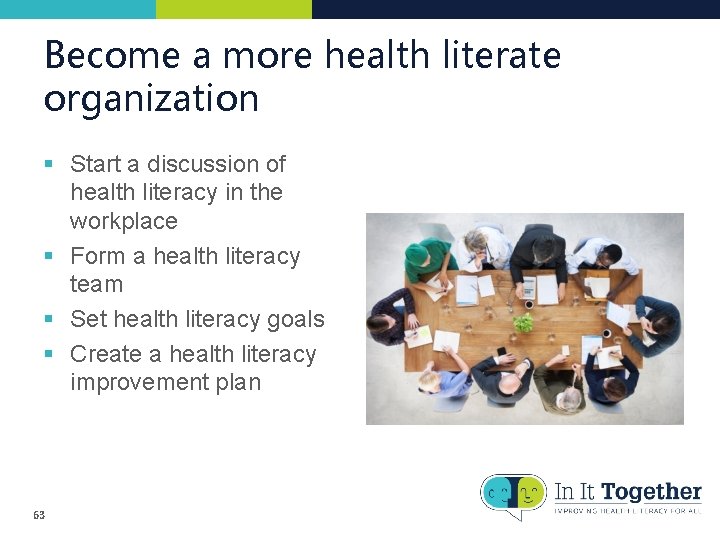
Become a more health literate organization § Start a discussion of health literacy in the workplace § Form a health literacy team § Set health literacy goals § Create a health literacy improvement plan 63
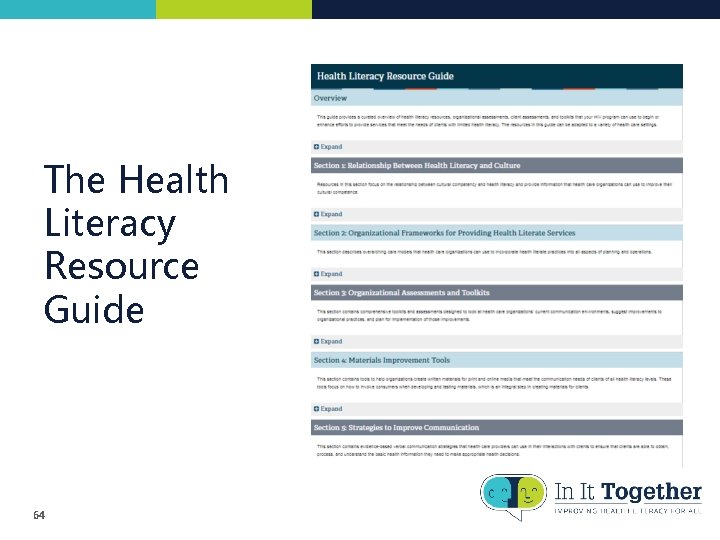
The Health Literacy Resource Guide 64
Start today! Promote the use of health literate practices § Universal precautions approach § Clear communications § Cultural competence 65
Thank you! Please complete your evaluation. [INSERT LINK HERE] This project is/was supported by the Health Resources and Services Administration (HRSA) of the U. S. Department of Health and Human Services (HHS) under grant number U 69 HA 30143: Building Ryan White HIV/AIDS Program Recipient Capacity to Engage People Living with HIV in Health Care Access. This information or content and conclusions are those of the author and should not be construed as the official position or policy of, nor should any endorsements be inferred by HRSA, HHS or the U. S. Government. The persons shown in photographs on this website/tool/resource are models and are being used for illustrative purposes only. 66