
In detail ap process 3 a reaction aaa

- Slides: 23
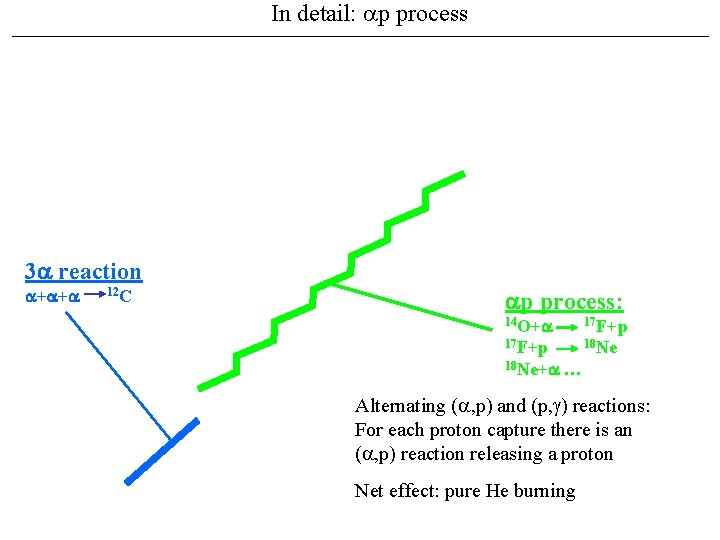
In detail: ap process 3 a reaction a+a+a 12 C ap process: 14 O+a 17 F+p 18 Ne+a … Alternating (a, p) and (p, g) reactions: For each proton capture there is an (a, p) reaction releasing a proton Net effect: pure He burning
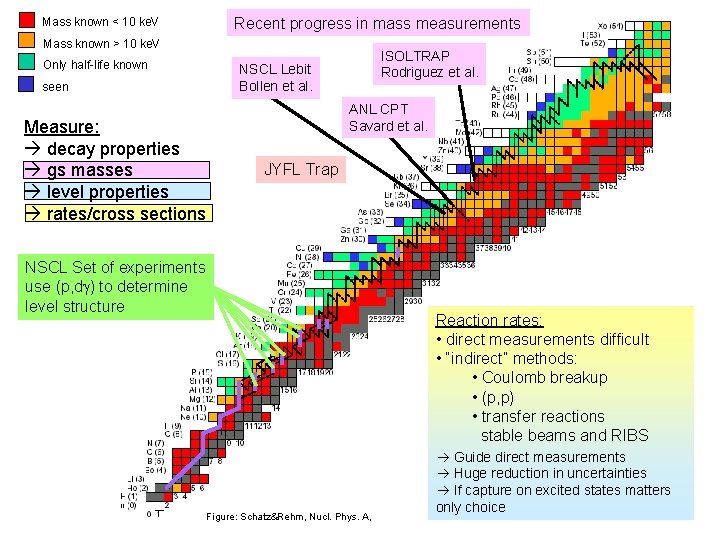
Recent progress in mass measurements Mass known < 10 ke. V Mass known > 10 ke. V Only half-life known ISOLTRAP Rodriguez et al. NSCL Lebit Bollen et al. seen Measure: decay properties gs masses level properties rates/cross sections ANL CPT Savard et al. JYFL Trap NSCL Set of experiments use (p, dg) to determine level structure Reaction rates: • direct measurements difficult • “indirect” methods: • Coulomb breakup • (p, p) • transfer reactions stable beams and RIBS Figure: Schatz&Rehm, Nucl. Phys. A, Guide direct measurements Huge reduction in uncertainties If capture on excited states matters only choice
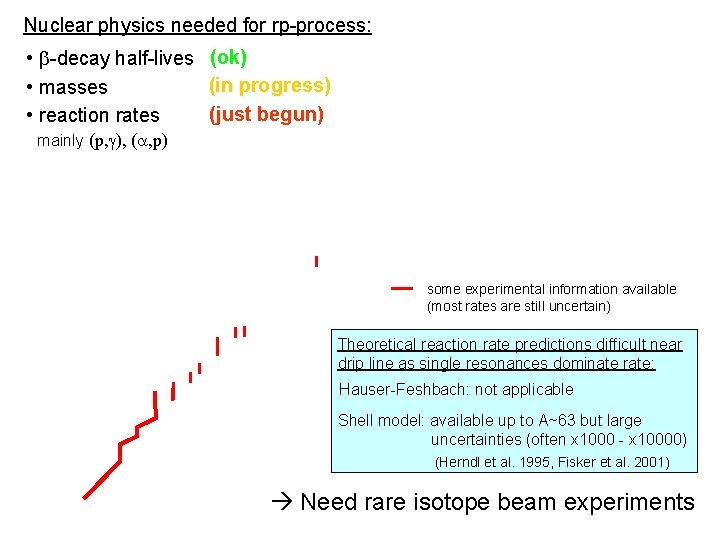
Nuclear physics needed for rp-process: • b-decay half-lives (ok) (in progress) • masses (just begun) • reaction rates mainly (p, g), (a, p) some experimental information available (most rates are still uncertain) Theoretical reaction rate predictions difficult near drip line as single resonances dominate rate: Hauser-Feshbach: not applicable Shell model: available up to A~63 but large uncertainties (often x 1000 - x 10000) (Herndl et al. 1995, Fisker et al. 2001) Need rare isotope beam experiments
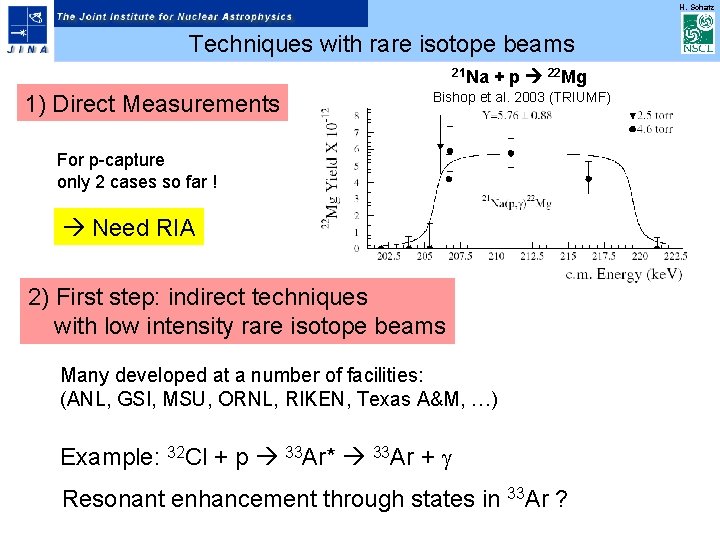
H. Schatz Techniques with rare isotope beams 21 Na 1) Direct Measurements + p 22 Mg Bishop et al. 2003 (TRIUMF) For p-capture only 2 cases so far ! Need RIA 2) First step: indirect techniques with low intensity rare isotope beams Many developed at a number of facilities: (ANL, GSI, MSU, ORNL, RIKEN, Texas A&M, …) Example: 32 Cl + p 33 Ar* 33 Ar + g Resonant enhancement through states in 33 Ar ?
H. Schatz NSCL Experiment: Clement et al. PRL 92 (2004) 2502 Doppler corrected g-rays in coincidence with 33 Ar in S 800 focal plane: 34 Ar g-rays from predicted 3. 97 Me. V state 33 Ar excited Plastic d 33 Ar level energies measured: 3819(4) ke. V (150 ke. V below SM) 3456(6) ke. V (104 ke. V below SM) reaction rate (cm 3/s/mole) stellar reaction rate with shellexperimental model only data x 3 uncertainty x 10000 uncertainty temperature (GK)
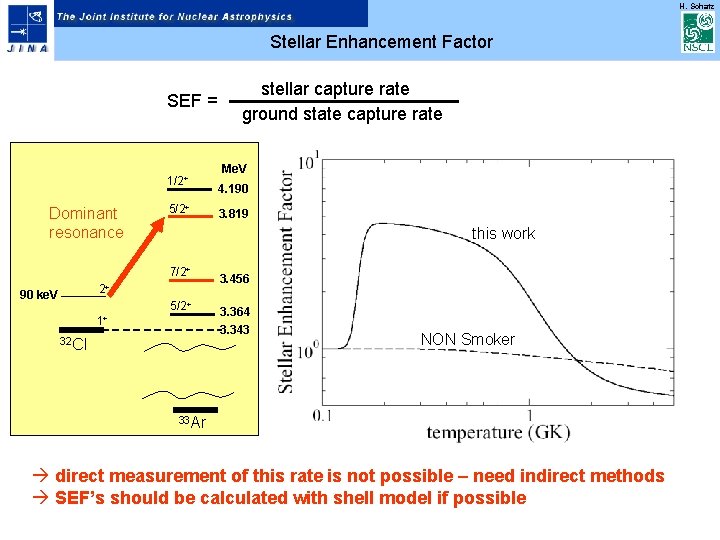
H. Schatz Stellar Enhancement Factor SEF = 1/2+ Dominant resonance 5/2+ Me. V 4. 190 3. 819 this work 7/2+ 2+ 90 ke. V stellar capture rate ground state capture rate 5/2+ 1+ 32 Cl 3. 456 3. 364 3. 343 NON Smoker 33 Ar direct measurement of this rate is not possible – need indirect methods SEF’s should be calculated with shell model if possible
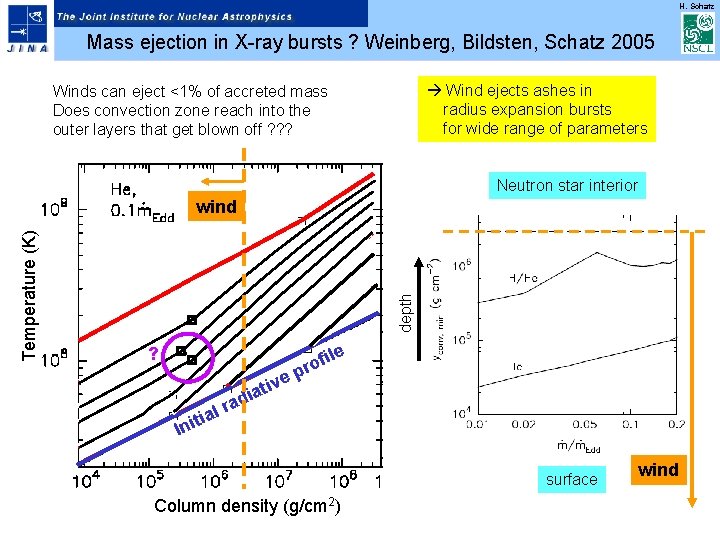
H. Schatz Mass ejection in X-ray bursts ? Weinberg, Bildsten, Schatz 2005 Wind ejects ashes in radius expansion bursts for wide range of parameters Winds can eject <1% of accreted mass Does convection zone reach into the outer layers that get blown off ? ? ? Neutron star interior depth Temperature (K) wind ? ve ti a i d ile f o pr a lr a i t i In surface Column density (g/cm 2) wind
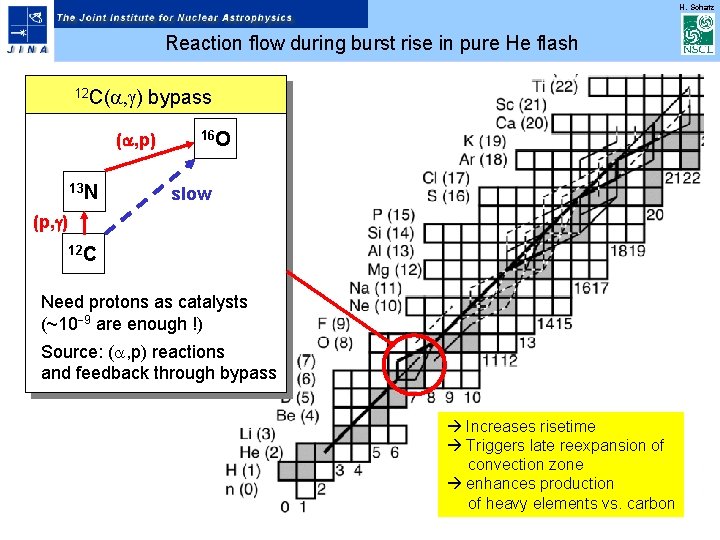
H. Schatz Reaction flow during burst rise in pure He flash 12 C(a, g) bypass (a, p) 13 N 16 O slow (p, g) 12 C Need protons as catalysts (~10 -9 are enough !) Source: (a, p) reactions and feedback through bypass Increases risetime Triggers late reexpansion of convection zone enhances production of heavy elements vs. carbon
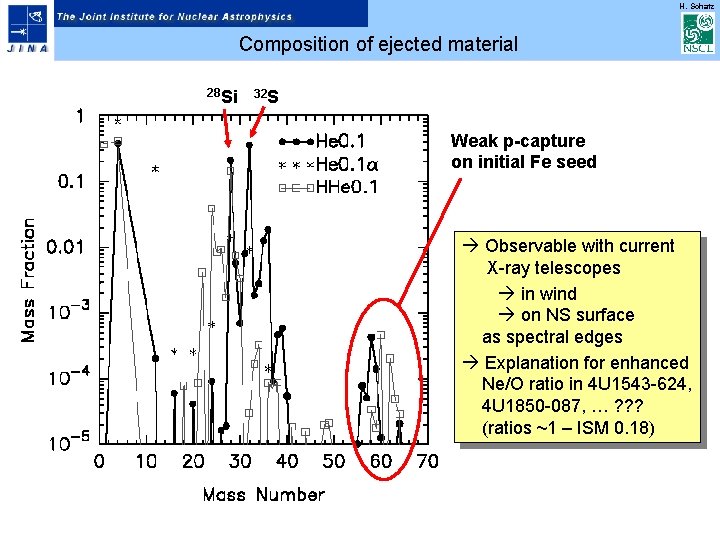
H. Schatz Composition of ejected material 28 Si 32 S Weak p-capture on initial Fe seed Observable with current X-ray telescopes in wind on NS surface as spectral edges Explanation for enhanced Ne/O ratio in 4 U 1543 -624, 4 U 1850 -087, … ? ? ? (ratios ~1 – ISM 0. 18)
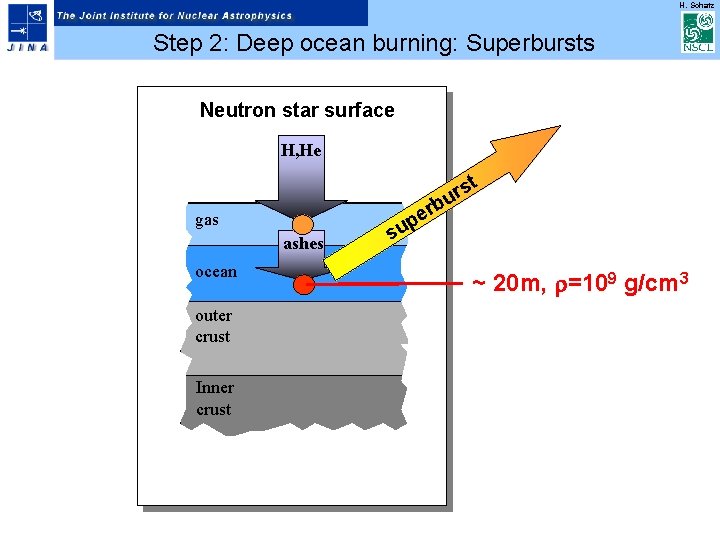
H. Schatz Step 2: Deep ocean burning: Superbursts Neutron star surface H, He t b gas ashes ocean outer crust Inner crust s ur r pe su ~ 20 m, r=109 g/cm 3
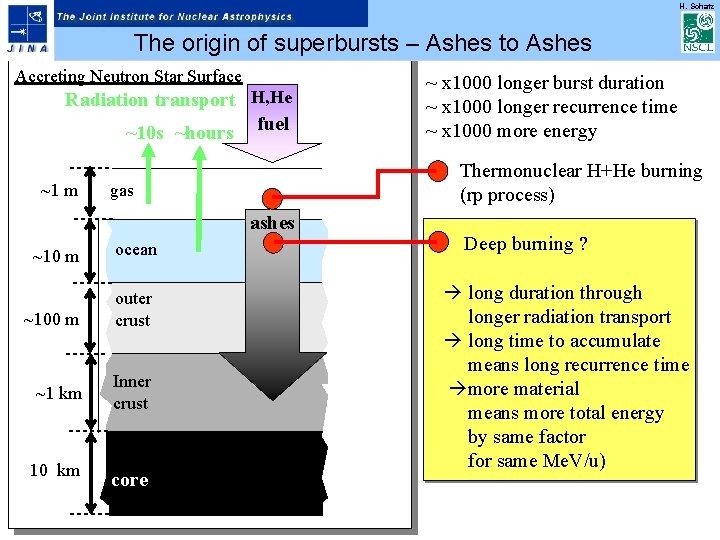
H. Schatz The origin of superbursts – Ashes to Ashes Accreting Neutron Star Surface Radiation transport H, He ~10 s ~hours ~1 m fuel Thermonuclear H+He burning (rp process) gas ashes ~10 m ocean ~100 m outer crust ~1 km 10 km Inner crust core ~ x 1000 longer burst duration ~ x 1000 longer recurrence time ~ x 1000 more energy Deep burning ? long duration through longer radiation transport long time to accumulate means long recurrence time more material means more total energy by same factor for same Me. V/u)
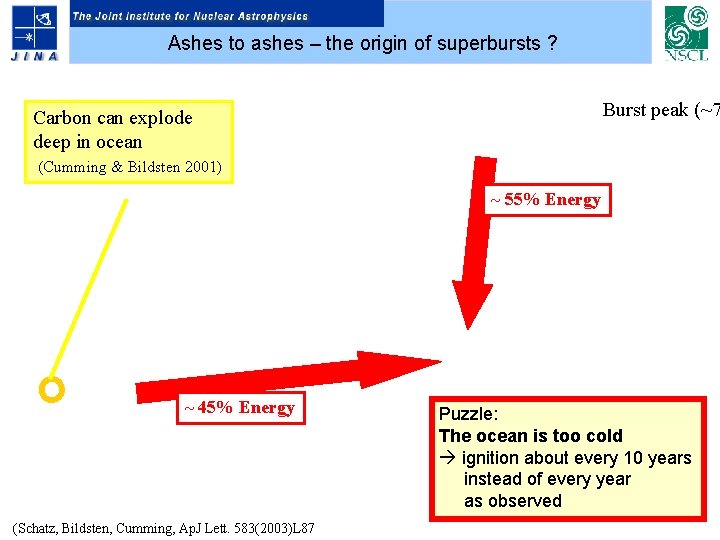
Ashes to ashes – the origin of superbursts ? Burst peak (~7 Carbon can explode deep in ocean (Cumming & Bildsten 2001) ~ 55% Energy ~ 45% Energy (Schatz, Bildsten, Cumming, Ap. J Lett. 583(2003)L 87 Puzzle: The ocean is too cold ignition about every 10 years instead of every year as observed
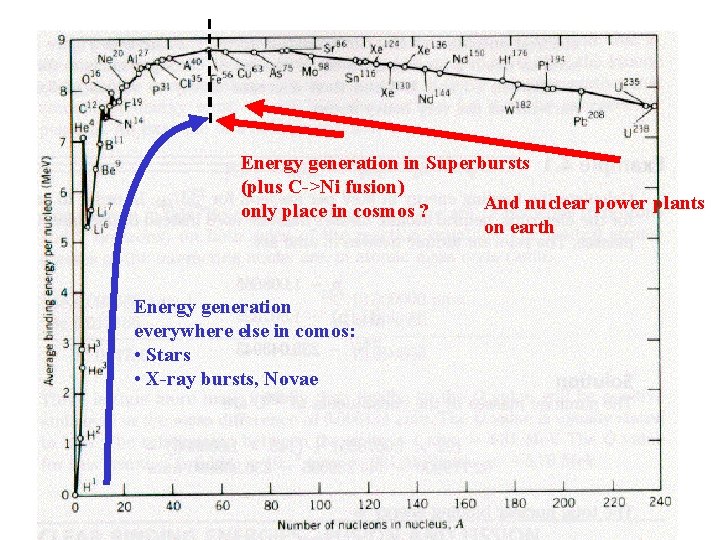
Energy generation in Superbursts (plus C->Ni fusion) And nuclear power plants only place in cosmos ? on earth Energy generation everywhere else in comos: • Stars • X-ray bursts, Novae
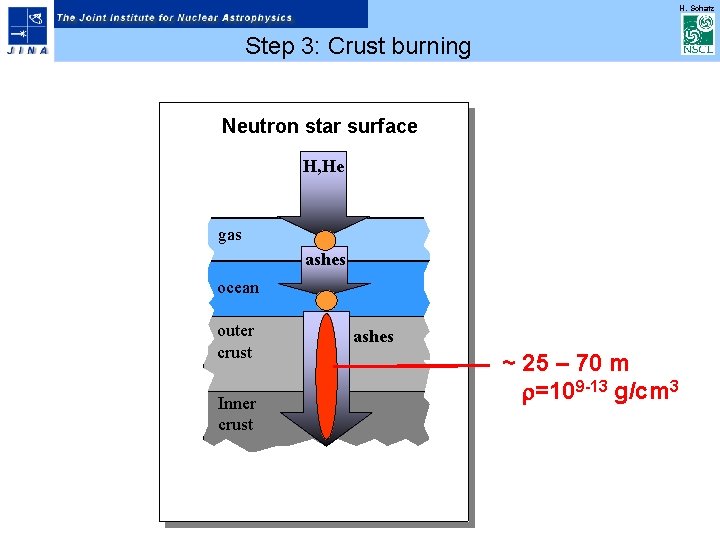
H. Schatz Step 3: Crust burning Neutron star surface H, He gas ashes ocean outer crust Inner crust ashes ~ 25 – 70 m r=109 -13 g/cm 3
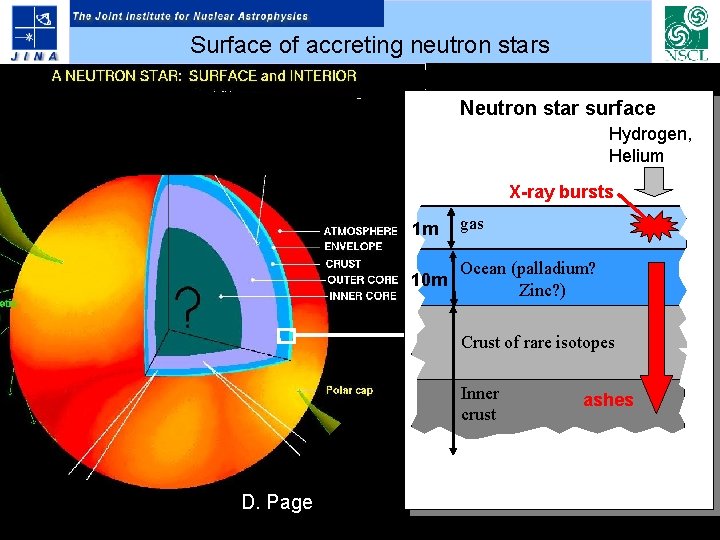
Surface of accreting neutron stars Neutron star surface Hydrogen, Helium X-ray bursts 1 m gas 10 m Ocean (palladium? Zinc? ) Crust of rare isotopes Inner crust D. Page ashes
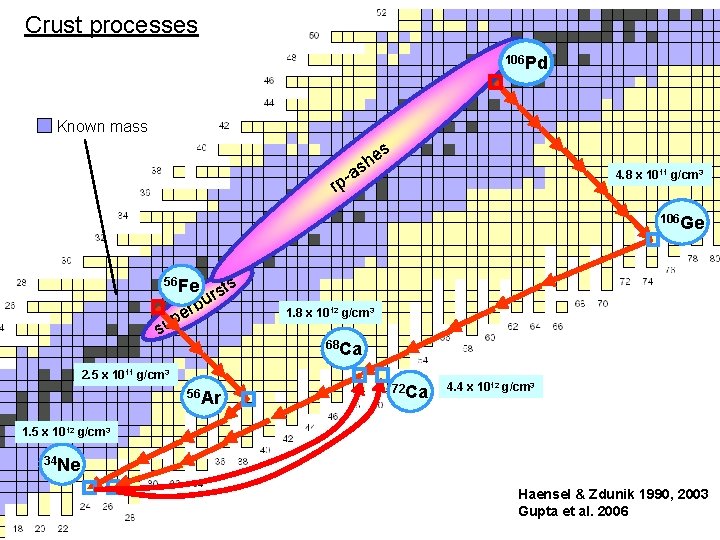
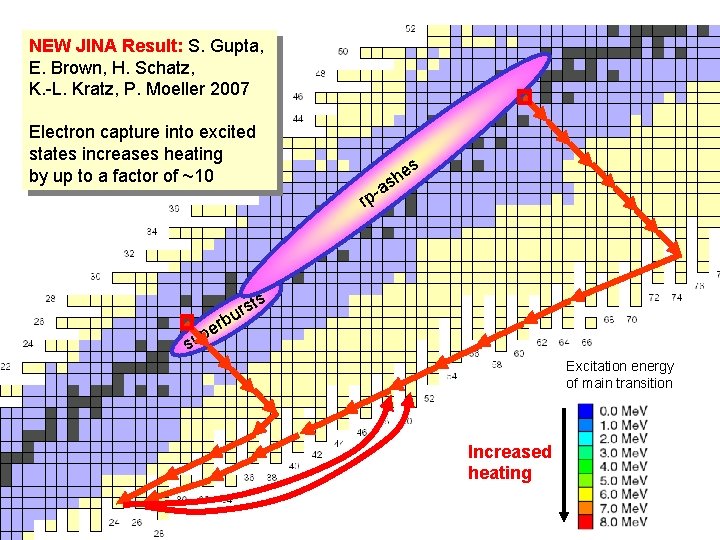
Crust processes 106 Pd Known mass s e sh a p- r 4. 8 x 10¹¹ g/cm 3 106 Ge 56 Fe ts s r u rb e p su 1. 8 x 10¹² g/cm 3 68 Ca 2. 5 x 10¹¹ g/cm 3 56 Ar 72 Ca 4. 4 x 10¹² g/cm 3 1. 5 x 10¹² g/cm 3 34 Ne Haensel & Zdunik 1990, 2003 Gupta et al. 2006
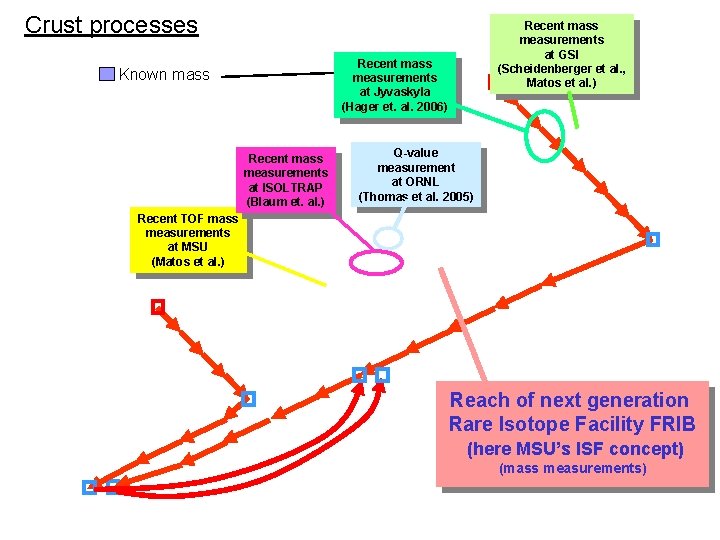
Crust processes Recent mass measurements at GSI (Scheidenberger et al. , Matos et al. ) Recent mass measurements at Jyvaskyla (Hager et. al. 2006) Known mass Recent mass measurements at ISOLTRAP (Blaum et. al. ) Q-value measurement at ORNL (Thomas et al. 2005) Recent TOF mass measurements at MSU (Matos et al. ) Reach of next generation Rare Isotope Facility FRIB (here MSU’s ISF concept) (mass measurements)
NEW JINA Result: S. Gupta, E. Brown, H. Schatz, K. -L. Kratz, P. Moeller 2007 Electron capture into excited states increases heating by up to a factor of ~10 s e sh a rp s t urs rb e p su Excitation energy of main transition Increased heating
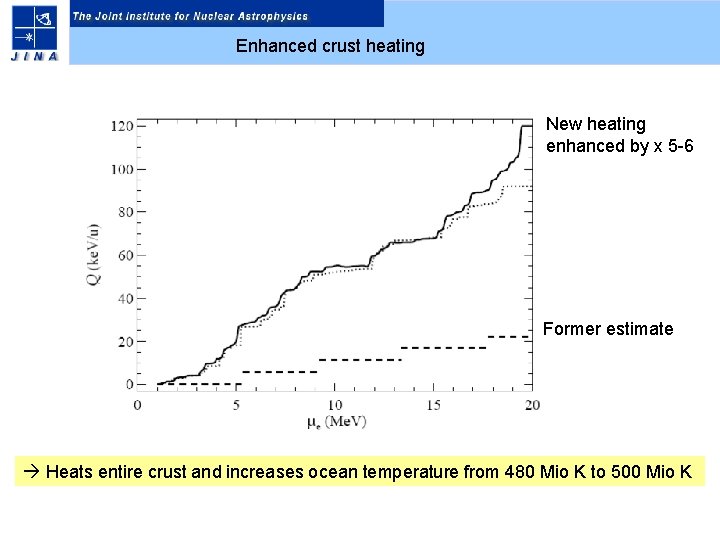
Enhanced crust heating New heating enhanced by x 5 -6 Former estimate Heats entire crust and increases ocean temperature from 480 Mio K to 500 Mio K
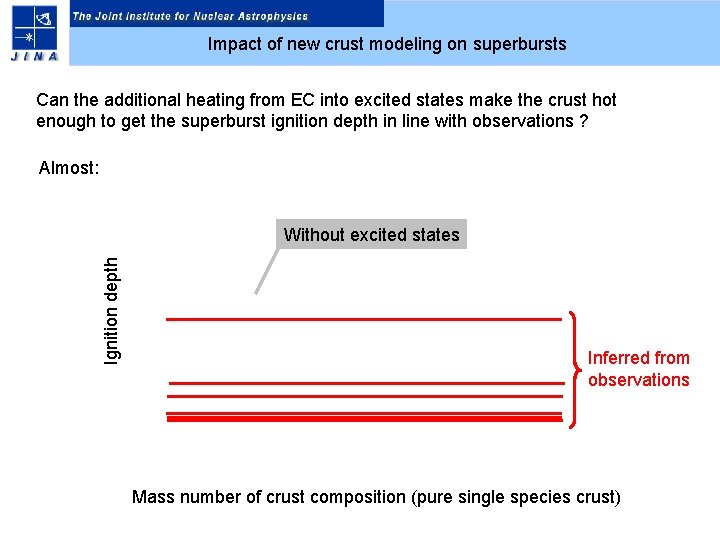
Impact of new crust modeling on superbursts Can the additional heating from EC into excited states make the crust hot enough to get the superburst ignition depth in line with observations ? Almost: Ignition depth Without excited states Inferred from observations Mass number of crust composition (pure single species crust)
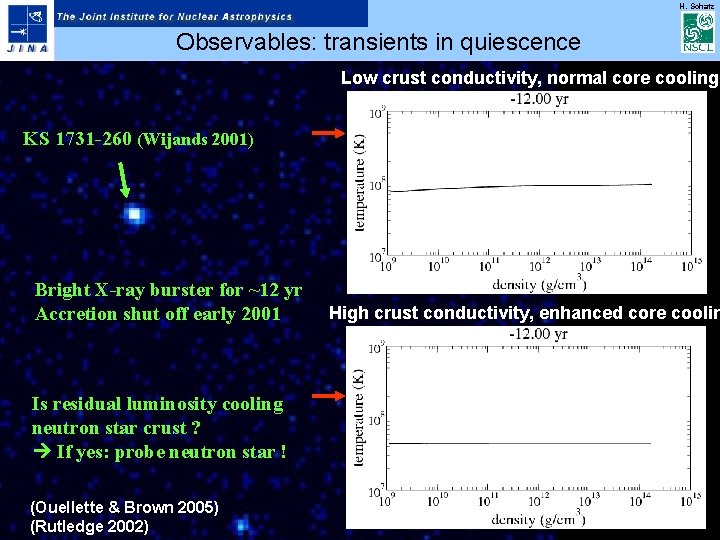
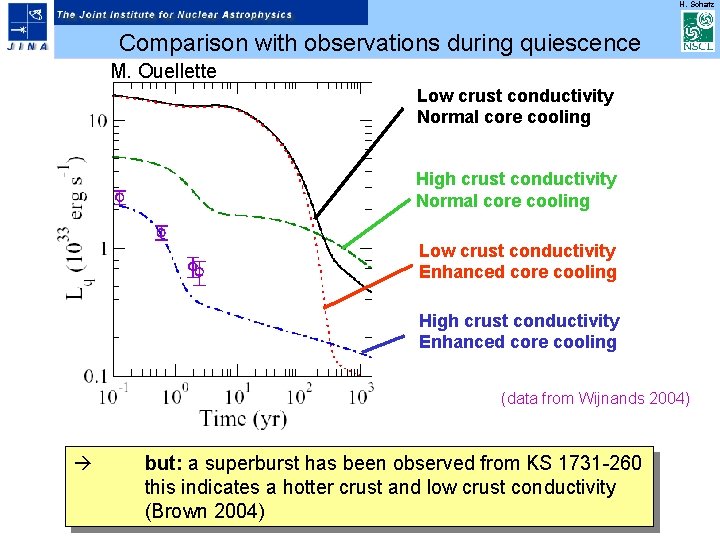
H. Schatz Observables: transients in quiescence Low crust conductivity, normal core cooling KS 1731 -260 (Wijands 2001) Bright X-ray burster for ~12 yr Accretion shut off early 2001 Is residual luminosity cooling neutron star crust ? If yes: probe neutron star ! (Ouellette & Brown 2005) (Rutledge 2002) High crust conductivity, enhanced core coolin
H. Schatz Comparison with observations during quiescence M. Ouellette Low crust conductivity Normal core cooling High crust conductivity Normal core cooling Low crust conductivity Enhanced core cooling High crust conductivity Enhanced core cooling (data from Wijnands 2004) but: a superburst has been observed from KS 1731 -260 this indicates a hotter crust and low crust conductivity (Brown 2004)
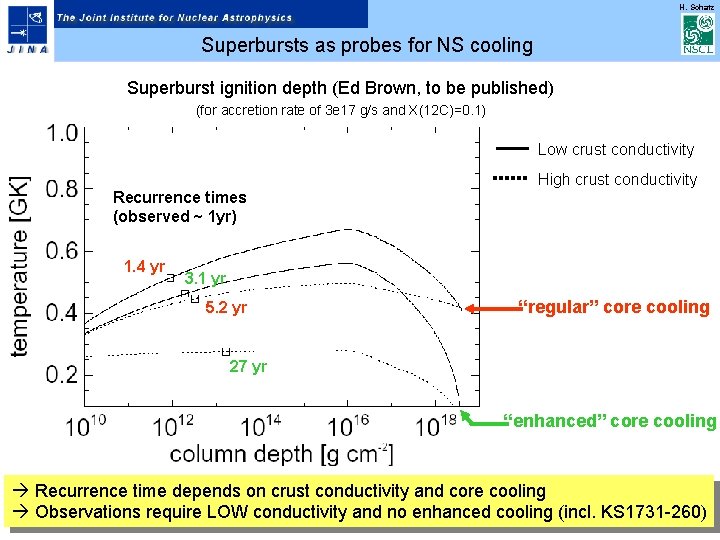
H. Schatz Superbursts as probes for NS cooling Superburst ignition depth (Ed Brown, to be published) (for accretion rate of 3 e 17 g/s and X(12 C)=0. 1) Low crust conductivity High crust conductivity Recurrence times (observed ~ 1 yr) 1. 4 yr 3. 1 yr 5. 2 yr “regular” core cooling 27 yr “enhanced” core cooling Recurrence time depends on crust conductivity and core cooling Observations require LOW conductivity and no enhanced cooling (incl. KS 1731 -260)