
In Defence of NATs Geoff Huston Chief Scientist

- Slides: 38
In Defence of NATs Geoff Huston, Chief Scientist APNIC
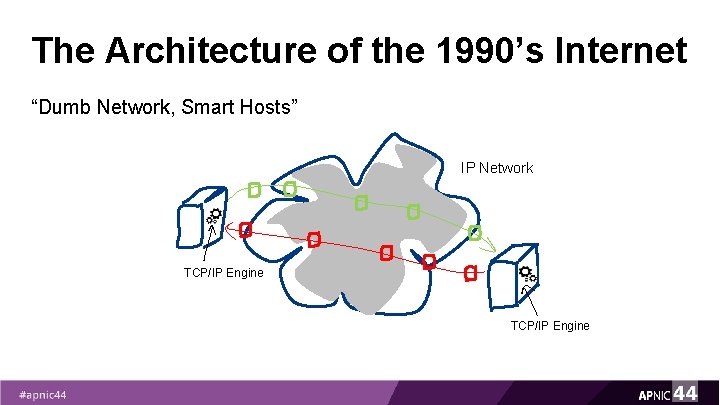
The Architecture of the 1990’s Internet “Dumb Network, Smart Hosts” IP Network TCP/IP Engine
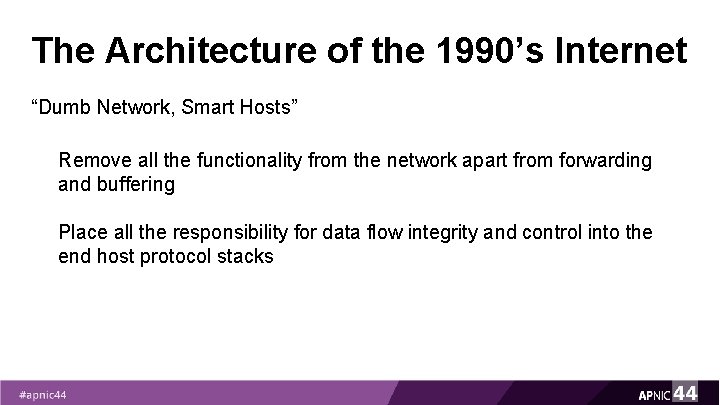
The Architecture of the 1990’s Internet “Dumb Network, Smart Hosts” Remove all the functionality from the network apart from forwarding and buffering Place all the responsibility for data flow integrity and control into the end host protocol stacks
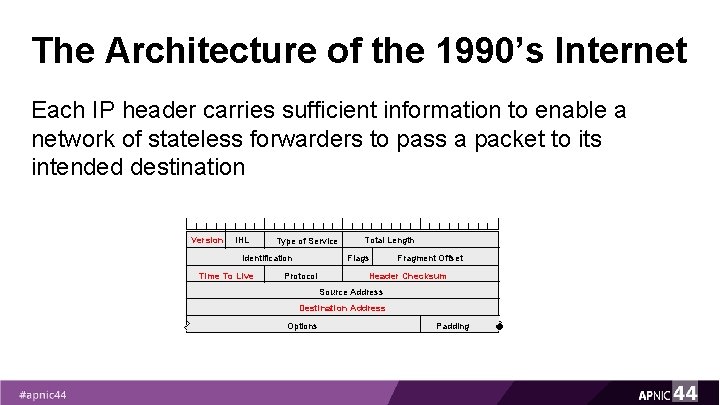
The Architecture of the 1990’s Internet Each IP header carries sufficient information to enable a network of stateless forwarders to pass a packet to its intended destination Version IHL Type of Service Identification Time To Live Total Length Flags Protocol Fragment Offset Header Checksum Source Address Destination Address Options Padding
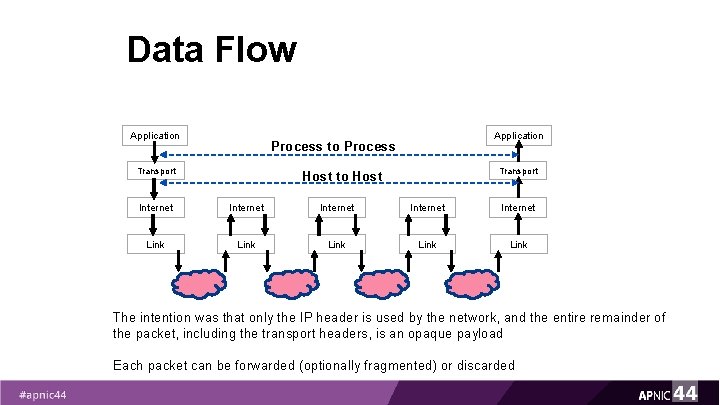
Data Flow Application Process to Process Transport Host to Host Internet Internet Link Link The intention was that only the IP header is used by the network, and the entire remainder of the packet, including the transport headers, is an opaque payload Each packet can be forwarded (optionally fragmented) or discarded
IP’s Strengths • There is no “setup” and “tear down” of network state • There is no requirement for symmetry between forward and reverse packet flows • While it is preferred that the network maintain the order of packets, it’s not a strict requirement • End-to-End Transport and Hop-by-Hop Forwarding are decoupled: the end-to-end transport protocol is a host choice, not a network choice
Consequences • IP addresses are globally significant unique identifiers – they are not local virtual circuit identifiers • All IP routers need to be aware of the relative location of all active IP addresses • The total capacity of the network is limited by the number of IP addresses and the ability to represent the relative location of all these addresses within every router
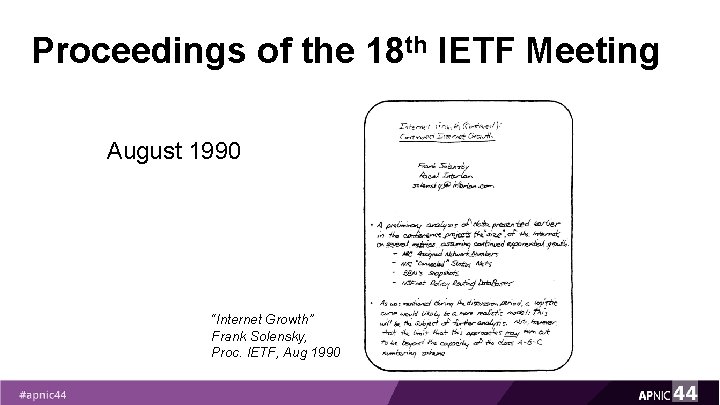
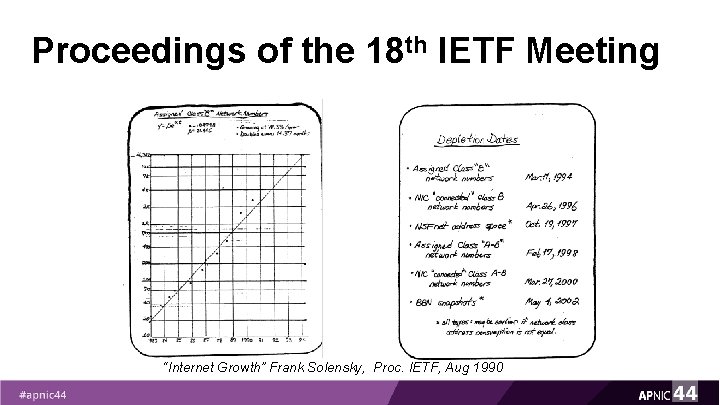
Proceedings of the 18 th IETF Meeting August 1990 “Internet Growth” Frank Solensky, Proc. IETF, Aug 1990
Proceedings of the 18 th IETF Meeting “Internet Growth” Frank Solensky, Proc. IETF, Aug 1990
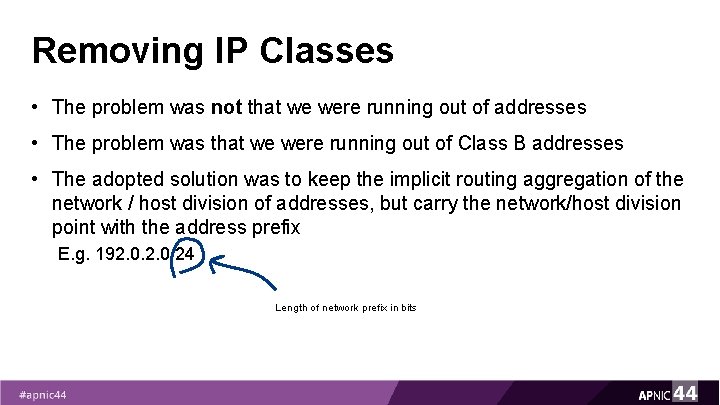
Removing IP Classes • The problem was not that we were running out of addresses • The problem was that we were running out of Class B addresses • The adopted solution was to keep the implicit routing aggregation of the network / host division of addresses, but carry the network/host division point with the address prefix E. g. 192. 0/24 Length of network prefix in bits
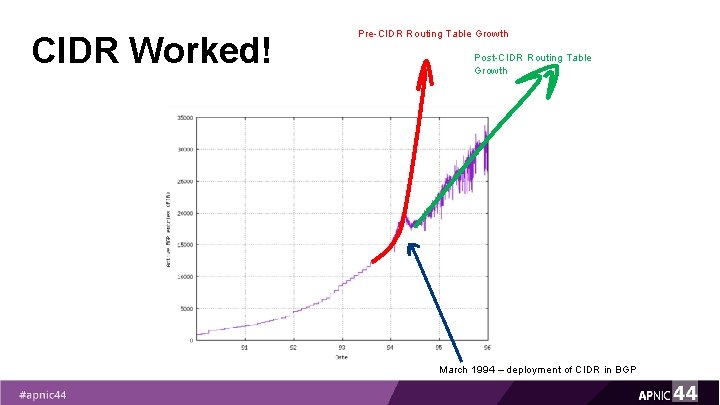
CIDR Worked! Pre-CIDR Routing Table Growth Post-CIDR Routing Table Growth March 1994 – deployment of CIDR in BGP
“Buying Time” was just a stopgap measure • The underlying issue was the personal computer, which dramatically increased the numbers of connected devices and indirectly fueled the first wave of commercialization of the Internet • And this was not going to stop – laptops, mobile devices, and embedded ‘things’ have all added to the numbers of connected devices • The thinking at the time was to change as little as possible, so we thought that enlarging the address fields of the IP header would be sufficient to meet this challenge to scaling The “answer” that was adopted by the IETF was IPv 6
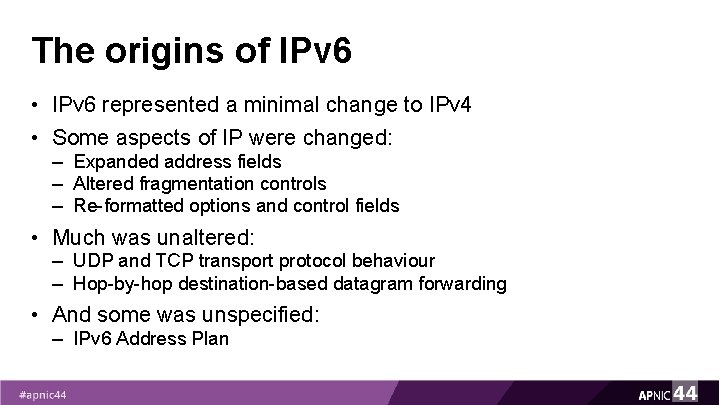
The origins of IPv 6 • IPv 6 represented a minimal change to IPv 4 • Some aspects of IP were changed: – Expanded address fields – Altered fragmentation controls – Re-formatted options and control fields • Much was unaltered: – UDP and TCP transport protocol behaviour – Hop-by-hop destination-based datagram forwarding • And some was unspecified: – IPv 6 Address Plan
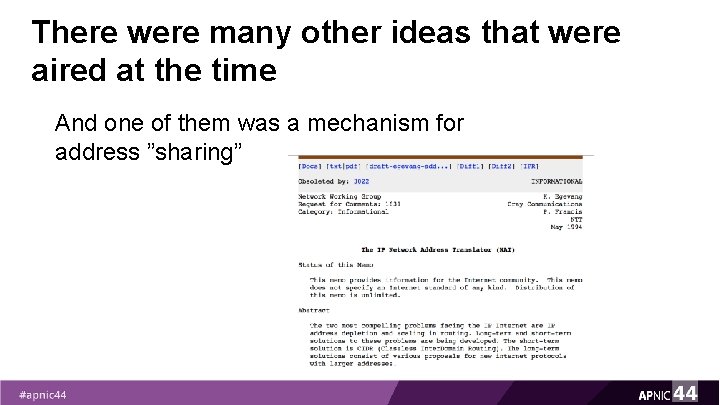
There were many other ideas that were aired at the time And one of them was a mechanism for address ”sharing”
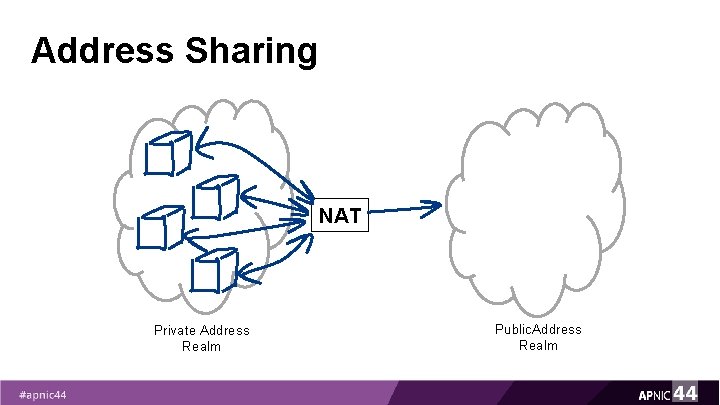
Address Sharing NAT Private Address Realm Public. Address Realm
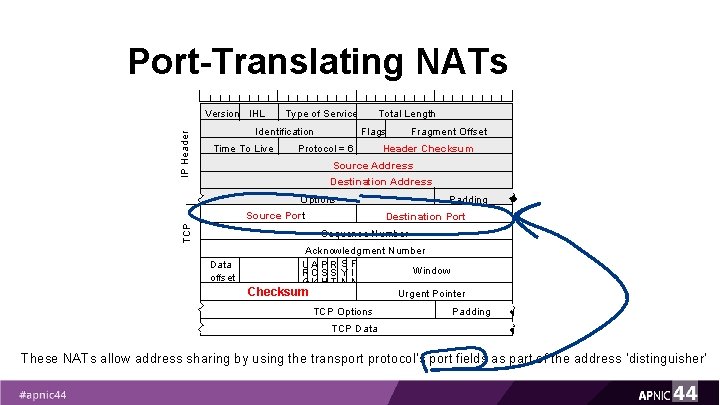
Port-Translating NATs IP Header Version IHL Identification Time To Live Total Length Type of Service Flags Protocol = 6 Fragment Offset Header Checksum Source Address Destination Address Options TCP Source Port Padding Destination Port Sequence Number Data offset Acknowledgment Number UA P R SF Window RCS S YI GK H T N N Checksum Urgent Pointer TCP Options Padding TCP Data These NATs allow address sharing by using the transport protocol’s port fields as part of the address ‘distinguisher’
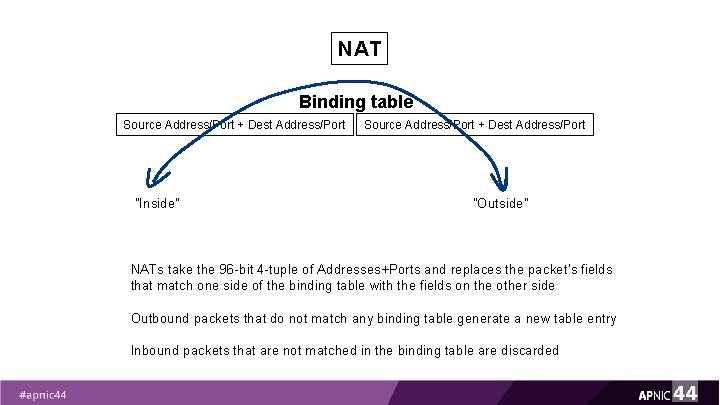
NAT Binding table Source Address/Port + Dest Address/Port ”Inside” Source Address/Port + Dest Address/Port ”Outside” NATs take the 96 -bit 4 -tuple of Addresses+Ports and replaces the packet’s fields that match one side of the binding table with the fields on the other side Outbound packets that do not match any binding table generate a new table entry Inbound packets that are not matched in the binding table are discarded
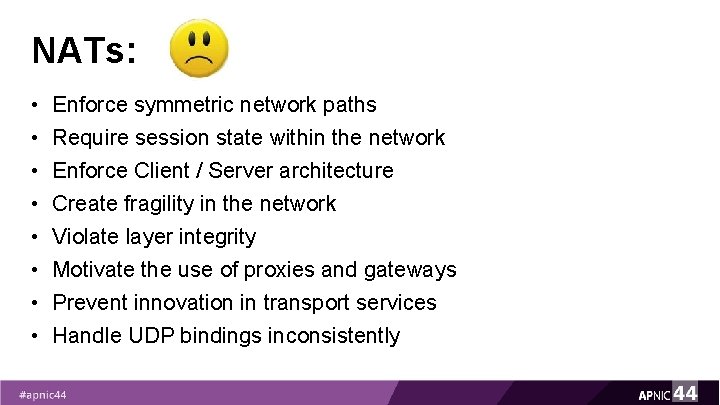
NATs: • • Enforce symmetric network paths Require session state within the network Enforce Client / Server architecture Create fragility in the network Violate layer integrity Motivate the use of proxies and gateways Prevent innovation in transport services Handle UDP bindings inconsistently
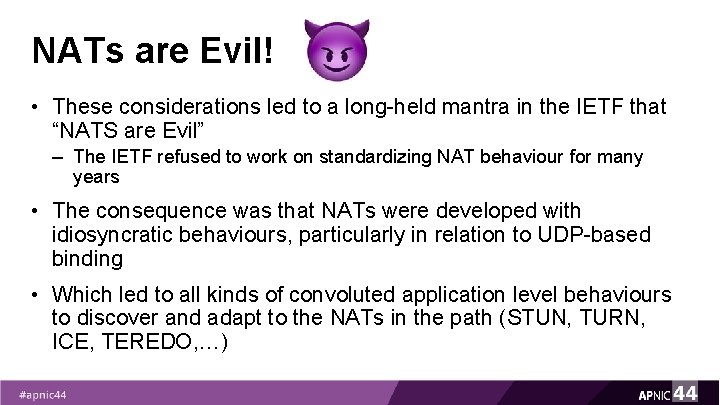
NATs are Evil! • These considerations led to a long-held mantra in the IETF that “NATS are Evil” – The IETF refused to work on standardizing NAT behaviour for many years • The consequence was that NATs were developed with idiosyncratic behaviours, particularly in relation to UDP-based binding • Which led to all kinds of convoluted application level behaviours to discover and adapt to the NATs in the path (STUN, TURN, ICE, TEREDO, …)
And yet…
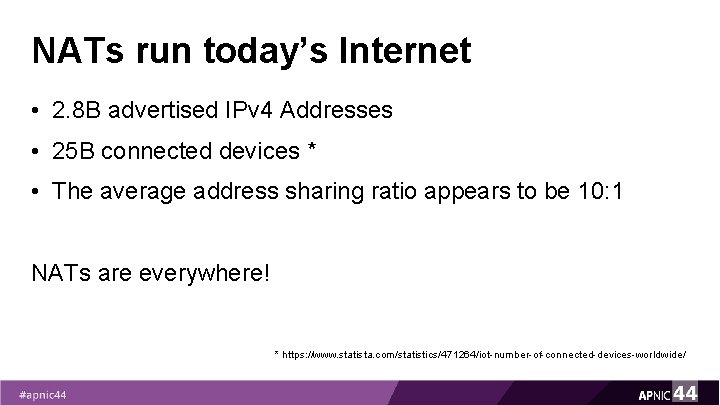
NATs run today’s Internet • 2. 8 B advertised IPv 4 Addresses • 25 B connected devices * • The average address sharing ratio appears to be 10: 1 NATs are everywhere! * https: //www. statista. com/statistics/471264/iot-number-of-connected-devices-worldwide/
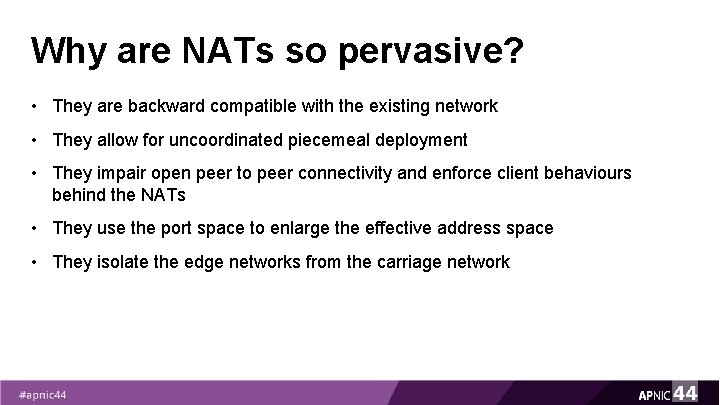
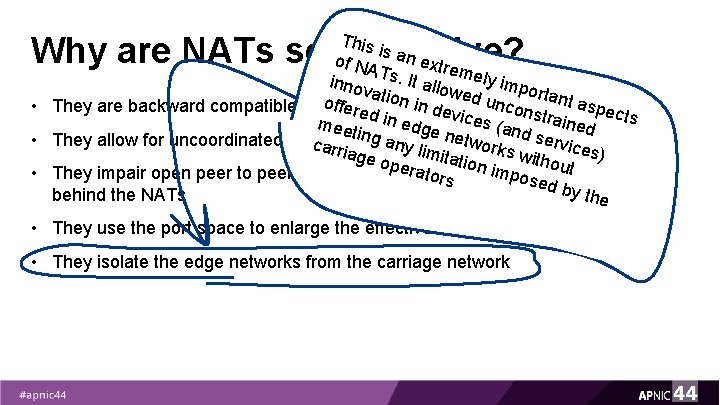
Why are NATs so pervasive? • They are backward compatible with the existing network • They allow for uncoordinated piecemeal deployment • They impair open peer to peer connectivity and enforce client behaviours behind the NATs • They use the port space to enlarge the effective address space • They isolate the edge networks from the carriage network
This is of NA an extre m T innov s. It allo ely impo wed ation rtant u aspe o n i f n • They are backward compatible with the existing network fered cons devi cts t r c in ed a e i s n mee e d ting a ge net (and se • They allow for uncoordinated piecemeal deployment w r v n carri age y limitat orks with ices) i oper ators on impos out • They impair open peer to peer connectivity and enforce client behaviours ed b y the behind the NATs Why are NATs so pervasive? • They use the port space to enlarge the effective address space • They isolate the edge networks from the carriage network
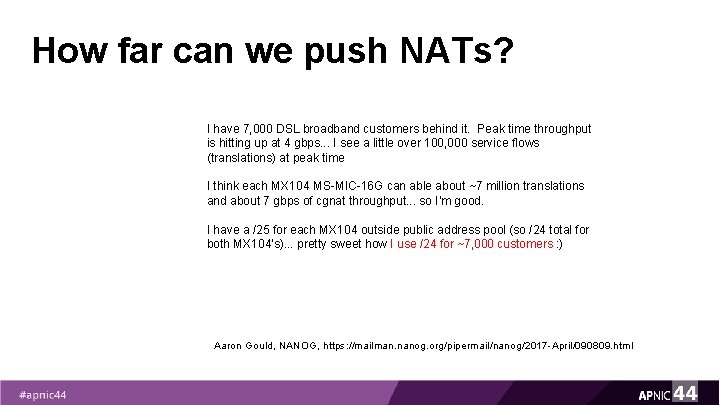
How far can we push NATs? I have 7, 000 DSL broadband customers behind it. Peak time throughput is hitting up at 4 gbps. . . I see a little over 100, 000 service flows (translations) at peak time I think each MX 104 MS-MIC-16 G can able about ~7 million translations and about 7 gbps of cgnat throughput. . . so I'm good. I have a /25 for each MX 104 outside public address pool (so /24 total for both MX 104's). . . pretty sweet how I use /24 for ~7, 000 customers : ) Aaron Gould, NANOG, https: //mailman. nanog. org/pipermail/nanog/2017 -April/090809. html
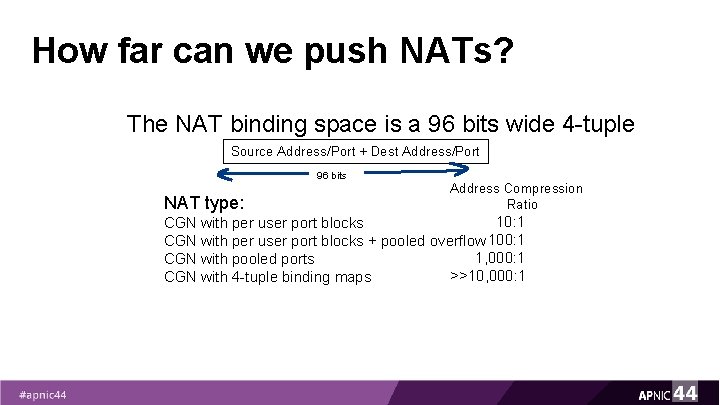
How far can we push NATs? The NAT binding space is a 96 bits wide 4 -tuple Source Address/Port + Dest Address/Port 96 bits NAT type: Address Compression Ratio 10: 1 CGN with per user port blocks 100: 1 CGN with per user port blocks + pooled overflow 1, 000: 1 CGN with pooled ports >>10, 000: 1 CGN with 4 -tuple binding maps
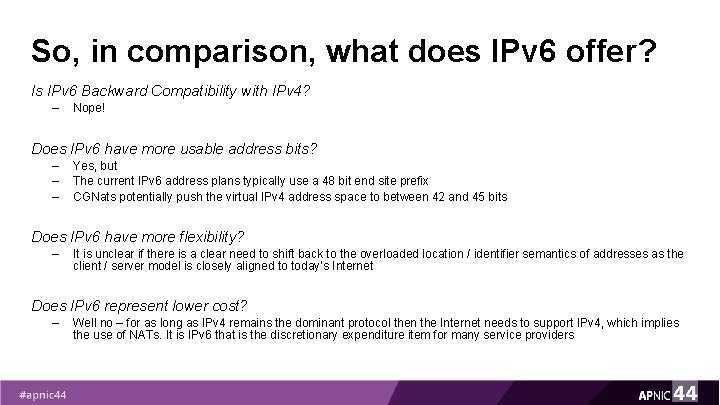
So, in comparison, what does IPv 6 offer? Is IPv 6 Backward Compatibility with IPv 4? – Nope! Does IPv 6 have more usable address bits? – – – Yes, but The current IPv 6 address plans typically use a 48 bit end site prefix CGNats potentially push the virtual IPv 4 address space to between 42 and 45 bits Does IPv 6 have more flexibility? – It is unclear if there is a clear need to shift back to the overloaded location / identifier semantics of addresses as the client / server model is closely aligned to today’s Internet Does IPv 6 represent lower cost? – Well no – for as long as IPv 4 remains the dominant protocol then the Internet needs to support IPv 4, which implies the use of NATs. It is IPv 6 that is the discretionary expenditure item for many service providers
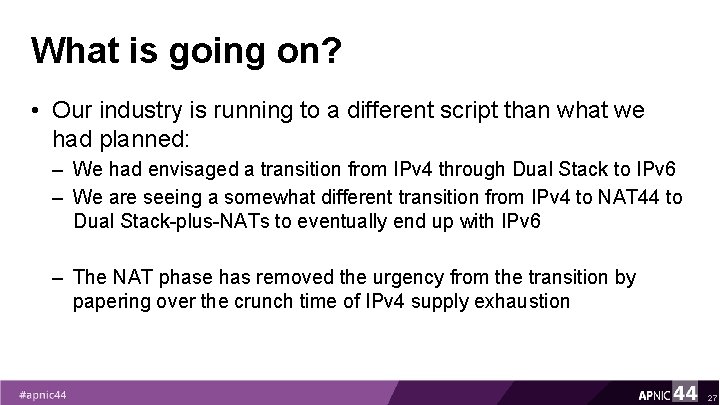
What is going on? • Our industry is running to a different script than what we had planned: – We had envisaged a transition from IPv 4 through Dual Stack to IPv 6 – We are seeing a somewhat different transition from IPv 4 to NAT 44 to Dual Stack-plus-NATs to eventually end up with IPv 6 – The NAT phase has removed the urgency from the transition by papering over the crunch time of IPv 4 supply exhaustion 27
But its not just transition • NATs have bought the Internet around 5 years of additional time in the transition by extending IPv 4 addresses • But they do more than address extension – they also alter the relative roles of names and addresses in the network’s architecture 28
NATs make addresses temporary For some time now we have been contemplating what it means to have a name-based data network, where instead of using a fixed relationship between names and IP addresses, we eschew this mapping and perform network transactions by specifying the name of the desired service or resource to the network NATs are an interesting step in this direction, where IP addresses have lost their static association with particular endpoints, and are used more as ephemeral session tokens than endpoint locators
Name-based Networks This certainly appears to be an important step in the direction of named data networking where addresses lose any permanent association with endpoint identity, and retain only the fixed semantics of a network locator used in routing The service name becomes the endpoint identifier Addresses are not used to identify service endpoints, but instead are used to distinguish and direct session traffic within the network
In Defence of NATs • It’s NATs, and only NATs, that have kept the Internet running for the past decade • In that time the network has grown from around 2 B connected devices to ten times that number • The IPv 4 network and its application suite is now built on the assumption of pervasive use of NATs • These same application and service design parameters are used in the context of IPv 6
IPv 6 Addresses • Do we use “fixed” end addresses in IPv 6 anyway? – Well, not all the time! – Clients typically use “privacy” addresses that use a random 64 bit interface identifier – So the IPv 6 IP end address is now ephemeral for clients • Services are increasingly using name based hosting – There are more levers and control points in the DNS as distinct from IP anycast • So even IPv 6 has eschewed “fixed” end addressing!
NATs in IPv 6 For some this is heresy! However: – IPv 6 has already dissociated itself from fixed end addresses – we have already marked off ULAs as private use IPv 6 address prefixes (fc 00: : /7 – RFC 4193) – Persistent private addresses and NATs avoid forced site renumbering – NATs allow site multi-homing without route de-aggregation – NATs obscure internal site network details and enforce client obscurity • As IPv 6 gathers momentum it may be the case that network admins will use ULA prefixes plus NATs to re-create the IPv 4 NAT architecture in IPv 6
What’s the Message Here? 34
NATs are Good! • Maintaining a network infrastructure that uniquely names and numbers every attached device has proved to be economically infeasible in the Internet • NATs segment the device population into clients and servers - Clients are not uniquely named, nor uniquely addressed • We may not have planned it this way, but undeniably what keeps today’s Internet running as a single cost effective network is NATs.
NATs as part of the Architecture • NATs have pushed the network into a mode where IP addresses are ephemeral conversation tokens without lasting significance as an endpoint identifier • For clients, address uniqueness is a locally scoped property, rather than a globally scoped attribute • Some services still use unique addresses • Other services use generic “aggregate” addresses and relay on the application to perform service identification
Today’s Internet Architecture Is this the model of disambiguation of location and service identity that we’ve been searching for the past couple of decades? Are we over a model of networking where “addresses” uniquely denote points of attachment to a common network? Are addresses locally scoped elements that provides disambiguation only to the extent that they are necessary?
Questions?