
In Concert An Integrated Reading and Writing Approach
- Slides: 27
In Concert: An Integrated Reading and Writing Approach by Kathleen T. Mc. Whorter Part Four: Critical Thinking, Reading, and Writing Chapter 13: Critical Thinking: Making Inferences and Analyzing the Author’s Point Power. Point by Sarah Gilliam, Instructor of English Mountain Empire Community College
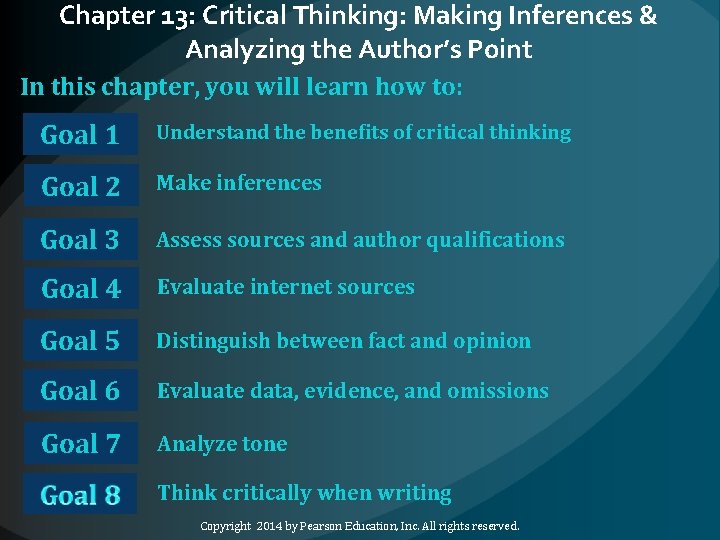
Chapter 13: Critical Thinking: Making Inferences & Analyzing the Author’s Point In this chapter, you will learn how to: Goal 1 Understand the benefits of critical thinking Goal 2 Make inferences Goal 3 Assess sources and author qualifications Goal 4 Evaluate internet sources Goal 5 Distinguish between fact and opinion Goal 6 Evaluate data, evidence, and omissions Goal 7 Analyze tone Think critically when writing Copyright 2014 by Pearson Education, Inc. All rights reserved.
Goal 1: Understand the Benefits of Critical Thinking: • Is analytical thinking • Requires you to evaluate what you read • Sometimes requires you to disagree with the author • Sometimes requires you to express a different opinion Copyright 2014 by Pearson Education, Inc. All rights reserved.
Goal 2: Make Inferences An inference is an educated guess or prediction about something unknown based on available facts or information. What are some strategies for making inferences? Copyright 2014 by Pearson Education, Inc. All rights reserved.
Goal 3: Assess Sources and Author Qualifications Important Considerations: • The source in which the material is printed • The authority/qualifications of the author How do I assess a source? Copyright 2014 by Pearson Education, Inc. All rights reserved.
Goal 4: Evaluate Internet Sources The internet contains a fair amount of valuable information; however, it also contains misinformation. How do I evaluate internet sources? Copyright 2014 by Pearson Education, Inc. All rights reserved.
Goal 4: Evaluate Internet Sources How do I evaluate the accuracy and timeliness of a website? Copyright 2014 by Pearson Education, Inc. All rights reserved.
Goal 5: Distinguish Between Fact and Opinion Facts are statements that can be proven or verified. Opinions are statements that express feelings, attitudes, or beliefs. Opinions are not necessarily true or false. Copyright 2014 by Pearson Education, Inc. All rights reserved.
Goal 6: Evaluate Data, Evidence, and Omissions The reader must determine what evidence the author has chosen to include in a writing and what information the author has omitted. Why do authors pick and choose what to use and omit in a particular writing? Copyright 2014 by Pearson Education, Inc. All rights reserved.
Goal 7: Analyze Tone The tone of an author’s writing helps the reader interpret what he or she is saying. Types of Tone: Instructive Sympathetic Convincing Entertaining Nostalgic Outraged Copyright 2014 by Pearson Education, Inc. All rights reserved.
Goal 8: Think Critically When Writing What are some strategies for thinking critically while writing? Copyright 2014 by Pearson Education, Inc. All rights reserved.
Goal 1: Understand the Benefits of Critical Thinking Review Questions True or False: Critical thinking allows you to distinguish good information from inaccurate or incomplete information. True or False: “Critical” refers to “negative” in terms of critical thinking. Copyright 2014 by Pearson Education, Inc. All rights reserved.
Goal 1: Understand the Benefits of Critical Thinking Review Questions True or False: True: Critical thinking allows you to distinguish good information from inaccurate or incomplete information. True or False: “Critical” refers to “negative” in terms of critical thinking. Copyright 2014 by Pearson Education, Inc. All rights reserved.
Goal 2: Make Inferences Review Questions Which of the following is NOT a strategy for making inferences? A. Notice details B. Pay attention to word choice C. The inference does not need to be fact-based D. Understand the writer’s purpose Copyright 2014 by Pearson Education, Inc. All rights reserved.
Goal 2: Make Inferences Review Questions Which of the following is NOT a strategy for making inferences? A. Notice details B. Pay attention to word choice C. The inference does not need to be fact-based D. Understand the writer’s purpose Copyright 2014 by Pearson Education, Inc. All rights reserved.
Goal 3: Assess Sources and Author Qualifications Review Questions True or False: It is important to consider the source in which the material is printed. True or False: Authors would not be published if they were not credible. Copyright 2014 by Pearson Education, Inc. All rights reserved.
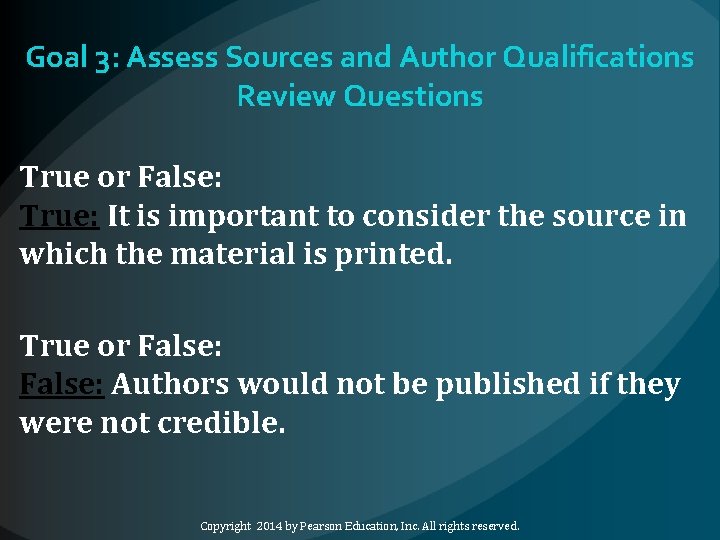
Goal 3: Assess Sources and Author Qualifications Review Questions True or False: True: It is important to consider the source in which the material is printed. True or False: Authors would not be published if they were not credible. Copyright 2014 by Pearson Education, Inc. All rights reserved.
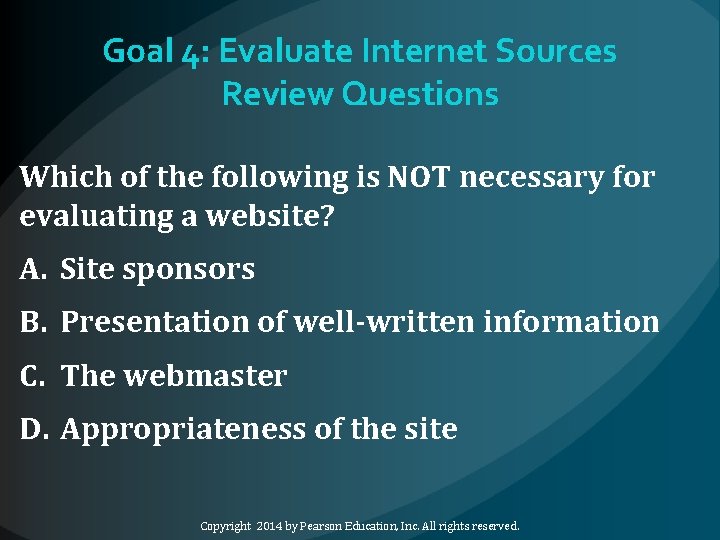
Goal 4: Evaluate Internet Sources Review Questions Which of the following is NOT necessary for evaluating a website? A. Site sponsors B. Presentation of well-written information C. The webmaster D. Appropriateness of the site Copyright 2014 by Pearson Education, Inc. All rights reserved.
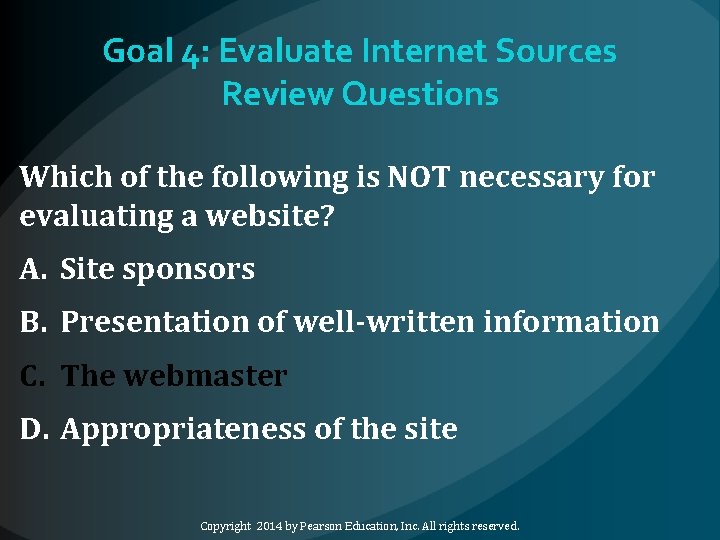
Goal 4: Evaluate Internet Sources Review Questions Which of the following is NOT necessary for evaluating a website? A. Site sponsors B. Presentation of well-written information C. The webmaster D. Appropriateness of the site Copyright 2014 by Pearson Education, Inc. All rights reserved.
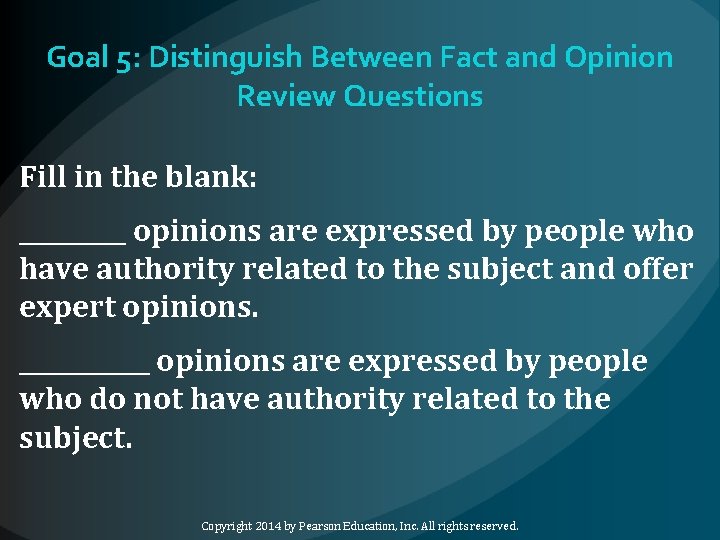
Goal 5: Distinguish Between Fact and Opinion Review Questions Fill in the blank: _____ opinions are expressed by people who have authority related to the subject and offer expert opinions. ______ opinions are expressed by people who do not have authority related to the subject. Copyright 2014 by Pearson Education, Inc. All rights reserved.
Goal 5: Distinguish Between Fact and Opinion Review Questions Fill in the blank: Informed opinions are expressed by people who have authority related to the subject and offer expert opinions. Uninformed opinions are expressed by people who do not have authority related to the subject Copyright 2014 by Pearson Education, Inc. All rights reserved.
Goal 6: Evaluate Data, Evidence, and Omissions Review Questions True or False: When evaluating evidence, one must be concerned with the type of evidence presented. True or False: When evaluating information, authors should omit certain details so the reader only receives a certain perspective. Copyright 2014 by Pearson Education, Inc. All rights reserved.
Goal 6: Evaluate Data, Evidence, and Omissions Review Questions True or False: True: When evaluating evidence, one must be concerned with the type of evidence presented. True or False: When evaluating information, authors should omit certain details so the reader only receives a certain perspective. Copyright 2014 by Pearson Education, Inc. All rights reserved.
Goal 7: Analyze Tone Review Questions True or False: Tone is directly related to the author’s purpose. Copyright 2014 by Pearson Education, Inc. All rights reserved.
Goal 7: Analyze Tone Review Questions True or False: True: Tone is directly related to the author’s purpose. Copyright 2014 by Pearson Education, Inc. All rights reserved.
Goal 8: Think Critically When Writing Review Questions True or False: Using appropriate tone is a critical thinking strategy. True or False Readers can easily distinguish fact from opinion without explanation or clarification. Copyright 2014 by Pearson Education, Inc. All rights reserved.
Goal 8: Think Critically When Writing Review Questions True or False: True: Using appropriate tone is a critical thinking strategy. True or False: Readers can easily distinguish fact from opinion without explanation or clarification. Copyright 2014 by Pearson Education, Inc. All rights reserved.