
In Beers We Trust Use of Deprescribing Tools
In Beers We Trust: Use of Deprescribing Tools to Reduce Inappropriate Polypharmacy in Adults Age ≥ 65 A Quality Improvement Project ANGELICA FERRAZZI, DNP, RN-BC, CMSRN, AGPCNP-BC August 2020
The Problem Adverse drug events (ADEs) are a major health concern in older adults • Age-related physiological changes increase ADE risk – exacerbated by: • Potentially inappropriate medications (PIMs) • Inappropriate polypharmacy • Use of multiple medications where risk outweigh the benefits (Molokia & Majeed, 2017). • Providers have limited knowledge of deprescribing tools that can reduce PIMs
Facts and Stats ü According to the United States Census Bureau (2018), all baby boomers will be older than age 65 by the year 2030 and represent over 20% of the population. üAn adverse drug event is defined as a “harm experienced by a patient as a result of exposure to a medication” (Agency for Healthcare Research and Quality [AHRQ], 2019) üAccording to the AHRQ (2019), ADEs account for nearly 700, 000 emergency department visits and 100, 000 hospitalizations each year. üPotentially inappropriate medications (PIMs) in older adults are associated with confusion, falls, and mortality; and inappropriate medication use increases risk of morbidity, mortality, and health care costs (Zullo et al. , 2018). üMedication safety has been recognized as a 2019 National Patient Safety Goal by the Joint Commission with an emphasis on frequent and accurate medication reconciliation
Objectives During this quality improvement project, primary care providers: v Receive comprehensive yet succinct education including written literature of PIMs in the older adult, the 2019 AGS Beers Criteria®, and deprescribing tools/ algorithms v. Perform a comprehensive medication reconciliation that will evaluate the risk and benefit of each medication at the start of each visit with patients age ≥ 65 v. Utilize the deprescribing process and given tools during their medication reconciliation practice with older adult patients
The Intervention Multi-Modal Provider Education • In-person presentation • Written literature given to all participants • Official 2019 American Geriatric Society (AGS) Beers Criteria pocket guide • Evidence-based deprescribing algorithms • Weekly email lessons • Resource binder available in clinic
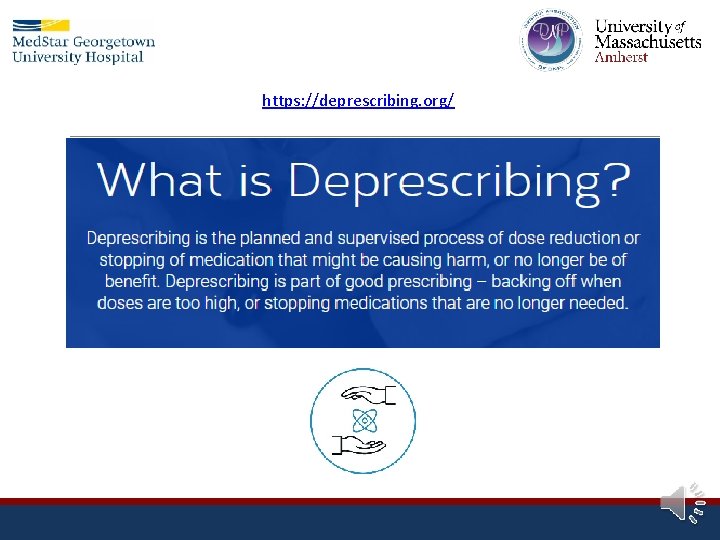
https: //deprescribing. org/
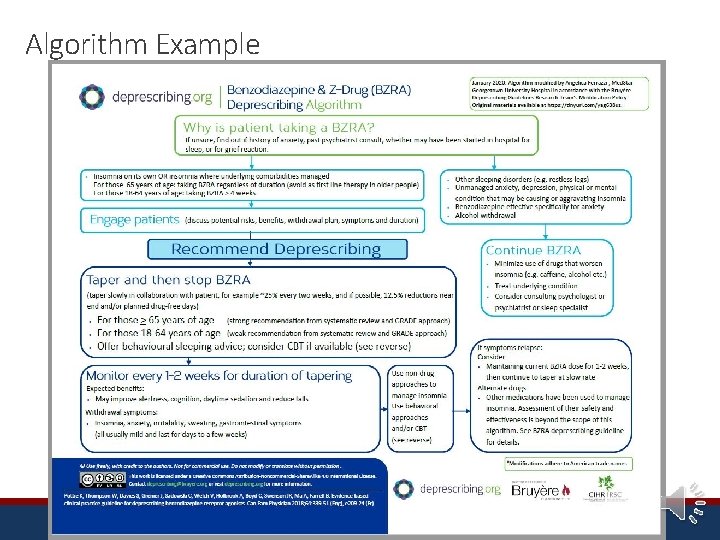
Algorithm Example

Algorithm Example
Data Collection • Pre-post intervention surveys were conducted to assess knowledge and perception of PIMs, the Beers Criteria®, and self -efficacy of deprescribing. • Self-efficacy was reported on a unipolar scale from 0 (cannot do at all) to 100 (highly certain can do).
Results • The 34 clinicians who completed each survey demonstrated an increased knowledge of AGS Beers Criteria® medications and reported a greater frequency in medication reconciliation performance. • A paired t-test was performed to measure 13 providers’ reported self-efficacy deprescribing; and each participant’s response improved postintervention.
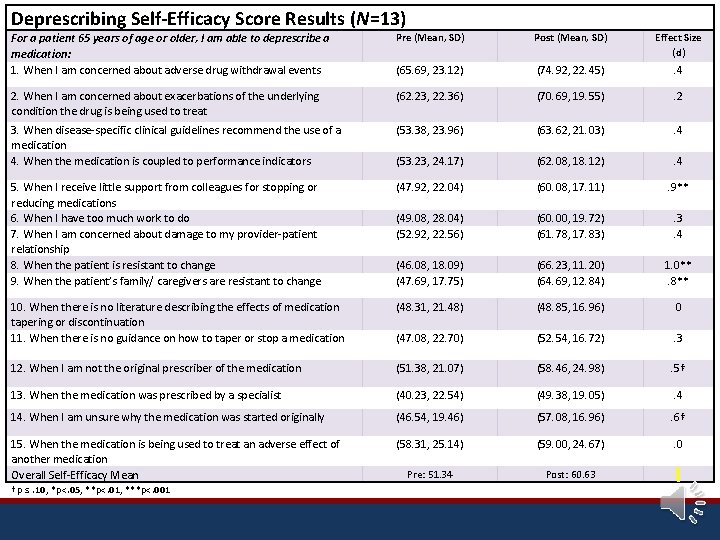
Deprescribing Self-Efficacy Score Results (N=13) For a patient 65 years of age or older, I am able to deprescribe a medication: 1. When I am concerned about adverse drug withdrawal events Pre (Mean, SD) Post (Mean, SD) Effect Size (d) (65. 69, 23. 12) (74. 92, 22. 45) . 4 2. When I am concerned about exacerbations of the underlying condition the drug is being used to treat (62. 23, 22. 36) (70. 69, 19. 55) . 2 3. When disease-specific clinical guidelines recommend the use of a medication 4. When the medication is coupled to performance indicators (53. 38, 23. 96) (63. 62, 21. 03) . 4 (53. 23, 24. 17) (62. 08, 18. 12) . 4 5. When I receive little support from colleagues for stopping or reducing medications 6. When I have too much work to do 7. When I am concerned about damage to my provider-patient relationship 8. When the patient is resistant to change 9. When the patient’s family/ caregivers are resistant to change (47. 92, 22. 04) (60. 08, 17. 11) . 9** (49. 08, 28. 04) (52. 92, 22. 56) (60. 00, 19. 72) (61. 78, 17. 83) . 3. 4 (46. 08, 18. 09) (47. 69, 17. 75) (66. 23, 11. 20) (64. 69, 12. 84) 1. 0**. 8** 10. When there is no literature describing the effects of medication tapering or discontinuation 11. When there is no guidance on how to taper or stop a medication (48. 31, 21. 48) (48. 85, 16. 96) 0 (47. 08, 22. 70) (52. 54, 16. 72) . 3 12. When I am not the original prescriber of the medication (51. 38, 21. 07) (58. 46, 24. 98) . 5† 13. When the medication was prescribed by a specialist (40. 23, 22. 54) (49. 38, 19. 05) . 4 14. When I am unsure why the medication was started originally (46. 54, 19. 46) (57. 08, 16. 96) . 6† 15. When the medication is being used to treat an adverse effect of another medication Overall Self-Efficacy Mean (58. 31, 25. 14) (59. 00, 24. 67) . 0 Pre: 51. 34 Post: 60. 63 †p ≤. 10, *p<. 05, **p<. 01, ***p<. 001
Conclusion • Proper medication safety standards in older adults is a complex issue that requires significant education in order for clinicians to adopt informed prescribing practices, thus ongoing provider education and evaluation are recommended. • This multi-modal educational intervention is feasible for implementation in various healthcare settings to expand knowledge and elicit practice change. • Further research is necessary to correlate deprescribing with ADEs and other clinical outcomes.
Thank You! Please reach out to me with questions or if you’d like any of the educational materials. angelica. n. ferrazzi@gunet. georgetown. edu
References Agency for Healthcare Research and Quality (AHRQ) Patient Safety Network. (January, 2019). Medication errors and adverse drug events. Retrieved from https: //psnet. ahrq. gov/primers/primer/23/Medication-Errors-and-Adverse. Drug-Events Farrell, B. , Richardson, L. , Raman-Wilms, L. , de Launay, D. , Alsabbagh, M. W. , & Conklin, J. (2018). Self-efficacy for deprescribing: A survey for health care professionals using evidence-based deprescribing guidelines. Research in Social and Administrative Pharmacy, 14(1), 18– 25. https: //dx. doi. org /10. 1016/j. sapharm. 2017. 01. 003 Fick, D. M. , Semla, T. P. , Steinman, M. , Beizer, J. , Brandt, N. , Dombrowski, R. , … Sandhu, S. [2019 American Geriatrics Society Beers Criteria® Update Expert Panel] (2019). American Geriatrics Society 2019 Updated AGS Beers Criteria® for Potentially Inappropriate Medication Use in Older Adults. Journal of the American Geriatrics Society, 67(4), 674– 694. https: //doi-org. 10. 1111/jgs. 15767 Molokhia, M. , & Majeed, A. (2017). Current and future perspectives on the management of polypharmacy. BMC Family Practice, 18(70), 1– 9. https: //doi. org /10. 1186/s 12875 -017 - 0642 -0 Zullo, A. R. , Gray, S. L. , Holmes, H. M. , & Marcum, Z. A. (2018). Screening for medication appropriateness in older adults. Clinics in Geriatric Medicine, 34(1), 39– 54. https: //doi-org/10. 1016/j. cger. 2017. 09. 003 vcb. mm
- Slides: 15