
In a Reading State of MIND Brain Research
In a Reading State of MIND Brain Research, Teacher Modeling, and Comprehension Instruction Douglas Fisher, Nancy Frey, Diane Lapp Laura Baker, Jeanne Zanegood-Giardino, Amanda Gaspary, Cindy Knoblauch
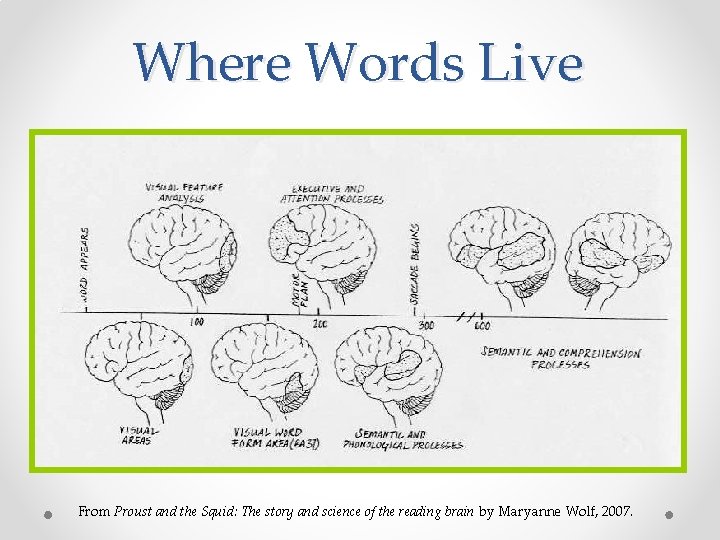
Where Words Live From Proust and the Squid: The story and science of the reading brain by Maryanne Wolf, 2007.
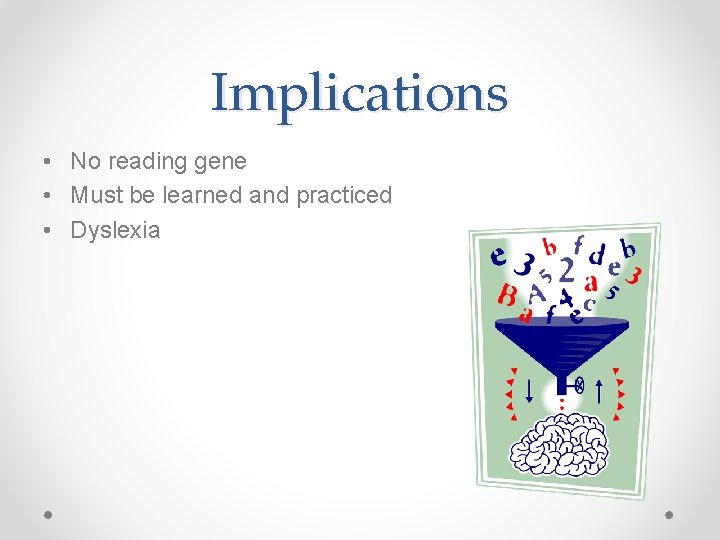
Implications • No reading gene • Must be learned and practiced • Dyslexia

Modeling and the Brain • Experience changes neural connections • Automaticity – experiences must be repeated often enough until they are internalized as habits • The brain prefers novel stimulus and pays less attention to familiar information • Our brain is hardwired to mimic and imitate – mirror neuron
Classroom Practices • Provide lesson objectives “…allows the brain to anticipate the critical features of ideas and increases the likelihood that the brain will focus on the essential information. ” (Wolfe, 2001) • Model thinking Comprehension, word solving, text structures, and text features • Provide visual representations Utilize pictures, diagrams, replicas, prompts, cues, questions • Guided instruction Use shared readings and reciprocal teaching to practice summarizing, question generating, clarifying, and predicting • Independent learning Writing essays, summaries, graphic organizers, etc.
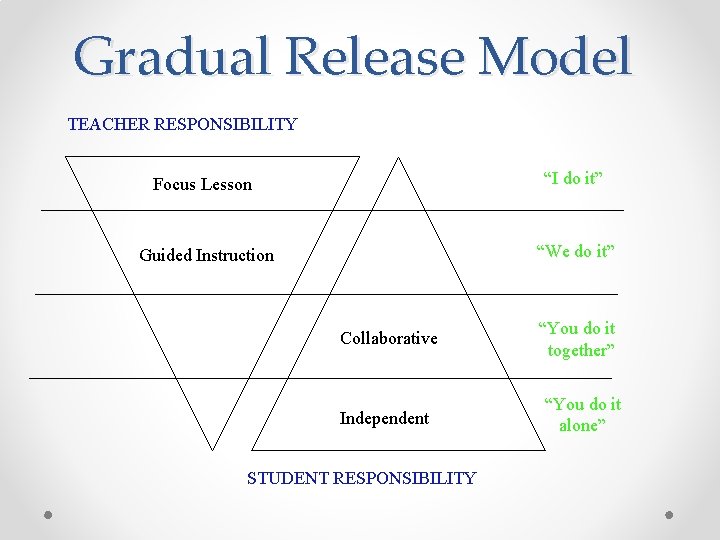
Gradual Release Model TEACHER RESPONSIBILITY Focus Lesson “I do it” Guided Instruction “We do it” Collaborative Independent STUDENT RESPONSIBILITY “You do it together” “You do it alone”
Vocabulary • • • Representative Repeatability Transportable Contextual Analysis Structural Analysis Cognitive Load AVOID: • Choosing the “big” words • Choosing too many words • Overlooking the “little” words
Brain Connection • Wernicke’s Area: Is in the temporal lobe and is responsible for comprehending language (develops first) • Broca’s Area: in the frontal lobe and is responsible for producing speech • Arcute Fasciculus: the neural pathway between the two which is critical in vocabulary development o Dyslexia may be result of poor connections in this area
Text Structures • Structure o Ways ideas or topics are arranged impacts comprehension • Coherence o Internal connections in systematic or logical way • Appropriateness o Background and prior knowledge • Informal Text Structures o o o Compare/Contrast Cause/Effect Descriptive Chronological Sequence Problem/Solution • Narrative Text Structures o o o Characters Dialogue Setting Point of View Plot structure
Brain Connection • Working Memory and Text Structure o Brain notices signal words and complex idea units (If/Then) o As readers develop, need fewer signal words to make connections
Text Features • • • Explain and Elaborate Notify Locate Information Organize Illustrate
Brain Connection • Dual Code Theory o Non-linguistic and Linguistic • Audio-motor – inner speech • Visual-spatial – mental imagery o Text features help tap into visual and nonverbal sources of knowledge
Virtual Implications • • • Live lessons, especially for challenged readers Model! Gradual Release Visual features Working with complex text Interact with other students
- Slides: 13