
IN 51 D1713 Semantic Visualization Provenance Records Applying
- Slides: 1
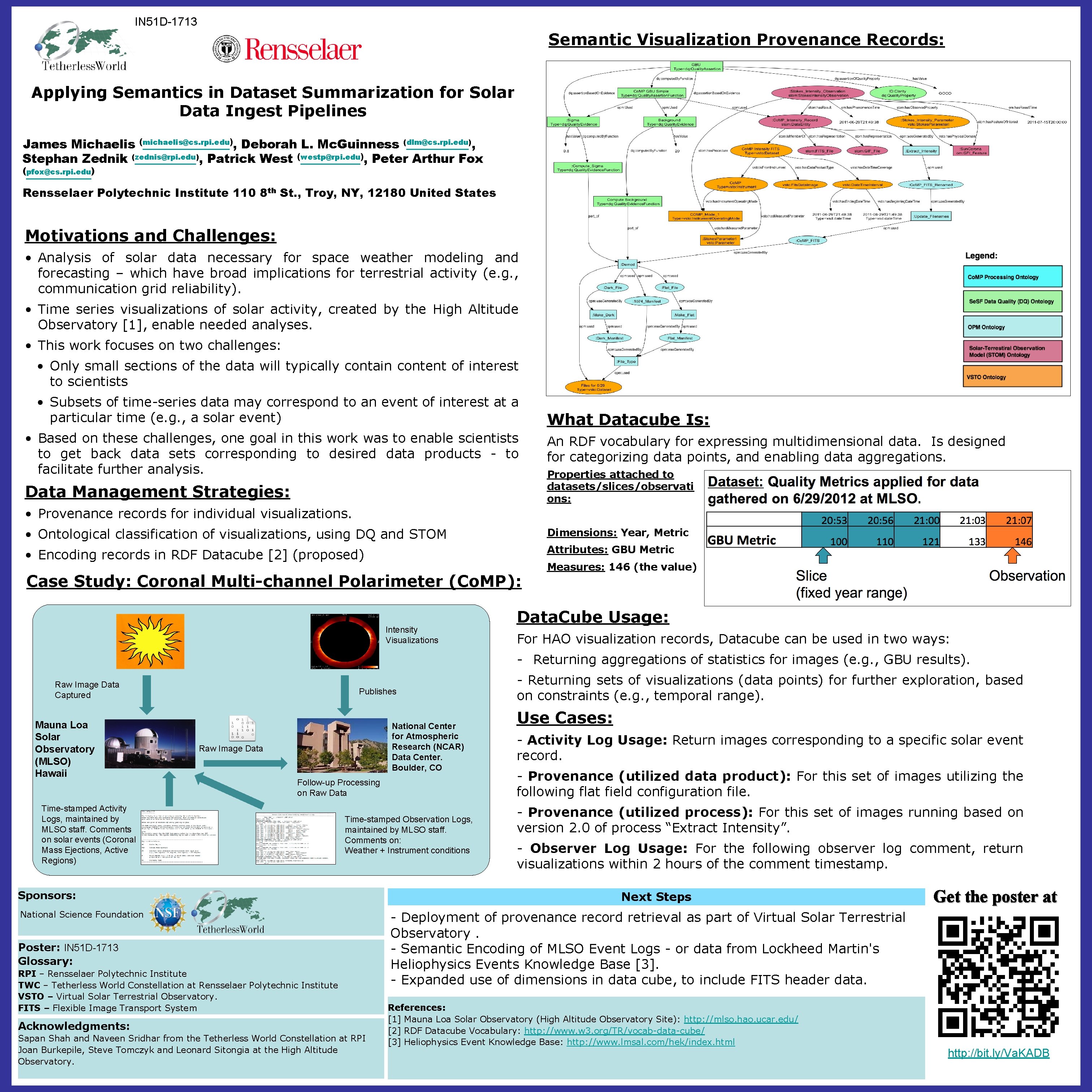
IN 51 D-1713 Semantic Visualization Provenance Records: Applying Semantics in Dataset Summarization for Solar Data Ingest Pipelines James Michaelis (michaelis@cs. rpi. edu), Deborah L. Mc. Guinness (dlm@cs. rpi. edu), Stephan Zednik (zednis@rpi. edu), Patrick West (westp@rpi. edu), Peter Arthur Fox (pfox@cs. rpi. edu) Rensselaer Polytechnic Institute 110 8 th St. , Troy, NY, 12180 United States Motivations and Challenges: • Analysis of solar data necessary for space weather modeling and forecasting – which have broad implications for terrestrial activity (e. g. , communication grid reliability). • Time series visualizations of solar activity, created by the High Altitude Observatory [1], enable needed analyses. • This work focuses on two challenges: • Only small sections of the data will typically contain content of interest to scientists • Subsets of time-series data may correspond to an event of interest at a particular time (e. g. , a solar event) • Based on these challenges, one goal in this work was to enable scientists to get back data sets corresponding to desired data products - to facilitate further analysis. Data Management Strategies: What Datacube Is: An RDF vocabulary for expressing multidimensional data. Is designed for categorizing data points, and enabling data aggregations. Properties attached to datasets/slices/observati ons: • Provenance records for individual visualizations. • Ontological classification of visualizations, using DQ and STOM Dimensions: Year, Metric • Encoding records in RDF Datacube [2] (proposed) Attributes: GBU Metric Case Study: Coronal Multi-channel Polarimeter (Co. MP): Intensity Visualizations Measures: 146 (the value) Data. Cube Usage: For HAO visualization records, Datacube can be used in two ways: - Returning aggregations of statistics for images (e. g. , GBU results). Raw Image Data Captured Mauna Loa Solar Observatory (MLSO) Hawaii Publishes National Center for Atmospheric Research (NCAR) Data Center. Boulder, CO Raw Image Data Follow-up Processing on Raw Data Time-stamped Activity Logs, maintained by MLSO staff. Comments on solar events (Coronal Mass Ejections, Active Regions) Time-stamped Observation Logs, maintained by MLSO staff. Comments on: Weather + Instrument conditions Sponsors: National Science Foundation Poster: IN 51 D-1713 Glossary: RPI – Rensselaer Polytechnic Institute TWC – Tetherless World Constellation at Rensselaer Polytechnic Institute VSTO – Virtual Solar Terrestrial Observatory. FITS – Flexible Image Transport System Acknowledgments: Sapan Shah and Naveen Sridhar from the Tetherless World Constellation at RPI Joan Burkepile, Steve Tomczyk and Leonard Sitongia at the High Altitude Observatory. - Returning sets of visualizations (data points) for further exploration, based on constraints (e. g. , temporal range). Use Cases: - Activity Log Usage: Return images corresponding to a specific solar event record. - Provenance (utilized data product): For this set of images utilizing the following flat field configuration file. - Provenance (utilized process): For this set of images running based on version 2. 0 of process “Extract Intensity”. - Observer Log Usage: For the following observer log comment, return visualizations within 2 hours of the comment timestamp. Next Steps Get the poster at - Deployment of provenance record retrieval as part of Virtual Solar Terrestrial Observatory. - Semantic Encoding of MLSO Event Logs - or data from Lockheed Martin's Heliophysics Events Knowledge Base [3]. - Expanded use of dimensions in data cube, to include FITS header data. References: [1] Mauna Loa Solar Observatory (High Altitude Observatory Site): http: //mlso. hao. ucar. edu/ [2] RDF Datacube Vocabulary: http: //www. w 3. org/TR/vocab-data-cube/ [3] Heliophysics Event Knowledge Base: http: //www. lmsal. com/hek/index. html http: //bit. ly/Va. KADB