
IMT2000 System Overview cdma 2000 Architecture Contents q
- Slides: 42
IMT-2000 System Overview 전자통신연구실
cdma 2000 Architecture 전자통신연구실
Contents q Introduction q Market Forecast q Standardization of IMT-2000 Ø Ø Standard Organizations Standards by ITU-R 18 th Meeting FDD-CDMA : Features of WCDMA & cdma 2000 TDD-CDMA System q Status for IMT-2000 in Korea Ø System Development Ø Standardization Ø System Implementation q Conclusions 전자통신연구실
Introduction q Known as FPLMTS with the same system concept as the UMTS of ETSI for creating a globally compatible public mobile system q A multi-function, multi-service, multi-application digital system that will use end-of-the-century technology to support universal roaming and offer broadband multimedia services requiring up to 2 Mb/s throughput Ø Minimum capability set ü ü ü Indoor : 2 Mb/s Indoor to Outdoor/Pedestrian : 384 Kb/sec Mobile : 144 Kb/sec 전자통신연구실
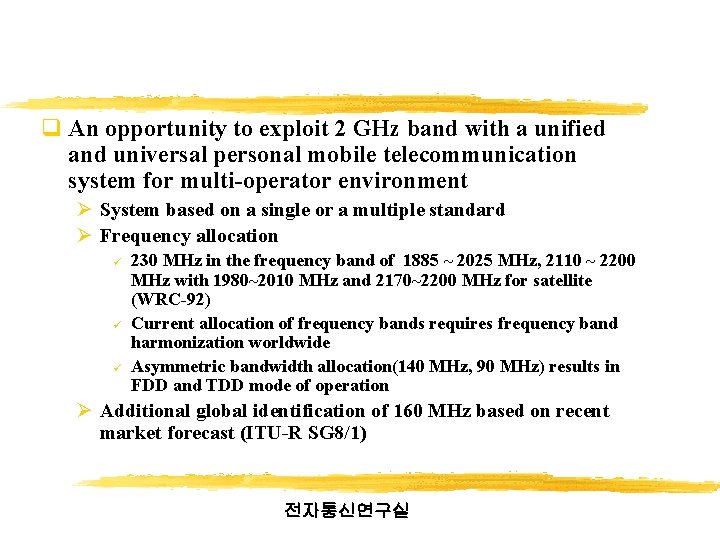
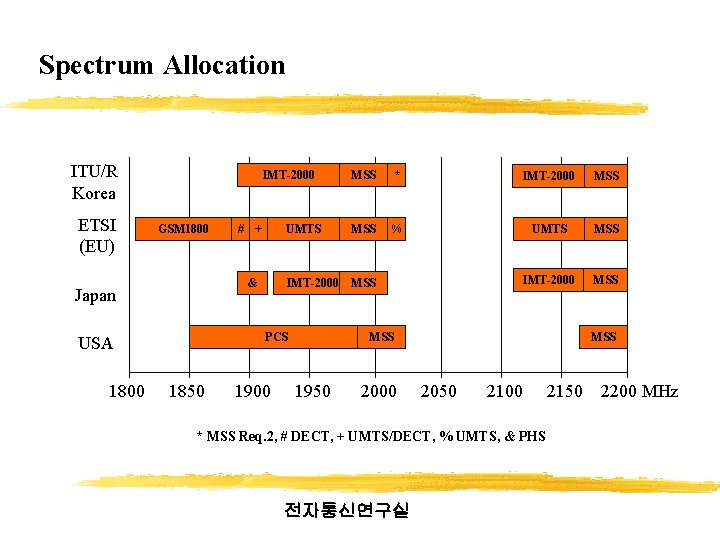
q An opportunity to exploit 2 GHz band with a unified and universal personal mobile telecommunication system for multi-operator environment Ø System based on a single or a multiple standard Ø Frequency allocation ü ü ü 230 MHz in the frequency band of 1885 ~ 2025 MHz, 2110 ~ 2200 MHz with 1980~2010 MHz and 2170~2200 MHz for satellite (WRC-92) Current allocation of frequency bands requires frequency band harmonization worldwide Asymmetric bandwidth allocation(140 MHz, 90 MHz) results in FDD and TDD mode of operation Ø Additional global identification of 160 MHz based on recent market forecast (ITU-R SG 8/1) 전자통신연구실
Spectrum Allocation ITU/R Korea ETSI (EU) IMT-2000 GSM 1800 & Japan * IMT-2000 MSS UMTS MSS % UMTS MSS IMT-2000 MSS PCS USA 1800 # + MSS 1850 1900 MSS 1950 2000 MSS 2050 2100 * MSS Req. 2, # DECT, + UMTS/DECT, % UMTS, & PHS 전자통신연구실 2150 2200 MHz
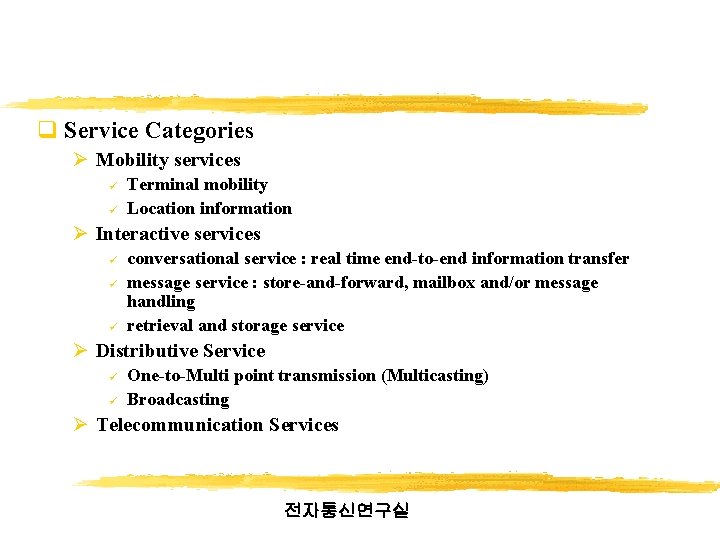
q Service Categories Ø Mobility services ü ü Terminal mobility Location information Ø Interactive services ü ü ü conversational service : real time end-to-end information transfer message service : store-and-forward, mailbox and/or message handling retrieval and storage service Ø Distributive Service ü ü One-to-Multi point transmission (Multicasting) Broadcasting Ø Telecommunication Services 전자통신연구실
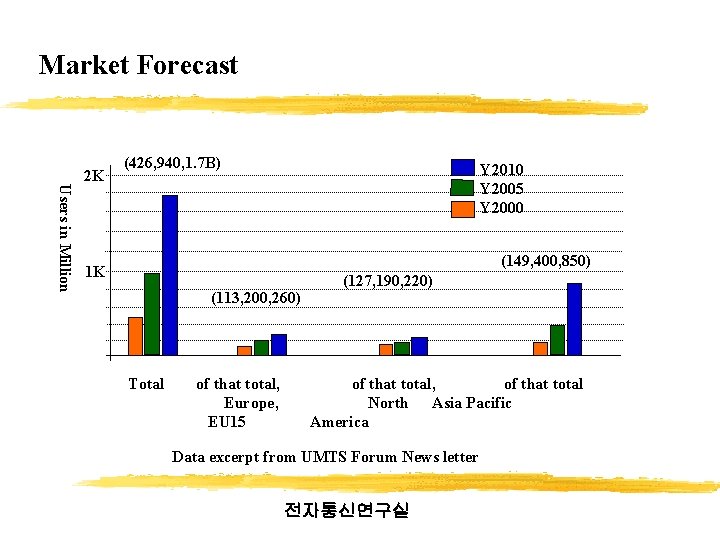
Market Forecast Users in Million 2 K (426, 940, 1. 7 B) Y 2010 Y 2005 Y 2000 (149, 400, 850) 1 K (113, 200, 260) Total of that total, Europe, EU 15 (127, 190, 220) of that total, of that total North Asia Pacific America Data excerpt from UMTS Forum News letter 전자통신연구실
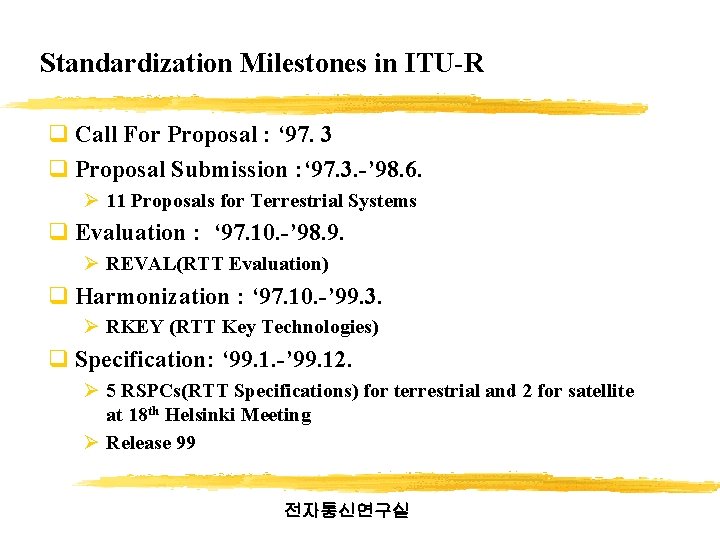
Standardization Milestones in ITU-R q Call For Proposal : ‘ 97. 3 q Proposal Submission : ‘ 97. 3. -’ 98. 6. Ø 11 Proposals for Terrestrial Systems q Evaluation : ‘ 97. 10. -’ 98. 9. Ø REVAL(RTT Evaluation) q Harmonization : ‘ 97. 10. -’ 99. 3. Ø RKEY (RTT Key Technologies) q Specification: ‘ 99. 1. -’ 99. 12. Ø 5 RSPCs(RTT Specifications) for terrestrial and 2 for satellite at 18 th Helsinki Meeting Ø Release 99 전자통신연구실
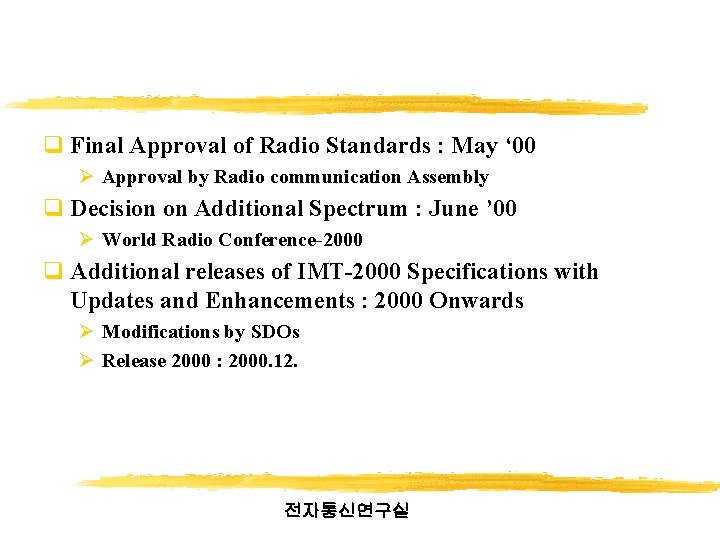
q Final Approval of Radio Standards : May ‘ 00 Ø Approval by Radio communication Assembly q Decision on Additional Spectrum : June ’ 00 Ø World Radio Conference-2000 q Additional releases of IMT-2000 Specifications with Updates and Enhancements : 2000 Onwards Ø Modifications by SDOs Ø Release 2000 : 2000. 12. 전자통신연구실
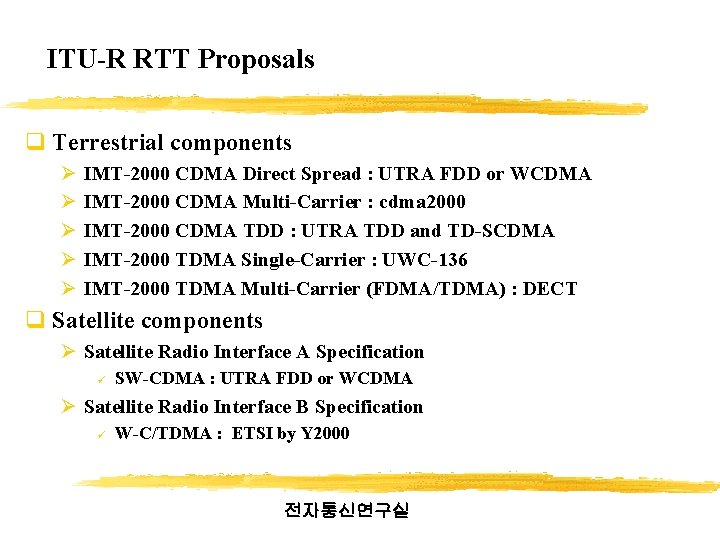
ITU-R RTT Proposals q Terrestrial components Ø Ø Ø IMT-2000 CDMA Direct Spread : UTRA FDD or WCDMA IMT-2000 CDMA Multi-Carrier : cdma 2000 IMT-2000 CDMA TDD : UTRA TDD and TD-SCDMA IMT-2000 TDMA Single-Carrier : UWC-136 IMT-2000 TDMA Multi-Carrier (FDMA/TDMA) : DECT q Satellite components Ø Satellite Radio Interface A Specification ü SW-CDMA : UTRA FDD or WCDMA Ø Satellite Radio Interface B Specification ü W-C/TDMA : ETSI by Y 2000 전자통신연구실
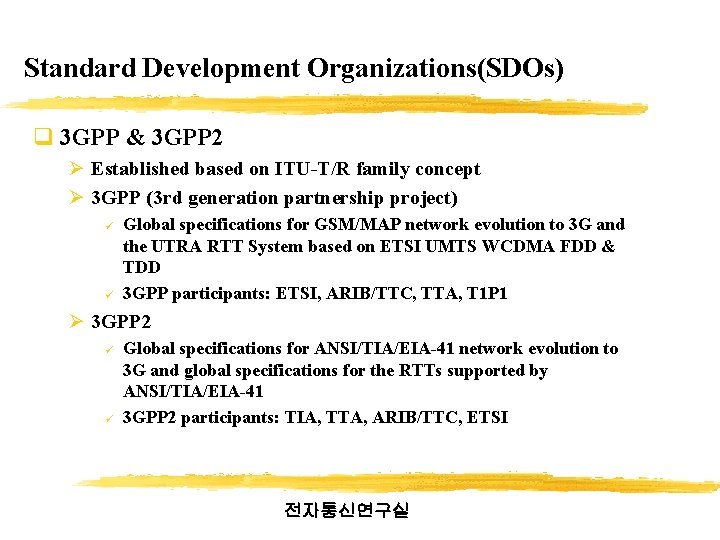
Standard Development Organizations(SDOs) q 3 GPP & 3 GPP 2 Ø Established based on ITU-T/R family concept Ø 3 GPP (3 rd generation partnership project) ü ü Global specifications for GSM/MAP network evolution to 3 G and the UTRA RTT System based on ETSI UMTS WCDMA FDD & TDD 3 GPP participants: ETSI, ARIB/TTC, TTA, T 1 P 1 Ø 3 GPP 2 ü ü Global specifications for ANSI/TIA/EIA-41 network evolution to 3 G and global specifications for the RTTs supported by ANSI/TIA/EIA-41 3 GPP 2 participants: TIA, TTA, ARIB/TTC, ETSI 전자통신연구실
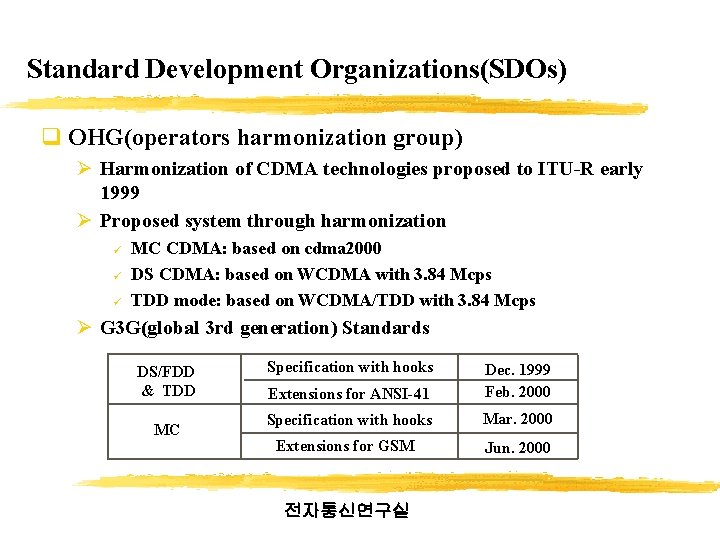
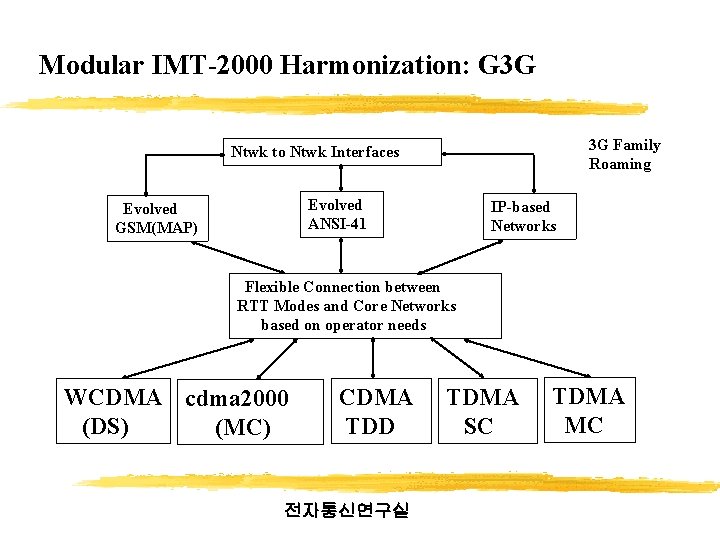
Standard Development Organizations(SDOs) q OHG(operators harmonization group) Ø Harmonization of CDMA technologies proposed to ITU-R early 1999 Ø Proposed system through harmonization ü ü ü MC CDMA: based on cdma 2000 DS CDMA: based on WCDMA with 3. 84 Mcps TDD mode: based on WCDMA/TDD with 3. 84 Mcps Ø G 3 G(global 3 rd generation) Standards DS/FDD & TDD MC Specification with hooks Extensions for ANSI-41 Dec. 1999 Feb. 2000 Specification with hooks Mar. 2000 Extensions for GSM Jun. 2000 전자통신연구실
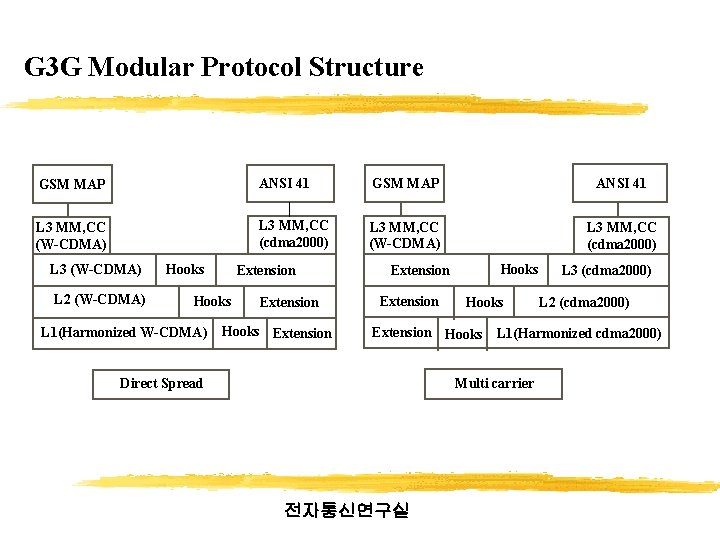
G 3 G Modular Protocol Structure GSM MAP ANSI 41 L 3 MM, CC (W-CDMA) L 3 MM, CC (cdma 2000) L 3 (W-CDMA) L 2 (W-CDMA) Hooks Extension Hooks L 1(Harmonized W-CDMA) Extension Hooks Extension Hooks 전자통신연구실 L 2 (cdma 2000) L 1(Harmonized cdma 2000) Multi carrier Direct Spread L 3 (cdma 2000)
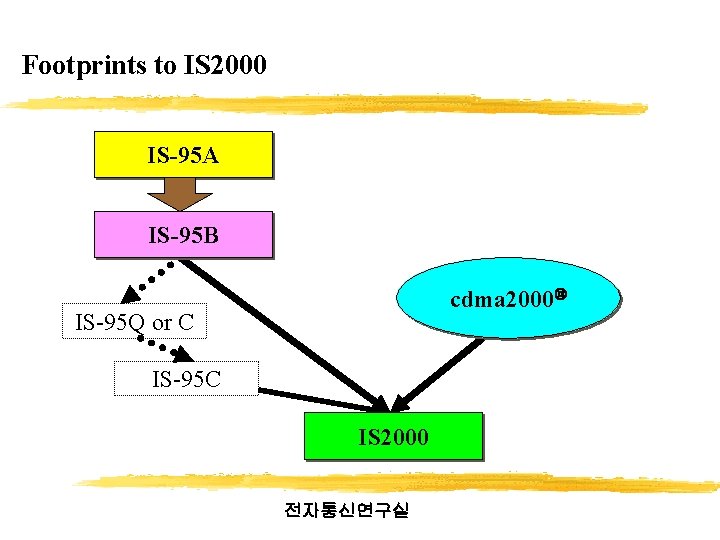
Footprints to IS 2000 IS-95 A IS-95 B cdma 2000 IS-95 Q or C IS-95 C IS 2000 전자통신연구실
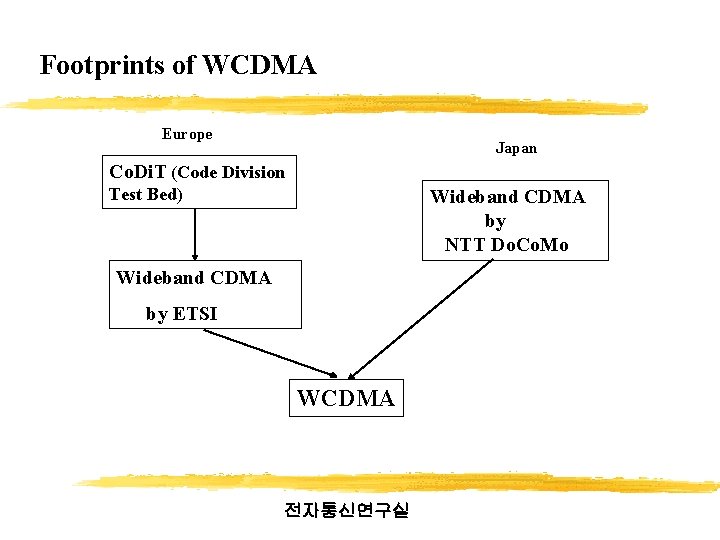
Footprints of WCDMA Europe Japan Co. Di. T (Code Division Test Bed) Wideband CDMA by NTT Do. Co. Mo Wideband CDMA by ETSI WCDMA 전자통신연구실
Modular IMT-2000 Harmonization: G 3 G 3 G Family Roaming Ntwk to Ntwk Interfaces Evolved ANSI-41 Evolved GSM(MAP) IP-based Networks Flexible Connection between RTT Modes and Core Networks based on operator needs WCDMA cdma 2000 (DS) (MC) CDMA TDD 전자통신연구실 TDMA SC TDMA MC
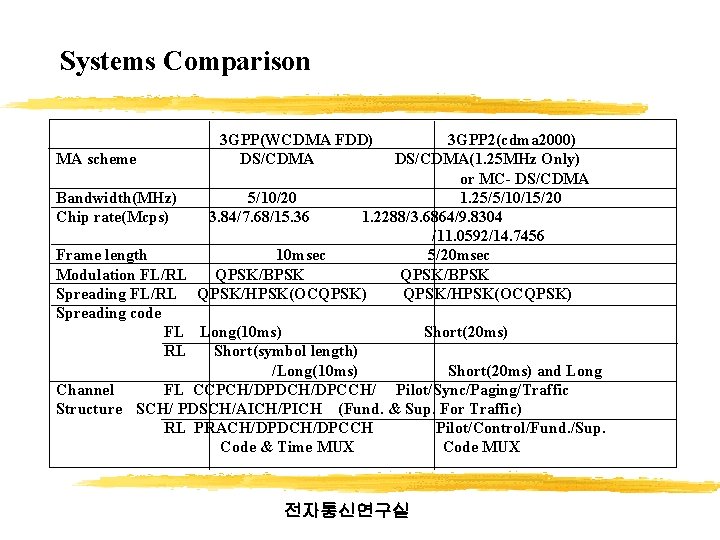
Systems Comparison 3 GPP(WCDMA FDD) DS/CDMA 3 GPP 2(cdma 2000) MA scheme DS/CDMA(1. 25 MHz Only) or MC- DS/CDMA Bandwidth(MHz) 5/10/20 1. 25/5/10/15/20 Chip rate(Mcps) 3. 84/7. 68/15. 36 1. 2288/3. 6864/9. 8304 /11. 0592/14. 7456 Frame length 10 msec 5/20 msec Modulation FL/RL QPSK/BPSK Spreading FL/RL QPSK/HPSK(OCQPSK) Spreading code FL Long(10 ms) Short(20 ms) RL Short(symbol length) /Long(10 ms) Short(20 ms) and Long Channel FL CCPCH/DPDCH/DPCCH/ Pilot/Sync/Paging/Traffic Structure SCH/ PDSCH/AICH/PICH (Fund. & Sup. For Traffic) RL PRACH/DPDCH/DPCCH Pilot/Control/Fund. /Sup. Code & Time MUX Code MUX 전자통신연구실
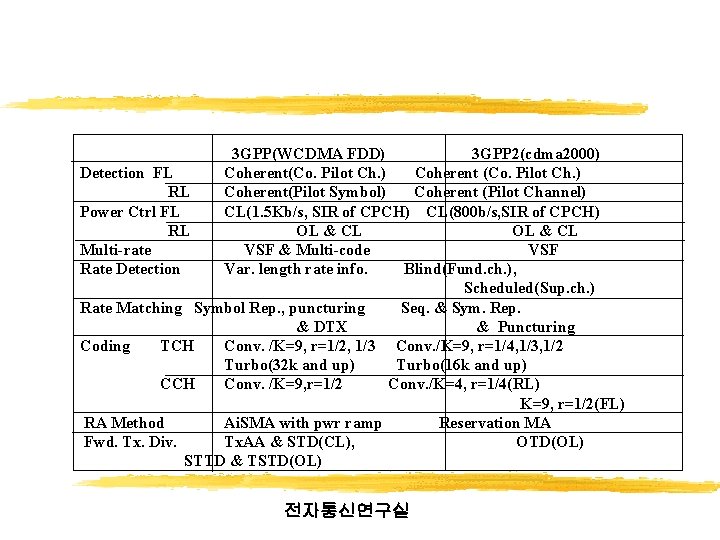
3 GPP(WCDMA FDD) 3 GPP 2(cdma 2000) Detection FL Coherent(Co. Pilot Ch. ) Coherent (Co. Pilot Ch. ) RL Coherent(Pilot Symbol) Coherent (Pilot Channel) Power Ctrl FL CL(1. 5 Kb/s, SIR of CPCH) CL(800 b/s, SIR of CPCH) RL OL & CL Multi-rate VSF & Multi-code VSF Rate Detection Var. length rate info. Blind(Fund. ch. ), Scheduled(Sup. ch. ) Rate Matching Symbol Rep. , puncturing Seq. & Sym. Rep. & DTX & Puncturing Coding TCH Conv. /K=9, r=1/2, 1/3 Conv. /K=9, r=1/4, 1/3, 1/2 Turbo(32 k and up) Turbo(16 k and up) CCH Conv. /K=9, r=1/2 Conv. /K=4, r=1/4(RL) K=9, r=1/2(FL) RA Method Ai. SMA with pwr ramp Reservation MA Fwd. Tx. Div. Tx. AA & STD(CL), OTD(OL) STTD & TSTD(OL) 전자통신연구실
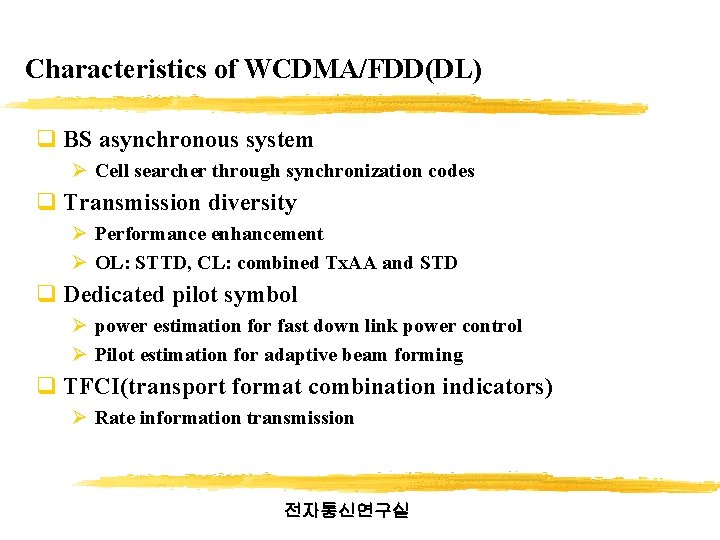
Characteristics of WCDMA/FDD(DL) q BS asynchronous system Ø Cell searcher through synchronization codes q Transmission diversity Ø Performance enhancement Ø OL: STTD, CL: combined Tx. AA and STD q Dedicated pilot symbol Ø power estimation for fast down link power control Ø Pilot estimation for adaptive beam forming q TFCI(transport format combination indicators) Ø Rate information transmission 전자통신연구실
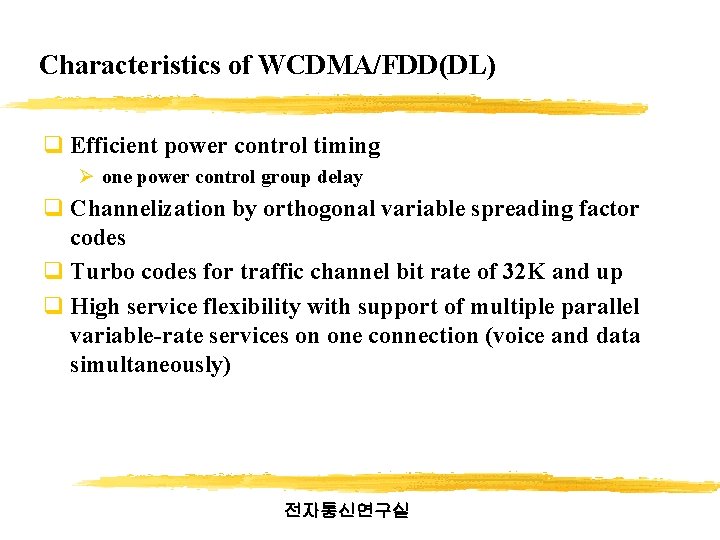
Characteristics of WCDMA/FDD(DL) q Efficient power control timing Ø one power control group delay q Channelization by orthogonal variable spreading factor codes q Turbo codes for traffic channel bit rate of 32 K and up q High service flexibility with support of multiple parallel variable-rate services on one connection (voice and data simultaneously) 전자통신연구실
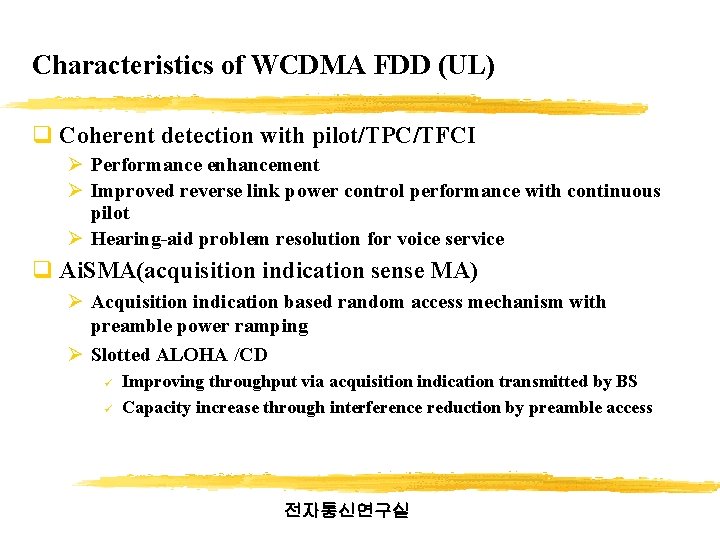
Characteristics of WCDMA FDD (UL) q Coherent detection with pilot/TPC/TFCI Ø Performance enhancement Ø Improved reverse link power control performance with continuous pilot Ø Hearing-aid problem resolution for voice service q Ai. SMA(acquisition indication sense MA) Ø Acquisition indication based random access mechanism with preamble power ramping Ø Slotted ALOHA /CD ü ü Improving throughput via acquisition indication transmitted by BS Capacity increase through interference reduction by preamble access 전자통신연구실
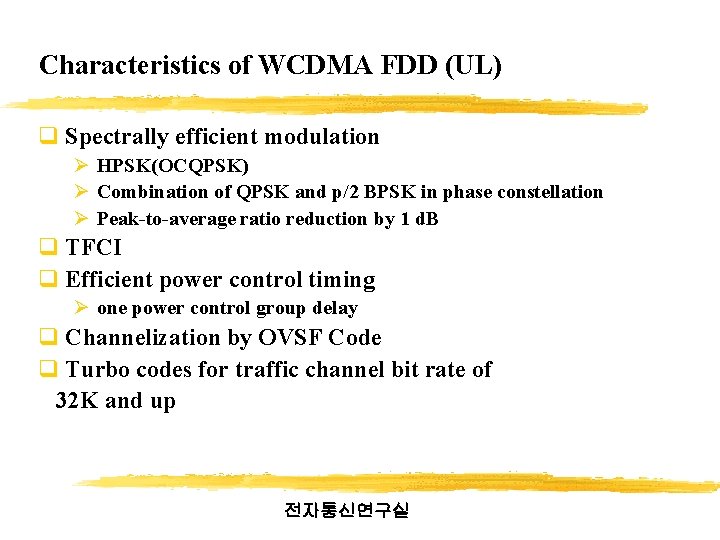
Characteristics of WCDMA FDD (UL) q Spectrally efficient modulation Ø HPSK(OCQPSK) Ø Combination of QPSK and p/2 BPSK in phase constellation Ø Peak-to-average ratio reduction by 1 d. B q TFCI q Efficient power control timing Ø one power control group delay q Channelization by OVSF Code q Turbo codes for traffic channel bit rate of 32 K and up 전자통신연구실
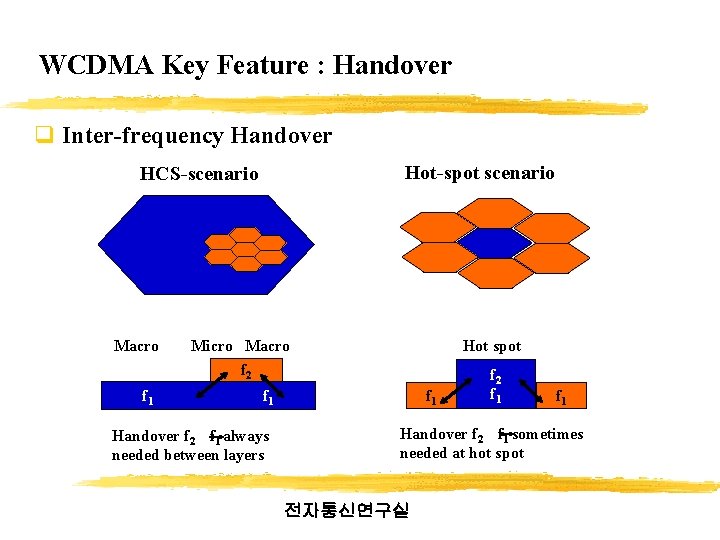
WCDMA Key Feature : Handover q Inter-frequency Handover Hot-spot scenario HCS-scenario Macro Micro Macro Hot spot f 2 f 1 Handover f 2 f 1 always needed between layers f 1 f 2 f 1 Handover f 2 f 1 sometimes needed at hot spot 전자통신연구실
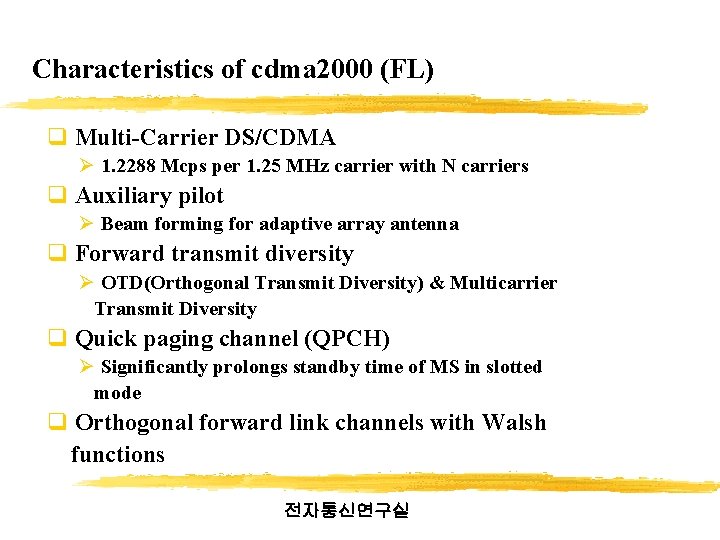
Characteristics of cdma 2000 (FL) q Multi-Carrier DS/CDMA Ø 1. 2288 Mcps per 1. 25 MHz carrier with N carriers q Auxiliary pilot Ø Beam forming for adaptive array antenna q Forward transmit diversity Ø OTD(Orthogonal Transmit Diversity) & Multicarrier Transmit Diversity q Quick paging channel (QPCH) Ø Significantly prolongs standby time of MS in slotted mode q Orthogonal forward link channels with Walsh functions 전자통신연구실
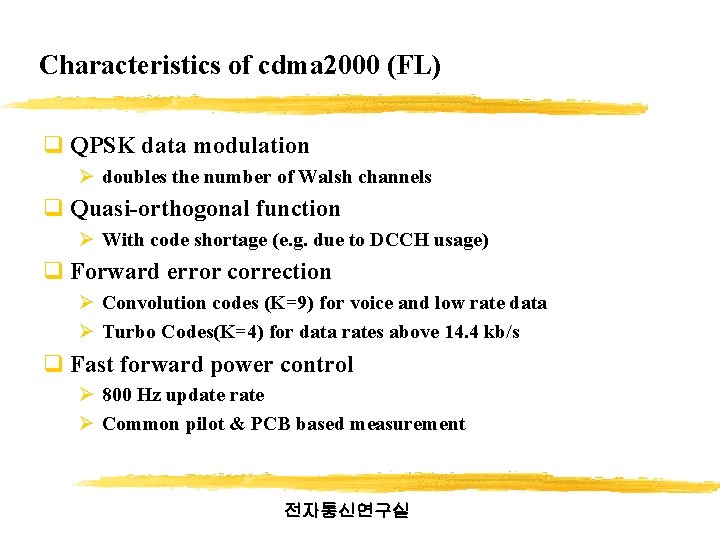
Characteristics of cdma 2000 (FL) q QPSK data modulation Ø doubles the number of Walsh channels q Quasi-orthogonal function Ø With code shortage (e. g. due to DCCH usage) q Forward error correction Ø Convolution codes (K=9) for voice and low rate data Ø Turbo Codes(K=4) for data rates above 14. 4 kb/s q Fast forward power control Ø 800 Hz update rate Ø Common pilot & PCB based measurement 전자통신연구실
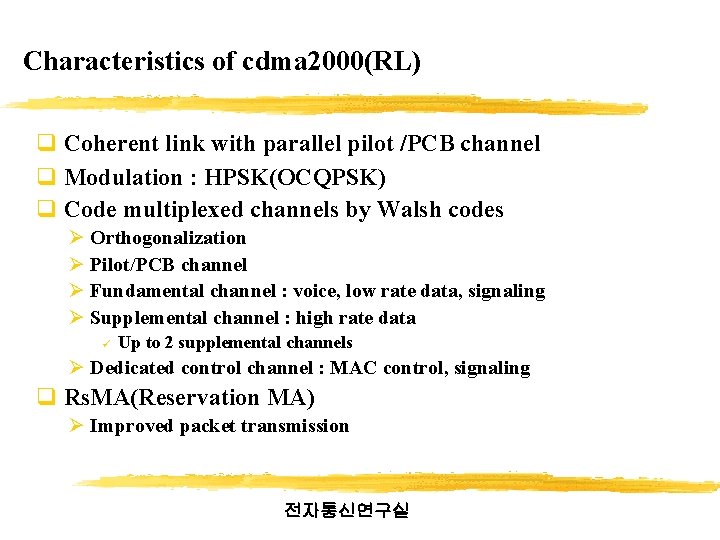
Characteristics of cdma 2000(RL) q Coherent link with parallel pilot /PCB channel q Modulation : HPSK(OCQPSK) q Code multiplexed channels by Walsh codes Ø Orthogonalization Ø Pilot/PCB channel Ø Fundamental channel : voice, low rate data, signaling Ø Supplemental channel : high rate data ü Up to 2 supplemental channels Ø Dedicated control channel : MAC control, signaling q Rs. MA(Reservation MA) Ø Improved packet transmission 전자통신연구실
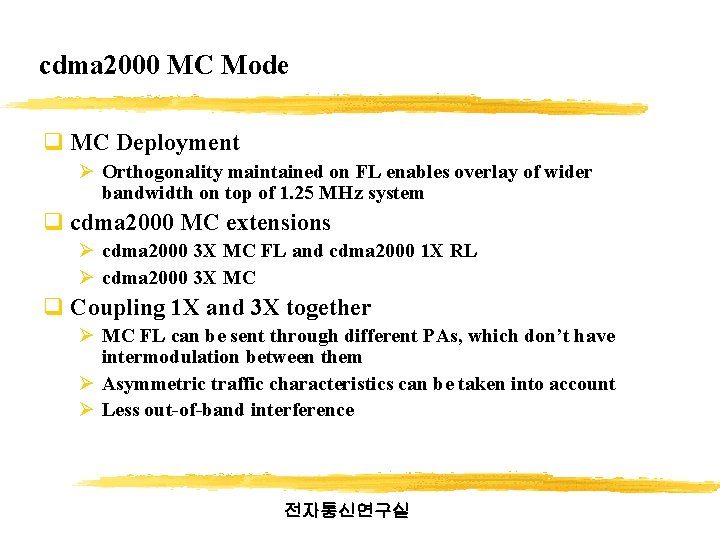
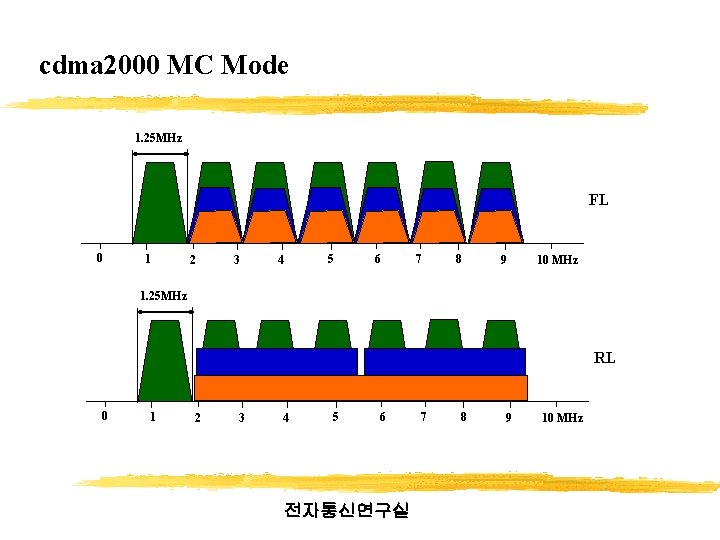
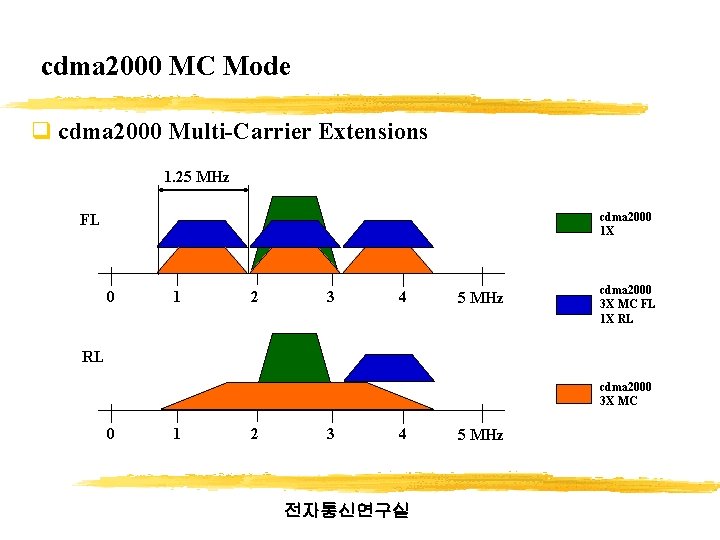
cdma 2000 MC Mode q MC Deployment Ø Orthogonality maintained on FL enables overlay of wider bandwidth on top of 1. 25 MHz system q cdma 2000 MC extensions Ø cdma 2000 3 X MC FL and cdma 2000 1 X RL Ø cdma 2000 3 X MC q Coupling 1 X and 3 X together Ø MC FL can be sent through different PAs, which don’t have intermodulation between them Ø Asymmetric traffic characteristics can be taken into account Ø Less out-of-band interference 전자통신연구실
cdma 2000 MC Mode 1. 25 MHz FL 0 1 2 3 5 4 6 7 8 9 10 MHz 1. 25 MHz RL 0 1 2 3 4 5 6 전자통신연구실 7 8 9 10 MHz
cdma 2000 MC Mode q cdma 2000 Multi-Carrier Extensions 1. 25 MHz cdma 2000 1 X FL 0 1 2 3 4 5 MHz cdma 2000 3 X MC FL 1 X RL RL cdma 2000 3 X MC 0 1 2 3 4 전자통신연구실 5 MHz
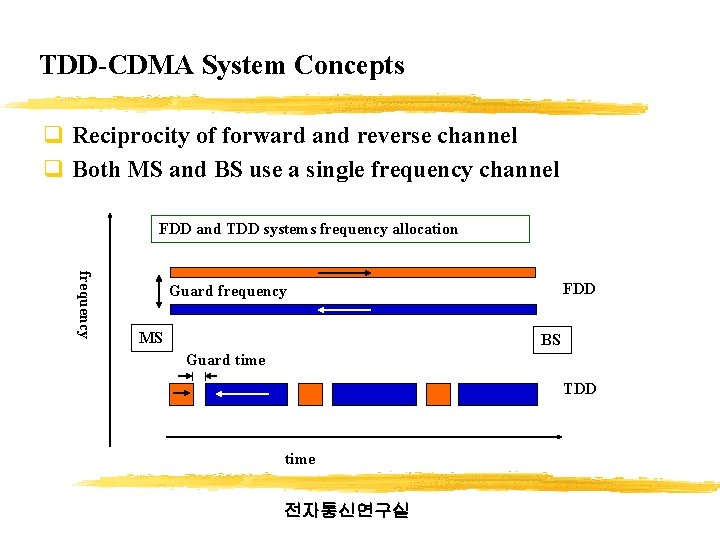
TDD-CDMA System Concepts q Reciprocity of forward and reverse channel q Both MS and BS use a single frequency channel FDD and TDD systems frequency allocation frequency FDD Guard frequency MS BS Guard time TDD time 전자통신연구실
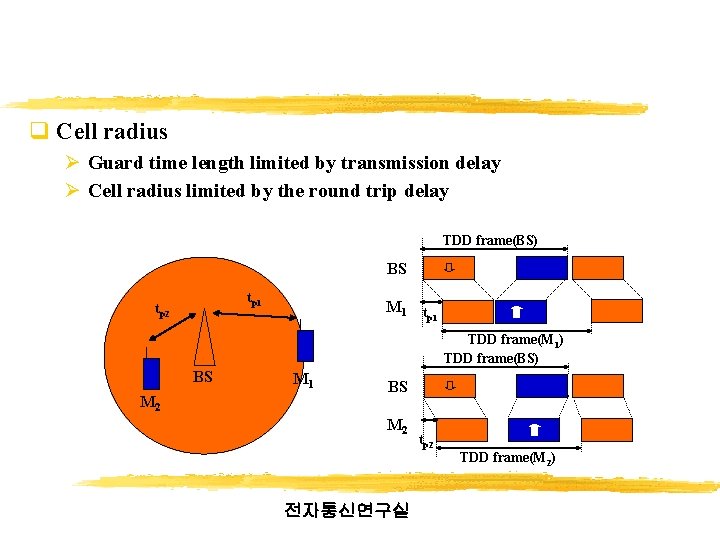
q Cell radius Ø Guard time length limited by transmission delay Ø Cell radius limited by the round trip delay TDD frame(BS) BS tp 1 tp 2 M 1 tp 1 TDD frame(M 1) TDD frame(BS) BS M 2 M 1 BS M 2 tp 2 TDD frame(M 2) 전자통신연구실
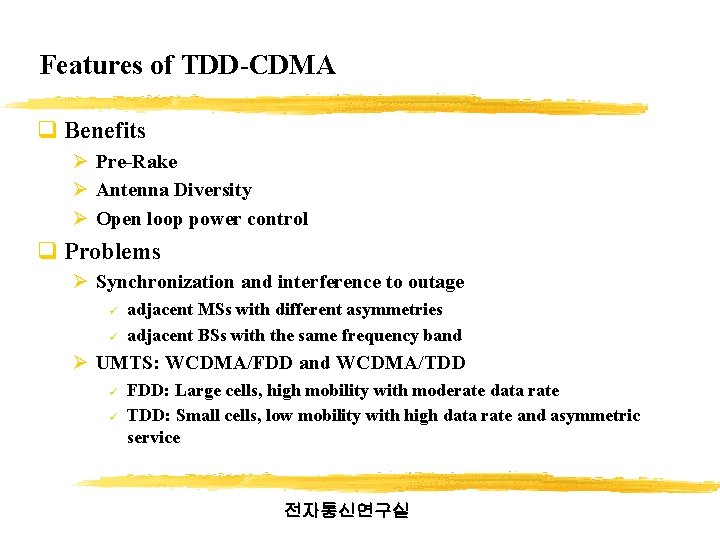
Features of TDD-CDMA q Benefits Ø Pre-Rake Ø Antenna Diversity Ø Open loop power control q Problems Ø Synchronization and interference to outage ü ü adjacent MSs with different asymmetries adjacent BSs with the same frequency band Ø UMTS: WCDMA/FDD and WCDMA/TDD ü ü FDD: Large cells, high mobility with moderate data rate TDD: Small cells, low mobility with high data rate and asymmetric service 전자통신연구실
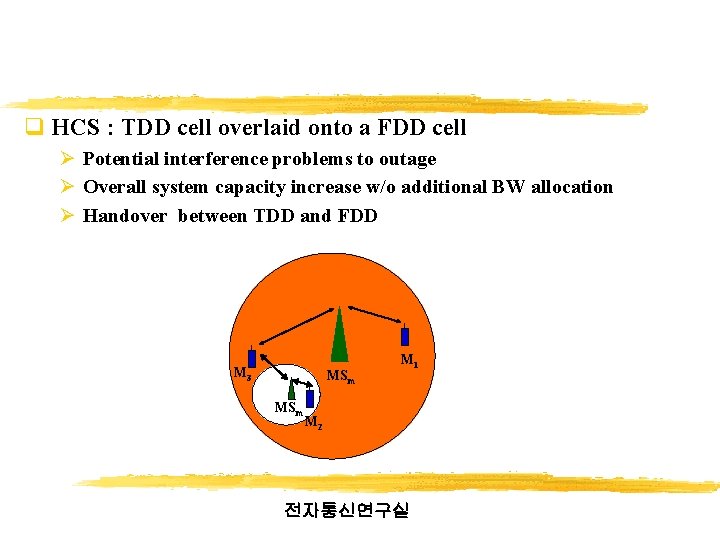
q HCS : TDD cell overlaid onto a FDD cell Ø Potential interference problems to outage Ø Overall system capacity increase w/o additional BW allocation Ø Handover between TDD and FDD M 3 MSm M 1 M 2 전자통신연구실
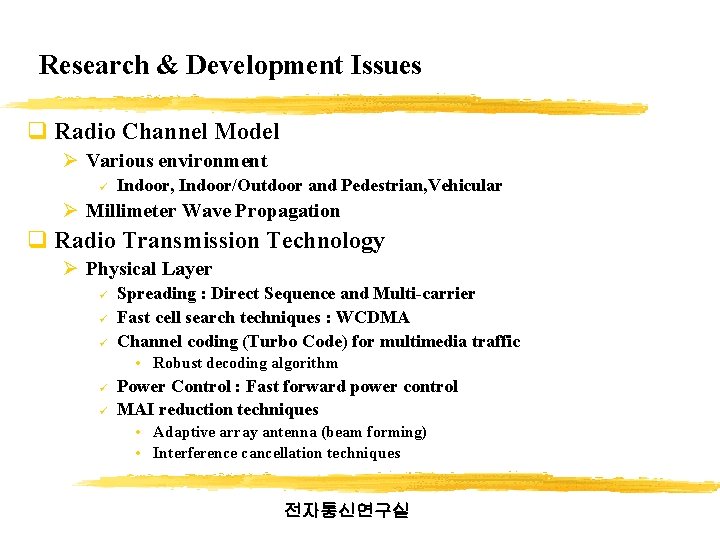
Research & Development Issues q Radio Channel Model Ø Various environment ü Indoor, Indoor/Outdoor and Pedestrian, Vehicular Ø Millimeter Wave Propagation q Radio Transmission Technology Ø Physical Layer ü ü ü Spreading : Direct Sequence and Multi-carrier Fast cell search techniques : WCDMA Channel coding (Turbo Code) for multimedia traffic • Robust decoding algorithm ü ü Power Control : Fast forward power control MAI reduction techniques • Adaptive array antenna (beam forming) • Interference cancellation techniques 전자통신연구실
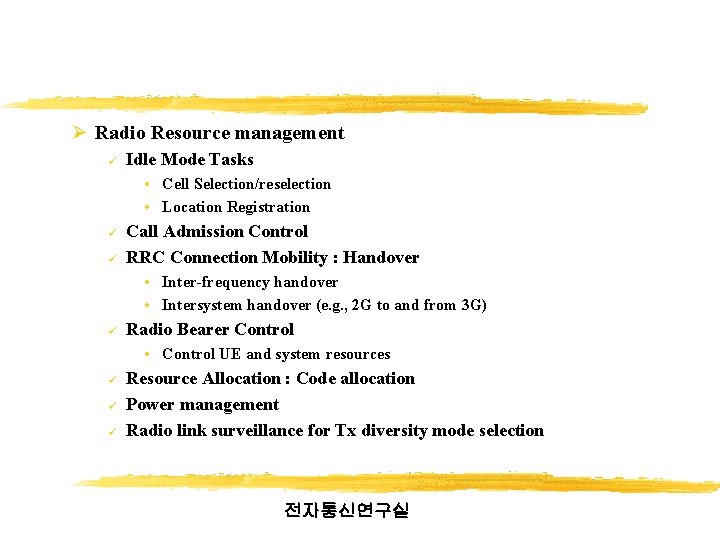
Ø Radio Resource management ü Idle Mode Tasks • Cell Selection/reselection • Location Registration ü ü Call Admission Control RRC Connection Mobility : Handover • Inter-frequency handover • Intersystem handover (e. g. , 2 G to and from 3 G) ü Radio Bearer Control • Control UE and system resources ü ü ü Resource Allocation : Code allocation Power management Radio link surveillance for Tx diversity mode selection 전자통신연구실
q Optimal operation Ø Optimal parameter selection Ø Hierarchical cell structure ü ü Overlay cell (various 3 Gs, IS 95 and 3 G) Hot spot cell q Networks Ø Wireless ATM Ø Mobile IP (Mobile Internet) to All IP q Future Radio System Concepts Ø Software Defined Radio(SDR) Ø Cognitive Radio 전자통신연구실
Status of IMT-2000 in Korea q System Development Ø Project for a prototype system development ü ü finished with a system based on Global CDMA I (similar to IS-2000) by ETRI Grand Consortium supported by MIC and Industries including Motorola and Ericsson in 1996 Ø Project for a system development based on W-CDMA ü ü Started in September, 1999 at ETRI Consortium supported mainly by Industries including • 2 Supporters for infrastructure development : Samsung, Hyundai • 3 Supporters for mobile unit : Samsung, Hyundai, and Pan. Tech 전자통신연구실
q Implementation scenario Ø Milestone announced by MIC (Sept. 1999) ü ü ü June ‘ 00 : Decision will be made on the number of Licensees and method of allocating spectrum bands September ‘ 00 : Call For Proposal December ‘ 00 : License awarding with frequency allocation January ‘ 02 : Launching IMT-2000 Service May ‘ 02 : (World cup Soccer Game) Nationwide Commercial Service q Issues to be resolved Ø Debate on the service category Ø License awarding process ü ü Frequency auction Beauty contest 전자통신연구실
Conclusions q CDMA Technology Trends Ø Narrowband DS/CDMA(IS-95) to Wideband DS/CDMA and MCDS/CDMA(W-CDMA, IS 2000) ü Averaging Effect (more widespread) Ø How to achieve widespread ü MC(Multi-carrier) or DS(Direct Sequence) Ø Inter BS Synchronization ü ü Synchronous (GPS) Asynchronous : cell search by codes 전자통신연구실
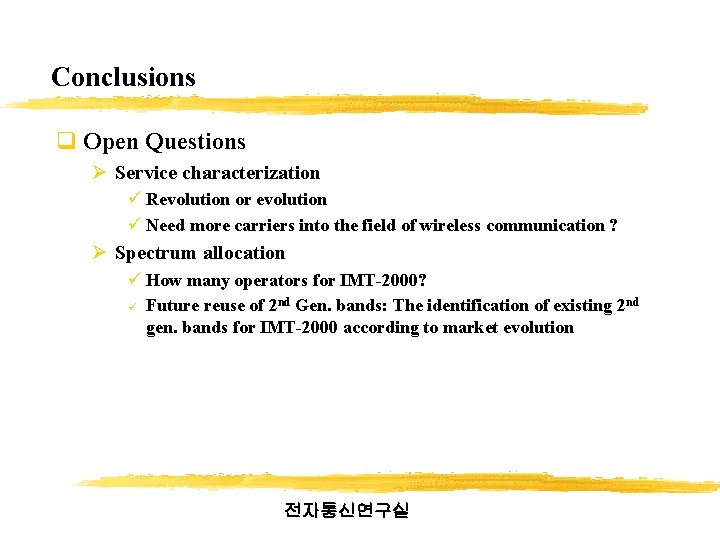
Conclusions q Open Questions Ø Service characterization ü Revolution or evolution ü Need more carriers into the field of wireless communication ? Ø Spectrum allocation ü How many operators for IMT-2000? ü Future reuse of 2 nd Gen. bands: The identification of existing 2 nd gen. bands for IMT-2000 according to market evolution 전자통신연구실
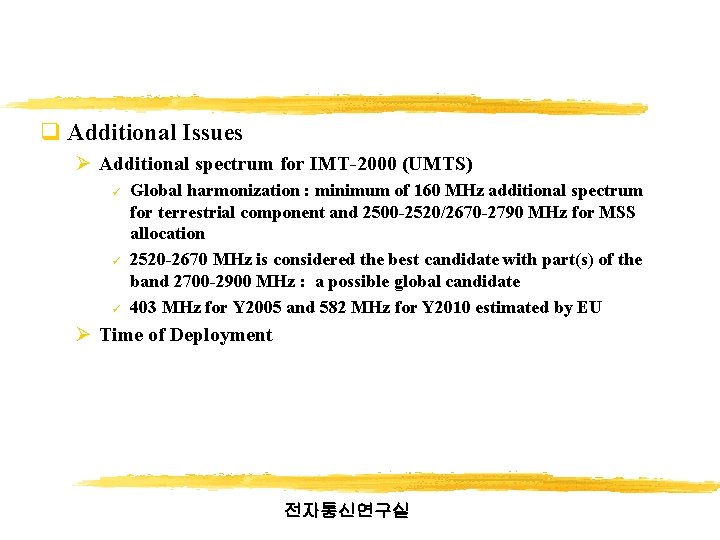
q Additional Issues Ø Additional spectrum for IMT-2000 (UMTS) ü ü ü Global harmonization : minimum of 160 MHz additional spectrum for terrestrial component and 2500 -2520/2670 -2790 MHz for MSS allocation 2520 -2670 MHz is considered the best candidate with part(s) of the band 2700 -2900 MHz : a possible global candidate 403 MHz for Y 2005 and 582 MHz for Y 2010 estimated by EU Ø Time of Deployment 전자통신연구실