
Impurities in Frustrated Magnets Leon Balents UCSB Disorder
Impurities in Frustrated Magnets Leon Balents, UCSB Disorder, Fluctuations, and Universality, 2008
Collaborators Doron Bergman (Yale) p Jason Alicea (Caltech) p Simon Trebst (MS Station Q) p Lucile Savary (ENS Lyon) p

What is frustration? p Competing interactions n n p Can’t satisfy all interactions simultaneously Optimization is “frustrating” “People need trouble – a little frustration to sharpen the spirit on, toughen it. Artists do; I don't mean you need to live in a rat hole or gutter, but you have to learn fortitude, endurance. Only vegetables are happy. ” – William Faulkner
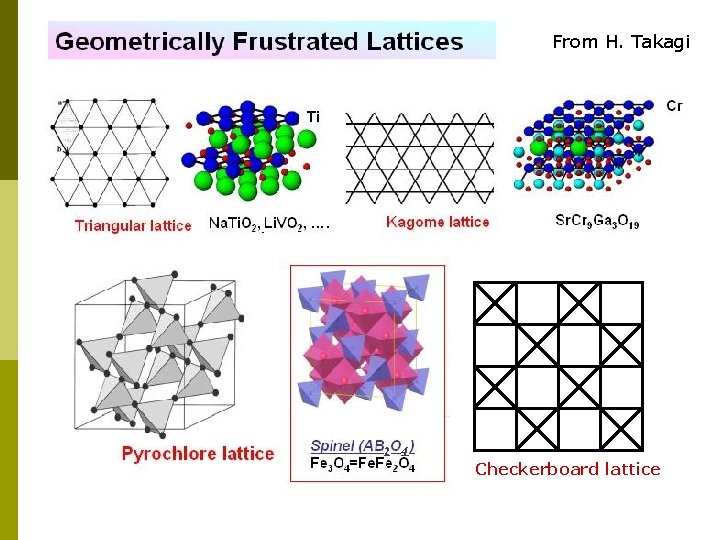
From H. Takagi Checkerboard lattice

Frustration: Constrained Degeneracy p p When k. BT ¿ J, system (classically) is constrained to ground state manifold Triangular lattice Ising antiferromagnet n n One dissatisfied bond per triangle Entropy 0. 34 k. B / spin p Pyrochlore Heisenberg antiferromagnet p Pyrochlore “Spin ice”: 2 in/2 out Ising spins n Pauling entropy ¼ ½ ln(3/2) k. B / spin
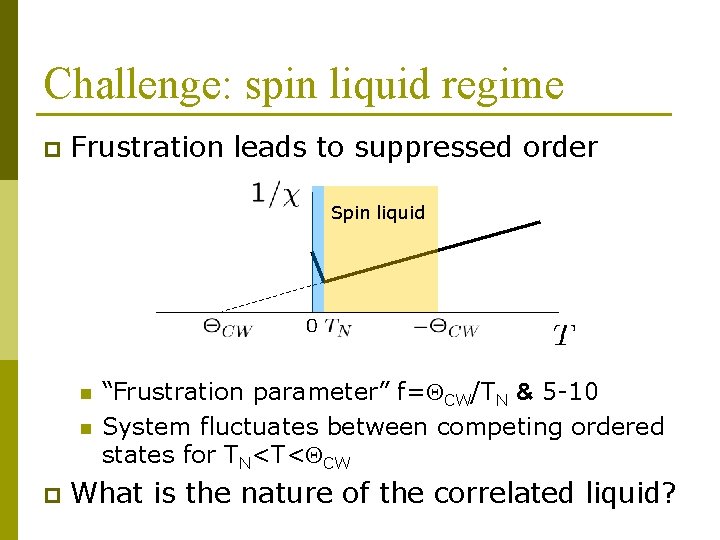
Challenge: spin liquid regime p Frustration leads to suppressed order Spin liquid n n p “Frustration parameter” f= CW/TN & 5 -10 System fluctuates between competing ordered states for TN<T< CW What is the nature of the correlated liquid?
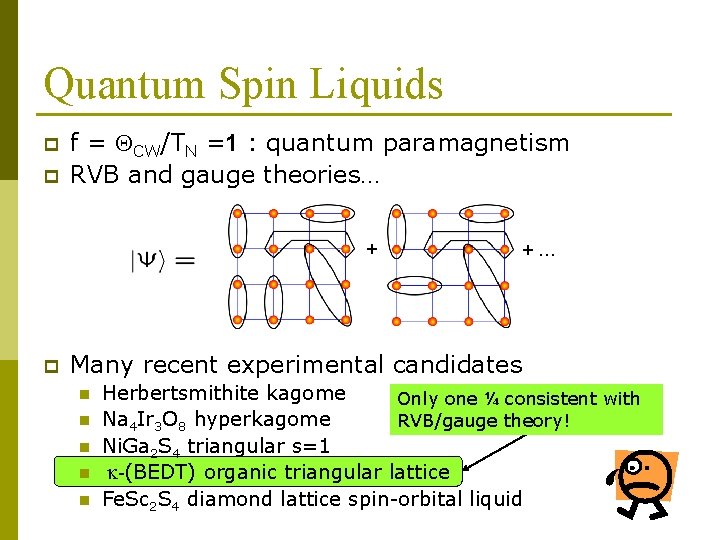
Quantum Spin Liquids p p f = CW/TN =1 : quantum paramagnetism RVB and gauge theories… + p +… Many recent experimental candidates n n n Herbertsmithite kagome Only one ¼ consistent with Na 4 Ir 3 O 8 hyperkagome RVB/gauge theory! Ni. Ga 2 S 4 triangular s=1 -(BEDT) organic triangular lattice Fe. Sc 2 S 4 diamond lattice spin-orbital liquid
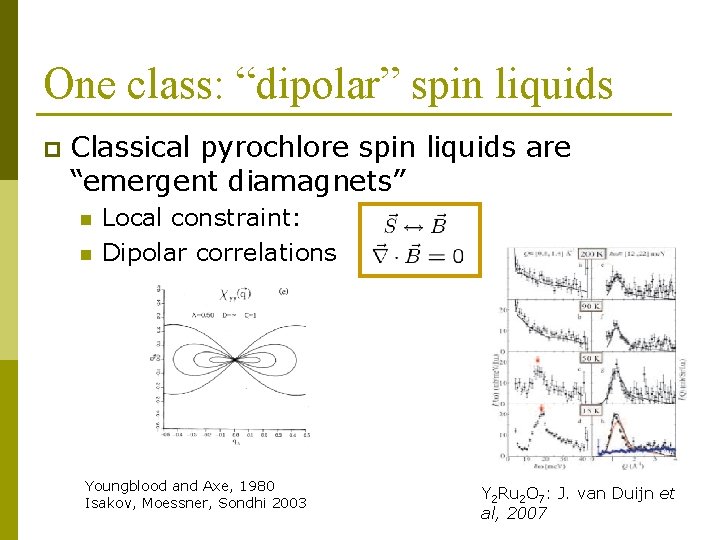
One class: “dipolar” spin liquids p Classical pyrochlore spin liquids are “emergent diamagnets” n n Local constraint: Dipolar correlations Youngblood and Axe, 1980 Isakov, Moessner, Sondhi 2003 Y 2 Ru 2 O 7: J. van Duijn et al, 2007
A Problem p Signatures of spin liquid correlations in neutron scattering are subtle n p Not peaks Often single crystal neutron scattering in not available
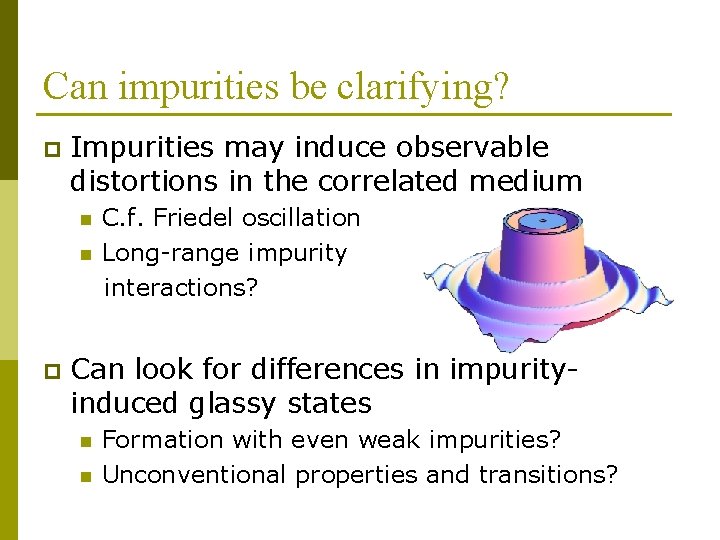
Can impurities be clarifying? p Impurities may induce observable distortions in the correlated medium n n p C. f. Friedel oscillation Long-range impurity interactions? Can look for differences in impurityinduced glassy states n n Formation with even weak impurities? Unconventional properties and transitions?
Some experimental features Appearance of spin glass state for very weak disorder (e. g. in kagome and spin ice materials) p Commonly observed T 2 specific heat in glass state p Ni. Ga 2 S 4 – coherent spin waves in disordered state, without observable glass transition p Mn. Si – partial order: disordered spirals? p
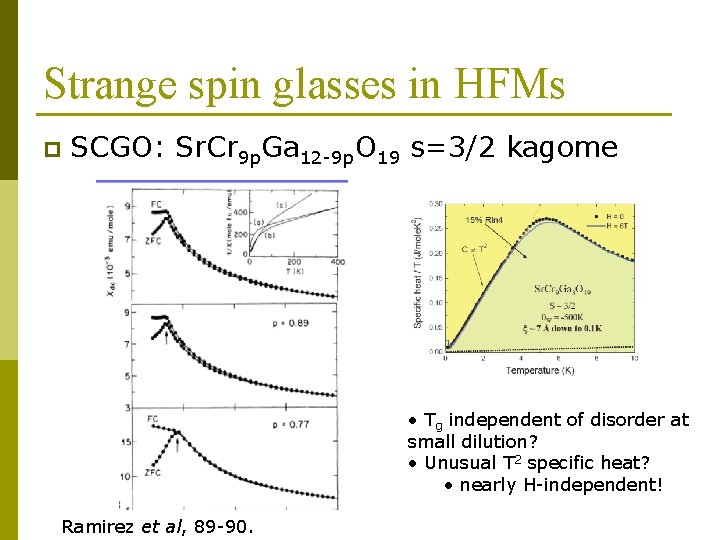
Strange spin glasses in HFMs p SCGO: Sr. Cr 9 p. Ga 12 -9 p. O 19 s=3/2 kagome • Tg independent of disorder at small dilution? • Unusual T 2 specific heat? • nearly H-independent! Ramirez et al, 89 -90.
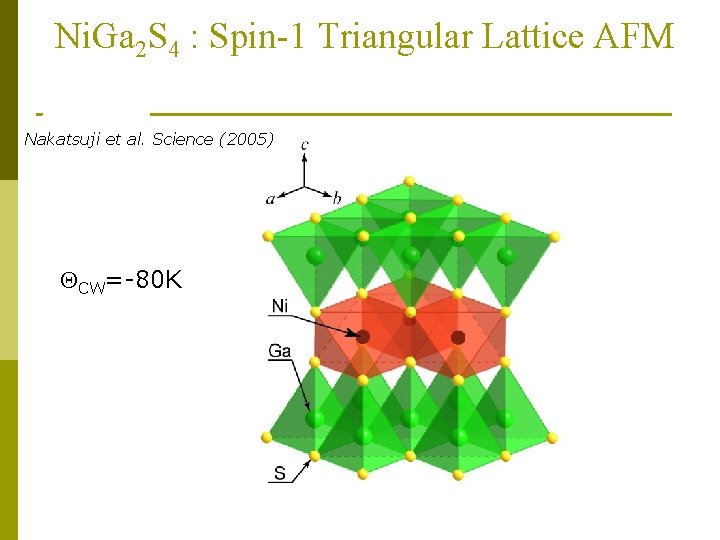
Ni. Ga 2 S 4 : Spin-1 Triangular Lattice AFM Nakatsuji et al. Science (2005) CW=-80 K
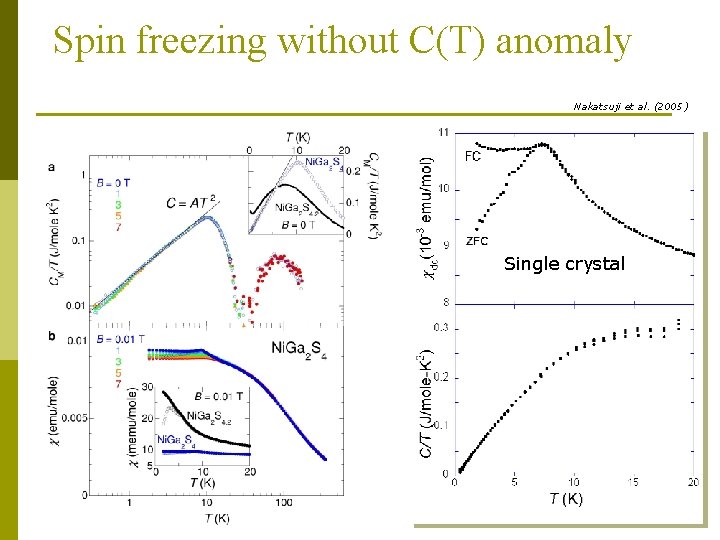
Spin freezing without C(T) anomaly Nakatsuji et al. (2005) Single crystal
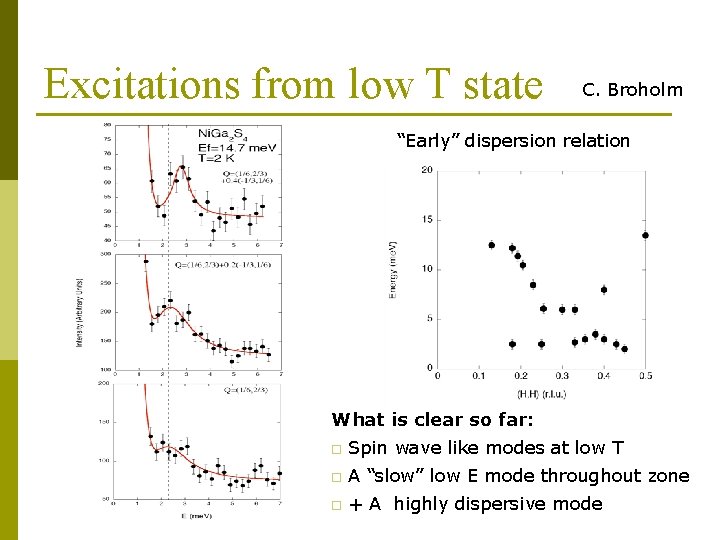
Excitations from low T state C. Broholm “Early” dispersion relation What is clear so far: o Spin wave like modes at low T o A “slow” low E mode throughout zone o + A highly dispersive mode
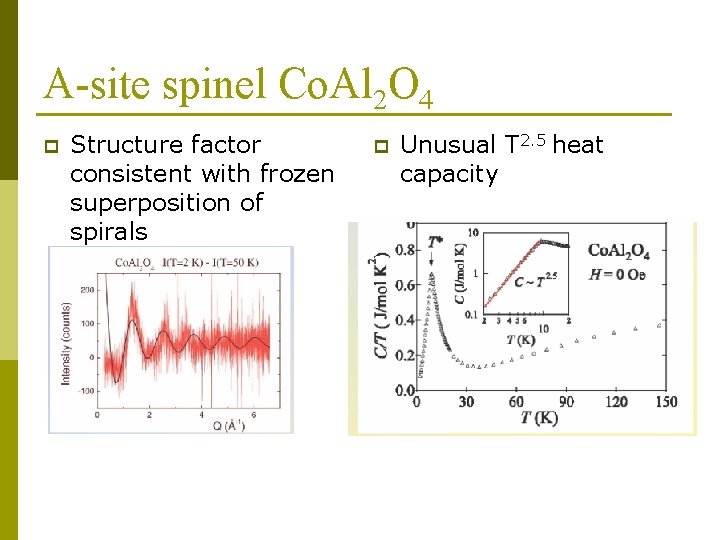
A-site spinel Co. Al 2 O 4 p Structure factor consistent with frozen superposition of spirals p Unusual T 2. 5 heat capacity
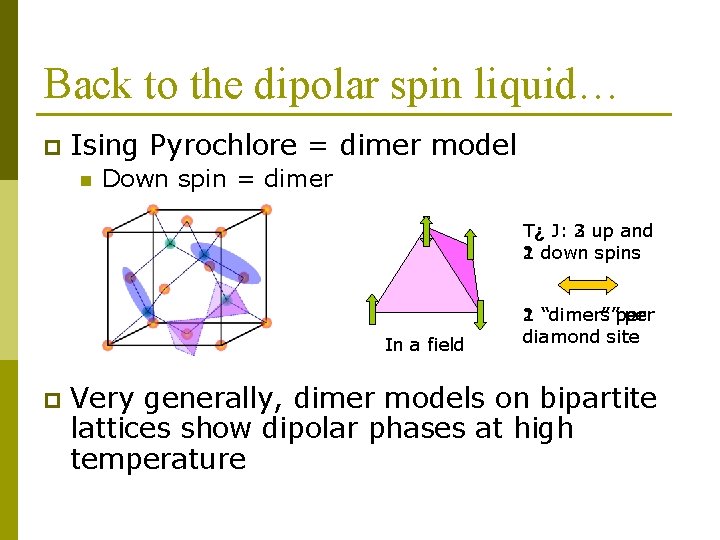
Back to the dipolar spin liquid… p Ising Pyrochlore = dimer model n Down spin = dimer T¿ J: 3 2 up and 2 down spin 1 spins In a field p 1 “dimer” 2 “dimers”per diamond site Very generally, dimer models on bipartite lattices show dipolar phases at high temperature
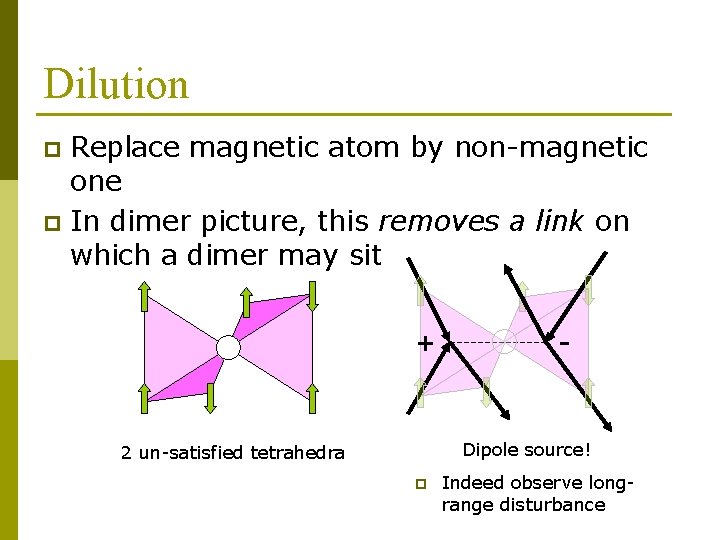
Dilution Replace magnetic atom by non-magnetic one p In dimer picture, this removes a link on which a dimer may sit p + - Dipole source! 2 un-satisfied tetrahedra p Indeed observe longrange disturbance
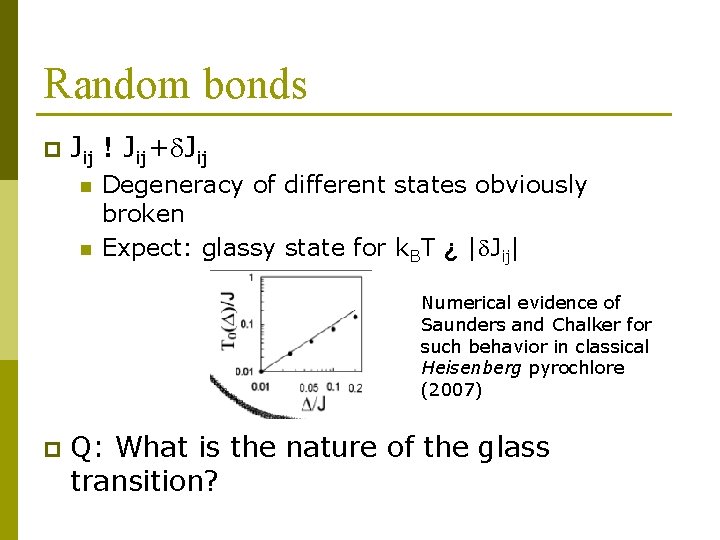
Random bonds p Jij n n ! Jij+ Jij Degeneracy of different states obviously broken Expect: glassy state for k. BT ¿ | Jij| Numerical evidence of Saunders and Chalker for such behavior in classical Heisenberg pyrochlore (2007) p Q: What is the nature of the glass transition?
Expect unconventional transition p General argument (Bergman et al, 2006): n n p Spin glass order parameter does not describe the dipolar correlations in the paramagnetic phase Can be argued that transition should be described by a gauge theory in which the Higgs phenomena quenches the dipolar fluctuations in the low temperature state Holds for any interactions (also nonrandom) that quench the entropy n Recent examples studied by Alet et al and Pickles et al
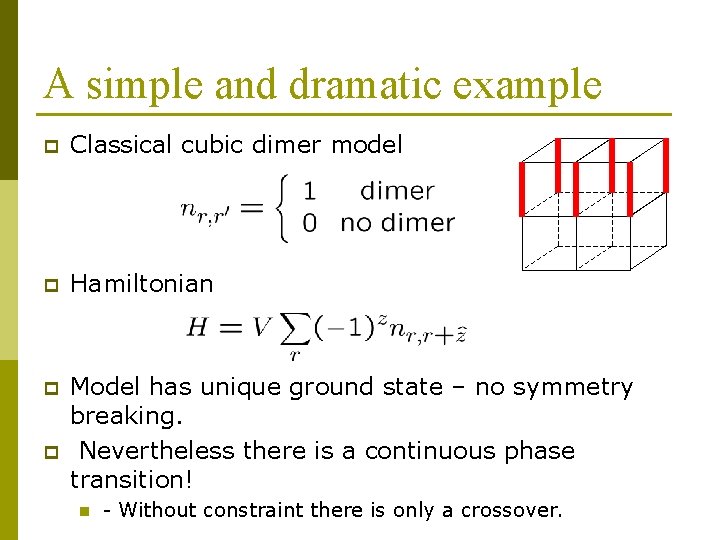
A simple and dramatic example p Classical cubic dimer model p Hamiltonian p Model has unique ground state – no symmetry breaking. Nevertheless there is a continuous phase transition! p n - Without constraint there is only a crossover.
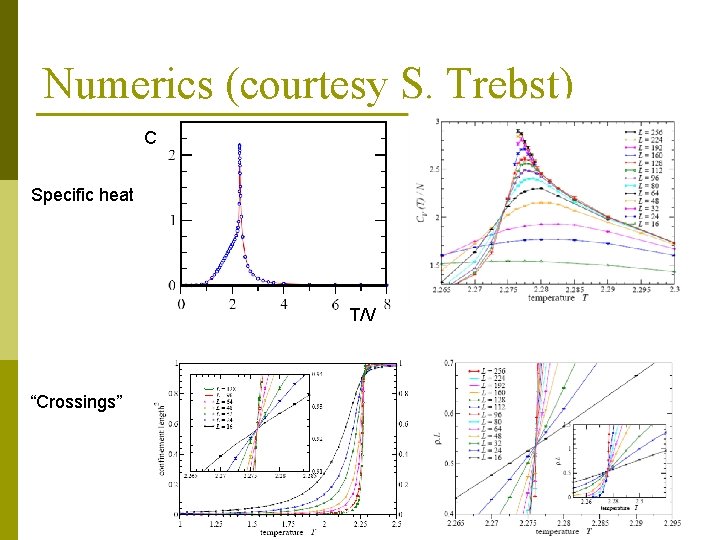
Numerics (courtesy S. Trebst) C Specific heat T/V “Crossings”
Many open issues How do multiple non-magnetic impurities interact in a dipolar spin liquid? p What is the phase diagram of a bonddiluted dimer model? p n p Purely geometrical problem with no energy scale! What is the nature of the glass transition from a dipolar Ising spin liquid?
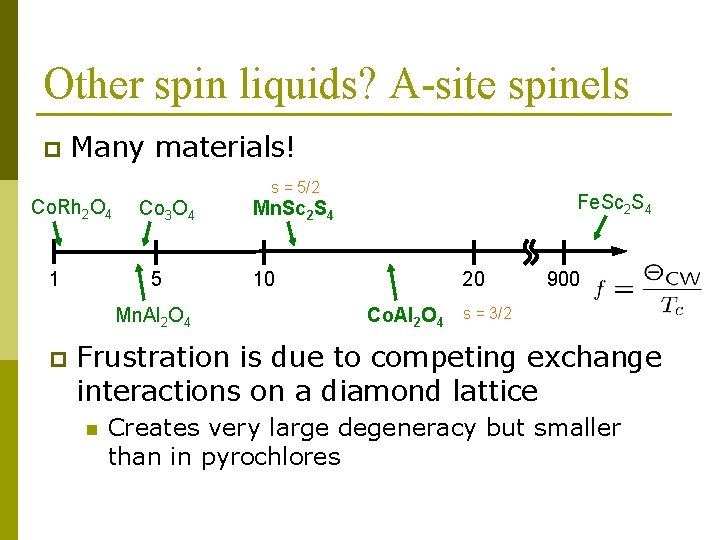
Other spin liquids? A-site spinels p Many materials! Co. Rh 2 O 4 1 s = 5/2 Co 3 O 4 5 Mn. Al 2 O 4 p Fe. Sc 2 S 4 Mn. Sc 2 S 4 10 20 Co. Al 2 O 4 900 s = 3/2 Frustration is due to competing exchange interactions on a diamond lattice n Creates very large degeneracy but smaller than in pyrochlores
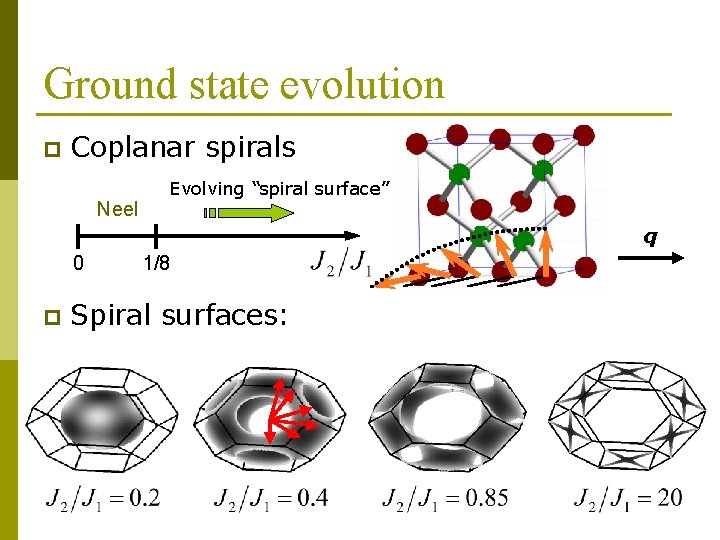
Ground state evolution p Coplanar spirals Neel Evolving “spiral surface” q 0 p 1/8 Spiral surfaces:
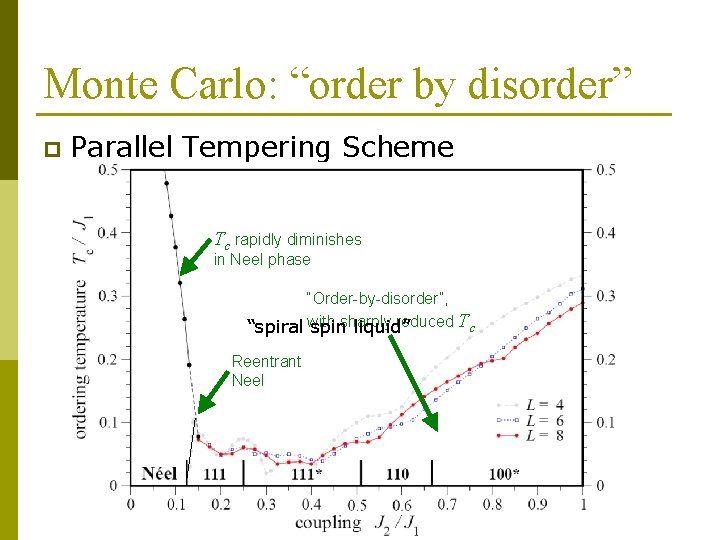
Monte Carlo: “order by disorder” p Parallel Tempering Scheme Tc rapidly diminishes in Neel phase “Order-by-disorder”, reduced Tc “spiral with spinsharply liquid” Reentrant Neel
Effects of impurities? p Competing tendencies n n Break spiral degeneracy: stabilize order? Locally random: create glass? What would Thomas do? Use scaling arguments!
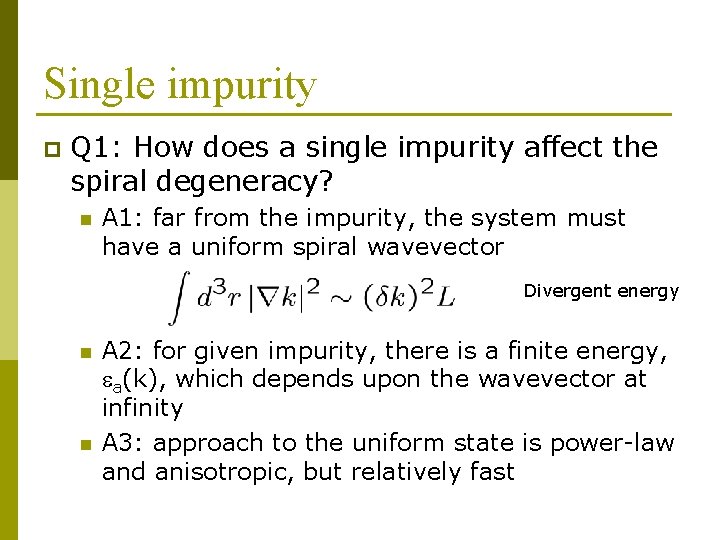
Single impurity p Q 1: How does a single impurity affect the spiral degeneracy? n A 1: far from the impurity, the system must have a uniform spiral wavevector Divergent energy n n A 2: for given impurity, there is a finite energy, a(k), which depends upon the wavevector at infinity A 3: approach to the uniform state is power-law and anisotropic, but relatively fast
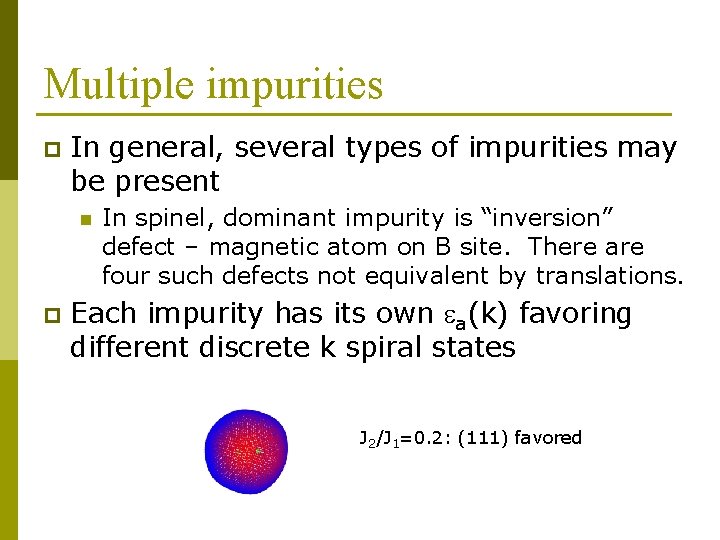
Multiple impurities p In general, several types of impurities may be present n p In spinel, dominant impurity is “inversion” defect – magnetic atom on B site. There are four such defects not equivalent by translations. Each impurity has its own a(k) favoring different discrete k spiral states J 2/J 1=0. 2: (111) favored
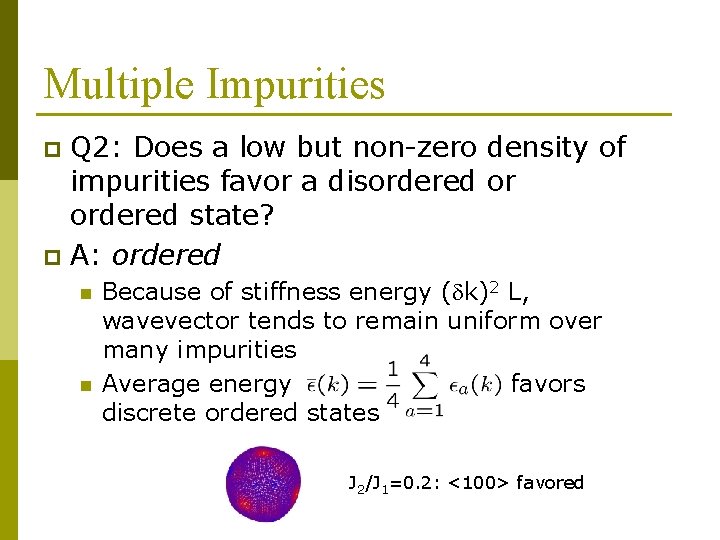
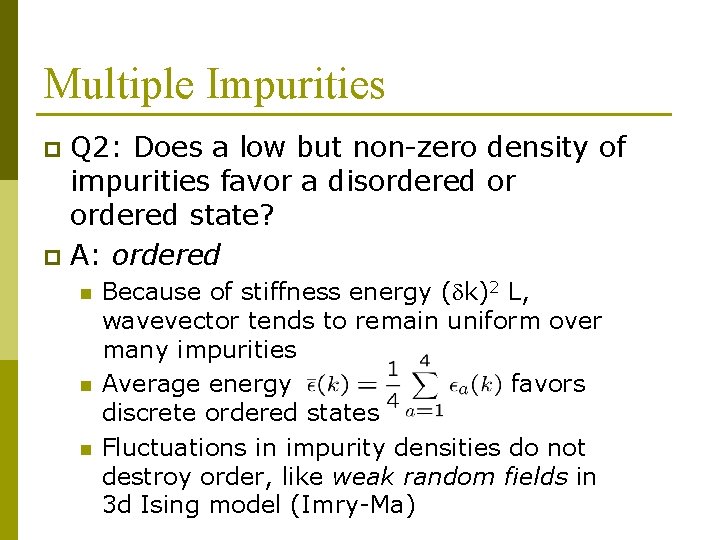
Multiple Impurities Q 2: Does a low but non-zero density of impurities favor a disordered or ordered state? p A: ordered p n n Because of stiffness energy ( k)2 L, wavevector tends to remain uniform over many impurities Average energy favors discrete ordered states J 2/J 1=0. 2: <100> favored
Multiple Impurities Q 2: Does a low but non-zero density of impurities favor a disordered or ordered state? p A: ordered p n n n Because of stiffness energy ( k)2 L, wavevector tends to remain uniform over many impurities Average energy favors discrete ordered states Fluctuations in impurity densities do not destroy order, like weak random fields in 3 d Ising model (Imry-Ma)
Quantum Spin Liquids
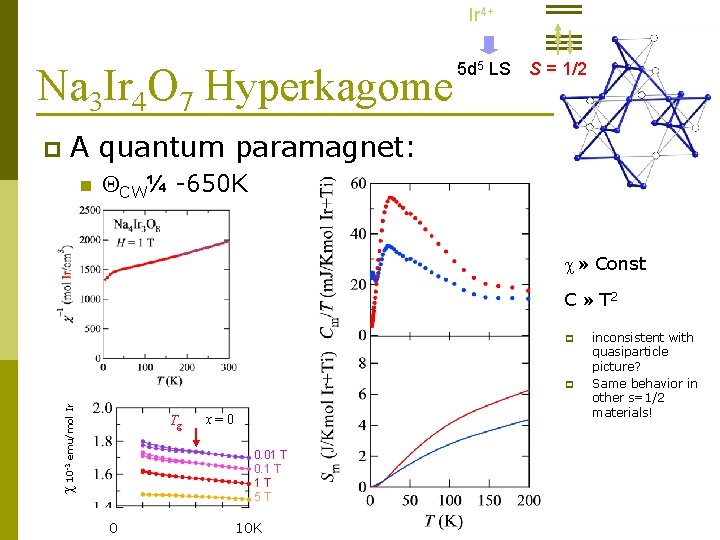
Ir 4+ Na 3 Ir 4 O 7 Hyperkagome p 5 d 5 LS S = 1/2 A quantum paramagnet: n CW¼ -650 K » Const C » T 2 p 10 -3 emu/mol Ir p Tg x=0 0. 01 T 0. 1 T 1 T 5 T 0 10 K inconsistent with quasiparticle picture? Same behavior in other s=1/2 materials!
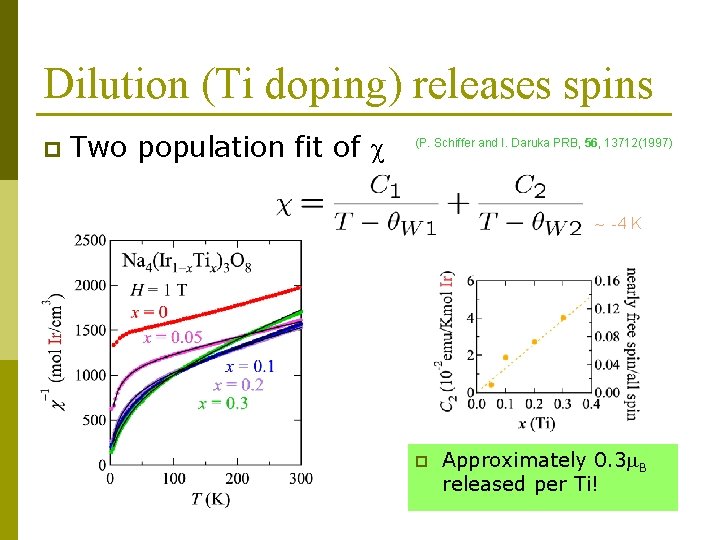
Dilution (Ti doping) releases spins p Two population fit of (P. Schiffer and I. Daruka PRB, 56, 13712(1997) ~ -4 K p Approximately 0. 3 B released per Ti!
Conclusions Impurities can reveal the correlations in spin liquid states p Experiments and theory point to new types of glassy phases and transitions in these materials p Even for the best understood “dipolar” spin liquid, impurity physics is largely mysterious p
- Slides: 35