
Impurities Dr Antony Fake WHO Prequalification Team Medicines
- Slides: 55
Impurities Dr Antony Fake WHO Prequalification Team - Medicines 1 1 1| 3. 2. S. 3. 2 Impurities, Malaysia, 29 September 2011 Impurities, PQT Training May 2014
Introduction l This presentation is made with reference to the preparation of the API. l This is because the API is the source of the majority of impurities. l When considering FPPs, the focus is largely on degradants, although excipient-API and leaching from containers must not be overlooked. 2| Impurities, PQT Training May 2014
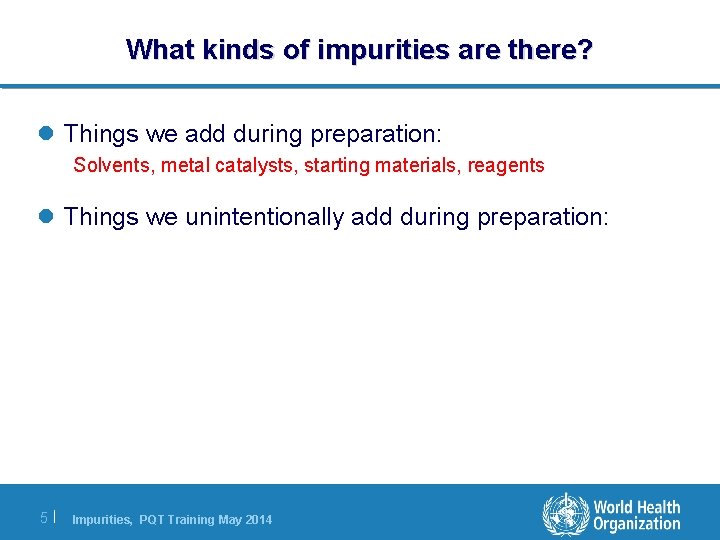
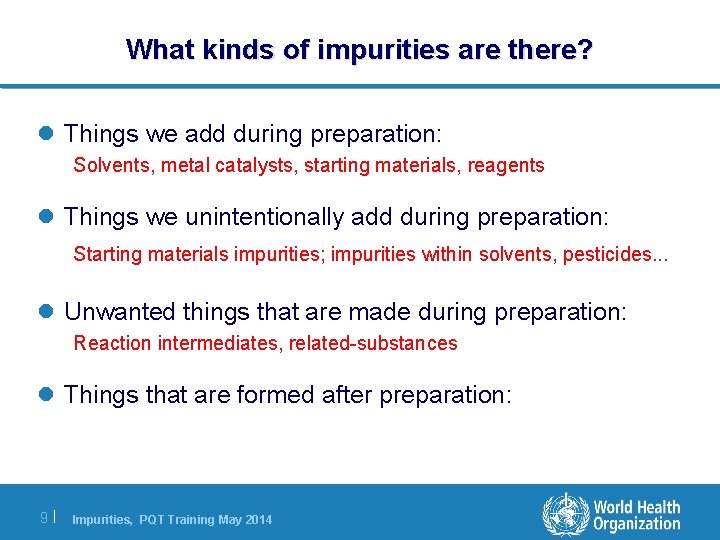
What kinds of impurities are there? l Things we add during preparation: 3| Impurities, PQT Training May 2014
What kinds of impurities are there? l Things we add during preparation: Solvents, metal catalysts, starting materials, reagents 4| Impurities, PQT Training May 2014
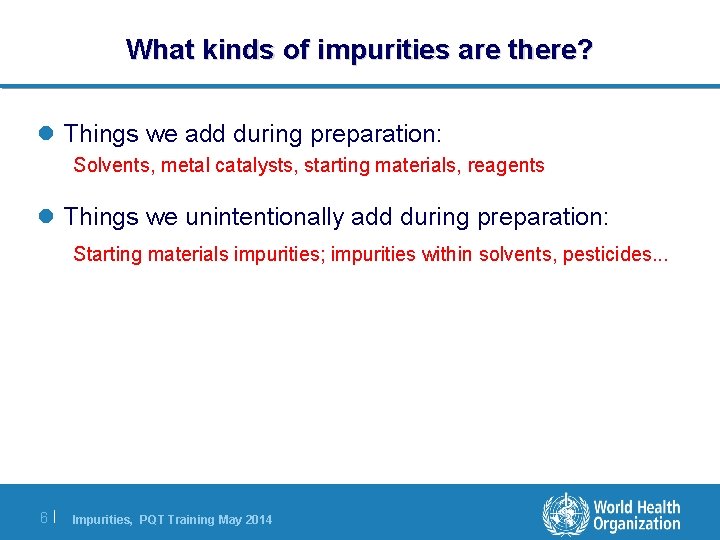
What kinds of impurities are there? l Things we add during preparation: Solvents, metal catalysts, starting materials, reagents l Things we unintentionally add during preparation: 5| Impurities, PQT Training May 2014
What kinds of impurities are there? l Things we add during preparation: Solvents, metal catalysts, starting materials, reagents l Things we unintentionally add during preparation: Starting materials impurities; impurities within solvents, pesticides. . . 6| Impurities, PQT Training May 2014
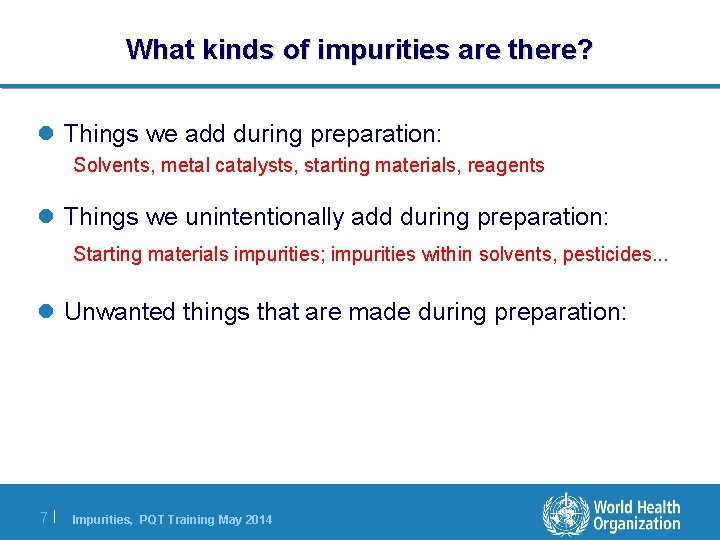
What kinds of impurities are there? l Things we add during preparation: Solvents, metal catalysts, starting materials, reagents l Things we unintentionally add during preparation: Starting materials impurities; impurities within solvents, pesticides. . . l Unwanted things that are made during preparation: 7| Impurities, PQT Training May 2014
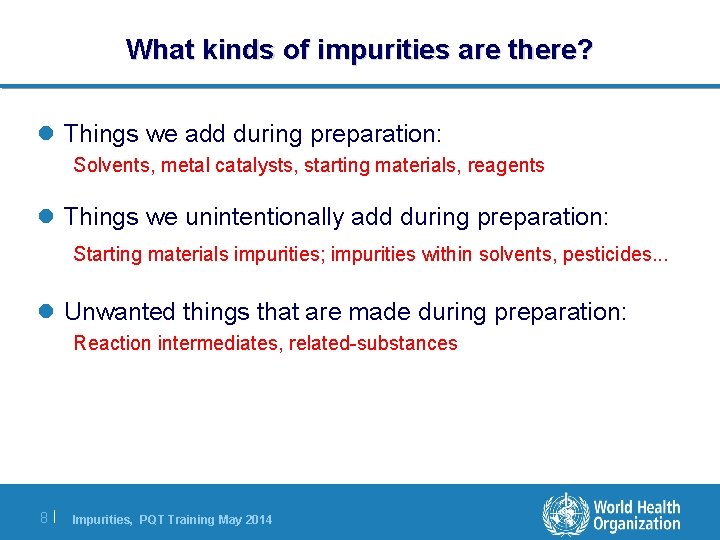
What kinds of impurities are there? l Things we add during preparation: Solvents, metal catalysts, starting materials, reagents l Things we unintentionally add during preparation: Starting materials impurities; impurities within solvents, pesticides. . . l Unwanted things that are made during preparation: Reaction intermediates, related-substances 8| Impurities, PQT Training May 2014
What kinds of impurities are there? l Things we add during preparation: Solvents, metal catalysts, starting materials, reagents l Things we unintentionally add during preparation: Starting materials impurities; impurities within solvents, pesticides. . . l Unwanted things that are made during preparation: Reaction intermediates, related-substances l Things that are formed after preparation: 9| Impurities, PQT Training May 2014
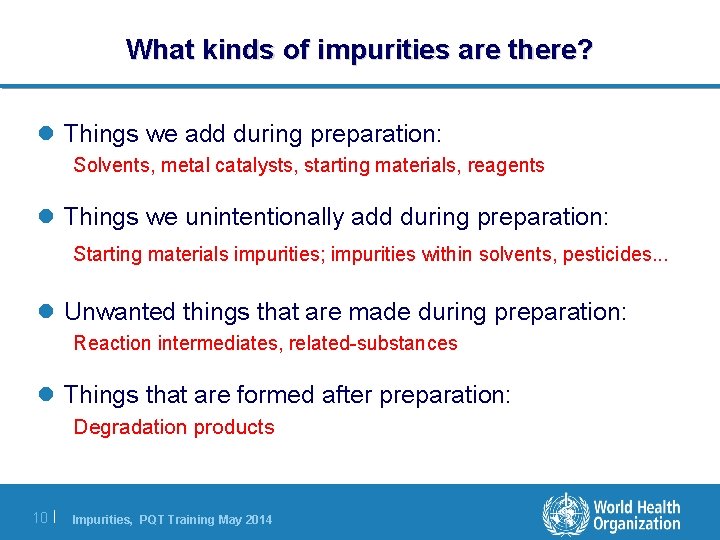
What kinds of impurities are there? l Things we add during preparation: Solvents, metal catalysts, starting materials, reagents l Things we unintentionally add during preparation: Starting materials impurities; impurities within solvents, pesticides. . . l Unwanted things that are made during preparation: Reaction intermediates, related-substances l Things that are formed after preparation: Degradation products 10 | Impurities, PQT Training May 2014
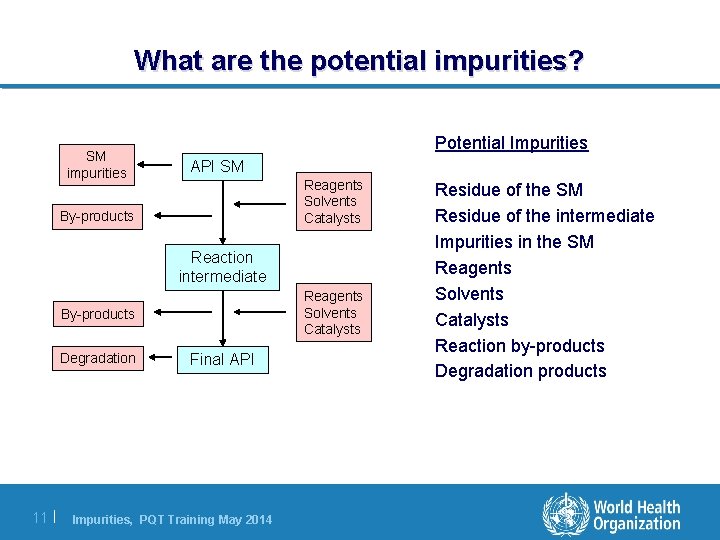
What are the potential impurities? SM impurities Potential Impurities API SM Reagents Solvents Catalysts By-products Reaction intermediate Reagents Solvents Catalysts By-products Degradation 11 | Final API Impurities, PQT Training May 2014 Residue of the SM Residue of the intermediate Impurities in the SM Reagents Solvents Catalysts Reaction by-products Degradation products
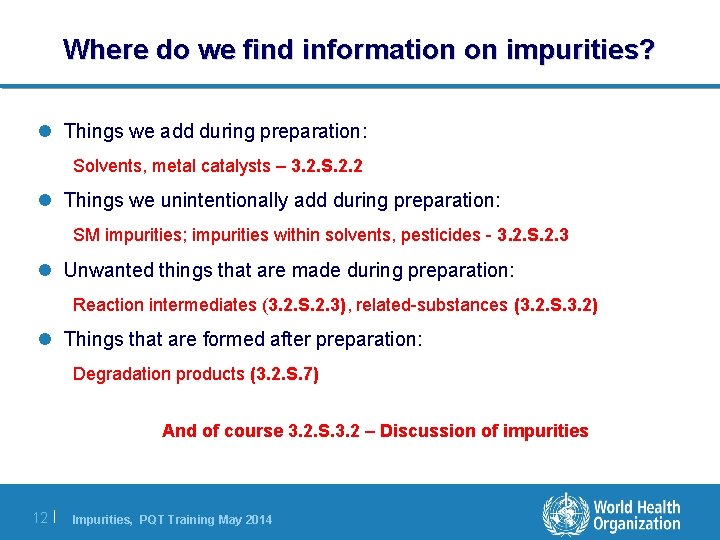
Where do we find information on impurities? l Things we add during preparation: Solvents, metal catalysts – 3. 2. S. 2. 2 l Things we unintentionally add during preparation: SM impurities; impurities within solvents, pesticides - 3. 2. S. 2. 3 l Unwanted things that are made during preparation: Reaction intermediates (3. 2. S. 2. 3), related-substances (3. 2. S. 3. 2) l Things that are formed after preparation: Degradation products (3. 2. S. 7) And of course 3. 2. S. 3. 2 – Discussion of impurities 12 | Impurities, PQT Training May 2014
Types of Impurities l Organic impurities Related substances and Degradation products l Solvents l Metals l Genotoxins 13 | Impurities, PQT Training May 2014
API Monographs l You can not rely upon an API monograph entirely for potential organic impurities. l Many impurities are specific to the manner of API preparation and may not have been considered when the monograph was published. l Of course monographs are a great start. 14 | Impurities, PQT Training May 2014
Potential Organic Impurities l The applicant should consider all potential impurities and then by logic, or by testing, reduce the set of potential impurities to a set of probable impurities. l There are probably four categories: – Degradants – Synthetic by-products of the API – Remnants of earlier intermediates – Synthetic by products of earlier intermediates 15 | Impurities, PQT Training May 2014
Degradants: l Forced degradation studies will provide information on major degradants. l Forced degradation studies will provide information on the acceptability of the analytical technique l Monographs tend to be better at listing degradants. 16 | Impurities, PQT Training May 2014
Related Substances l Impurities are more difficult to predict. l Test method sensitivity is extremely important. What can it detect? l Mass balance should be kept in mind. l If there are multiple pharmacopoeial monographs, then at the very least consider all of these impurities. At least for investigation purposes. 17 | Impurities, PQT Training May 2014
Setting specifications 18 | Impurities, PQT Training May 2014
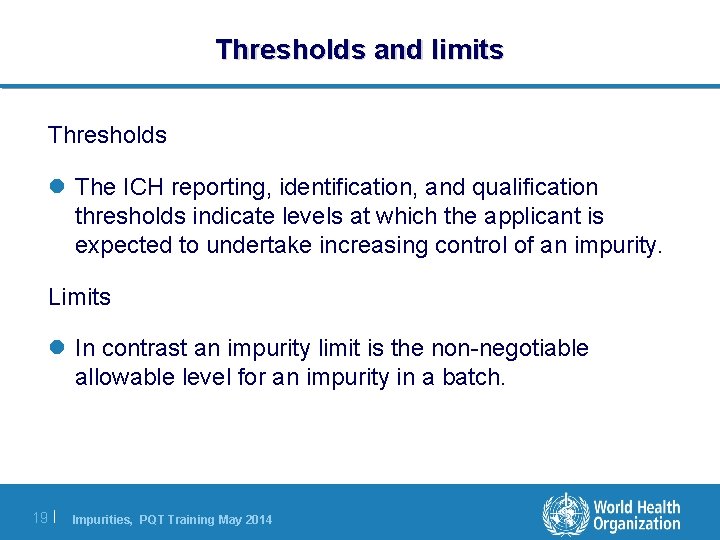
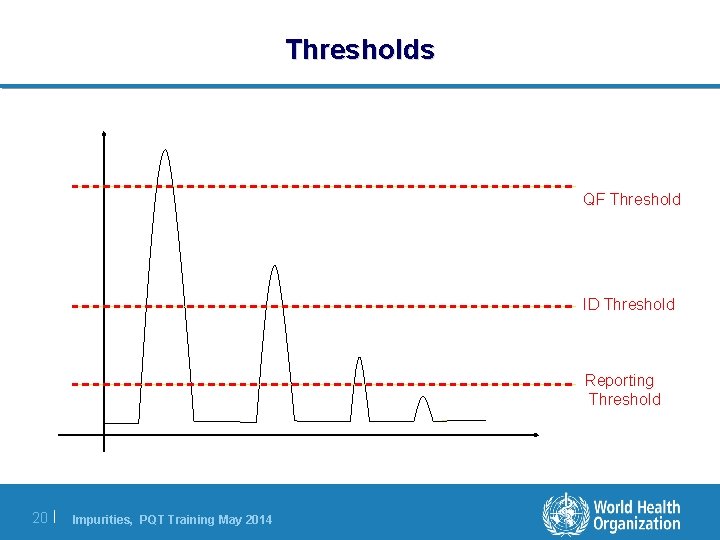
Thresholds and limits Thresholds l The ICH reporting, identification, and qualification thresholds indicate levels at which the applicant is expected to undertake increasing control of an impurity. Limits l In contrast an impurity limit is the non-negotiable allowable level for an impurity in a batch. 19 | Impurities, PQT Training May 2014
Thresholds QF Threshold ID Threshold Reporting Threshold 20 | Impurities, PQT Training May 2014
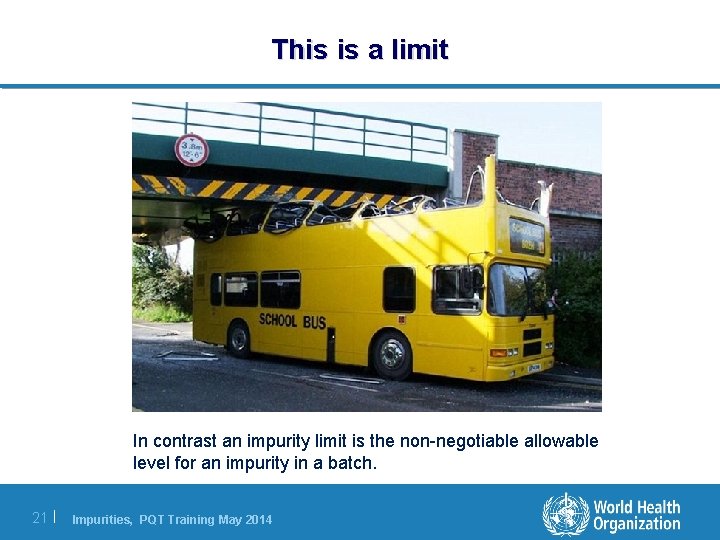
This is a limit In contrast an impurity limit is the non-negotiable allowable level for an impurity in a batch. 21 | Impurities, PQT Training May 2014
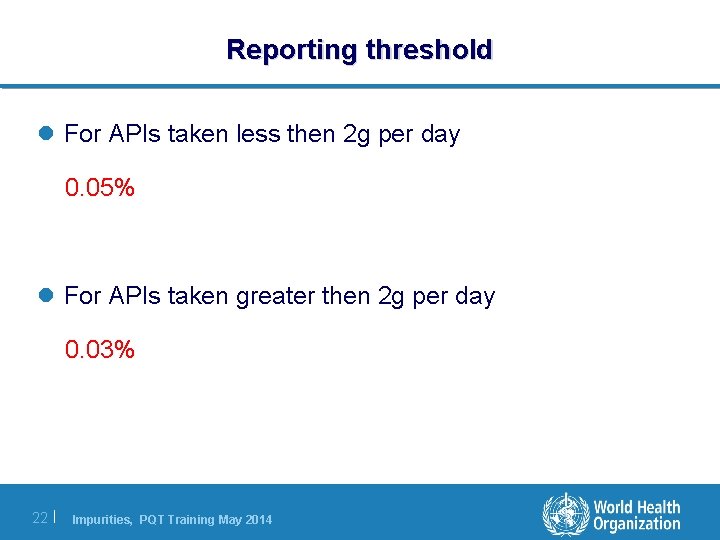
Reporting threshold l For APIs taken less then 2 g per day 0. 05% l For APIs taken greater then 2 g per day 0. 03% 22 | Impurities, PQT Training May 2014
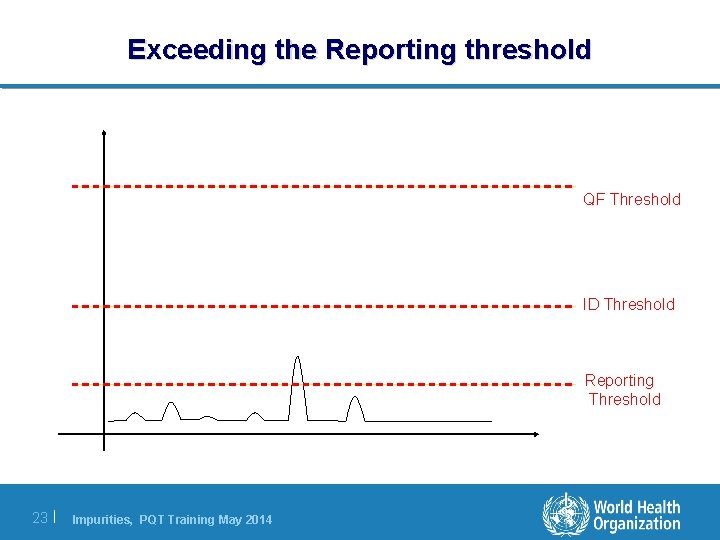
Exceeding the Reporting threshold QF Threshold ID Threshold Reporting Threshold 23 | Impurities, PQT Training May 2014
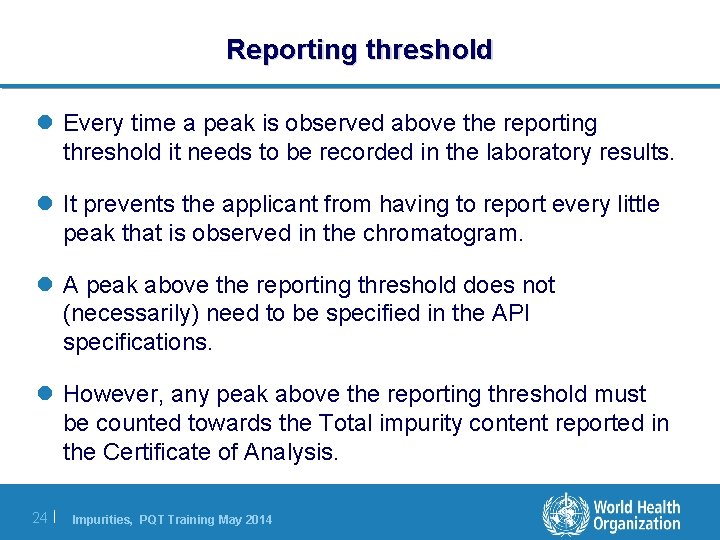
Reporting threshold l Every time a peak is observed above the reporting threshold it needs to be recorded in the laboratory results. l It prevents the applicant from having to report every little peak that is observed in the chromatogram. l A peak above the reporting threshold does not (necessarily) need to be specified in the API specifications. l However, any peak above the reporting threshold must be counted towards the Total impurity content reported in the Certificate of Analysis. 24 | Impurities, PQT Training May 2014
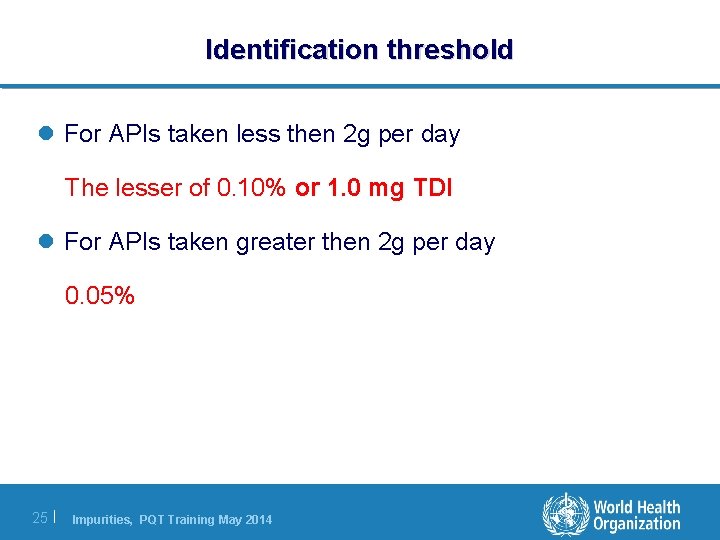
Identification threshold l For APIs taken less then 2 g per day The lesser of 0. 10% or 1. 0 mg TDI l For APIs taken greater then 2 g per day 0. 05% 25 | Impurities, PQT Training May 2014
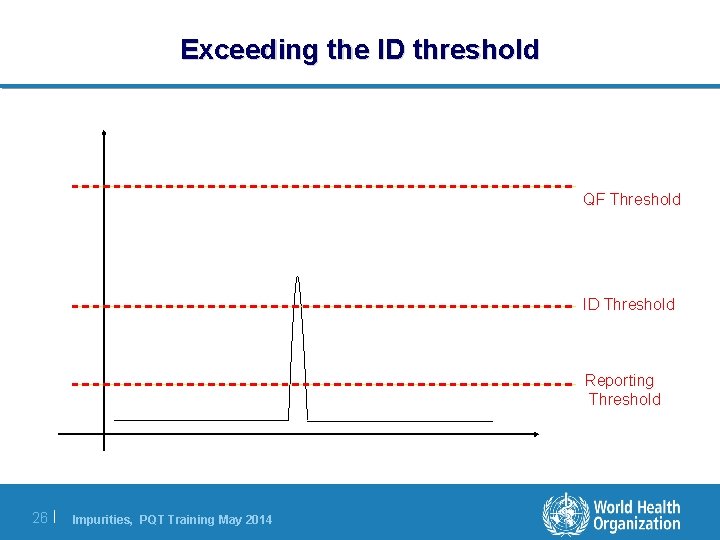
Exceeding the ID threshold QF Threshold ID Threshold Reporting Threshold 26 | Impurities, PQT Training May 2014
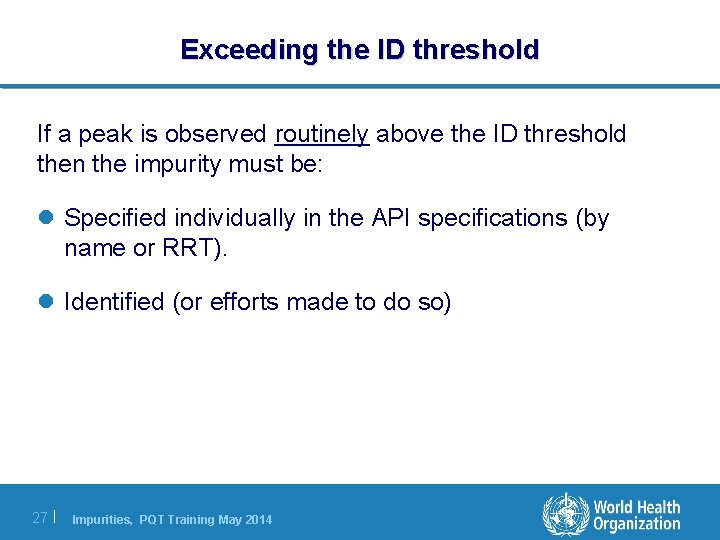
Exceeding the ID threshold If a peak is observed routinely above the ID threshold then the impurity must be: l Specified individually in the API specifications (by name or RRT). l Identified (or efforts made to do so) 27 | Impurities, PQT Training May 2014
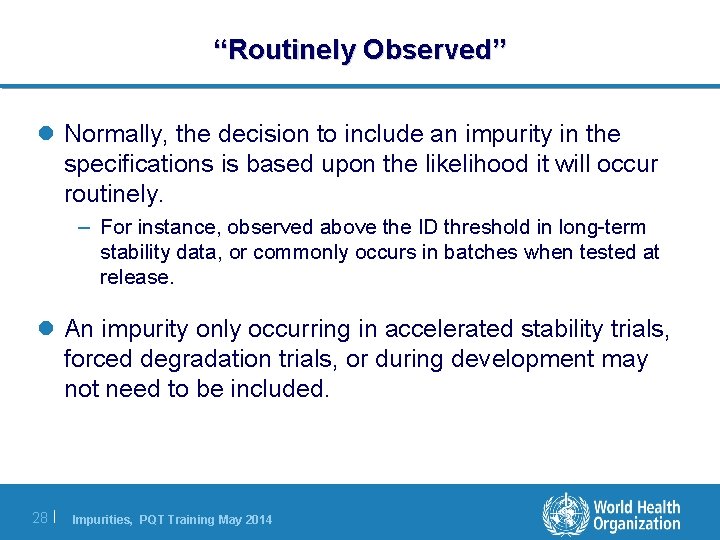
“Routinely Observed” l Normally, the decision to include an impurity in the specifications is based upon the likelihood it will occur routinely. – For instance, observed above the ID threshold in long-term stability data, or commonly occurs in batches when tested at release. l An impurity only occurring in accelerated stability trials, forced degradation trials, or during development may not need to be included. 28 | Impurities, PQT Training May 2014
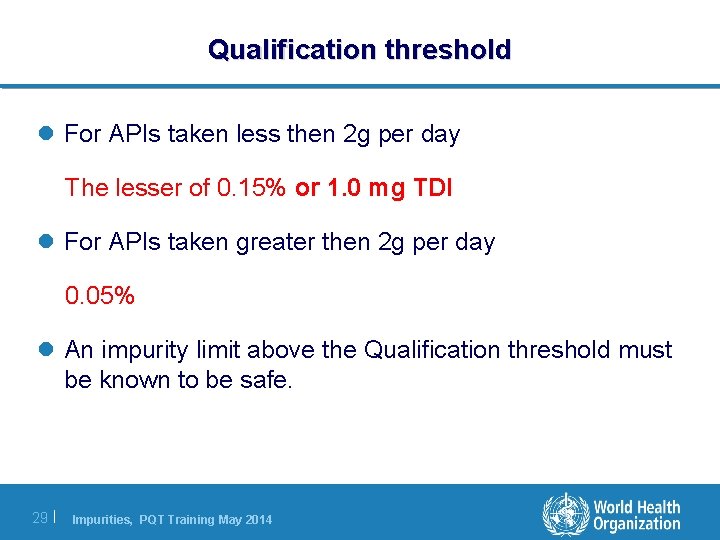
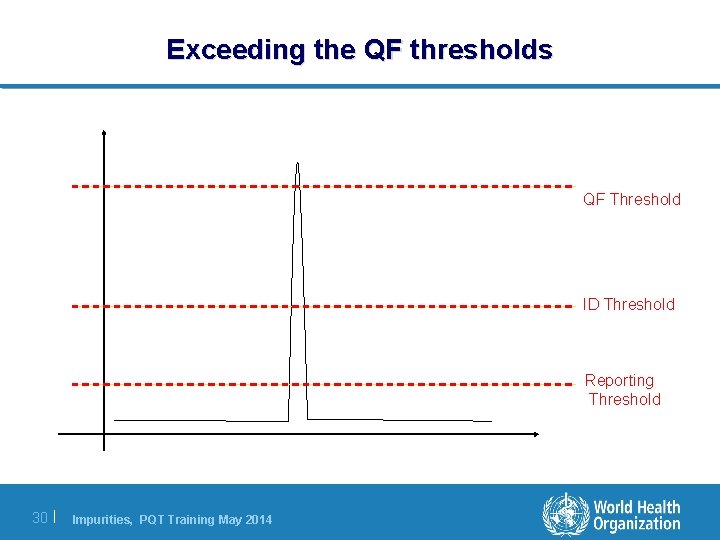
Qualification threshold l For APIs taken less then 2 g per day The lesser of 0. 15% or 1. 0 mg TDI l For APIs taken greater then 2 g per day 0. 05% l An impurity limit above the Qualification threshold must be known to be safe. 29 | Impurities, PQT Training May 2014
Exceeding the QF thresholds QF Threshold ID Threshold Reporting Threshold 30 | Impurities, PQT Training May 2014
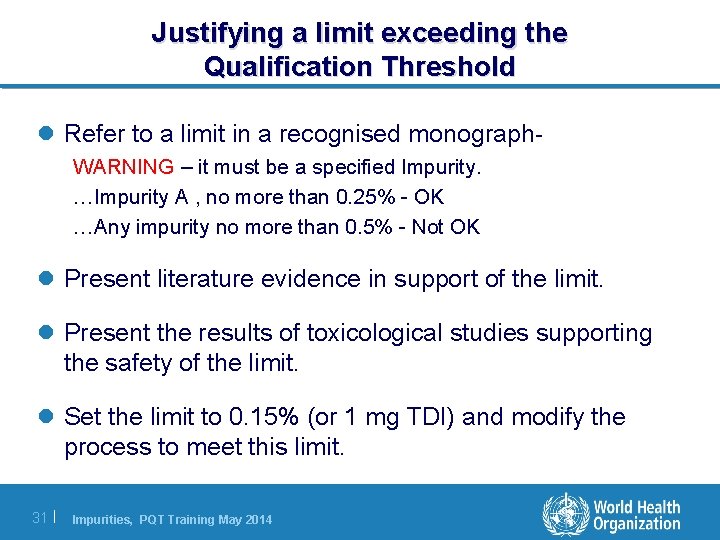
Justifying a limit exceeding the Qualification Threshold l Refer to a limit in a recognised monograph. WARNING – it must be a specified Impurity. …Impurity A , no more than 0. 25% - OK …Any impurity no more than 0. 5% - Not OK l Present literature evidence in support of the limit. l Present the results of toxicological studies supporting the safety of the limit. l Set the limit to 0. 15% (or 1 mg TDI) and modify the process to meet this limit. 31 | Impurities, PQT Training May 2014
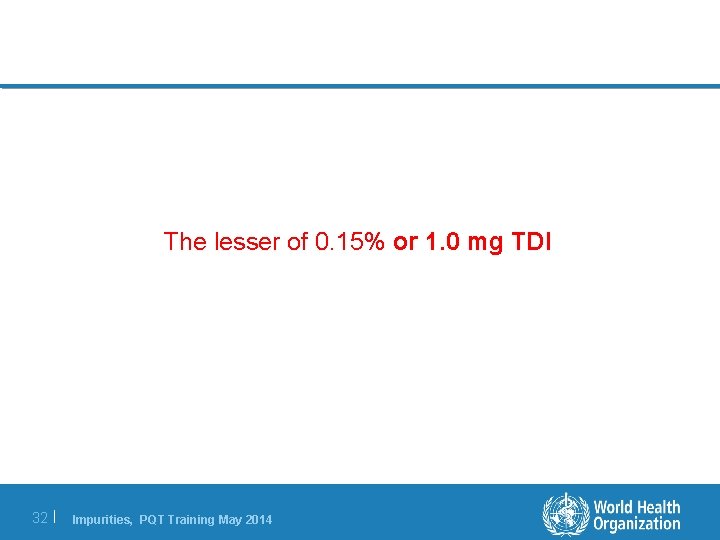
The lesser of 0. 15% or 1. 0 mg TDI 32 | Impurities, PQT Training May 2014
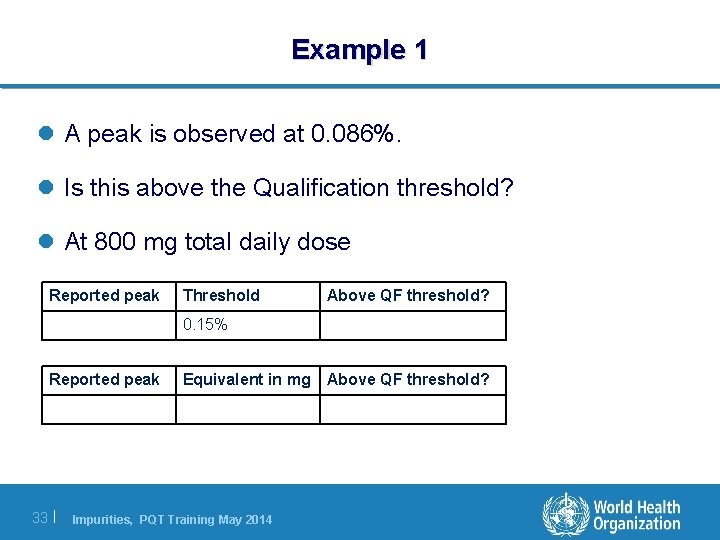
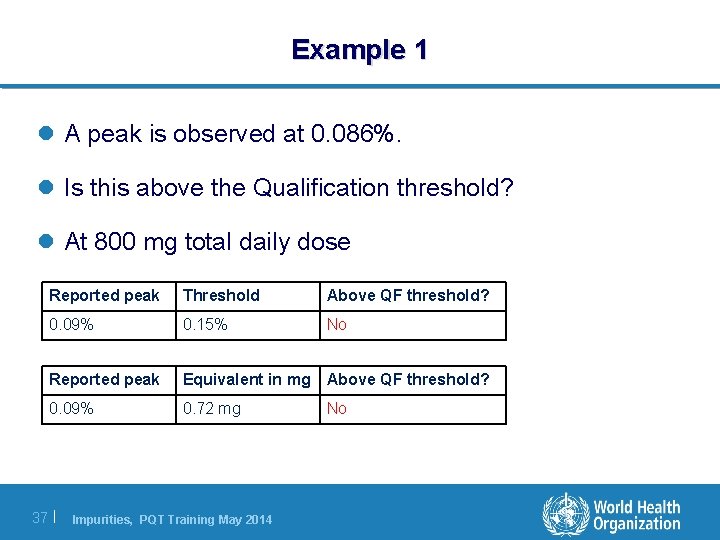
Example 1 l A peak is observed at 0. 086%. l Is this above the Qualification threshold? l At 800 mg total daily dose Reported peak Threshold Above QF threshold? 0. 15% Reported peak 33 | Equivalent in mg Impurities, PQT Training May 2014 Above QF threshold?
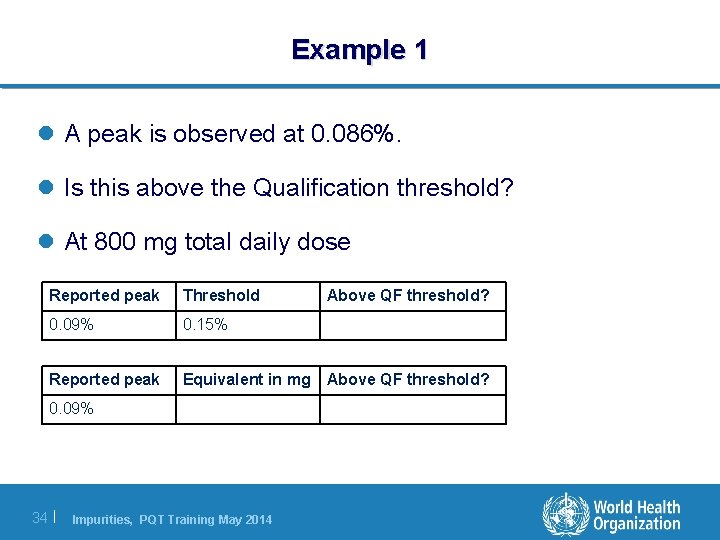
Example 1 l A peak is observed at 0. 086%. l Is this above the Qualification threshold? l At 800 mg total daily dose Reported peak Threshold 0. 09% 0. 15% Reported peak Equivalent in mg 0. 09% 34 | Impurities, PQT Training May 2014 Above QF threshold?
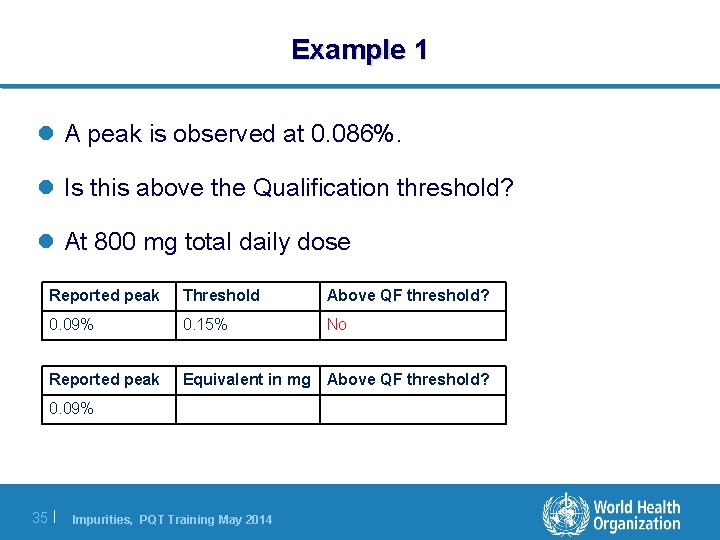
Example 1 l A peak is observed at 0. 086%. l Is this above the Qualification threshold? l At 800 mg total daily dose Reported peak Threshold Above QF threshold? 0. 09% 0. 15% No Reported peak Equivalent in mg Above QF threshold? 0. 09% 35 | Impurities, PQT Training May 2014
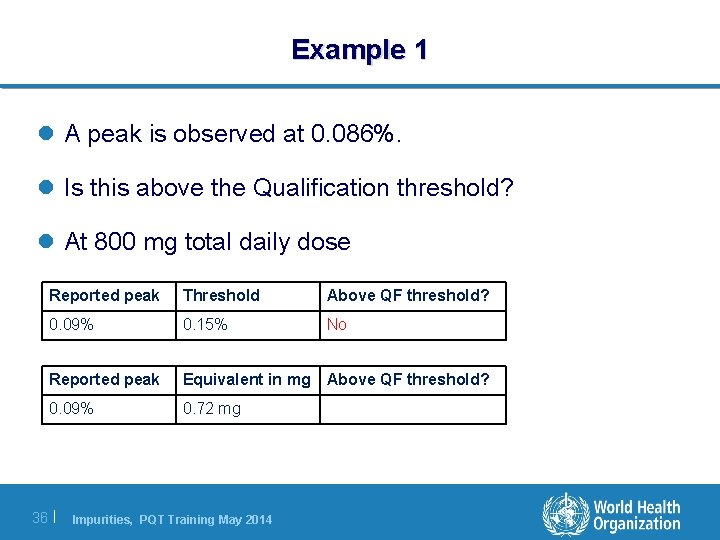
Example 1 l A peak is observed at 0. 086%. l Is this above the Qualification threshold? l At 800 mg total daily dose Reported peak Threshold Above QF threshold? 0. 09% 0. 15% No Reported peak Equivalent in mg Above QF threshold? 0. 09% 0. 72 mg 36 | Impurities, PQT Training May 2014
Example 1 l A peak is observed at 0. 086%. l Is this above the Qualification threshold? l At 800 mg total daily dose Reported peak Threshold Above QF threshold? 0. 09% 0. 15% No Reported peak Equivalent in mg Above QF threshold? 0. 09% 0. 72 mg No 37 | Impurities, PQT Training May 2014
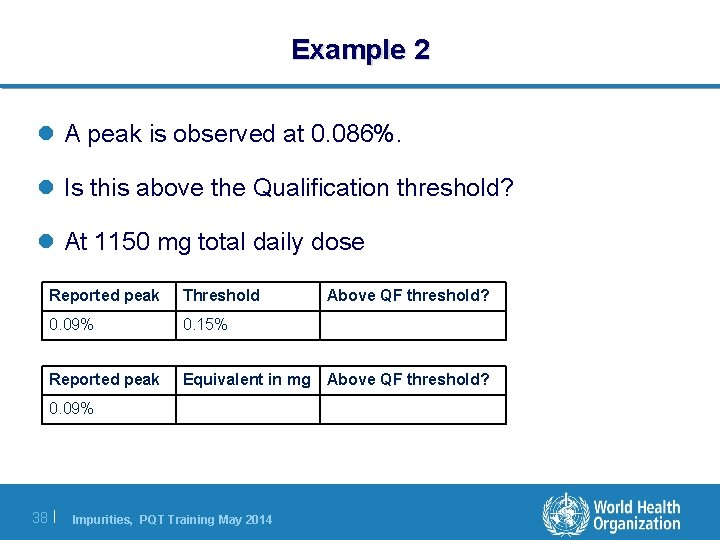
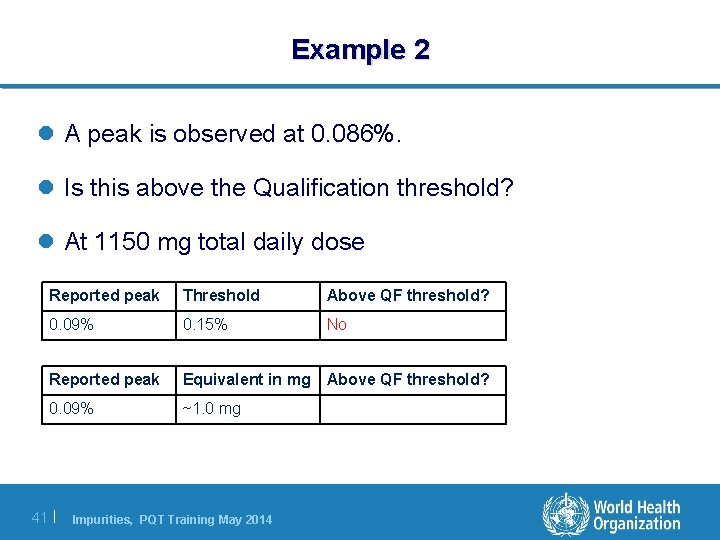
Example 2 l A peak is observed at 0. 086%. l Is this above the Qualification threshold? l At 1150 mg total daily dose Reported peak Threshold 0. 09% 0. 15% Reported peak Equivalent in mg 0. 09% 38 | Impurities, PQT Training May 2014 Above QF threshold?
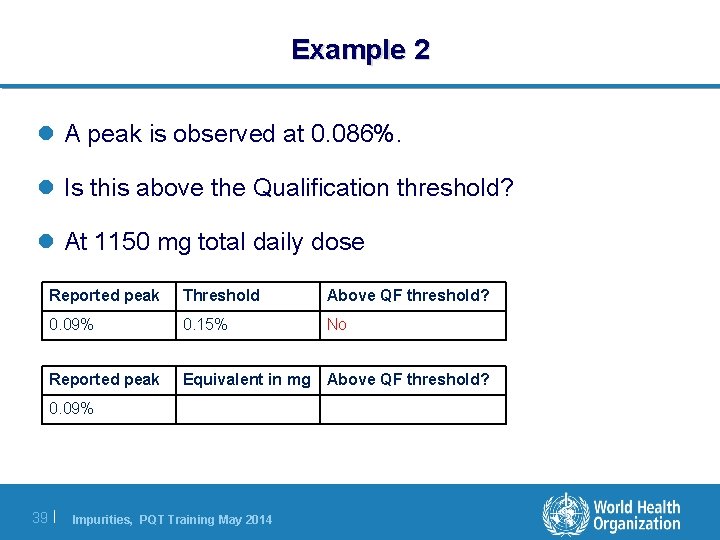
Example 2 l A peak is observed at 0. 086%. l Is this above the Qualification threshold? l At 1150 mg total daily dose Reported peak Threshold Above QF threshold? 0. 09% 0. 15% No Reported peak Equivalent in mg Above QF threshold? 0. 09% 39 | Impurities, PQT Training May 2014
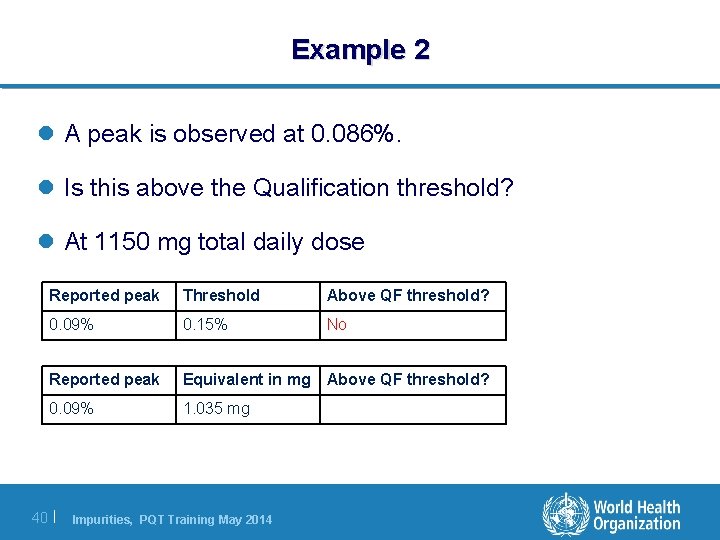
Example 2 l A peak is observed at 0. 086%. l Is this above the Qualification threshold? l At 1150 mg total daily dose Reported peak Threshold Above QF threshold? 0. 09% 0. 15% No Reported peak Equivalent in mg Above QF threshold? 0. 09% 1. 035 mg 40 | Impurities, PQT Training May 2014
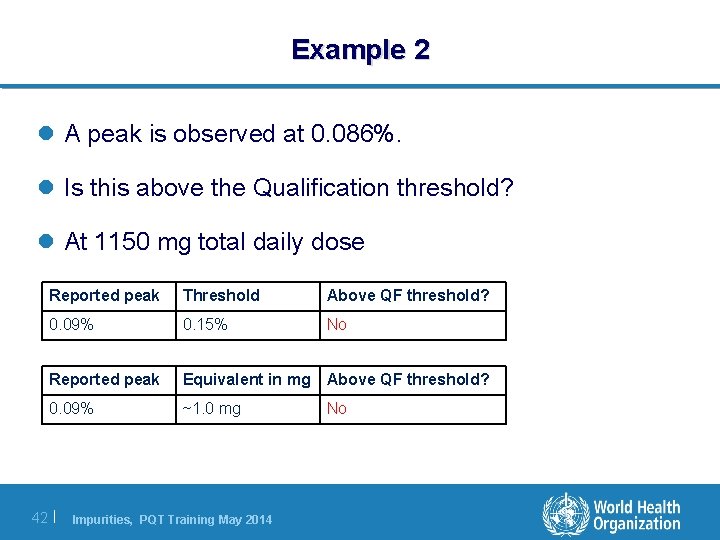
Example 2 l A peak is observed at 0. 086%. l Is this above the Qualification threshold? l At 1150 mg total daily dose Reported peak Threshold Above QF threshold? 0. 09% 0. 15% No Reported peak Equivalent in mg Above QF threshold? 0. 09% ~1. 0 mg 41 | Impurities, PQT Training May 2014
Example 2 l A peak is observed at 0. 086%. l Is this above the Qualification threshold? l At 1150 mg total daily dose Reported peak Threshold Above QF threshold? 0. 09% 0. 15% No Reported peak Equivalent in mg Above QF threshold? 0. 09% ~1. 0 mg No 42 | Impurities, PQT Training May 2014
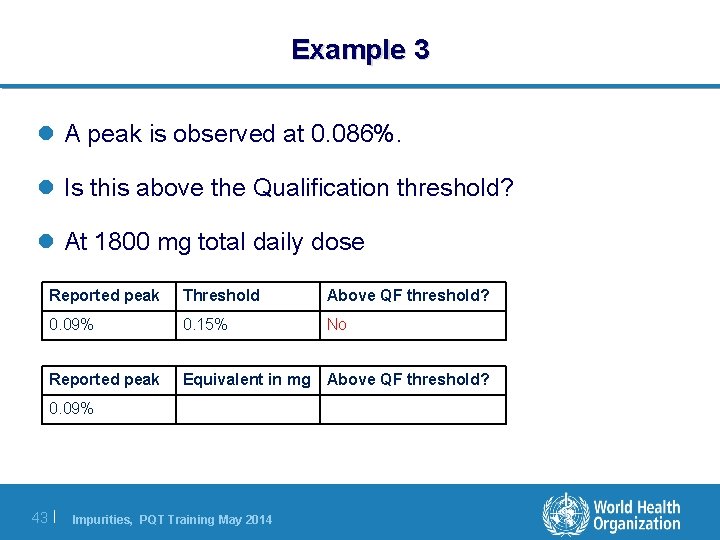
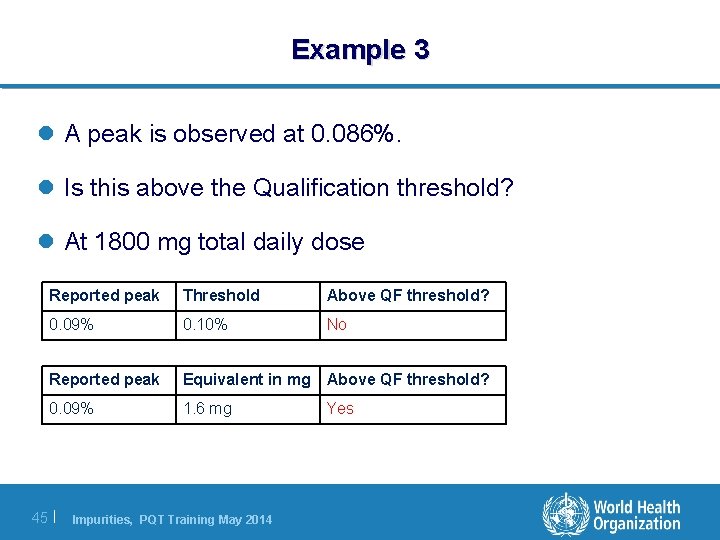
Example 3 l A peak is observed at 0. 086%. l Is this above the Qualification threshold? l At 1800 mg total daily dose Reported peak Threshold Above QF threshold? 0. 09% 0. 15% No Reported peak Equivalent in mg Above QF threshold? 0. 09% 43 | Impurities, PQT Training May 2014
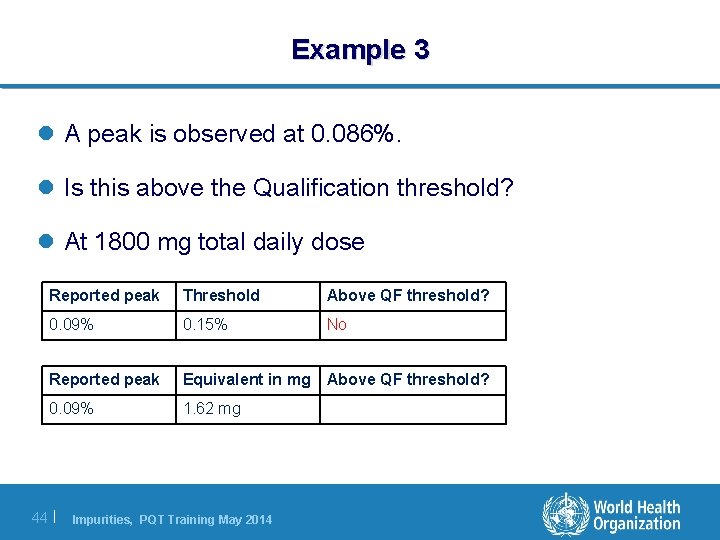
Example 3 l A peak is observed at 0. 086%. l Is this above the Qualification threshold? l At 1800 mg total daily dose Reported peak Threshold Above QF threshold? 0. 09% 0. 15% No Reported peak Equivalent in mg Above QF threshold? 0. 09% 1. 62 mg 44 | Impurities, PQT Training May 2014
Example 3 l A peak is observed at 0. 086%. l Is this above the Qualification threshold? l At 1800 mg total daily dose Reported peak Threshold Above QF threshold? 0. 09% 0. 10% No Reported peak Equivalent in mg Above QF threshold? 0. 09% 1. 6 mg Yes 45 | Impurities, PQT Training May 2014
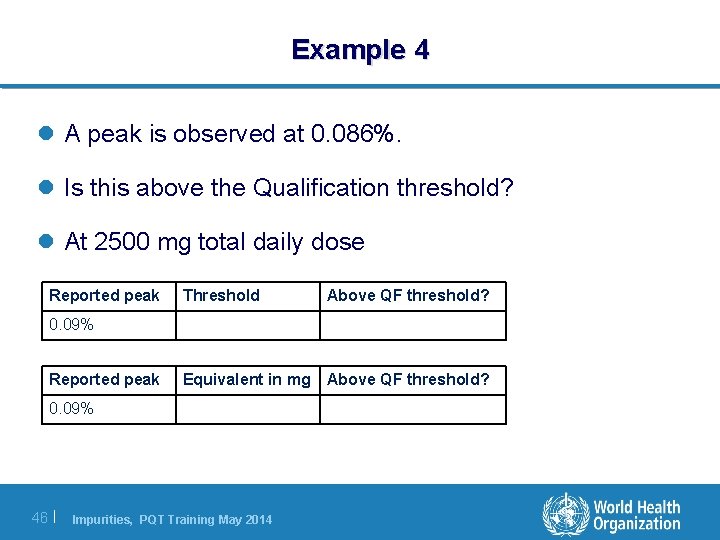
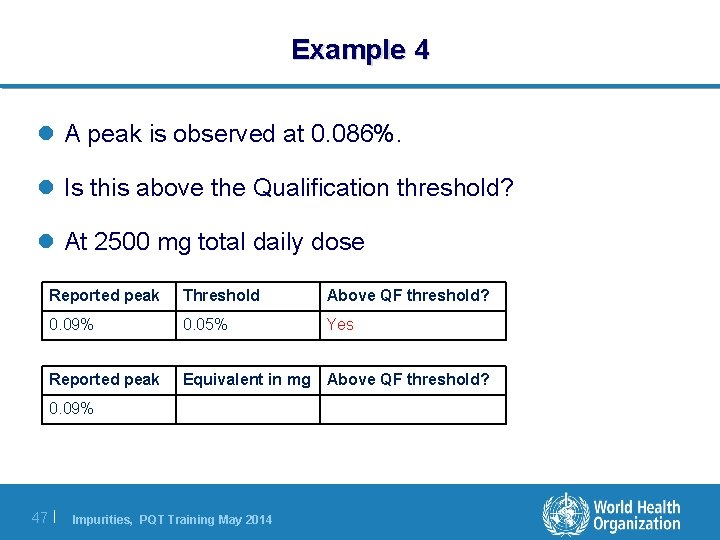
Example 4 l A peak is observed at 0. 086%. l Is this above the Qualification threshold? l At 2500 mg total daily dose Reported peak Threshold Above QF threshold? Equivalent in mg Above QF threshold? 0. 09% Reported peak 0. 09% 46 | Impurities, PQT Training May 2014
Example 4 l A peak is observed at 0. 086%. l Is this above the Qualification threshold? l At 2500 mg total daily dose Reported peak Threshold Above QF threshold? 0. 09% 0. 05% Yes Reported peak Equivalent in mg Above QF threshold? 0. 09% 47 | Impurities, PQT Training May 2014
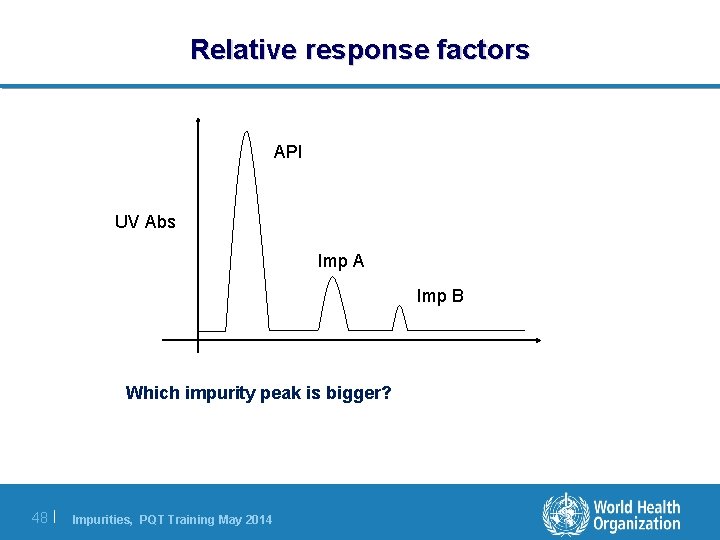
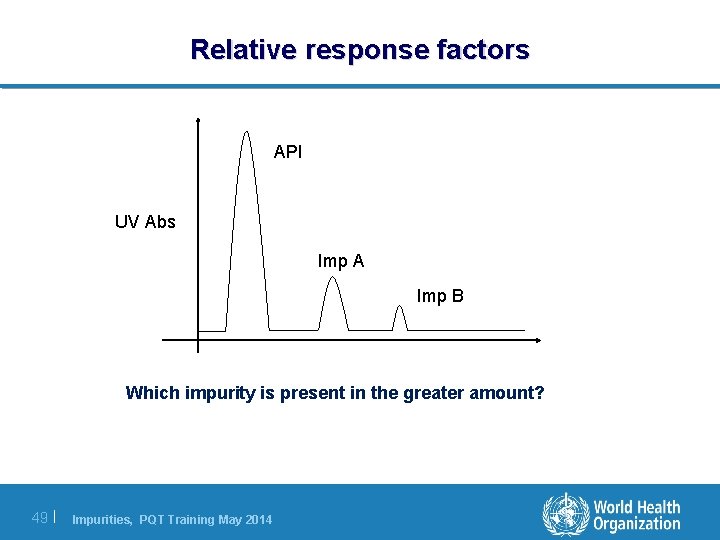
Relative response factors API UV Abs Imp A Imp B Which impurity peak is bigger? 48 | Impurities, PQT Training May 2014
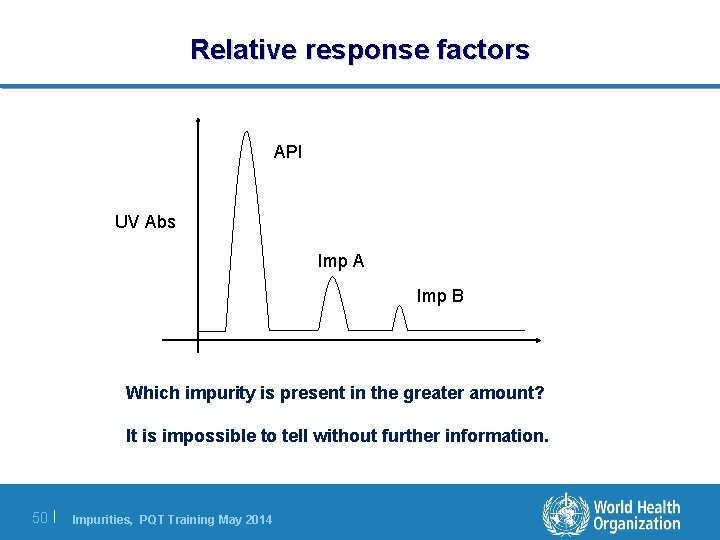
Relative response factors API UV Abs Imp A Imp B Which impurity is present in the greater amount? 49 | Impurities, PQT Training May 2014
Relative response factors API UV Abs Imp A Imp B Which impurity is present in the greater amount? It is impossible to tell without further information. 50 | Impurities, PQT Training May 2014
Relative response factors l The size of a peak in a chromatogram is determined by the amount of impurity present, but also how well it responds to the detector. l In HPLC-UV techniques the response is due to the inherent UV absorbance of the impurity at the detected wavelength. l Some impurities will not be detected at all! l RRF = Response of Imp/Response of API, but always check the formula just in case the ratio is described differently. 51 | Impurities, PQT Training May 2014
Response factors l At the time of initial development and investigation it is assumed the response factor = 1. l For reporting thresholds it is assumed the response factor = 1. l When impurities are identified their response factor must be considered. l The RRF for all identified impurities should be established. 52 | Impurities, PQT Training May 2014
Relative response factors l When an RRF of between 0. 8 to 1. 2 is it not mandatory to apply the correction. l The use of a RRF could shift an observed impurity from one threshold to another. l This is often of benefit to the applicant. If the response of an impurity is greater than the equivalent amount of API (RRF>1) it could mean a peak no longer exceeds the Qualification threshold. 53 | Impurities, PQT Training May 2014
Conclusion l The applicant should discuss the possible generation of related substances in 3. 2. S. 3. 2 l They must undertake a rigorous testing investigation, including use of appropriate test methods. l Monographs are an excellent source of information on possible related substances and degradation impurities but are not complete. l When applying thresholds consider TDI and RRF of the impurity 54 | Impurities, PQT Training May 2014
Further information Please feel free to ask me any questions now or later. http: //www. who. int/prequal/info_applicants/API_info_applicants. htm Or email me at: Fakea@who. int Thank you 55 | Impurities, PQT Training May 2014